How Much Does a 4×4 Tent Cost to Run Per Month? Real Examples by Power Rate
A 4×4 tent’s monthly electricity cost is mostly a story about three things: how hard you drive the light, how much climate control your room forces you to run, and what you pay per kWh. If you ignore the climate devices, your estimate will usually be too low. If you assume everything runs 24/7 at full power, your estimate will usually be too high.
What follows is a practical way to price it accurately, with examples you can reuse at any power rate.
1: The Monthly Cost Range for a Typical 4×4 Tent
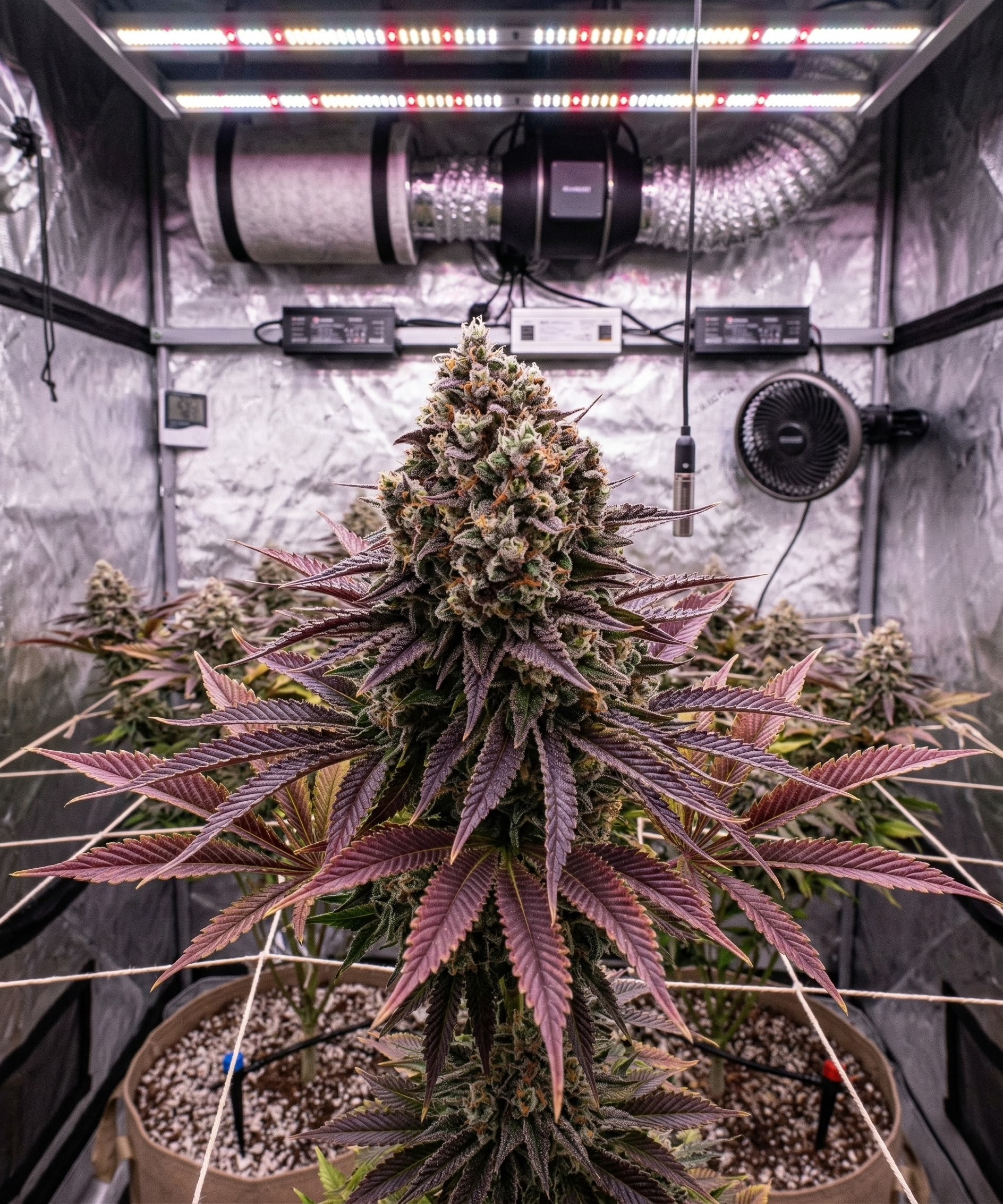
A “typical” 4×4 tent has a modern LED in the rough neighborhood of 400 to 600 watts at the wall, plus an exhaust fan and a couple of circulation fans. That LED range is a common recommendation for a 4×4 footprint and it is also what you see in real-world wall-draw specs.
When you run only those basics, your bill is usually dominated by the light schedule. Once you add dehumidification, AC, or electric heat, the tent’s cost stops behaving like a simple “light times hours” problem and starts behaving like a climate problem.
What most growers pay in a low rate area
In a low-rate area, a basic 4×4 with no dehumidifier and no AC often lands in a comfortable monthly range because your kWh price is forgiving. You might still notice the tent on the bill, but it rarely feels shocking unless you add a heavy climate device or run a high-wattage light at full output all month.
The trap in low-rate areas is overconfidence. People assume the tent is “cheap to run,” then later add a dehumidifier or run a heater in winter and wonder why the bill suddenly jumps.
What changes in mid rate areas
Mid-rate areas are where the same tent can start feeling unpredictable. The baseline may still be manageable, but every extra kWh matters enough that duty cycles become the difference between “fine” and “annoying.”
This is also the zone where dehumidification can quietly become the largest line item, especially if your ambient humidity is high or your lung room is small and poorly ventilated.
When high rates make the tent feel expensive
In high-rate areas, the math becomes emotionally loud. Even a disciplined, efficient setup can feel expensive because you are paying so much for each kWh.
At that point, “How do I lower watts without lowering quality?” becomes a core strategy rather than an optimization hobby. You stop thinking in terms of gear and start thinking in terms of heat load, moisture load, and runtime.
What this article counts as “running cost”
This guide treats “running cost” as electricity used by the tent system and any climate equipment you run because of the tent.
It does not include nutrients, water, filters you replace, or any one-time purchases. It also does not include your general household electricity use that would exist even with the tent off. The goal is to isolate what the tent adds to your monthly bill so you can compare that number to your actual utility statement.
2: The Assumptions Behind the Numbers
You can customize every assumption in this article, but you need a starting point so the examples make sense.
The baseline 4×4 power profile
A baseline 4×4 profile is the light, an exhaust fan, and circulation fans, plus a few small devices. Your exact numbers depend on what you own and how you run it, but the ranges below are common enough to build estimates that are close before you measure.
Typical LED wattage range for a 4×4
A practical LED range for a 4×4 tent is often around 400 to 600 watts at the wall for flowering intensity, depending on how hard you push the canopy and how efficient the fixture is. Another way this is expressed is watts per square foot, with common guidance putting flowering LEDs in roughly the 30 to 45 watts per square foot range. In a 16 sq ft tent, that points you toward roughly 480 to 720 watts as an upper envelope, with many growers landing lower in practice.
For the examples later, I will use 500W as a clean, middle-of-the-road wall draw for the light. You can swap your own number in.
Typical fan and circulation wattage
A typical 6-inch inline exhaust fan often draws somewhere in the tens of watts up to around the 70W range depending on motor type and speed setting.
Clip fans vary wildly. Some are tiny and barely draw anything, while others draw closer to a household fan. Seeing 20W to 30W for a clip fan is common for many oscillating models, although small USB fans can be lower.
For the example math, I will assume:
- Inline fan: 60W average
- Two clip fans: 20W each (40W total)
- Small controllers and misc devices: 10W
That creates a realistic baseline of about 110W running 24 hours a day in many setups.
The schedule assumptions for veg and flower
A tent’s monthly cost is largely driven by light hours, which is why veg and flower months often look different.
Veg at 18 hours per day
Veg is typically modeled at 18 hours of light per day. That often makes veg months look expensive on paper because the light is on longer. In reality, veg can still be cheaper than flower in some homes because humidity loads can be lower and climate devices might run less.
Flower at 12 hours per day
Flower is typically modeled at 12 hours of light per day. Light cost drops, but humidity and odor management needs can rise. In many spaces, flower becomes the month where dehumidification cost shows its teeth.
Optional loads that change everything
If you add any of the devices below, do not treat them like small extras. They are often the real bill.
Dehumidifier
A dehumidifier commonly pulls something like 300W to 700W while the compressor is actively running, and around 500W is a frequently cited “average” ballpark.
The key word is “while running.” Dehumidifiers cycle. Your real cost depends on runtime, not just wattage.
AC
Mini-splits and portable AC units vary widely, but it is common to see a 12,000 BTU mini-split drawing somewhere around 900W to 1,500W while cooling, depending on efficiency and conditions.
AC cost is not linear because it is responding to heat load, insulation, room size, and whether you are pulling in warm outside air.
Heater
Electric space heaters are often around 1,500 watts on high, which is why they can blow up a winter bill if they run for many hours per day.
Like dehumidifiers, heaters cycle. The danger is that the cycle can become “almost always on” if the room leaks heat.
3: The Simple Math You Will Use
If you understand this section, you can estimate your cost for any tent size and any power rate.
Converting watts to kWh
Electric bills are charged in kWh.
- Watts are how fast a device consumes power.
- kWh is how much energy it uses over time.
The conversion is simple:
- kWh = (Watts ÷ 1000) × Hours
So a 500W light running 12 hours uses:
- (500 ÷ 1000) × 12 = 6 kWh per day
Monthly cost formula
Once you have kWh, cost is:
- Monthly cost = Monthly kWh × Price per kWh
If your electricity rate is $0.20 per kWh and you use 300 kWh:
- 300 × 0.20 = $60/month
How to include 24 7 equipment correctly
Devices that run 24 hours a day are where people miscount.
The safest way is to calculate them separately:
- 24/7 kWh per day = (Watts ÷ 1000) × 24
- Monthly kWh = Daily kWh × 30
So a 110W baseline of fans and small devices:
- (110 ÷ 1000) × 24 = 2.64 kWh/day
- 2.64 × 30 = 79.2 kWh/month
The two ways people accidentally undercount their bill
The first undercount is forgetting the 24/7 devices. The inline fan and circulation are not optional in most setups, and they run all day.
The second undercount is treating climate devices as occasional. A dehumidifier running “a few hours” can become a dehumidifier running most of the day during parts of flower. AC can do the same in summer.
If your estimate feels too cheap, check those two places first.
4: Your 4×4 Tent Power Loads, Item by Item
This section is about reality at the wall, not marketing labels.
Grow light draw in real life
The light is usually the largest consistent load. You can estimate it, but you should still verify it at the plug because driver settings, dimming, and real wall draw matter.
A useful mindset is this: your light has a “nameplate identity,” and then it has its real behavior in your tent. Your bill only cares about behavior.
Why a “600W light” rarely means 600W wall draw
Many fixtures are named in ways that do not match wall consumption. The model name can be based on equivalence, diode count, or a product line label. The only number that matters for cost is actual watts at the wall.
If you cannot measure directly, use the manufacturer’s listed “power draw” spec, not the marketing name.
Inline fan and carbon filter baseline
The exhaust fan is often less dramatic than the light, but it runs continuously in many setups, which is why it still matters. A fan drawing 40W to 80W 24/7 adds up over a month.
The carbon filter itself does not draw power, but it increases resistance. That can push the fan to run at higher speed to maintain airflow, which raises wattage.
Clip fans and circulation
Circulation fans are usually small, but you often run more than one, and you run them all day. Many clip fans sit around the 20W to 30W range.
The important part is not the exact wattage. It is the idea that “small always-on” becomes meaningful.
Controllers, pumps, and small devices that quietly add up
Controllers, small pumps, sensors, air pumps, and similar devices usually look like noise in isolation. In combination, they can be another 10W to 40W running all day.
If you want clean numbers, group them. Put them on one power strip and measure the strip. It is faster and it matches how they behave in real life.
Dehumidification and why it can rival the light
A dehumidifier that draws 500W while running can cost as much as your light if it runs long enough.
This is the detail that surprises people the most. They budget for the light, then they discover the tent is a humidity machine, and the dehumidifier becomes their real monthly spend.
If your lung room is small, poorly ventilated, or naturally humid, expect more dehumidifier runtime. If your room is large, dry, and has stable HVAC, runtime can be much lower.
5: Monthly Cost Examples by Power Rate
These examples use the baseline assumptions below:
- Light: 500W
- Veg light schedule: 18 hours/day
- Flower light schedule: 12 hours/day
- 24/7 equipment: 110W total (inline fan + circulation + small devices)
- Month length: 30 days
- No dehumidifier, no AC, no heater (those come in the scenario section)
First, compute monthly kWh:
Veg month
- Light: (500/1000) × 18 × 30 = 270 kWh
- 24/7 gear: (110/1000) × 24 × 30 = 79.2 kWh
- Total veg: 349.2 kWh
Flower month
- Light: (500/1000) × 12 × 30 = 180 kWh
- 24/7 gear: 79.2 kWh
- Total flower: 259.2 kWh
Now apply power rates.
Low rate example ($0.08 to $0.12 per kWh)
Veg month estimate
- 349.2 kWh × $0.08 = $27.94
- 349.2 kWh × $0.12 = $41.90
Flower month estimate
- 259.2 kWh × $0.08 = $20.74
- 259.2 kWh × $0.12 = $31.10
Veg plus flower blended monthly average
If you average a veg month and a flower month:
- Average kWh = (349.2 + 259.2) ÷ 2 = 304.2 kWh
Cost:
- 304.2 × $0.08 = $24.34
- 304.2 × $0.12 = $36.50
Mid rate example ($0.13 to $0.22 per kWh)
Veg month estimate
- 349.2 × $0.13 = $45.40
- 349.2 × $0.22 = $76.82
Flower month estimate
- 259.2 × $0.13 = $33.70
- 259.2 × $0.22 = $57.02
Veg plus flower blended monthly average
- 304.2 × $0.13 = $39.55
- 304.2 × $0.22 = $66.92
High rate example ($0.23 to $0.35 per kWh)
Veg month estimate
- 349.2 × $0.23 = $80.32
- 349.2 × $0.35 = $122.22
Flower month estimate
- 259.2 × $0.23 = $59.62
- 259.2 × $0.35 = $90.72
Veg plus flower blended monthly average
- 304.2 × $0.23 = $69.97
- 304.2 × $0.35 = $106.47
Very high rate example ($0.36 to $0.50 per kWh)
Veg month estimate
- 349.2 × $0.36 = $125.71
- 349.2 × $0.50 = $174.60
Flower month estimate
- 259.2 × $0.36 = $93.31
- 259.2 × $0.50 = $129.60
Veg plus flower blended monthly average
- 304.2 × $0.36 = $109.51
- 304.2 × $0.50 = $152.10
These numbers are the “clean baseline.” If your tent needs dehumidification, AC, or electric heat, the next section is where your real monthly bill often lives.
6: Scenario Builds That Change the Monthly Bill
This is where the cost becomes personal, because climate forces your runtime.
Scenario A: Basic tent, no dehumidifier, no AC
This is the baseline you just saw.
What this setup looks like in watts
- Light: 500W during on-hours
- 24/7 gear: 110W all day
A helpful mental picture is “500W part-time plus 110W always.”
Monthly cost across power rates
Use the blended monthly average of 304.2 kWh from earlier, then multiply by your rate.
- Low rate ($0.08 to $0.12): $24 to $37
- Mid rate ($0.13 to $0.22): $40 to $67
- High rate ($0.23 to $0.35): $70 to $106
- Very high rate ($0.36 to $0.50): $110 to $152
If your real bill is much higher than this and your setup is truly basic, the usual reason is that your “optional” device is not optional after all.
Scenario B: Basic tent plus dehumidifier
A dehumidifier is usually 300W to 700W while active, so I will use 500W as a realistic working number.
The entire story becomes runtime.
When the dehumidifier runs a little vs constantly
Two realistic runtime patterns:
- Light duty: 4 hours/day average
- Heavy duty: 12 hours/day average
Monthly kWh for a 500W dehumidifier:
- 4h/day: (500/1000) × 4 × 30 = 60 kWh/month
- 12h/day: (500/1000) × 12 × 30 = 180 kWh/month
Now add that to the baseline blended average (304.2 kWh):
- Light duty total: 304.2 + 60 = 364.2 kWh
- Heavy duty total: 304.2 + 180 = 484.2 kWh
Monthly cost across power rates
Light duty (364.2 kWh):
- $0.08 to $0.12: $29 to $44
- $0.13 to $0.22: $47 to $80
- $0.23 to $0.35: $84 to $127
- $0.36 to $0.50: $131 to $182
Heavy duty (484.2 kWh):
- $0.08 to $0.12: $39 to $58
- $0.13 to $0.22: $63 to $107
- $0.23 to $0.35: $111 to $169
- $0.36 to $0.50: $174 to $242
If those numbers look familiar, it is because this is the point where people say, “My light is not the problem. Something else is eating power.”
Scenario C: Hot climate, AC becomes part of the system
AC is the classic silent multiplier because it is cooling the heat produced by the light and every other device, plus whatever heat leaks in from the home.
A common 12,000 BTU mini-split can draw around 900W to 1,500W while cooling.
To keep this simple, use 1,200W while running as a middle estimate. Then decide a runtime pattern.
Why AC cost is not linear
AC runtime is shaped by:
- How hot the room gets without cooling
- Whether you exhaust conditioned air and replace it with warm air
- Insulation and air leaks
- How much heat the light adds and whether you dim it
This means two people can have the same tent and the same AC unit, yet one runs it a few hours a day and the other runs it most of the day.
Two example runtimes:
- Moderate: 4 hours/day average
- Heavy: 10 hours/day average
Monthly kWh for AC at 1,200W:
- 4h/day: (1200/1000) × 4 × 30 = 144 kWh/month
- 10h/day: (1200/1000) × 10 × 30 = 360 kWh/month
Add to baseline blended (304.2 kWh):
- Moderate total: 304.2 + 144 = 448.2 kWh
- Heavy total: 304.2 + 360 = 664.2 kWh
Monthly cost:
Moderate (448.2 kWh):
- $0.08 to $0.12: $36 to $54
- $0.13 to $0.22: $58 to $99
- $0.23 to $0.35: $103 to $157
- $0.36 to $0.50: $161 to $224
Heavy (664.2 kWh):
- $0.08 to $0.12: $53 to $80
- $0.13 to $0.22: $86 to $146
- $0.23 to $0.35: $153 to $232
- $0.36 to $0.50: $239 to $332
If you are in a high-rate area and you need heavy AC, that is the point where a 4×4 can start feeling like a luxury.
Scenario D: Cold climate, heater loads and winter spikes
Electric heat is the fastest way to create a scary bill because wattage is high and winter runtimes can be long.
Many space heaters are around 1,500W on high.
To keep the example honest, assume your heater cycles and averages:
- Light winter: 3 hours/day
- Hard winter: 8 hours/day
Monthly kWh at 1,500W:
- 3h/day: (1500/1000) × 3 × 30 = 135 kWh/month
- 8h/day: (1500/1000) × 8 × 30 = 360 kWh/month
Add to baseline blended (304.2 kWh):
- Light winter total: 439.2 kWh
- Hard winter total: 664.2 kWh (same kWh as the heavy AC example, which is the point)
The heater trap and why insulation matters
The heater trap is simple. You are paying to heat a room that leaks heat, while your exhaust fan is constantly exchanging air.
If you can reduce heat loss and reduce how much cold air you pull in, the heater runtime drops. That drop is often worth more than buying a more powerful heater.
Monthly cost across power rates
Light winter (439.2 kWh):
- $0.08 to $0.12: $35 to $53
- $0.13 to $0.22: $57 to $97
- $0.23 to $0.35: $101 to $154
- $0.36 to $0.50: $158 to $220
Hard winter (664.2 kWh):
- $0.08 to $0.12: $53 to $80
- $0.13 to $0.22: $86 to $146
- $0.23 to $0.35: $153 to $232
- $0.36 to $0.50: $239 to $332
7: Veg vs Flower: Why the Month Can Look “Wrong” on Your Bill
People expect veg to be cheaper because the plants look smaller. Bills do not care what the plants look like. Bills care about runtime.
Veg has more light hours, but not always the higher bill
Veg has more light hours, so if all else is equal, veg costs more. But all else is often not equal.
If your lung room sits at comfortable humidity in veg and you barely run a dehumidifier, veg may be a clean “light-driven” month. Then flower hits and humidity climbs and the dehumidifier starts cycling hard. That can flip the cost ranking.
Flower lowers light hours, but humidity can rise
Flower’s shorter light schedule lowers light kWh, but moisture management can take that savings back and then some.
If your flower month is mysteriously expensive, look for a dehumidifier that is running longer than you think, or an AC unit that is removing heat created by both the light and the dehumidifier.
Transition weeks and why your average month matters
Bills do not align to your grow calendar. You might have two transition weeks, a week of heavy dehumidifier use, and a hot spell that triggers AC, all inside one utility month.
That is why the blended average is useful. It smooths out the spikes so you can plan budgets instead of chasing one weird month.
Autos in a 4×4 and how the schedule shifts
If you run a longer light schedule through the entire cycle, the light’s monthly kWh looks more like veg all the time.
That does not automatically mean higher total cost, but it does mean your bill becomes more predictable and more tightly tied to light hours.
8: The Breakpoints That Decide Whether a 4×4 Feels Affordable
This section is not about what you “should” do. It is about when the math starts pushing you.
The kWh price where downsizing starts to make sense
If your rate is in the high or very high bands, the easiest way to reduce cost is to reduce total watts and total runtime.
A simple breakpoint mindset:
- At $0.10/kWh, saving 100 kWh saves $10.
- At $0.40/kWh, saving 100 kWh saves $40.
Same kWh saved, very different emotional result. That is why high-rate regions often favor smaller footprints or more conservative watt settings.
The kWh price where dehumidification becomes the main cost
If your dehumidifier is adding 180 kWh/month in heavy duty months, then at:
- $0.20/kWh that is $36/month
- $0.40/kWh that is $72/month
Once that number is large, you stop thinking of dehumidification as “support gear” and start treating it as a core part of your operating cost.
The kWh price where AC changes the entire ROI story
AC is often the biggest single swing because the wattage is high and the runtime can creep up.
If AC adds 360 kWh/month in heavy months, that becomes:
- $72/month at $0.20
- $144/month at $0.40
That is the point where efficiency choices and heat load reduction start to matter more than almost anything else.
Time of use pricing and what to do if you have it
Time-of-use pricing changes the game because the same kWh can cost different amounts depending on the hour.
If you have time-of-use, the practical move is to:
- Identify your off-peak window
- Put as much of your light schedule into that window as you can
- Keep 24/7 devices efficient because they will still run during peak
Then sanity-check it on the bill. If your peak kWh stayed high, your schedule may not be aligning the way you think.
9: Turning Monthly Electricity Into Cost per Harvest
Monthly numbers are useful, but growers usually think in cycles.
Estimating cost per cycle from monthly numbers
Take your monthly cost and multiply by how many months the cycle runs, then adjust for veg versus flower if you want more precision.
A common way to do it is:
- Veg cost per month × veg months
- Flower cost per month × flower months
- Add them
8 week flower cycle example
If you run:
- 1 month veg (veg estimate)
- 2 months flower (flower estimate)
Then cycle kWh is:
- 1 × 349.2 + 2 × 259.2 = 867.6 kWh
At $0.20/kWh, that is about $173.52 for electricity across that cycle.
10 week flower cycle example
Now flower is 2.5 months:
- 1 × 349.2 + 2.5 × 259.2 = 997.2 kWh
At $0.20/kWh: $199.44
12 week flower cycle example
Now flower is 3 months:
- 1 × 349.2 + 3 × 259.2 = 1,126.8 kWh
At $0.20/kWh: $225.36
These are baseline examples. If you add AC, heat, or heavy dehumidification, your cycle cost can climb quickly, especially in high-rate regions.
Electricity cost per ounce as a simple reality check
Cost per ounce is a useful reality check because it shows you whether your operation is efficient, not just whether electricity is cheap.
The clean formula is:
- Electricity cost per ounce = Cycle electricity cost ÷ Yield (ounces)
If your cycle electricity cost is $200:
- At 8 oz yield: $25/oz
- At 16 oz yield: $12.50/oz
You do not need perfect yield numbers to use this. You can run it as a range and see where you land.
Why yield efficiency matters more than chasing lower watts
In practice, two growers can spend the same electricity and get very different outcomes. That gap is usually not solved by shaving 30W off a fan. It is solved by not wasting the energy you already pay for.
If you lower watts too aggressively and your yield drops more than your bill drops, your cost per ounce can get worse, not better. The best strategy is usually “right-sized intensity and stable environment,” not “lowest possible wattage.”
10: How to Lower the Bill Without Lowering Quality
Lowering cost without sacrificing outcomes is mostly about stopping waste.
Right size the light to the canopy, not the tent label
A 4×4 footprint does not force you to run maximum watts 100% of the time.
If you are not filling the canopy, you are often paying for light that hits walls and floor. Dimming to match canopy coverage can cut cost without harming quality, especially in veg and early flower.
Reduce dehumidifier runtime by fixing airflow and leaf wetness
Dehumidifiers run harder when moisture lingers and when air stays stagnant.
If you improve mixing and avoid dead zones, humidity tends to equalize faster and the dehumidifier can cycle less. The goal is not to blast air at plants. The goal is to keep the air from becoming a humid blanket.
Lower heat load instead of paying for AC
AC cost often tracks heat load more than anything.
If you reduce how much heat builds up in the lung room and how much hot air leaks in, the AC runs less. That can mean managing exhaust so you are not dumping conditioned air and constantly pulling in warm air.
Even small improvements can have a visible impact when your power rate is high.
Pick equipment that does the same job with less draw
A fan that moves air efficiently at lower wattage is a real monthly saving because it runs all day. The same idea applies to dehumidifiers and AC. Efficiency is not a marketing word here. It is literally fewer kWh for the same job.
ENERGY STAR dehumidifier criteria focus on efficiency metrics for moisture removal per kWh, which is the right way to think about “how much work you get for your electricity.”
Small habits that quietly cut monthly cost
A few habits are boring but effective:
- Keep filters and intakes clean so fans do not work harder than they should.
- Avoid running devices at full power out of habit when a lower setting does the job.
- Check for duct leaks and unnecessary restrictions that force higher fan speeds.
- Use a plug-in power meter to find your real wall draw instead of guessing.
These are not glamorous optimizations, but they are the ones that show up on the bill.
11: The Questions That Decide Your Monthly Bill
These are the questions that usually resolve the uncertainty fast.
What is a realistic monthly range for my situation
Start with the baseline blended range and then add only what you truly run.
If you run no dehumidifier, no AC, and no heater, your number is usually close to the baseline examples in Section 5 once you plug in your real wattages.
If you run dehumidification or AC, estimate those as “watts while running” times “hours per day” and be honest about runtime. If you are unsure, assume higher for one month, compare to your bill, and then refine.
Which single device is most likely inflating my bill
Most of the time, it is one of these:
- Dehumidifier
- AC
- Heater
Lights matter, but lights are predictable. Climate is where your estimate gets broken.
If your bill feels strangely high, measure the climate device at the wall and track how many hours per day it actually runs.
How do I estimate my cost if my power rate is tiered
Tiered rates usually mean your marginal kWh cost changes as you use more.
The simplest practical approach:
- Calculate your tent’s monthly kWh
- Assume the tent kWh is charged at your marginal tier, not your cheapest tier
- Use your last bill to identify what tier you were already in without the tent
This avoids the common mistake of pricing every kWh at the lowest tier.
How do I sanity check the estimate against my utility statement
Do a two-month check:
- One month with the tent off or at minimal operation
- One month with the tent running normally
Compare the difference in total kWh. Then compare that difference to your estimated tent kWh.
If your estimate is low, the missing kWh is usually 24/7 devices you forgot, or climate devices you mentally categorized as “sometimes.” If your estimate is high, the device probably cycles less than you assumed, or your light is dimmed more than you thought.
If you want a clean next step, measure your real wall draw for the big three categories: light, 24/7 fans, and any climate device. Once you have those three numbers, your monthly cost stops being a mystery and turns into simple math.
Share this article

Written by : Weedth
A quick overview of the topics covered in this article.
Follow us
Latest articles

April 10, 2026

April 10, 2026

April 10, 2026

April 10, 2026