Nutrient Basics
Before You Start
Is This Guide Right for You?
This guide is for growers who want to understand what nutrients do, how labels work, and why a yellow leaf does not automatically mean the plant needs a stronger feed.
If pH, EC, mixing order, and feeding strategy are already your next questions, continue with Nutrients and Fertilizers. If watering still feels like guesswork, establish that foundation first with Watering Basics.
Plant nutrition becomes much easier when you stop treating every bottle as a separate promise and start seeing the root zone as one connected system. The plant needs mineral elements, but it can only use them when the roots are healthy, moisture is available, oxygen reaches the root zone, and the chemistry stays within a workable range. A strong feeding program therefore begins with observation, not a larger dose.
We are going to build that understanding in a practical order. First, we will learn what the nutrients do. Then we will read a fertilizer label, match the program to soil, coco, hydroponics, or living soil, mix a solution without creating avoidable reactions, and diagnose problems without turning one yellow leaf into a shopping list.
Use this guide only for lawful cultivation. Fertilizer storage, runoff disposal, water use, and cultivation rules vary by location. Follow the product label, protect children and animals from concentrates, and use suitable gloves and eye protection when handling acids, bases, powders, or concentrated nutrient products.
Master Advice: Feed the root zone you actually have, not the plant size you hope to have next week.

What Plant Nutrition Really Means
A cannabis plant does not eat fertilizer in the way a person eats a meal. Roots absorb nutrients mainly as dissolved ions. Nitrogen may arrive as nitrate or ammonium, potassium as K+, calcium as Ca2+, and phosphorus mainly as phosphate forms whose availability changes with pH. Organic materials must usually be decomposed and mineralized before much of their nutrition becomes available to roots.
This distinction explains why three different statements can all be true at once: a nutrient can be present in the container, absent from the soil solution, or available in the solution but poorly absorbed by stressed roots. When we separate presence, availability, and uptake, many confusing plant problems become easier to diagnose.
Plant-available nutrients are mineral forms that roots can access under the current root-zone conditions.
Total nutrient content is not the same as immediate availability. Moisture, pH, temperature, oxygen, microbial activity, substrate chemistry, and competing ions all influence what reaches the plant.
The Root Zone Is the Delivery System
Healthy roots need more than nutrients. They need water to carry dissolved ions, oxygen for respiration, suitable temperature, and enough pore space to keep the medium from remaining stagnant. A saturated pot can contain plenty of fertilizer while the plant behaves as though it is deficient because damaged roots cannot absorb or transport it normally.
Severe drying creates a different problem. Water films around substrate particles shrink, salts become more concentrated, microbial activity can slow, and fine root tips can die. Repeated wet and dry extremes make nutrient readings harder to interpret because the chemistry changes even when the recipe stays the same.
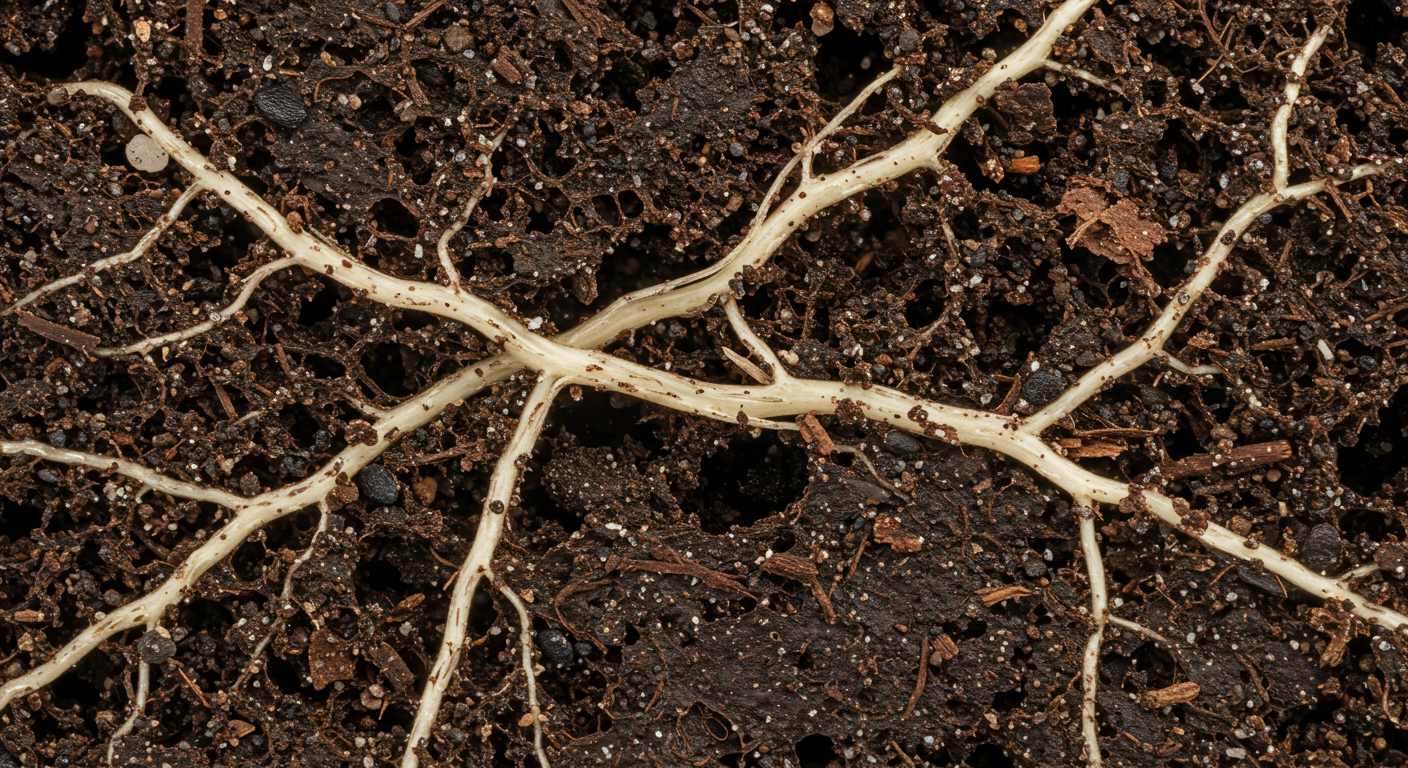
"If nutrients are already in the soil, why can the plant still look hungry?"
Question sent by: Avery Collins, via e-mail.
The nutrients may be tied up, unevenly distributed, outside a useful pH range, concentrated in dry areas, or inaccessible to weak roots. Check moisture, drainage, root condition, temperature, pH, recent feeding, and the age of the medium before adding more fertilizer. The first question is not only what the soil contains, but whether the plant can reach and absorb it.
Minimum, Sufficiency, and Excess
Each essential element has a useful range. Below that range, plant function becomes limited. Inside it, adding more may not improve growth. Above it, the element can create direct toxicity, raise salinity, shift pH, or interfere with another nutrient. The useful target is sufficient and balanced nutrition, not the highest concentration the plant can survive.
Remember: A darker green plant is not automatically a better-fed plant. Excess nitrogen can create very dark foliage, weak tissue, delayed maturity, or clawed leaves without improving flower quality.
The Essential Nutrients Cannabis Uses
Plants require carbon, hydrogen, and oxygen mainly from air and water. Fertilizer programs focus on the mineral nutrients supplied through the root zone or, in limited cases, the foliage. These minerals are grouped by the quantity the plant requires, not by their importance. A micronutrient is needed in a small amount, but its absence can still stop normal growth.
| Group | Elements | Main roles | Practical clue |
|---|---|---|---|
| Primary macronutrients | Nitrogen, phosphorus, potassium | Growth, energy transfer, water regulation, enzymes, structure, and reproduction | These are the three numbers on an N-P-K label, but the ratio alone does not describe a complete program |
| Secondary macronutrients | Calcium, magnesium, sulfur | Cell walls, chlorophyll, enzymes, proteins, signaling, and new tissue development | They are required in meaningful amounts and should not be treated as optional extras |
| Micronutrients | Iron, manganese, zinc, copper, boron, molybdenum, chlorine, nickel | Enzyme systems, electron transport, growth regulation, cell development, and nitrogen metabolism | The margin between enough and excess can be narrow, so random dosing is risky |
| Non-mineral inputs | Carbon, hydrogen, oxygen | Photosynthesis, carbohydrates, water relations, and most plant dry matter | More fertilizer cannot compensate for poor light, damaged roots, or restricted gas exchange |
Nitrogen: Growth, Chlorophyll, and Protein
Nitrogen supports amino acids, proteins, chlorophyll, nucleic acids, and vigorous canopy development. It is especially visible during vegetative growth because the plant is building leaves and stems quickly. Nitrogen remains necessary during flowering, although the required balance changes as vegetative expansion slows and flowers become the dominant sink.
Because nitrogen is mobile within the plant, shortage often appears first on older leaves as an even paling or yellowing that moves upward. Excess can produce unusually dark foliage, downward clawing, soft growth, and delayed progression. Do not diagnose nitrogen from color alone; light intensity, root stress, cultivar color, sulfur deficiency, and normal late-cycle senescence can create similar impressions.
"Should I remove nitrogen as soon as flowering starts?"
Question sent by: Liam Foster, via e-mail.
No. The plant still uses nitrogen for proteins, enzymes, chlorophyll, and continued development. The program may reduce nitrogen relative to the vegetative stage, but removing it abruptly can create premature loss of functional leaf area. Follow a complete flowering formula and judge the plant, medium, and measured solution rather than trying to force a zero-nitrogen finish.
Phosphorus: Energy Transfer and Development
Phosphorus is part of ATP and other molecules involved in energy transfer. It contributes to membranes, nucleic acids, roots, and reproductive development. That does not mean flowering cannabis needs unlimited phosphorus. Research has repeatedly challenged the idea that very high phosphorus automatically creates larger or more potent flowers.
Shortage can slow growth and may produce dark, dull, or purplish older foliage, but cool roots, genetics, and other stresses can also produce purple color. Excess phosphorus can increase runoff losses and may disturb the availability of other elements. Use a complete formula within the intended range instead of stacking several bloom boosters that all supply phosphorus.
Potassium: Water Balance and Enzyme Function
Potassium regulates stomata, water relations, charge balance, and many enzymes. It supports carbohydrate movement and the plant's response to environmental stress. Deficiency often develops on older leaves with marginal paling, spotting, or scorching, but high salinity and root damage can create similar burned edges.
Potassium also competes with calcium and magnesium at the root interface. This does not make potassium harmful; it means the recipe must remain balanced. Adding a strong potassium booster to a complete base formula can increase EC and intensify cation competition without solving the original problem.
Important: N, P, and K work as an interacting system. Changing one can alter growth, tissue concentration, and the uptake of others. Avoid treating the three numbers as independent volume controls.
Calcium, Magnesium, and Sulfur
Calcium contributes to cell walls, membranes, signaling, and new tissue. It moves mainly with the transpiration stream, so a plant may show calcium-related damage even when calcium exists in the solution if roots are impaired or movement to young tissue is limited. New leaves, growing tips, and rapidly forming tissues are common places to inspect.
Magnesium sits at the center of the chlorophyll molecule and supports enzymes and energy transfer. Because it is mobile, deficiency commonly begins as interveinal chlorosis on older leaves while veins remain greener. Sulfur is part of amino acids and proteins. Sulfur shortage can produce a more general paling that often affects newer tissue more strongly than classic nitrogen deficiency.
"Is Cal-Mag one nutrient deficiency?"
Question sent by: Madison Clark, via Facebook page.
No. Calcium and magnesium are separate elements with different movement patterns and symptom locations. A combined product can be useful when the water, medium, and base formula leave a real gap, but it should not replace diagnosis. Check whether the program already contains both elements, whether coco conditioning or reverse-osmosis water changes the requirement, and whether excess potassium, root stress, or pH is affecting uptake.
Micronutrients: Small Amounts, Specific Jobs
Iron, manganese, zinc, copper, boron, molybdenum, chlorine, and nickel support specialized enzyme and developmental processes. Iron shortage is commonly associated with interveinal chlorosis on young leaves because iron is poorly mobile within the plant. Boron and calcium problems can distort or kill growing points. Molybdenum supports nitrogen metabolism.
Micronutrient correction requires restraint. A small dose error can create toxicity, and symptoms frequently overlap. Confirm that the complete fertilizer actually contains micronutrients, review root-zone pH, and correct the environment before adding several trace-element products.
Do not improvise micronutrient doses from household chemicals.
Boron, copper, manganese, and other trace elements can become toxic at relatively low concentrations. Use a complete horticultural product or a laboratory-guided correction.
Mobile and Immobile Nutrients: Read Where Symptoms Begin
The position of the first symptoms is one of the most useful diagnostic clues. Mobile nutrients can be moved from older leaves to active growth, so shortage tends to appear low on the plant first. Less-mobile nutrients cannot be redistributed as easily, so new leaves and growing points often show damage earlier.
This is a guide, not a verdict. Cannabis studies have documented symptom patterns that do not always match textbook expectations perfectly, and root-zone stress can blur the pattern. Use location together with symptom shape, progression, pH, EC, irrigation history, root health, and the actual recipe.
| First symptom area | Nutrients to consider | Typical pattern | Confirm before feeding |
|---|---|---|---|
| Older leaves first | Nitrogen, phosphorus, potassium, magnesium, molybdenum | General paling, interveinal chlorosis, marginal damage, darkening, or progressive loss from lower foliage | Normal aging, root-zone EC, pH, irrigation, light penetration, and stage of growth |
| New growth first | Calcium, iron, boron, copper, manganese, sulfur, zinc | Distortion, pale new leaves, interveinal chlorosis, weak tips, spotting, or stalled growth | Root health, transpiration, humidity, root temperature, pH, and recent transplant stress |
| Whole plant | Severe deficiency, salinity, root failure, water stress, or environmental limitation | Uniform loss of vigor, slow growth, widespread chlorosis, or wilting | Roots, water status, drainage, temperature, pests, disease, and meter accuracy |
| One branch or zone | Often not a whole-program deficiency | Localized discoloration or weak growth | Stem injury, emitter failure, root damage, light pattern, pests, or physical blockage |
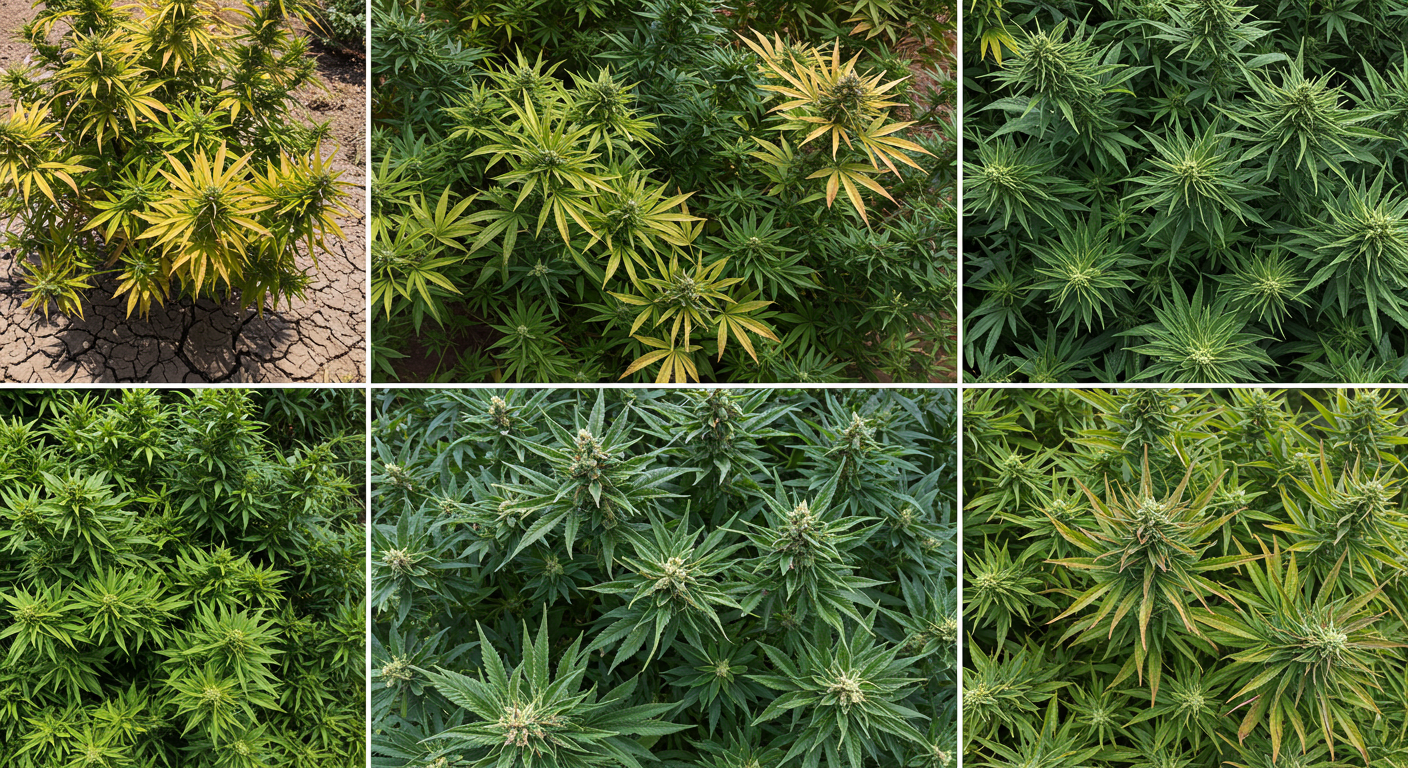
Track where the symptom started and how it moved.
Photograph the same plant under neutral light, mark the affected leaves, and compare new growth over several days.
Match one leaf to one internet picture and dose immediately.
Similar colors can come from different causes. A correction without confirmation can hide the pattern and create a second problem.
"The damaged leaves did not turn green after I corrected the feed. Did the treatment fail?"
Question sent by: Owen Tremblay, via e-mail.
Not necessarily. Necrotic tissue, burned margins, and heavily chlorotic leaves often do not recover. Judge the correction by the rate of progression, the appearance of new growth, root function, and renewed water use. Keep the old leaves long enough to observe the pattern unless they are dead, diseased, blocking airflow, or ready to detach.
How to Read a Fertilizer Label
A fertilizer label tells you what the product guarantees, not exactly how the plant will respond in your room or garden. Start with the three prominent numbers. They represent nitrogen, available phosphate, and soluble potash in that order. In many labeling systems, the phosphorus and potassium values are reported as P2O5 and K2O equivalents rather than elemental P and K.
Then read the guaranteed analysis. Look for calcium, magnesium, sulfur, iron, manganese, zinc, copper, boron, and molybdenum. Check the nitrogen forms, the intended crop or medium, the dilution instructions, application frequency, mixing order, and whether the product is a complete base, a supplement, or a single-element correction.
A complete fertilizer supplies the primary nutrients and the other mineral elements needed by the crop at the intended use rate.
A product can show three N-P-K numbers and still be incomplete if it lacks calcium, magnesium, sulfur, or micronutrients required by the rest of the program.
What a 4-4-4 or 3-1-2 Ratio Does Not Tell You
The ratio compares the three label numbers. It does not tell you the total dose, release speed, source-water contribution, micronutrient package, calcium and magnesium content, salinity, or how much becomes available in a living soil. Two products with the same ratio can behave very differently.
A 4-4-4 dry amendment and a 20-20-20 soluble fertilizer have the same N-P-K ratio, but the concentration and release behavior are not the same. Applying them at the same volume would be a serious dosing error. Use the product rate and the growing system, not the ratio alone.
Base Nutrient, Supplement, and Additive
A base nutrient is designed to supply most or all of the mineral program. A supplement fills a defined gap, such as calcium and magnesium in a particular water and substrate combination. An additive may supply biological inoculants, carbohydrates, humic substances, silica, enzymes, wetting agents, or plant extracts. Some additives contain nutrients; others do not.
Build the base first. If the base formula, water, and medium already cover the requirement, another bottle may duplicate the same element. A useful supplement solves a measured or predictable gap. It should not be included only because a schedule has an empty row.
"Can I combine products from different nutrient brands?"
Question sent by: RootRoomNorth, via X.
Sometimes, but you must compare the guaranteed analyses, intended concentrations, pH behavior, and compatibility. Two programs may both assume they are providing the full calcium, magnesium, or micronutrient load. Combining them can duplicate ingredients and raise EC. Begin with one complete base program, then add only a product whose purpose and contribution you can explain.
Dry Amendments and Release Time
Dry organic and mineral amendments release at different rates. Particle size, temperature, moisture, microbial activity, substrate pH, amendment chemistry, and incorporation depth all matter. A top-dress does not become fully available the moment it touches the soil, so waiting for a severe deficiency before applying a slow-release material can leave the plant behind.
At the other extreme, assuming that every organic input is gentle can lead to excess. Guano, meals, composted manures, and concentrated blends can create high nutrient levels or imbalances. Measure amendments, record the date, and account for what was already mixed into the container.
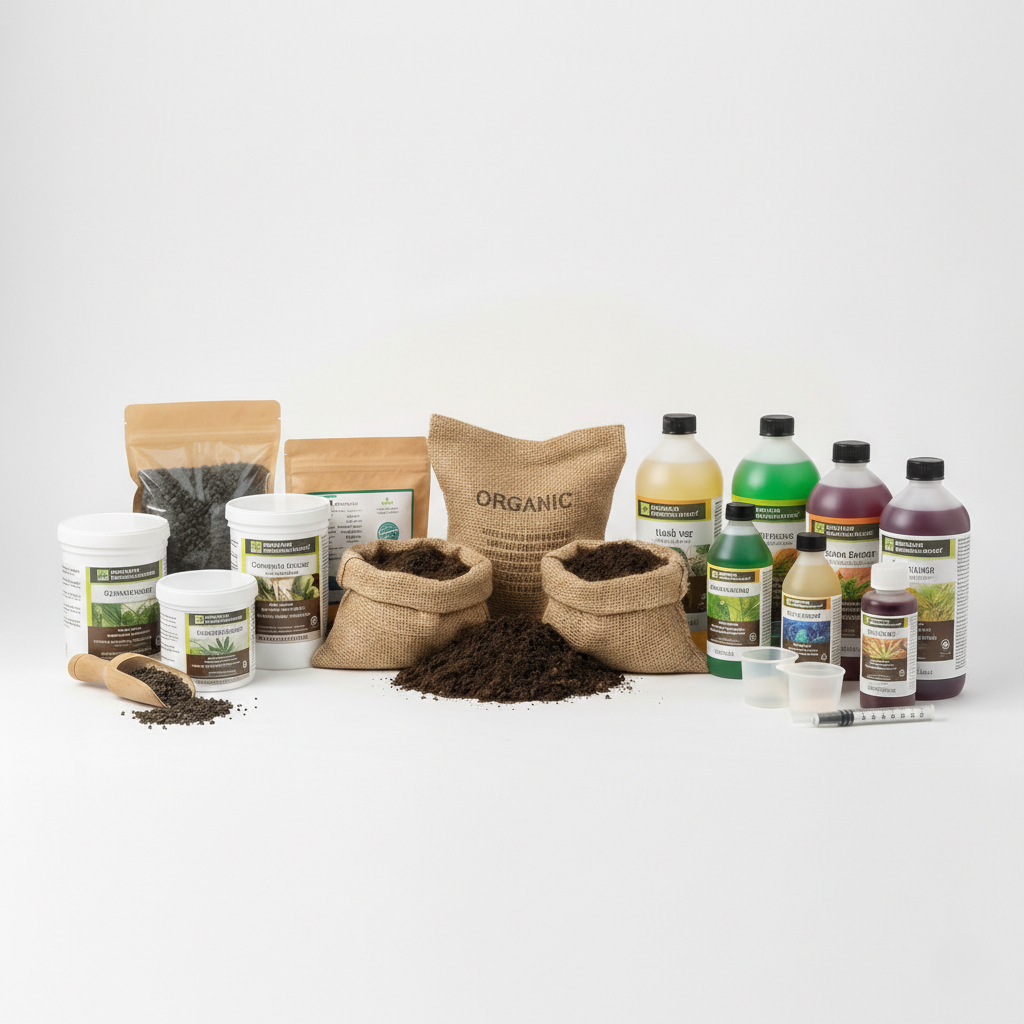
Pro Tip: Write the actual elemental contributions and application dates in your grow log. Product names are difficult to compare; inputs, concentrations, and plant response are useful data.
Choose a Program That Matches the Growing Medium
The same plant can be grown in fertilized potting soil, living soil, coco coir, peat-based soilless mix, rockwool, deep water culture, or native outdoor ground. The roots still need the same essential elements, but the delivery system changes how quickly nutrients arrive, how strongly they are buffered, and how closely the grower must monitor the solution.
| System | Main nutrient source | What the system buffers | Best monitoring habit | Common mistake |
|---|---|---|---|---|
| Pre-amended potting soil | Starter charge plus later liquid feed or top-dress | Some pH and nutrient change through organic matter and exchange sites | Know what is already in the bag and watch plant response before the first feed | Feeding a fully charged mix immediately |
| Living soil | Organic matter, amendments, microbes, and mineralization | Biological and chemical nutrient cycling in a sufficiently large soil volume | Stable moisture, top-dress timing, soil condition, and plant trend | Allowing severe drying or chasing runoff EC like coco |
| Coco coir | Complete mineral fertigation | Cation exchange affects calcium, magnesium, potassium, and sodium behavior | Input and drainage EC, pH, water use, and even irrigation | Treating coco like fertilized soil |
| Peat soilless mix | Pre-charge plus liquid fertilizer | Moderate chemical buffering that changes with lime, peat, and amendments | Substrate pH and EC using one consistent sampling method | Ignoring aging, compaction, and water alkalinity |
| Rockwool or inert slabs | Complete mineral solution | Very little nutrient reserve | Frequent solution, slab, and drainage trends | Large unmeasured recipe changes |
| Recirculating hydroponics | Complete reservoir solution | Water volume provides some short-term stability, but ions drift independently | Reservoir EC, pH, temperature, level, roots, and scheduled replacement | Correcting EC without considering which ions were consumed |
| Outdoor ground | Native fertility, amendments, compost, and supplemental fertilizer | Large soil volume and mineral or organic exchange capacity | Soil test, irrigation, weather, growth, and seasonal top-dress timing | Applying container rates to untested ground |
Pre-Amended Soil: Wait for Evidence
Many commercial potting soils contain a starter nutrient charge. Some are mild enough for seedlings; others are intended to feed established plants for several weeks. Read the bag, note the batch, and watch the new growth. Adding a full liquid feed to an already charged mix is one of the fastest ways to create excess EC.
As the charge declines, introduce the next nutrient source gradually. A sudden switch from no feed to the full schedule is harder to interpret than a cautious transition based on growth, color, root development, and water use.
Living Soil: Feed the Cycle, Not Only the Irrigation Water
Living soil relies on organic matter, microorganisms, roots, moisture, and mineral surfaces working together. Compost, castings, meals, plant residues, and mineral amendments become part of a nutrient cycle. The plant still absorbs mineral ions, but biology helps release and transform them.
Large, biologically active soil volumes are generally more stable than tiny organic containers. Keep the moisture reasonably consistent, avoid repeated heavy leaching, and plan top-dresses early enough to mineralize. A compost extract or microbial inoculant may support biology, but it cannot replace missing essential elements or correct a badly unbalanced soil by itself.

Coco Coir: Fertigation Is the Nutrient Program
Coco is commonly managed as a hydroponic substrate. Established roots receive a complete nutrient solution during irrigation, often more frequently than soil. The goal is stable moisture and chemistry, not a severe dry-back followed by a large rescue feed.
Coco's exchange sites interact strongly with calcium, magnesium, potassium, and sodium. Properly buffered coco and a formula designed for coco reduce surprises. Monitor the trend between input and drainage, but do not react to one runoff reading without using the same sampling method and considering irrigation uniformity.
"Can I use soil nutrients in coco?"
Question sent by: Elena Martinez, via e-mail.
Only if the product supplies a complete and suitable profile at the intended concentration. Many soil programs assume the medium or water will provide part of the calcium, magnesium, or micronutrient balance. Coco is usually more predictable with a formula designed for its cation behavior and frequent fertigation. Compare the guaranteed analysis rather than trusting the front label.
Hydroponics: A Reservoir Is a Moving Recipe
In a reservoir, plants remove water and ions at different rates. Evaporation, top-up water, root exudates, temperature, aeration, and microbial growth all change the solution. EC can tell you the total ionic strength has moved, but not which nutrient is high or low.
Record the starting volume, EC, pH, temperature, top-ups, and plant demand. Replace or reset the reservoir according to the system and recipe rather than endlessly correcting one old solution. Inspect roots whenever nutrient behavior changes unexpectedly.
pH, EC, PPM, and Alkalinity Without the Confusion
These measurements answer different questions. pH describes acidity or alkalinity on a logarithmic scale. EC estimates how well the solution conducts electricity, which rises as the concentration of dissolved ions increases. PPM on a handheld nutrient meter is usually a calculated conversion from EC. Alkalinity describes the water's resistance to pH change, largely through bicarbonates and carbonates.
You do not need to become a chemist to use these tools well. You need to know which measurement you are taking, use a repeatable method, calibrate the meter, and compare trends within the same system.
| Measurement | What it tells you | What it cannot identify | Good practice |
|---|---|---|---|
| pH | The acidity or alkalinity of the measured solution or extract | How much of each nutrient is present | Calibrate, measure at a consistent point, and use the range for the actual medium |
| EC | The combined electrical conductivity of dissolved ions | Which ions create the reading or whether the recipe is balanced | Record source EC, final EC, and trends using the same meter and units |
| PPM or TDS | A meter-specific conversion calculated from EC | A universal concentration unless the conversion scale is known | State whether the meter uses a 500, 640, or 700 scale; EC avoids this ambiguity |
| Alkalinity | How strongly water resists acidification and can push substrate pH over time | The current nutrient balance by itself | Use a water report or titration, especially when pH keeps drifting upward |
Why pH Changes Nutrient Availability
pH affects nutrient solubility, chemical form, microbial processes, and root uptake. At unsuitable pH, an element can become less available even when it is present. Other elements can become excessively soluble. This is why adding more fertilizer to a pH-related problem can increase salinity without restoring a balanced supply.
There is no single pH number for every system. Mineral-fed coco and hydroponics are often managed in a mildly acidic range around the upper fives to low sixes. Peat-based and soil systems often use a somewhat higher working range, influenced by lime, water alkalinity, fertilizer acidity, and biological activity. Follow the medium and product program, then confirm with plant and root-zone trends.

Why EC Is a Trend, Not a Recipe
An EC of 1.5 mS/cm does not tell you whether the solution contains a balanced fertilizer, sodium-heavy source water, or a dangerous mix of several boosters. It only summarizes conductivity. Use EC to confirm dilution, detect concentration changes, and compare input with root-zone or drainage trends. Use the label, water report, and recipe to understand composition.
Temperature compensation helps, but calibration still matters. Rinse the probe, use fresh standard solution, and do not store a pH electrode dry unless its manufacturer specifically permits it. Compare meters occasionally when a reading no longer matches plant behavior.
"My chart says 900 PPM, but another grower says that is too high. Who is right?"
Question sent by: Jordan Price, via Facebook page.
First identify the conversion scale. An EC of 1.8 mS/cm may display as about 900 ppm on a 500-scale meter or about 1260 ppm on a 700-scale meter. Then compare the source water, medium, stage, cultivar response, and complete recipe. Sharing EC with units removes the scale confusion.
Never add concentrated pH adjuster directly to the root zone.
Dilute and mix acids or bases according to the label, wear suitable protection, and measure the final solution. Concentrates can burn tissue, create extreme local pH, and react with other products.
Build a Feeding Program by Growth Stage
Stage charts are starting frameworks, not autopilots. A small plant under moderate light in a large pre-amended pot needs less immediate input than a root-bound plant under intense light in inert coco. Growth rate, root volume, cultivar, temperature, humidity, light, carbon dioxide, water quality, and medium all change demand.
| Stage | Plant priority | Feeding approach | Mistake to avoid |
|---|---|---|---|
| Seedling | Root establishment and compact new growth | Use the medium's existing charge or a mild complete solution only when the system requires it | Applying a mature-plant dose to a tiny root system |
| Fresh clone | Root initiation, low stress, and stable moisture | Use a low-strength complete program suited to the propagation medium | Trying to force roots with strong fertilizer |
| Vegetative growth | Leaves, stems, roots, and canopy structure | Increase a balanced complete feed only as roots, light, and water use justify it | Chasing the darkest possible leaf color |
| Transition | Rapid stretch, new branches, and early flower sites | Change formulas gradually while maintaining adequate nitrogen, calcium, magnesium, and micronutrients | Abruptly removing vegetative nutrition on the flip date |
| Flower development | Sustained photosynthesis, flower mass, resin, and structural support | Maintain a complete, balanced supply and watch root-zone concentration as water demand changes | Stacking several high-P and high-K boosters |
| Late flower | Maturation with functional leaves and stable roots | Adjust to actual demand; avoid forcing severe deficiency as a harvest signal | Assuming yellowing, starvation, or a calendar flush automatically improves quality |
Seedlings and Clones Need Proportion, Not Starvation
A seed contains stored energy, and many seedling mixes contain a mild charge. In those systems, plain suitable water may be enough at first. In inert plugs or hydroponic propagation, a mild complete nutrient solution can be appropriate because the medium supplies little nutrition. The correct choice depends on what the roots already have.
Watch new growth and root development. Small plants are sensitive to high salinity because their root system and water use are limited. Increase concentration only when the roots are established and growth demonstrates demand.
"When should I give a seedling its first nutrients?"
Question sent by: Cameron Hayes, via e-mail.
Identify the medium first. A charged potting mix may feed the seedling for a period, while an inert plug may require a mild complete solution earlier. Look for established roots, active new growth, and the beginning of a real decline in available nutrition. Do not wait for severe yellowing, but do not feed automatically by age.
Vegetative Growth: Increase Only With Capacity
As roots spread, leaves expand, and light intensity rises, nutrient demand usually increases. Water use is a useful companion signal. A plant that is growing quickly and drying the root zone predictably can often use more nutrition than a recently transplanted plant that remains wet for days.
Raise one variable at a time. If you increase concentration, keep irrigation and environment stable long enough to see the response. Healthy vegetative growth is not defined by maximum EC. It is defined by steady expansion, appropriate color, strong roots, and manageable internode spacing.
Flowering: Keep the Program Complete
Flowering changes the plant's allocation of resources, but it does not eliminate the need for nitrogen, calcium, magnesium, sulfur, or micronutrients. A flowering formula should remain complete. The balance and total concentration may change, while the root zone must still support photosynthesis and new tissue.
High phosphorus and potassium claims deserve skepticism. Controlled cannabis studies show that nutrient response depends on concentration, stage, cultivar, and interactions among elements. Excess input can increase leachate losses or disturb balance without increasing yield or quality.
Quality Note: Flower aroma and resin cannot be rescued by a late bottle if the plant spent weeks with damaged roots, unstable water status, excessive salinity, or a failing canopy. Quality is built through a stable cycle.
"Will a bloom booster make my buds denser?"
Question sent by: Priya Shah, via contact form.
Not by itself. Flower density is influenced by genetics, light distribution, temperature, plant health, canopy structure, water status, root function, and balanced nutrition. If the base program already provides sufficient phosphorus and potassium, another booster may mainly raise EC. Identify the limiting factor before adding a product.
Organic, Mineral, and Hybrid Nutrition
The plant does not absorb a brand philosophy. It absorbs mineral forms. The practical difference is how those forms become available, how quickly the grower can adjust them, and how the root-zone system stores or cycles them.
Organic nutrition uses materials derived from plant, animal, or mined sources and often depends on decomposition and microbial mineralization. Mineral fertilizer supplies measured soluble salts or ions that can be delivered directly. Both approaches can grow healthy plants. Both can be mismanaged.
Organic Programs
A well-built organic program can create a biologically active, buffered soil with slow nutrient release and useful reuse potential. It can also be difficult to correct quickly when the container is too small, amendment timing is late, moisture is unstable, or the original recipe is unbalanced.
Compost quality matters. Immature compost, excessive manure, unknown salts, contaminants, or poorly characterized homemade inputs can create problems. Use mature materials, reliable analyses where available, and conservative amendment rates. More microbial diversity does not excuse missing mineral balance.
Mineral Programs
Mineral nutrients offer precision and fast adjustment. They are useful in coco, rockwool, hydroponics, and controlled fertigation. Their speed also makes dosing and monitoring more important. A mixing error reaches the roots quickly, and repeated drain-to-waste irrigation can create nutrient-rich runoff.
Use one coherent base program, measure accurately, and respect the manufacturer's intended water and medium. Precision does not mean changing the recipe every day. It means making controlled changes that can be measured and repeated.
Can Organic and Mineral Inputs Be Used Together?
Yes, when the combination has a defined purpose and remains compatible with the system. A soil grower may use organic amendments with a measured mineral correction. A mineral program may include humic substances or biological inoculants. The risk is duplication, clogged irrigation, unstable reservoirs, or using incompatible products without understanding their chemistry.
Choose one primary nutrient strategy.
Let the medium, water, irrigation system, and monitoring routine support that strategy.
Build a program from unrelated products and overlapping schedules.
A crowded recipe is difficult to diagnose and can duplicate N, P, K, calcium, magnesium, or micronutrients.
"Are organic buds automatically more flavorful?"
Question sent by: Noah Bennett, via e-mail.
No single fertilizer category guarantees aroma or flavor. Genetics, flower health, light, temperature, water stress, nutrient balance, harvest timing, drying, storage, and curing all influence the final result. Organic systems can produce excellent flower, and so can well-managed mineral systems. Compare the complete process rather than treating the input label as a quality certificate.
How to Mix Nutrients Without Creating a Second Problem
Mixing order matters because concentrated fertilizer components can react. Calcium can form insoluble precipitates with concentrated phosphates or sulfates. Those solids are unavailable to roots and can clog irrigation. This is why many nutrient programs separate components into Part A and Part B.
Always follow the product label because formulations differ. A general small-batch workflow is to begin with source water, add each component separately, mix thoroughly between additions, measure final EC, and adjust pH last unless the manufacturer specifies another procedure. Never pour concentrates together before dilution.
A Repeatable Nutrient-Mixing Routine
- Use a clean reservoir, clean tools, and a known final water volume.
- Record source-water EC, temperature, and relevant water-report values.
- Confirm the product rate for the medium and growth stage.
- Measure by weight or with dedicated accurate tools; do not use kitchen utensils.
- Add the first component to water and mix until fully dispersed.
- Add each remaining component separately, mixing between additions.
- Keep Part A, Part B, calcium, phosphate, and sulfate concentrates separated as directed.
- Top up to the correct final volume before making the final concentration judgment.
- Measure EC and compare it with the source water and intended recipe.
- Measure and adjust pH after the nutrient solution is complete.
- Record the recipe, final EC, pH, temperature, volume, and date.
- Apply the solution while it is fresh unless the product is designed for storage or circulation.
Silica, Calcium, and Product-Specific Order
Some silica products require dilution into water before other nutrients. Some calcium-containing products belong early in the sequence, while complete premixes may require a different order. The safe rule is not a universal internet list; it is the current label for the exact products being used.
If a new combination becomes cloudy, forms flakes, warms unexpectedly, or leaves sediment, stop and review compatibility. A small jar test can reveal precipitation before the mix reaches the reservoir, but do not combine unfamiliar concentrates without manufacturer guidance.
Never mix nutrient concentrates directly with each other.
Always dilute each component in the final water or use the separate stock-tank system specified by the manufacturer. Concentrated calcium with phosphate or sulfate can form insoluble solids.
How Long Can Mixed Nutrients Sit?
Stability depends on the formula, temperature, light exposure, aeration, organic content, and reservoir hygiene. Clear mineral solutions designed for circulation can often remain stable longer than mixtures containing organic extracts, carbohydrates, or live microbes. Some biological products should be used promptly.
Watch for odor, slime, cloudiness, sediment, biofilm, pH drift, and temperature rise. Keep reservoirs covered from light, clean them between batches, and follow product storage guidance. Do not assume a clear solution is chemically unchanged.
"Why did my nutrient mix turn cloudy after I added everything?"
Question sent by: Chloe Wilson, via e-mail.
Cloudiness may come from precipitation, suspended organic material, microbes, or an emulsion. Review the mixing order, source-water hardness, pH, and product compatibility. If the mix contains calcium with concentrated phosphate or sulfate, precipitation is a strong possibility. Do not send an unexplained cloudy solution through emitters or roots until you identify the cause.
Feeding Frequency: Every Watering or Water Only Between Feeds?
There is no universal answer because the nutrient source and medium change the logic. Mineral-fed coco often receives a complete nutrient solution with most irrigations. A charged soil may alternate or receive only occasional liquid feed. Living soil may rely on amendments and mostly water. A hydroponic reservoir supplies nutrition continuously.
The useful question is: how does this system maintain a sufficient, balanced root-zone concentration without large swings? Use the product program, root-zone measurements, water use, and plant response. Alternating blindly can create repeated feast-and-famine cycles in one system and prevent salt accumulation in another.
Advice: Choose a program simple enough to repeat correctly. Consistency teaches you more than a complicated schedule that changes before the plant can respond.
"Should I feed every time I water?"
Question sent by: GrowLog604, via X.
Match the answer to the system. Frequent complete fertigation is normal in established coco and many inert media. Pre-amended soil may need no liquid feed at first, then a lower-frequency program. Living soil is managed through soil fertility and moisture. Write down what supplies the nutrients in your system before deciding what belongs in each irrigation.
Deficiency, Lockout, Toxicity, or Root Stress?
A deficiency means the plant is not receiving enough usable nutrient for normal function. That can happen because the element is missing, but it can also happen because roots cannot access it. Growers often call the second situation lockout. Toxicity means an element or salt concentration is high enough to injure the plant or disrupt balance.
These categories can overlap. Excess fertilizer raises root-zone EC, which makes water uptake more difficult. Damaged roots absorb nutrients poorly, so deficiency-like symptoms can appear in a highly fertilized pot. Adding more feed then raises EC again. The correction begins by identifying the mechanism.
| Observation | Possible cause | Check next | First response | Avoid |
|---|---|---|---|---|
| Pale older leaves | Nitrogen or magnesium shortage, low EC, aging, weak roots, or poor light penetration | Symptom pattern, new growth, root-zone EC and pH, roots, stage, and recipe | Correct the confirmed limitation gradually | Applying nitrogen and magnesium together without separating the pattern |
| Burned tips after a feed increase | Excess concentration, dry-back concentration, uneven mixing, or sensitive cultivar | Input EC, root-zone trend, water use, meter calibration, and mixing record | Stop increasing and restore a suitable concentration and irrigation pattern | Adding another product to treat the burn |
| Pale or distorted new growth | Iron, calcium, boron, sulfur, or root and transpiration limitation | Root health, pH, humidity, temperature, water movement, and complete analysis | Correct the root-zone or environmental cause before targeted supplementation | High-dose micronutrient cocktails |
| Marginal scorch | Potassium shortage, salinity, drought, heat, or root damage | Pot weight, EC, irrigation coverage, temperature, and progression | Stabilize water and root-zone chemistry, then reassess nutrition | Assuming every burned edge needs more potassium |
| One plant declines in a uniform room | Emitter failure, root disease, damaged stem, different medium, or individual sensitivity | Compare roots, pot weight, input volume, drainage, and location | Correct the local fault and isolate disease risk if necessary | Changing the whole room's recipe from one plant |
| Whole room changes together | Recipe error, source-water change, meter drift, environmental shift, or irrigation failure | Shared inputs, calibration, batch record, climate, and delivery equipment | Find and correct the common variable | Treating pots one by one before checking the system |
Start With the Pattern
Ask where the problem began, whether it is moving, and which plants share it. Compare old and new growth. Check whether the wettest pots, driest pots, one cultivar, one irrigation line, or one light zone are affected. A system pattern often points toward the cause faster than the exact shade of yellow.
Then inspect the roots and recent history. Record transplanting, pruning, heat events, cold nights, pesticide sprays, water-source changes, recipe changes, and meter calibration. Plant symptoms are delayed evidence. The cause may have occurred several days earlier.
Change One Major Variable at a Time
If you replace the nutrient line, increase EC, change pH, add Cal-Mag, flush the pot, and alter irrigation frequency on the same day, the plant cannot tell you which action helped. Choose the most strongly supported correction, stabilize the other variables, and observe new growth.
Field Advice: Write the hypothesis before the treatment. If you cannot explain why the correction should work, collect more evidence first.
"My runoff EC is high. Should I flush immediately?"
Question sent by: Sophie Martin, via Facebook page.
First confirm the sampling method, irrigation coverage, input EC, dry-back, and whether the runoff represents the whole root zone. A high trend with tip burn, reduced water use, or rising root-zone concentration may justify controlled leaching in a drain-to-waste system. Living soil, ground soil, and recirculating systems require different responses. Do not apply a large flush only because of one inconsistent sample.
What Flushing Can and Cannot Do
The word flushing is used for different actions. Corrective leaching moves excess soluble salts from a draining substrate. Reservoir replacement removes an old hydroponic solution. Preharvest water-only irrigation withholds fertilizer near harvest. These are not the same procedure and should not share one automatic rule.
Corrective leaching can be useful when measured salts have accumulated in a system designed to drain. It can also waterlog a compact medium, remove useful nutrients, create large runoff volumes, and stress weak roots. Fix the cause of accumulation, such as excessive concentration, insufficient drainage, uneven irrigation, or repeated severe dry-back.
Controlled research has not established a universal improvement in cannabinoid or terpene quality from preharvest water-only flushing. Avoid forcing severe deficiency or interpreting yellow leaves as proof that flavor is improving. Finish the crop according to the validated program and judge harvest readiness from plant maturity, not starvation alone.
"Do I need to flush for two weeks to remove fertilizer from the buds?"
Question sent by: Tyler Brooks, via e-mail.
A fixed two-week water-only period is not a universal requirement. Plants do not simply store bottled fertilizer that can be washed out of flowers. Nutrients are incorporated into plant tissues and metabolism. Separate a real root-zone salt problem from a preharvest habit, and follow evidence from the cultivar, medium, solution, and validated production method.
Foliar Feeding and Supplements
Foliar feeding can deliver small amounts of certain nutrients through leaves and may support a targeted correction when root uptake is temporarily limited. It is not a substitute for a functional root zone or a complete long-term program. Coverage, concentration, leaf age, humidity, temperature, light, and formulation all affect safety.
Test a small area first. Spray only products labeled for foliar use, avoid strong light and heat during application, maintain airflow, and do not leave dense flowers wet. Late-flower spraying can increase residue, moisture, and microbial risk. When flowers are present, the threshold for using a foliar product should be high.
Do not spray concentrated nutrients or unapproved mixtures onto flowers.
Residues, phytotoxicity, trapped moisture, and microbial contamination can damage crop quality. Follow the label and local rules for any foliar product.
Microbes, Enzymes, Carbohydrates, and Biostimulants
These products occupy different categories. Microbial inoculants introduce selected organisms. Enzyme products may help break down certain organic materials. Carbohydrate products feed microbes more directly than they feed the plant. Biostimulants may influence root growth, stress response, or nutrient efficiency without supplying a complete nutrient profile.
Use them for a defined reason and evaluate the result. Keep biological products out of reservoirs or irrigation equipment that cannot manage biofilm or organic load. A healthy plant with a balanced complete feed may not respond visibly to another additive.
"Do carbohydrates make cannabis buds sweeter?"
Question sent by: Ethan Walker, via e-mail.
Roots do not absorb a bottled sugar and send it directly into flower flavor. Carbohydrate products may affect microbial activity in some organic systems, but aroma and flavor depend on genetics, healthy flower development, environment, harvest timing, drying, and curing. Do not add sugars to a reservoir or root zone without considering microbial growth, oxygen demand, and system hygiene.
Build a Nutrient Record That Teaches You
A useful record connects the recipe to the plant response. Product name alone is not enough. Record the source water, volume, grams or milliliters of each input, final EC and pH, medium, irrigation volume, drainage, stage, temperature, humidity, and visible response.
Take photographs under the same neutral light and from the same angle. Note the first affected leaf position and whether symptoms progressed. Over several cycles, the record shows which cultivars feed lightly, which containers accumulate salts, and which environmental changes alter demand.
Pro Tip: Keep one healthy, representative plant as a comparison. A struggling outlier and an unusually vigorous plant can both distort your judgment of the whole garden.
Common Nutrient Questions
Do Cannabis Plants Need Special Cannabis Fertilizer?
They need a complete, appropriate nutrient profile, not necessarily a cannabis-branded label. A horticultural fertilizer can work when its analysis, concentration, nitrogen form, calcium and magnesium supply, micronutrients, pH behavior, and medium compatibility fit the crop. Cannabis-specific programs can make stage changes easier, but branding is not evidence of completeness.
"Can I use tomato fertilizer for cannabis?"
Question sent by: Maya Chen, via e-mail.
Possibly, but compare the complete guaranteed analysis and intended use. Tomato formulas can provide a useful horticultural profile, yet some assume particular water, substrate, or calcium sources. Start cautiously, monitor the root zone and plant, and avoid combining it with a second complete cannabis program.
Should the pH Drift Within a Range?
Small controlled movement can occur as plants absorb ions and the root zone exchanges them. The goal is not to force one exact decimal every hour. The goal is to keep the system within its validated working range and investigate rapid or repeated drift. Strong upward drift may reflect alkalinity, biological activity, or nutrient uptake; downward drift may reflect fertilizer chemistry, roots, or reservoir conditions.
Is More Runoff Always Better?
No. Runoff is a management tool in some mineral-fed drain-to-waste systems. Excessive runoff wastes water and nutrients and can create disposal problems. Living soil may aim to retain nutrients and biology with minimal leaching. Choose a drainage target for the actual medium and use measurements to confirm it is solving a problem.
Can Leaf Tips Burn Without Overfeeding?
Yes. Heat, drought, low humidity, wind exposure, root damage, salt concentration during dry-back, and spray injury can damage tips and margins. Review the whole pattern and history. Nutrient excess is common, but it is not the only cause.
Should Every Cultivar Receive the Same Feed?
Not automatically. Cultivars can differ in growth rate, root behavior, nutrient efficiency, flower structure, and sensitivity to high concentration. Begin with a conservative common program, group plants with similar demand, and adjust only after repeated evidence.
A Simple Nutrient Routine You Can Repeat
Let us reduce the full guide to a working routine. The point is not to remove judgment. It is to make each decision clear enough that the next plant response teaches you something.
Before You Change the Feed
- Identify the medium and what nutrients it already contains.
- Know the source-water EC, alkalinity, and relevant mineral content.
- Choose one complete base program for that water and medium.
- Calibrate pH and EC meters and state the units you use.
- Confirm roots, drainage, moisture, temperature, and irrigation uniformity.
- Read the guaranteed analysis before adding a supplement.
- Mix each component separately and follow the label order.
- Measure the finished solution rather than the source water alone.
- Record the recipe, application volume, drainage, and plant response.
- Change one major variable at a time.
- Judge recovery from new growth and the rate of progression.
- Carry cultivar-specific lessons into the next cycle.
Selected Research Behind This Guide
Cannabis nutrition research is developing quickly, and results depend on cultivar, growth stage, environment, and production system. The following primary studies and university resources support the central principles used in this guide:
- Mineral nutrition for Cannabis sativa in the vegetative stage
- Optimization of nitrogen, phosphorus, and potassium for soilless flowering cannabis
- Foliar symptoms and yield effects of individual cannabis nutrient deficiencies
- How ammonium-to-nitrate ratio affects cannabis yield and secondary metabolites
- Cannabis response to magnesium supply during vegetative growth
- Organic and mineral fertilizer levels, biomass, and nutrient-use efficiency
- Preharvest media flushing across five cannabis cultivars
- Virginia Tech guide to fertilizer labels and calculations
- University of New Hampshire nutrient-problem scouting and diagnosis
- University of Arkansas guidance on fertilizer compatibility and stock solutions
- University of Georgia guide to pH and plant nutrition
Feed With Evidence, Then Let the Plant Answer
A reliable nutrient program becomes simpler over time. You know what the medium contains, what the water contributes, what the base formula supplies, and which measurements describe the root zone. When the plant changes, you can trace the likely cause instead of adding products until the symptoms become unreadable.
Start conservatively, keep the program complete, and build concentration only when roots, light, growth, and water use support it. Protect the root zone, record each change, and judge the response from new growth. That is how a feeding chart becomes real cultivation knowledge.