Watering Basics
Before You Start
Is This Guide Right for You?
This guide teaches you to water by reading the plant, container, and root zone instead of obeying a calendar. After all, 'every three days' is not a promise the medium has agreed to keep.
If you are still choosing the medium and container that control drying speed, read Indoor Grow Mediums. If you grow indoors and need a more precise irrigation, runoff, pH, and EC routine, continue with Watering Indoor Plants.
The first watering mistake usually happens before any water reaches the pot: we choose a day on the calendar and assume every plant is ready. A seedling in a large container, a flowering plant in coco, and an outdoor plant in warm wind can all be two days past their last irrigation while needing completely different decisions.
Let us replace that calendar with evidence. You will learn how to read the container, the growing medium, the roots, the environment, and the plant together. We will also separate soil from coco and hydroponics, because a method that protects one root zone can suffocate or dehydrate another.
Good watering is not about keeping the medium constantly wet or forcing it to become bone dry. The goal is a repeatable cycle: water reaches the active root zone, excess drains or is used as the system intends, air returns to the pore space, and the next irrigation arrives before damaging water stress develops.
Master Advice: Do not ask, "Is it watering day?" Ask, "What evidence shows that this root zone is ready for water?"
What Good Watering Actually Does
Roots need both water and oxygen. Water carries dissolved mineral nutrients to root surfaces and replaces the moisture lost through transpiration. Oxygen supports root respiration, which helps power nutrient uptake and new root growth. A healthy container therefore needs pore spaces that can hold water and pore spaces that refill with air after drainage.
When a medium stays saturated for too long, oxygen movement slows. The plant may wilt even though the pot is wet because damaged or oxygen-limited roots cannot move water efficiently. When a medium becomes too dry, water films around particles shrink, nutrient movement slows, and the plant closes stomata to reduce water loss. Both extremes can reduce growth.
Container capacity is the water a medium retains after it has been thoroughly irrigated and allowed to drain.
It is not the same as permanent saturation. After drainage, part of the pore space should contain water and part should contain air.
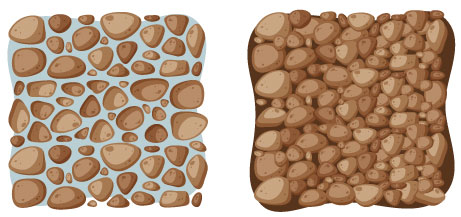
This is why the same volume of water behaves differently in a compact peat mix, an airy coco-perlite blend, a living soil bed, and native outdoor ground. The substrate, container shape, drainage path, root density, and irrigation speed all change how much water remains available and how quickly oxygen returns.
"Can a plant be overwatered from one large irrigation?"
Question sent by: Cameron Lewis, via e-mail.
A well-drained, appropriately sized root zone can usually handle a thorough irrigation. The more common problem is watering again before enough water has been used or drained, or using a compact medium and container that cannot restore air. One application can still cause trouble if the pot has blocked drainage, the medium is already saturated, or the plant occupies only a small part of a very large wet container.
When Should You Water Cannabis?
There is no universal answer such as every two days or every Wednesday. Water when the active root zone has used enough moisture to benefit from another complete irrigation, but before severe wilt, leaf damage, or root-zone salinity develops. You will make better decisions when you combine several signals instead of trusting one.
Use the Three-Signal Check
Start with container weight, confirm the moisture pattern, and then compare the plant and environment. This takes a little practice, but it quickly becomes more reliable than a fixed schedule.
| Signal | What it tells you | How to use it | Main limitation |
|---|---|---|---|
| Container weight | How much water has left the whole pot | Lift or tilt after full drainage, then compare as it dries | Large beds and fixed systems cannot be lifted |
| Moisture at depth | Whether the root zone is drying below the surface | Use a clean finger, wooden skewer, or probe at more than one point | The top layer may not represent the center or bottom |
| Plant posture | Whether water status may be affecting leaves and stems | Compare before lights-on, during peak demand, and after irrigation | Heat, root disease, pests, and nutrient problems can also cause droop |
| Runoff or drainage | How quickly water moves through and whether distribution is even | Observe start time, volume, color, and whether all outlets drain | Runoff alone does not prove the center was wetted |
| Moisture sensor | A repeatable reading at the sensor location | Calibrate it against pot weight and plant response | One sensor can miss dry pockets or represent only one medium |
Learn the Weight of a Wet and Drying Pot
After a thorough irrigation has finished draining, lift the container or gently tilt one edge. That is your wet reference. Check it again over the next day or two. The aim is not to memorize an exact number; it is to feel the change as the plant and environment remove water.
Small pots can be lifted directly. Larger fabric pots can be tilted from one side without pulling the stem. For repeatability, place one representative container on a platform scale. Record the weight after drainage and again just before the next successful irrigation. This creates a useful local range for that cultivar, pot, and medium.
Tip: Label one healthy, average-sized plant as your reference pot. The smallest or largest plant in the room can give you a misleading schedule for the rest.
"The top inch is dry, but the pot still feels heavy. Should I water?"
Question sent by: Alyssa Grant, via Facebook page.
Usually not yet. Surface evaporation can dry the top layer while the center and lower root zone remain wet. Check deeper at the side of the root ball and compare the container weight. If the pot is still heavy and the plant is not showing genuine water demand, give the root zone more time to restore air.
Finger Tests, Skewers, and Moisture Meters
A finger test is useful in small containers, but one inch of dry surface cannot describe a deep pot. Check more than one location and avoid damaging major roots. A clean wooden skewer inserted into the medium can reveal dampness deeper in the pot, much like testing a cake, although dense roots and some substrates make the result harder to interpret.
Low-cost moisture meters can help with consistency, but they are not universal truth machines. Electrical probes respond differently to salts, substrate composition, temperature, and probe contact. Calibrate the reading against pot weight, a manual moisture check, and plant response before using it to trigger irrigation.
Combine two or three watering signals.
Container weight, moisture at depth, and recent water use create a much stronger decision than one surface observation.
Wait for severe wilt as your normal trigger.
Repeated hard wilting interrupts photosynthesis, slows growth, and makes nutrient concentration in the root zone less stable.
How to Water by Hand
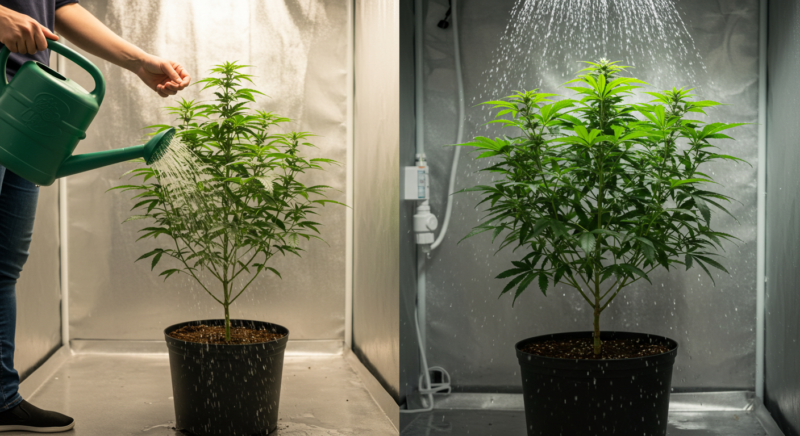
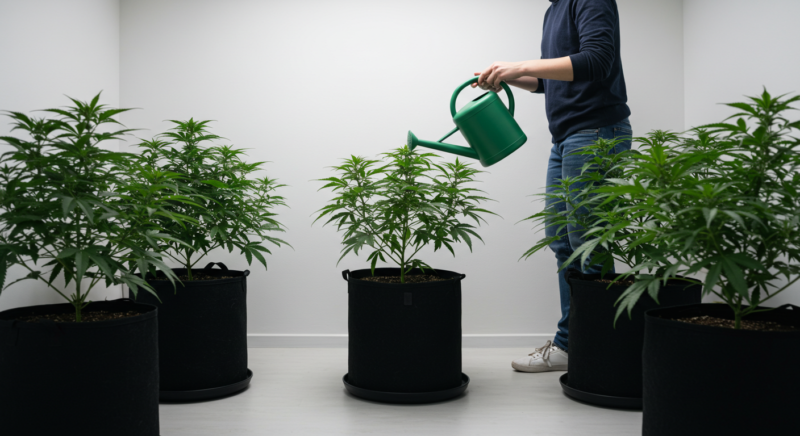
Manual watering is often the best teacher for a first grow because you see how each container accepts water. It works well for small gardens, plants with different sizes, and situations where one cultivar dries faster than another. The method becomes unreliable when the application is rushed or every pot receives the same volume without inspection.
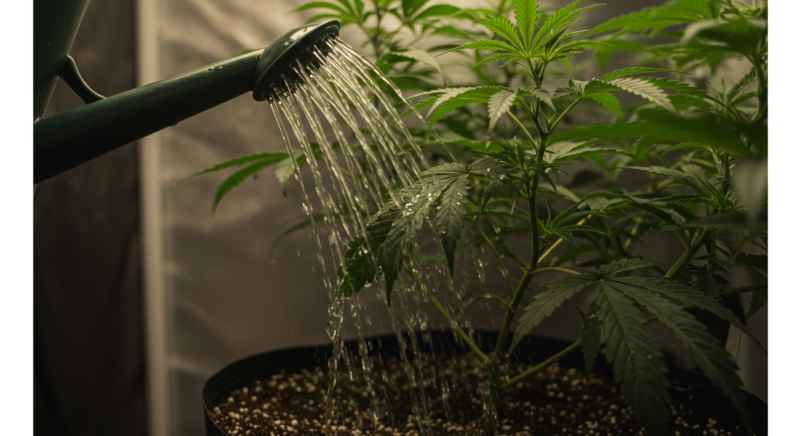
A Clear Hand-Watering Sequence
First confirm that the pot is ready. Prepare water at a suitable temperature, mix nutrients when the program calls for them, and measure the finished solution rather than the source water alone. Remove standing drainage from saucers so the container does not sit in it.
- Start around the established root zone. For a small plant in a large pot, water the area occupied by roots and expand the circle as the plant grows. Do not keep the entire unused container saturated.
- Apply a light first pass. Moisten the surface slowly. This reduces runoff down the sides and gives dry peat or soil time to accept water.
- Pause briefly. Let capillary movement spread the first pass before adding more.
- Water in overlapping passes. Move around the pot rather than pouring into one spot. Include the center without repeatedly blasting the stem.
- Watch drainage. Note when it begins and whether one side drains much earlier than another.
- Stop for the system you are using. Soil, living soil, coco, and drain-to-waste programs do not all require the same runoff target.
- Record the volume and response. The next irrigation decision becomes easier when you know what went in, what drained, and how long the cycle lasted.
Pro Tip: A small measuring jug makes hand watering more repeatable. "About one can" is difficult to compare across plants and days.
Water Slowly Enough to Wet the Whole Root Ball
Water can follow the easiest path through cracks, gaps beside the pot, old root channels, or coarse sections of medium. Fast drainage may therefore mean excellent structure, but it can also mean that much of the root ball stayed dry. If water exits immediately from one side, slow down, divide the application into passes, and check whether the medium has pulled away from the container.
Very dry peat-based media can become difficult to rewet. A small first pass followed by a pause is safer than one heavy pour. If the medium remains water-repellent, use a wetting approach approved for that substrate or rehydrate gradually. Do not compensate by leaving the pot submerged for a long period.
Channeling is water moving through a few easy pathways while other parts of the root ball remain relatively dry.
Early runoff, dry pockets, uneven roots, and unstable EC can all appear when water distribution is poor.
"Water runs out of my fabric pot in seconds. Does that mean drainage is perfect?"
Question sent by: Jordan McKay, via e-mail.
Not necessarily. Check whether the entire surface accepts water and whether the center of the root ball becomes evenly moist. A shrunken or hydrophobic mix can send water down the fabric wall while the roots remain dry. Use a slow first pass, wait, then apply the rest in several circles.
How to Water Seedlings and Fresh Transplants
A seedling has a small root system and cannot use the water stored in a large saturated container. Keep the immediate root zone evenly moist without repeatedly soaking the entire pot. Expand the watered area as roots and leaf area grow. This encourages exploration without creating a cold, oxygen-poor reservoir around a tiny plant.
Fresh transplants need enough water to settle the new medium around the root ball, but their demand may pause while roots establish. Watch container weight and new growth rather than continuing the previous high-frequency schedule automatically.
"Should I water a seedling until the whole five-gallon pot drains?"
Question sent by: Priya Shah, via contact form.
Usually no. The young roots occupy only a small volume, so saturating the entire container can leave unused medium wet for too long. Moisten the established root zone in a widening circle and use pot weight to prevent the surrounding mix from becoming permanently saturated.
Manual Watering, Drip, Soaker Hose, and Flood-and-Drain
The best delivery method is the one you can measure, maintain, and match to the root zone. Automation can improve consistency, but a timer does not know that an emitter clogged, a plant stopped drinking, or yesterday was cooler. Every automated system still needs observation.
| Method | Best fit | Main strength | Main risk |
|---|---|---|---|
| Hand watering | Small gardens and uneven plant demand | Direct observation and individual control | Inconsistent volume, speed, or coverage |
| Drip irrigation | Repeated container layouts and larger gardens | Measured, repeatable root-zone delivery | Clogs, pressure differences, unnoticed failures |
| Soaker hose | Outdoor beds and broad soil zones | Simple distribution across a row | Uneven output along long runs |
| Flood-and-drain | Purpose-built hydroponic tables | Fast, automated wetting and drainage | Pump, timer, sanitation, and reservoir failures |
| Overhead irrigation | Specific propagation or outdoor uses | Broad coverage | Wet flowers, evaporation, disease spread, uneven pot delivery |
Drip Irrigation
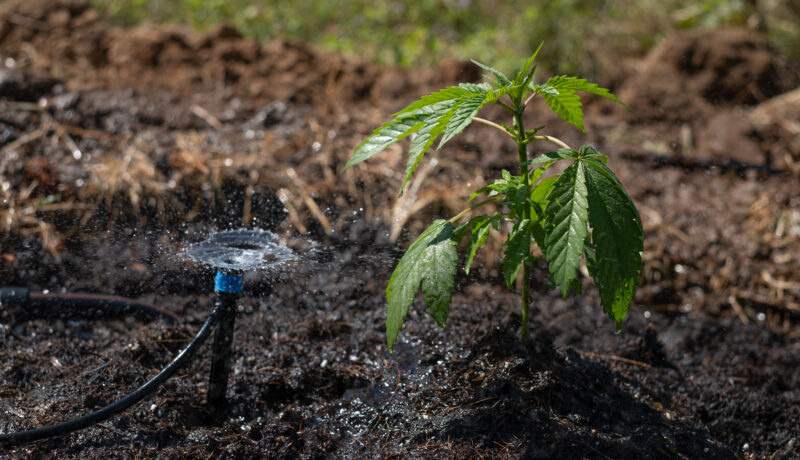
Drip systems deliver water through tubing and emitters placed near the root zone. They can reduce labor and make small, frequent irrigations possible in fast-draining media. Their success depends on pressure, filtration, emitter selection, line length, water quality, and regular output testing.
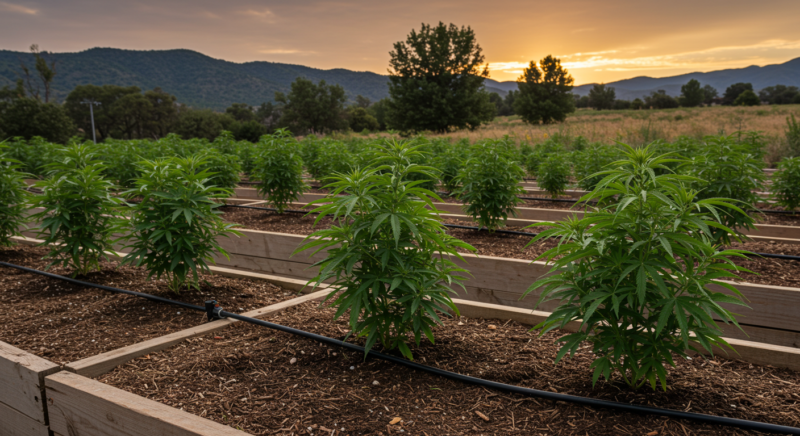
One emitter beside a large plant may create a narrow wet column rather than watering the whole root mass. Increase the number or position of emitters as the root zone expands. In containers, confirm that each pot receives similar output by running the system for a fixed time into measuring cups at the first, middle, and last positions.
Drip Setup and Maintenance
Use a filter suited to the emitter, a pressure regulator when the system requires one, and tubing sized for the total flow. Keep concentrated nutrients separate until diluted in the main water volume. Flush line ends periodically and inspect emitters for mineral scale, organic residue, algae, and root intrusion.
- Before planting: run the system, collect output from several emitters, and correct pressure differences.
- During the crop: inspect wetting patterns, drainage timing, and plant-to-plant differences.
- After nutrient changes: check for precipitation or residue that may clog small passages.
- Between cycles: clean and sanitize using a method compatible with the tubing, reservoir, and emitters.
Do not assume a running pump means every plant was watered.
A kink, clogged emitter, empty reservoir, failed valve, or pressure imbalance can leave one container dry while the rest of the system appears normal.
"Can I put drip irrigation on a timer and stop checking pots?"
Question sent by: Tyler Bennett, via e-mail.
No. The timer repeats a duration, not a successful irrigation. Check output, reservoir volume, pot weight or sensor trends, and drainage. Automation should reduce repetitive labor while preserving inspection, not replace it.
Using Soaker Hoses
Soaker hoses release water along a porous line and are most useful in outdoor beds, long rows, and broad soil root zones. Keep runs reasonably short, use low controlled pressure, and place the line where roots are active. Covering it with a suitable mulch can reduce evaporation outdoors, but do not bury it so deeply that failures become invisible.

Output often falls toward the end of a long hose, especially on slopes or with weak pressure. Test the beginning, middle, and end using shallow collection containers or by checking the wetting depth after a timed run.
Flood-and-Drain Systems
Flood-and-drain, also called ebb-and-flow, temporarily fills a tray or root zone with nutrient solution and then returns the solution to a reservoir. Roots receive water and nutrients during the flood; drainage allows fresh air to return. The flood height, duration, frequency, medium, root density, and drain speed must work together.
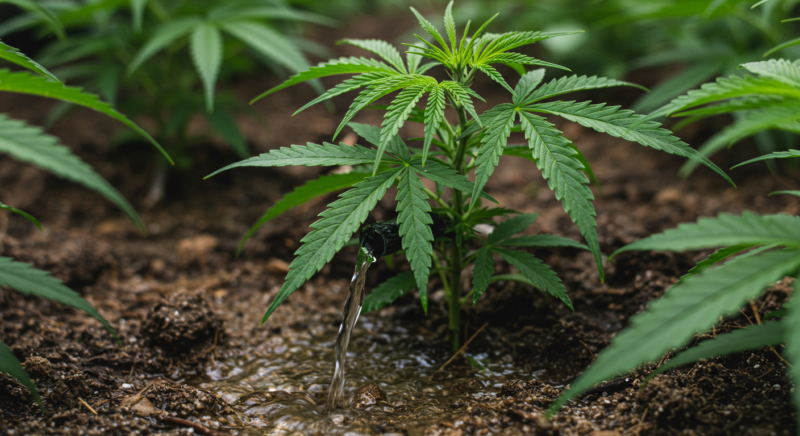
These systems are not simply soil pots placed in standing water. They require a suitable medium, reliable pump and timer, overflow protection, reservoir monitoring, and sanitation. Check that the tray drains completely and that roots do not block outlets.
Rainwater Collection and Safe Use
Rainwater can be a useful irrigation source, especially where municipal water has high alkalinity or salinity. It is not automatically pure, sterile, or nutritionally complete. Roof material, gutters, bird droppings, airborne dust, smoke, metals, storage conditions, and local pollution can all change its quality.
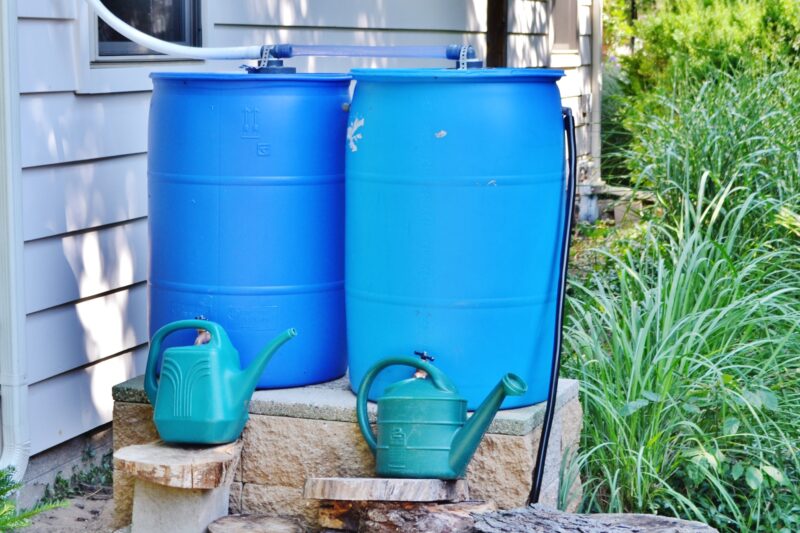
Build the Collection System Around Water Quality
Use a sound roof and gutter material appropriate for harvested irrigation water. Install leaf screens, divert the dirty first portion of runoff when practical, keep the barrel covered against debris and insects, and provide a safe overflow route. Opaque storage reduces light-driven algae growth.
Test pH, EC, and alkalinity before using collected water in a controlled nutrient program. Where roof materials or local pollution create a contamination concern, laboratory testing may be appropriate. Do not assume that clear water is free of metals or microbes.
Do not collect irrigation water from an unknown or contaminated roof.
Lead flashing, copper, treated wood, deteriorating roofing, industrial dust, wildfire ash, pesticides, and animal waste can make roof runoff unsuitable without testing and treatment.
"Is rainwater always better than tap water?"
Question sent by: Emily Carter, via Facebook page.
No. Good tap water can be more consistent and easier to monitor than poorly collected rainwater. Compare actual EC, alkalinity, pH stability, contaminants, and storage hygiene. Choose the source you can test and manage reliably.
How Much Water Should You Give?
The correct amount is the volume needed to wet the intended root zone evenly and complete the irrigation goal for that medium. It is not a fixed number per plant. Pot size, plant size, substrate water-holding capacity, starting moisture, root density, irrigation method, and whether runoff is required all change the answer.
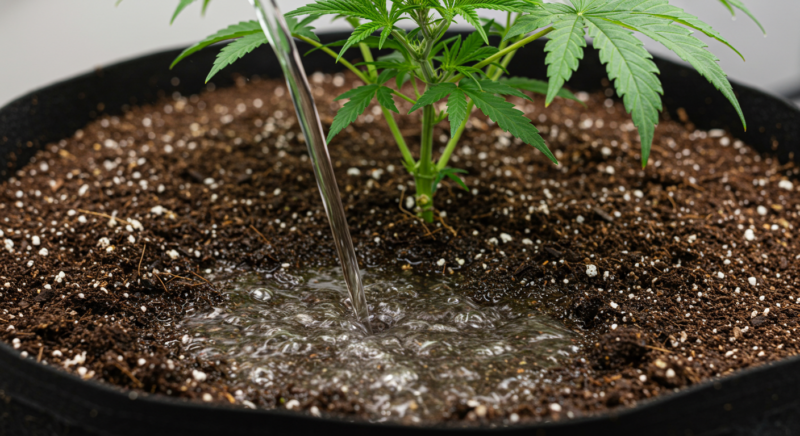
Start With Root-Zone Coverage, Not a Percentage of Pot Size
Rules such as watering one quarter of the container volume can be rough starting experiments, but they are not universal. Two five-gallon pots can hold very different amounts of water when one contains compact peat and the other contains coarse coco-perlite. A small transplant and a root-filled flowering plant also use that stored water at different rates.
For an established plant in a draining container, apply water slowly until the root ball is evenly wetted and the drainage behavior matches the system. Measure the input. If runoff begins almost immediately, investigate channeling before adding more. If no drainage appears after a large volume and the pot remains heavy for many days, inspect compaction, blocked holes, container size, and root health.
Remember: Thorough watering describes coverage of the active root zone. It does not mean drowning every empty section of an oversized container.
Should You Water Until Runoff?
Runoff is a tool, not a universal ritual. In coco and mineral-fed drain-to-waste systems, planned drainage can help maintain even wetting and manage accumulated salts. In a well-managed living soil container, routinely washing large volumes through the pot may waste nutrients and disrupt the moisture stability the biology needs. Outdoor ground soil may have no measurable container runoff at all.
When runoff is part of the program, record input volume and collected drainage. Do not chase an exact percentage without considering media, root-zone EC trends, water quality, and plant response. A little drainage does not prove that every part of the root ball was wetted, and a lot of drainage can mean the application was too fast.
"Do I need 20 percent runoff every time I water?"
Question sent by: Noah Williams, via e-mail.
No universal runoff percentage fits every medium and nutrient program. Coco drain-to-waste often uses controlled leaching, while living soil may aim for minimal loss. Use root-zone EC, input quality, moisture distribution, and crop response to decide whether drainage is solving a real problem.
Why Overhead Sprinkling Is Different
Overhead irrigation can be useful for some outdoor crops and propagation systems, but it is difficult to measure per container and wets leaves and flowers. Water on dense flowers can raise disease risk, and splashing can move soil particles and pathogens. Indoor flowering plants are usually easier to manage when water is directed to the root zone.
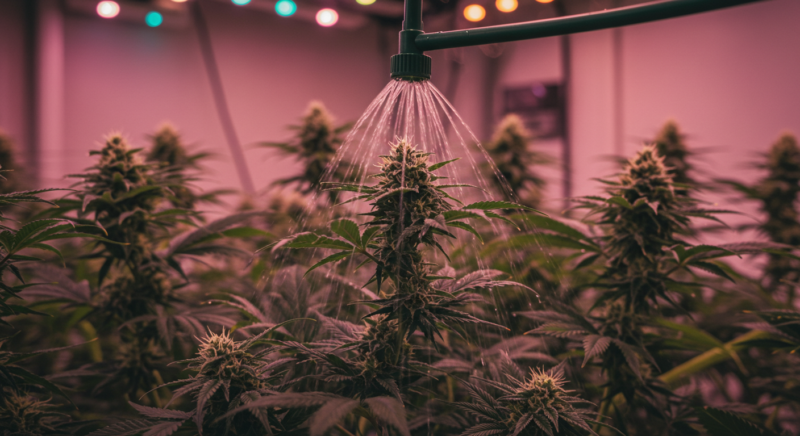
Direct routine irrigation to the root zone.
Measure what each container or bed receives and keep late-flower foliage dry whenever possible.
Use overhead spraying to cool a hot room.
Correct heat and airflow directly. Wetting foliage can add humidity and disease risk without fixing the environmental cause.
How Often Should You Water?
Frequency is the time required for the root zone to move from its post-irrigation moisture level to the next useful irrigation point. That time can shrink from several days to less than one day as roots fill the pot, leaf area expands, light increases, and the environment becomes warmer or drier.
| Variable | Usually dries faster | Usually dries slower | What to check |
|---|---|---|---|
| Plant | Large canopy, dense healthy roots, rapid growth | Seedling, recent transplant, damaged roots, small canopy | Daily water use and new growth |
| Environment | Higher light, warmth, low humidity, strong air movement | Cool conditions, high humidity, low light | Canopy temperature and room trends |
| Container | Small pot, breathable fabric, root-filled volume | Large pot, nonporous walls, oversized volume | Wet-to-dry weight change |
| Medium | Coarse, airy, fast-draining mix | Fine, compact, high water-holding mix | Moisture at the center and bottom |
| Outdoors | Sun, heat, wind, small containers | Cloud, cool weather, rain, protected ground | Forecast, soil depth, and drainage |
Growth Stage Changes Demand
Seedlings use little water because their roots and leaf area are small. Vegetative plants increase demand as the canopy expands. Stretch and early flowering can be a high-demand period, but late-flower demand does not always keep rising. Root health, cultivar, temperature, humidity, and leaf area still control water use.
Do not increase frequency simply because the calendar says flowering began. Watch how quickly the container loses weight and how the plant responds. A sudden drop in water use can be an early sign of root trouble, environmental change, or plant damage.
"My flowering plant stopped drinking as fast. Should I keep the old schedule?"
Question sent by: Brooke Anderson, via e-mail.
No. Recheck root-zone moisture, temperature, humidity, light, drainage, roots, and plant health before the next irrigation. Lower demand means the previous schedule may now keep the pot wet too long. Find the cause instead of forcing the former volume into the container.
Indoor and Outdoor Frequency Are Not the Same
Indoor rooms can be stable, but fans, light intensity, pot size, and dehumidification can create high demand. Outdoor plants experience sun, wind, rain, changing day length, and heat waves. A pot in direct afternoon sun may dry much faster than the same pot in a controlled room, while a plant in native ground can access a far larger moisture reserve.
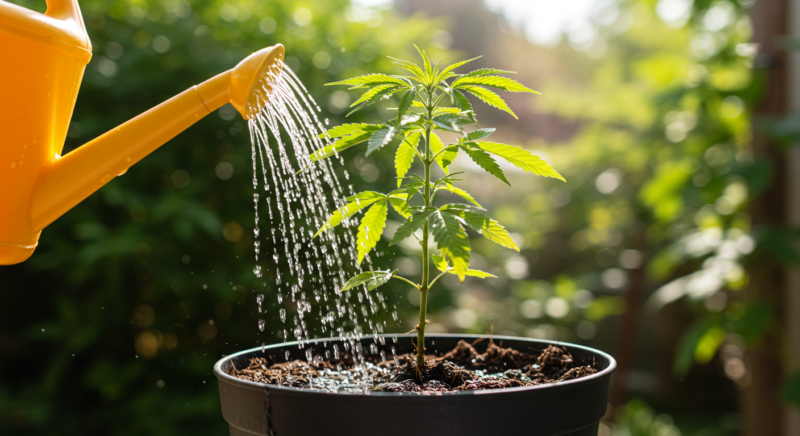
During extreme heat, inspect earlier than usual and protect the root zone from overheated surfaces. Do not respond to midday leaf droop with automatic flooding if the soil is already wet. Some plants temporarily reduce leaf angle under peak heat even when water is present.
What Is the Best Time of Day to Water?
In most soil and container gardens, watering early in the active light period gives the plant access to water as demand increases and allows surfaces to dry. Outdoors, morning irrigation reduces midday evaporation and avoids leaving foliage wet through a cool night. Indoor timing can be coordinated with lights-on, drainage access, and the needs of the chosen medium.
Fast-draining coco and rockwool systems may use several irrigations during the light period. Those events are part of a controlled fertigation strategy, not a rule for soil. Avoid large, unnecessary irrigations immediately before a cool dark period when uptake falls and the medium may remain saturated.
Advice: Choose a watering time that lets you observe drainage and plant response. A perfect schedule that nobody can inspect is not a reliable schedule.
Watering by Growing Medium
The medium decides how water is stored, how quickly it moves, and how much air remains after drainage. This is the point where simplified advice often becomes confusing: "let it dry" may be useful for one soil container and damaging in a small, mineral-fed coco pot.
| System | Watering pattern | Useful signal | Common mistake |
|---|---|---|---|
| Potting soil | Thorough irrigation followed by a meaningful dry-down | Pot weight plus moisture at depth | Small daily sips that leave dry pockets |
| Living soil | Relatively stable moisture with minimal severe drying | Bed or pot moisture trend across several points | Repeated heavy runoff or bone-dry cycles |
| Coco coir | Frequent, evenly distributed fertigation as roots establish | Input, drainage, EC trend, and daily water use | Treating coco like dense soil |
| Peat soilless mix | Depends strongly on particle size, amendments, and root density | Weight and center moisture | Letting peat become hydrophobic |
| Rockwool | Small controlled events with monitored water content | Slab or block weight, sensor, drainage EC | Keeping the block fully saturated |
| Deep water culture | Roots remain in aerated nutrient solution | Water level, oxygenation, temperature, root condition | Calling reservoir problems "overwatering" without checking oxygen |
| Outdoor ground | Deep irrigation matched to soil texture and weather | Moisture below the surface and root-zone depth | Frequent shallow sprinkling |
Soil and Peat-Based Potting Mixes
Water slowly and evenly, then allow enough moisture use for air to return. The exact dry-down depends on texture, compaction, pot height, root density, and amendments. Do not use only the surface color. A fine mix can remain wet near the bottom long after the top looks dry.
Living Soil
Living soil biology functions best with relatively stable moisture. Repeated bone-dry cycles can reduce microbial activity and make peat difficult to rewet, while saturation reduces oxygen. Large beds often benefit from several moisture observations, because edges, corners, and the center dry at different rates.
Coco Coir
Coco is usually managed as a soilless hydroponic substrate. Once roots are established, frequent fertigation can maintain nutrient balance and stable moisture without suffocating roots, provided the mix has good structure and drainage. Letting a small coco pot become severely dry can concentrate salts and create sharp EC changes.
"Should coco dry out like soil before I feed again?"
Question sent by: Mateo Ruiz, via e-mail.
Usually no. Established coco is commonly fertigated more frequently to keep moisture and root-zone EC stable. The correct interval depends on pot size, root density, coco texture, environment, and drainage. A fresh transplant still needs careful volume because its roots have not occupied the full container.
Hydroponic Reservoir Systems
In deep water culture, roots are intentionally submerged. The problem is not water itself; it is low dissolved oxygen, unsuitable solution temperature, pathogens, poor circulation, or nutrient chemistry. Monitor reservoir level, aeration, temperature, pH, EC, and root appearance. Do not diagnose hydroponic root stress using soil watering rules.
Fertigation means applying dissolved nutrients through irrigation water.
In coco, rockwool, drip systems, and many hydroponic systems, watering and feeding are parts of the same root-zone event.
Water Quality Essentials
Water can look clean while carrying dissolved salts, bicarbonate, sodium, chloride, calcium, magnesium, or contaminants that affect the root zone. You do not need to become a water chemist before the first irrigation, but you should know the source and establish a baseline.
Tap Water
Many growers can use tap water successfully. Obtain a municipal report when available and measure source EC. Alkalinity is especially useful because it describes how strongly the water resists pH change over time. Source pH alone does not tell you how the water will behave in the medium.
Chlorine may dissipate from an open container, but chloramine is more persistent. Do not assume that leaving water out overnight removes every disinfectant. If a biologically active system appears sensitive, identify what the utility uses and choose a suitable treatment method rather than relying on a timer.
Reverse Osmosis and Very Low-Mineral Water
Reverse osmosis water gives the grower control over the starting solution, but it has little buffering and contributes few minerals. It may require a nutrient program designed for low-mineral water. It also creates reject water and requires filter maintenance. RO is a tool for a measured water-quality problem, not an automatic upgrade for every garden.
pH, EC, and Alkalinity
pH affects nutrient availability, EC estimates the total ionic concentration, and alkalinity influences how the pH behaves after irrigation. Measure the final mixed solution when nutrients or amendments are used. Soil, coco, and hydroponic systems do not share one universal pH target, so follow the range appropriate to the medium and program rather than correcting every source to the same number.
"Do I need to let tap water sit for 24 hours?"
Question sent by: Lauren Kim, via Facebook page.
Not as a universal rule. First identify whether the supply uses free chlorine or chloramine and whether either is creating a real problem in your system. Standing can reduce free chlorine under some conditions, but it is unreliable for chloramine. Test the source and use treatment that matches the actual disinfectant.
Water Temperature
Use water near the root-zone temperature rather than very hot or ice-cold water. Large temperature shocks can slow root function and alter dissolved oxygen. In reservoirs, warmer water generally holds less oxygen and can favor biological problems, so solution temperature and aeration belong in the same inspection.
Important: Change one major water variable at a time. Switching source, nutrient strength, pH method, and watering frequency together makes the plant response impossible to interpret.
Overwatering and Underwatering: How to Tell the Difference
Both problems can make leaves droop, so the leaf shape alone is not enough. The diagnosis begins with the medium: is it wet or dry at root depth, how heavy is the container, when was it last irrigated, and how quickly has water use changed?
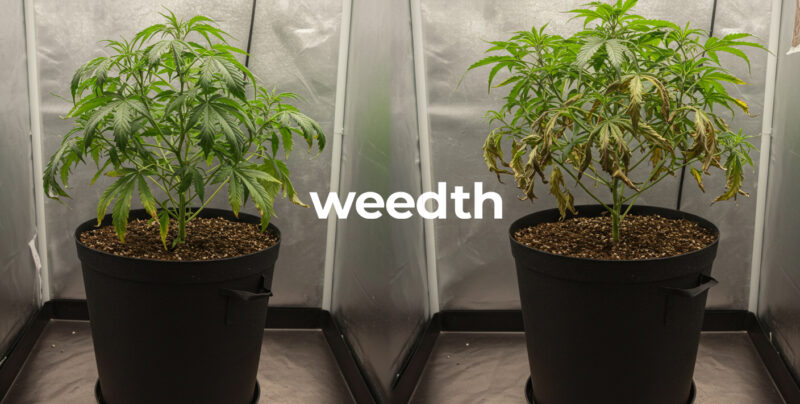
| Observation | Overwatering more likely | Underwatering more likely | Confirm before acting |
|---|---|---|---|
| Container | Heavy for too long | Very light | Compare with a known wet and drying weight |
| Medium | Wet or saturated at depth | Dry, shrunken, or water-repellent | Check center, edge, and lower zone |
| Leaves | Droop with firm or swollen appearance; yellowing may develop | Thin, limp droop; dry margins in advanced cases | Observe before and after a correct irrigation |
| Roots | Low oxygen, brown tissue, odor, slow new growth | Dry fine roots, stalled tips | Inspect only when accessible without major damage |
| Response | Does not improve from more water | Often improves after even rehydration | Allow time and avoid repeated corrections |
Signs of Overwatering
Overwatering is a root-zone condition, not simply a large volume. It develops when water is supplied more frequently than the plant and medium can use or drain it, leaving too little air for too long. Cool temperatures, low light, high humidity, oversized pots, compaction, blocked drainage, and poor root health can all make the same schedule become excessive.
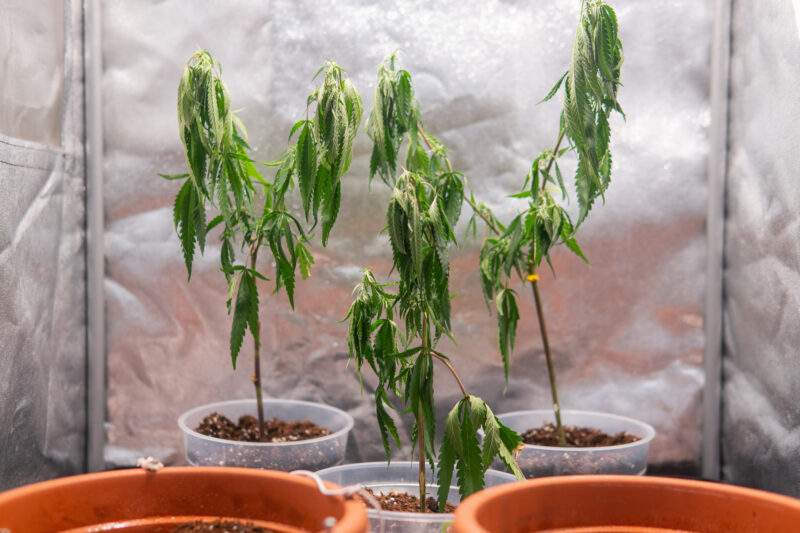
- The pot stays heavy: little weight is lost between checks.
- Droop continues in wet medium: leaves do not recover because roots lack oxygen or are damaged.
- Growth slows: new leaves remain small and the plant uses less water.
- Lower leaves yellow: root stress can limit nutrient uptake, but yellowing alone is not proof.
- Edema or swelling appears: cells take up water faster than leaves release it under some conditions.
- Roots darken or smell: severe cases may involve root decay and pathogens.
How to Help an Overwatered Plant
Stop adding water until the root zone reaches a safer moisture level, but do not force-dry it with extreme heat. Empty standing runoff, confirm drainage holes are open, improve gentle air movement around the container, and bring temperature and humidity into an appropriate range. Reduce the next irrigation volume or frequency based on the actual root zone.
Do not add extra nutrients to correct yellow leaves while the medium is saturated. Roots must recover before the plant can respond predictably. If the medium is compact, sour-smelling, or structurally unsuitable, careful transplanting into an appropriate mix may be necessary, but transplant stress can worsen a weak plant. Use it when the root-zone problem cannot be corrected in place.
Do not keep testing an overwatered plant with more water.
Repeated "small rescue drinks" extend oxygen stress. Confirm moisture at depth and wait for evidence that the root zone is ready.
"Can I point a fan at the pot to fix overwatering?"
Question sent by: Ethan Moore, via e-mail.
Gentle room circulation can support normal evaporation, but a strong fan blasting the medium can dry the surface while the center stays saturated. Correct the irrigation interval, drainage, temperature, humidity, and medium structure. Airflow is support, not the main cure.
Signs of Underwatering
Underwatering occurs when roots cannot access enough water to match plant demand. The pot is usually light and the medium is dry at depth. Leaves may become thin and limp, growth slows, and advanced stress can produce dry margins or damaged fine roots.
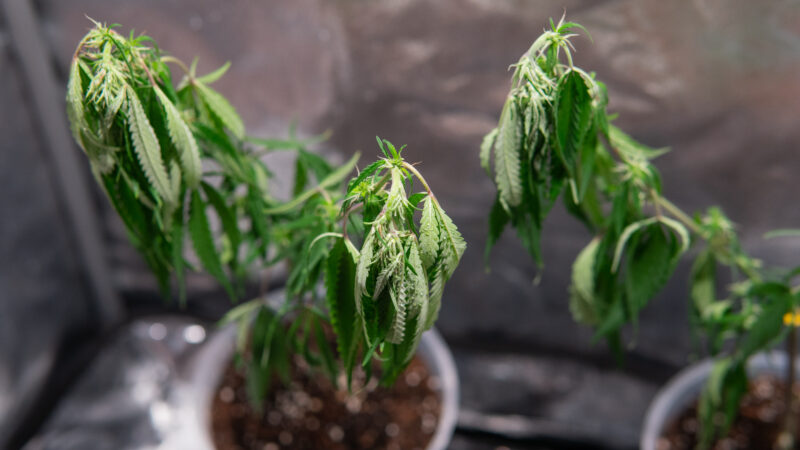
Dry medium can shrink away from the pot wall and become difficult to rewet. When water is finally applied, it may run around the root ball. Rehydrate in slow stages, waiting between passes, until moisture spreads through the root zone. Remove drainage after the pot finishes dripping.
How to Help an Underwatered Plant
Water gradually and evenly. If the medium is extremely dry, use several small passes instead of one fast flood. A severely wilted plant may recover posture within hours, but damaged leaves and roots may not return to their previous condition. Resume a measured cycle rather than watering again simply because the plant was recently stressed.
"My plant stood up after watering. Does that prove it was underwatered?"
Question sent by: MapleRoom, via X.
It is strong evidence when the pot was light, the root zone was dry, and the recovery followed even irrigation. Record how long recovery took and adjust the next trigger. Do not use repeated wilt and recovery as the normal cycle, because chronic stress reduces growth.
Watering Problems That Look Like Nutrient Deficiencies
Water controls nutrient movement and root function, so watering mistakes often create yellowing, burnt margins, weak growth, or twisted new leaves. Adding fertilizer without checking moisture can increase root-zone EC and make the problem worse.
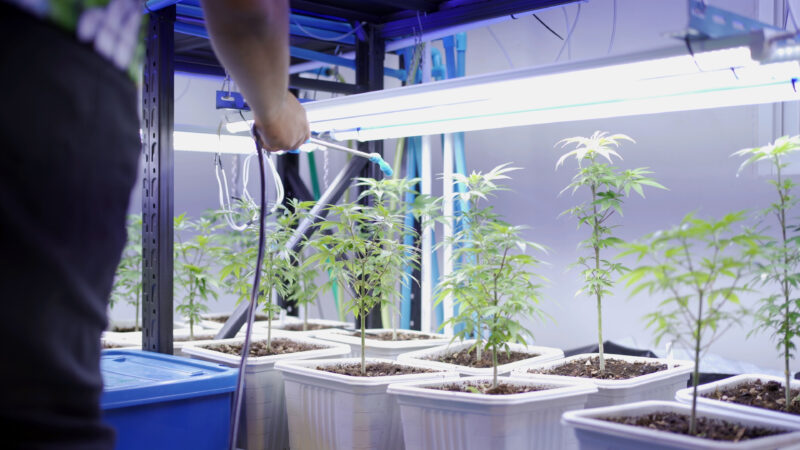
Check whether symptoms follow the wettest pots, the driest edge of a bed, one irrigation line, one cultivar, or one light zone. A pattern across the delivery system often tells you more than the color of a single leaf.
Check roots and water history first.
Review pot weight, moisture at depth, input volume, drainage, pH, EC, temperature, and recent environmental changes.
Treat every yellow leaf with fertilizer.
A saturated or damaged root system may contain nutrients it cannot absorb. Stronger feed can raise salinity without restoring uptake.
Build a Watering Record You Can Actually Use
You do not need complicated software. A notebook or simple spreadsheet can reveal whether water use is increasing normally, whether one cultivar needs a separate zone, and whether a change improved the cycle.
- Date and time
- Plant or irrigation zone
- Input volume
- Plain water or nutrient solution
- Input pH and EC when relevant
- Drainage volume and EC when the system uses runoff data
- Container weight or moisture reading before irrigation
- Room temperature, humidity, and major weather changes
- Plant response and time to the next irrigation
After several cycles, look for trends rather than isolated numbers. A healthy plant often uses more water as it grows, then changes demand with pruning, transplanting, flowering progression, or environment. A sudden unexplained decline deserves inspection before the schedule is repeated.
Field Advice: Record exceptions. The one pot that always dries early may have a smaller container, warmer position, larger canopy, damaged emitter, or different root structure.
Common Watering Questions
These are the questions that usually appear after the first few irrigation cycles. The answers are short, but each one still depends on the medium and root zone you are managing.
Can I Use Distilled Water for Cannabis?
You can, but distilled water contains very little mineral content and buffering. It does not automatically improve plant health. Use a nutrient and pH strategy designed for low-mineral water, and compare the cost and handling with tested tap or filtered water.
Should I Mist Cannabis Leaves Every Day?
No. Established plants obtain routine water through roots. Daily misting can raise humidity, leave residues, and increase disease risk, especially in dense flowers. Foliar applications should have a specific purpose, suitable product, correct timing, and good drying conditions.
Should Water Come Out of Every Drainage Hole?
Drainage should be open and the root ball should wet evenly, but water may not exit every hole at the same moment. Check for blocked outlets and tilt-free placement. The important result is uniform wetting followed by effective drainage, not a visual performance from each hole.
Can I Reuse Runoff?
Drain-to-waste runoff may contain imbalanced nutrients, salts, organic debris, and pathogens. Reuse belongs to a designed recirculating system with filtration, sanitation, testing, and recipe correction. Do not pour mixed saucer runoff from stressed plants back across a healthy garden.
"Is bottom watering better than watering from the top?"
Question sent by: Daniel Foster, via e-mail.
Bottom watering can help small containers absorb moisture evenly, but it can also leave salts near the surface and makes input volume harder to judge. Use it for a defined reason and allow the pot to drain. Established mineral-fed containers often benefit from measured top irrigation and planned drainage.
Do Fabric Pots Prevent Overwatering?
Fabric walls improve gas exchange and can speed drying, but they do not make overwatering impossible. A compact medium, oversized container, standing runoff, cool room, or excessive frequency can still keep the center wet. Fabric pots also dry faster at the edges, so apply water evenly.
Can I Water With Ice Cubes?
Avoid it. Ice creates a cold, uneven wetting pattern and provides little control over root-zone coverage. Use measured water near the root-zone temperature.
Does Drooping Always Mean the Plant Needs Water?
No. Heat stress, high light, root disease, saturation, transplant shock, stem damage, pests, and the normal day-night leaf rhythm can all change posture. Check the medium and recent history before irrigating.
How Long Should a Pot Stay Wet?
There is no universal number of days. It should stay moist long enough to supply the plant, then lose water at a rate that restores air without reaching severe drought. If an established plant in active growth remains very heavy for many days, inspect pot size, medium structure, drainage, roots, and environment.
"Should every plant in one tent receive the same amount?"
Question sent by: Sophie Tremblay, via Facebook page.
Only if their pot size, medium, root development, canopy, cultivar behavior, and environment produce similar demand. Group similar plants where possible. When one plant consistently differs, water it separately or investigate why.
A Repeatable Watering Routine
We can now turn the whole guide into a routine. The goal is not to remove judgment; it is to make your judgment consistent enough that you can learn from each cycle.
Before, During, and After Every Irrigation
- Confirm the root zone is ready using weight and moisture at depth.
- Check the plant, environment, and recent water-use trend.
- Use the correct water source and finished-solution measurements.
- Apply slowly across the active root zone.
- Pause when dry media needs time to absorb the first pass.
- Watch for channeling, blocked drainage, leaks, and uneven emitters.
- Use runoff only when it serves the medium and nutrient program.
- Remove standing drainage from ordinary saucers.
- Record input, drainage, and time to the next irrigation.
- Change one major variable at a time.
Let the Root Zone Set the Schedule
A good watering practice becomes quiet. The container loses weight predictably, the medium wets evenly, roots receive both moisture and air, and the plant reaches the next irrigation without emergency wilt or prolonged saturation. You stop guessing because the same signals keep telling the same story.
Begin with one healthy reference plant, measure what you apply, and learn how the root zone changes from wet to ready. As the plant grows, adjust the amount and frequency from evidence. That single habit will prevent more avoidable watering problems than any perfect-looking calendar.