What Is a Cannabis Strain?
Before You Start
Is This Guide Right for You?
This guide separates useful plant identity from label hype by explaining strains, cultivars, chemovars, genotype, phenotype, cannabinoids, terpenes, and why the same name does not guarantee the same plant.
If cultivation itself is still new, start with Grow Basics. If you are ready to turn a seed or cutting into a plant after choosing genetics, continue with Planting and Germination.
A cannabis strain is a named plant lineage or population associated with a recognizable set of inherited traits. Those traits may include plant structure, flowering behavior, cannabinoid potential, aroma, resin production, color, resistance to stress, and the kind of experience people commonly report from the finished product.
That definition is useful, but it needs one immediate qualification: a strain name is not a complete genetic certificate, chemical analysis, cultivation record, or guarantee of effects. It is a starting point for identifying cannabis, not the final proof of what a particular seed, plant, harvest, or product will be.
This is why a familiar name can produce conflicting descriptions. Two seeds from one pack can grow into noticeably different plants. Two producers can sell flower under the same name with different aromas and laboratory results. Even clones of one selected plant can finish differently when light, root-zone conditions, harvest timing, drying, and storage change.
The word “strain” is therefore both valuable and imperfect. It helps people discuss ancestry and expected characteristics, but it often carries more confidence than the available evidence supports. To use strain information intelligently, you need to separate the name from the genetics, the genetics from their expression, and the living plant from the finished product.
This guide explains that complete chain in plain language. It also shows growers and consumers how to evaluate strain descriptions without being misled by a famous name, an indica or sativa label, a high THC number, or an attractive seed catalog photograph.
A Practical Definition of a Cannabis Strain
In everyday cannabis language, a strain is a distinct named form of cannabis that has been selected, maintained, or marketed for particular characteristics. It may be preserved as a clone, reproduced as a seed population, or recreated through breeding from related parental lines.
The word can describe several different levels of consistency. At one end is a selected clone that traces back to one plant. Every genuine cutting from that plant starts with essentially the same genotype. At the other end is a loosely defined seed population sold under a familiar name even though its parents, breeding history, and uniformity are poorly documented. Both may be called strains, but they do not offer the same level of predictability.
A well-described strain may give useful expectations about:
- Plant height, branching, internode spacing, and stretch
- Flowering response and approximate finishing time
- Flower density, resin production, and aroma direction
- Potential cannabinoid ratios
- Common terpene patterns
- Sensitivity to heat, cold, humidity, drought, pests, or disease
- Likely variation within a seed population
- Suitability for indoor, outdoor, greenhouse, or container cultivation
- Reported subjective effects of particular tested batches
None of those traits should be interpreted as an unconditional promise. A genetic line may carry the potential for dense, aromatic flowers, for example, but poor root health, excessive heat, an early harvest, rough drying, or warm storage can prevent that potential from reaching the final jar.
Important: A strain name describes an expected family of traits. The actual plant and the actual batch provide the evidence.
“If the strain name is not proof, what should I put on my plant label?”
Question sent by: Reese Holloway, via email.
Keep the familiar strain name, but add the information that makes it traceable: source, seed or clone status, generation, seed lot when available, and an individual plant number. A label such as “Line Name, F2, lot 24B, plant 06” preserves the claim without pretending every sibling is identical.
Why the term remains useful
Cannabis has been selected by people for a very long time. Farmers, traditional communities, informal breeders, and modern breeding programs have all preserved plants that performed well for particular uses and environments. Names make those selections easier to discuss, compare, and pass on.
The term also reflects how the modern cannabis community developed. For much of recent history, prohibition prevented the kind of formal registration, transparent breeding records, certified seed production, and coordinated research seen in many legal crops. Informal names became the practical system for tracking plants through private collections, seed exchanges, and underground gardens.
The system is imperfect, but it contains real information when a name is supported by reliable provenance. The mistake is not using strain names. The mistake is assuming the name alone proves identity, purity, chemical composition, or effect.
Strain, Cultivar, Variety, Chemovar, Genotype, and Phenotype
Cannabis vocabulary becomes confusing because several related words are used as if they mean the same thing. They do not. Learning a few distinctions makes the rest of the subject far easier.
| Term | Plain-language meaning | What it helps describe | What it does not guarantee |
|---|---|---|---|
| Strain | The common cannabis term for a named lineage, population, or selected plant | Recognizable identity, ancestry, and expected traits | Formal registration, genetic uniformity, or consistent effects |
| Cultivar | A cultivated plant selection maintained for distinct traits | A deliberately selected and cultivated plant variety | That every commercially used cannabis name meets formal cultivar standards |
| Variety | A broad word for a distinct type; in formal botany it can have a specific taxonomic meaning | General differences within a species | A precise commercial or genetic identity when used casually |
| Chemotype | A category based mainly on chemical composition | THC-dominant, balanced THC:CBD, CBD-dominant, or another measured chemical pattern | Complete genetics, aroma, or subjective effects |
| Chemovar | A cultivated plant type discussed primarily through its chemical profile | A chemistry-centered alternative to relying on strain names | That one laboratory result represents every future batch |
| Genotype | The inherited genetic makeup of a plant | The range of traits a plant can potentially express | The exact appearance or performance in every environment |
| Phenotype | The observable expression produced by genetics interacting with environment | Height, color, aroma, flowering time, resin, yield, and other expressed traits | That two similar-looking plants are genetically identical |
| Batch | Material harvested and processed as one production lot | What the consumer actually receives at a particular time | That a later batch with the same name will be identical |
“Strain” and “cultivar” are not perfect synonyms
Cultivar is the more established horticultural term. It is formed from “cultivated variety” and refers to a plant selected and maintained because it has distinct characteristics. In formal use, cultivar naming follows rules that are much more disciplined than the informal naming system used across much of the cannabis market.
Many cannabis writers therefore prefer cultivar. That preference is reasonable, especially when discussing a documented plant selection. However, replacing every use of strain with cultivar does not automatically solve the identity problem. A loosely sourced product does not become genetically reliable merely because someone calls it a cultivar.
For reader clarity, this guide uses strain when discussing the familiar industry term and cultivar when horticultural precision matters. The practical question remains the same: what plant material is being identified, how was it maintained, and what evidence supports the name?
Chemotype and chemovar focus on chemistry
A strain name may imply aroma, potency, or effects, but a chemotype classification begins with measured chemistry. The simplest common framework groups cannabis by the relationship between THC and CBD:
- Type I: THC-dominant
- Type II: mixed or relatively balanced THC and CBD
- Type III: CBD-dominant with comparatively little THC
Some scientific systems extend the classification to additional types, including plants dominated by other cannabinoids or plants that produce very low total cannabinoid levels. For most readers, the first three types provide the clearest introduction.
Chemovar is often used when people want to describe a cultivated cannabis type by a broader chemical fingerprint, potentially including cannabinoids and terpenes. This approach can be more informative than an indica or sativa label, but it still has limits. Chemistry can vary across environments and batches, laboratories do not all test the same compounds in the same way, and a chemical profile alone does not fully predict an individual’s response.
Chemovar
A cultivated plant type grouped mainly by its measured chemical profile rather than by a familiar strain name or a broad indica-sativa label. A chemovar description is only as current as the sample and batch behind it.
Genotype is potential; phenotype is expression
The genotype is the inherited blueprint. It defines possibilities and constraints. A plant may inherit the capacity for strong lateral branching, purple pigmentation, a particular cannabinoid ratio, or a rapid flowering response.
The phenotype is what becomes observable when that genotype develops in a real environment. Light intensity, day length, root-zone oxygen, water availability, nutrition, temperature, humidity, pathogens, physical training, and plant age can all influence expression. Harvest and post-harvest handling then shape what remains in the final flower.
The familiar formula is useful:
Phenotype = genotype interacting with environment
It should not be interpreted to mean that the environment can create any trait from any plant. Cultivation cannot make a genotype express genetic potential it does not possess. It can help or hinder the expression of what is already possible.
This distinction explains two situations that appear contradictory:
- Two seeds from the same parents can differ because each seed contains a different combination of inherited alleles.
- Two clones with essentially the same genotype can differ because their environments, health, maturity, and handling were not identical.
Genotype × environment is a pattern, not a slogan
Growers often shorten the relationship to “genetics plus environment,” but the more useful idea is an interaction. An environmental change does not affect every genotype in the same way. One plant may tolerate warmer nights with little visible change, while another from the same seed population may stretch, lose aroma intensity, or become more vulnerable to disease under the same conditions.
This interaction is commonly written as G×E, meaning genotype by environment. It explains why a cultivar that appears stable in one room can show a wider range outdoors, and why rankings can change between locations. The plant that performs best in a dry, bright setting may not be the best performer in a cool, humid season.
Genotype × Environment (G×E)
The way different genotypes respond differently to environmental conditions. It is not simply that the environment changes plants. It means the same environmental change can produce a different response depending on the plant’s genetics.
For practical selection, this means a breeder’s or grower’s test environment is part of the result. Statements such as “handles humidity,” “finishes early,” or “stays compact” become more trustworthy when they are repeated across several plants, cycles, and relevant environments.
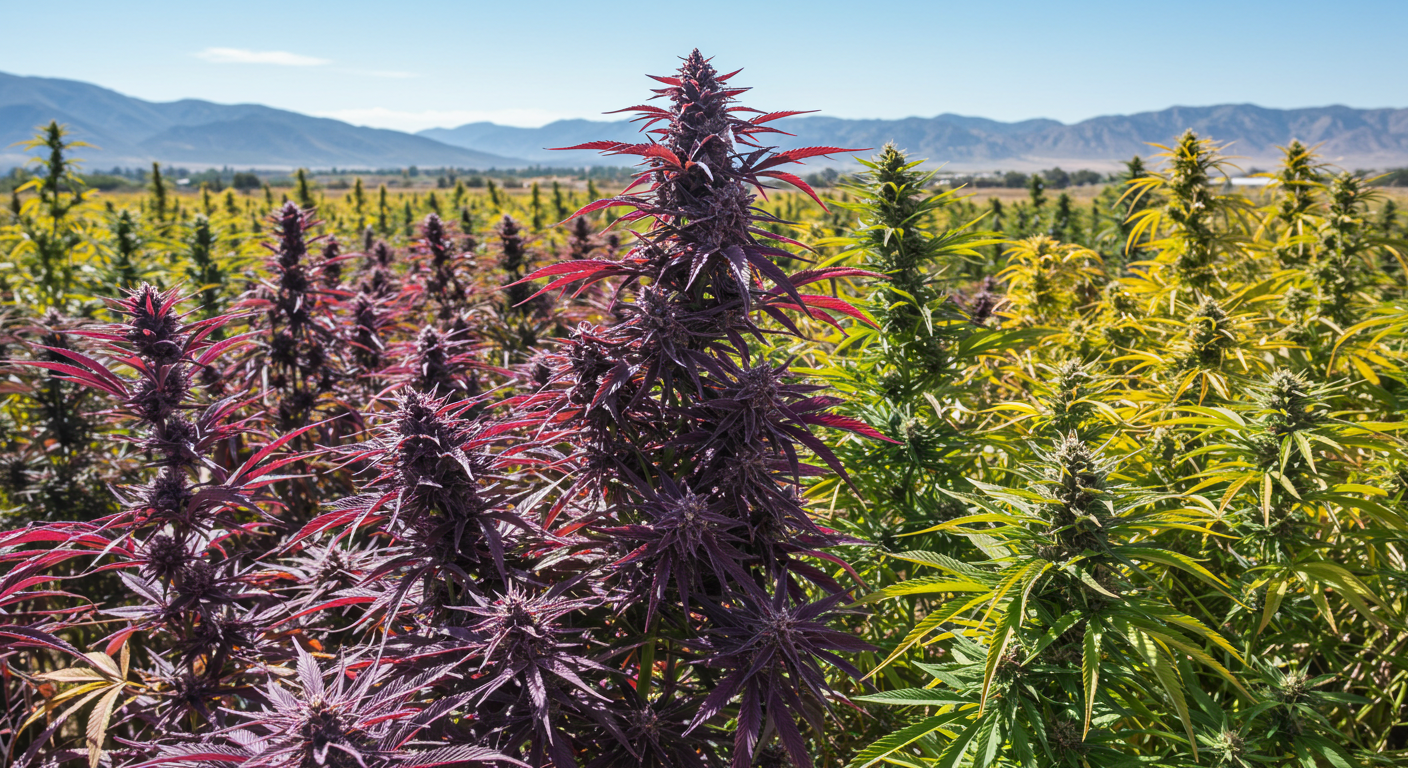
“Why does the same clone smell brighter outdoors but heavier and sweeter indoors?”
Question sent by: Kittisak, via contact form.
The clone begins with essentially the same genotype, but light spectrum, day and night temperature, root volume, airflow, plant stress, harvest timing, and drying conditions can all shift chemical expression and retention. The different aroma does not automatically mean one plant is mislabeled. Compare matched cuttings, take samples from similar flower positions, harvest at a comparable stage, and keep the drying process as consistent as possible before judging the genetic identity.
Remember: A strain description is most transferable when it tells you where, how, and across how many plants the traits were observed.
Cannabis Taxonomy Without the Usual Confusion
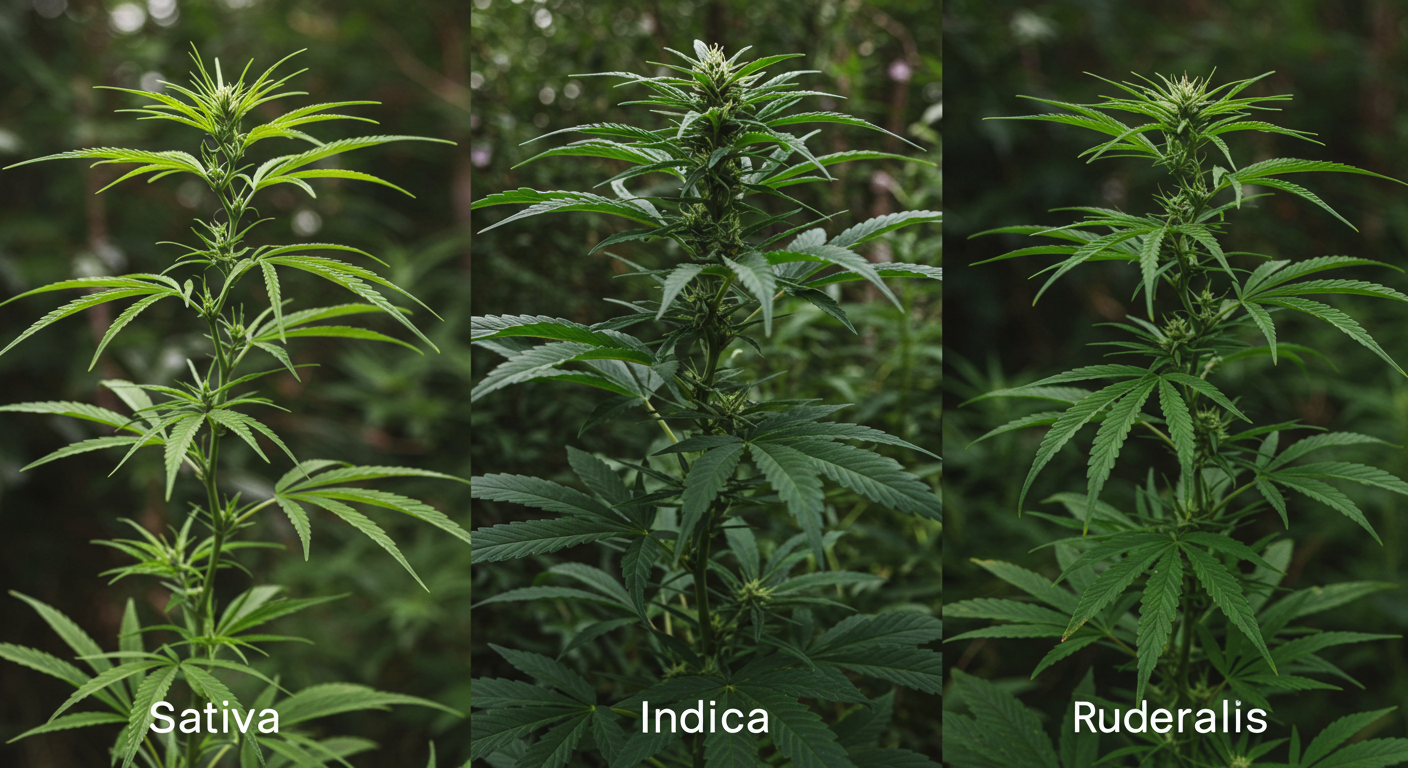
Cannabis is often introduced as three species: Cannabis sativa, Cannabis indica, and Cannabis ruderalis. That explanation is memorable, but it presents a debated subject as settled fact.
Many modern botanical and genomic references treat cannabis as a single, highly variable species, Cannabis sativa L., with different subspecies, populations, gene pools, cultivated groups, and vernacular categories. Other taxonomic treatments recognize more than one species. The debate reflects the plant’s long domestication, geographic spread, extensive crossbreeding, environmental plasticity, and the inconsistent use of old names.
For practical readers, two rules prevent most confusion:
- Formal botanical sativa and indica do not map neatly onto the retail labels “Sativa” and “Indica.”
- Commercial sativa, indica, and hybrid categories are not reliable shortcuts for predicting a specific effect.
What sativa and indica originally described
Historical botanical classifications tried to organize cannabis by geography, use, morphology, and chemical characteristics. Tall, narrow-leaf plants associated with some equatorial or warm-region populations became linked with “sativa” in cannabis culture. Shorter, broader-leaf plants associated with some Central and South Asian drug-type populations became linked with “indica.”
Those broad growth forms can still help describe architecture. A narrow-leaf plant with long internodes and strong flowering stretch may require different space and training than a compact broad-leaf plant with dense branching. Outdoor adaptation and finishing time can also differ among genetic populations.
The problem begins when plant form is converted into a universal effect prescription:
- Sativa equals energetic
- Indica equals sedating
- Hybrid equals a predictable middle point
Large genetic and chemical studies have not found those commercial labels to be dependable genome-wide or chemical classifications. Some terpene tendencies may be associated with particular labels, and historical population structure has not vanished completely, but modern labels are too inconsistent to carry the certainty often assigned to them.
This does not mean every reported difference is imaginary. It means the label combines ancestry, appearance, aroma, market convention, and user expectation in a way that makes precise prediction difficult.
“Why is my indica-labeled plant tall with narrow leaves?”
Question sent by: Bram De Smet, via Facebook page.
The retail label does not define one fixed morphology. Modern lines often contain mixed ancestry, and individual seedlings can express different combinations of height, leaflet width, branching, and stretch. Check the documented parents and observe flowering behavior instead of treating one broad label as a botanical diagnosis.
Where ruderalis and autoflowering fit
“Ruderalis” has been used for wild, feral, short-season, or day-neutral cannabis populations. In modern seed language, it is most strongly associated with autoflowering genetics.
Photoperiod-sensitive cannabis generally begins flowering in response to a sufficiently long and uninterrupted night, although the exact threshold varies by genotype. Autoflowering or day-neutral plants can initiate flowering with much less dependence on day length. This trait is valuable where seasons are short or where growers want a rapid, compact crop.
It is common to say that every autoflower is simply a drug-type plant crossed with Cannabis ruderalis. That is an oversimplification. Day-neutral flowering has a genetic basis, modern autoflowers have been selected through many generations, and research indicates that flowering-time control can involve more than one locus and more than one population history. “Autoflower” is best understood as a flowering trait and cultivation category, not a complete description of quality, potency, ancestry, or species identity.
Why most modern drug-type cannabis is hybridized
Repeated crossing has blended ancestry that was once more geographically separated. Breeders selected plants for potency, aroma, resin, compactness, stretch, color, flowering speed, stress response, and many other traits. Those hybrids were crossed again, often without public records or a formal registration system.
As a result, “hybrid” is technically accurate for a large share of modern commercial cannabis but not very informative on its own. A hybrid may be uniform or highly variable, tall or compact, THC-dominant or CBD-dominant, early or late flowering, delicate or resilient. The useful information comes from the actual parents, breeding method, selected traits, testing, and observed population.
What to Remember: Sativa, indica, hybrid, and autoflower can provide context. None of them replaces lineage, chemistry, batch information, and direct observation.
The Cannabis Identity Stack
Readers often ask one word, “What strain is this?”, to do the work of several separate questions. A more dependable approach is to examine cannabis as a stack of identities.
1. Lineage
Lineage is the recorded or claimed ancestry. It may name two parents in a direct cross, describe several generations of breeding, or trace a selected clone back through a known community. Good lineage information explains where the plant came from and how the current form relates to its parents.
Lineage is valuable, but a family tree is not proof that every offspring expresses the same traits. The reliability of that tree also depends on accurate records and authentic parent material.
Provenance
The documented history of where plant material came from, who maintained it, and how it moved from its earlier source to the present holder. Provenance supports an identity claim, but it does not replace observation, health screening, or batch testing.
2. Seed population or clone
The next question is how the genetic material is being maintained.
A seed population contains sexually produced individuals. Each seed receives a combination of genetic material from its parent or parents. The population may be highly uniform if it was created from carefully developed parental lines, or widely variable if it came from a recent polyhybrid cross or poorly controlled pollination.
A clone is a vegetative cutting from one selected plant. Properly maintained clones begin as essentially the same genotype as the donor plant. This can greatly improve crop uniformity, although plant health, pathogens, accumulated mutations, epigenetic state, and environment can still affect performance.
3. Genotype
The genotype belongs to the individual plant. Two seed siblings do not normally have identical genotypes. A clone line, by contrast, is used to preserve one chosen genotype.
Knowing the genotype would be ideal, but most home growers and consumers do not have complete genomic data. They work with provenance, breeding records, clone history, repeated observation, and chemical testing as practical substitutes.
4. Phenotype
The phenotype is the expressed plant. It includes visible structure and measurable performance, but it is broader than appearance. Flowering time, aroma, resin output, cannabinoid concentration, response to drought, nutrient demand, and susceptibility to disease can all be phenotypic traits.
Growers often use “pheno” as shorthand for an individual seed-grown plant with a particular combination of desirable traits. A pheno-hunt is the process of growing multiple individuals from a population, evaluating them, and selecting one or more keepers.
5. Chemical profile
The chemical identity includes cannabinoids, terpenes, and other metabolites present in a sample. It is closer to what a consumer actually encounters than ancestry percentages alone.
One result is still a snapshot. Chemistry can change with plant maturity, sampling location, cultivation, processing, storage, and analytical method. A result from one harvest should not be silently applied to every future harvest bearing the same name.
6. Batch
A batch is a specific harvested and processed lot. This level matters because consumers do not inhale a family tree or a seed catalog description. They interact with a batch that has its own potency, aroma, moisture level, cleanliness, age, and storage history.
Batch identity also matters to growers evaluating their own work. A successful first run does not prove that every later run will match it unless the genotype, environment, harvest window, drying process, and storage remain controlled.
7. Finished product
Flower, dry sift, rosin, distillate, and edibles are not interchangeable expressions of a strain. Processing can concentrate some compounds, remove others, introduce carriers, combine batches, or transform how dose is delivered. A strain name on an edible may reveal far less than the measured dose and formulation.
8. Individual response
The final layer is the person. Dose, tolerance, previous experience, route of administration, food intake, mood, setting, sleep, medications, and individual biology can influence the experience. Expectations created by a label may also shape how effects are noticed and described.
This is why no responsible strain guide can promise that a named product will make every person creative, sleepy, social, focused, or free from a symptom.
| Identity layer | Best question to ask |
|---|---|
| Lineage | What ancestry is claimed, and how well is it documented? |
| Seed or clone | Is this a population of individuals or one preserved genotype? |
| Genotype | What inherited potential does this individual carry? |
| Phenotype | What traits did it actually express in this environment? |
| Chemical profile | What compounds were measured in this sample? |
| Batch | When, where, and how was this material produced and handled? |
| Product | How did processing and dose change what reaches the user? |
| Individual response | How does this person respond under these conditions? |
The identity stack is the central reason strain conversations become confusing. Different people may be using the same name while talking about different layers.
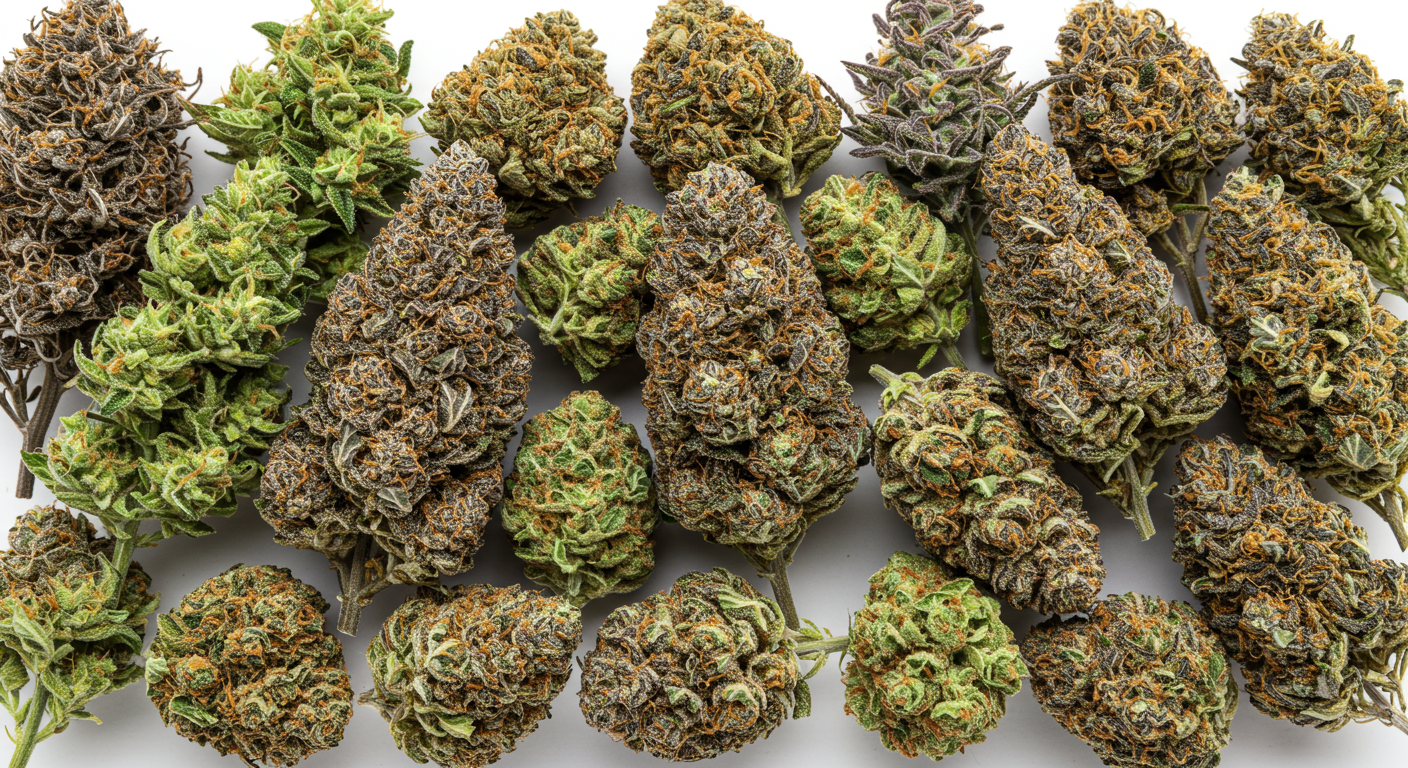
Important: When two people disagree about a strain, first check whether one is discussing ancestry, another a seed population, and another a particular retail batch.
What Actually Makes One Strain Different From Another?
A meaningful strain distinction is not based on one trait. It emerges from a repeatable combination of inherited characteristics, even though individual plants and batches can vary around that general pattern.
Growth architecture
Plant architecture affects how a cultivar fits a space and responds to training. Relevant traits include:
- Overall height and width
- Apical dominance
- Lateral branching
- Internode length
- Stem strength
- Leaflet width and canopy density
- Flowering stretch
- Root vigor
- Response to pruning, topping, bending, or trellising
These differences have practical consequences. A cultivar that triples in height after flowering begins can overwhelm a low indoor room. A compact plant with dense internal growth may fit the room but require careful thinning and airflow. A heavy-flowering branch may need support even if the plant remains short.
Architecture should be treated as a range rather than a fixed measurement. Container size, root restriction, light, plant age, training, and health all affect final size.
Flowering behavior
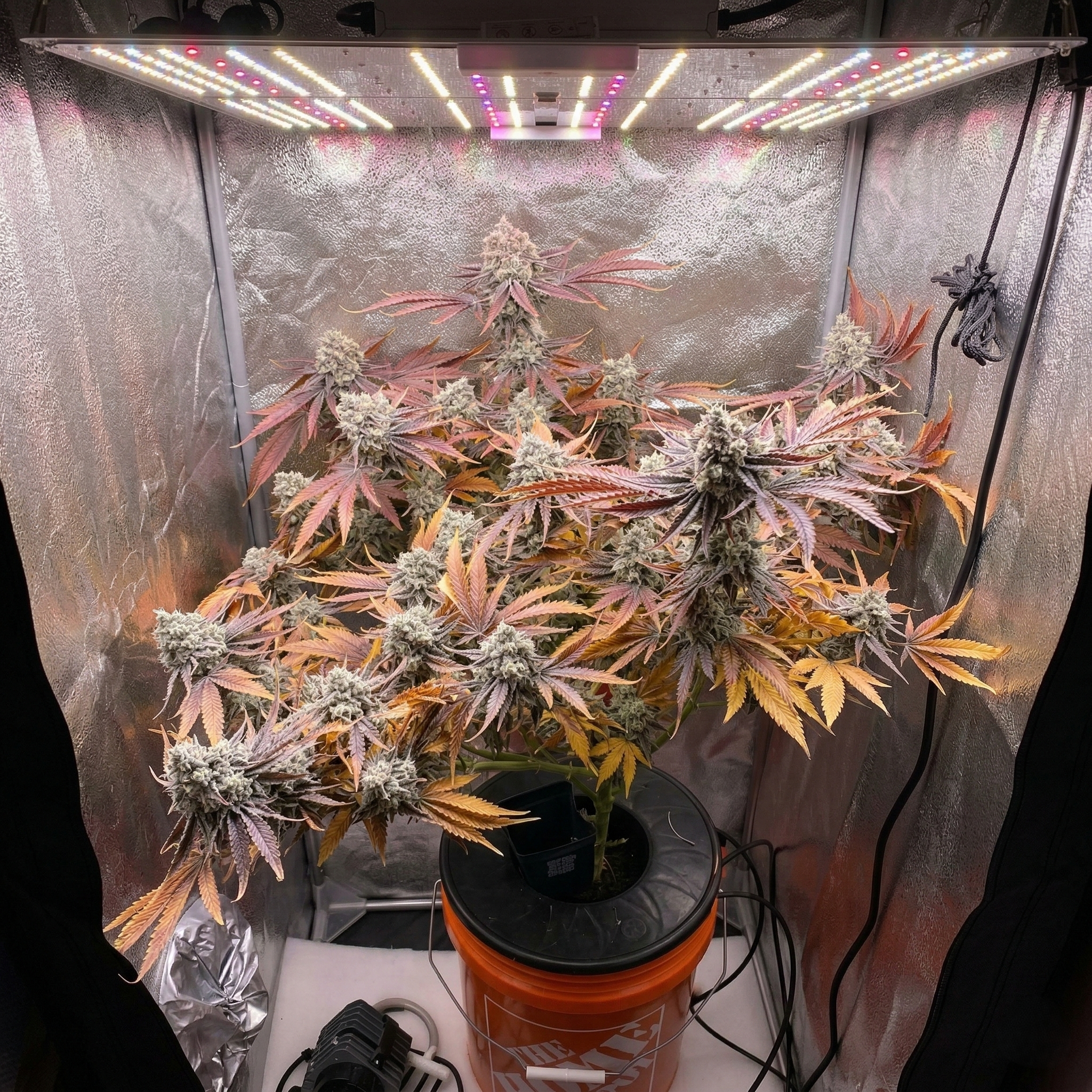
Genetics influences when a plant becomes capable of flowering, how strongly it responds to day length, how quickly flowers develop, and when they mature. Seed descriptions often reduce this to a single number of weeks, but flowering time depends on how the breeder counted, which phenotype was observed, and the environment used for testing.
Outdoor timing is even more complex. A plant advertised as “eight weeks” indoors does not automatically finish on the same calendar date at every latitude. The local pattern of day length, temperature, rain, frost, and plant maturity all matter.
Autoflowering adds another model. The transition is driven more strongly by age and internal flowering signals than by a strict short-day schedule. That can reduce scheduling control because severe early stress consumes a larger share of the plant’s limited vegetative period.
Cannabinoid potential
Genetics strongly influences whether a plant tends toward THC dominance, CBD dominance, a mixed ratio, or another cannabinoid pattern. Genes involved in cannabinoid biosynthesis create meaningful biological differences among cultivars.
The advertised percentage is less dependable than the general chemical direction. A seed does not contain a fixed THC score waiting to be unlocked. Potency is measured in harvested material, and the result depends on genotype, environment, flower maturity, sampling, processing, and laboratory method.
This is why a range based on multiple batches and multiple plants is more useful than one exceptional test result.
Aroma and terpene expression
Genetics also influences which terpene synthase genes and metabolic pathways are available. This helps create recurring aroma families such as citrus, floral, pine, spice, fruit, earth, fuel, or fermented notes.
Aroma remains highly sensitive to expression and preservation. Heat can increase volatile loss. Harvest timing changes the mature profile. Slow or poorly controlled drying can either preserve complexity or flatten it. Warm storage and repeated air exposure can reduce fresh top notes. Microbial contamination or excess moisture can add odors that have nothing to do with the intended cultivar.
Strain aroma is therefore a combined result of genetic potential, cultivation, maturity, post-harvest handling, and age.
Flower form, resin, and quality potential
Cultivars can differ in flower density, calyx-to-leaf ratio, trichome coverage, resin texture, color, and the physical arrangement of the inflorescence. These traits affect trimming, drying behavior, mold risk, bag appeal, and suitability for different forms of processing.
Dense flowers are not automatically superior. They can be desirable for appearance and handling but may trap moisture in humid conditions. Airier flowers can be better adapted to wet climates and can still deliver excellent aroma, resin, and experience.
Likewise, visible frost is not a complete quality measurement. Trichome density matters, but so do trichome maturity, gland condition, chemical composition, contamination, dryness, aroma, flavor, and storage.
“Does purple color prove that a plant is the strain named on the pack?”
Question sent by: Mika, via Instagram.
No. Purple pigmentation can be influenced by genetics, maturity, temperature, nutrition, and stress, and many unrelated lines can show it. Color can be a recorded phenotype trait, but it cannot authenticate lineage or establish potency by itself.
Environmental adaptation and stress response
Plants differ in their tolerance of heat, cool nights, humidity, drought, root restriction, salinity, pathogens, and pests. A cultivar that performs beautifully in a dry controlled room may struggle outdoors where nights are damp. A vigorous outdoor plant may become unmanageable in a small tent.
The best strain is therefore always conditional. It is the strain whose characteristics fit the goal, environment, skill level, and acceptable risk.
Remember: A visible trait becomes useful strain evidence only when it repeats with the expected lineage, population, environment, and supporting records.
How Cannabis Strains Are Created and Maintained
New strains do not appear because two famous names were placed on a package. A meaningful new line requires parent selection, controlled reproduction, evaluation, and a decision about how the result will be maintained.
Local populations and landraces
Before modern seed catalogs, cannabis populations adapted to local regions under a combination of climate, human use, farmer selection, and natural reproduction. These locally adapted populations are often called landraces.
A landrace is not one genetically identical plant. It is usually a variable population connected to a place, farming tradition, and history. Its internal diversity may be part of its value because diversity allows a population to respond to changing conditions.
The word is frequently used too loosely. A modern seed line with distant ancestry from a region is not automatically a preserved landrace. A seed collected in a particular country is not automatically representative of a long-established local population. Claims of purity should be supported by collection history, stewardship, population size, and protection from recent introgression.
Landrace also does not mean universally better. A locally adapted population may carry valuable aroma, resistance, or architecture, but it may flower too late, grow too tall, produce an unsuitable cannabinoid profile, or show too much variation for a particular controlled setup.
Selecting parents and making a cross
In a conventional cross, pollen from one parent fertilizes flowers on another parent. Each resulting seed inherits genetic material from both. The offspring population may express different combinations of parental traits.
A breeder then evaluates individuals for the breeding goal. Selection might prioritize:
- A defined cannabinoid ratio
- Aroma quality and stability
- Resin production
- Plant architecture
- Flowering speed
- Yield under a stated environment
- Resistance to a specific disease or stress
- Reduced sensitivity to intersex expression
- Seed production and germination
- Uniformity across the population
Selection should continue across enough plants, generations, and environments to show that the desired traits are heritable rather than one-time accidents. A beautiful individual can be worth preserving as a clone, but one outstanding plant does not prove that its seed siblings or offspring will reproduce the same combination.
F1 does not always mean the same thing in cannabis marketing
F1 means first filial generation, the first generation produced from a particular parental cross. In formal hybrid breeding, an F1 created from well-developed, genetically distinct inbred parent lines can be highly uniform and may show hybrid vigor.
Cannabis catalogs sometimes use F1 more casually for any first cross between two named parents, even when both parents are heterozygous polyhybrids. Such offspring can show substantial variation. The F1 label accurately describes generation, but it does not by itself prove uniformity, stability, vigor, or quality.
Useful questions are:
- Were the parents fixed or highly variable?
- Were individual parents selected clones or seed populations?
- How many offspring were tested?
- Were traits evaluated across more than one environment?
- Is the seller describing the average, the range, or only a selected example?
Why F2 populations often show more visible variation
When F1 individuals are crossed with each other or selfed, alleles can recombine and segregate in new combinations in the F2 generation. Traits that appeared hidden or paired in the first generation can separate. Growers may see a wider range of height, aroma, flowering time, color, and other characteristics.
That diversity is useful to breeders and pheno-hunters searching for unusual combinations. It is less convenient for growers who need a uniform canopy and a synchronized harvest.
Later generation labels such as F3, F4, or F5 show the number of filial steps, but the number alone does not prove that selection was competent or that the line is uniform. A breeder can advance generations without selecting toward a clear goal. Conversely, a population can be intentionally maintained with diversity rather than narrowed into a uniform line.
Backcrossing
A backcross mates offspring back to a parent or a genetically close representation of that parent. It is used to recover or strengthen selected parental traits while retaining something introduced through the other parent.
BX1 indicates one backcross generation. Repeated backcrossing can make a population increasingly resemble the recurrent parent for many traits, but the outcome depends on selection, population size, recombination, and what was actually used as the recurrent parent.
Backcross does not automatically mean stable, authentic, or superior. A recreation made by backcrossing toward a related seed line may not reproduce a famous original clone exactly.
Selfing and S1 seed
Selfing uses one genetic individual as both sides of a cross. In cannabis, breeders can induce a genetically female plant to produce viable pollen and use that pollen on the same plant or a clone of it. The first selfed generation is called S1.
S1 seed is often described as a clone in seed form. That is misleading. A clone preserves the selected genotype through vegetative propagation. Selfing creates seeds through meiosis and recombination. The offspring draw from one plant’s alleles, but they can separate into different combinations and reveal recessive traits that were hidden in the parent.
An S1 population may preserve many characteristics of a valuable female line and can be more focused than an unrelated cross. It is still a population of new individuals, not a packet of genetic photocopies.
Polyhybrids
A polyhybrid is produced from parents that are themselves hybrids, often with several hybrid ancestors behind them. Much modern cannabis fits this description.
Polyhybrids can combine exceptional aroma, potency, resin, and visual traits. They can also contain broad hidden variation. A breeder may find one outstanding keeper among many offspring while the retail seed population remains less predictable than the promotional photograph suggests.
Polyhybrid is not a negative label. It simply increases the importance of parental selection, population testing, honest range reporting, and knowing whether the buyer wants exploration or uniformity.
Stability is not one single property
“Stable genetics” is one of the most overused phrases in cannabis. It can refer to several different goals:
- Trait stability: a target trait appears reliably.
- Morphological uniformity: plants have similar structure and timing.
- Chemical consistency: cannabinoid and terpene profiles remain within a useful range.
- Sex-expression reliability: plants show a low tendency toward unwanted intersex expression under normal conditions.
- Generational stability: offspring reproduce key characteristics across generations.
- Environmental stability: the cultivar performs consistently across different environments.
A line may be stable in one sense and variable in another. Plants can share a reliable THC:CBD ratio while differing in aroma. A clone line can be genetically uniform while producing different yields across rooms. Good descriptions state which traits were evaluated rather than using stable as a universal promise.
Pheno-hunting and keeper selection
Pheno-hunting is the practical search through seed-grown individuals for a plant that best matches the grower’s priorities. The keeper might have superior aroma, manageable stretch, strong roots, rapid finishing, attractive resin, resistance to mold, or a balanced combination of traits.
Selection requires more than choosing the prettiest plant in early vegetative growth. Many important traits become visible only after flowering, harvest, drying, and evaluation. A plant can look impressive but carry weak aroma, poor flower structure, or an unsuitable response. If preservation is legal and intended, growers take labeled cuttings before flowering so a selected individual can be retained after evaluation.
The result of a pheno-hunt is usually one selected genotype. It does not redefine every sibling in the original population.
Clone-only cultivars
Some well-known cannabis identities are maintained primarily or exclusively as living clones. A clone-only cultivar refers to a selected plant whose defining genotype is passed through cuttings rather than reproduced as a true seed line.
Seeds sold under the same name may be:
- Selfed offspring of the clone
- A backcross toward the clone
- A cross using the clone as one parent
- A recreation using related genetics
- An unrelated product using a recognizable name
Each can be worthwhile, but none should be silently presented as identical to the original cutting.
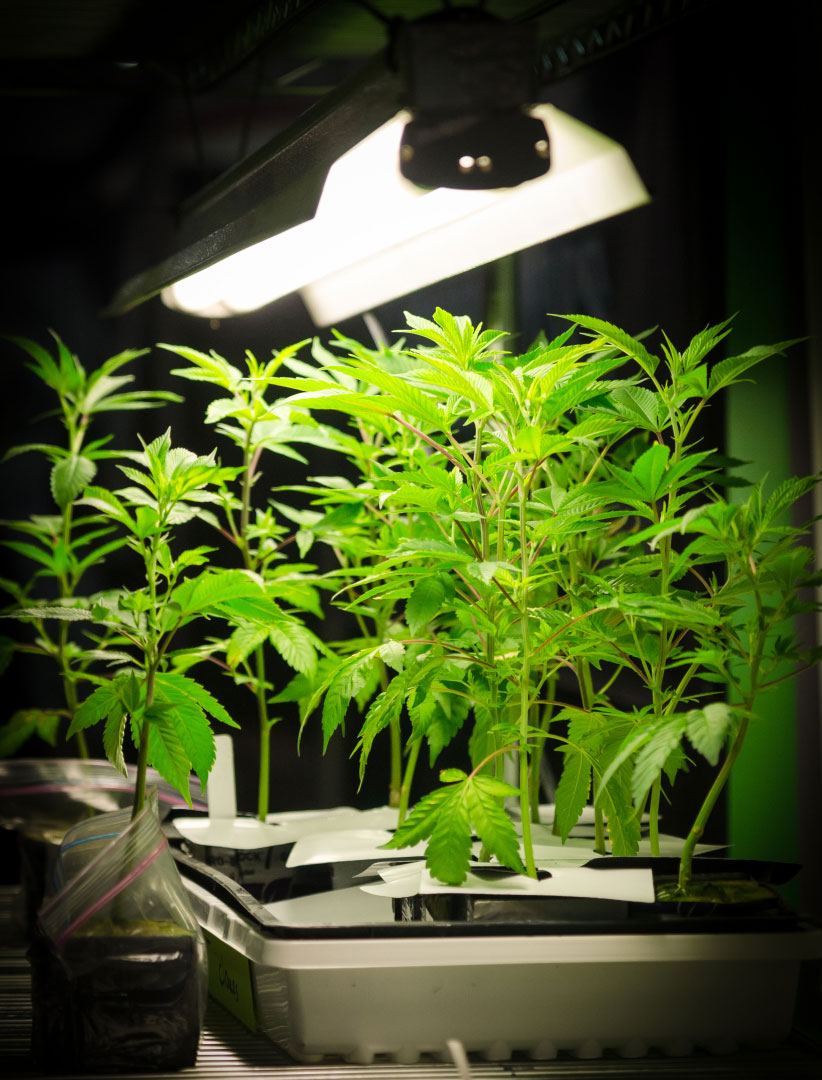
Why an authentic clone can still lose performance
A cutting can be genuine and still perform poorly. Genetic identity is only one part of clone quality. A weak root system, repeated pest pressure, chronic environmental stress, poor mother-plant nutrition, and systemic pathogens can travel with or affect clonal material. Some problems remain hidden while the stock plant still looks acceptable.
Hop latent viroid is an important example because infected stock plants and rooted cuttings can be asymptomatic. A grower may interpret reduced vigor, smaller flowers, or a quieter aroma as “genetic drift” when the more immediate problem is plant health. Visual inspection is useful, but it cannot replace appropriate quarantine, sanitation, and diagnostic testing where valuable stock is being preserved.
Clonal lines can also accumulate biological change over time. Somatic mutations arise in non-reproductive cells, and tissue-culture systems can produce somaclonal variation across repeated subcultures. Research does not support the simple claim that every old clone inevitably becomes a different strain, but it does support careful stock management rather than assuming a name guarantees permanent fidelity.
Somatic Mutation
A DNA change that arises in a plant cell during growth rather than through sexual reproduction. If the changed tissue is propagated, the variation may continue in part of a clonal line. It is one possible cause of change, not the automatic explanation for every declining clone.
“My keeper has been cloned for years. Why is it suddenly less vigorous?”
Question sent by: NordlichtRoots, via Instagram.
Do not diagnose “genetic drift” from reduced vigor alone. First compare rooting time, root health, mother age and condition, irrigation, light, pest history, and sanitation. Quarantine the line and consider pathogen testing, especially when several cuttings decline in the same way. If clean backup stock exists, run it beside the suspect line under matched conditions. That comparison is more informative than the age of the name.
Practical distinction: When identity matters, ask whether a name refers to a seed population, a selected clone, or a seed recreation of a clone. Those are three different products.
A Strain Is Not a Seed
The simplest distinction is also one of the most important:
A strain is a named genetic identity or population. A seed is one individual reproductive package produced within or from that genetic material.
A packet can be labeled with a strain name, but the name describes the family or breeding population. Each viable seed contains an embryo with its own combination of inherited alleles.
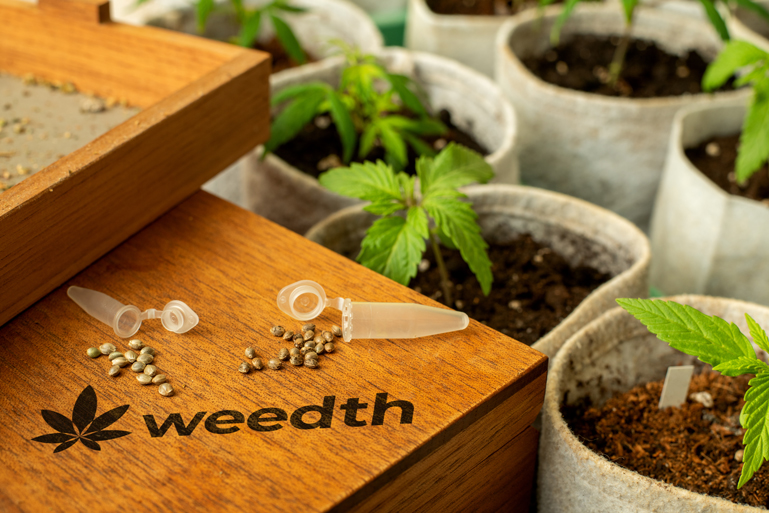
Seeds are siblings, not copies
When two parents reproduce sexually, their offspring are related but not identical. This is familiar in people and animals, and it applies to seed-grown plants. Two seeds from the same pollination can inherit different combinations of traits.
The amount of visible variation depends on the parents and breeding design. Seed made from stable inbred lines can be relatively uniform. Seed from heterozygous polyhybrids can produce a wider spectrum. Even a uniform population is not perfectly identical, and environmental differences can widen the visible gap.
“Why are two plants from the same seed pack growing at completely different speeds?”
Question sent by: Mason Brooks, via Facebook page.
The first possibility is ordinary genetic variation. Seeds from one pack are siblings, and one may inherit stronger early vigor, different branching, or a different root-growth pattern. Environment still needs checking because uneven moisture, compaction, temperature, light, root damage, or pests can create the same contrast. Compare the root-zone conditions and plant health before deciding the difference is entirely genetic.
Seed versus clone
A seed begins a new genotype. A clone continues an existing genotype.
| Starting material | Genetic relationship | Main advantage | Main limitation |
|---|---|---|---|
| Seed | A new individual created through sexual reproduction | Vigor, accessibility, genetic diversity, and breeding potential | Variation in sex, structure, timing, chemistry, and performance depending on seed type and line |
| Clone | A vegetative copy of one selected plant | Greater genetic and canopy consistency; known selected traits | Can carry pests or pathogens, may be difficult to source, and still responds to environment |
Clones can make crop management easier because plants tend to stretch, feed, and finish more similarly when their health and size are matched. Seeds can provide stronger population diversity and give growers the chance to discover a unique keeper.
Neither is universally superior. The right choice depends on legal access, disease risk, need for uniformity, breeding goals, available space, and the value of genetic exploration.
What a seed lot can and cannot tell you
Two packs with the same strain and generation label may still come from different seed-production runs. A seed lot is a traceable group produced and handled together. Its identity can include the exact parent plants, pollination date, production population, harvest, cleaning, quality checks, storage conditions, and packaging date.
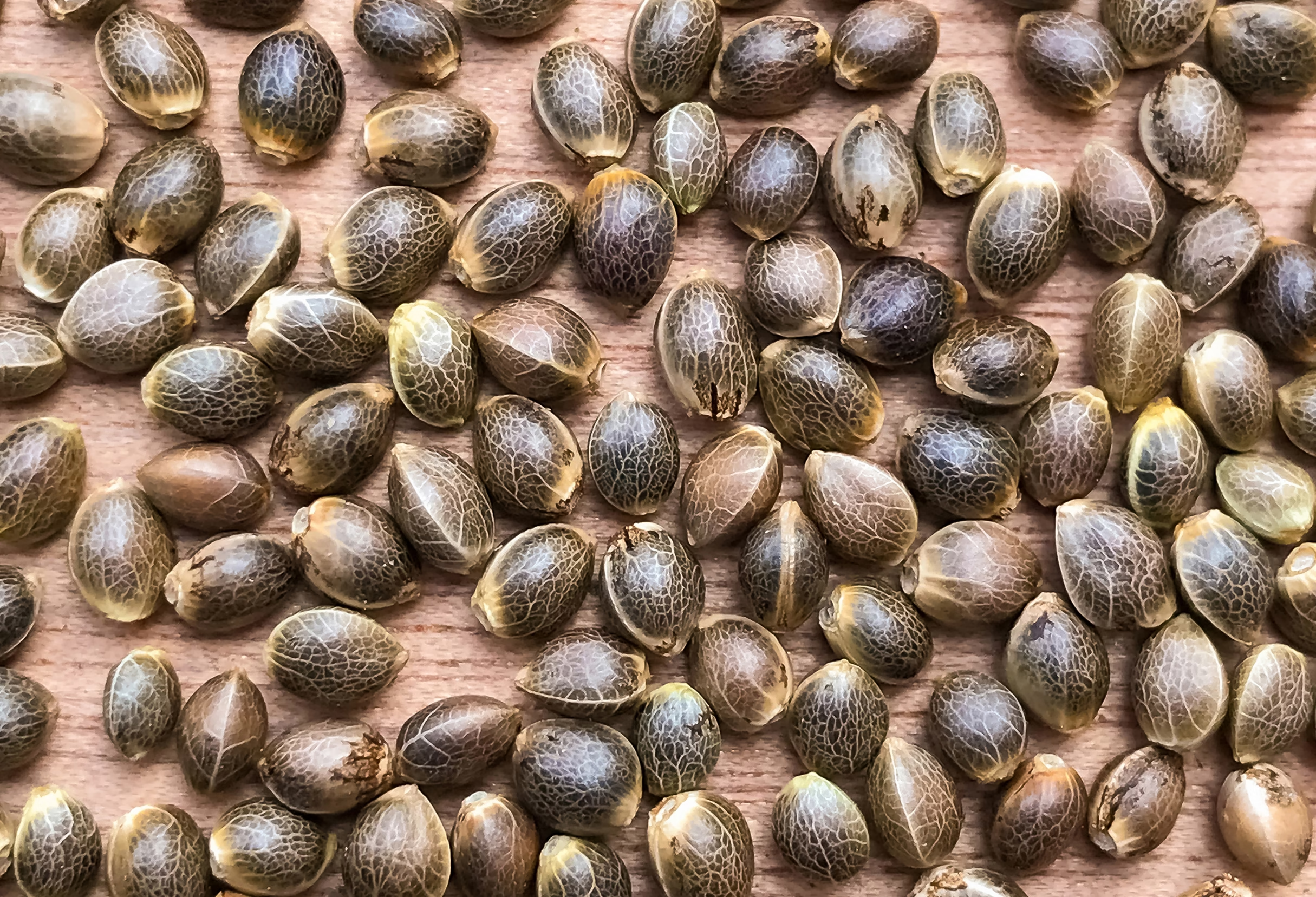
Seed Lot
A defined batch of seeds produced, processed, and recorded together. A useful lot identifier connects the pack to its specific production history rather than only to a strain name.
A lot number does not guarantee that every seed is uniform or viable. It makes the claims auditable. If a germination problem or unexpected trait appears, the grower can determine whether it belongs to one pack, one production lot, or the broader line.
Seed age and storage belong in the same record, but they answer a different question from genetics. Warm, damp, or unstable storage can reduce germination and seedling vigor without changing the stated lineage. Conversely, excellent germination does not prove that the pack contains the claimed genetics.
“Three plants from one pack have three different aroma directions. Does that mean the seeds were mixed?”
Question sent by: Theo Vandenberg, via Facebook page.
Not necessarily. A genetically diverse population can separate into several aroma combinations, especially in an early-generation cross, polyhybrid, F2, or loosely selected line. Check whether the description promised uniformity or described a range. A mix-up becomes more plausible when plants fall completely outside the documented ancestry and expected population, but variation alone is not proof.
What to Remember: Lineage identifies the genetic claim, the seed lot identifies the production batch, and storage history helps explain viability. Keep those three records separate.
Regular, feminized, and autoflowering describe different questions
Seed labels often mix several independent properties.
| Label | The main question it answers |
|---|---|
| Regular | Can the offspring include typical male and female plants? |
| Feminized | Was the seed produced to make female offspring overwhelmingly likely? |
| Autoflowering | Is flowering relatively independent of a short-day light trigger? |
| Photoperiod | Does the plant rely more strongly on day length or uninterrupted darkness to flower? |
| F1, F2, F3 | Which filial generation is this population? |
| S1 | Is this the first selfed generation from one genetic individual? |
| BX1, BX2 | How many stated backcross generations were made? |
| Diploid, triploid | How many chromosome sets does the plant have? |
These labels can be combined. A seed can be feminized and photoperiod-sensitive. It can be feminized and autoflowering. An F1 may be regular or feminized. S1 describes breeding history, while autoflower describes flowering behavior.
Confusing these axes leads to false comparisons. Asking whether autoflower or feminized is better is incomplete because many autoflower seeds are also feminized.

Ploidy is a separate genetic label
Most cannabis plants are diploid, meaning their cells usually contain two sets of chromosomes. Triploid plants contain three sets, and tetraploid plants contain four. These terms describe chromosome-set number, not strain identity, sex, cannabinoid type, or flowering trigger.
Ploidy
The number of complete chromosome sets in a cell. Diploid, triploid, and tetraploid labels describe genome copy number. They do not tell you the complete lineage or guarantee yield, potency, sterility, or quality.
Triploid seed is sometimes discussed as if triploidy were a new kind of strain. It is better understood as one breeding and reproductive characteristic layered onto a particular genetic line. Research has found naturally occurring triploid cannabis at a low frequency, while breeders can also create triploid material through planned crosses involving plants with different ploidy levels.
Odd chromosome-set numbers can reduce fertility, but “triploid” should not be translated into an absolute promise of seedlessness or pollen immunity. Environmental stress, biological variation, breeding quality, and nearby pollen still matter. The useful questions are how ploidy was verified, what parental material was used, and how the resulting population performed in actual trials.
Pro Tip: Read triploid as a chromosome-level descriptor. Read the strain name, lineage, seed format, flowering behavior, and test results as separate descriptors.
Feminized does not mean genetically modified
Feminized seeds are usually produced by using pollen from a genetically female plant on another female plant or on the same genotype. Silver-based treatments are commonly used in controlled breeding to induce pollen-producing flowers on female plants.
This is manipulation of sex expression for breeding, not the insertion of foreign DNA through genetic engineering. Feminized seeds are therefore not automatically genetically modified organisms.
Feminized also does not mean a literal 100 percent guarantee. Good production can make male offspring very unlikely, but genetics, seed quality, labeling errors, and sex-expression complexity prevent responsible writers from promising absolute certainty.
Autoflower is not the strain name
Autoflowering tells the grower how flowering is regulated, not what the finished plant will smell like, how potent it will be, or whether it is easy to grow. Modern autoflower lines may be crossed and selected for many generations with drug-type cultivars.
An autoflower can be THC-dominant, CBD-dominant, balanced, compact, relatively tall, aromatic, bland, uniform, or variable. The flowering trait is only one layer of its identity.
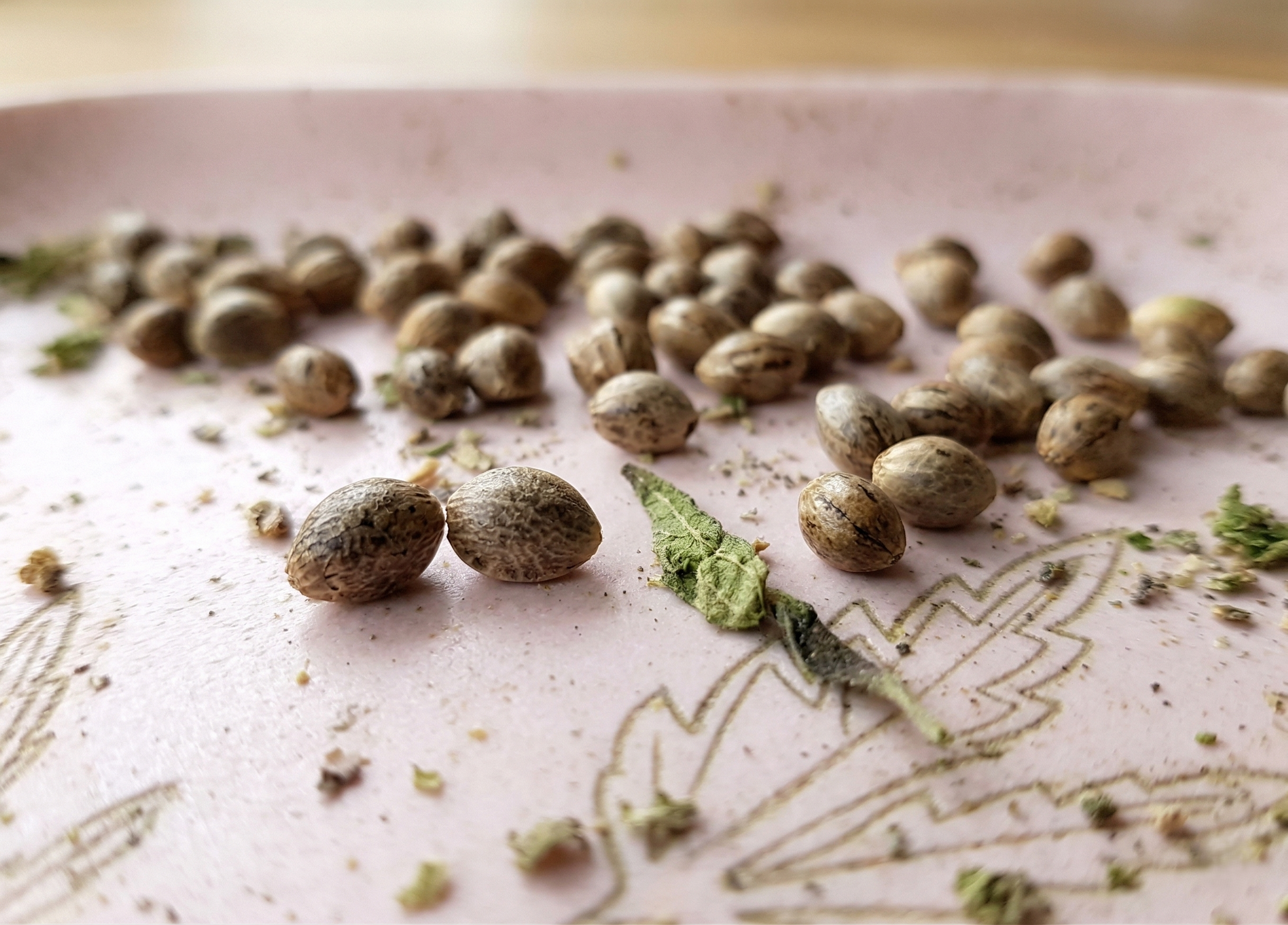
Can you identify a strain by looking at its seed?
No dependable visual method can identify a strain from the seed shell. Size, color, mottling, and hardness can be influenced by genetics, maturity, seed position, production conditions, handling, and age. A mature seed may look dark and patterned, but appearance cannot reveal its named lineage, cannabinoid potential, sex, or future quality.
Very pale, soft, cracked, moldy, or damaged seeds may raise viability concerns. That is a seed-condition assessment, not strain identification.
“Can I tell whether a seed is indica or sativa by its size and markings?”
Question sent by: Emily Carter, via email.
No. Seed appearance cannot reliably reveal an indica or sativa label, the plant’s sex, THC level, aroma, or exact lineage. Use documented provenance for identity and grow the plant to observe its traits. Even then, appearance alone cannot confirm a named strain.
Once seed appearance has been separated from identity, the next useful step is to distinguish seed format from the genetic line named on the pack.
“I found one seed in excellent flower. Will it grow the same strain?”
Question sent by: Nino, via email.
The seed has the flower-producing plant as its maternal parent, but its pollen source may be unknown. It could come from another plant or from pollen-producing flowers in the crop. The seed is a new offspring, not a clone of the flower you enjoyed. Label it by the known maternal source and unknown pollen parent, then evaluate the plant on its own instead of treating the original strain name as guaranteed.
Why the Same Strain Can Look, Smell, Grow, or Feel Different
Variation under one name does not have one cause. It can enter at every layer of the identity stack, from the parent plants to the person using the finished product.
The source may not be the same
Two sellers can use the same name for different material. One may hold a documented clone, another may sell selfed seed from that clone, and a third may offer a recreation made from related parents. A fourth may be using the name without reliable lineage.
This is especially common with old, famous, or commercially attractive names. The longer a cultivar has circulated through informal networks, the more opportunities there are for mislabeling, selection drift, renaming, accidental pollination, and competing origin stories.
A shared name therefore creates a hypothesis of relatedness, not proof.
Seed populations contain genetic variation
Even when the source is authentic, seed-grown individuals can differ. One seed may produce a tall plant with long internodes and a sharp citrus aroma. Its sibling may be shorter, finish earlier, and lean toward spice or earth. Both may fall within the breeder’s population, especially if the line is not narrowly uniform.
This is not automatically evidence of bad seed. The meaningful question is whether the amount and direction of variation match the way the population was described. A pheno-hunting release can honestly contain broad diversity. A production hybrid sold for uniformity should meet a stricter expectation.
The environment changes expression
Cultivation influences what the plant can express and preserve. Important variables include:
- Root-zone moisture and oxygen
- Container volume and root restriction
- Growing medium
- Nutrient availability and salinity
- Light intensity, spectrum, uniformity, and photoperiod
- Day and night temperature
- Relative humidity and airflow
- Carbon dioxide concentration in controlled environments
- Plant density and training
- Pathogen and pest pressure
- Water quality
- Stress timing and severity
These variables do not simply increase or decrease yield. They can change architecture, flower density, pigment, maturation, terpene concentration, cannabinoid yield, and susceptibility to damage. Genotypes can also respond differently to the same stress, which is called a genotype-by-environment interaction.
This is why a feeding or irrigation schedule that works for one cultivar may be excessive or insufficient for another. It is also why one plant in a mixed canopy can show stress before its neighbors.
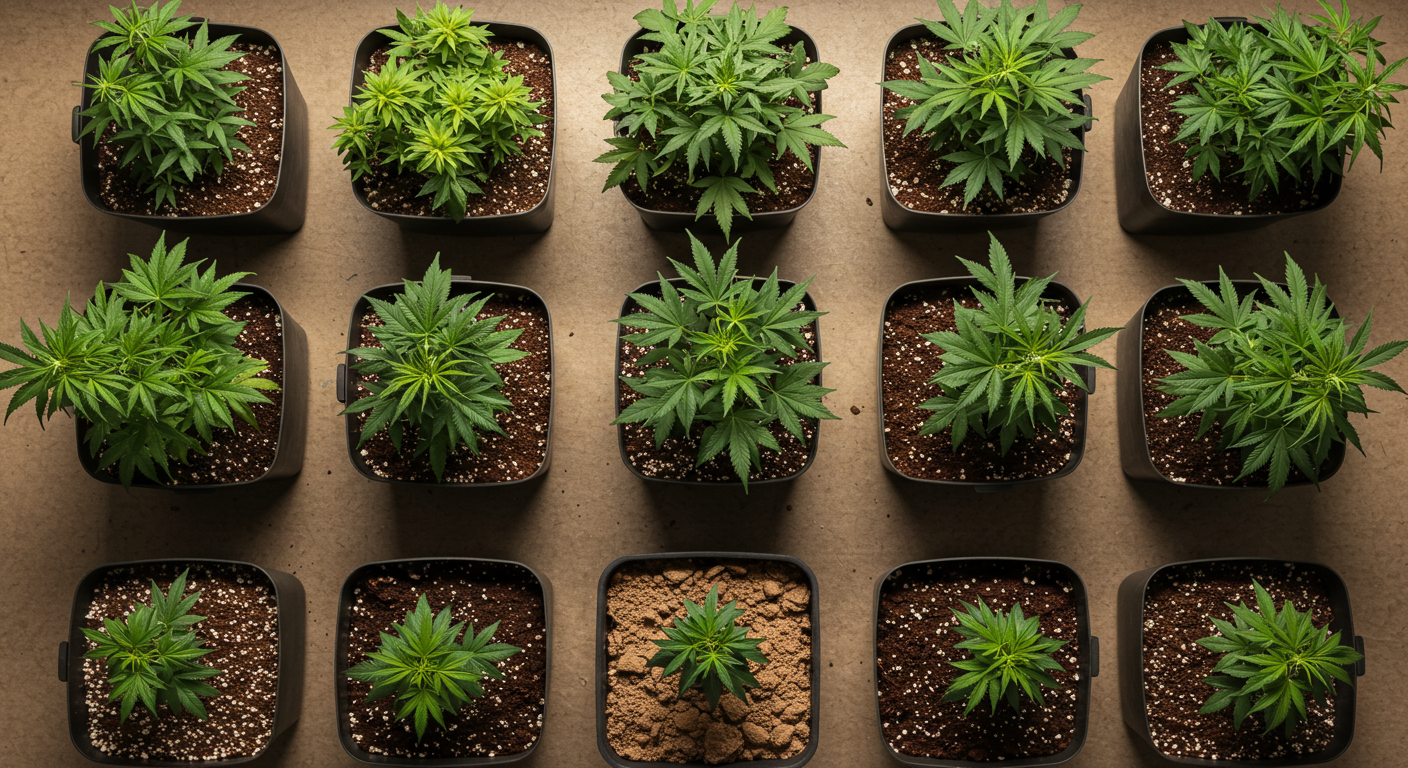
Harvest timing changes the sample
Harvest date affects flower maturity, aroma, cannabinoid composition, moisture, and the proportion of aged or oxidized compounds. Different branches on one plant may mature at different rates, especially in an uneven canopy.
A producer harvesting early to meet a schedule can create a different result from a grower waiting for a cultivar-specific maturity window. Neither strain name nor seed description captures that decision.
Drying and curing reshape quality
Drying removes water, but it also exposes the flower to time, oxygen, temperature, and physical handling. Drying too warm can accelerate volatile loss. Drying too slowly under unsafe humidity can create mold risk. Overdrying can make flower harsh and fragile, while packaging too wet can create microbial and storage problems.
Curing does not manufacture genetics or add terpenes that were never present. It can help moisture equalize and allow the aroma and smoking characteristics of properly dried flower to settle. Poor storage after curing can still undo much of the work.
For this reason, two batches from the same clone can smell and taste different even when the plants were grown well.
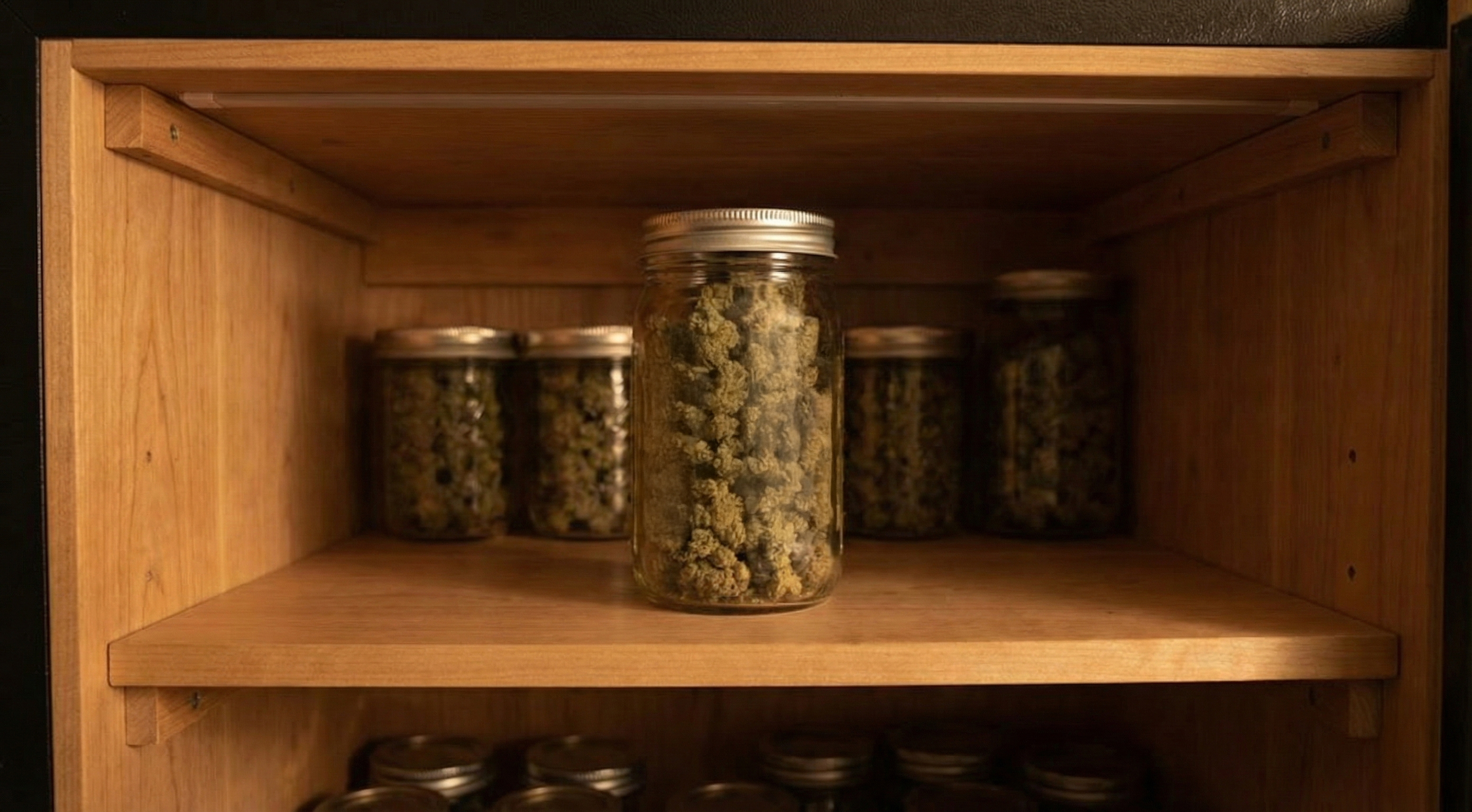
Storage and age matter
Heat, light, oxygen, and repeated opening can change the product. Volatile aromatic compounds dissipate, acidic cannabinoids can decarboxylate, THC can degrade into other compounds, and very dry trichomes can break away from the flower.
A fresh batch and a poorly stored older batch should not be treated as two clean tests of the strain’s genetics.
Laboratory results can vary
Testing is useful, but sampling and methods matter. Cannabinoid and terpene concentrations may differ between flowers, positions on the plant, and subsamples from a batch. Laboratories can use different instruments, preparation procedures, reporting conventions, and measurement uncertainty.
One decimal-heavy certificate should not be mistaken for permanent genetic precision. Look for batch-specific testing, accredited or regulated methods where available, realistic ranges, and repeated results rather than one record-setting number.
Sampling matters before the sample reaches the laboratory
A laboratory can analyze only the material it receives. Cannabis flowers are not perfectly uniform within one plant or across every plant in a batch. Flower position, maturity, light exposure, plant-to-plant variation, and the way material is combined can influence whether the submitted portion represents the whole lot.
This creates two separate questions. Analytical accuracy asks whether the laboratory measured the submitted sample correctly. Sampling representativeness asks whether that sample fairly described the plant or batch. A precise test on an unrepresentative handful can still create a misleading headline number.
For a home record, sample consistently from comparable positions and stages. For a production batch, use a documented random or stratified sampling plan that draws from multiple plants and locations. Do not choose only the most resinous top flower and silently apply the number to the entire harvest.
“My top flower tested higher than the rest. Which number is the real potency?”
Question sent by: Marlene, via email.
Both measurements can be real for the material tested. The question is which sample represents the decision you are making. If you want to describe a whole batch, combine material according to a repeatable plan across plant positions and individuals. If you are studying within-plant variation, keep the positions separate and label them clearly. One selected top flower should not be presented as the batch average.
Important: A laboratory result has three identities: the sample, the method, and the batch it is supposed to represent. Losing any one of them makes comparison weaker.
Product format changes the experience
The same named flower and an extract made from it may not have the same chemical balance. Extraction can concentrate cannabinoids, alter the terpene profile, remove plant components, or blend material from several batches. Distillate may contain mostly refined cannabinoids with terpenes added separately. An edible changes absorption and metabolism compared with inhalation.
When the product format changes, the strain name often becomes less predictive than the dose and formulation.
Dose, tolerance, and the person change the response
THC exposure is a major driver of acute intoxication. The amount consumed, speed of consumption, route, tolerance, and previous experience can overshadow the subtle differences people expect from strain categories.
The same product may feel different when used after a tolerance break, when tired, after eating, in an unfamiliar environment, or alongside other substances or medications. Two people can respond differently to the same dose.
Reported effects remain useful as observations, but they should be framed as patterns rather than guarantees.
Never Forget: A different experience does not automatically prove that the strain was mislabeled. First compare the source, batch, age, product format, dose, tolerance, and setting.
How Reliable Are Cannabis Strain Names?
Strain names are neither completely dependable nor completely meaningless. Their value exists on a confidence spectrum.
| Confidence level | What may support the name | Reasonable expectation |
|---|---|---|
| Higher | Documented clone provenance, controlled chain of custody, repeated chemical and horticultural records | Stronger genetic continuity, with environmental and batch variation still possible |
| Moderate | Defined parental cross from a tested breeding population with honest range data | A recognizable family of traits, not identical plants |
| Limited | Recreation, selfed version, or backcross with clear disclosure | Some relationship to the reference line, with meaningful variation expected |
| Low | Famous name with no breeder, parent, generation, or source information | Treat the name primarily as a marketing label until evidence improves |
When a name carries useful information
A name becomes more meaningful when it is connected to:
- A traceable breeder or preservation source
- Clearly identified parents
- A stated seed generation or clone status
- Descriptions of population variation
- Testing across multiple plants and runs
- Batch-specific chemical results
- Repeatable horticultural observations
- Transparent disclosure of recreations, selfing, or backcrossing
Provenance does not need to be a dramatic story. Short, verifiable records are more valuable than a long legend that cannot be checked.
When a name is mostly a market label
Warning signs include:
- No source or parent information
- Conflicting parentage across listings
- One famous name sold by many unrelated sellers with no explanation
- Exact potency or yield promises without ranges or test conditions
- “Pure,” “elite,” “premium,” or “stable” used without defining the tested trait
- Stock photographs reused across different seed lines
- An indica or sativa percentage presented as if it were a genomic analysis
- Aroma and medical effects described as guaranteed outcomes
The appropriate response is not panic. It is to lower confidence and make the decision using information that can be verified.
“If two seed companies sell the same strain name, are the seeds actually the same?”
Question sent by: Olivia Bennett, via Facebook page.
Sometimes they may share genuine ancestry, but the name alone cannot prove it. One seller may have the original parental material, another may offer a licensed or authentic seed lot, and another may sell a recreation or unrelated white-label line. Compare the named breeder, parent plants, generation, clone or seed status, and any disclosure about how the line was reproduced.
“Can I give my keeper phenotype a new name?”
Question sent by: Savannah Price, via email.
You can give a selected plant a working name for your records, but the name should not hide its origin. Keep the original cross, source, generation, seed lot, and plant number attached to it. A keeper name identifies your selected individual; it does not automatically establish a newly bred, stable seed line.
A practical strain-name verification ladder
Use the following order when identity matters:
- Source: Who preserved or produced the genetics?
- Propagation: Is it a clone, a seed line, or a seed version of a clone?
- Lineage: Are the parents and breeding steps stated clearly?
- Population evidence: How many plants and generations were evaluated?
- Trait ranges: Are height, time, yield, chemistry, and aroma reported as ranges?
- Batch evidence: Is there current testing or production information for the material being used?
- Direct observation: Does the actual plant or flower match the expected family of traits?
This method respects the usefulness of a name without allowing the name to replace evidence.
Cannabinoids and Chemotypes: A Better Starting Point Than the Name Alone
Cannabinoids are a major part of cannabis chemistry. The plant primarily produces acidic forms such as THCA and CBDA. Heat and time can convert these into neutral forms such as THC and CBD through decarboxylation.
THC is strongly associated with intoxication. CBD is not intoxicating in the same way, although it is biologically active and can cause side effects or interact with medications. Other cannabinoids, including CBG, CBC, THCV, and CBN, receive growing attention, but their concentrations and evidence bases vary.
Type I, Type II, and Type III
The THC:CBD relationship offers a clearer first chemical distinction than sativa or indica:
| Chemotype | General pattern | Practical interpretation |
|---|---|---|
| Type I | THC-dominant | Intoxication risk and dose sensitivity are central considerations |
| Type II | Meaningful THC and CBD | The ratio may moderate the experience, but response remains dose- and person-dependent |
| Type III | CBD-dominant with relatively little THC | Usually less intoxicating, but not automatically THC-free or risk-free |
This framework is not a complete prediction model. Two Type I products can have different potency, minor cannabinoids, terpene profiles, freshness, and effects. It does, however, prevent the serious mistake of treating all strains as chemically equivalent.
Potency is a concentration, not a quality score
A higher THC percentage can mean more THC in a given weight of material. It does not prove better genetics, better cultivation, richer aroma, smoother smoke, stronger therapeutic value, or a more enjoyable experience.
Potency also interacts with dose. A lower-percentage product consumed in a larger amount can deliver more THC than a high-percentage product used sparingly. Product labels are most useful when they help the reader estimate actual exposure.
For growers, selecting only for maximum potency can narrow other goals. Aroma complexity, resin quality, flower structure, stress resistance, finishing time, and post-harvest performance may matter more to the intended result.
“Why did the same clone test at 18 percent THC in one run and 23 percent in another?”
Question sent by: Anong, via contact form.
The genotype may be the same while the sampled flower, environment, maturity, plant position, post-harvest handling, and analytical method differ. Treat both values as results for their specific samples. Compare matched sampling plans and laboratory methods before interpreting the gap as a genetic change.
Minor cannabinoids need measured context
Catalog descriptions may list many cannabinoids because the names sound advanced. Unless those compounds were measured repeatedly at meaningful concentrations, the list may say more about possibility than the actual product.
Minor does not mean unimportant, but it does mean that careful measurement and evidence are needed. Avoid assigning a precise effect to a trace compound based on marketing alone.
Read the actual certificate carefully
Where regulated testing is available, check:
- Whether results belong to the current batch
- The units used, such as percentage or milligrams per gram
- Whether values are reported as acidic forms, neutral forms, or calculated totals
- The sample and test date
- The laboratory and accreditation context
- Contaminant screening, not only potency
- Whether the terpene panel was tested or merely copied from a strain description
A laboratory report can answer what was measured in the submitted sample. It cannot confirm every unmeasured flower, prove the full genetic lineage, or guarantee a personal outcome.
Advice: Use chemistry to narrow uncertainty, not to create a new form of false certainty.
Terpenes, Aroma, Flavor, and the Entourage Question
Terpenes are volatile aromatic compounds produced by cannabis and many other plants. They contribute to recognizable aroma families and play ecological roles for the plant. Cannabis can produce many terpenes, with the dominant pattern varying by genotype and expression.
What terpenes clearly tell you
A measured terpene profile can help describe the aroma chemistry of a sample. It may distinguish a terpinolene-forward batch from one dominated by myrcene, caryophyllene, limonene, or pinene. It can also help compare batches sold under one name.
Terpenes matter greatly to sensory quality. Their volatility also makes them useful indicators of harvest and post-harvest care. A fresh, carefully handled flower may retain a layered aroma that fades after warm or oxygen-rich storage.
What a terpene list cannot promise
Popular charts often assign one effect to each terpene:
- Myrcene means sedation
- Limonene means energy or happiness
- Pinene means focus
- Linalool means sleep
These statements usually extend laboratory, animal, isolated-compound, or anecdotal findings beyond what has been demonstrated for ordinary cannabis use. A terpene can be biologically active without producing a predictable strain effect at the concentration and route in a particular product.
The presence of one dominant terpene also does not erase dose, THC exposure, other compounds, tolerance, expectation, or individual response.
“If a flower smells strongly of citrus, does that prove limonene is dominant?”
Question sent by: Mariam K., via Facebook page.
No. Citrus perception can come from several volatile compounds acting together, and the strongest sensory note does not always match the highest single terpene on a laboratory panel. Record the aroma honestly, but use a current test if you need to identify and compare the measured terpene profile.
Is the entourage effect proven?
The entourage effect is the hypothesis that cannabis compounds interact so the combined result differs from the effect of isolated compounds. The idea is plausible, and some human and preclinical findings support investigating particular combinations. However, the broad marketing version, in which terpene charts reliably predict the effect of every strain, is not established.
Research remains mixed and incomplete. Some laboratory work has not found common terpenes to alter cannabinoid activity through the main cannabinoid receptors in the proposed way. More recent controlled human research on specific combinations suggests that particular interactions may exist, but one positive finding cannot validate every claimed synergy.
The evidence-aware conclusion is:
Cannabis chemistry may involve meaningful compound interactions, but the size, mechanism, dose, and practical predictability of those interactions are not fully established.
This wording protects both scientific accuracy and reader curiosity.
What to Remember: Sensory language describes what a person notices. A terpene panel describes what a laboratory measured. They can inform each other, but they are not interchangeable.
Aroma is still valuable even when effect prediction is uncertain
Rejecting exaggerated terpene claims does not make aroma irrelevant. Aroma is central to variety recognition, product enjoyment, freshness assessment, and flower quality. It can help a person build a record of which chemical and sensory patterns they prefer.
The sensible use of terpene data is comparative: “I consistently prefer fresh batches with this aroma and measured profile.” The less defensible use is prescriptive: “This terpene always creates this mental or medical result.”
Choosing a Strain as a Consumer
Choosing by name alone asks the least reliable part of the label to make the whole decision. A better method begins with the intended experience, then narrows by chemistry, potency, product format, batch quality, and personal response.
Start with the real goal
The goal should be specific enough to guide a choice without becoming a medical promise. Examples include:
- A lower-intensity introduction to cannabis
- A particular aroma or flavor family
- A product that is easier to dose carefully
- A THC-dominant, mixed THC:CBD, or CBD-dominant profile
- A flower suitable for a preferred time or setting based on previous response
- Avoiding a compound, potency range, or format that previously caused discomfort
“The strongest strain” is not a useful goal for most people. A more potent product may require a smaller dose and can increase impairment or adverse effects.
Choose the chemistry before the folklore
First determine the broad chemotype and current batch potency. If the person is inexperienced or sensitive to THC, lower THC and a cautious amount provide a more controllable starting point than chasing a highly rated name.
Where terpene testing exists, use it as descriptive information. It can help locate batches with similar aroma chemistry to a previously preferred product. Do not use it as a guaranteed prescription for mood, sleep, pain, or focus.
Product format may matter more than strain
Inhaled and oral cannabis have different onset and duration. Concentrates can deliver a large dose rapidly. Edibles can take much longer to reach full effect, and their effect can last much longer than inhaled flower.
For an edible made from refined THC, a strain name may have little practical value. The measured dose per serving, formulation, and safe waiting period matter more. For intact flower with batch-specific cannabinoid and terpene data, the cultivar identity may be more informative.
Evaluate the batch, not only the menu description
Useful batch information includes:
- Production and package date
- Cannabinoid results
- Terpene results if genuinely tested
- Contaminant testing where required
- Producer or cultivator identity
- Storage condition
- Aroma, dryness, and visible integrity of the actual flower
A product with a famous name but stale aroma, damaged trichomes, contamination, or uncertain storage is not rescued by its lineage.
“Why can the same product feel comfortable one evening and overwhelming another time?”
Question sent by: Noah Tremblay, via email.
The label may be unchanged while dose, inhalation pattern, tolerance, food intake, sleep, stress, setting, product age, and expectations differ. Use the batch number and approximate dose in your notes, then record the context. A strain name cannot control those variables.
Keep a simple response record
Memory tends to compress complex experiences into “good strain” or “bad strain.” A short record creates more useful evidence. Note:
- Product and producer
- Batch or test date
- Product format
- THC and CBD values
- Dominant measured terpenes if available
- Approximate dose
- Time and setting
- Desired and unwanted effects
- Duration
Over time, patterns may appear. The pattern may follow dose or THC:CBD ratio more strongly than the strain name. It may also reveal a preferred aroma family or show that a specific product format is difficult to control.
Advice: When a consumer record shows inconsistent results, check dose and product format before searching for a more precise strain label.
Medical and safety boundaries
A strain name is not a diagnosis or treatment plan. Evidence for cannabis and cannabinoids differs by condition, preparation, dose, and study quality. People using cannabis for a health concern should discuss it with a qualified healthcare professional, particularly if they take other medications, are pregnant or breastfeeding, have a cardiovascular concern, or have a personal or family risk of psychosis or substance-use disorder.
Do not drive or operate machinery while impaired. Store cannabis securely away from children and pets. Local laws differ for possession, purchase, cultivation, transport, and use.
“Medical strain,” “sleep strain,” and similar labels do not guarantee treatment or safety. Product chemistry, dose, individual risk, and professional guidance matter more than the name.
Choosing a Strain as a Grower
For a grower, strain selection is an environmental and operational decision before it becomes an aroma or effect decision. The plant must be able to finish safely in the available space and climate.
1. Begin with legal and practical limits
Confirm the laws that apply to seed possession, plant numbers, visibility, security, and cultivation. Legal rules vary by country, state, province, and municipality and can change over time.
Then define the fixed limits of the setup:
- Indoor, outdoor, greenhouse, balcony, or mixed environment
- Available height and floor area
- Number of plants allowed and manageable
- Length of outdoor season
- Expected frost, rain, and humidity pattern
- Electrical and cooling capacity indoors
- Time available for daily care
- Ability to separate male plants or isolate pollen
- Need for crop uniformity
These limits remove unsuitable options before attractive names create bias.
2. Match flowering behavior to the environment
Photoperiod cultivars give indoor growers more control over plant size because vegetative duration can be adjusted before flowering. They can also be cloned and retained more easily in a vegetative state.
Autoflowers can suit short seasons, small independent cycles, or growers who value rapid turnover. They provide less time to recover from severe early stress and are less flexible when the grower wants to delay flowering for training or canopy repair.
Outdoors, estimated finishing time must fit the local season. A late-maturing cultivar may encounter cold rain, declining light, or frost before it reaches maturity. In humid regions, an earlier or more open-flowered plant can be more dependable than a dense, late cultivar with a higher advertised yield.
3. Match architecture to space
Indoor growers should evaluate:
- Expected flowering stretch
- Branching pattern
- Internode spacing
- Response to training
- Canopy density
- Support needs
- Flower density and airflow risk
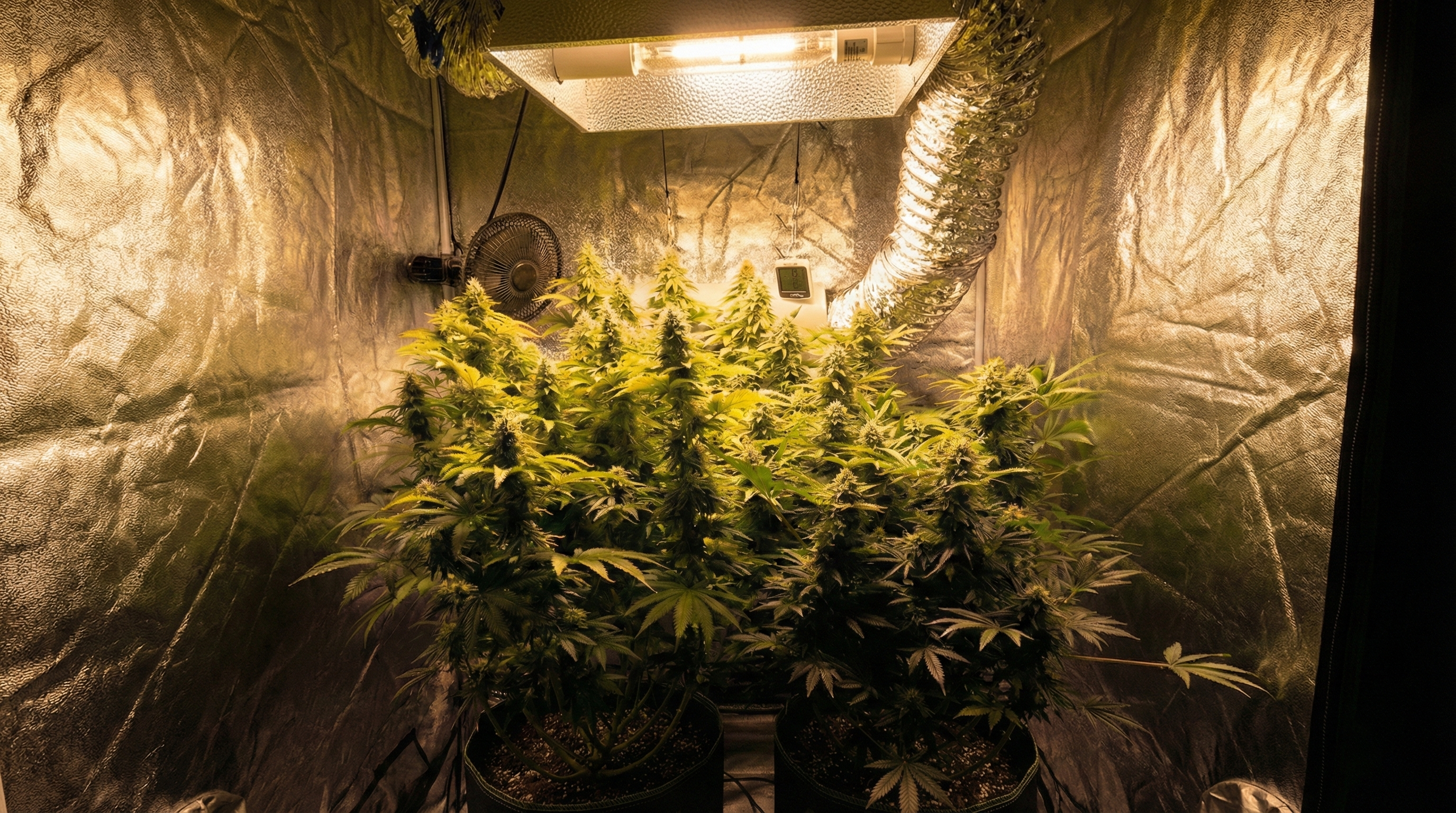
A low ceiling favors manageable stretch, but a short plant is not automatically easy. Very dense branching can create shaded interiors and stagnant air. A flexible, trainable plant may use a horizontal space more efficiently than a rigid compact plant.
Mixed-strain canopies are harder to manage because plants can differ in height, flowering time, irrigation demand, nutrient sensitivity, and light tolerance. Beginners often learn faster with fewer cultivars or several clones of one selected plant.
4. Match the plant to outdoor climate
Outdoor selection should consider:
- Latitude and seasonal day length
- Last spring frost and first autumn frost
- Rain during flowering
- Night humidity and dew
- Summer heat
- Wind exposure
- Drought and water access
- Local pest and disease pressure
- Soil or container constraints
- Visibility and odor impact
Seed descriptions written for one country may not translate directly to another. “Outdoor harvest in October” is not a universal recommendation. Northern and Southern Hemisphere calendars differ, and two locations at similar latitude can have very different rainfall, temperature, and disease pressure.
5. Decide how much variation the crop can tolerate
Uniformity matters when plants share one irrigation system, one light height, and one harvest schedule. A grower with a small tent may prefer a tested, relatively uniform feminized seed line or healthy clones.
A breeder or pheno-hunter may actively want diversity. Regular seed, F2 populations, landrace populations, or exploratory polyhybrids can provide selection material, but they require more space, labeling, evaluation, and patience.
Neither approach is more advanced in every situation. Uniform production and genetic exploration are different goals.
6. Choose seed type after defining the goal
Regular seed is useful when male plants, breeding, preservation, or broad selection are part of the plan. It is inefficient when a plant limit is strict and every space is intended for unpollinated female flower.
Feminized seed improves space efficiency for flower-focused cultivation. Quality depends on parental selection and testing, not on the feminized label alone.
Autoflowering seed can shorten the cycle and reduce dependence on a flowering light schedule. It requires good early management and should be selected for proven performance in the intended environment.
Clone material offers greater genetic predictability but introduces biosecurity concerns. New clones should be inspected and quarantined where possible because they can carry insects, mites, fungi, viruses, viroids, or other pathogens.
“Should a beginner grow several different strains in one small tent?”
Question sent by: Waldgeist_47, via Instagram.
Usually fewer variables make the first comparison clearer. Different lines may stretch, drink, feed, and finish at different rates while sharing one light height and irrigation routine. One relatively uniform line, or matched clones where appropriate, lets a beginner learn the environment before managing a mixed canopy.
7. Evaluate resistance claims carefully
“Mold resistant,” “pest resistant,” and “drought resistant” are often used without a defined test. Resistance is rarely absolute. A cultivar may tolerate one pathogen, environment, or stress better than comparison plants while remaining vulnerable under more severe pressure.
Useful resistance information identifies:
- The specific pest, disease, or stress
- The environment where it was observed
- The comparison population
- The growth stage
- Whether the trait appeared across several plants and runs
Open flower structure, earlier maturity, and vigorous recovery can reduce risk without making a plant biologically immune.
8. Treat yield as a conditional result
Yield estimates often assume strong light, healthy roots, an experienced grower, a particular plant density, and favorable phenotypes. Indoor figures per square meter can hide the number of plants, vegetative time, canopy method, and actual power use. Outdoor yield per plant can be inflated by long seasons and very large root zones.
Use yield descriptions comparatively, not as contracts. More dependable questions are:
- Does the plant fill the available canopy efficiently?
- Does it finish within the safe season?
- Can the branches support the flowers?
- Does density create mold risk?
- Is the flower-to-leaf ratio practical?
- Does the cultivar maintain aroma and resin quality at the intended harvest size?
9. Put flower quality into the decision
Genetics influences resin, aroma, flower structure, and cannabinoid potential. The highest-yielding cultivar is not necessarily the best choice if it finishes with weak aroma, excessive leaf, poor drying behavior, or a profile the grower does not value.
Quality goals may include:
- Distinct natural aroma
- Terpene retention
- Resin-head condition
- Flower density appropriate to climate
- Low contamination risk
- Smooth drying behavior
- Manageable trimming
- Stable moisture during curing
- Desired cannabinoid ratio
The best selection balances production, resilience, and final quality rather than maximizing one catalog number.
10. Match difficulty to the grower, not the label
“Beginner strain” should mean more than a plant that survives neglect. A beginner-friendly cultivar is usually forgiving across ordinary variations, has manageable stretch, communicates stress clearly, finishes within a realistic window, and does not demand a narrow environmental target.
An advanced cultivar may be worthwhile when its special aroma, structure, or chemistry justifies greater sensitivity. Difficulty should be explained through the actual management challenge.
Master Advice: Select genetics in this order: legal fit, environmental fit, flowering behavior, plant architecture, uniformity needs, quality goal, then the name.
How to Build a Reliable Strain Record in Your Own Garden
A personal strain record becomes useful when it can separate genetic differences from differences in cultivation. A photograph and a final rating are not enough. The goal is not to turn a small garden into a laboratory. It is to record the few variables that prevent memory, excitement, and a famous name from rewriting the result later.
Start with one permanent plant or seed-lot identifier. Do not relabel a plant after it develops an unexpected aroma or structure. If the material arrived as a clone, record the source and date received. If it came from seed, record the pack, breeder or producer, stated cross, generation, seed type, lot number when available, and the individual seedling number.
For example, “Line A F2, lot 2409, plant 07” is more useful than “purple pheno.” Descriptive nicknames can be added later, but the original identifier should remain unchanged through propagation, testing, harvest, and storage.
| Record layer | Minimum information | Why it matters |
|---|---|---|
| Identity | Source, stated lineage, seed or clone status, generation, seed type, lot, individual number | Prevents the name from replacing the actual material history |
| Timeline | Germination or rooting date, transplant dates, flowering start, harvest date | Makes growth and flowering comparisons meaningful |
| Environment | Light cycle, approximate intensity, temperature and humidity range, indoor or outdoor location | Provides context for G×E and stress responses |
| Root zone | Container volume, medium, irrigation method, notable drybacks or saturation events | Explains vigor and nutrient symptoms that can be mistaken for genetics |
| Plant traits | Branching, internode spacing, stretch, flowering range, support needs, stress response | Turns vague impressions into comparable observations |
| Flower traits | Aroma at several stages, density, resin, color, trimming effort, fresh and dry weight | Separates production traits from final quality |
| Health | Pests, disease, unusual decline, quarantine and test history for clones | Stops a health problem from being mislabeled as a strain trait |
| Post-harvest | Drying duration and conditions, cure container, storage temperature, evaluation date | Aroma and quality continue changing after harvest |
Use repeated checkpoints instead of one final impression
Record observations at consistent stages: early vegetative growth, pre-flower, early flower, mid-flower, late flower, harvest, after drying, and after a defined curing period. Aroma at week four of flower may not match aroma after drying. A plant that begins slowly may finish with excellent structure. Checkpoints preserve that development rather than compressing it into one memory.
Use measurements where they are easy and descriptions where they are not. Dates, height, stretch ratio, container size, and dry weight can be measured. Aroma can be described with a short vocabulary and an intensity score, but it should still be treated as sensory observation rather than chemical proof.
“What should I record if laboratory testing is not available to me?”
Question sent by: MapleMoth, via email.
Keep stable identifiers, dates, source and lot information, environment ranges, root-zone notes, flowering time, stretch, aroma checkpoints, health events, harvest criteria, drying conditions, and photographs taken from comparable angles. A consistent observational record cannot replace chemistry, but it can make your horticultural conclusions far more reliable.
Change one major variable when comparison matters
If the goal is to compare two phenotypes, keep their container size, medium, plant age, light exposure, training, harvest criteria, and drying conditions as similar as practical. If the goal is to compare environments, use matched clones and deliberately record what changed. A comparison in which genetics, container size, harvest timing, and drying all change at once cannot identify the cause of the difference.
Replicates are valuable. One plant can be affected by a damaged root, irrigation error, pest pocket, or unusual position. Repeated performance across clones, siblings, or cycles provides more confidence than a single exceptional result.
Separate keeper quality from breeding value
A plant can be an excellent keeper because its exact combination works well as a clone. That does not prove it will pass the same combination predictably through seed. Breeding value requires offspring testing. Record whether a conclusion belongs to the plant itself, its clones, its seed siblings, or its progeny.
Preserve the evidence with the plant
Before flowering a promising individual, take labeled backup cuttings where legal and practical. Link every photograph, clone, harvested jar, and test result to the same permanent identifier. Keep the original data even if the plant is later given a keeper name.
When sharing results, report the environment and sample size. “Tested one plant indoors” is honest and useful when stated clearly. It becomes misleading only when the result is presented as a universal property of the entire strain.
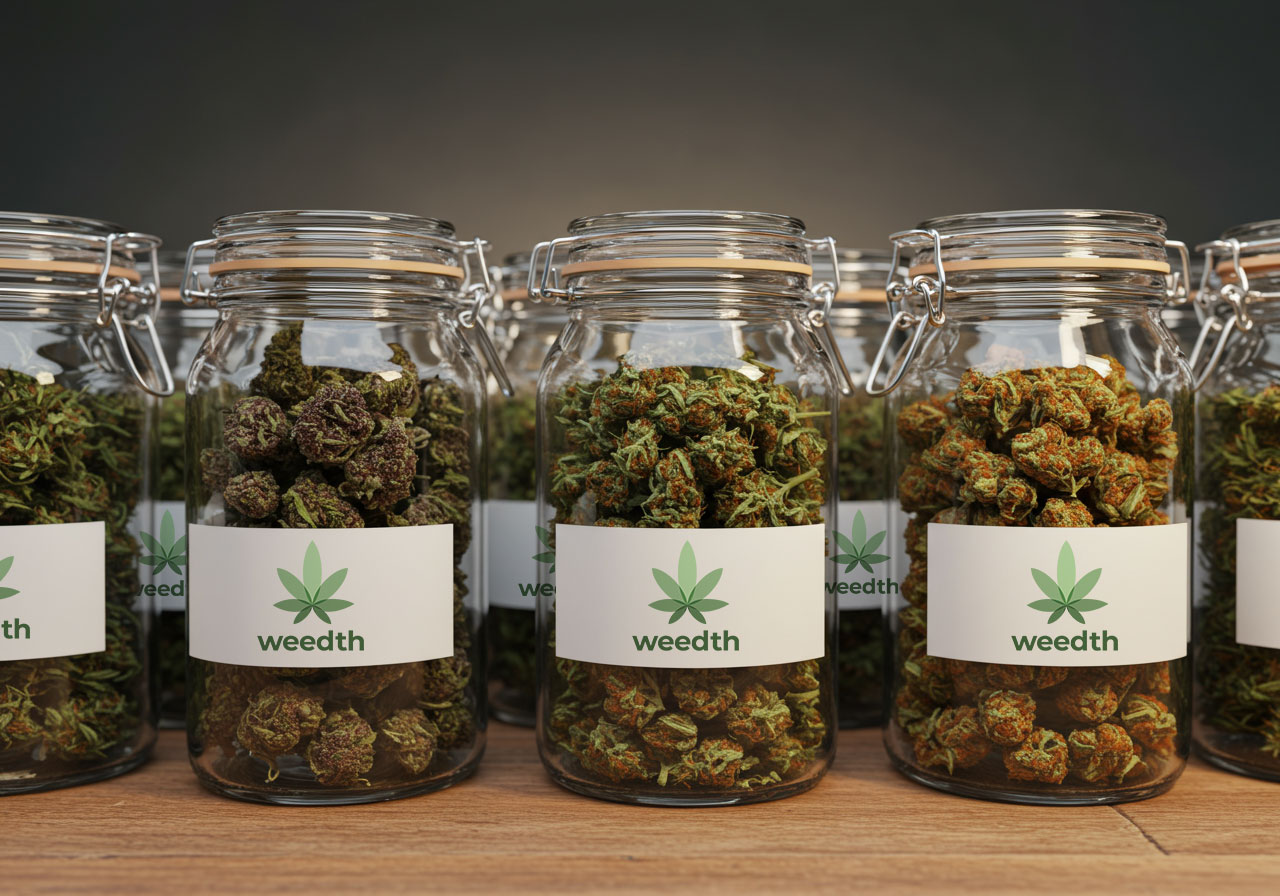
Master Tip: A reliable grow record does not need to be complicated. It needs stable identifiers, consistent checkpoints, and enough environmental context to explain why two results may differ.
How to Read a Strain or Seed Description Without Being Misled
A useful description separates identity, observation, measurement, and marketing. Read each field with a different level of confidence.
Lineage
Look for clearly stated parents and source. If a famous clone was used, the description should say whether it is the actual clone, an S1, a backcross, or a recreation. Vague phrases such as “inspired by” or “based on” may indicate distance from the reference line.
Indica and sativa percentage
Treat a precise percentage cautiously unless a genomic method and reference population are explained. In many catalogs, the percentage is an informal ancestry estimate, not a laboratory measurement.
It may provide a rough expectation of plant form based on the breeder’s observations. It should not be used as a mathematical prediction of effects.
Flowering time
Ask when counting started and whether the number represents an average, fastest phenotype, or tested range. Indoor photoperiod flowering time does not directly provide an outdoor harvest date.
Height and stretch
Look for relative descriptions and test conditions. “Medium height” means little without container size, vegetative duration, training, and light. Stretch expressed as a multiplier or observed range is more useful.
Yield
Check whether the figure is indoor or outdoor, dry or wet, per plant or per area, and based on what plant density. Exact maximum figures are less useful than repeated typical performance under stated conditions.
THC and CBD
Prefer ranges from several plants or batches. Determine whether values represent total potential cannabinoids, a single selected phenotype, or retail flower from a different producer. Seed offspring may not reproduce one parent’s exact test result.
Terpenes and flavor
Separate measured terpenes from sensory descriptions. “Citrus and pine” can be an honest aroma observation. “Limonene creates happiness and pinene guarantees focus” overstates the evidence.
Difficulty
The description should name the challenge: nutrient sensitivity, large stretch, long flowering, weak branches, humidity risk, low stress tolerance, or demanding post-harvest handling. A difficulty score without reasons does not help the grower prepare.
Stability and uniformity
Ask which trait is stable and how many plants were evaluated. A catalog should not use one uniform photograph to hide a broad population range.
Photographs
Photographs usually show a selected plant under favorable conditions. They demonstrate possibility, not the average result. Useful documentation shows several individuals, different environments, or a stated representative phenotype.
“A catalog says 90 percent indica. Is that a measured genetic percentage?”
Question sent by: Lena Hoffmann, via Facebook page.
Usually not unless the seller explains a genomic method, reference populations, and how the percentage was calculated. In many descriptions it is a conventional ancestry estimate or shorthand for observed plant form. Use the parents, flowering behavior, structure, chemistry, and test conditions as the decision-making information.
Pro Tip: Read every precise number with its method. A percentage without a measurement process may be a description, estimate, target, or marketing claim rather than a test result.
Common Cannabis Strain Myths That Create Bad Decisions
Myth 1: Indica always sedates and sativa always energizes
These labels are not dependable effect prescriptions. Chemistry, dose, product format, tolerance, and the person contribute more directly to the experience.
Myth 2: Every seed in one pack is the same phenotype
Every sexually produced seed is a new individual. A uniform line can produce similar siblings, but they are not genetic copies.
Myth 3: A clone always produces identical flower
A clone preserves the selected genotype much more closely than seed. Environment, plant health, pathogens, maturity, harvest, and post-harvest handling can still change phenotype and batch quality.
Myth 4: Feminized seeds are genetically modified
Feminized seed is usually produced by controlled sex-expression manipulation and breeding between genetically female material. This is not the same as inserting foreign genes through genetic engineering.
Myth 5: Autoflowering automatically means small, weak, and low quality
Early autoflowers often carried limitations associated with their breeding history. Modern lines cover a wider range of size, potency, aroma, and quality. The autoflower trait still changes management and timing, but it does not determine every other trait.
Myth 6: A darker or more striped seed contains better genetics
Seed-shell appearance can help identify obvious immaturity or damage, but it cannot prove lineage, sex, potency, or quality.
Myth 7: A high THC percentage proves top-shelf flower
THC concentration is one measurement. Cleanliness, maturity, aroma, trichome condition, moisture, flavor, smoothness, storage, and the suitability of the dose all contribute to quality.
Myth 8: Purple flower is more potent
Purple coloration often reflects anthocyanin expression influenced by genetics and environment. Color does not establish cannabinoid concentration or overall quality.
Remember: Leaf shape, color, aroma, and seed markings can support a phenotype description. None can authenticate a strain alone.
Myth 9: Landrace means pure, uniform, and superior
A landrace is usually a locally adapted population with internal diversity. Its value may lie in adaptation and genetic breadth, not modern production uniformity. Authenticity and stewardship matter more than romantic language.
Myth 10: F1 always means stable
F1 identifies a generation. A true production F1 from developed parent lines can be highly uniform, but a first cross of two heterozygous polyhybrids may vary widely.
Myth 11: Backcrossing copies the original parent
Backcrossing can recover parental traits, but recombination and selection remain involved. A backcross seed population is not identical to the recurrent parent clone.
Myth 12: S1 seeds are clones in seed form
S1 offspring come from one genetic line but are created through sexual reproduction. They can segregate and reveal hidden recessive traits.
Myth 13: A famous name guarantees authentic genetics
The popularity of a name can make it more likely to be reused. Provenance and propagation method determine confidence.
Myth 14: Terpene charts can prescribe an effect
Terpenes describe aroma chemistry and may have biological activity, but common one-terpene, one-effect charts exceed current evidence.
Myth 15: The grower can overcome any genetic limitation
Good cultivation helps a plant express its potential. It cannot turn unsuitable genetics into a different cultivar, remove every inherited weakness, or create absent chemical pathways.
Myth 16: Genetics alone creates premium flower
Elite potential can be lost through unhealthy roots, poor climate control, an unsuitable harvest window, rough drying, contamination, or warm storage. Final quality is a chain, and every link matters.
Do This, Avoid That
| Do | Avoid |
|---|---|
| Use the strain name as a starting clue | Treating the name as proof of identity or effects |
| Confirm seed, clone, S1, BX, or recreation status | Assuming every product under one name is the original genotype |
| Compare cannabinoid ratios and current batch data | Choosing only by indica or sativa label |
| Match flowering behavior and architecture to the setup | Selecting by a catalog photograph before checking environmental fit |
| Expect some seed-grown variation | Diagnosing every difference as a cultivation failure |
| Evaluate aroma, resin, cleanliness, maturity, and handling | Using THC percentage as the only quality score |
| Record actual results | Relying on memory and strain reputation alone |
A Practical Strain Selection Framework
The decision becomes easier when it is made in stages. Do not begin with a list of thousands of names. Begin with the factors that can disqualify a poor fit.
For growers
- Confirm legality. Check the rules for possession, seed, plant count, location, and security.
- Define the environment. Indoor height, outdoor season, humidity, temperature, wind, and water access create the boundaries.
- Choose flowering behavior. Decide whether photoperiod control or autoflower timing better fits the plan.
- Choose propagation format. Decide whether you need regular seed, feminized seed, a tested seed population, or a clean clone.
- Set the uniformity requirement. Production gardens and pheno-hunts need different populations.
- Match architecture. Check stretch, branching, canopy density, support, and training response.
- Match risk. Consider mold, pests, cold, heat, drought, and the reliability of the finishing window.
- Define quality. Select the desired cannabinoid direction, aroma family, resin characteristics, flower structure, and post-harvest behavior.
- Evaluate the evidence. Review lineage, generation, testing, trait ranges, and independent grow observations without copying their conclusions blindly.
- Start with a manageable comparison. Label every plant and record germination, vigor, structure, stress response, flowering, harvest, aroma, and final quality.
For consumers
- Confirm legality and safety. Use regulated sources where available and understand local rules.
- Choose the broad chemotype. THC-dominant, mixed THC:CBD, or CBD-dominant is more informative than a broad plant label.
- Set a potency range. Higher is not automatically better.
- Choose product format. Flower, concentrate, and edible products have different dosing behavior.
- Check the current batch. Use test date, cannabinoid values, contaminant information, freshness, and storage.
- Use aroma and terpenes comparatively. Look for patterns you have preferred before, without treating them as guaranteed effects.
- Begin with a cautious dose. Allow enough time before increasing it, especially with oral products.
- Record the response. Product, batch, dose, setting, desired effects, unwanted effects, and duration are more useful than the name alone.
Before Accepting a Strain Description
Before accepting a strain description, ask:
- Do I know whether this is seed or clone material?
- Is the original source or breeder identified?
- Are the parents and generation explained?
- Are advertised traits given as ranges?
- Does the flowering behavior fit my environment?
- Does the architecture fit my space?
- Is the chemical information batch-specific or only a generic description?
- Are terpene effects described cautiously?
- Does the seller define what “stable,” “resistant,” or “beginner-friendly” means?
- Am I selecting for my goal rather than for the most famous name?
Frequently Asked Questions About Cannabis Strains
What is the simplest definition of a cannabis strain?
A cannabis strain is the common name for a distinct lineage, seed population, or selected plant associated with a recognizable family of inherited traits. Those traits can include growth, flowering, cannabinoids, aroma, resin, and stress response. The name provides an expectation, but the actual seed, genotype, phenotype, batch, and product determine what the reader receives.
Is a cannabis strain the same thing as a seed?
No. A strain is an identity or genetic-population concept. A seed is one reproductive unit produced from that genetic material. Each sexually produced seed is a new individual, so seeds sold under one strain name can be siblings without being genetically identical.
Is strain the same as cultivar or chemovar?
The words overlap but emphasize different information. Cultivar is the established horticultural term for a cultivated selection maintained for distinct traits. Strain is the familiar cannabis term and may be applied more loosely. Chemovar focuses on measured chemical characteristics, potentially including cannabinoids and terpenes. None of these words alone proves identity, genetic uniformity, or a guaranteed effect.
How many cannabis strains exist?
There is no dependable global count. Thousands of names are used, but names do not correspond one-to-one with unique, registered genetic identities. The same genetics can receive multiple names, one name can be used for different material, and new crosses appear continually. Any precise worldwide total would create false certainty.
Why do two plants from the same strain look different?
If they came from seed, each plant may carry a different combination of parental alleles. Environment can then widen the difference through light, roots, water, temperature, nutrition, pests, or stress. If they are clones, check plant health and environmental uniformity because essentially matching genotypes can still express differently.
Can the same strain from two breeders be different?
Yes. The breeders may use different parent plants, selections, generations, or recreations. One may hold a documented clone while another sells selfed or backcrossed seed. Compare source, parents, generation, propagation method, and testing rather than assuming the shared name proves identical genetics.
Can a photograph or laboratory test identify the exact strain?
Not by itself. A photograph can show structure, leaf shape, color, flower density, and trichomes, but many cultivars overlap visually and environment changes appearance. A chemical test can describe measured compounds, but different cultivars can have overlapping profiles and one cultivar can vary between batches. Genomic testing can examine relatedness more directly, but exact identification still requires a trustworthy reference database and chain of custody.
Are sativa and indica real?
They are real words with botanical, historical, morphological, and cultural meanings, but those meanings are frequently mixed together. Commercial sativa and indica labels do not consistently reflect genome-wide genetic identity and should not be treated as dependable effect prescriptions. They can remain useful as rough market or plant-form descriptions when their limitations are stated.
Are autoflowering and feminized types of strains?
They describe different properties, not complete strain identities. Autoflowering describes a flowering trait that is relatively independent of a short-day trigger. Feminized describes seed produced to make female offspring overwhelmingly likely. A named cultivar can be both autoflowering and feminized, and its seeds can still contain genetic variation.
What does “stable strain” really mean?
It should mean that named traits reproduce within a stated range across enough plants and generations. A useful stability claim identifies the trait: flowering time, architecture, cannabinoid ratio, aroma, sex expression, or another characteristic. “Stable” without a tested trait and population is too vague to evaluate.
Does higher THC mean a better strain?
No. It means the tested sample contained a higher concentration of THC or total potential THC under that laboratory’s method. Quality also involves cleanliness, aroma, maturity, resin condition, moisture, flavor, smoothness, suitability of dose, and personal preference.
Is bag seed the same strain as the flower it came from?
Not necessarily. The seed’s maternal parent is the flower-producing plant, but the pollen source may be unknown. Pollen could come from a nearby male, another cultivar, or pollen-producing flowers on the same or a neighboring female plant. The seed is offspring, not a clone of the flower in the bag.
Is landrace cannabis always better than a modern hybrid?
No. A genuine landrace population can provide valuable adaptation, diversity, and breeding material. A modern hybrid may offer more suitable flowering time, chemistry, architecture, or uniformity for a particular grower. Better depends on the goal and environment.
Using Strain Names More Intelligently
A cannabis strain name is most useful when it opens a line of inquiry. It can point toward ancestry, a selected clone, a seed population, an aroma family, or a set of grow traits. It becomes unreliable when it is asked to guarantee genetics, chemistry, quality, medical value, and personal effects all at once.
The practical approach is to move through the identity stack. Confirm the source and propagation method. Understand whether the material is seed or clone. Observe the phenotype. Use current chemical and batch information where available. Account for cultivation and post-harvest handling. For consumption, consider dose, product format, tolerance, and individual response.
For growers, the most productive question is not “Which strain is best?” It is “Which genetics fit this environment, schedule, risk level, and quality goal?” For consumers, the better question is not “Which name guarantees this effect?” It is “Which tested product, dose, and chemical pattern has been suitable for me before?”
When the name is supported by evidence, it remains valuable. When evidence is weak, the name should carry less weight. That balanced approach preserves the history and usefulness of cannabis strains while giving readers a more accurate way to understand the plant.
Never Forget: The strongest strain record connects the name to a source, the source to living material, the material to an environment, and the final claim to a specific observation or test.
Scientific References
- Smith CJ, et al. The phytochemical diversity of commercial Cannabis in the United States. PLOS ONE. 2022.
- Watts S, et al. Cannabis labelling is associated with genetic variation in terpene synthase genes. Nature Plants. 2021.
- Sawler J, et al. The Genetic Structure of Marijuana and Hemp. PLOS ONE. 2015.
- Schwabe AL, McGlaughlin ME. Genetic tools weed out misconceptions of strain reliability in Cannabis sativa: implications for a budding industry. Journal of Cannabis Research. 2019.
- McPartland JM. The Name of Cannabis: A Short Guide for Nonbotanists. Cannabis and Cannabinoid Research. 2017.
- McPartland JM. Cannabis Systematics at the Levels of Family, Genus, and Species. Cannabis and Cannabinoid Research. 2018.
- Hurgobin B, et al. Potentials and Challenges of Genomics for Breeding Cannabis Cultivars. Frontiers in Plant Science. 2020.
- Monthony AS, et al. The Past, Present and Future of Cannabis sativa Tissue Culture. Plants. 2021.
- Petit J, et al. Genetic Architecture of Flowering Time and Sex Determination in Hemp (Cannabis sativa L.): A Genome-Wide Association Study. Frontiers in Plant Science. 2020.
- Dowling CA, et al. Identification and mapping of major-effect flowering time loci Autoflower1 and Early1 in Cannabis sativa L. Frontiers in Plant Science. 2022.
- Toth JA, et al. Production of Feminized Seeds of High CBD Cannabis sativa L. by Manipulation of Sex Expression and Its Application to Breeding. Frontiers in Plant Science. 2021.
- Finlay DB, et al. Terpenoids From Cannabis Do Not Mediate an Entourage Effect by Acting at Cannabinoid Receptors. Frontiers in Pharmacology. 2020.
- Spindle TR, et al. Vaporized D-Limonene Selectively Mitigates the Acute Anxiogenic Effects of Delta-9-Tetrahydrocannabinol in Healthy Adults Who Intermittently Use Cannabis. Drug and Alcohol Dependence. 2024.
- Rodriguez-Morrison V, et al. Cannabis Yield, Potency, and Leaf Photosynthesis Respond Differently to Increasing Light Levels in an Indoor Environment. Frontiers in Plant Science. 2021.
- Zandkarimi F, Decatur J, Casali J, et al. Comparison of the Cannabinoid and Terpene Profiles in Commercial Cannabis from Natural and Artificial Cultivation. Molecules. 2023.
- Punja ZK, Scott C, Tso HH, Munz J, Buirs L. Transmission, Spread, Longevity and Management of Hop Latent Viroid, a Widespread and Destructive Pathogen Affecting Cannabis Plants in North America. Plants. 2025.
- Adamek K, Jones AMP, Torkamaneh D. Somatic Mutation Accumulations in Micropropagated Cannabis Are Proportional to the Number of Subcultures. Plants. 2024.
- Cleary B, Maloney K, Toor A, Vandermeirsch G. Variability of Total THC in Greenhouse Cultivated Dried Cannabis. Scientific Reports. 2025.
- Philbrook R, Jafari M, Gerstenberg S, et al. Naturally Occurring Triploidy in Cannabis. Plants. 2023.
- Small E, Brookes B. Temperature and Moisture Content for Storage Maintenance of Germination Capacity of Seeds of Industrial Hemp, Marijuana, and Ditchweed Forms of Cannabis sativa. Journal of Natural Fibers. 2012.