
Nutrients and Fertilizers
Before You Start
Is This Guide Right for You?
This guide goes beyond bottle schedules to connect fertilizer choice, source water, pH, EC, growing medium, environment, and plant response into one readable feeding system.
If you need a simpler introduction to essential elements and fertilizer labels, begin with Nutrient Basics. If you grow indoors and want to connect feeding with irrigation and runoff, continue with Watering Indoor Plants.
Let's begin with the mistake that makes indoor feeding more expensive and more confusing than it needs to be: treating every pale leaf, burnt tip, or slow week as a request for a stronger bottle. Indoor cannabis nutrition is the controlled delivery of the right mineral ions, in the right concentration, to an active root system at the right time. The fertilizer matters, but it has to work with your water, medium, root-zone oxygen, irrigation, light, climate, plant size, and genetics. When one of those controls is wrong, adding more nutrients often makes the original problem harder to see.
In this guide, we will build the feeding system in the order the plant actually experiences it. We will compare soil, coco, peat-based soilless mixes, drain-to-waste systems, deep water culture, and recirculating hydroponics. We will separate organic, mineral, and hybrid programs without pretending that one label guarantees better flowers. We will also test the expensive claims around high-phosphorus bloom boosters, automatic Cal-Mag use, sugar additives, fruit extracts, and routine preharvest flushing.
The objective is straightforward: create a stable root zone that gives the cultivar the best chance to express resin, aroma, flavor, density, and consistency. You do not need the longest bottle list to reach that point. You need a program you can explain, measure, repeat, and correct without guessing. Nutrition supports genetic potential, while light, climate, harvest timing, drying, and curing protect what the plant builds.
Master Advice: Feed the root zone you actually have, not the schedule printed for an imaginary plant. A soil container, a coco pot, and a recirculating reservoir can hold the same cultivar while requiring very different nutrient strategies.

What Plant Nutrition Means Indoors
Before we compare products, let's make one idea clear: the plant does not grow from fertilizer alone. A cannabis plant builds most of its dry mass from carbon dioxide and water. Mineral nutrients make up a much smaller portion, but they are essential to photosynthesis, enzymes, cell walls, energy transfer, water regulation, proteins, nucleic acids, and reproductive growth. A deficiency can limit the entire plant even when every other element is present. An excess can also reduce growth by increasing salinity or interfering with the uptake of another nutrient.
Indoor cultivation changes the grower's role. Outdoors, soil volume, rainfall, weathering, native minerals, organic matter, roots, and a diverse soil community interact across a large area. Indoors, the root volume is restricted and the grower controls nearly every input. That precision is an advantage, but it also means a mixing error, dry-back mistake, pH drift, or salt buildup can affect the whole crop quickly.
Nutrition therefore has three connected parts:
- Supply: the nutrients dissolved in the irrigation water or released from the medium.
- Availability: whether pH, chemistry, moisture, temperature, and microbial activity keep those nutrients accessible.
- Demand: how much the plant can use under its current light, climate, root health, growth stage, and genetic behavior.
A bottle only controls part of supply. It does not guarantee availability or demand. This is why a pale plant is not automatically a hungry plant. Waterlogged roots, cold media, damaged roots, high root-zone EC, or unsuitable pH can make a well-fed plant look deficient.
Root-zone nutrition is the complete environment around the roots.
It includes water, dissolved ions, oxygen, pH, electrical conductivity, temperature, biology, container volume, and the physical structure of the medium.

The Environmental Ceiling on Indoor Nutrient Demand
A plant can use mineral nutrients only as fast as the rest of its metabolism allows. Light supplies the energy for photosynthesis. Carbon dioxide supplies most of the carbon that becomes plant dry matter. Water moves through the plant and carries several nutrients toward growing tissues. Temperature controls reaction rates. Humidity affects transpiration. Root-zone oxygen supports respiration and active ion uptake. If one of these factors becomes limiting, a stronger nutrient solution does not raise the ceiling. It usually raises salinity below a canopy that cannot use the extra supply.
This is one of the most important differences between indoor feeding and bottle scheduling. A label may recommend one dose for "vegetative growth" and another for "bloom," but two indoor rooms at the same stage can have very different demand. A small canopy under moderate light does not have the same capacity as a fully rooted canopy receiving a much higher daily light integral. A hot, dry room may remove water faster without increasing nutrient demand at the same rate. A cold root zone may slow uptake while the feed remains fully concentrated.
Photosynthetic demand is the crop's capacity to turn light, carbon dioxide, water, and nutrients into new growth.
It rises only when the canopy, roots, climate, irrigation, and genetics can support the extra work. A stronger feed cannot compensate for a lower environmental ceiling.
What to Remember: Water use and nutrient demand can move at different speeds. Read EC, climate, root health, and new growth together before changing concentration.
Light Sets the Energy Budget
Increasing light can increase photosynthesis and flower yield when the canopy, climate, roots, carbon dioxide, and irrigation system can support it. In a controlled cannabis study by Rodriguez-Morrison, Llewellyn, and Zheng, dry flower yield increased across the tested light range while cannabinoid potency did not increase in the same way. That distinction matters. More light can create more productive capacity, but it does not prove that every quality compound rises in direct proportion or that more fertilizer must automatically follow.
Feed should respond to the crop that exists under the light, not to the wattage printed on the fixture. Measure or map canopy-level PPFD when possible. Look for uneven height, hot spots, shaded corners, bleaching, leaf angle, and the rate at which different zones use water. If only the center of the room shows pale upper leaves, a room-wide nutrient increase is a weak first response. The pattern may point to excessive light or canopy temperature instead.
Daily light integral also matters because duration changes the total number of photosynthetic photons received each day. Two rooms can show the same instantaneous PPFD while delivering different daily light because the photoperiod differs. Nutrient demand follows total growth opportunity and actual plant response, not one isolated light reading.

Carbon Dioxide Does Not Work Alone
Supplemental carbon dioxide can increase photosynthetic capacity when light, temperature, leaf area, irrigation, and roots are able to use it. It is not a reason to jump immediately to the highest EC on a chart. The plant first needs enough healthy canopy and root mass to convert the added carbon into growth. If irrigation uniformity is poor or roots are oxygen-limited, carbon dioxide enrichment can increase the gap between the strongest and weakest plants rather than solve it.
Enrichment also requires sealed-room safety, accurate control, and compliance with applicable workplace and building rules. A leaking, poorly mixed, or unmonitored system is not a nutrient strategy. When carbon dioxide is not supplemented, ventilation and air exchange still affect how quickly the canopy depletes the carbon available around leaves.
"Can extra CO2 fix a weak nutrient program?"
Question sent by: Ethan Brooks, via e-mail.
No. Carbon dioxide can raise photosynthetic capacity only when light, temperature, water delivery, roots, and mineral balance are already capable of supporting more growth. It can expose a weak irrigation zone faster, but it cannot repair poor oxygen, precipitation, excessive EC, or an incomplete formula.
Temperature, Humidity, and VPD Change Water Movement
Vapor pressure deficit helps describe the drying force between the leaf and the air. It can be useful for comparing climate conditions, but it is not a universal feeding target. High evaporative demand can make a plant drink quickly while mineral uptake does not rise at the same rate. In a reservoir, this can produce a falling water level and rising EC. In coco, it can concentrate salts between irrigations. Increasing nutrient strength because the plants are "drinking more" can make both problems worse.
Very humid air can reduce transpiration, especially in a dense canopy. Calcium delivery to rapidly expanding tissues may then be restricted even when calcium is present in the solution. The correct response may involve airflow, leaf temperature, root health, and climate stability rather than a larger calcium dose. Conversely, excessively dry air can close stomata, accelerate dry-back, and create tip burn that resembles a fertilizer problem.
Air temperature and leaf temperature should not be treated as identical. Strong lights, low airflow, evaporative cooling, and fixture type can move leaf temperature above or below the room sensor. Place sensors where the canopy actually lives, shield them correctly, and compare more than one zone before changing the feed.
"My plants drink faster after I lowered humidity. Do they need stronger feed?"
Question sent by: Chloe Martin, via Facebook page.
Not necessarily. Lower humidity can increase transpiration and dry-back before nutrient demand rises. Check whether root-zone or reservoir EC is climbing, stable, or falling. If EC rises while water disappears faster, the crop is taking proportionally more water and a stronger solution would increase the imbalance.
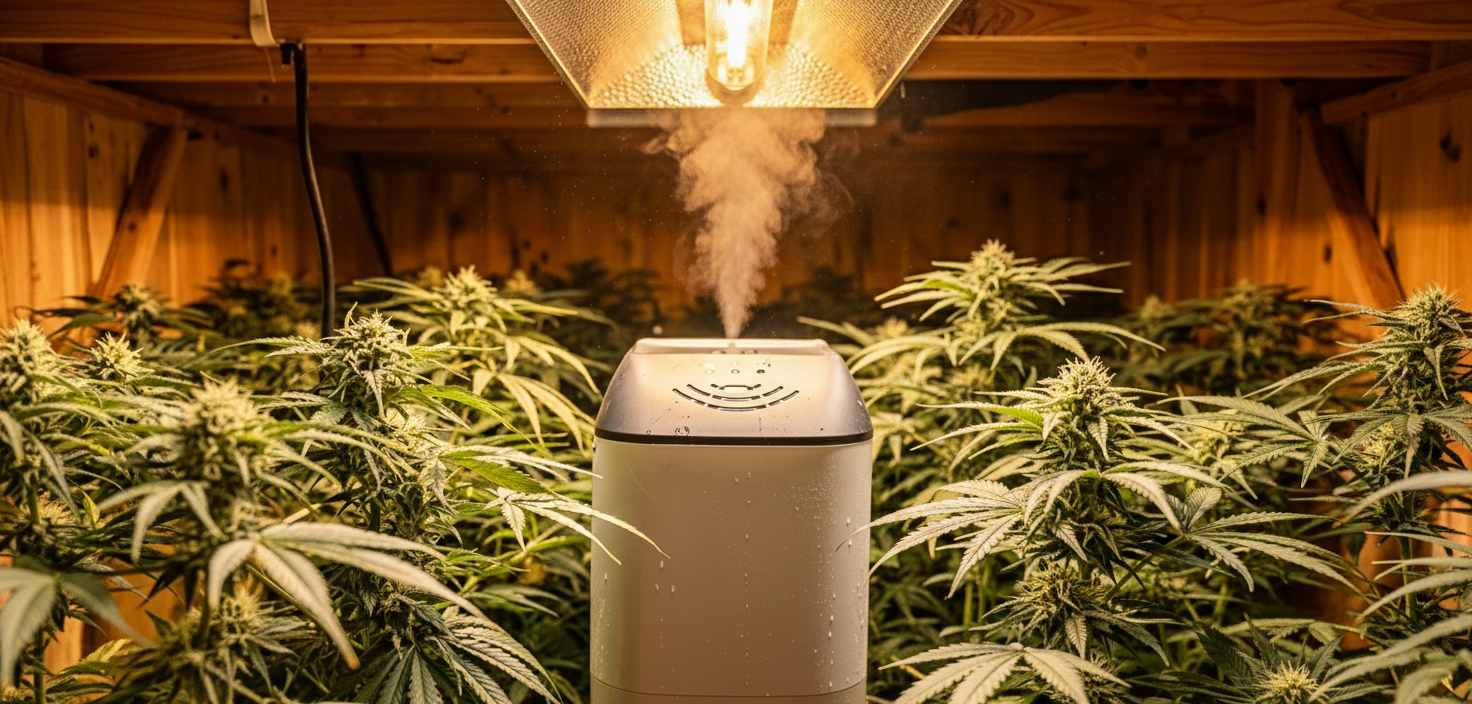
Root Temperature and Oxygen Control Uptake
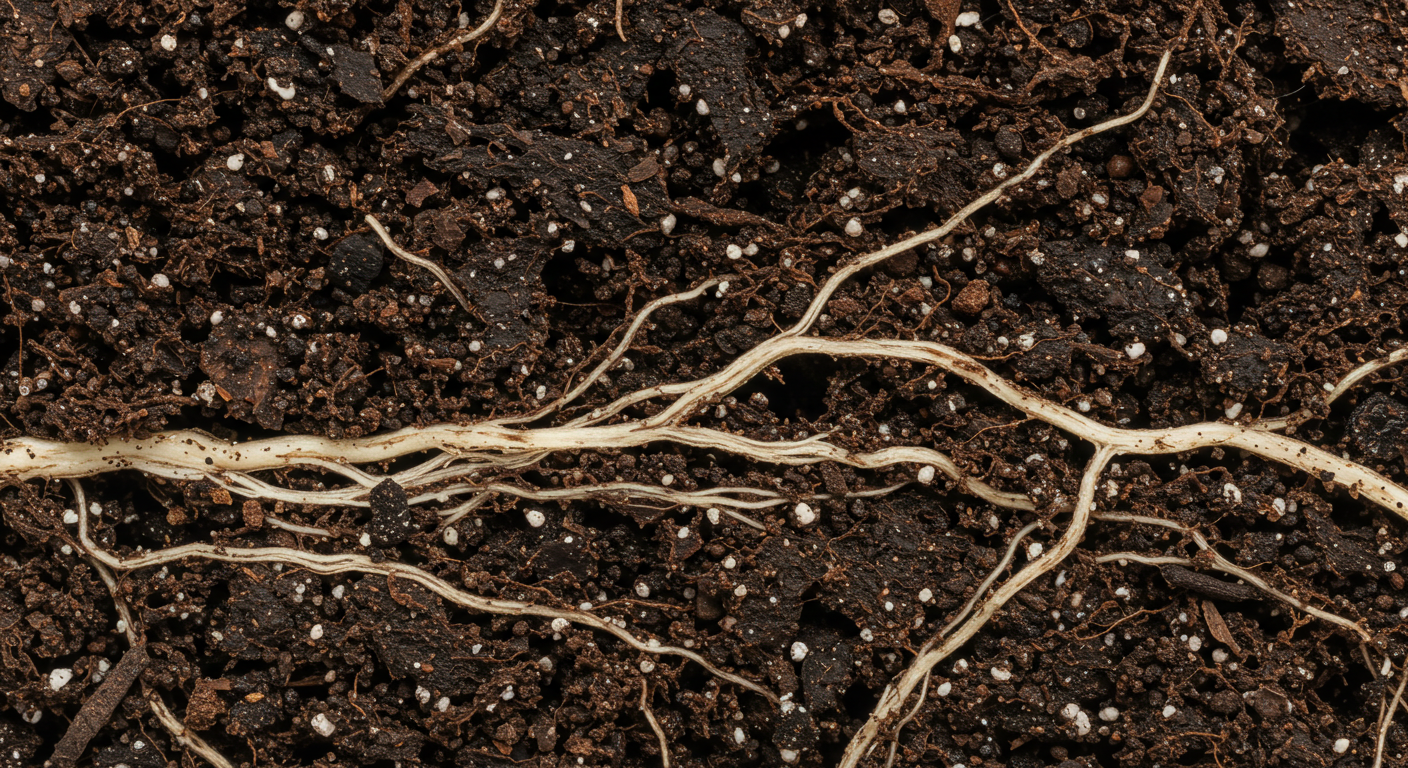
Roots need oxygen to generate the energy used for maintenance, growth, and active nutrient uptake. Saturated dense media, warm stagnant solution, decaying organic material, and biofilm can reduce oxygen around roots. The canopy may then show broad yellowing, weak posture, slowed water use, and multiple deficiency-like symptoms. Adding a complete deficiency kit to an oxygen problem increases EC around roots that are already struggling.
Cold roots can also slow nutrient uptake and water movement. This is common when pots sit directly on a cold floor or when reservoir temperature swings between light and dark periods. Warm roots are not always safer, because warmer water holds less dissolved oxygen and can favor unwanted biological growth. Stability and root observation matter more than chasing one temperature number without context.
"Why do the leaves look deficient when the reservoir numbers are correct?"
Question sent by: Mason Reed, via X.
Correct input numbers do not prove healthy uptake. Inspect root color, smell, solution temperature, aeration, water movement, biofilm, and recent pH behavior. Oxygen-limited or damaged roots can produce several deficiency-like symptoms while the required ions remain present in the reservoir.
"I increased the light, so should I raise EC on the same day?"
Question sent by: MaplePorch, via Facebook page.
Not automatically. Increase light in a controlled step, then watch canopy temperature, water use, root-zone EC, leaf posture, and new growth. If the crop uses more water and nutrients while remaining stable, a small feed adjustment may become justified. Raising light and EC together removes your ability to identify which change caused the response.
Plant Density and Root Volume Change the Same Recipe
A crowded canopy can intercept more light but also trap humidity, reduce lower-canopy airflow, and create large differences in water use. A root-bound plant can dry quickly while having less functional root volume through which to absorb ions. A large pot with a small plant can remain wet for too long. The concentration in the mixing tank does not reveal these differences.
Plant count, cultivar vigor, training style, container size, and irrigation layout should therefore be part of nutrient planning. When the room changes from a few large plants to many smaller plants, the same total canopy area may be supported by a very different root system and number of emitters. Revalidate irrigation volume, distribution, and dry-back before assuming the previous recipe will transfer unchanged.
Master Advice: Raise nutrient supply only after the crop proves it can use more. Healthy roots, increasing light interception, stable climate, stronger water use, and a controlled EC trend are evidence. A calendar date is not.
The practical sequence is environment first, roots second, irrigation third, and nutrient concentration fourth. These controls are not separate departments. Together they decide whether the ions in the solution become useful growth or unused salt.
The Essential Nutrients Cannabis Uses
Cannabis uses the same essential mineral elements as other higher plants. They are often divided into primary macronutrients, secondary macronutrients, and micronutrients. The categories describe the quantity required, not importance. A micronutrient can limit the crop just as completely as nitrogen if it is unavailable.
Carbon, hydrogen, and oxygen come mainly from carbon dioxide and water. The root-zone program must provide nitrogen, phosphorus, potassium, calcium, magnesium, sulfur, iron, manganese, zinc, copper, boron, molybdenum, chlorine, and nickel in usable forms. Silicon is not universally classified as essential, but it can be beneficial in some systems and conditions.
| Nutrient | Primary roles | Mobility and early clue |
|---|---|---|
| Nitrogen (N) | Chlorophyll, amino acids, proteins, vegetative growth | Mobile. Older leaves become uniformly pale or yellow; growth slows. |
| Phosphorus (P) | Energy transfer, nucleic acids, membranes, roots, reproduction | Mobile. Growth slows and lower leaves may spot or become necrotic. Purple color alone is not a reliable diagnosis. |
| Potassium (K) | Water regulation, stomata, enzymes, carbohydrate movement | Mobile. Older leaf margins or tips develop chlorosis and necrosis. |
| Calcium (Ca) | Cell walls, membranes, signaling, new tissue | Low mobility. New growth, leaf margins, and root tips are affected first. |
| Magnesium (Mg) | Central atom in chlorophyll, enzyme activation | Mobile. Interveinal chlorosis begins on older leaves. |
| Sulfur (S) | Amino acids, enzymes, proteins | Relatively low mobility. Younger growth becomes pale before older leaves. |
| Iron (Fe) | Electron transport and chlorophyll formation | Low mobility. Interveinal chlorosis appears on the newest leaves. |
| Manganese (Mn) | Photosynthesis and enzyme systems | Low mobility. Interveinal chlorosis with small specks appears on newer leaves. |
| Zinc (Zn) | Enzymes, growth regulation, internode development | Low mobility. New leaves may be small or distorted and internodes shorten. |
| Boron (B) | Cell walls, meristems, sugar transport, reproduction | Low mobility. Growing tips are damaged and new tissue becomes brittle or distorted. |
| Copper (Cu) | Enzymes, lignin, electron transfer | Low mobility. Young growth may become weak, twisted, or necrotic. |
| Molybdenum (Mo) | Nitrate metabolism | Mobile in many plants. Nitrogen-like paling can appear despite nitrogen supply. |
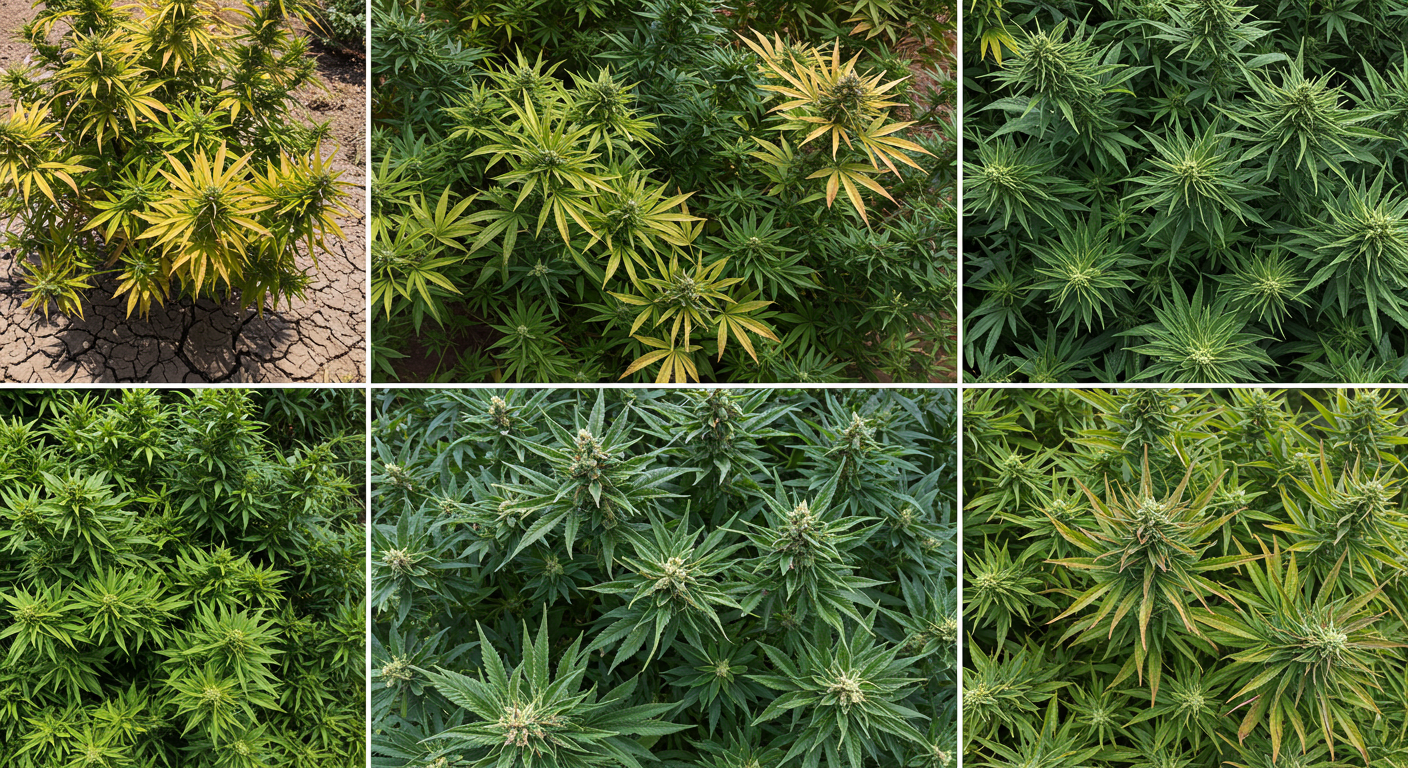
These clues are starting points, not diagnoses. Symptoms overlap. Light stress can bleach the upper canopy. Overwatering can create broad yellowing. Root disease can imitate multiple deficiencies. High potassium can suppress calcium and magnesium uptake. A damaged pH probe can make the grower chase a problem that was created by the measurement itself.
"Should I remove every leaf that shows a deficiency?"
Question sent by: Olivia Grant, via e-mail.
No. Remove tissue that is dead, diseased, or blocking necessary access, but keep useful leaves while they remain functional. Damaged leaves help show whether a symptom is still progressing. Judge the correction by healthy new growth and a stable root zone, not by expecting old necrotic tissue to become new again.
Pro Tip: Mark the newest affected leaf and photograph the same canopy zone under neutral light. Progression over several days is more useful than comparing unrelated leaves.
Do not diagnose from one leaf photograph.
Check symptom location, recent feed, source-water EC, root-zone pH and EC, irrigation behavior, root condition, canopy temperature, and light exposure before changing the formula.
How to Read N-P-K and Fertilizer Labels Correctly
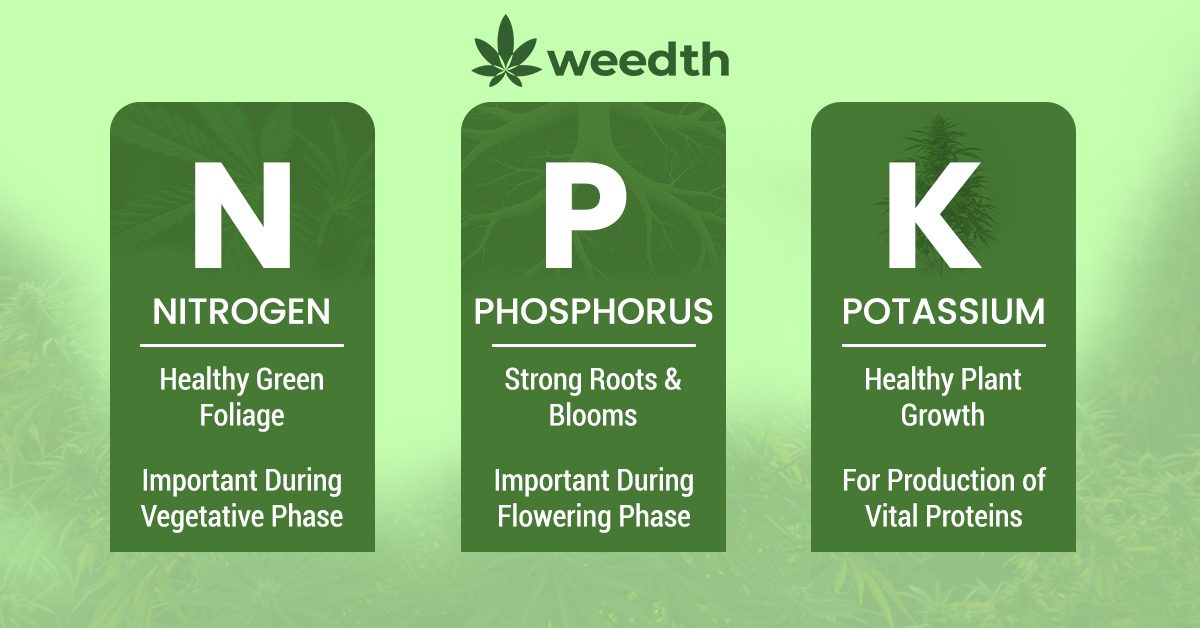
The three numbers on a fertilizer label are the guaranteed analysis for nitrogen, phosphate, and potash. In common labeling systems, a product marked 4-4-4 contains 4 percent total nitrogen, 4 percent available phosphate expressed as P2O5, and 4 percent soluble potash expressed as K2O by weight. The second and third numbers are not direct percentages of elemental phosphorus and elemental potassium.
This distinction matters when comparing a label with a research paper, water test, or nutrient calculator that reports elemental concentrations in milligrams per liter. Elemental phosphorus is approximately 43.6 percent of P2O5. Elemental potassium is approximately 83 percent of K2O. A grower who treats label numbers as elemental ppm can make a large calculation error.
Label strength also does not tell you the final root-zone dose. A concentrated 5-3-8 liquid can produce a mild or strong solution depending on dilution. A 0-50-30 bloom booster can still add a large and unnecessary phosphorus load at a small dose. The complete feed must be judged after every component and the source water are combined.
"Why can two 4-4-4 fertilizers behave differently?"
Question sent by: Derek Hall, via e-mail.
The front-label ratio does not show nutrient forms, micronutrients, release speed, raw materials, salinity, density, biology, or the recommended dose. One product may release through microbial mineralization while another dissolves quickly. Compare the full guaranteed analysis and directions, then test the final program in the intended medium.
Remember: A fertilizer label describes the product. Your meter, water report, recipe, irrigation volume, runoff, and plant response describe the feeding program.
Base Nutrients, Supplements, and Additives
A complete base nutrient should provide the essential elements in proportions suitable for the intended system. A supplement adds a targeted component such as calcium, magnesium, silicon, enzymes, or a biological inoculant. An additive may affect microbes, wetting, carbohydrates, or plant signaling without being a complete mineral feed.
The practical test is not how many bottles a program contains. It is whether the final solution supplies what the plant and medium need without duplication, precipitation, excessive EC, or unstable biology. Many three-part and two-part mineral programs are separated because calcium can react with concentrated phosphate or sulfate. The parts must be diluted into water separately.
"How do I know whether my base nutrient is complete?"
Question sent by: Hannah Cole, via Facebook page.
Read the guaranteed analysis for N, P, K, Ca, Mg, sulfur, and micronutrients, then check whether the manufacturer intends it for your medium and water type. A low label number does not mean incomplete, but a product that omits essential elements may depend on another part or on nutrients already present in the source water or medium.
Important: Count every bottle as part of one recipe. A supplement does not sit outside the EC budget merely because its label calls it optional.
Choose the Nutrient Program by Growing Medium
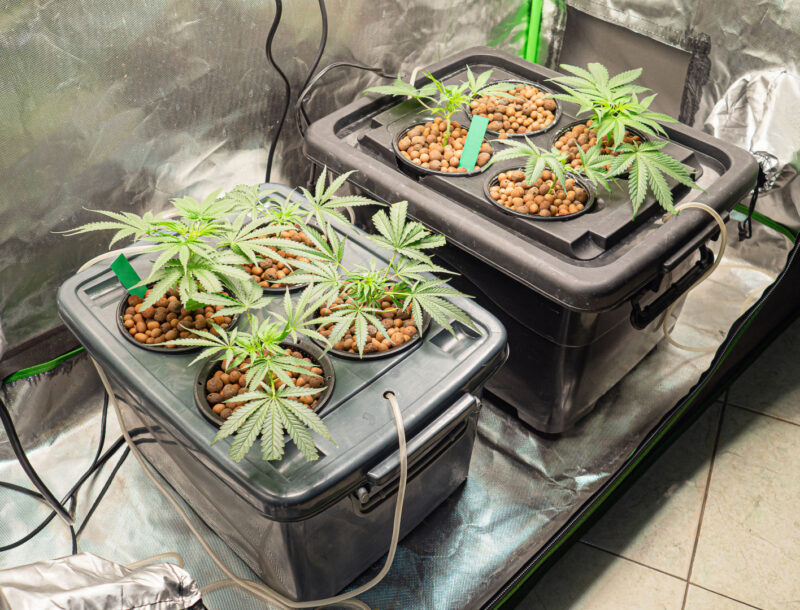
Now we can make the first major practical choice: what is standing between the nutrient solution and the root? The medium determines how much buffering exists between them. A pre-amended potting soil may already contain weeks of nutrition. Coco has a high cation exchange behavior that affects potassium, calcium, and magnesium management. Peat can acidify and change moisture behavior as it dries. Water culture exposes roots directly to the solution and responds quickly to chemistry and oxygen problems.
Do not use the same feeding frequency, pH target, or runoff interpretation across every system.
| System | Nutrition source | Main control | Main advantage | Main risk |
|---|---|---|---|---|
| Amended potting soil | Preloaded organic or mineral charge plus later top-dress or liquid feed | Moisture, root-zone pH, amendment release | Buffering and simpler early care | Stacking bottled feed onto a hot mix |
| Living soil | Mineralization of organic matter and amendments | Soil volume, moisture, biology, temperature | Biological nutrient cycling | Small pots, poor compost, uneven mineralization |
| Coco coir | Frequent complete fertigation | Input EC, runoff EC, irrigation frequency | Fast growth and precise control | Dry-back, salt concentration, Ca/Mg/K imbalance |
| Peat-based soilless | Complete liquid feed with some buffering | Moisture pattern, pH drift, substrate EC | Familiar container behavior | Compaction, channeling, acidic drift |
| Drain-to-waste hydroponics | Fresh solution supplied at each irrigation | Feed EC, drainage, runoff trend | Repeatability and oxygenated media | Waste, emitter variation, unchecked runoff |
| DWC or recirculating hydro | Shared aerated reservoir | Solution EC, pH, temperature, dissolved oxygen | Immediate access and rapid adjustment | Fast crop-wide failure from heat, pathogens, or mixing errors |
Soil and Living Soil
In soil, the grower is managing both the plant and the medium. Cation exchange sites, organic matter, microbes, moisture, and pH can buffer short-term changes. That does not make soil impossible to overfeed. Pre-amended mixes can be strong enough for young plants, and repeated bottled feeding can create salt accumulation in containers.
Living soil depends on biological mineralization. Microbes do not create nutrients from nothing; they transform nutrients already present in organic matter and mineral amendments. Release rate depends on moisture, temperature, aeration, substrate volume, carbon-to-nitrogen balance, and biological activity. A large, evenly moist container can be more stable than a small pot that repeatedly swings from saturated to dry.
"When should I begin feeding a pre-amended soil?"
Question sent by: Liam Fraser, via e-mail.
Begin only after the original charge is no longer meeting demand. Use the mix label as a rough starting point, then watch new growth, leaf color, water use, container size, and root-zone behavior. Feeding too early stacks liquid nutrition on top of nutrients that are still releasing.
Advice: In amended soil, write down what entered the container before the plant did. That inventory is the first page of the feeding schedule.
For a deeper explanation of physical structure, amendments, and root-zone behavior, use the cannabis soil and growing media guide.

Coco and Peat-Based Soilless Media
Coco is not soil. It is commonly managed with frequent, complete fertigation and controlled drainage. New or poorly buffered coco can exchange potassium and sodium while holding calcium and magnesium. A coco-specific base nutrient usually accounts for this behavior. Automatic heavy Cal-Mag dosing is not the solution; source water and the full formula still determine the requirement.
Frequent irrigation in coco is not the same as chronically waterlogging a dense soil. A well-structured coco container can retain air after irrigation, especially once roots are established. The danger is allowing the root zone to concentrate salts during an excessive dry-back, then applying a stronger feed to a plant that was already under osmotic stress.
Peat-based soilless mixes behave between soil and hydroponics. They offer useful water holding and some chemical buffering, but can shrink, channel, or become difficult to rewet when allowed to dry too far. Lime charge, irrigation-water alkalinity, and fertilizer acidity all influence long-term pH.
"Why does coco EC climb when my input EC stays the same?"
Question sent by: Noah Bennett, via contact form.
The root zone can concentrate salts when dry-back is too large, irrigation coverage is uneven, drainage is insufficient, or the plant removes proportionally more water than ions. Check moisture distribution and irrigation frequency before treating the higher EC as proof that the next feed must be stronger.
Remember: In coco, concentration and delivery are one decision. A suitable recipe delivered too late or too unevenly can become an unsuitable root-zone EC.
Water Culture and Recirculating Hydroponics
In DWC, NFT, and other recirculating systems, the reservoir is the root zone. Roots have immediate access to dissolved ions, so correction is fast, but mistakes are also fast. Temperature, dissolved oxygen, sanitation, pH stability, and the balance between water uptake and nutrient uptake matter every day.
Warm solution holds less oxygen and increases biological risk. A falling water level with rising EC usually means the plant is removing proportionally more water than nutrients. A falling EC can mean nutrient uptake is outpacing concentration. These patterns should be read over time, not from a single measurement.
"My DWC pH rises every day, but the plants look healthy. Is that always a problem?"
Question sent by: Sophia Tremblay, via Facebook page.
No. A gradual, repeatable drift can accompany plant uptake and changing solution chemistry. Record pH with EC, water level, temperature, and root condition. Rapid or accelerating movement, repeated large corrections, cloudy solution, or unhealthy roots justify investigation.
Test Source Water Before Choosing Supplements
Before you buy Cal-Mag, an acid, or an RO system, let's find out what is already coming from the tap. Source water is the first ingredient in every liquid feeding program, and its pH alone does not describe it. A useful water report includes electrical conductivity, alkalinity or bicarbonate, hardness, calcium, magnesium, sodium, chloride, sulfate, and, where relevant, boron, iron, manganese, and microbial quality.
Alkalinity is the water's resistance to acidification. Water can have an acceptable pH and still contain enough bicarbonate to push substrate pH upward over time. Hardness usually reflects calcium and magnesium, but it is not identical to alkalinity. High source-water EC can leave little room for fertilizer and may contain unwanted sodium or chloride.
Alkalinity measures acid-neutralizing capacity, not whether the water currently reads above pH 7.
Bicarbonate is a common contributor. A water report expressed as mg/L CaCO3 gives more useful long-term root-zone information than one source-water pH reading.
"Can I judge tap water from hardness or TDS alone?"
Question sent by: Caleb Turner, via e-mail.
No. Hardness does not reveal sodium, chloride, bicarbonate, or the separate calcium and magnesium concentrations. TDS is only a conversion from conductivity. Use a current water report to decide whether the water is useful, treatable, blendable, or unsuitable for the formula.
What to Remember: Water pH describes the sample now. Alkalinity helps predict how strongly that water will keep influencing the root zone later.
| Water pattern | What it may mean | Nutrient implication | First response | Avoid |
|---|---|---|---|---|
| Low EC, low alkalinity | Very soft or reverse-osmosis water | Little Ca, Mg, or buffering | Use a complete formula designed for soft water and monitor pH | Adding Cal-Mag without checking the base formula |
| Moderate hardness | Useful Ca and Mg may already be present | Hard-water formula may fit | Read the water report and product analysis together | Duplicating calcium and magnesium |
| High alkalinity | Bicarbonate can raise media pH | Acid requirement and pH drift increase | Measure alkalinity and use appropriate treatment | Judging the problem from source-water pH alone |
| High sodium or chloride | Salinity risk | Reduced osmotic margin and possible toxicity | Blend, filter appropriately, or change source | Trying to correct sodium with more fertilizer |
| Unstable well water | Seasonal mineral or microbial variation | Recipes may stop behaving consistently | Retest on a schedule | Assuming one old report is permanent |
Pro Tip: Record source-water EC before mixing. Total input EC without the source value hides how much of the reading came from fertilizer and how much came from the water.
Reverse-Osmosis Water
RO water gives the grower a clean and repeatable starting point, but it is not automatically better. It removes much of the calcium, magnesium, alkalinity, and other dissolved material. The nutrient program must rebuild an appropriate mineral profile. Very low alkalinity can also make pH move quickly when concentrated acid or base is added.
RO is useful when the original water contains excessive sodium, chloride, alkalinity, or inconsistent dissolved solids. It is unnecessary when the source water is already compatible with the chosen program. Producing RO water also creates reject water, so efficiency and disposal matter.
"Do I need Cal-Mag every time I use RO water?"
Question sent by: Emma Walsh, via e-mail.
No. RO water removes calcium and magnesium, but a complete soft-water or coco nutrient may already replace them. Add a separate supplement only after checking the base formula, medium, target EC, and plant response. More calcium and magnesium can raise EC and compete with potassium or other ions.
How the Growing Medium Buffers Nutrients
The irrigation solution is not the same thing as the solution touching every root. As water enters a container, ions can bind to exchange sites, react with amendments, precipitate, move with drainage, become immobilized in microbial biomass, or concentrate as water is removed. The medium decides how quickly the root zone follows an input change and how much history remains after the irrigation event.
Cation exchange capacity, usually shortened to CEC, describes a material's capacity to hold positively charged ions such as potassium, calcium, magnesium, and ammonium. It does not tell the whole story, but it helps explain why soil, peat, coco, rockwool, and water culture respond differently to the same recipe. A buffered medium can soften a small mistake, yet it can also store an imbalance that continues after the input has changed.
| Medium | Main buffering behavior | Practical feeding consequence |
|---|---|---|
| Mineral or amended soil | Clay, organic matter, lime, compost, and amendments can hold and release nutrients over time. | Input EC alone cannot describe fertility. Use amendment history, moisture, pH, and a suitable media test before adding more. |
| Peat-based soilless mix | Peat has exchange capacity and is commonly limed. Fertilizer acidity and water alkalinity can shift pH during the crop. | Track root-zone pH over time. Dry peat can channel water and create misleading runoff. |
| Coco coir | Exchange sites interact strongly with K, Ca, Mg, and sometimes Na. Product quality and buffering history matter. | Use a complete coco-compatible feed and stable fertigation. Do not correct every issue with an unmeasured Cal-Mag dose. |
| Rockwool or perlite | Relatively little chemical buffering compared with organic media, though water distribution still creates local differences. | Input changes reach roots quickly. Precise irrigation, drainage, and measurement are central. |
| Expanded clay | Low nutrient storage, but pores, dust, and reused material can hold residue or support biofilm. | Clean preparation and reservoir control matter more than a soil-style amendment plan. |
| DWC or aeroponics | The nutrient solution is the immediate root environment with almost no substrate buffer. | Corrections act quickly, so mixing errors, heat, oxygen loss, and pH drift can affect the whole crop quickly too. |
Coco Buffering Is a Chemical Process, Not a Product Ritual
Coco often contains exchange sites that preferentially hold calcium and magnesium while releasing potassium or sodium, especially when the material is new, poorly washed, or poorly buffered. Commercial buffering commonly exposes coco to calcium and magnesium so exchange sites are occupied before planting. The goal is not to make the medium permanently full of Cal-Mag. The goal is to begin with a more predictable exchange balance.
Once the crop is established, heavy supplemental calcium can still create problems. Calcium, magnesium, and potassium share parts of the uptake system and contribute to total salinity. If the base nutrient already accounts for coco and the source water contains useful minerals, another full-strength supplement can distort the ratio. Diagnose from the complete recipe and root-zone trend, not from the word "coco" alone.
Peat, Lime, and Alkalinity Work Over Time
Peat is naturally acidic, so commercial mixes commonly contain lime to raise and buffer pH. That lime charge is finite and can differ among products. Irrigation water with high alkalinity continually adds bicarbonate, which can push pH upward. A strongly acidifying fertilizer can move it in the other direction. This is why a fresh bag's stated pH does not guarantee the same pH six weeks later.
Repeatedly adjusting only the final irrigation pH may hide the longer-term cause. A grower using high-alkalinity water can reach an input pH of 6.0 with acid while still delivering substantial residual alkalinity if treatment is incomplete or inconsistent. A laboratory water report and root-zone samples reveal more than the pH number from one bucket.
"Why did a pH correction take days to show in peat?"
Question sent by: Carter Nguyen, via Facebook page.
Peat, lime, exchange sites, stored salts, moisture distribution, and alkalinity can delay or reshape the response. One corrected irrigation does not instantly replace the chemistry throughout the container. Standardize sampling and watch the trend before making a second large correction.
Master Advice: Match correction speed to buffering speed. A rapid hydroponic response and a delayed peat response should not be managed with the same rhythm.
Runoff Does Not Mean the Same Thing in Every Medium
Runoff from coco or rockwool can be a useful trend when irrigation timing and sampling are standardized. It can show that salts are concentrating or that one zone is receiving less solution. Runoff from a heavily amended soil is harder to interpret. Water may channel along the pot wall, dissolve localized fertilizer, or bypass dry pockets. The sample can look extreme without representing the average root environment.
Do not compare a first-drip sample from one day with a combined late-runoff sample from another. Record when the sample was collected, how much solution had been applied, pot moisture before irrigation, and whether several representative containers were combined. A number without a method is not a trend.
Ion Balance and Nutrient Antagonism
Nutrients do not enter the root independently. Ions share transport pathways, electrical balance, exchange sites, and a limited osmotic budget. An excess of one nutrient can therefore reduce the uptake or distribution of another even when the second nutrient is present. This interaction is commonly called antagonism. It is one reason why stacking supplements can create the appearance of deficiency.
Nutrient antagonism is reduced uptake or availability caused by the balance among ions, not simply by the absence of one nutrient.
Potassium, calcium, magnesium, and ammonium are common practical examples because increasing one can change access to the others.
Potassium, Calcium, and Magnesium
Potassium, calcium, and magnesium are all cations. High potassium supply can suppress calcium and magnesium acquisition. Cannabis research by Saloner, Sacks, and Bernstein found genotype-dependent growth responses to potassium and documented competition involving K, Ca, and Mg. One cultivar was damaged by the highest tested K supply while another responded differently. The study is a warning against universal potassium-heavy bloom recipes.
The practical consequence is straightforward. When older leaves show interveinal chlorosis, do not look only at the magnesium concentration. Check whether potassium was recently increased, whether a bloom booster was added, whether the source water changed, and whether root-zone EC rose. A magnesium supplement may temporarily increase Mg supply while leaving the excess K and salinity in place.
"Can too much potassium create a calcium problem?"
Question sent by: Abigail Ross, via e-mail.
Yes. High potassium can compete with calcium and magnesium acquisition, especially when total EC is already high. Review every potassium source, including bloom boosters and silica products that contribute K, before increasing calcium.
Ammonium, Nitrate, and Root-Zone pH
Plants can use nitrogen in nitrate and ammonium forms, but the ratio affects growth, charge balance, pH behavior, and metabolism. High ammonium can be toxic and can compete with other cations. A controlled cannabis study found that increasing the ammonium share reduced multiple measures of plant performance and secondary metabolism under its tested conditions. This supports a nitrate-dominant strategy for many controlled indoor systems, not a rule that ammonium must always be zero.
Nitrogen form also influences how roots exchange ions with the surrounding solution. Uptake of nitrate and ammonium can push rhizosphere pH in different directions. Urea must first be transformed before much of its nitrogen becomes directly available, and that transformation depends on biology and temperature. Total nitrogen on the label is therefore only the first layer of the formula.
Phosphorus, Micronutrients, and Precipitation
Excess phosphorus can contribute to micronutrient imbalance and environmental waste. At high concentration, phosphate can also react with calcium in a stock tank or improperly mixed reservoir and form insoluble material. The plant cannot use a nutrient that has fallen out of solution simply because the label says it was added.
Iron, manganese, zinc, copper, and boron are required in small amounts. Their availability is strongly affected by pH, chelation, precipitation, and competition. Adding separate micronutrient products to a complete base formula can narrow the safety margin. Boron and copper, for example, can move from deficiency toward toxicity across a much smaller concentration range than primary macronutrients.
Sodium, Chloride, and Bicarbonate Consume the EC Budget
EC counts conductive ions whether they help the plant or not. Sodium and chloride from source water can raise EC while reducing the room available for useful fertilizer. Bicarbonate can drive long-term pH behavior. A grower who sees a moderate total EC may assume the crop is fully fed even when a substantial part of the reading comes from unwanted source-water ions.
Reverse osmosis, blending, acid treatment, or a different water source may be appropriate depending on the laboratory report. No fertilizer additive converts excessive sodium into useful nutrition. This is why water treatment decisions should be based on individual ion concentrations and alkalinity, not on total dissolved solids alone.
"My formula contains magnesium, so why do the lower leaves still show interveinal yellowing?"
Question sent by: Dustin Miller, via e-mail.
Presence is not proof of uptake. Check root-zone pH and EC, potassium supply, irrigation uniformity, root health, temperature, and how the symptom moves through the canopy. Confirm the pattern before adding more magnesium. The cause may be competition or root stress rather than an empty bottle.
Important: When a complete formula produces a new deficiency-like symptom after an additive was introduced, investigate duplication and antagonism before buying another additive.
pH, EC, and PPM Without the Confusion
This is the point where many feeding conversations become harder than they need to be, so let's separate the measurements. pH describes acidity and alkalinity. EC describes how well the solution conducts electricity and acts as a practical indicator of total ionic concentration. PPM meters usually convert EC into a displayed number using a scale. Different 500, 640, or 700 conversion factors can show different PPM values for the same solution. EC is therefore the clearest number to share between growers.
Neither pH nor EC identifies individual nutrients. A solution with the correct EC can still have the wrong balance. A runoff sample with high EC may contain useful nutrients, unwanted ions, or both. A pH reading can be wrong when the probe is dry, dirty, old, poorly stored, or calibrated with expired solution.
Practical Starting Windows
The following values are conservative starting windows for established indoor systems, not universal laws. Product chemistry, source water, cultivar, stage, root-zone temperature, irrigation frequency, and light intensity can justify a different target. Measure the response rather than forcing the plant to match the table.
| Root-zone system | Common pH start | Cautious total input EC start | Main adjustment signal |
|---|---|---|---|
| Amended soil | About 6.0 to 6.8 | Often plain water early; later feed depends on charge | Plant color, vigor, substrate test, amendment history |
| Coco or peat soilless | About 5.7 to 6.3 | Young plants 0.6 to 1.0; established plants often 1.2 to 2.0 mS/cm | Runoff trend, dry-back, cultivar response |
| DWC or recirculating hydro | About 5.5 to 6.2 | Young plants 0.5 to 0.9; established plants often 1.1 to 1.9 mS/cm | Daily EC, pH, water uptake, root condition |
Some productive crops run outside these windows. That does not make the windows useless; it means they are starting points. A healthy, fast-growing crop with stable root-zone data should not be disrupted merely to reach a number seen online.
"Should I chase pH back to one exact number every hour?"
Question sent by: Ava Sinclair, via Facebook page.
No. Work within a suitable operating range and learn the system's normal drift. Repeated small doses of acid and base can add ions, destabilize a small reservoir, and hide alkalinity or biological problems. Correct a meaningful trend after confirming the probe, not every decimal movement.
Measure a stable, fully mixed sample.
Calibrate the probes, note temperature, and allow the reading to settle before recording it.
Correct every decimal change.
Frequent acid and base additions can create more chemistry than the original drift.
Tip: Keep a simple pH, EC, water-level, and temperature log. The direction of four measurements is more informative than one perfect-looking number.
Important: Measure pH after every nutrient component is fully diluted and mixed. Adjust pH last, then recheck after the solution has stabilized according to the product instructions.
Calibrating Meters
pH probes require correct storage solution, regular cleaning, and two-point calibration when precision matters. EC meters require calibration solution in the expected range. Rinse probes between solutions and do not pour used calibration liquid back into the bottle. Replace a probe that drifts, responds slowly, or will not calibrate.
Good records should include the meter model, calibration date, solution lot or expiry, source-water EC, final EC, final pH, irrigation volume, runoff percentage where relevant, runoff EC trend, and visible plant response. This turns diagnosis into comparison instead of memory.
"My two EC meters disagree. Which one should I trust?"
Question sent by: Logan Pierce, via e-mail.
Trust the meter that passes a fresh calibration check in a known standard and repeats the result. Rinse both probes, compare them at the same sample temperature, inspect for residue, and verify the displayed unit. Replace or service the meter that cannot hold calibration.
Fertilizer Math Without Guessing
You do not need to become a fertilizer chemist to make better calculations. We only need to keep the units honest and count every source. EC is useful for repeating a solution, but it does not reveal how many milligrams per liter of nitrogen, phosphorus, potassium, calcium, or magnesium are present. Two recipes can have the same EC and very different elemental balance. To compare products, read research, or build a precise program, we need the guaranteed analysis and the final dilution.
In dilute water solutions, one milligram per liter is approximately one part per million. To calculate the contribution of a dry fertilizer, convert the guaranteed percentage to a decimal, multiply it by the product mass, convert grams to milligrams, and divide by the final water volume.
Grams of product = target mg/L x final liters / (nutrient fraction x 1,000)
A 4 percent nutrient has a fraction of 0.04. This formula calculates only the nutrient named in the guaranteed analysis and assumes the label percentage is expressed in the same elemental form as the target.
A Simple Nitrogen Example
Suppose a dry fertilizer is 4 percent total nitrogen and you want that product to contribute 80 mg/L N to 10 liters of final solution. The required nitrogen is 80 mg/L x 10 L, which equals 800 mg N. The product contains 0.04 g N per gram, or 40 mg N per gram. Dividing 800 mg by 40 mg/g gives 20 grams of product.
The same result can be checked from the other direction. One gram of a 4 percent N dry fertilizer contains 40 mg N. Added to one liter, it contributes 40 mg/L N. Added to ten liters, that same gram contributes 4 mg/L. This quick check catches decimal errors before a concentrate reaches the plants.
That calculation does not prove the recipe is complete. The product may also add phosphorus, potassium, sulfur, or micronutrients. Every part of the program must be included in the final sum. Source water may also contribute calcium, magnesium, nitrogen, sulfur, sodium, or other ions.
Important: Write the chemical form beside every calculated number. Elemental P is not P2O5, elemental K is not K2O, and a product dose is not a final solution concentration.
Convert P2O5 and K2O Before Comparing Research
Fertilizer labels commonly express phosphorus as phosphate, P2O5, and potassium as potash, K2O. Research papers usually report elemental P and K. To estimate elemental phosphorus, multiply the P2O5 amount by about 0.436. To estimate elemental potassium, multiply the K2O amount by about 0.830.
For example, one gram of a dry product labeled 10 percent P2O5 contains 100 mg P2O5. That corresponds to about 43.6 mg elemental P. If the product is diluted into ten liters, it contributes about 4.36 mg/L elemental P. Treating the label's 10 percent as elemental phosphorus would overstate the contribution substantially.
The reverse conversion is useful when a target is elemental but a calculator asks for oxide form. Divide elemental P by 0.436 to estimate P2O5, and divide elemental K by 0.830 to estimate K2O. Keep the form written beside every number so P, P2O5, K, and K2O are never silently mixed in the same worksheet.
Liquid Products Need Density or a Manufacturer Calculator
A liquid label percentage is commonly a percentage by weight, while the grower measures milliliters by volume. Accurate conversion therefore requires the product density. Assuming one milliliter always weighs one gram can create error because concentrated fertilizers can be denser than water.
If the density is 1.20 g/mL, then 5 mL weighs 6 g. A 4 percent nitrogen product at that dose contains 0.24 g, or 240 mg, of nitrogen. In ten liters it contributes 24 mg/L N. If density is not listed, use a reliable manufacturer calculator or ask for the technical data sheet rather than inventing a conversion.
"Can I calculate liquid fertilizer ppm without knowing density?"
Question sent by: Natalie Chen, via contact form.
Not accurately when the guaranteed percentage is by weight and the dose is measured by volume. Use the product density, a reliable manufacturer calculator, or a laboratory formulation sheet. Assuming every milliliter weighs one gram can create a meaningful error in a concentrated product.
Household teaspoons and capfuls are poor precision tools. Use a clean graduated syringe, cylinder, or scale appropriate to the dose. Keep tools dedicated to each concentrate so residue from Part A does not contaminate Part B.
Calculate the Final Recipe, Not One Bottle
A multi-part program can supply the same element from several sources. Calcium nitrate adds both calcium and nitrate nitrogen. Magnesium sulfate adds magnesium and sulfur. Monopotassium phosphate adds potassium and phosphorus. A bloom additive can duplicate P and K already supplied by the base. A Cal-Mag supplement can add more nitrogen than expected.
Create one line for every product and source-water contribution. Sum elemental N, P, K, Ca, Mg, and S first, then verify micronutrients. Record the nitrogen forms when available. Compare the totals with published research only after accounting for the different cultivar, stage, environment, and root-zone system.
| Step | Record | Why it matters | Common error |
|---|---|---|---|
| 1. Water | Final volume, source EC, alkalinity, and individual ions | The source contributes to both nutrition and total salinity. | Calling all source-water EC "calcium and magnesium." |
| 2. Products | Dose, guaranteed analysis, nutrient form, and density for liquids | Each product can supply several elements. | Counting only the nutrient advertised on the front label. |
| 3. Conversion | Elemental N, P, K, Ca, Mg, S, and micronutrients in mg/L | Elemental units allow a valid comparison with research and tissue targets. | Using P2O5 as P or K2O as K. |
| 4. Verification | Mixed EC, pH, appearance, and a small test batch | The physical solution must match the calculation. | Trusting a spreadsheet after precipitation or a weighing mistake. |
EC Is a Checksum, Not a Recipe
Once a known recipe is mixed in the same water at the same temperature, EC becomes an excellent consistency check. A reading far from the normal value can reveal a missed part, double dose, incorrect water volume, or meter problem. It cannot prove that the recipe contains the correct ratio of individual nutrients.
Temperature compensation also deserves attention. Many meters compensate automatically, but the feature and reference temperature vary. Let calibration solution and samples reach a similar stable temperature when possible. Rinse the probe and allow the reading to settle rather than accepting the first changing number.
"My calculated recipe is correct, but the EC is much higher than expected. What should I check first?"
Question sent by: RiverRoom, via Facebook page.
Confirm final water volume, source-water EC, product doses, liquid density assumptions, meter calibration, and whether a part was added twice. Look for evaporation, sediment, or a concentrate that was not fully dispersed. Do not irrigate until the difference is explained.
Dry Salts vs Liquid Nutrient Concentrates
Dry mineral salts and liquid concentrates can deliver the same plant-available ions. The meaningful differences are formulation, convenience, shipping weight, measurement, solubility, stability, and the grower's ability to calculate and mix accurately. A liquid is not automatically more available to the plant once both products are fully dissolved.
Dry Salts
Dry fertilizers can be economical because the grower is not paying to ship as much water. They can offer transparent elemental control and long storage life when kept dry, sealed, and uncontaminated. They also require an accurate scale, correct water volume, suitable purity, complete dissolution, and an understanding of incompatibilities.
Hygroscopic salts pull moisture from the air and may cake or change weighing behavior. Some compounds dissolve endothermically and cool the water. Others have limited solubility at low temperature. A clear solution after mixing is useful evidence, but not all precipitation appears immediately. Never assume every agricultural salt is appropriate for a recirculating cannabis system. Purity, contaminants, and labeling matter.
"Is a cheaper dry-salt program automatically better?"
Question sent by: Benjamin Clark, via e-mail.
No. Compare purity, analysis, trace contaminants, solubility, storage, scale accuracy, labor, and the risk of a calculation error. Dry salts can be precise and economical, but only when the room can prepare and verify them consistently.
Liquid Concentrates
Liquids simplify small-batch dosing and can keep compatible ingredients together at useful concentrations. Commercial two-part or three-part programs separate reactive ions and often include chelated micronutrients. Their main disadvantages are shipping water, higher cost per unit of nutrient, density-dependent calculations, and the possibility of settling, freezing damage, crystallization, or biological spoilage in products containing organic material.
Shake only when the label instructs it. Some concentrates should be homogeneous; others may contain suspended material by design. Check the storage temperature, expiry, lot number, and whether opened biological products require refrigeration. Discard a product that has an unexplained odor, gas pressure, mold, or permanent precipitate inconsistent with the technical instructions.
Stock Solutions and Injector Systems
Larger rooms may prepare concentrated stock tanks for proportional injectors. Stock concentration must stay below solubility limits, and incompatible materials must be separated. Calcium belongs apart from concentrated phosphate and sulfate in many programs. Acid injection requires compatible equipment, secondary containment, ventilation, personal protective equipment, and trained handling.
Injector calibration should be verified by measuring actual drawdown or output, not accepted from the dial alone. Check the first and last emitter, because a correctly injected reservoir does not guarantee uniform delivery through a long line. Flush equipment according to the system design and record stock preparation by lot.
Pro Tip: Choose the format you can measure, explain, store, and repeat. Precision from dry salts is valuable only when the calculations and scale are correct. Convenience from liquids is valuable only when every dose and nutrient contribution is understood.
Build the Feeding Program by Growth Stage
Let's stop treating the feeding chart as a set of chemical calendar flips. Cannabis nutrient demand changes with plant size, root mass, light interception, transpiration, and reproductive development, and that change is gradual. A plant does not suddenly stop needing nitrogen when flowering begins, and it does not require an extreme phosphorus dose simply because buds are forming.
| Stage | Plant priority | Nutrition and irrigation priority | Main risk and quality focus |
|---|---|---|---|
| Seedling or fresh clone | Establish active roots and compact new growth. | Use low-concentration complete nutrition only when the medium needs it. Wet the small root zone without saturating the whole container. | Avoid feeding a pre-amended mix too soon. Protect root health before chasing leaf size. |
| Early vegetative | Expand roots, leaves, and branches evenly. | Supply adequate N, Ca, Mg, and micronutrients. Expand the wetted area as roots colonize the pot. | Avoid excess N used only to darken leaves. Aim for strong structure and an even canopy. |
| Late vegetative | Construct the flowering canopy. | Match feed to rising light interception and water use. Prevent dry pockets and salt concentration. | Avoid raising EC faster than demand. Preserve uniform branches and active roots. |
| Transition | Support stretch and flower initiation together. | Maintain useful N while adjusting the complete balance gradually. Track rapid changes in water use. | Avoid an overnight switch to a zero-N bloom feed. Keep stretch controlled and flower sites healthy. |
| Early to mid flower | Build flowers while maintaining leaf and root function. | Keep a stable complete feed with sufficient K, Ca, Mg, and S but no extreme P. Hold root-zone EC steady. | Avoid stacking boosters. Protect resin potential, aroma, and density through consistency. |
| Late flower | Maintain function while the crop ripens. | Reduce supply only when uptake and the crop plan justify it. Avoid severe wet-dry or salt swings. | Avoid calendar-based starvation. Finish with healthy flowers and correct harvest timing. |

Seedlings and Rooted Clones
Young plants have a small root system and low total demand. The correct strategy depends on the starter medium. A mild, pre-amended mix may need only correctly managed water. An inert plug or coco starter may need a low-strength complete nutrient early. The first target is active white roots and steady new growth, not maximum leaf darkness.
Feed concentration must rise with demonstrated demand. Cotyledons naturally age, but fast yellowing, stalled new growth, persistent saturation, or burnt tips require investigation. In small containers, poor watering technique causes more problems than minor changes in N-P-K ratio.
"My seedling is pale. Should I feed immediately?"
Question sent by: Grace Wilson, via e-mail.
First check whether the paling is limited to aging cotyledons or is spreading through new growth. Confirm moisture, root-zone temperature, medium charge, pH, and root development. A cautious complete feed may help an inert medium, while the same dose can burn a wet or pre-amended mix.
Vegetative Growth
Nitrogen supports proteins and chlorophyll, but excessive nitrogen is not a shortcut to more photosynthesis. Very dark leaves, soft growth, clawing, delayed dry-back, and rising root-zone EC can indicate an overly strong or imbalanced program. The ideal vegetative plant is vigorous and structurally balanced, not merely dark green.
"Do dark green leaves mean the plant is healthy?"
Question sent by: Owen Murphy, via Facebook page.
Not by themselves. Healthy color must be read with growth rate, leaf posture, internode spacing, root-zone EC, and water use. Very dark, glossy, clawed leaves with soft growth can signal excessive nitrogen even when the canopy looks impressively green.
Pro Tip: Use new-leaf size, branch strength, root expansion, and daily water use as vegetative performance markers. Color alone is too easy to overfeed.

Transition and Flowering
During the stretch, the plant is still building substantial stems and leaves while initiating flowers. Removing nitrogen too aggressively can create premature deficiency and reduce canopy function. A sensible bloom transition changes the overall ratio gradually and monitors the crop.
Flowering demand is not a license for extreme phosphorus. Peer-reviewed cannabis studies have repeatedly found useful phosphorus concentrations far below the dramatic levels suggested by some bloom boosters. In one soilless Gelato study, modeled maximum yield occurred near 59 mg/L elemental P, while increasing potassium across a broad tested range did not increase yield. Another study found that 30 mg/L P produced most of the maximum yield in two genotypes and that more P could dilute cannabinoid concentration. These are specific experiments, not universal recipes, but they strongly challenge the assumption that more bloom phosphorus always builds better flowers.
Weedth Grower Note: Flower quality comes from sustained plant function. A balanced program that keeps roots active and leaves productive usually beats a late stack of high-EC boosters.
A Detailed Indoor Stage Playbook
The following stage notes are operating logic, not a week-by-week recipe. Cultivars finish at different speeds, and a mother plant, a small autoflower, and a long-flowering photoperiod plant should not be forced into the same calendar. Move to the next feeding decision when root development, canopy growth, water use, and flower development show that the plant has moved.
Propagation and the First Active Roots
Fresh cuttings have limited or no functional roots. Their early survival depends more on water balance, sanitation, oxygen, and a suitable propagation environment than on strong root-zone nutrition. A lightly charged propagation plug may already contain enough material for the first stage. In an inert plug, a low-concentration complete solution can support the roots as they emerge.
Avoid soaking large cubes or containers around a tiny root system. The outer medium can remain wet and oxygen-poor while the cutting uses very little water. Judge progress by new root tips, stable leaf posture, and resumed growth. Foliar color can remain pale briefly after rooting; raising EC before the roots expand may burn the first delicate tissue.
Early Vegetative Establishment
After transplant, the root system must connect the starter plug to the new medium. Irrigation should encourage that expansion without leaving a permanently saturated outer zone. In coco or rockwool, gradually increase the volume and distribution of complete feed. In amended soil, count the existing charge before introducing liquid fertilizer.
Nitrogen demand rises as leaf area expands, but the target is functional green tissue, not the darkest possible leaf. Track internode spacing, side-branch development, new-leaf size, and daily water use. If a plant is dark, clawed, and slow to dry, more nitrogen is unlikely to improve it.
Late Vegetative Canopy Construction
Late vegetative nutrition prepares the plant for flowering. Roots, stems, branches, and leaf area must be able to support future flowers. This is the time to correct irrigation nonuniformity, weak root development, and recurring pH drift. Problems carried into flower become harder to correct without affecting bud development.
Training and pruning temporarily change the balance between roots and shoots. Water use may pause after a major canopy adjustment. Do not increase feed merely because the calendar says the plant is larger. Wait for new growth and demand to resume. A stable late-vegetative crop should show even tops, predictable dry-back, and no expanding deficiency or burn pattern.
Transition and Stretch
The first part of flowering is still a period of rapid vegetative growth. Stems elongate, leaves expand, roots remain active, and flower sites form. Nitrogen remains essential. The useful change is a gradual rebalance of the complete formula, not an abrupt removal of N combined with a large P-K increase.
Water use often changes quickly during stretch. Recheck emitter coverage and pot moisture rather than simply increasing shot volume everywhere. Plants at the edge of the room or smaller phenotypes may not need the same frequency. Root-zone EC should remain controlled while the canopy is changing most rapidly.
Early Flower Construction
During early flower, the plant builds the framework of the inflorescence while maintaining leaves and roots. A complete formula should still supply every essential element. Calcium delivery depends on roots and water movement, magnesium supports chlorophyll, potassium supports water relations, sulfur supports proteins and metabolism, and phosphorus remains necessary without needing extreme concentration.
A common mistake is to add a base bloom formula, a PK booster, a carbohydrate product, and a Cal-Mag supplement at the same time. If the plant then burns or fades, the cause is difficult to isolate. Introduce only a justified change, record the final EC and elemental contribution, and watch new growth.
Mid Flower and Peak Demand
Mid flower can combine high water use, substantial light interception, dense roots, and increasing flower mass. The crop may use more total nutrients because it uses more solution, even when concentration stays unchanged. Total delivery is concentration multiplied by irrigation volume. A grower who raises both at once can create a much larger nutrient increase than intended.
Inspect flowers and the inner canopy while evaluating feed. Disease, trapped humidity, or root stress can slow demand. If water use falls suddenly, do not keep delivering the previous volume and strength without investigating. Confirm climate, irrigation hardware, roots, and crop health first.
"Water use increased in mid flower, but runoff EC also rose. Should feed go up?"
Question sent by: Madison Hart, via e-mail.
No. Rising runoff EC shows that the root zone is concentrating ions despite the higher water use. Check irrigation frequency, distribution, drainage, input EC, and climate. The crop may need more solution volume or better timing, not a stronger concentration.
Late Flower and Ripening
Late flower is not a contest to keep every leaf perfectly green, and it is not a requirement to force every plant yellow. Older leaves may senesce as the crop matures, but rapid whole-canopy collapse can shorten productive function and increase disease risk. The rate and timing differ among cultivars.
Use water use, root-zone EC, flower maturity, and cultivar history to decide whether supply should decline. Avoid maintaining an unnecessarily strong recipe after uptake falls. Also avoid replacing complete nutrition with plain water too early based only on an expected harvest date. A harvest date can move; severe stress cannot be undone instantly.
Mother Plants and Long-Term Vegetative Plants
Mother plants create a different nutrition problem because they remain vegetative for months and are repeatedly pruned. Salt accumulation, root binding, woody growth, uneven irrigation, and micronutrient drift can appear even when the weekly recipe never changes. Periodic root-zone assessment and planned renewal are more useful than continually increasing nitrogen.
After taking many cuttings, water use may drop because leaf area was removed. Adjust irrigation temporarily while roots and shoots rebalance. Maintain enough nutrition for clean new growth, but do not treat every pale shoot after heavy pruning as an immediate deficiency.
"Should I switch to bloom nutrients on the first 12/12 day?"
Question sent by: Lucas Martin, via e-mail.
Not as an abrupt nutrient reset. The plant is entering stretch and still needs nitrogen, calcium, magnesium, sulfur, and micronutrients. Follow the base program's intended transition, change the overall balance gradually, and use plant response and root-zone data instead of treating the timer as a chemical switch.
What Cannabis Research Says About N, P, and K
Cannabis nutrition research is expanding, but many trials use one or two cultivars, a specific environment, and a specific hydroponic or soilless system. The most responsible use of this evidence is to identify direction and risk, then validate the final recipe in the actual room.
Nitrogen: Essential, Powerful, and Easy to Overdo
A controlled vegetative study reported an optimum near 160 mg/L N for the tested drug-type cannabis conditions, while severe nitrogen limitation sharply reduced biomass and photosynthesis. A separate flowering study modeled maximum yield near 194 mg/L N in one Gelato cultivar. These values show that cannabis needs meaningful nitrogen, but they do not establish a universal target for every cultivar, medium, or room.
"Should I copy the 194 mg/L nitrogen result exactly?"
Question sent by: Emily Dawson, via Facebook page.
No. It is evidence from a defined cultivar, stage, solution, environment, and research method. Use it to understand the response curve and the risk of too little or too much N. Build your operating range from the actual medium, water, light, cultivar, and root-zone trend.
Advice: Carry the method with the number. A concentration separated from cultivar, stage, environment, and sampling method is not a transferable recipe.
Nitrogen form also matters. Research comparing ammonium and nitrate ratios found that high ammonium reduced yield, cannabinoids, and terpenes under the tested conditions. Most complete cannabis fertilizers therefore rely mainly on nitrate with a smaller ammonium fraction. The correct ratio also interacts with pH behavior and root-zone chemistry.
Phosphorus: Necessary, but High-P Marketing Is Ahead of the Evidence
Phosphorus is essential for energy transfer, membranes, and reproductive development. Deficiency can be severe. However, high phosphorus is not automatically beneficial. Trials have found plateaus in yield at moderate P supply, while excessive root-zone P accumulated without improving flower quality. This makes routine use of 0-50-30 style products difficult to justify without measured evidence of need.
Potassium: Cultivar Response and Ion Balance Matter
Potassium regulates water relations, stomata, enzymes, and transport. It is important during flowering, but response is genotype-dependent. A study comparing two cannabis genotypes found very different growth responses to potassium supply, and high K influenced calcium and magnesium acquisition. This is why a single "indica feed" or "sativa feed" chart is too crude. The individual cultivar and root-zone data matter more than the marketing category.
Raise nutrition from measured demand.
Use plant vigor, input and root-zone EC, water use, stage, and cultivar history to make small changes.
Stack boosters because flowering started.
Multiple phosphorus, potassium, carbohydrate, and Cal-Mag products can duplicate ions and raise EC without improving quality.
Calcium, Magnesium, Sulfur, and Micronutrients
Calcium, magnesium, and sulfur are sometimes called secondary nutrients only because plants need less of them than N, P, and K. They remain central to structure, chlorophyll, proteins, enzymes, and signaling. Their management is strongly affected by source water, medium, transpiration, and competition among ions.
Calcium
Calcium moves mainly with the transpiration stream and is not easily relocated from old leaves to new tissue. New growth and rapidly expanding tissues are therefore vulnerable when root uptake or water movement is restricted. Low root-zone oxygen, cold roots, high humidity, damaged roots, and excessive salinity can create calcium-like symptoms even when calcium is present in the solution.
Adding calcium without checking potassium, magnesium, ammonium, and total EC can increase competition rather than solve the cause. In coco, use a formula designed for the medium and monitor the actual root-zone trend.
"Why can calcium symptoms appear in high humidity?"
Question sent by: Jack Thompson, via e-mail.
Calcium is carried largely with water movement toward developing tissue. High humidity, dense foliage, weak airflow, or low root activity can reduce that delivery even when the solution contains enough Ca. Correct the transport problem before raising calcium and total EC.
Remember: Calcium management is partly climate management. Presence in the tank does not guarantee delivery to the newest tissue.
Magnesium
Magnesium is mobile and central to chlorophyll. Deficiency often begins as interveinal chlorosis on older leaves. A recent controlled cannabis trial found an optimum near 35 mg/L Mg under its specific conditions, with reduced performance at low and high supply. That value is useful evidence of a response curve, not a universal recipe.
Epsom salt supplies magnesium and sulfur. It does not supply calcium and is not a complete Cal-Mag replacement. Use it when the formula or a test identifies a magnesium requirement, not as an automatic weekly ritual.

Sulfur and Micronutrients
Sulfur contributes to amino acids and proteins and can affect the plant's metabolic capacity. Micronutrients are required at low concentrations, so the distance between deficiency and excess can be small. A complete base fertilizer normally supplies them. Repeatedly adding separate iron, zinc, boron, or manganese products without evidence is risky.
"Should I add iron when the newest leaves turn yellow?"
Question sent by: Sarah Collins, via e-mail.
Only after confirming the pattern and cause. High pH, cold or damaged roots, excess moisture, precipitation, or micronutrient antagonism can reduce iron availability while the formula already contains enough. Check the root zone and complete recipe before adding a narrow-margin micronutrient.

Indoor vs Outdoor Cannabis Nutrition
Now let's answer a comparison that often creates the wrong feeding advice: does an indoor plant need a different set of nutrients from an outdoor plant? The essential nutrient list does not change. The important differences come from root volume, environmental control, nutrient sources, water movement, biological diversity, and our ability to measure and correct the system.
An outdoor plant in healthy ground can explore a much larger soil volume. Weathering, organic matter, rain, irrigation, native minerals, fungi, bacteria, insects, and seasonal temperature all influence nutrient release. That plant may access reserves unavailable to a small indoor container, but it also faces leaching, drought, cold soil, heavy rain, and less predictable mineralization.
An indoor plant is deprived of that large natural buffer and broad ecological network unless the grower intentionally recreates part of it. In return, indoor cultivation offers consistent light, temperature, irrigation, solution chemistry, and root-zone design. Outdoor plants are deprived of that precision. Neither environment is inherently superior. Each creates a different management problem.
"Can I bring an outdoor feeding schedule indoors?"
Question sent by: Wyatt Campbell, via Facebook page.
Use it only as background information. Indoor containers have less root volume, controlled irrigation, different light, and faster salt accumulation. Recalculate the recipe for the indoor medium and water, then start cautiously and verify the root-zone trend.
| Factor | Indoor management | Outdoor management |
|---|---|---|
| Root volume | Containers and hydroponic systems restrict the root zone, so concentration can change quickly. Irrigation and EC need close control. | In-ground roots may explore a much larger volume. Soil structure and testing matter more than a bottle schedule. |
| Nutrient reserve | The medium and feed define the reserve. Recipe records and substrate tests reveal what is available. | Native soil and amendments provide broader but less predictable reserves. Soil and water tests guide additions. |
| Biology | Biology may be narrow, deliberately managed, or excluded in a clean mineral system. Small pots magnify release-rate errors. | Biology is usually more diverse and seasonal. Indoor amendment rates should not be copied directly from ground soil. |
| Leaching | Drainage is created by irrigation, so the grower controls both salt removal and nutrient waste. | Rain can leach mobile nutrients, especially after storms. Split applications reduce avoidable loss. |
| Climate | A stable room can support predictable uptake, but equipment failure changes the whole crop quickly. | Weather controls root temperature and moisture. Diagnose cold or saturated soil before adding feed. |
| Light | Spectrum, intensity, and photoperiod are fixed by the fixture and schedule. EC must match the actual photosynthetic load. | Sun angle, day length, and clouds change demand. Feeding must follow seasonal growth rather than an indoor chart. |
Do Indoor and Outdoor Strains Need Different Fertilizers?
There is no reliable universal nutrient formula for "indoor strains" and another for "outdoor strains." Breeders may select cultivars for compact structure, flowering time, mold resistance, heat tolerance, or production environment, but those labels do not reveal a precise nutrient requirement.
Use phenotype behavior. A compact, slow-transpiring cultivar in a small room may accumulate salts at a feed that a vigorous, high-transpiration cultivar uses comfortably. A long-flowering cultivar may need sustained nitrogen longer than a fast cultivar. A cultivar prone to weak stems may benefit from better environmental and mineral balance, but simply increasing potassium or silicon is not a substitute for correct light, airflow, and structure.
Advice: Build a cultivar record. Note the EC at which tips first burn, how quickly the pot dries, how pH moves, when lower leaves fade, and how the plant responds after each change. The second run should not begin from zero knowledge.
Cultivar, Phenotype, and Autoflower Feeding Differences
Scientific work has already shown cultivar-specific responses to potassium, nutrient uptake, and microbial inoculants. This means brand schedules should be treated as starting templates. The same cultivar can also behave differently under another light level, VPD, root volume, or irrigation frequency.
Do not rely on indica, sativa, or hybrid labels for feeding strength. Those commercial categories do not predict exact nutrient demand. Observe growth rate, leaf posture, color, internode spacing, root-zone EC, and water use.
Autoflowers
Autoflowers often have a shorter life cycle and less recovery time after early stress. That does not mean every autoflower requires half-strength nutrients. It means the grower should avoid abrupt jumps, oversized doses in a small root zone, and transplant or watering mistakes that consume a large fraction of the plant's schedule.
A vigorous large autoflower in coco under strong light may use more nutrition than a small photoperiod plant. Start cautiously, then respond to the actual plant. Keep nitrogen available through the early flowering transition rather than forcing an early bloom-only formula.
"Should autoflowers always receive half-strength nutrients?"
Question sent by: Lily Morgan, via e-mail.
No. Half-strength is a cautious starting phrase, not a biological rule. A vigorous autoflower in an inert medium can use more than a small photoperiod plant in amended soil. Increase only from measured demand because an autoflower has less time to recover from an early excess.
"Should every cultivar receive the same EC if they are in the same room?"
Question sent by: GrowNorth, via X.
No. Shared climate does not create identical uptake. Group cultivars by observed demand where possible. If one reservoir must serve all plants, use the concentration tolerated by the more sensitive group and correct irrigation uniformity before increasing strength.
Organic vs Synthetic Fertilizers Indoors
The organic-versus-synthetic debate gets loud quickly, but the plant gives us a calmer place to begin. Plants absorb mineral ions. Organic and synthetic describe the source and delivery pathway, not a different set of plant requirements. Organic inputs depend more heavily on decomposition and mineralization. Mineral salt fertilizers deliver soluble ions more directly. Both can grow excellent cannabis when the complete root-zone system is well managed.
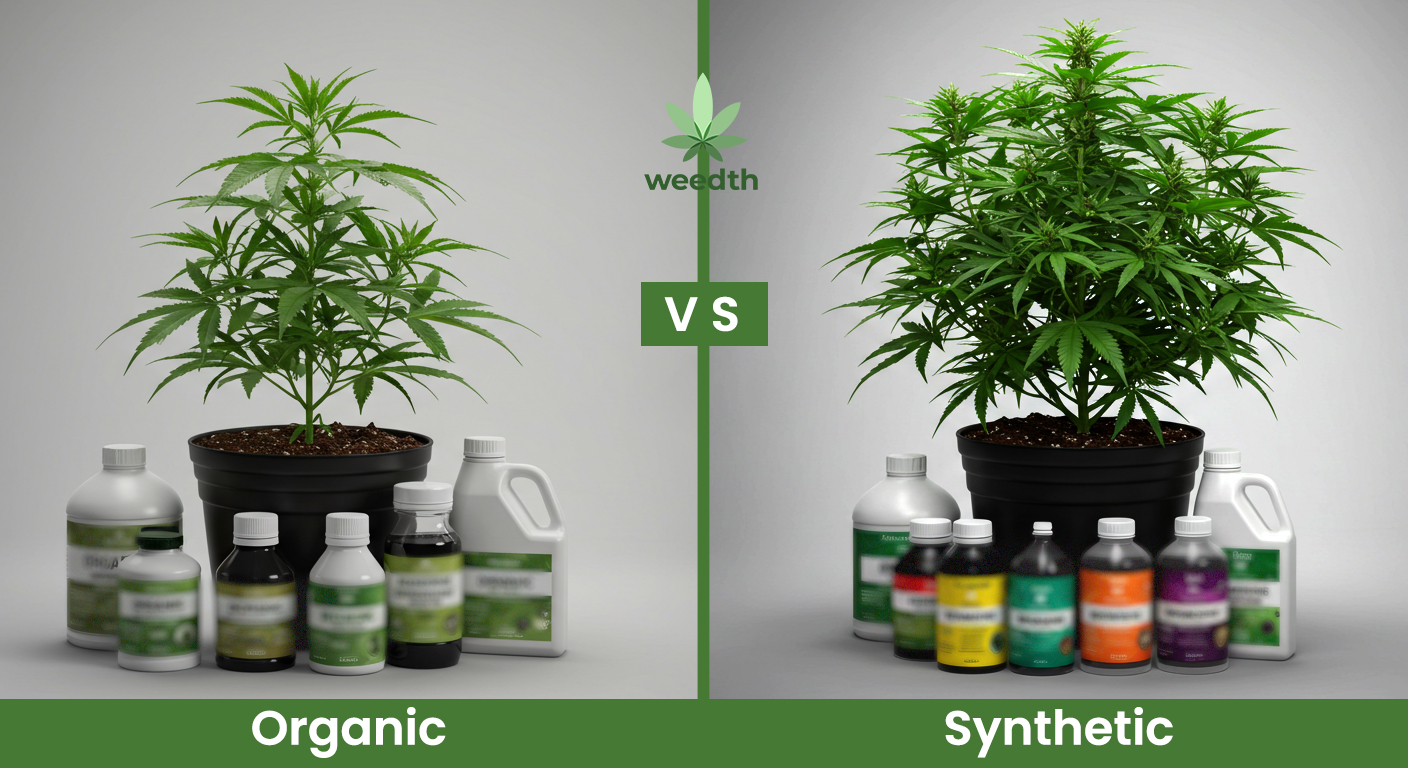
Organic Nutrition
Organic indoor programs may use compost, worm castings, meals, guano, kelp products, fish hydrolysate, mineral amendments, top-dressing, and biologically active liquid feeds. Their strength is a biologically buffered root zone and gradual nutrient cycling. Their weaknesses include variable composition, slower correction, odor, biofilm, fungus gnats, inconsistent mineralization, and difficulty in very small containers.
Organic does not automatically mean gentle. Blood meal, guano, concentrated liquids, and heavily amended soils can burn plants. Organic does not automatically mean complete, clean, sustainable, or high quality. Input source, testing, maturity, contamination, application rate, and root-zone management still matter.
Mineral or Synthetic Nutrition
Mineral fertilizers offer precision, solubility, repeatability, and fast correction. They are particularly compatible with coco, drip systems, and recirculating hydroponics when formulated correctly. Their weaknesses are the ease of overconcentration, salt accumulation, precipitation, and the temptation to solve every symptom by adding another bottle.
Mineral nutrition does not automatically create harsh flavor. Harshness can result from poor drying, poor curing, immature harvest, contamination, disease, excess leaf material, or combustion conditions. A well-managed mineral crop can produce clean, aromatic flowers. A badly managed organic crop can produce weak or unpleasant flowers.
"Will mineral fertilizer kill every beneficial microbe?"
Question sent by: Aaron Mitchell, via contact form.
No. Mineral ions are not automatically sterilizing. Microbial response depends on concentration, salinity, pH, carbon supply, oxygen, moisture, and whether oxidizers or incompatible pesticides are used. A very high-EC program can reduce biological diversity, but a measured mineral supplement can coexist with biology in a well-designed hybrid root zone.
Can Organic and Synthetic Nutrients Be Used Together?
Yes, a hybrid program can work. A grower may use an amended biological medium with a measured mineral supplement, or use a mineral base with selected biological inputs. Compatibility depends on system design.
- Do not add thick organic materials to emitters or recirculating equipment that cannot handle particles and biofilm.
- Do not use oxidizing sterilants while expecting living inoculants to survive.
- Do not assume an organic amendment is immediately available.
- Count the N, P, K, Ca, Mg, S, and EC contributed by every soluble product.
- Provide filtration, aeration, cleaning, and reservoir turnover appropriate to the inputs.
A peer-reviewed CBD cannabis trial found that organic and mineral strategies could both be productive, while nutrient acquisition and late-cycle behavior differed. Another body of work shows that microbial inoculant response can be cultivar-dependent. The lesson is not that one category wins. The lesson is that biology, mineral supply, and cultivar must be managed as a system.
Master Advice: Choose one operating philosophy for the root zone, then add only compatible tools. Hybrid nutrition works when each input has a known purpose, not when two complete programs are stacked.
Choose a coherent program.
Know which product supplies each nutrient, how it becomes available, and whether the irrigation equipment can carry it.
Build a bottle collection.
Mixing every organic and mineral additive together creates duplication, unstable biology, clogged equipment, and a diagnosis problem.
Compost Tea and Microbial Products
Compost tea is not a guaranteed fertilizer or disease treatment. Its composition depends on compost quality, water, aeration, temperature, ingredients, brewing time, and sanitation. Poorly controlled brews can grow unwanted organisms. In an indoor cannabis program, use only high-quality inputs, clean equipment, and a defined purpose. Do not spray unverified biological brews onto developing flowers.
"Can I add mycorrhizae to a sterile DWC reservoir?"
Question sent by: Isabelle Roy, via e-mail.
That is usually a poor match. Mycorrhizae need compatible root contact and conditions that allow colonization, while a sterile reservoir is managed to suppress living organisms. Use inoculants where the root-zone strategy can support them, and use sanitation where the system depends on cleanliness and rapid solution control.

How to Mix Nutrients Without Precipitation
We have chosen the ingredients; now let's make sure they remain available after they enter the reservoir. Concentrated fertilizer parts must not be mixed directly together unless the manufacturer explicitly says they can be. Calcium can react with concentrated phosphate or sulfate and form insoluble precipitates. Once minerals fall out of solution, the EC may still look plausible while the plant no longer receives the intended balance.
A safe general sequence is:
- Fill the clean reservoir with source water and record its temperature and EC.
- Add silica first if its instructions require it, then mix and allow the recommended reaction time.
- Add Part A to the full water volume and mix completely.
- Add Part B only after Part A is dispersed, then mix completely.
- Add compatible supplements one at a time, mixing between each.
- Measure final EC and dilute or adjust the recipe if needed.
- Adjust pH last with diluted acid or base.
- Recheck EC and pH before irrigation.
Always follow the product's own order when it differs. Use clean measuring tools and never return a contaminated syringe or cup to a concentrate bottle.
"Why did my reservoir turn cloudy after mixing?"
Question sent by: Dylan Parker, via e-mail.
Stop before irrigating. Cloudiness can come from precipitation, incompatible concentrates, microbial growth, contaminated tools, or a suspended product. Review the order, dilution, water temperature, pH adjustment, and product compatibility. A normal EC does not prove that every intended nutrient remains dissolved.
What to Remember: A successful mix is not only the right EC. It must also be chemically compatible, visibly stable, correctly ordered, and reproducible from batch to batch.
Never mix A and B concentrates together.
Dilute each part into the main water volume separately. Cloudiness, crystals, sediment, or unexpected residue can indicate precipitation or incompatibility.
Reservoir Management
Keep reservoirs covered from light, clean, well mixed, and within a root-safe temperature range. Aeration strategy depends on the system. DWC requires strong dissolved oxygen at the roots. Stock tanks feeding drip irrigation need circulation without turning every organic ingredient into foam.
Track daily water level, pH, EC, temperature, odor, clarity, and root appearance. Top-offs change ratios if only water or only concentrated feed is added repeatedly. Periodic complete replacement restores the intended balance in recirculating systems. The interval depends on reservoir size, crop demand, water quality, and stability.
Tip: Label every reservoir with the date, recipe, source-water EC, final EC, final pH, and person who mixed it. This simple habit prevents duplicate dosing and makes crop differences explainable.
Irrigation and Nutrient Delivery
Now follow the solution out of the tank and into the container. The right formula can still fail when it is delivered unevenly. Roots need a suitable combination of water, oxygen, and nutrients, and every irrigation changes all three.
Soil Irrigation
In soil, irrigate enough to wet the active root zone evenly, then allow an appropriate dry-back for the medium, container, plant, and climate. Frequent small sips can leave the center dry or keep the upper zone chronically wet. Large plants in well-rooted, airy containers use water differently from seedlings in dense soil.
Do not apply a full nutrient solution every time simply because the calendar says "feed day." Consider the charge already in the soil, recent runoff or substrate data, and plant response. For practical irrigation diagnosis, see How Often Should I Water Cannabis?.
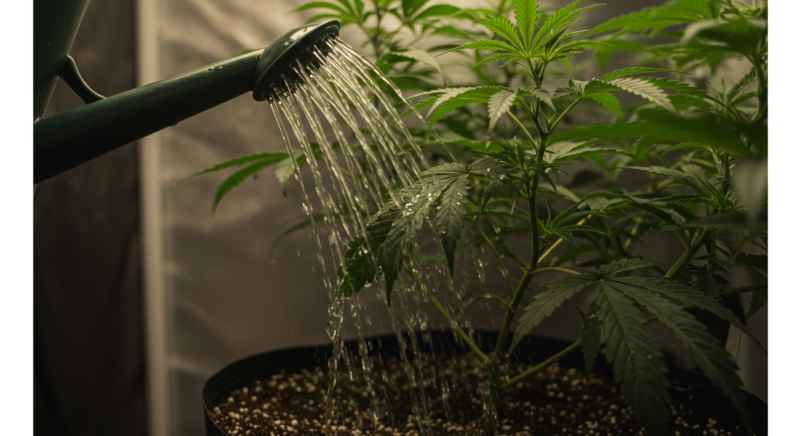
Coco Fertigation
Established coco commonly performs well with frequent complete fertigation and some drainage. The goal is to keep the root-zone concentration stable, not to let the medium dry hard between strong feeds. Irrigation frequency should increase with root establishment and plant water use. Emitters must deliver evenly across the room.
Runoff percentage is not a fixed universal number. It is a tool. Use enough drainage to manage salt balance without wasting excessive water and fertilizer. Compare runoff EC as a trend, understanding that the sampling method affects the number.
Hydroponic Delivery
In water culture, roots are always in contact with solution, so oxygen and temperature become part of feeding. In drip hydroponics, pulse frequency controls moisture, oxygen renewal, and salt distribution. A blocked emitter can create a deficiency in one plant while the shared reservoir looks perfect.
"Why does one plant burn while the shared tank looks correct?"
Question sent by: Kayla Bennett, via contact form.
The tank describes supply, not delivery to every root zone. Compare emitter flow, pot moisture, drainage, dry-back, root health, cultivar sensitivity, and light exposure. One restricted or over-delivering emitter can create a local EC problem that a room-wide reservoir change will not solve.
Test delivery at the first, middle, and last emitter.
Measure equal run times and compare flow before changing the shared recipe.
Read the reservoir as proof of uniform irrigation.
Correct tank chemistry can still reach containers at different volumes and times.
System-Specific Correction Protocols
A correction should move the root zone toward stability without adding a second stress. The same symptom can require different actions in amended soil, coco, rockwool, or DWC. Before correcting, confirm the meter, source water, recipe, plant pattern, irrigation delivery, and root condition. Photograph the symptom and record the time so the next leaves can be compared with the old damage.
Old necrotic tissue will not turn green again. Judge recovery by new growth, stabilized symptom margins, improved water use, and a controlled root-zone trend. Repeatedly changing the formula because an old leaf still looks damaged can push the plant past the correct balance.
"Can damaged leaves recover after I correct the cause?"
Question sent by: NorthernRoots, via e-mail.
Chlorotic tissue may regain some color when damage is mild, but dead spots and burnt margins do not rebuild. Watch whether symptoms stop advancing and whether new leaves emerge healthy. Do not keep increasing the remedy because the oldest injury remains visible.
Pro Tip: Place a small removable marker beside the newest symptom boundary. Recovery is easier to judge when you know exactly where progression stopped.
Amended Soil: Slow the Correction Down
In amended soil, nutrients may continue mineralizing after the bottle is removed. If plants show burnt tips, dark clawing, and slow dry-back, first stop stacking feed and assess moisture. A saturated pot should not receive repeated large volumes solely to force runoff. Restore an appropriate wet-dry rhythm and confirm that drainage and root oxygen are adequate.
When a true soluble-salt excess is confirmed and the medium drains well, controlled leaching may be appropriate. The volume and pace depend on container size, soil structure, crop stage, and root health. Follow with adequate drainage and climate control. A dense or poorly aerated soil can suffer more from an indiscriminate flood than from the original EC problem.
For suspected deficiency, review what the mix contained and how long the plant has occupied it. A top-dress requires time, moisture, temperature, and biological activity. A compatible liquid feed acts faster but can overlap with amendments. Use a substrate or soil test when the history is unclear rather than applying several remedies at once.
Living Soil: Protect Biology Without Romanticizing It
A living soil correction begins with volume, moisture distribution, aeration, temperature, and amendment balance. Microbes cannot mineralize efficiently in a bone-dry or anaerobic zone. They also cannot create an element absent from the system. If a laboratory test identifies a shortage, correct it with a known input at a measured rate.
Avoid combining microbial inoculants with oxidizing sterilants and expecting both strategies to work. Avoid repeated sugar additions to "wake up" a root zone that smells sour or remains saturated. That condition needs oxygen and moisture correction, not more microbial food.
Coco: Correct Concentration and Delivery Together
In coco, rising root-zone EC often reflects excessive dry-back, insufficient irrigation frequency, low drainage, uneven emitters, or an input concentration above crop demand. Lowering the feed without correcting delivery can leave concentrated pockets in place. Increasing runoff without checking emitter uniformity can waste solution while the weakest pot remains under-irrigated.
Prepare a complete coco-compatible solution at a conservative EC and correct pH. Increase irrigation frequency or improve distribution as needed to bring the root-zone trend down gradually. Collect comparable samples from representative plants. When EC stabilizes and new growth improves, avoid another large change merely to accelerate cosmetic recovery.
If the root zone has dried severely, rewet it evenly in controlled passes. One fast irrigation can channel through the easiest path and create reassuring runoff while much of the medium remains dry. Pot weight, moisture checks at different positions, and emitter catch tests are more informative than runoff volume alone.
Rockwool and Drain-to-Waste: Check the Irrigation Geometry
Rockwool responds quickly to changes in input solution, but water content and EC vary vertically and horizontally inside the block. Shot size, frequency, start time, stop time, drainage path, and root distribution all affect the sample. High EC near the top may coexist with a wetter, lower-EC zone below.
Verify injector output and dripper flow before changing the elemental recipe. Correct the delivery schedule in small steps and compare blocks from strong and weak canopy zones. Excessive early irrigation can keep roots wet overnight, while starting too late can create a strong morning concentration spike.
DWC and Recirculating Systems: Protect the Whole Crop
A shared reservoir spreads both corrections and mistakes. If EC is too high, confirm the reading with a calibrated meter, then dilute using water prepared for the system rather than pouring untreated water around individual roots. Recheck pH after dilution because alkalinity and nutrient ratios have changed.
If pH moves rapidly, record the direction together with EC and water level. A rising pH with falling EC can accompany active nutrient uptake, while rapid irregular movement can indicate low buffer, biological activity, root problems, contamination, or an undersized reservoir. Repeated acid dosing treats the display but may add substantial phosphorus, sulfur, or nitrogen depending on the acid.
Inspect roots for color, texture, odor, and new tips. Check solution temperature, dissolved oxygen, circulation, light leaks, pump operation, and dead zones. A full reservoir replacement may restore the intended ion balance when top-offs have distorted it, but sanitation and the underlying environmental cause must be addressed or the problem will return.
Emitter Failure: Correct Hardware Before Chemistry
When one row, corner, or plant declines, perform a catch test. Run the irrigation for a fixed time and measure the output from representative emitters, including the first and last point on each line. Compare flow, look for pressure differences, and inspect filters. A nutrient deficiency affecting one hydraulic zone is often a delivery deficiency.
After restoring flow, do not immediately apply a concentrated rescue solution. Previously dry roots can be sensitive, and salts may already be present in the medium. Rewet with the normal or slightly milder complete solution appropriate to the system, then watch recovery.
Never correct a room-wide recipe from one damaged plant.
Confirm whether the pattern follows a cultivar, irrigation line, light zone, container size, or individual root problem. A shared nutrient change can injure every healthy plant while missing the original cause.
"After a correction, how long should I wait before changing the feed again?"
Question sent by: Marcus Lee, via e-mail.
Wait for the system to produce new evidence. In fast hydroponic systems, solution trends can change within hours, while visible new growth takes longer. Soil responds more slowly. Use stable pH, EC, water use, root condition, and symptom progression rather than a fixed number of days. Make an immediate second change only when the first action created a clear safety problem.
Diagnose Deficiency, Excess, Lockout, and Irrigation Stress
When a plant looks wrong, our first job is to slow the diagnosis down. Good diagnosis moves from the whole system to the leaf. Before naming a deficiency, ask whether the environment and roots can support uptake. Then use symptom position and crop history to narrow the cause.
- Check the pattern: one leaf, one plant, one irrigation zone, one cultivar, or the whole room?
- Check environment: light intensity, canopy temperature, air temperature, humidity, airflow, and recent events.
- Check roots and water: pot weight, dry-back, drainage, root color, odor, solution temperature, and dissolved oxygen.
- Check chemistry: source-water EC, mixed feed EC and pH, root-zone or runoff trend, recipe, and calibration.
- Check symptom mobility: older leaves first suggests a mobile nutrient; new growth first suggests a less mobile nutrient or root problem.
- Make one measured correction: then document the response before adding another treatment.
| Pattern | Likely possibilities | Confirm with | First correction | Do not |
|---|---|---|---|---|
| Burnt tips across the room | High EC or rapid feed increase | Input and root-zone EC trend | Reduce concentration and stabilize irrigation | Add another deficiency product |
| Pale lower leaves | N deficiency, root restriction, low uptake, natural late fade | Stage, feed N, roots, EC, growth rate | Correct the identified limit | Assume every late yellow leaf is normal |
| Upper yellowing or bleaching | Light stress, Fe issue, root damage, heat | Canopy map, light measurement, new-growth pattern | Correct environment or root cause | Increase N automatically |
| Interveinal chlorosis low on plant | Mg deficiency, high K, root-zone pH problem | Formula, source water, EC, pH, symptom progression | Rebalance the root zone | Stack Epsom salt and Cal-Mag blindly |
| One drip row declines | Emitter or pressure problem | Catch-can test and substrate moisture | Restore uniform delivery | Change the reservoir for the whole room |
| Droop with wet medium | Low oxygen, overwatering, root disease | Pot weight, roots, odor, temperature | Restore oxygen and irrigation rhythm | Feed a plant that cannot take up water |

Nutrient Burn
Early nutrient burn often appears as browned leaf tips while the rest of the leaf remains green. Severe excess can cause marginal necrosis, clawing, slowed water uptake, and root damage. The response is not always an aggressive flush. First determine whether the medium is pre-amended, the crop is in coco, or the roots share a hydroponic reservoir.
In coco or hydroponics, reduce solution strength and restore a stable root-zone EC with correctly pH-adjusted complete solution. In heavily amended soil, repeated large leaching events can create saturation and new imbalance. Correct gently, improve the irrigation plan, and allow the plant to resume growth.
Nutrient Lockout
"Lockout" is a useful description but an incomplete diagnosis. It may involve pH-driven availability, ion competition, salinity, root damage, cold temperature, or low oxygen. The fix depends on the mechanism. More fertilizer cannot repair roots that are suffocating.
"My runoff EC is high. Should I flush immediately?"
Question sent by: Rachel Adams, via e-mail.
Not from one number alone. Confirm the meter, sampling method, input EC, dry-back, irrigation uniformity, and plant response. In coco, a consistent rise can justify more frequent irrigation or a lower input EC. In soil, runoff can be difficult to interpret and aggressive leaching may create waterlogging. Correct the system, not only the sample.
Sampling, Tissue Testing, and Verification
When the leaf, the meter, and the feeding chart seem to disagree, we need better evidence rather than a fourth opinion. Measurement becomes useful only when the sample represents the question. A reservoir sample can describe the shared solution but not a dry pot at the end of a blocked line. Runoff can reveal a trend but may not represent the average substrate. A leaf analysis can show what accumulated in sampled tissue but cannot, by itself, identify why the level is high or low.
Build a sampling protocol before the crop has a problem. Use the same containers, irrigation timing, sample volume, meter, and recording method. Include at least one strong and one weak area when investigating spatial differences. Label every sample immediately with cultivar, location, date, stage, and method.
Input Solution Samples
Measure source water before nutrients are added, then measure the final mixed solution after all components are fully dispersed. At an emitter-fed room, sample actual output at the far end of the line as well as the tank. Injector error, line residue, pressure, or a partially blocked filter can make emitter solution differ from the mixing tank.
Record temperature with EC and pH. Note whether the sample was taken immediately after mixing or after the tank had circulated. If a biological or suspended product is used, note settling and filtration. A recipe that is correct in the tank but absent at the dripper is not a successful feed.
Runoff and Leachate
Runoff is most comparable when containers begin at a similar moisture state and receive a known volume. First runoff, middle runoff, and a combined sample can produce different results. Choose one method and keep it. Pooling equal amounts from several representative containers can reduce the influence of one unusual pot, but it also hides plant-to-plant variation. Use individual samples when diagnosing uniformity.
High runoff EC can result from a strong input, evaporation during dry-back, insufficient drainage, ion exchange, fertilizer release, or a biased first fraction. Low runoff EC can reflect dilution, channeling, or high plant uptake. Always interpret it with input EC, water content, irrigation volume, and plant condition.
Pour-Through and Saturated Media Extract
For peat and other container media, standardized horticultural methods such as pour-through and saturated media extract can provide more consistent root-zone pH and EC information than random runoff. The pour-through method applies a measured amount of water to an irrigated container and collects the displaced root-zone solution. A saturated media extract uses a representative media sample brought to a defined saturation before extraction.
These methods are not interchangeable, and their interpretation ranges differ. Follow one documented laboratory or university protocol from sampling through analysis. The University of Missouri hydroponic nutrient-solution guide describes both root-zone monitoring concepts and emphasizes that organic components can make substrate pH and EC differ from the input solution.
Do not take destructive media samples only from the top crust or the wettest bottom corner. Combine material from the active root zone according to the laboratory's instructions. Record whether controlled-release fertilizer granules or fresh top-dress were included, because direct contact can distort the result.
Leaf Tissue Analysis
Leaf tissue analysis measures elemental concentrations in selected tissue. It can help confirm a suspected deficiency, compare cultivars, and reveal accumulation before visible injury. It is most useful when the crop is sampled consistently and compared with a relevant reference population or a healthy control from the same room.
Leaf age changes mineral concentration. A young expanding leaf, the youngest fully developed leaf, and an old lower fan leaf are not equivalent samples. Choose the tissue specified by the laboratory or research protocol. Avoid leaves contaminated by foliar sprays, substrate splash, dust, or recent pesticide residue. Do not wash samples unless the laboratory instructs you, because the method affects the result.
Cannabis reference ranges are still developing and can vary with cultivar, stage, and system. A value outside one published range is not an automatic instruction to add or remove fertilizer. Compare the tissue result with the feed calculation, root-zone data, symptom pattern, and yield or quality outcome.

Water and Media Laboratory Tests
A complete irrigation-water test should report more than pH and total dissolved solids. Request alkalinity or bicarbonate, EC, Ca, Mg, Na, Cl, S or sulfate, B, Fe, Mn, and any local contaminants relevant to the source. For well water, repeat testing across seasons or after changes in drought, rainfall, or treatment equipment.
Media tests can measure pH, EC, nitrate, phosphorus, potassium, calcium, magnesium, sodium, and other elements depending on the laboratory. Use a lab familiar with greenhouse or container media and tell it whether the sample is soil, peat, coco, compost, or an inert substrate. The extraction method determines how numbers should be interpreted.
Controlled Side-by-Side Trials
A side-by-side trial is the best way to determine whether an additive improves flower quality, aroma, resin, structure, consistency, and efficient yield. Keep cultivar, clone age, pot size, medium, irrigation, light zone, training, and harvest timing as similar as possible. Change one treatment, randomize positions when practical, and include enough plants to avoid judging the result from one unusual individual.
Define success before starting. Record total fertilizer cost, labor, water use, runoff, visible stress, dry trimmed flower mass, flower size distribution, aroma observations made blind when possible, and laboratory cannabinoid or terpene data when available. A product that raises wet weight but adds no dry marketable flower has not proven a benefit.
Repeat promising results in another cycle. Cultivar, season, and room conditions can change the response. A single comparison can generate a hypothesis; repeated controlled comparisons build a program.
"Should I trust leaf color or the tissue test when they disagree?"
Question sent by: Tyler Brooks, via e-mail.
Trust neither in isolation. Confirm that the correct leaf was sampled, review the laboratory method and reference range, then compare roots, pH, EC, irrigation, light exposure, and symptom progression. Color can be altered by environment and genetics, while tissue concentration can show accumulation without proving availability in every growing point.
Evidence Rule: A number becomes evidence only when the sampling method is repeatable and the result is connected to plant performance.
Can Nutrients Improve Bud Quality, Aroma, and Flavor?
This is the question behind many expensive bottles: can nutrition make the finished flower smell stronger, taste better, and carry more resin? It can protect quality by preventing limitations and maintaining healthy metabolism. It can also reduce quality when excess salts, ammonium, nitrogen, or imbalance suppress growth and secondary metabolism. Fertilizer is important, but it is only one part of flower quality.
The largest controls include genetics, healthy roots, adequate light, stable climate, carbon dioxide availability, disease prevention, correct harvest maturity, gentle handling, slow controlled drying, and curing. A nutrient additive cannot force a cultivar to produce a terpene profile it does not genetically express.
Nutrition Protects Quality by Preventing Limits
The most reliable nutrition contribution to flower quality is the prevention of avoidable stress. Nitrogen supports the photosynthetic canopy and enzymes. Potassium supports water regulation and transport. Calcium supports growing tissues and membranes. Magnesium supports chlorophyll. Sulfur and micronutrients support proteins and metabolic reactions. When one becomes limiting, flower development can slow and the canopy can lose function before maturity.
That does not mean maximum tissue concentration produces maximum quality. Plants need balance. Excess nitrogen can maintain overly soft, dark vegetative growth and has reduced performance or secondary metabolites in some controlled cannabis conditions. Excess phosphorus can accumulate without increasing yield or quality. Excess potassium can interfere with calcium and magnesium and can affect genotypes differently. The target is adequate supply without creating a new limitation through salinity or antagonism.
Yield, Potency, and Total Compound Yield Are Different
Flower yield is the mass harvested. Potency is the concentration of a compound in that mass. Total compound yield combines both. A treatment can increase flower mass while slightly diluting cannabinoid concentration, yet still produce more total cannabinoids. Another treatment can raise concentration in stressed, smaller flowers while reducing total compound yield.
This distinction prevents misleading product claims. A nutrient trial should report dry flower yield, cannabinoid or terpene concentration, and ideally total compound yield. Visual frost, wet weight, or one laboratory percentage does not describe the whole crop. Quality also includes aroma integrity, flower structure, freedom from disease and residue, and the behavior of the dried flower after storage.
Nitrogen Timing and the Functional Canopy
Nitrogen should support useful leaf function through flower development without keeping the plant in unnecessary vegetative excess. Removing nitrogen very early can create a dramatic fade that looks like ripening while actually reducing photosynthetic capacity. Maintaining excessive nitrogen late can waste fertilizer and may delay or distort the crop's normal senescence.
The correct late-cycle approach depends on cultivar, medium, root-zone reserve, and uptake. A living soil can continue releasing nitrogen after liquid inputs stop. An inert hydroponic system changes quickly. Watch the rate of lower-leaf fade, flower maturity, water use, EC, and new damage. Do not judge readiness by leaf color alone.
"Should late-flower yellowing always be corrected?"
Question sent by: Megan Foster, via e-mail.
No. Slow senescence of older leaves can be part of maturation, while rapid or early canopy collapse can reduce function and increase risk. Compare the timing with cultivar history, flower maturity, root-zone EC, water use, and the location and speed of the fade.
Important: Protect quality by preventing severe stress, then protect it again after harvest. Extra fertilizer cannot replace lost aroma from a hot, fast dry.
Sulfur Is Essential, but It Is Not a Terpene Switch
Sulfur is part of amino acids, proteins, enzymes, and several plant metabolites. A true sulfur deficiency can limit growth and metabolism. That does not prove that continually increasing sulfate will intensify every cannabis aroma. Terpenes are not sulfur compounds, and their expression depends heavily on genetics and the whole environment.
A complete base fertilizer commonly supplies sulfur through sulfate salts. Epsom salt adds both magnesium and sulfur, potassium sulfate adds potassium and sulfur, and some acids add sulfate to irrigation water. Count these sources before using a separate sulfur additive. More sulfate also increases EC and can contribute to precipitation with concentrated calcium.
Controlled Stress Is Not the Same as Chronic Damage
Growers sometimes attempt drought, nutrient restriction, cold, darkness, stem injury, or extreme light to trigger more resin. Plants can alter secondary metabolism under stress, but a stress response is not automatically a quality improvement. Severe or poorly timed stress can reduce photosynthesis, root function, flower mass, aroma retention, and disease resistance.
If testing a controlled stress, change one variable in a small comparison and measure the outcome. Keep an unstressed control. Define the duration and recovery period in advance. Do not combine drought, nutrient withdrawal, cold nights, and high light, then attribute the result to one treatment. The better first strategy is a healthy crop harvested at the correct maturity.
Nutrition Cannot Repair Harvest and Drying Damage
Terpenes are volatile. High heat, aggressive airflow, very fast drying, excessive handling, and poor storage can reduce aroma after a well-grown crop is cut. Nutrient additives applied weeks earlier cannot protect flowers from a hot dry room. Likewise, a perfect cure cannot restore flower that was diseased, immature, or severely nutrient-stressed.
Plan nutrient management and postharvest handling as one quality chain. Avoid late root-zone instability that delays maturity or introduces disease. Harvest when the cultivar and crop are ready. Transfer flowers promptly into a clean, controlled drying environment. Judge nutrient trials only after equivalent drying and storage, because postharvest variation can easily hide or imitate a cultivation effect.
"Which nutrient makes buds smell stronger?"
Question sent by: Jordan Ellis, via e-mail.
No single nutrient reliably acts as an aroma control. Supply every essential element without deficiency or excess, protect roots and the canopy, use appropriate light and climate, harvest at maturity, and dry gently. Genetics sets the aroma potential; the complete process determines how much of that potential is expressed and preserved.
Master Advice: Do not ask which bottle creates flavor. Ask which limit is preventing the cultivar from expressing and preserving the flavor it already has the genetic capacity to produce.
Flavor Extracts, Fruit Juice, and Citrus Peels
Adding vanilla, fruit extract, juice, mint, or other flavorings to the root zone does not reliably transfer those flavors into cannabis flowers. These materials can add sugars, oils, acids, preservatives, sodium, and microbial food to a system that was not designed for them. In hydroponics they can reduce oxygen, create biofilm, clog equipment, and destabilize the reservoir.
Putting fresh citrus peel or fruit into a curing jar is also risky. It raises local moisture and can introduce mold at the moment dense flowers need stable water activity. If a dried crop lacks aroma, fix genetics, crop health, harvest timing, drying, and storage on the next run. Do not hide the problem with wet fruit.
Do not put fruit peels in curing cannabis.
They create uneven moisture and a mold risk. Flavor quality must be protected through genetics, plant health, harvest timing, drying, and storage.
Molasses and Carbohydrate Supplements
Molasses contains sugars and minerals. In a living soil it may act as a microbial carbon source, but more microbial food is not automatically beneficial. Excess can consume oxygen, attract pests, create odor, and disturb the biological balance. Roots do not absorb table sugar and send sweetness directly into the flowers.
Complex commercial biostimulants sometimes include carbohydrates alongside many other components, and specific products can produce a response under specific conditions. That is not evidence that plain molasses sweetens buds. Judge any product by transparent composition, a controlled side-by-side test, and the final crop, not by the word "carbohydrate."
Quality Rule: Flavor is expressed by the plant and preserved by the grower. It is not poured into the roots from a kitchen bottle.
Should Indoor Cannabis Be Flushed Before Harvest?
Preharvest flushing is the practice of withholding fertilizer and supplying water or a low-nutrient solution before harvest. It is often claimed to remove nutrients from flowers, improve flavor, whiten ash, or increase cannabinoids. Current controlled evidence does not support those claims as universal outcomes.
Recent cannabis studies found limited or no meaningful improvement in flower yield, cannabinoid content, terpene content, or mineral composition from standard preharvest flushing treatments. One study across five cultivars reported only limited chemical effects. A Utah State University thesis found no increase in total cannabinoids or flower quality, while leaf nitrogen fell more than flower nitrogen.
This does not mean late-cycle nutrient management never changes. A grower may reduce supply when plant uptake declines, when a substrate is overcharged, or to avoid wasting fertilizer that the crop will not use. That is different from claiming that several days of water remove stored fertilizer from the flowers or guarantee better smoke.
Pro Tip: If reducing late feed improves the crop, ask why. The previous EC may have been excessive, the medium may have accumulated salts, or uptake may have slowed. Use that information to improve the next cycle.
Foliar Feeding Indoors
Foliar feeding can deliver small amounts of specific nutrients quickly, but it is not a replacement for a healthy root zone. Coverage, concentration, leaf age, surfactant, light, temperature, and humidity affect safety and uptake. Test a small area first and follow the product label.
Avoid spraying developing flowers unless a legitimate crop-protection program requires it and the product is approved for that use. Residue, trapped moisture, and microbial risk increase as flowers become dense. Never improvise foliar recipes from household oils, juices, or concentrated salts.
Test a labeled foliar treatment on a small leaf area.
Apply under suitable light and climate, then inspect the response before expanding coverage.
Spray dense flowers as a nutritional shortcut.
Residue and trapped moisture can create a larger quality and microbial risk than the original deficiency.
Reduce Waste Without Sacrificing Quality
Efficient nutrition is not underfeeding. It is supplying what the crop can use while limiting runoff, salt discharge, and unused product. Cannabis research has shown that some crops can maintain most of their yield with substantially less fertilizer than conventional practice. High root-zone phosphorus and EC can accumulate without increasing yield or quality.
Nutrient use efficiency compares useful crop output with the nutrients supplied or absorbed.
It improves when the crop maintains quality and yield with fewer unused inputs, less runoff, and fewer corrective interventions. It does not mean starving the plant.
Practical efficiency includes:
- Testing source water before buying corrective products.
- Using a complete base nutrient instead of overlapping additives.
- Calibrating emitters and repairing low-flow zones.
- Matching container size and irrigation frequency to roots.
- Reducing excessive dry-back that concentrates salts.
- Reusing or treating runoff only when sanitation and ion balance can be controlled.
- Keeping phosphorus out of drains and natural water systems.
- Buying only enough biological product to use while viable.
- Running a small controlled comparison before adopting a costly additive.
Higher nutrient input is not the definition of higher quality. The target is a healthy, stable crop that reaches maturity with the fewest unnecessary interventions.

A Repeatable Indoor Feeding Workflow
Let's pull the entire guide into one routine you can actually use on a busy day. A reliable program is built from measurements, observation, and small corrections. Use the following workflow for every crop, then carry the notes into the next run.
Build a Repeatable Indoor Feeding Program
- Identify the medium and whether it already contains nutrients.
- Obtain a source-water report and record baseline EC and alkalinity.
- Choose one complete base program made for the water and medium.
- Calibrate pH and EC meters before the crop depends on them.
- Start young plants at a cautious concentration appropriate to the medium.
- Increase feed only after roots, water use, light, and growth justify it.
- Record every recipe, irrigation volume, pH, EC, and visible response.
- Compare root-zone or runoff trends using the same sampling method.
- Change one major variable at a time.
- Carry cultivar-specific lessons into the next cycle.
When to Increase Feed
Consider a small increase when growth is vigorous, roots are healthy, input and root-zone data are stable, leaf color is becoming lighter without environmental stress, and EC is falling relative to water use in a well-managed hydroponic system. Increase light and environmental demand only with equal care.
When to Reduce Feed
Consider a reduction when tips burn across the crop, leaves become unusually dark or clawed, root-zone EC rises consistently, water uptake slows, or the plant improves after dilution. First rule out heat, dry-back, emitter failure, and meter error.
When Not to Change the Formula
Do not change the formula because one old leaf is damaged, because a social-media chart names a deficiency from a photograph, or because a new bottle promises more terpenes. If the crop is growing well and the root zone is stable, unnecessary correction creates noise and risk.
Indoor Cannabis Nutrient FAQ
What are the best nutrients for indoor cannabis?
The best program is a complete, transparent formula matched to the medium and source water. Soil, coco, and recirculating hydroponics need different delivery strategies. Brand count matters less than complete analysis, compatibility, measurement, and crop response.
Should I feed nutrients every time I water?
It depends on the system. Coco and many soilless programs commonly use complete nutrient solution at each fertigation. Pre-amended soil may need plain water for an extended period. Living soil relies on amendments and mineralization. Follow root-zone data, not a universal feed-water-feed rule.
Is more phosphorus better during flowering?
No. Phosphorus is essential, but controlled cannabis trials show yield plateaus at moderate supply and no reliable benefit from extreme root-zone P. Excess adds EC, cost, environmental waste, and possible nutrient imbalance.
Do I need Cal-Mag?
Only if the combined source water, base fertilizer, medium, and crop demand leave a real calcium or magnesium gap. Coco and RO water can increase the likelihood, but a suitable base nutrient may already cover it.
Can I mix organic and synthetic fertilizer?
Yes, when the products and irrigation system are compatible and the total nutrient contribution is understood. Avoid thick organics in equipment prone to clogging, and do not combine living inoculants with sterilizing treatments.
Does molasses make cannabis buds sweeter?
No evidence shows that sugar sweetness moves from molasses into flowers. Molasses can feed microbes in some organic systems, but it can also consume oxygen and create biofilm or pests. It is not a direct flavoring agent.
Can I add fruit juice or flavor extracts to the feed?
No. It is unreliable and can add sugars, acids, oils, preservatives, sodium, and microbes to the root zone. Build aroma through genetics, plant health, harvest timing, drying, and curing.
What is better, EC or PPM?
EC is easier to compare because PPM displays use different conversion scales. If using PPM, always state the meter's conversion factor.
What pH should indoor cannabis use?
As a starting point, soil is commonly managed around pH 6.0 to 6.8, while coco and hydroponic systems commonly begin around 5.5 to 6.3. Product chemistry, alkalinity, substrate, and crop response may justify a narrower or different operating range.
How do I know whether yellow leaves are a deficiency?
Check where symptoms begin, how they progress, and whether the whole room or one irrigation zone is affected. Then verify roots, moisture, pH, EC, light, temperature, and feed history. Yellowing is a symptom, not a diagnosis.
Should I flush before harvest?
Routine flushing is not proven to improve cannabinoids, terpenes, mineral removal, or flower quality. Reduce late nutrition when crop uptake and efficiency justify it, not because water alone is expected to clean stored nutrients from flowers.
Why does pH keep rising in my reservoir?
Possible causes include alkalinity, plant ion uptake, microbial activity, aeration, temperature, media interaction, top-off practice, and an undersized reservoir. Measure source-water alkalinity and track pH with EC and water level instead of repeatedly adding acid without identifying the trend.
Why does EC rise while the water level falls?
The crop is taking proportionally more water than dissolved ions, often because the solution is strong, the climate drives transpiration, or roots are stressed. Add correctly prepared water or a milder solution as the system requires, then review the recipe and environment.
Can nutrients fix weak aroma late in flower?
Not reliably. Confirm genetics, light, temperature, root health, disease pressure, and harvest maturity. Protect volatile aroma during drying and storage. A late additive cannot rebuild lost genetic or environmental potential.
Is silica an essential cannabis nutrient?
Silicon is considered beneficial rather than universally essential for higher plants. A compatible silica product may support tissue strength or stress response in some systems, but it does not replace calcium, potassium, airflow, training, or correct light. Silicate products can be strongly alkaline and may precipitate when mixed incorrectly. Follow the product's order, count its potassium contribution when relevant, and test it against a control.
Do mycorrhizae work in every indoor system?
No. Mycorrhizal fungi need a compatible host, root contact, suitable moisture, temperature, and chemistry. Their value is more plausible in soil and some soilless media than in a sanitized DWC reservoir. High phosphorus, fungicides, oxidizers, and incompatible sanitation can reduce colonization. A label spore count does not prove successful root colonization or a yield benefit in a specific cultivar.
Can I use tap water that is called hard?
Possibly. "Hard" usually means calcium and magnesium are present, but the useful decision depends on alkalinity, sodium, chloride, and the actual Ca and Mg concentrations. Many hard waters work with an appropriate hard-water formula or partial blending. Test the water before buying RO equipment or adding more Cal-Mag.
Is pH Up or pH Down part of the nutrient formula?
It can be. Phosphoric, nitric, and sulfuric acids add different nutrient ions. Potassium hydroxide or potassium bicarbonate adds potassium. Repeated correction can therefore change the elemental recipe, especially in high-alkalinity water or a small reservoir. Treat the underlying alkalinity and use a compatible product at a measured dose.
Should I remove all nitrogen in late flower?
No universal rule requires zero nitrogen. The crop still needs functioning proteins and leaves while flowers mature. Reduce nitrogen when the cultivar, medium reserve, uptake trend, and harvest plan justify it. An amended soil and an inert hydroponic system will not respond at the same speed.
Why are only the tallest tops pale?
Map light intensity and leaf temperature before changing the room-wide feed. Upper-canopy bleaching can come from excessive light, heat, iron availability, root stress, or a combination. If lower and shaded growth remain normally colored, the spatial pattern is important evidence against a simple whole-room nitrogen deficiency.
Can I use the manufacturer's full schedule as written?
Use it as a starting structure, then account for source water, medium charge, cultivar, light, irrigation volume, and final EC. Check whether optional additives duplicate the base. Begin cautiously with young or sensitive plants and document every departure so the next cycle starts with evidence.
What should I do when two nutrient charts disagree?
Check the units, elemental versus oxide form, EC conversion, stage, cultivar, medium, and whether the chart describes input solution or tissue concentration. Prefer a transparent formula and primary research over an unattributed graphic. When uncertainty remains, use the conservative overlap and run a measured comparison.
Related Guides
Selected Research Behind This Guide
The values in this guide are presented as evidence-based starting points, not universal prescriptions. Cannabis trials often use one or a few cultivars in a specific root-zone system and environment. The notes below identify both the source and the part of this guide it supports, so a reader can inspect the original methods before applying a result.
- Bevan, L., Jones, M., and Zheng, Y. (2021). "Optimisation of Nitrogen, Phosphorus, and Potassium for Soilless Production of Cannabis sativa in the Flowering Stage Using Response Surface Analysis." Frontiers in Plant Science, 12:764103. DOI: 10.3389/fpls.2021.764103.
Used here for: the flowering-stage N and P response, the absence of a K yield response across the tested range, and the warning that one DWC cultivar does not create a universal recipe. - Saloner, A., and Bernstein, N. (2020). "Response of Medical Cannabis (Cannabis sativa L.) to Nitrogen Supply Under Long Photoperiod." Frontiers in Plant Science, 11:572293. DOI: 10.3389/fpls.2020.572293.
Used here for: the vegetative nitrogen response, the tested optimum near 160 mg/L N, and the physiological costs observed below and above that treatment in the study. - Saloner, A., and Bernstein, N. (2022). "Nitrogen Source Matters: High NH4/NO3 Ratio Reduces Cannabinoids, Terpenoids, and Yield in Medical Cannabis." Frontiers in Plant Science, 13:830224. DOI: 10.3389/fpls.2022.830224.
Used here for: ammonium-to-nitrate balance, ammonium toxicity risk, cation competition, rhizosphere pH behavior, and the reason nitrogen form matters in addition to total N. - Shiponi, S., and Bernstein, N. (2021). "The Highs and Lows of P Supply in Medical Cannabis: Effects on Cannabinoids, the Ionome, and Morpho-Physiology." Frontiers in Plant Science, 12:657323. DOI: 10.3389/fpls.2021.657323.
Used here for: the phosphorus response in two genotypes, the difference between flower yield and cannabinoid concentration, and the caution against treating more P as automatic quality. - Saloner, A., Sacks, M. M., and Bernstein, N. (2019). "Response of Medical Cannabis (Cannabis sativa L.) Genotypes to K Supply Under Long Photoperiod." Frontiers in Plant Science, 10:1369. DOI: 10.3389/fpls.2019.01369.
Used here for: genotype-dependent potassium response and the documented competition among potassium, calcium, and magnesium. - Llewellyn, D., Golem, S., Jones, A. M. P., and Zheng, Y. (2023). "Foliar Symptomology, Nutrient Content, Yield, and Secondary Metabolite Variability of Cannabis Grown Hydroponically with Different Single-Element Nutrient Deficiencies."<[Truncated]