
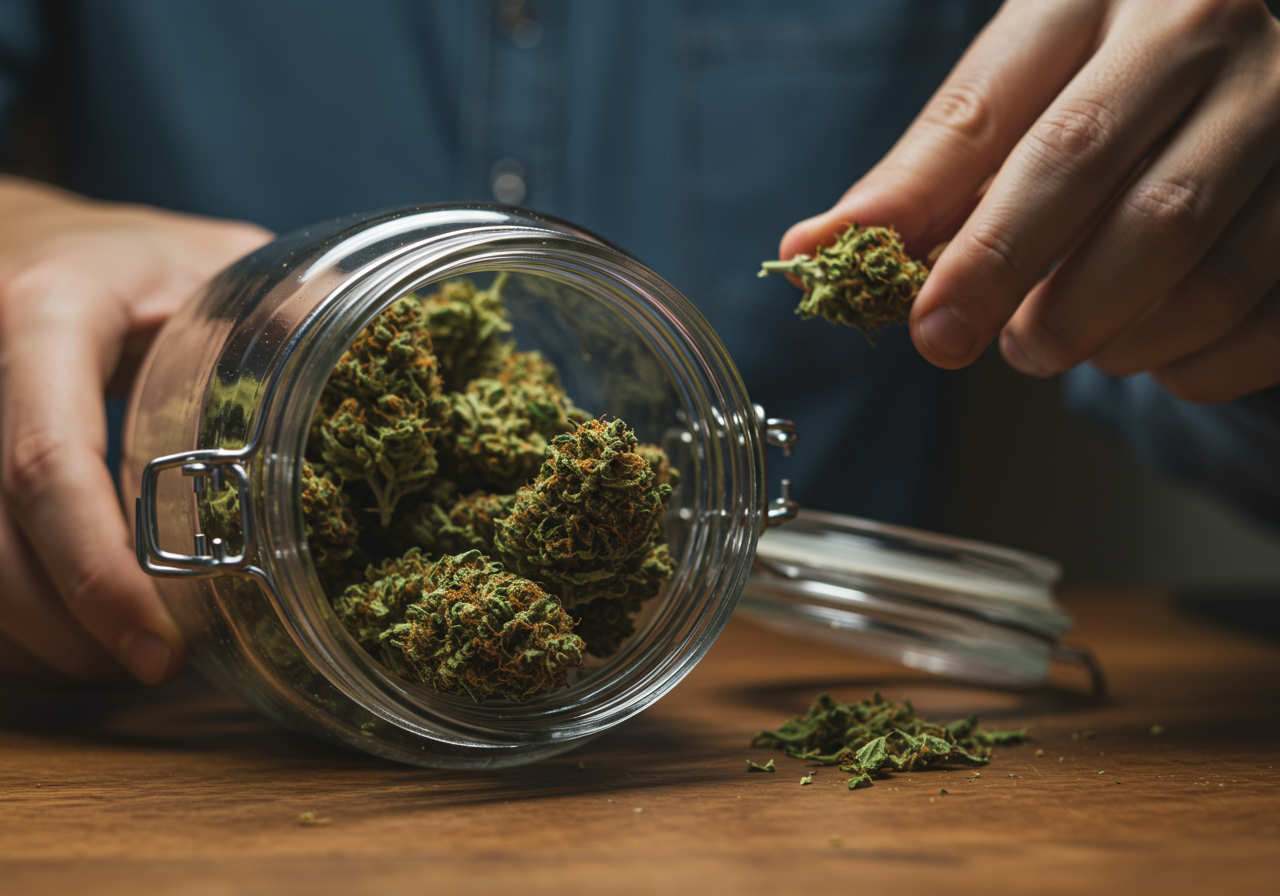
How Dry Should Buds Be Before Jarring
The moment you jar buds decides how the cure will feel weeks later. Jar too early and you trap moisture that does not belong in a sealed space. Jar too late and you lose the soft humidity that makes curing work.
The goal is not “as dry as possible.” The goal is “dry enough to be safe and still moist enough to finish evenly.”
A simple way to think about readiness is this.
- Drying removes the risky moisture on and near the surface.
- Jarring lets the remaining inner moisture redistribute slowly and evenly.
- Curing only works well when the jar stays in a safe humidity zone without big spikes.
Why jarring too early ruins flavor
Jarring too early usually creates two problems at the same time. Moisture stays trapped and the air in the jar turns stale. That combination is what leads to grassy smells, heavy notes, and a cure that never fully cleans up.
Trapped moisture and the grassy smell problem
Fresh plant material has a bright green smell. Some of that fades during a normal dry. Some of that fades during cure.
When buds go into a jar too wet, the jar becomes a humid chamber. Moisture keeps moving out of the center of the bud and into the headspace. The jar humidity rises and stays high. Air exchange is limited. The smell often stays grassy longer and it can shift into sharp or sour notes.
This is not because curing is “bad.” It is because you are not curing yet. You are slow drying inside a sealed container.
A good cure smells cleaner over time. A too-wet jar often smells heavier over time.
If the jar ever smells like ammonia or strong “sharp” fermentation, treat it as a warning. Open the jar and correct moisture right away. Do not wait for it to improve on its own.
Slow spoilage vs clean curing
Clean curing is slow and controlled. Spoilage is also slow, but it moves in the wrong direction.
The difference is the environment.
If the jar sits too humid for too long, you increase the risk of microbial growth and musty off-notes. A peer reviewed review of postharvest cannabis describes slow drying as common and it also points out the risk of contamination by molds or fungi and inconsistent quality when conditions are not controlled.
A clean cure stays below the humidity zone where mold and musty smells thrive. It also keeps air fresh enough that the jar does not turn stale.
Why harshness persists if jarring is wrong
Many people expect harshness to vanish if they “just cure longer.” That is sometimes true. It is not true when the starting moisture was wrong.
When buds are jarred too wet, the outside can dry unevenly during repeated burps while the inside stays damp. You end up with a bud that feels dry in your hand but still behaves wet in the jar. That uneven structure tends to smoke poorly. It can stay sharp even after weeks.
When buds are jarred too dry, curing slows down. Aroma and smoke texture do not improve much because the moisture that helps equalization is already gone.
So harshness can persist for two different reasons, and the fix depends on which mistake happened.
What the goal looks and feels like
Readiness has a feel and a behavior. You want both.
Outer texture that is dry but not brittle
The outside should feel dry to the touch. It should not feel cool or damp. It should not feel sticky.
At the same time, it should not feel brittle. If the outer layer crumbles easily, you probably waited too long or dried too fast.
A good outer texture feels like this.
You squeeze a bud gently and it compresses slightly and springs back. The surface feels dry and slightly textured. It does not feel crispy like dried leaves.
If you handle two buds and one feels crisp while another feels soft, do not jar them together. That mix creates unstable jar humidity later.
Inner moisture that still exists but is controlled
There will still be moisture inside the bud when you jar. That is normal. The difference is whether it is controlled.
Controlled inner moisture means the bud does not “sweat” after sealing. It means the jar humidity does not climb into a risky zone and stay there.
A bud can feel dry outside and still be too wet inside. Dense buds do this often. That is why the jar test matters more than any single hand test.
What a good snap test actually indicates
The snap test is useful, but only if you know what it is telling you.
A small stem snap is not a guarantee that the bud is ready to jar. It is a rough sign that drying has progressed.
What it really indicates is that the outer structure has lost enough moisture to become less flexible. It does not measure the moisture locked inside the flower.
Use the snap test as one clue. Pair it with touch, smell, and a sealed jar humidity check.
If small stems snap and the jar humidity still jumps high after sealing, the stems are giving you a false sense of readiness.
Step by step dryness checks
You do not need a complicated system. You need a repeatable routine that catches borderline buds before they ruin the jar.
Touch and feel test with clear cues
Start with a consistent touch test. Use the same pressure each time. Check the same part of the bud.
Look for these cues.
The bud surface feels dry and not cool. The bud is firm but not crunchy. When you squeeze, it rebounds. When you break a small piece, it tears rather than smears.
Also use your nose.
A clean drying smell is mild and plant like. A risky “too wet” smell is heavy and sharp. A risky “too dry” smell is dusty and flat.
Touch and smell are fast. They are not final. They tell you whether to jar test or to wait.
Small jar test for 12 to 24 hours
This is the most reliable readiness test for home curing.
Put a small amount of buds in a jar. Do not pack it tight. Seal it and leave it alone for 12 to 24 hours.
Then read what the jar does.
If the jar humidity rises fast and stays high, the buds were too wet. If the jar humidity settles into a safe range and stays steady, the buds are ready to cure.
Industry guidance for dry cannabis flower often targets a water activity range around 0.55 to 0.65, which lines up with an equilibrium relative humidity of about 55% to 65% in a sealed container.
You do not need to chase a perfect number. You need a stable number that stays out of the danger zone.
Paper bag test for borderline buds
Sometimes buds feel close. They are not wet, but the jar test still creeps high.
A paper bag can help in that borderline situation because it wicks moisture gently. It can take the edge off without blasting the buds with airflow.
Use it like a short correction step, not a storage method.
Place buds in a clean paper bag in a cool dark space. Fold the top loosely. Check after a short interval. Then jar test again.
If the bag makes the buds feel brittle fast, your room is too dry or your buds were already close to the limit. Stop and reassess. It is easy to overdo this step.
Using humidity as your decision tool
Humidity is the cleanest way to stop guessing, but only if you read it the right way.
Jar humidity targets after sealing
A useful readiness target is a jar that settles into a safe cure range and stays there without repeated spikes.
A common industry target for shelf stable flower is water activity around 0.55 to 0.65, which corresponds roughly to 55% to 65% equilibrium relative humidity in sealed storage.
Within that band, many growers prefer a tighter working zone for curing feel and burn quality. Often that is the high 50s to low 60s.
The exact number matters less than stability.
If the jar sits stable, the buds are ready. If the jar climbs day after day, you jarred too early or your batch is mixed.
How to interpret a fast jump in RH
A fast jump after sealing usually means one of these.
The buds were jarred too early. The buds are uneven and some pieces are wetter. The buds dried fast on the outside while the inside is still releasing moisture.
Your next step depends on how high the jump goes and how long it stays there.
If it rises a little and then levels off, you can manage with burping and patience. If it rises into a risky zone and stays there, take the buds out and re dry. Do not try to “burp it out” over several days.
Fast jumps are not rare. They are information.
When the reading is stable enough to cure
A jar is stable enough to cure when it behaves the same way across repeated checks.
Seal the jar and wait. Check at a few hours, then check at 12 to 24 hours.
You want to see this pattern.
Humidity rises slightly or not at all, then it settles and holds. The smell stays clean. Bud texture feels consistent across buds in that jar.
If you get that pattern, start your cure and follow a burping routine that matches the jar response.
If you do not get that pattern, fix dryness first.
Drying speed and why it changes the jarring moment
Drying speed changes everything because it changes how moisture leaves the bud. It also changes how much aroma survives.
Too fast dry signs and outcomes
A too fast dry often looks “ready” earlier than it should.
The outside feels dry fast. Small stems snap early. Buds feel crisp on the surface. The jar test can still spike because inner moisture did not have time to move outward gradually.
Common outcomes are muted aroma and harsher smoke.
A postharvest review describes slow drying at near ambient conditions as common practice and it notes typical drying conditions around 18 to 21 C and 50% to 55% relative humidity.
That slow approach exists for a reason. Gentle drying reduces stress on the flower.
Research on drying methods also shows that process choices can affect quality and terpene retention. For example, studies exploring drying and pretreatment methods often frame terpene retention as a key quality outcome that can be harmed by aggressive conditions.
If your dry is finishing in a very short time, treat it as a warning. You may still cure, but the ceiling for aroma is lower.
Too slow dry signs and outcomes
A too slow dry usually smells wrong before it looks wrong.
Buds stay soft for too long. The room smells heavy. You may notice damp pockets inside dense flowers.
The biggest risk is microbial growth. The same postharvest review highlights contamination by molds or fungi as a drawback in common drying practices when conditions are not controlled well.
Too slow drying can also cause curing confusion. You jar because the outside feels dry, but the inside is still wet. Then the jar spikes and you end up in an endless loop of long burps and uneven buds.
Room conditions that create each problem
Fast drying is usually caused by low humidity, high airflow, and warm air. Direct airflow on buds is a common trigger.
Slow drying is usually caused by high humidity, weak airflow, and overcrowding. Dense buds and thick branches make it worse.
Peer reviewed sources describe typical controlled drying conditions in the cool range with moderate humidity. For industrial hemp, one study notes drying air often controlled around 15 to 20 C and 50% to 60% RH.
You do not need to copy any exact setup. The point is balance. Gentle airflow and stable conditions create a predictable jarring moment.
Whole plant vs branch drying effects on readiness
How you hang the plant changes how moisture leaves the flower. That changes how even the batch becomes and how easy jarring is.
Why whole plant dries more evenly
Whole plant drying slows the process because there is more plant mass and more structure holding moisture.
That slower pace often helps moisture move from inside the buds outward without the outside turning crisp too early. It can reduce the “dry shell and wet core” problem.
A postharvest review describes hang drying of stalks as a common slow drying practice and it notes that material is dried until the desired water activity is achieved.
That lines up with the practical benefit. Whole plant drying often gives you a wider safe window for jarring.
Why branches can create mixed moisture levels
Branch drying can dry unevenly because branches differ in thickness and buds differ in density.
Top buds dry differently than lower buds. Thick stems hold moisture longer. Smaller buds can dry faster and end up overdry while larger buds are still releasing moisture.
That mixed moisture is what makes jar humidity unpredictable.
If you dry by branches, expect to sort before jarring. Do not assume the whole batch is ready at once.
How to compensate for each method
With whole plant drying, your main job is patience and monitoring. The readiness window is often smoother, but dense buds can still lag. Use the jar test before you commit a large batch.
With branch drying, your main job is sorting and staging.
Jar the buds that test ready. Hold back the ones that spike high. Use paper bag or a short re dry for borderline pieces. Keep jars consistent by size and density.
Either method can work. The best choice is the one that produces even moisture for your space and your climate.
Trimming timing and dryness
Trimming changes airflow around the bud and it changes how fast the outside dries. That is why it changes the jarring moment.
Wet trim impact on drying and taste
Wet trimming removes leaf material early. That increases exposed surface area. It often speeds up drying.
A faster dry can be useful if you are fighting high humidity, but it can also create a dry outer layer too soon. That is where you see buds that feel dry outside but spike high in the jar.
When drying speed becomes too fast, aroma can flatten. The cure can still improve smoke, but it cannot rebuild what evaporated.
Scientific literature tends to focus on drying conditions and methods and their effect on quality and consistency, rather than “trim style” alone, but the physical mechanism is straightforward. Less leaf cover means faster moisture loss at the surface.
Dry trim impact on curing consistency
Dry trimming leaves more plant material around the bud during drying. That usually slows drying. It can protect the flower surface from overdrying.
That slower pace often improves consistency. Buds in the same batch tend to reach readiness closer together, which makes jarring simpler.
The downside is risk if your drying environment is too humid or too stagnant. More leaf material can hold moisture in dense buds and slow the process too much.
So dry trim works best when your drying space already supports a slow and safe dry.
Hybrid approach that works for flavor
A hybrid approach often gives the best balance.
Remove large fan leaves early to improve airflow. Leave some surrounding leaf material to slow the surface dry. Then do the final trim after drying when buds are close to jarring readiness.
This approach helps in two ways.
It reduces the chance of mold pockets from heavy leaf mass. It also reduces the chance of overdrying the bud surface.
It also makes the jar test easier because your batch tends to behave more consistently.
What to do if you jarred too early
This happens to everyone. The fix is simple when you act quickly.
Immediate steps to reduce risk
Open the jar right away. Do not leave it sealed while you decide what to do.
Smell the buds. Inspect them closely. Look for any condensation in the jar. Feel the buds for tackiness and cool damp spots.
If the jar humidity is high or the smell is sharp, remove the buds and spread them out in a thin layer in a cool dark place with gentle airflow.
Your goal is to remove moisture from the flower itself, not only from the jar air.
If you suspect mold, stop and do not try to salvage. Safety comes first.
How to reset the cure safely
Resetting the cure means going back one step.
Re dry until the buds pass a jar test without risky spikes. Then jar again and start curing from week one behavior.
Do not try to cure while the jar is unstable. A cure needs a stable baseline.
One study on drying and curing in industrial hemp found that curing in sealed containers can increase moisture content modestly after drying. That is a reminder that sealed curing can move moisture upward if the flower starts too wet.
So the reset is not wasted time. It prevents the same mistake from repeating.
When to stop and re-dry
Stop and re dry when any of these are true.
The jar shows condensation. The jar humidity stays in a high zone after sealing. The smell turns ammonia like or musty. The buds feel wetter after a few hours sealed than they did when you jarred them.
In those cases, burping longer is not the right tool. You need to lower moisture before you return to a sealed cure.
What to do if you waited too long
Overdry buds can still be usable, but the cure will be limited. Think of this as damage control and future prevention.
How overdrying changes terpene perception
Aroma is partly chemistry and partly mechanics.
When buds are too dry, they release smell differently. The jar smell can feel faint. The smoke can feel sharp and thin. Flavor can feel flatter.
Also, terpene loss increases with heat and time and exposure. Studies that evaluate drying and storage emphasize preserving quality compounds and note that method and conditions matter for terpene retention.
So overdrying can change both how much aroma remains and how it presents when you open the jar.
Controlled recovery without creating off-notes
If you want to recover texture, do it slowly.
The safest approach is controlled humidity recovery that nudges the jar toward a stable range over days, not hours. Avoid quick hacks that add wet organic material into the jar. Those methods can spike humidity and create off-notes or mold risk.
After any recovery step, seal the jar for 12 to 24 hours and watch the trend. Stability matters more than chasing a number.
If the jar swings high, stop and dry again. Do not bounce back and forth.
Prevention for the next run
Most overdrying is caused by one of these.
Airflow hitting buds directly. Humidity too low for your bud density. Drying space too warm. Not checking smaller buds early.
The fix is to tighten your monitoring loop.
Check a few buds daily near the end. Jar test small samples. Separate smaller buds sooner. Adjust airflow so it circulates the room and not the flower surface.
Jarring Readiness Checklist
This checklist is meant to be practical. Each item is a decision tool, not a ritual.
What jar RH after 12 hours confirms you are ready
You are ready when a sealed jar settles into a safe curing band and stays there.
A widely used standard target for dry flower storage is water activity around 0.55 to 0.65, which corresponds roughly to 55% to 65% equilibrium relative humidity.
In practice, readiness looks like this.
After 12 hours sealed, the reading is stable and not climbing. After 24 hours sealed, it is still stable. The smell is clean and not sharp. Buds feel evenly dry across the jar.
If the number is stable but a little higher than your preference, you can manage with a careful early cure routine. If it is climbing, do not proceed.
The most reliable “too wet” signs in the first 24 hours
These signs mean you should stop and correct moisture.
Condensation inside the jar. A strong sharp ammonia like smell. A humidity reading that jumps up and keeps rising. Buds that feel tacky or cool after sealing.
When you see these signs, remove buds and re dry. Do not try to out burp a wet jar.
The most reliable “too dry” signs before jarring
These signs mean curing gains will be limited.
Buds feel brittle and crumbly. Outer leaf edges shatter easily. The jar reading settles low and the buds feel harsh when tested.
If you are already in this zone, focus on stable storage and gentle texture recovery if needed. Do not chase a perfect cure that the moisture no longer supports.
Can you mix small and large buds in the same jar
You can, but it is usually a mistake early.
Small buds dry faster and they tend to stabilize sooner. Large dense buds release moisture longer. If you mix them, the jar humidity is driven by the wettest pieces and the small buds can overdry while you manage the spike.
A better approach is to cure by size and density at first. Once everything is stable and cured, mixing becomes less risky.
How to handle buds that dry unevenly
Uneven batches need sorting and staging.
Separate buds into groups by feel and by size. Jar test each group. Re dry the groups that spike. Paper bag borderline groups for short intervals and re test.
If a few dense buds keep spiking, do not let them control the whole batch. Give them extra time outside the jar and then jar them later.
Once you build this habit, the process becomes predictable. You stop losing jars to moisture surprises, and the cure becomes something you manage with simple feedback instead of guesswork.
Share this article
A quick overview of the topics covered in this article.
Follow us
Latest articles
September 26, 2026
September 26, 2026
September 26, 2026
September 26, 2026