
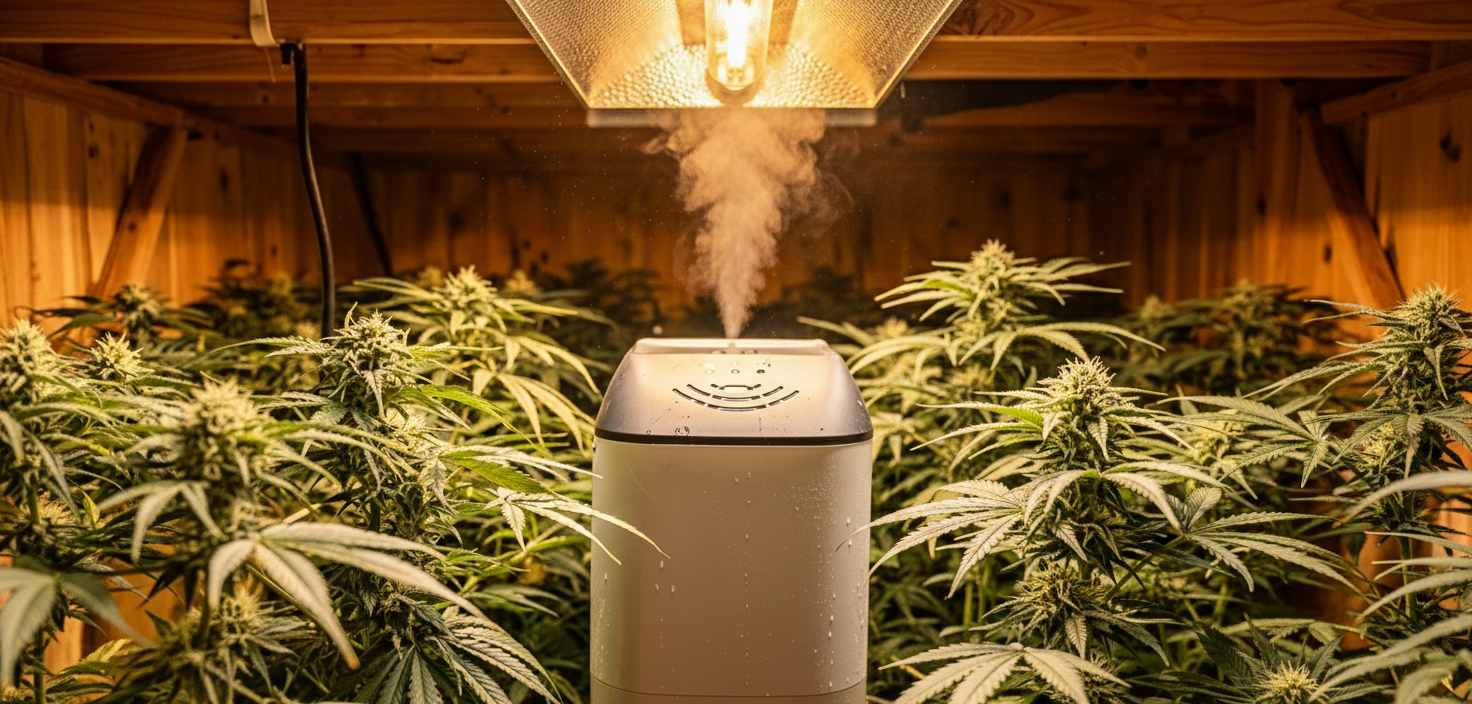
Why a Dehumidifier Can Match a Grow Light’s Bill
Why a Dehumidifier Can Match a Grow Light’s Bill
A grow light is usually your biggest predictable load because it has fixed hours. A dehumidifier is often your biggest unpredictable load because it runs until a moisture problem is solved. When the room keeps producing moisture faster than the room can safely hold it, the dehumidifier can end up running so many hours that it catches up to the light’s kWh.
It is not the wattage, it is the runtime
People fixate on wattage because it is printed on a label. The bill is built from watts multiplied by hours.
A light might pull more watts, but it is limited by a schedule you control. A dehumidifier might pull fewer watts, but it can run most of the day if humidity keeps rebounding. In real grows, that rebound often happens for predictable reasons: a big canopy, wet media surfaces, lights-off temperature drops, and outside air that is already humid.
Moisture removal is paid in kWh, not in “pints”
“Pints per day” describes output, not cost. Output tells you how much water a unit can remove under test conditions, but it says nothing about how many kWh it will take in your room at your temperature and your humidity.
Efficiency is the missing piece. That is why dehumidifier regulations and efficiency labels use metrics like liters per kWh, including how the unit behaves across operating modes, not just its maximum pints per day.
The simplest comparison that makes it click
Think of both machines as kWh engines.
- Your light converts kWh into photons plus heat. It does this on a timer.
- Your dehumidifier converts kWh into water removal plus heat. It does this until your room stops pushing RH above your target.
If your room is producing a lot of water vapor every day, the dehumidifier has to keep paying the energy cost of condensing that water and dumping the heat back into the room. That cost repeats cycle after cycle.
Why a “small” dehu can still dominate monthly cost
A “small” unit can dominate when it never catches up. It runs constantly, often in inefficient conditions like cool intake air, and it still fails to hold target RH.
That is the painful combo: high runtime plus low efficiency plus poor results. In that situation, the bill goes up and the room still feels wet.
Humidity Is an Energy Load, Not a Comfort Setting
If you treat humidity as comfort, you will always wonder why the numbers feel irrational. In a grow, humidity is closer to a waste product you must manage. It behaves like an energy load because removing it requires real work.
Latent heat vs sensible heat in a grow room
Sensible heat is what a thermometer sees. Latent heat is what humidity hides.
A room can feel “not that hot” and still be expensive to control because moisture removal is a separate job from temperature control. HVAC design treats these as different loads because they are different kinds of work.
What “latent load” means in plain terms
Latent load is the energy tied up in water vapor in the air. When you remove moisture, you are forcing water vapor to become liquid again. That phase change carries a large energy exchange.
A useful reference point is the latent heat of vaporization for water, commonly cited around 2,257 kJ/kg at atmospheric pressure near 100°C, which is also expressed as 970 Btu per pound. The exact value varies with temperature, but the takeaway is simple: phase change is energy heavy.
Why plants turn your room into a water factory
In flower, a dense canopy can transpire shocking amounts of water. You can think of transpiration as the plant’s cooling system, and the byproduct is water vapor.
A practical industry rule of thumb used for facility planning is that peak water demand can approach about 1 liter per square foot of flowering canopy per day under demanding conditions. Your room will not always hit that maximum, but it explains why humidity becomes a real mechanical problem once the canopy is full.
The work the machine must do every cycle
A dehumidifier is not “drying the air” in a vague way. It is doing a repeatable process that costs kWh.
Condense water, reject heat, repeat
A typical compressor dehumidifier pulls humid air across a cold coil, cools it below its dew point, and forces water to condense into liquid. Then it rejects heat back into the room through a hot coil.
So the room gets drier, but it also gets warmer. That warmth matters because it can change your humidity behavior and it can increase the need for cooling.
Where All That Water Comes From
If you want to cut dehumidifier cost, you need to know what is feeding it. Some sources are unavoidable. Others are self-inflicted.
Transpiration, the main source you cannot “turn off”
Transpiration is the main moisture engine. You can influence it by changing temperature, light intensity, airflow, and plant size, but you cannot remove it without affecting growth.
How canopy size changes the moisture load
Canopy size is the hidden control knob. A half-filled tent might be easy to keep stable. A full, healthy canopy changes everything because leaf area is what breathes water into the air.
When people say their dehumidifier “suddenly stopped working,” it is often not the unit. It is the canopy crossing a threshold where moisture production starts outrunning removal capacity.
Why late flower is the peak risk and peak cost window
Late flower stacks dense mass that holds moisture, and it often coincides with a need for tighter RH targets to reduce rot risk. That combination drives runtime.
Even if your setpoint does not change, late flower tends to create bigger RH swings and longer recovery times after lights-off. Those recovery hours are often where the bill grows.
Evaporation from your setup, not just your plants
A lot of humidity is not transpiration. It is evaporation you accidentally encourage.
Fabric pots, wet media surfaces, runoff, and trays
Any exposed wet surface evaporates. Fabric pots increase surface area and air exchange around the media, which can increase evaporation. Runoff sitting in trays adds a steady evaporative source. Wet top layers of media act like shallow pans.
None of this is “wrong,” but it changes your moisture budget. If you want lower runtime, reducing unnecessary exposed wet surface is one of the highest impact moves.
Fresh air exchange, the outside humidity wildcard
Ventilation can help, but it can also sabotage you.
If outside air is humid, every cubic meter you pull in brings more moisture you must remove. At that point, more exhaust can increase dehumidifier runtime instead of lowering it.
When more exhaust raises dehu runtime instead of lowering it
If your outside air has a high dew point, exchanging air may lower temperature or odor concentration, but it does not necessarily lower absolute moisture. You can end up in a loop where you exhaust air that you already paid to dehumidify, then you pull in more humid air, and the dehumidifier works harder to fix the same problem again.
This is why the “just vent it more” advice works in some climates and fails badly in others.
The Multiplier Most Growers Miss: Temperature and Targets
Humidity control is not only about RH. It is about temperature interacting with RH targets and with the way your room swings during the day and night.
Warm air holds more moisture, and that changes everything
RH is a percentage, not a quantity. Warm air can hold more water vapor, so the same absolute moisture can look like a lower RH during lights-on and a higher RH during lights-off.
That is why rooms that look stable in the day can become chaotic at night without any new water being produced.
Why a small temp shift can change duty cycle
A small temperature drop can push air toward saturation, which forces the dehumidifier to respond. If lights-off drops happen every night, the unit is not just solving a “humidity” problem. It is also cleaning up a temperature-driven spike that repeats daily.
Lights-off spikes, the nightly bill-builder
Lights-off is where many grows lose control. The light turns off, heat input drops fast, leaf surfaces cool, and RH rises.
The typical pattern, stable days and chaotic nights
A common pattern looks like this: RH is stable during lights-on, then the lights go off and RH jumps, then the dehumidifier runs for hours to pull it back down. If you only look at daytime readings, you will underestimate runtime and you will underestimate cost.
This is also why people are surprised when they add a humidity controller. They finally see how often the unit is being called at night.
How Dehumidifiers Really Use Power
If you understand the power anatomy, you can predict cost and avoid the common traps.
Compressor units, the standard choice and the main cost driver
Most grow dehumidification is done with compressor units because they remove a lot of water per kWh when conditions are right.
Why the compressor is most of your kWh
The compressor is the muscle. It is what enables the cold coil and the hot coil to exist as a system. When the compressor is running, watt draw is high. When it is off, the unit may still draw some standby power, but the real bill is built during compressor run time.
Efficiency programs and regulations measure performance in liters per kWh because this ratio is what matters for real operating cost.
Fan power is smaller but it runs a lot
Fans usually draw less than the compressor, but they can run often, sometimes continuously depending on the unit and controller logic. This matters most when your compressor is cycling frequently. In a short-cycling setup, the fan can become a bigger percentage of total consumption than you expect.
Defrost cycles and cold-room penalties
Compressor dehumidifiers struggle more as intake air gets cooler. This is not a minor detail. It changes both capacity and efficiency.
Official testing and rating standards acknowledge that performance depends heavily on test conditions, which is part of why modern rating procedures moved away from older warm-condition tests and toward conditions that better represent cooler spaces.
Why performance drops when intake air is cool
Cooler air carries less moisture and it also makes the coil more likely to ice. When icing happens, the unit must defrost, which is energy spent that is not directly removing water. The result is lower water removal per kWh and longer runtime to hit the same RH target.
The side effect that can raise your total bill
A dehumidifier does not make energy disappear. It moves heat around and often adds heat to the space.
Dehu heat output and the extra AC demand
Because the unit rejects heat back into the room, it can increase room temperature. If you are already cooling the space, you may pay twice: once to run the dehumidifier and again to remove the heat it added.
This indirect cost is one reason people are shocked by summer bills in small rooms. The dehumidifier is doing its job, but it is also feeding the cooling problem.
Why Runtime Usually Beats Wattage in Monthly Cost
You can predict which device will cost more by asking one question: which one has a fixed schedule and which one is trying to solve an ongoing load?
A grow light has a schedule, a dehu has a problem to solve
Light hours are fixed. Moisture hours are demand-driven.
The difference between fixed hours and demand-driven hours
A light may run 12 or 18 hours, and you know that number today and next week. A dehumidifier might run 2 hours today, 10 hours next week, and 16 hours during a humid weather pattern or a late-flower swell.
If you budget using “average” runtime, you will be wrong in the weeks that actually matter, which are the peak moisture weeks.
Short-cycling vs steady runs, and why it matters
Dehumidifiers are most efficient when they run long enough to stabilize coils and operate in their efficient zone. Short-cycling can waste energy and reduce real water removal.
How placement and sizing create wasted kWh
Short-cycling often comes from poor matching, poor placement, or a control strategy that forces tight on-off behavior.
Common causes include:
- The unit is oversized for the space but the target band is extremely tight, so it turns on, overshoots, and turns off repeatedly.
- The unit is placed where it measures drier air than the wettest zone, so it cycles based on misleading readings.
- Airflow creates pockets where the unit “sees” dry air while the canopy zone stays wet.
The fix is rarely “buy a bigger unit.” The fix is usually matching capacity to the peak weeks and making sure the unit is sampling the air that actually needs drying.
Real-World Power Math: Dehumidifier vs Grow Light
This is where the concept stops being theoretical. Once you put realistic watt draw next to realistic hours, the surprise disappears.
Typical wall-draw ranges that show up in real grows
Many household compressor dehumidifiers commonly land in a few hundred watts while actively removing moisture, with around 500W often cited as a typical ballpark, and smaller or larger units ranging lower or higher.
For grow lights, the watt draw depends on the footprint and intensity. A 4×4 often ends up with a few hundred watts to the 600W range at the wall in many setups, depending on goals and equipment.
LED draw in common tent footprints
A practical way to think about it is this: tent size suggests a typical watt range, but the actual draw depends on how hard you run the fixture.
If you dim a light to match canopy size and stage, light kWh can drop fast. The dehumidifier does not care about your dimmer. It cares about how much water vapor is in the air and how often spikes happen.
Dehu rated watts vs operating watts
Do not trust “rated watts” as a constant. Actual watt draw can change with fan speed, compressor behavior, and defrost logic.
Also, rated moisture removal is tied to test conditions. AHAM-style capacity ratings have historically used warm conditions like 80°F and 60% RH, which can make units look stronger than they will be in cooler grow spaces.
Scenarios where the dehu ties or beats the light
A dehumidifier matches or beats the light when it is running most of the day and the light is on a fixed schedule.
Dense canopy in late flower
Late flower is the classic case. Transpiration is high, buds are dense, and targets often get stricter. Runtime rises. The dehumidifier becomes a near-constant load.
High humidity regions with heavy air exchange
If your outside air is humid, heavy air exchange can keep introducing moisture. The dehumidifier has to remove not only what the plants produce but also what the outside air brings in.
Cool nights that trigger frequent defrost
Cool intake air can reduce water removal efficiency and trigger defrost behavior, which extends runtime and raises kWh per liter removed. Modern rating discussions highlight how much test conditions matter because of exactly this kind of behavior shift.
Price It Accurately: A Simple Cost Calculation You Can Reuse
This is the part that removes guessing. The goal is not perfect precision. The goal is a number that matches your utility bill closely enough that you can make decisions confidently.
Measure real power draw, do not trust the box
Marketing names and lab ratings are not your room.
Using a plug-in meter and what to record
Use a plug-in power meter for the dehumidifier and record two things:
- Typical running watts during steady operation
- Total kWh over a full day
The daily kWh number is the most useful because it automatically captures cycling, defrost, and real behavior.
If your meter only shows cumulative kWh, reset it and run a 24-hour sample.
Estimate true runtime with controller logs or a one-week sample
Runtime is the multiplier, so estimate it like it matters.
Why “I run it sometimes” is never a number
“Sometimes” feels honest, but it is not usable. A one-week sample is usually enough to reveal reality because it includes day-night swings and a few normal weather changes.
If you have controller logs, use them. If you do not, your power meter’s daily kWh effectively becomes your runtime proxy.
Convert to kWh and apply your rate
You only need one formula.
Daily, monthly, and per-harvest totals
- Daily cost = daily kWh × your $/kWh
- Monthly cost = daily cost × 30
- Per-harvest cost = monthly cost × months in your cycle
If you want a quick sanity check, compare your dehumidifier’s kWh over 7 days to your light’s kWh over 7 days. You will immediately see why the dehumidifier can compete.
Add the hidden line item when AC has to fight the dehu heat
If you cool the space, the dehumidifier’s heat output can become part of your cooling bill.
How to spot when indirect cost is bigger than direct cost
A simple sign: your room temperature rises noticeably when the dehumidifier runs hard, and your cooling runs longer to maintain the same setpoint.
If your cooling kWh climbs in the same weeks your dehumidifier kWh climbs, treat them as a coupled system. The right solution might be reducing moisture load so both devices calm down.
Stress-test your numbers for the worst week of flower
Average weeks do not ruin harvests. Peak weeks do.
Building a realistic buffer without guessing
Use your highest 7-day dehumidifier kWh during late flower as your planning number. That is the buffer.
If you have not hit late flower yet, assume runtime will increase and plan for that. The canopy will get bigger, transpiration will rise, and lights-off spikes will become more pronounced.
Sizing Mistakes That Inflate the Bill and Still Leave You Wet
Sizing errors create the worst outcome: high cost plus poor control.
Why pint-per-day ratings mislead growers
Pint-per-day numbers are real, but they are conditional. Ratings are anchored to specific test conditions, and the same unit can remove far less water in cooler air.
Ratings are based on warm, wet lab conditions
Warm, humid air is easier for many compressor units to process at high output. Cooler basements and cool night intake air can reduce performance significantly, which is why test procedures and labels focus on standardized conditions and integrated measures, not just a single headline capacity.
Undersized units run forever and still fail
An undersized unit is the most expensive kind over time because it never gets ahead of the load.
The mold-risk trap
If a unit runs constantly and RH still spikes at night, you are paying maximum kWh while living in the danger zone.
The immediate move is not to chase a perfect RH number. The immediate move is to reduce spike risk: fix airflow dead zones, stop adding evaporative load from runoff, and stabilize temperature swings. Then reassess whether capacity is still insufficient.
Oversized units can short-cycle and waste energy
Oversizing can look safe on paper, but in a small room it can lead to frequent on-off cycling.
What oversizing looks like in a small room
You see RH drop quickly, then rebound quickly, and the unit keeps restarting. You also notice less water collected than expected because the unit is not running long enough in its efficient zone.
The fix is often a better control band, better placement, and sometimes running in a mode that favors longer cycles rather than tight chasing.
The sizing approach that actually matches grow reality
The most useful sizing mindset is peak moisture weeks, not room volume.
Think in moisture load and peak weeks, not room volume
Room volume matters, but moisture generation is the driver. A small tent with a full canopy can out-humidify a larger room with sparse plants.
If you want a planning anchor, use canopy-based water demand as an upper bound and then assume a portion of that becomes humidity load that must be removed mechanically, especially in sealed or semi-sealed situations.
Placement and Airflow: The Efficiency You Do or Do Not Earn
A dehumidifier can be technically capable and still perform badly if it is placed where it cannot access the wet air.
Put the unit where it can “see” the wet air
The wettest air is often under and within the canopy, not in the open aisle.
Avoiding dead zones under the canopy
Dead zones form where leaves block mixing and where airflow is weak. These are the same zones that invite bud rot because RH can be higher there than the room sensor shows.
A practical check is to measure RH in the canopy zone and compare it to the room reading. If they differ consistently, placement and circulation need attention.
Air movement that prevents local RH pockets
Air movement is not about blasting plants. It is about preventing pockets.
The difference between room RH and bud-zone RH
Room RH is an average. Bud-zone RH is what matters.
When the bud zone stays wet, you can have “safe” room numbers and still have risk. When the bud zone is well mixed, you often can run slightly less aggressive dehumidification because spikes resolve faster.
Drainage and maintenance details that quietly change performance
Small maintenance issues can turn into big kWh waste.
Filters, coils, and why a dirty unit costs more
A restricted filter reduces airflow, which reduces heat exchange and moisture removal efficiency. Dirty coils worsen this. The unit compensates by running longer to do the same job.
If your unit’s runtime has been creeping up over months without a clear plant or climate change, maintenance is one of the first suspects.
Cutting Dehumidifier Cost Without Inviting Bud Rot
The goal is not “lowest RH at any cost.” The goal is safe conditions with the least wasted kWh.
Reduce moisture production before you buy more capacity
Before you add capacity, reduce avoidable load.
Watering timing, runoff control, and surface drying
Watering right before lights-off often makes nights harder because evaporation continues while temperature drops. Moving watering earlier can reduce the size of lights-off spikes.
Runoff control is another high-impact lever. If water sits in trays, you are paying to evaporate it and then paying again to remove it.
Surface drying matters too. If the top of the media stays wet for long periods, it keeps feeding humidity. Improving surface aeration and reducing unnecessary wetness lowers load without harming the plants.
Medium and pot choices that change evaporation
Some setups expose more wet surface area than others. Fabric pots can increase evaporation. Large, constantly moist top layers evaporate more. Trays that hold runoff evaporate more.
You do not need to change everything to get benefit. Even small changes that reduce exposed wet area can cut runtime.
Control strategy that lowers runtime while staying safe
A good strategy holds safety without forcing constant correction.
Humidity hysteresis, why tight bands cost more
Hysteresis is the allowed range before the unit turns on or off. Tight bands can create constant cycling and high runtime because the controller is chasing small fluctuations that do not matter for safety.
A slightly wider band often reduces cycling and reduces kWh, while the room still stays within safe limits.
Separate day and night targets that make sense
Because nights tend to spike, your day target and your night target do not need to be identical.
A common approach is to accept a slightly higher RH during lights-on when temperatures are stable and plants are transpiring heavily, then tighten at night to reduce the peak spike and its duration. The exact numbers depend on your bud density, temperature, and airflow, so focus on the pattern: reduce the spike window, not just the average.
Using AC and ventilation as tools, not enemies
AC, ventilation, and dehumidification can either fight each other or cooperate.
When AC dehumidification is cheaper
AC removes moisture as part of cooling because air passes over a cold coil. If you already need cooling, letting the AC handle some moisture can be efficient.
This is most likely to be beneficial when the room is warm and you are already running cooling anyway.
When a standalone dehu is the better tool
When you do not need cooling, running AC just to dehumidify can be wasteful, especially if it overcools the room and triggers heater use later.
A standalone dehumidifier is often the better tool when the room temperature is already where you want it, but humidity needs control.
When the Numbers Do Not Make Sense: Spotting Setup Problems Fast
If your bill jumps and you cannot explain it, assume something changed in runtime, efficiency, or infiltration.
Red flags that suggest poor matching or a struggling unit
These signs usually mean you are paying kWh without getting results.
Low water collection with high power draw
If the unit draws strong watts but collects little water, check:
- Intake air temperature is too cool, causing poor performance or frequent defrost
- The unit is short-cycling and never stabilizing
- Air is bypassing the wet zone so the unit is drying already-dry air
- Coils or filters are dirty and airflow is restricted
The common setup errors that spike kWh
Most high bills come from a few repeating mistakes.
Exhausting too much air
If outside air is humid, heavy exhaust can import moisture. You pay to remove it, then you exhaust it, and you import more. This can create runaway runtime.
Leaks, unsealed intakes, and humid air infiltration
Small leaks matter because they operate 24/7. If humid air constantly seeps in, the dehumidifier never rests.
A simple test is to watch RH recovery. If RH rises quickly even when the unit is off and the plants are not changing, infiltration is likely.
Running cold without planning for defrost behavior
If your room runs cool, plan for the unit’s reduced capacity and potential defrost penalties. Modern test procedures emphasize that dehumidifier ratings and efficiency depend heavily on conditions, which is exactly why cool operation can surprise growers.
A clean troubleshooting path that fixes the biggest issues first
You do not need a complicated process. You need a sequence that avoids chasing minor tweaks while the big leak stays open.
What to change in the first 30 minutes
Start with fast, high-impact checks:
- Empty standing water and stop runoff from sitting in trays.
- Clean or replace the unit filter and make sure airflow is not blocked.
- Move the unit so it pulls air from the wettest zone, not from an aisle.
- Improve canopy mixing so the bud zone is not isolated.
These steps often reduce runtime immediately because they reduce the amount of “easy evaporation” and improve how quickly wet air reaches the unit.
What to measure for the next 24 hours
Then measure instead of guessing:
- Total dehumidifier kWh over 24 hours
- Room temperature and RH trends during lights-on and lights-off
- RH peak height and how long it takes to recover after lights-off
If your peak is high and recovery is slow, capacity or airflow is still insufficient. If the peak is moderate but the unit runs constantly, infiltration or inefficient operation is likely.
The Questions Growers Always Ask When the Bill Jumps
Should dehumidification run during lights-on, lights-off, or both?
In many rooms it needs to run during both, but for different reasons.
During lights-on, it is chasing steady moisture production. During lights-off, it is often fighting a temperature-driven RH spike. If you only run it during lights-on, you may still pay for it with bigger nighttime peaks that create risk.
A practical rule is to focus on the lights-off peak window. If you can shorten that window, you usually cut risk and often cut kWh because the unit stops being forced into long overnight runs.
Is it cheaper to vent humid air outside instead of dehumidifying?
Sometimes. It depends on the dew point of the outside air and on whether you are exhausting air you already heated or cooled.
If outside air is dry, ventilation can be a cheap dehumidifier. If outside air is humid, ventilation can import the very moisture you are trying to remove.
Can an exhaust fan alone replace a dehumidifier in some climates?
Yes, in dry climates or during dry seasons, and especially if the room has access to large volumes of dry replacement air.
In humid climates, exhaust alone often fails during late flower because the outside air cannot absorb enough moisture without pushing indoor RH high.
What RH range stays safe without forcing nonstop runtime?
Safety depends on bud density, airflow quality, and how long peaks last.
A safer strategy than chasing one perfect number is to control duration. A brief RH rise that recovers quickly is less risky than a smaller rise that lingers for hours in stagnant canopy pockets.
If you are forced into nonstop runtime to hold an aggressive setpoint, consider whether a slightly wider control band plus better airflow reduces total risk and cost.
Does a bigger dehumidifier always cost more per month?
Not always. A properly matched, more efficient unit can use fewer kWh per liter removed because it runs more steadily and spends less time struggling.
The cost winner is not “small vs big.” It is liters removed per kWh at your real operating conditions and the runtime required to hold your targets.
Why does dehumidifying make the room hotter, and what do I do about it?
Compressor dehumidifiers reject heat into the room as part of their process. That heat can raise room temperature and increase cooling demand if you are already near your heat limit.
If the room runs hot:
- Reduce moisture load so the unit runs less.
- Improve airflow and placement so the unit removes more water per hour when it does run.
- If you already need cooling, consider whether your cooling system can handle more of the moisture work efficiently during the hottest periods.
Key Takeaways
The single rule that predicts cost better than any spec sheet
Monthly cost is watts multiplied by hours. The dehumidifier wins the bill fight when it is forced into long runtimes, especially during late flower and lights-off recovery.
If you want to predict cost quickly, stop asking “How many watts is it?” and start asking “How many hours will it actually run in the worst week of flower?”
The highest ROI fixes if your goal is lower kWh and safer buds
Start with the moves that cut wasted moisture and reduce peak spikes:
- Remove avoidable evaporation sources like standing runoff and constantly wet surfaces, because you are otherwise paying to evaporate water and then paying again to remove it.
- Fix canopy airflow and dead zones, because bud-zone RH is what drives risk and it also drives long recovery runtimes.
- Use a control strategy that avoids tight-band chasing, because short-cycling and constant correction are expensive without meaningfully improving safety.
- Measure one full week of real kWh, because the bill is built from runtime, and a one-week sample exposes reality better than any guess.
Once those are in place, you can judge capacity honestly. If the room still cannot recover from lights-off spikes without long runs, then it is a sizing problem. If it can recover but your kWh is still huge, then it is usually an efficiency, placement, or infiltration problem.
Share this article
A quick overview of the topics covered in this article.
Follow us
Latest articles
October 28, 2026
October 28, 2026
October 28, 2026
October 28, 2026