
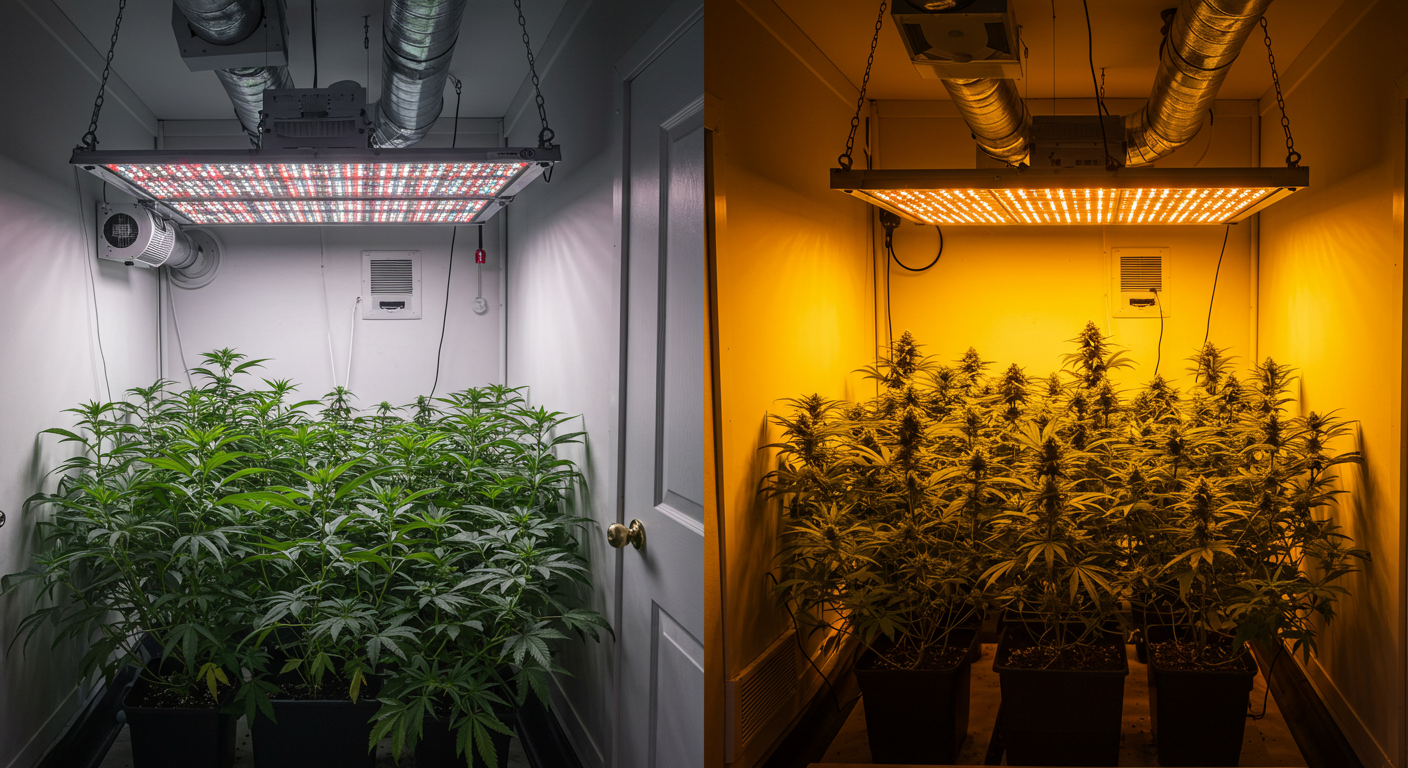
Veg vs Flower Power Use in One Sentence
Veg usually costs more in light hours and flower usually costs more in humidity control, so veg is predictable and flower is where the bill can swing.
Veg is longer hours, flower is higher humidity and higher climate load
Veg is the stage where you often run the light longer each day. That pushes kWh in a steady and predictable way.
Flower is the stage where the plants and the room start pushing back. The canopy gets bigger, transpiration rises, and lights-off humidity spikes become a nightly event. That is when dehumidifiers, AC, and sometimes heaters start behaving like primary loads instead of background loads.
Important: if you only budget for the light, you are budgeting for the easy part.
Your biggest swing is not the light, it is what the room needs to stay stable
Lights are scheduled. Climate devices are demand-driven.
That single difference explains why two growers with the same tent and the same light can have very different monthly bills. One grow happens in a stable room and the dehumidifier barely runs. Another grow happens in a humid room or a room with big temperature drops at night and the dehumidifier runs for hours to chase spikes.
What Actually Changes Between Veg and Flower
You do not change “one thing” when you flip to flower. You change the whole behavior of the room because the plants change how they breathe and how they hold moisture.
Light schedule shifts the baseline immediately
The first change is obvious. The light schedule changes. The baseline kWh from lighting changes on day one.
18/6 and 20/4 veg schedules vs 12/12 flower
Most veg schedules are longer than flower. The common ones are 18 hours on and 6 off, or 20 on and 4 off. Flower is usually 12 on and 12 off.
If your light draw stayed identical, going from 18/6 to 12/12 would cut light kWh by one third. That is real. It is also why many people expect flower to be cheaper.
Why fewer light hours does not always mean a cheaper month
Flower can still cost more because the room’s “support system” starts working harder.
The biggest reason is humidity. The light turning off drops temperature fast. RH rises even if the room did not gain any new water. That spike triggers dehumidification. The dehumidifier dumps heat back into the room and that can trigger more cooling. The end result is that the light got cheaper but the room got harder to control.
Remember: RH is a percentage. It changes when temperature changes.
Light intensity often changes even if the fixture stays the same
Many growers run the same fixture all cycle. They still change the average watts because they change dimming.
Dimming strategy and why many grows ramp in flower
A typical pattern is lower intensity early in veg, then higher intensity as plants fill the space, then a ramp into early flower, and then a steady high output through mid and late flower.
That means the light can draw more watts in flower even though it runs fewer hours. If you dimmed to 60 percent in veg and you run 100 percent in flower, your “watts per hour” just changed the equation.
Tip: when you estimate costs, use average watt draw for the stage, not the max watt label on the fixture.
Plant water output changes, and that moves your dehumidifier and AC
The most important shift between veg and flower is water movement.
Why transpiration rises as canopy and flower mass increase
As the canopy fills out, leaf area increases. More leaf area means more transpiration and more water vapor released into the room.
In flower, you also create more dense plant mass. Dense mass holds moisture longer and it slows drying in microclimates inside the canopy. That keeps the local RH higher near buds and it makes dehumidification run longer to pull the room back down.
The nightly humidity spike problem in flower
Lights-off spikes are the classic reason flower becomes expensive.
During lights-on, temperature is steady and air can hold more moisture. During lights-off, temperature drops, the air holds less moisture, and RH rises. The dehumidifier then has to pull water out of the air while the room is cooler, which often reduces dehumidifier efficiency and increases runtime.
Master advice: if your flower bill surprises you, look at lights-off trends first. That is where the hidden hours are.
Device by Device: How the Load Shifts
This is the practical way to think about veg vs flower. The devices do not just “use power.” Their duty cycle changes.
Grow light
The grow light is your most predictable kWh source. It changes mainly through schedule and dimming.
Hours per day, average watt draw, and dimming reality
For budgeting, the light needs three numbers:
- average wall watts for the stage
- hours per day
- days in the billing period
If you do not know your average wall watts, do not guess based on a model name. Use a plug-in meter or a controller readout if you have one. Even small changes in dimming can change your monthly total more than you expect.
When flower draws more light power even on fewer hours
Flower draws more light power when you run higher intensity.
This happens a lot in real grows. Veg might be 18 hours at lower intensity. Flower might be 12 hours at high intensity. The total kWh could still be similar, and then the climate load decides which month is more expensive.
Exhaust and intake
Ventilation can either help your bill or destroy it. It depends on outside air and on how your room behaves.
Why airflow is often higher in flower
Flower often demands more odor control and more canopy control. Many growers increase exhaust speed. Some run more active intake. Some open passive intakes wider.
That airflow can reduce heat and reduce humidity when outside air is dry enough. It can also increase humidity load when outside air is wet.
The cost of pulling in wet outside air
If outside air is humid, every air exchange brings in water vapor. That water vapor becomes your dehumidifier’s job.
This is where people pay twice. They exhaust air they already conditioned and then they pull in air that needs to be dehumidified again. The equipment is working, but the strategy is fighting itself.
Important: ventilation is not automatically dehumidification. In humid conditions, it can be the opposite.
Circulation fans
Circulation fans are the classic “small load that adds up” device. They also tend to run 24/7.
The constant load that quietly adds up
A few fans that run all day can be a meaningful monthly kWh number even though each fan seems small. This matters most in long veg periods because the hours accumulate.
Why flower usually needs more air movement at the canopy
In flower, dense buds and dense leaves create microclimates. Those microclimates are where RH pockets form. That is why many setups add more circulation or aim airflow more carefully across and under the canopy.
More fans means more kWh. Better airflow can also reduce dehumidifier runtime. The tradeoff is worth thinking about as a system, not as a single device.
Dehumidifier
The dehumidifier is the reason flower cost is variable.
Why flower can turn it into a near 24/7 device
Flower can push moisture load to the point where the dehumidifier runs most of the day. It is not only plant transpiration. It is also evaporation from wet surfaces, and it is the lights-off spike pattern.
If you are hitting high spikes every night, the unit may spend hours just recovering to target. That is where “it runs sometimes” becomes “it runs all the time” without you noticing.
How target RH and temperature change runtime
Tighter targets increase runtime because the unit has to work harder to hold a narrow band.
Cooler temperature often increases runtime because many compressor dehumidifiers remove less water per hour in cool intake air. That means the same moisture load takes longer to remove.
Tip: if you want lower dehumidifier cost, start by reducing spike duration, not by chasing lower RH numbers all day.
Air conditioner
AC and dehumidification are linked more than most growers expect.
Light heat vs dehumidifier heat
The light adds heat. The dehumidifier also adds heat because it rejects heat back into the room during operation.
That means a strong dehumidifier cycle can raise temperature and then trigger more cooling. If you are already near your temperature limit, dehumidification can become an indirect AC cost multiplier.
The common trap where “solving humidity” increases cooling demand
The trap is simple. You add dehumidification to make flower safer. The room gets warmer. AC runs longer. You did solve humidity, but your total kWh rose more than you expected.
Advice: when you budget flower, treat dehumidifier and AC as one combined system if you use both.
Heater and heat mats
Heating loads can flip the equation in some seasons.
Why shoulder seasons can flip the equation
In shoulder seasons, days can be mild and nights can drop hard. Lights-on may be fine and lights-off may get cold.
If you heat at night, that is a big load. In those cases, flower can sometimes be cheaper than veg because the light runs fewer hours and contributes less heat, so you might need less cooling, but you may still need heat at night. It depends on your room.
Pumps, reservoirs, and automation
These loads are usually smaller. They still matter because they can run continuously or frequently, especially in long veg.
Small loads that matter in long veg periods
A small pump that runs 24/7 might not sound serious, but over a month it becomes real kWh. Veg periods can stretch. Those weeks are when “small always-on” devices quietly show up on the bill.
Controllers, sensors, and humidifiers
These are often low power, but they can change how other devices behave.
When a humidifier matters in veg, and why it can disappear in flower
In dry climates, veg can require humidification because young plants and early veg can run best with higher RH. A humidifier can become a real load if it runs often.
In flower, the same room often stops needing a humidifier and starts fighting humidity instead. That is one of the reasons the bill can flip in unexpected ways.
Remember: a “dry veg” plus a “wet flower” is a common pattern, and it changes which device dominates.
The Two Curves That Explain Most Electricity Bills
If you understand these curves, you can predict your bill before it arrives.
The light curve, schedule plus intensity over time
Light cost is not one flat number. It changes as your intensity changes and as your schedule changes.
Ramping plans that match plant size, not calendar days
The clean way to ramp is to match light intensity to canopy development, not to a fixed calendar.
Early veg usually needs less intensity because the canopy is small. Late veg and early flower often ramp up because the canopy fills. Mid and late flower often holds steady at a high level.
This explains why some flower months do not drop in cost as much as expected. The hours dropped, but watts increased.
Tip: when you build a “flower month” model, use the watt draw you actually run in mid flower, not the watt draw you used in early veg.
The moisture curve, transpiration and evaporation over time
Moisture load is the curve that makes flower expensive.
Late flower peak week and why it sets your “worst case” budget
Most grows have a peak moisture window in late flower. The canopy is full, buds are dense, and the room’s nightly spikes are strong.
If you budget for average weeks, you will be surprised in peak week. If you budget for peak week, average weeks feel easy.
Important: build your budget from the worst week first. That one week often decides your comfort and your risk.
The Transition Week: Where Many Estimates Break
The week you flip is a weird zone. Your light hours drop, but your room load can increase.
Flip week often increases total load even though light hours drop
This happens because the plants are changing fast and the canopy can expand quickly.
Stretch, canopy expansion, and sudden RH swings
Stretch can increase leaf area quickly. More leaf area means more transpiration. At the same time, you may still have veg-like watering habits and wet surfaces that add evaporation.
If your room was barely stable in late veg, flip week can push it over the edge.
Dial changes that trigger new runtime patterns
Most people change more than the schedule when they flip, even if they do not think they do.
Day and night targets that need separate settings
Flip week is when you should separate day and night targets if you can. Nights tend to spike, and days tend to be more stable.
If you use a single target for the entire day, you can end up forcing expensive runtime during the day while still getting dangerous spikes at night. A smarter approach is to control the spike window and keep the day stable without overworking the system.
Advice: treat lights-off as its own climate problem with its own strategy.
Planning Your Budget Without Guessing
This is the repeatable method. Do it once and your future grows become easy to price.
Step 1: List devices and measure real watt draw
Start with a list of everything that uses power. Then measure the real wall draw.
Why nameplate wattage is not your monthly number
Nameplate wattage is often a maximum or a rated draw under a condition. Your room is not that condition.
Your light might be dimmed. Your fan might be at 60 percent. Your dehumidifier might cycle and draw different power during different phases.
Tip: measure the light at the setting you actually use, and measure the dehumidifier over a full day so cycling is captured.
Step 2: Assign stage based runtime
Now assign runtime differently for veg and flower.
Fixed schedule devices vs demand driven devices
Fixed schedule devices are lights and any pumps or devices you run on timers.
Demand-driven devices are dehumidifiers, AC, heaters, and sometimes exhaust fans if you run them based on temperature or humidity.
This is the core budgeting concept. Fixed schedule is easy. Demand-driven needs observation and a buffer.
Step 3: Build two monthly models, veg month and flower month
Build one model for a veg month and one model for a flower month. Keep them separate.
A conservative model and a realistic model
A conservative model assumes higher runtime for demand-driven devices. A realistic model assumes the typical runtime you see most weeks.
Both models are useful. Conservative prevents surprise bills. Realistic prevents overestimating and making the grow feel more expensive than it will be most of the time.
Remember: a budget is not a prediction. It is protection against the bad week.
Step 4: Add a peak buffer for late flower and bad weather weeks
Now add a buffer for the week that usually breaks estimates.
The buffer that prevents surprise bills
Your buffer should be based on something real. The cleanest method is one week of data during late flower. If you do not have that yet, assume that late flower will increase dehumidifier and AC runtime and plan for it.
A practical buffer is not a random number. It is an extra chunk of kWh tied to demand-driven devices.
Step 5: Convert monthly cost into per harvest cost
Once you have monthly numbers, convert them to cycle cost.
Why per harvest planning beats per month planning
A utility bill month does not match your grow calendar. Per harvest cost lets you think in cycles and decisions.
If you add dehumidification only for the last half of flower, that is a per harvest decision. It might barely change your average monthly bill but it can strongly change your harvest outcome and your risk.
Tip: if you track cost per cycle, you also learn which changes improved efficiency and which changes just added watts without return.
Example Scenarios That Show the Real Difference
These scenarios are not about one perfect answer. They are about what dominates in different environments.
Dry climate, minimal dehumidification, light dominates
In a dry climate, the dehumidifier may barely run. Your biggest loads are the light and the 24/7 fans.
Veg often looks more expensive because of long light hours. Flower often looks cheaper because the light hours drop and there is no major climate device taking over.
Humid climate, dehumidifier dominates flower
In a humid climate, the dehumidifier can become the main load in flower, especially during lights-off.
This is where growers feel like flower is “supposed to be cheaper” and then they get a bigger bill. The light dropped, but the dehumidifier ran longer and sometimes the AC ran longer because the dehumidifier added heat.
Cold season grow, heater dominates and flower becomes cheaper than expected
In cold seasons, the heater can dominate, especially at night.
Flower can become cheaper than expected if the room holds stable humidity and the heater runs less because the light is contributing less heat. Or flower can become more expensive if you are heating aggressively to hold stable temperatures at night.
The point is that the dominant device changes. Your bill follows the dominant device, not the stage label.
Hot season grow, AC dominates and veg can be the expensive stage
In hot seasons, AC can dominate.
Veg can be expensive if the light runs many hours and adds heat all day. Flower can also be expensive because dehumidification adds heat and AC runs to compensate.
If you are in a hot season environment, the best cost move is often reducing heat load so AC runtime drops, rather than obsessing over small device watts.
Where Growers Usually Miscalculate Veg vs Flower
Most miscalculations come from treating the grow like a light schedule problem only.
Assuming fewer light hours always means a cheaper flower
This is the most common mistake.
Flower can cost more because the room needs more climate control and that climate control is demand-driven. It runs when the room asks for it, and the room asks for it more in flower.
Ignoring lights-off humidity spikes
If you budget based on daytime readings, you are missing the expensive part.
Lights-off spikes often create long recovery runtimes. Those runtimes are the hidden hours that turn flower into a higher cost stage.
Important: if you do not measure at night, you are guessing.
Forgetting the dehumidifier heat load on AC
A dehumidifier adds heat. AC removes heat. If you run both, the devices interact.
This is why some grows see a double climb in kWh during late flower. The dehumidifier runs more and then AC runs more because the room is hotter.
Using a single RH target for the entire cycle
One target all cycle is simple, but it is often expensive and it is sometimes ineffective.
Veg, early flower, and late flower do not have the same risk profile. Nights do not behave like days. A smarter approach is stage-aware and day-night aware targets.
Advice: widen your control band when you can, and tighten only where risk forces you to.
Not separating the room cost from the tent cost
Many growers estimate “tent cost” and forget the room.
If your tent exhausts into a room that then needs AC or heating to stay stable, that is part of the tent’s operational cost. The tent is forcing the room to do work.
Remember: the tent does not live in isolation. Your bill does not either.
Reducing Cost Without Losing Control
Lower cost comes from reducing waste and controlling peaks, not from cutting random watts.
In veg, lower cost by controlling light intensity and unnecessary runtime
Veg cost is easier to control because it is more scheduled.
Smarter dimming and schedule choices
Run only the intensity your canopy can use. If the canopy is small, blasting full output is often wasted kWh.
If you run long veg schedules, consider whether 18 hours gives you what you need or whether a shorter schedule still supports your goals without adding hours. The right answer depends on your cycle strategy and your plant size goals.
Tip: do not dim just to dim. Dim to match canopy size and avoid paying for light that hits walls and floor.
In flower, lower cost by cutting dehumidifier duty cycle
Flower cost is often dehumidifier cost in disguise.
Better airflow, less evaporation, tighter sealing
Airflow reduces RH pockets and speeds recovery. Less evaporation reduces the moisture you have to remove. Better sealing reduces humid air infiltration.
These are high ROI because they reduce runtime. Reducing runtime lowers kWh without sacrificing safety.
Day and night RH targets that reduce runtime
Night spikes are often the worst window. If you can reduce the peak and shorten recovery, you often cut the longest runs.
A simple approach is to run a slightly different target and band at night than in the day, and to focus on preventing long periods of high RH rather than chasing a perfectly flat line.
Important: do not lower targets so aggressively that the system runs nonstop. Nonstop runtime often means you are chasing an unrealistic setpoint for your capacity and your environment.
Using ventilation strategically instead of reflexively
Ventilation is a tool. Use it when it helps, and avoid it when it makes you pay twice.
When outside air helps, and when it makes you pay twice
Outside air helps when it is cooler and drier than your room. It can remove heat and dilute moisture.
Outside air makes you pay twice when it is humid and you are exhausting conditioned air. You pay to condition and dehumidify the air, then you throw it away, and then you bring in more humid air that needs work again.
Master advice: learn your outside humidity pattern. If you know when outside air is dry, you can time ventilation to reduce runtime.
The Questions That Decide Your Final Number
These are the questions that tell you whether veg or flower will be cheaper in your specific setup.
What climate am I fighting, humidity or temperature or both?
Some grows are humidity-limited. Some are temperature-limited. Many are both.
If you are humidity-limited, flower cost is likely to swing. If you are temperature-limited, the hottest weeks can dominate cost regardless of stage.
Do I run a dehumidifier, AC, or a mix?
If you run a dehumidifier and AC together, treat them as linked. If you run only one, your budget is simpler.
Your dominant device often becomes your dominant cost.
Is my grow sealed, semi sealed, or fully vented?
Sealed and semi sealed grows often rely more on mechanical dehumidification. Fully vented grows rely more on outside air conditions.
Neither is automatically cheaper. It depends on outside humidity and on how much conditioned air you throw away.
Do I ramp light intensity, or run one fixed level?
Ramping changes average watt draw by stage. A fixed level makes the light curve flatter.
If you ramp hard into flower, your lighting kWh may not drop as much as you expect when you switch to 12/12.
Key Takeaways
Veg is predictable cost, flower is variable cost
Veg is mostly scheduled loads. Flower is where demand-driven loads can dominate, especially humidity control.
If your bill surprises you, it is usually because a demand-driven device ran far more hours than you assumed.
Plan for peak week first, then average weeks become easy
Late flower peak week is where most people get hit.
Budget for the worst week. If you do that, the rest of the cycle feels stable and your monthly bill stops feeling random.
Track real watt draw and real runtime once, and your future grows price themselves
Measure once, model once, and your future grows become easy to price.
Get real wall watts for your main devices. Log or estimate runtime by stage. Add a peak buffer based on late flower behavior. After that, your next run is not a guess. It is a simple update to a system you already understand.
Share this article
A quick overview of the topics covered in this article.
Follow us
Latest articles
October 27, 2026
October 27, 2026
October 27, 2026
October 27, 2026
