
What are F1 Hybrid Seeds?
“F1 hybrid” is one of the most misunderstood seed labels in cannabis. In traditional plant breeding, an F1 hybrid has a precise meaning. In cannabis marketing, the term is often used loosely to mean “a cross.” Those are not the same thing, and the difference matters because it changes what you can expect in uniformity, vigor, timing, and repeatability.
This guide explains what an F1 hybrid seed really is, what it is not, why it can be valuable, and how to evaluate F1 claims without guessing.
What “F1 hybrid seed” means in real breeding terms
An F1 is the first filial generation. It is the direct offspring of a cross between two distinct parents.
In classic hybrid breeding, those parents are usually stable, inbred lines. They are made uniform over generations so that crossing them produces an F1 generation that is highly uniform.
That uniformity is the core value proposition of “true F1.”
Why this requires stable parents: if the parents are genetically “fixed,” the F1 offspring tend to express a consistent combination of those parental traits.
Important: an F1 hybrid does not “breed true” from saved seed. The next generation (F2) typically shows much wider variation because the genetics reshuffle.
What cannabis growers often mean when they say “F1”
In cannabis, many “F1” products are simply the first cross between two non-inbred parents. That can still be a good cross. It just will not behave like a classic agricultural F1 hybrid.
This matters because cannabis and hemp are often described as highly heterozygous, meaning there is lots of genetic variation inside a line compared to many highly standardized crops.
So you have two different realities:
- True F1 (hybrid-breeding sense): stable parents, high uniformity, repeatable results when the cross is repeated.
- First cross (common cannabis use): parents may be variable, results can be more variable, “F1” is more of a timeline label than a uniformity guarantee.
Critical warning: if you buy “F1” expecting corn-like uniformity, you can end up disappointed. The label alone does not prove the parents were stabilized.
Why true F1 hybrids are a big deal when they are real
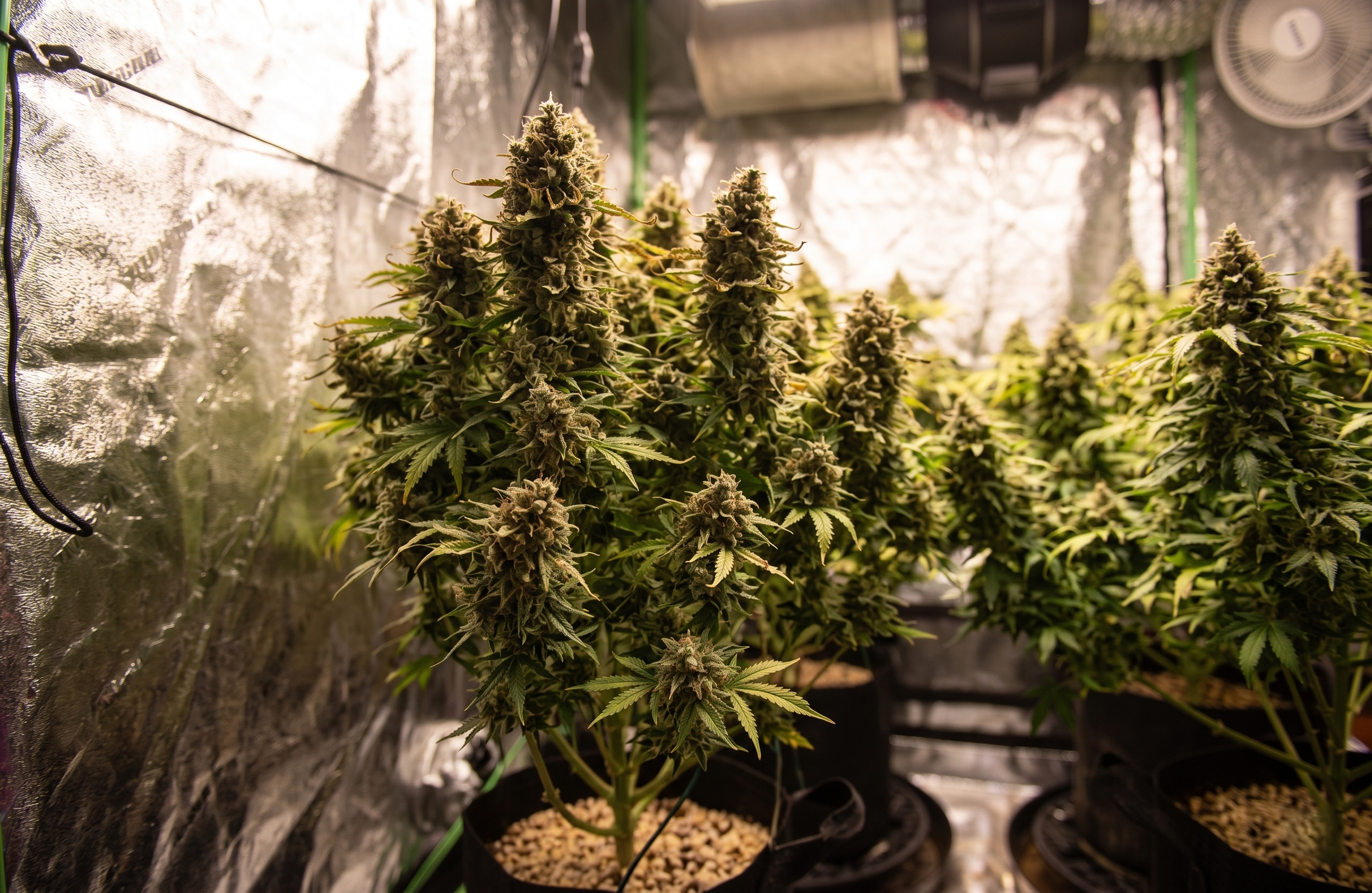
Uniformity that changes how you grow
Uniformity is not only “nice.” It changes operations.
A uniform crop is easier to:
- train to one canopy shape
- feed consistently
- dial irrigation rhythm
- time defoliation and harvest windows
- manage humidity and airflow because plant size is predictable
In large grows, uniformity reduces labor and reduces the “one weird plant” problem.
In small grows, uniformity reduces stress because you are not solving five different plant personalities at once.
Hybrid vigor and why it shows up in the first year
F1 hybrids often show heterosis (hybrid vigor), where the F1 offspring outperform the inbred parents in traits like growth and yield.
That is the classic pattern: inbreeding creates stable parents, then crossing them can restore vigor in the F1.
Cannabis-specific research supports the potential. A 2024 HortScience paper reported that F1 hybridization in cannabis could improve uniformity and increase biomass and flower dry weight compared with self-lines, with the authors pointing to heterosis as a likely driver.
Remember: vigor does not mean “automatic greatness.” It means the plant has a better baseline to express potential when the environment is decent.
How true F1 cannabis is becoming more possible
Historically, producing true F1 hybrids is difficult in highly heterozygous crops because you need stable inbred lines first. Cannabis is often described as challenging to breed for uniformity because of heterozygosity and complexity.
Newer methods are changing timelines. A 2026 study in Horticulture Research describes a proof-of-concept using single-seed descent and sex reversion to create homozygous lines and then produce multiple F1 hybrid accessions.
You do not need the technical details to benefit from the trend. The practical point is simple: true F1 cannabis is no longer just theory, but it is still not the default for most products labeled “F1.”
F1 vs F2 vs “hybrid” in cannabis terms
F1
First cross. In classic breeding, it is the uniform generation created from stable parents.
F2
Seed made from F1 plants. This generation tends to segregate, meaning you see a wider range of traits. That is why saved seed from an F1 does not replicate the same plant consistently.
“Hybrid” as a consumer word
In cannabis, “hybrid” often just means “not pure indica or sativa.” That is not a breeding-generation label. It is a market category.
So when you see “F1 hybrid seeds,” your job is to clarify which meaning is being used.
What F1 hybrids can realistically improve
Predictable structure and timing
When F1s are well-made, you usually get tighter clustering in:
- plant height
- branching style
- flowering onset window
- finish window
This is the most valuable improvement for most growers.
Consistency in cannabinoid outcomes
Cannabis F1 work has reported improvements not only in biomass and uniformity but also in cannabinoid-related measures in that dataset.
That does not mean “F1 equals higher potency.” It means uniform genetics can make the crop more consistent.
More forgiving growth rhythm
Hybrid vigor often shows as a smoother growth curve. F1 plants can feel less fragile than highly inbred parents, which can suffer inbreeding depression.
In cannabis, inbreeding depression is a real concern in selfed progeny according to HortScience work comparing selfed and outcrossed progeny.
So F1 hybrids can be a practical way to get stability without sacrificing vigor, if the breeding work is real.
What F1 hybrids do not automatically fix
They do not replace good environment control
Even the best genetics cannot overcome:
- chronic heat stress
- big humidity spikes
- poor airflow
- inconsistent root-zone management
F1 uniformity makes it easier to dial a system. It does not remove the need to dial it.
They do not guarantee “one phenotype”
Even in true F1 crops, uniform does not mean identical. It means variation is narrowed.
In cannabis, the baseline variability of many lines is higher than in standardized vegetable crops.
So your expectation should be “more consistent,” not “carbon copies.”
They do not guarantee seed-saving success
If you save seeds from an F1, you get an F2. F2s do not replicate the F1 consistently.
That is not a defect. That is how segregation works.
Indoor vs outdoor: where F1 shines differently
Indoor grows
F1 hybrids can be most valuable indoors because uniformity translates directly into:
- easier canopy control
- predictable stretch
- predictable humidity load
- smoother harvest planning
If you are running a tent or a single room, uniformity reduces the “one plant that forces you to change the whole room.”
Outdoor grows
F1s can be useful outdoors for a different reason: risk management.
Outdoor conditions are variable. A stable, vigorous genetic baseline can help the crop handle normal fluctuations. Hybrid vigor concepts are widely discussed in plant breeding, especially when crossing inbred parents.
Still, outdoors you must match genetics to climate. Uniformity does not protect against a poor fit to humidity or season length.
Feminized F1 vs Regular F1
“F1” describes generation. “Feminized” describes sex probability. They can overlap.
- F1 feminized means the F1 seeds are designed to produce mostly females. Cannabis feminization via sex reversion is well documented in horticultural research.
- F1 regular means male and female outcomes are both possible.
For flower production, feminized is usually more efficient.
For breeding projects, regular is usually more useful because you can select males.
How to evaluate an “F1” claim when you are shopping
This is the part that prevents regret.
Look for proof of stabilized parents, not only the word “F1”
In classic F1 production, the parents are stable lines.
So ask: does the description indicate the parents are inbred lines, or does it read like a standard cross between two already-hybrid parents?
Clues that the breeder did real line work:
- mentions of inbred line development or generations
- emphasis on uniformity across the pack
- repeatability language like “this cross is reproduced consistently”
Clues it is marketing “F1”:
- heavy emphasis on hype traits with no mention of uniformity
- extremely wide range in plant size or finish time
- vague parent descriptions
Look for narrow ranges
A true F1 product usually advertises tighter ranges:
- height range is narrow
- finish window is narrow
- structure description is consistent
Wide ranges can still be okay, but they conflict with the promise of F1 uniformity.
Use a simple “pack consistency” reality check
If the product claims strong uniformity, your experience should match:
- similar growth rhythm across plants
- similar stretch behavior
- similar flowering onset window
If you see extreme divergence, it may not be a stabilized-parent F1.
Common beginner misunderstandings
“F1 means I will get the exact plant I want”
No. It means the odds of consistency are higher when the breeding is real.
“F1 means the strongest version of a strain”
Not necessarily. It can be a strategic cross designed for uniformity, vigor, or production traits. Heterosis is trait-specific and environment-dependent.
“I can save F1 seeds and keep the same results”
Saved seed becomes F2, and F2 usually varies much more.
What you do when the “F1” pack is not uniform
This happens. It does not mean you failed.
What it usually means
- the parents were not stabilized
- the product is a first cross, not a classic F1
- the line is early in development
What you can do right now
- treat it like a small pheno hunt
- label plants early
- keep notes on timing and structure
- keep the best performer as a reference for future runs, if that fits your goals
Prevention next time
- buy F1 products only from sources that emphasize uniformity and repeatability
- avoid “mystery mix” packs labeled as F1
When F1 hybrids are worth paying more for
F1s are most valuable when the cost of inconsistency is high.
Examples:
- your canopy must be even because space is tight
- you need predictable harvest timing
- your climate control is sensitive to plant size swings
- you are scaling and labor consistency matters
If you are a hobby grower who enjoys variation, a true F1 might feel less exciting. F1 uniformity is a feature. It can also feel like less exploration.
Where F1 fits in a 2026 seed strategy
If you want one clean mental model, use this:
- Choose true F1 when you value uniformity, repeatability, and a smoother growth curve.
- Choose non-F1 crosses when you value variation and discovery, and you are willing to manage more plant-to-plant difference.
- Do not buy “F1” expecting a miracle. Buy it expecting less chaos.
Share this article
A quick overview of the topics covered in this article.
Follow us
Latest articles

June 24, 2026

June 24, 2026

June 24, 2026
June 24, 2026