
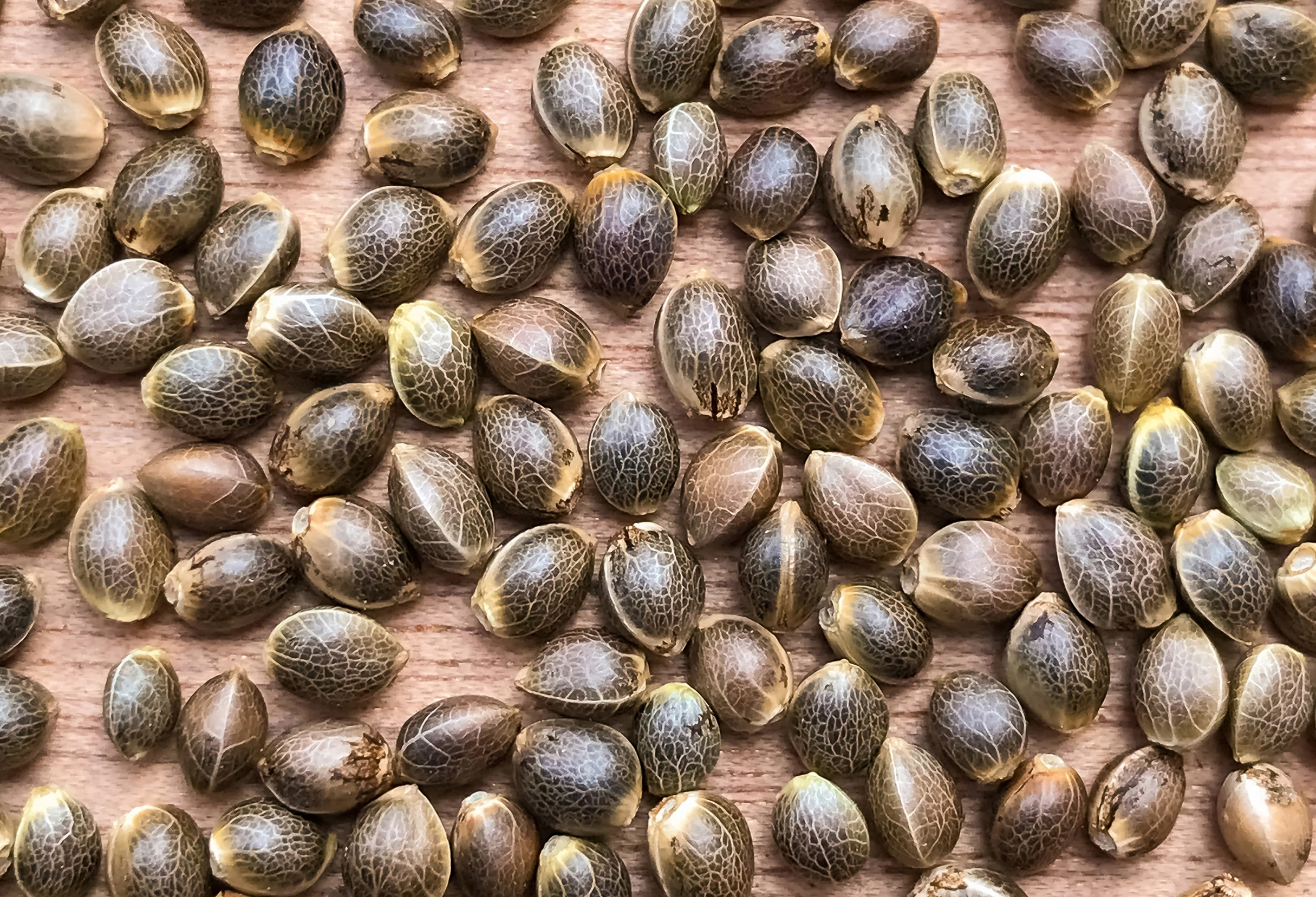
IBL Seeds Explained: What “Inbred Line” Really Means in Cannabis
IBL stands for Inbred Line. When you see it on a seed listing, it is meant to signal one main idea: the line has been bred through multiple generations of related parents so the offspring become more consistent and more predictable than an early cross.
In cannabis, this matters because seed-grown crops can show a lot of variation even within a single named cultivar. Research in cannabis breeding and genetics describes high levels of variability as a real constraint for seed-grown production and a reason breeders pursue homozygous parental lines for uniformity-focused seed systems.
IBL is one of the labels that tries to tell you, “This is closer to true-to-type seed behavior.” The label can be meaningful, but only if you understand what it can and cannot promise.
What an IBL is in plain terms
An IBL is a seed line that has been worked. Worked means the breeder repeatedly bred within a related family, and selected toward a target set of traits, until the population became noticeably more uniform.
A good way to picture the difference:
An early cross gives you siblings with a wide range of expressions.
An IBL gives you siblings that feel like they belong to the same “narrow family.”
That does not mean clones. It means the breeder is trying to make the seed line reproduce consistently.
This is the same concept you see in general horticulture. Inbred lines are created by allowing closely related plants to set seed over several generations, which leads to a population of very similar plants, and those inbred lines are the critical building blocks for repeatable hybrid systems.
Why cannabis breeders chase IBL style stability
Consistency is a production trait, not a marketing word
Uniform plants are easier to manage because timing and canopy behavior become more predictable. That shows up in real decisions:
You can set training and spacing once.
You can plan harvest windows more accurately.
You can anticipate humidity load because canopy size is less chaotic.
You can run a cleaner dry and cure plan because more plants finish together.
The cannabis industry interest in uniform seed is growing partly because vegetative propagation has drawbacks at scale, and because uniform seed could improve production efficiency and consistency.
Stable chemotypes are part of the long game
In cannabis, “stable” is not only plant height and flowering time. It also includes chemical outcomes.
A classic Genetics paper showed chemotype inheritance patterns using inbred Cannabis sativa plants, and it demonstrates why breeders care about controlled genetic systems when targeting chemical profiles.
You do not need to be breeding for cannabinoids to benefit from this. The point is that cannabis breeding often needs deliberate structure to reduce unpredictability.
How an IBL is created
There is more than one path, but the logic stays the same: inbreeding plus selection, repeated enough times that the line tightens.
The building blocks breeders use
Some programs lean on filial work, meaning they keep breeding forward generation after generation within the same family.
Some programs use backcrossing, meaning they repeatedly cross offspring back to a chosen parent to lock a trait direction.
Some programs use selfing steps in the process. A 2024 HortScience study describes inbred lines produced through repeated selfing rounds, labeled S1 through S4, which illustrates the “make it more homozygous over time” approach in cannabis research settings.
In practice, different breeders mix these tools. What makes it an IBL is not the specific tool. It is the result: the line becomes more homogeneous and more repeatable.
Why it takes multiple generations
Inbreeding is basically a process of narrowing genetic variation. Each generation, you select what you want and remove what you do not want. That takes time because many traits in cannabis are not controlled by one simple gene.
Some traits tighten quickly, like basic structure. Others take longer, like consistent finishing behavior and consistent aroma expression.
Tip: if a listing calls something “IBL” but describes extremely wide ranges in height and finish time, that is a warning that the line may not actually be tight.
What you gain when an IBL is real
A tighter phenotype range
A real IBL should shrink the “surprise zone.” You may still see variation, but it should be a narrower band than you would expect from an early cross.
Cleaner planning and less waste
Uniformity reduces the number of special cases. Special cases cost time and increase risk. This is why uniform hybrid seed systems in agriculture depend on controlling inbred lines.
A more repeatable seed experience
An IBL is often described as closer to “true breeding,” meaning offspring resemble the line consistently.
Be careful with the word true. In plants, true-to-type is a spectrum. It depends on how stabilized the line is and how strict selection was.
The tradeoffs nobody should hide from you
IBL style breeding is not free. The cost is often paid in vigor.
Inbreeding depression is real
In horticulture, inbred lines are known to often lack vigor and can perform poorly, and the term inbreeding depression is used for the loss of vigor, fertility, or stature caused by inbreeding.
Plant research shows that inbreeding depression can be high in some populations and can sometimes be purged over time, depending on mating system and selection.
In cannabis, you can see the practical version of this as lines that feel “locked in” but less robust, and then F1 hybrids that look more vigorous when two inbred lines are crossed. That pattern is exactly what modern cannabis hybrid research is exploring: inbred lines for uniformity and hybrids for vigor.
Not every IBL is a good IBL
A weak selection program can create an IBL that is uniform in the wrong direction, or uniform but fragile.
A line can be “stable” and still be a poor fit for your environment or your goals.
Critical warning: stability is not the same as quality. It is only predictability.
IBL vs other seed labels in practical buying terms
You do not need to memorize definitions. You need to know what each label usually implies for your expectations.
IBL vs F1
F1 hybrids are often uniform because the parent lines are controlled, and horticulture guidance explains that inbred lines are the critical part of producing uniform F1 hybrids.
F1 seed also usually does not breed true in the next generation, which is why saved F1 seed produces variable offspring in F2.
IBL is aiming for repeatability within the line itself, not hybrid vigor.
IBL vs F2 and F3
F2 is where recombination and segregation show up loudly. F3 often starts narrowing if selection is real. An IBL is farther down that road, at least in intent, because the goal is a line that reproduces consistently.
IBL vs S1
S1 is selfed seed, and it can tighten a line while also exposing recessives. IBL is a broader concept. It is the result of multiple generations of inbreeding and selection, often using several tools, not only selfing.
IBL vs “stabilized”
Some sellers use stabilized as a softer version of IBL. Stabilized can mean “we worked it some.” IBL should mean “we worked it enough that it behaves like a line.”
Because cannabis markets do not have one universal standard for these labels, the safest approach is to judge by the expectations they give you, not the label alone.
How to tell whether an IBL claim is likely real
You are looking for the signals of a breeder who understands stability as a measurable outcome.
The listing describes consistency, not only hype
A serious IBL listing usually tells you what is expected to be consistent:
Timing range is narrow.
Structure is predictable.
Phenotypes are described as a tight set rather than a huge spread.
The ranges make sense for an inbred line
If an IBL is described as both “highly uniform” and “wildly variable,” you already have your answer.
The source talks about selection work
You do not need their whole breeding diary. You do need to know the line was selected intentionally across generations.
If the listing cannot explain what was selected, it is hard to trust the IBL claim.
The line is tested across more than one run
An IBL claim is stronger when it is supported by repeat grows in different conditions. This matters in cannabis because genetic diversity and environmental interaction can create big differences across setups.
Tip: when you are forced to choose without proof, choose the line with tighter stated ranges and clearer descriptions, not the line with bigger promises.
Where IBL fits best indoors, outdoors, and in mixed setups
Indoor
IBL lines can be very satisfying indoors because uniformity makes everything easier. Canopy control, watering rhythm, and harvest planning all improve when plants behave similarly.
The flip side is vigor. If the IBL is less robust, a marginal environment may expose weakness faster. This is one reason hybrid seed systems aim to regain vigor through heterosis when crossing inbred parents.
Outdoor
Outdoors, uniformity helps planning, but climate fit still wins.
If the line finishes evenly but your region has humidity spikes or early cold nights, the environment can still decide the outcome. IBL helps you predict the plant. It does not change the weather.
Mixed
Mixed setups often benefit from using IBL lines as the “predictable base.” They give you a stable reference point. Then you can run experimental genetics in a separate space without turning your whole cycle into a moving target.
IBL seeds for future breeding projects
IBL lines are valuable in breeding because they behave like a stable ingredient.
If you cross two stable inbred lines, you can produce more uniform hybrid offspring, and that is exactly how classic F1 systems work in other crops.
Cannabis research is actively exploring this approach. A 2026 open-access paper describes producing fully homozygous lines through single-seed descent and then using them to create statistically more uniform F1 hybrid lines, with F1 lines also being more vigorous than the inbred lines.
If you are planning long-term projects, this is the logic behind the scenes: stable lines give you predictable building blocks.
The questions people ask most about IBL seeds
Are IBL seeds always feminized?
No. IBL refers to genetic stabilization, not sex format. An IBL can be regular or feminized depending on how the seed is produced.
When you shop, treat these as separate questions: is it an IBL, and is it feminized or regular.
Are IBL seeds “better” than hybrids?
Not automatically.
IBL is usually better for repeatability. Hybrids are often better for vigor. That tension is described clearly in horticulture: inbred lines can lack vigor while F1 crosses can be uniform and vigorous due to heterosis.
Can I save seeds from an IBL and keep the same results?
If the IBL is truly stable, saved seed can stay relatively consistent compared to saving seed from hybrids. Still, seed saving introduces risks like accidental outcrossing and drift if you do not control pollination.
So the honest answer is: you can often get closer repeatability than saved hybrid seed, but “identical” is not a safe promise.
How many generations does it take for a line to become IBL?
There is no universal cutoff, especially in cannabis where market labels are not standardized.
What matters is the measured outcome: does the line reproduce consistently, and does it keep doing that across runs.
Why do some IBL seeds still show variation?
Three common reasons.
The line is not as stabilized as the label implies.
The traits you care about are complex and not fully fixed yet.
Your environment is pushing expression hard and revealing differences.
Cannabis genetic diversity research reinforces the reality that variability is high and that reducing it takes structured approaches.
Do IBL seeds have lower potency or weaker flavor?
Not inherently. What can happen is that inbreeding depression reduces vigor, and weaker plants sometimes struggle to express their full potential.
The better way to think about it is this: IBL can improve consistency. It does not guarantee the ceiling. The ceiling still depends on genetics, environment, and finishing.
Choosing IBL with the right expectations
IBL seeds are for growers who value repeatability. They are often not the best tool if you want maximum variation, or if you want to hunt rare outliers, or if you want the vigor that often comes from outcrossing and hybrid vigor dynamics.
A good next step is simple. When you see IBL on a listing, read it as a question and answer it before you buy: What exactly is supposed to be stable here, and how tight is the expected range? If the listing can answer that clearly, you are probably dealing with a real line. If it cannot, the label is doing marketing work instead of informing you.
Share this article
A quick overview of the topics covered in this article.
Follow us
Latest articles
September 26, 2026
September 26, 2026
September 26, 2026
September 26, 2026