
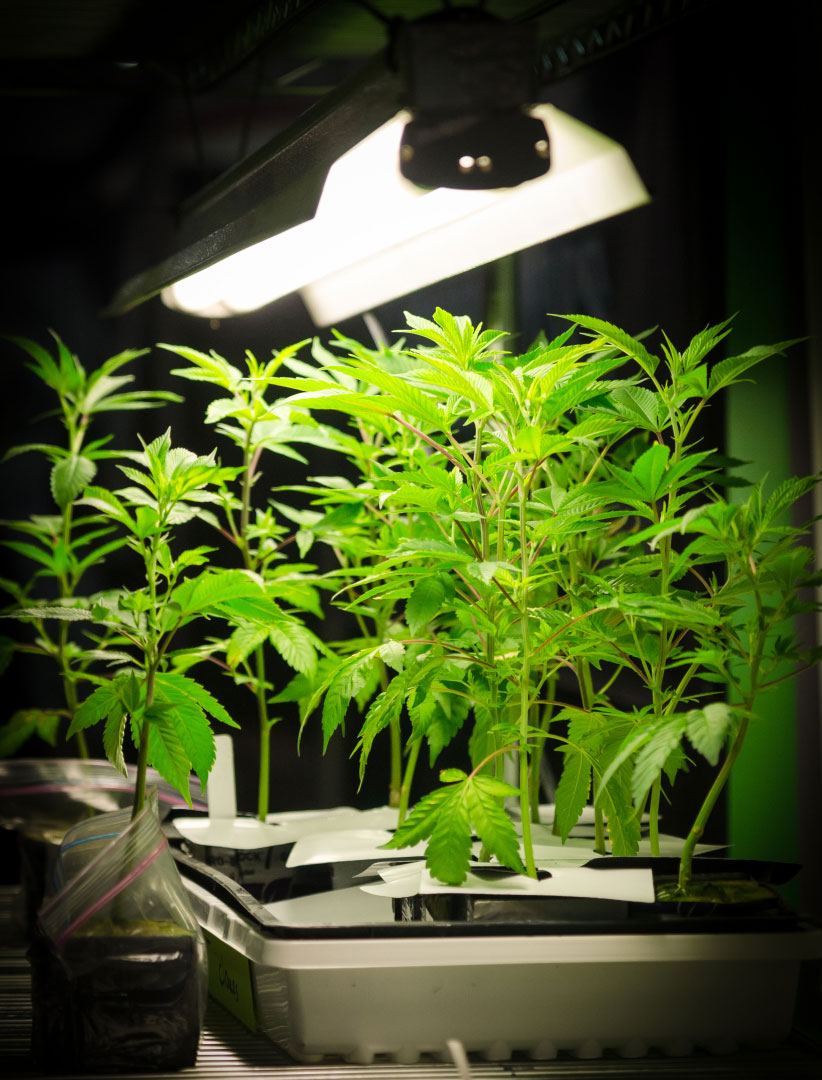
What Is the Best Light for Seedlings?
What seedlings actually need from light
The three metrics that matter: PPFD, photoperiod, DLI
Seedlings don’t “need watts.” They need photons in the photosynthetically active range delivered at the right rate and for long enough to build a healthy plant.
- PAR (photosynthetically active radiation) is commonly defined as 400–700 nm.
- PPFD is the density of PAR photons hitting a surface each second, measured as µmol·m⁻²·s⁻¹. Sensors that measure PPFD are often called quantum (PAR) sensors.
- DLI is the daily total of those photons across the photoperiod, measured as mol·m⁻²·day⁻¹.
A simple DLI rule you can actually use: DLI rises when PPFD rises, and also rises when photoperiod rises. An extension example shows that 200 PPFD for 16 h/day ≈ 12 mol·m⁻²·d⁻¹—that’s already “real seedling light,” not a pretty desk lamp.
Why lumens/lux “work” sometimes—and why they still bite growers
Lux and lumens weight light based on human eye sensitivity (peaks in green). Plants don’t run on the human photopic curve, which is why the same “lux” can mean very different PPFD depending on the spectrum.
So yes: you can use lux meters as a rough consistency tool only if you keep the same fixture and spectrum, but it’s not a universal plant-light metric—and conversions are spectrum-dependent.
If you want to go full Weedth-precision, the gold standard is a quantum sensor (or a properly-calibrated method) to read PPFD where the leaves actually live.
How much light do seedlings want?
For young plant production, multiple controlled-environment and extension resources converge on a consistent theme:
- Too low DLI (< ~10 mol·m⁻²·d⁻¹) tends to produce weaker rooting, more elongation, less shoot mass, and can delay “transplant-ready” timing significantly.
- For vegetable transplant production, an extension alert summarizing research suggests ~10–15 mol·m⁻²·d⁻¹ as an “optimal” DLI band that supports compact growth (thicker hypocotyls), stronger roots, quicker production time, and better vigor.
Cannabis seedlings are not magically exempt from plant physics. While cannabis flowering can tolerate very high PPFD later in the lifecycle, early-stage weed (especially small-root volume seedlings) does best when the DLI is appropriate and the climate supports transpiration and growth.
Here’s a practical seedling + clone target table you can start from, then tune by cultivar and environment.
| Stage | PPFD target (top of canopy) | Photoperiod | Approx DLI range | Why this range works |
|---|---|---|---|---|
| Freshly emerged seedlings (cotyledons) | ~80–150 | 18 h | ~5–10 | Enough photons to prevent stretching without overwhelming young tissue; aligns with “start seedlings lower DLI then build” logic. |
| Established seedlings (first true leaves → 2–4 nodes) | ~150–250 | 18 h | ~10–16 | Lands in the “high-quality transplant” DLI band for many crops; typically produces thicker stems and better roots. |
| Unrooted cuttings/clones (first days) | ~50–100 | 16–20 h | ~3–7 | Low light reduces transpiration demand while roots form; common propagation guidance and cannabis micropropagation ranges match this logic. |
| Rooted clones / “ready to veg” | ~100–200 | 18 h | ~6–13 | Scale up once roots exist and leaves can drink what the light demands. |
Cannabis-specific note: a peer-reviewed micropropagation study reports that cannabis micropropagation commonly uses 16–24 h photoperiods at 50–100 PPFD during rooting phases, and suggests ~100–150 PPFD with a 20 h photoperiod as an optimal combination for certain plantlets—while also warning that continuous lighting can hurt performance and trigger stress at high intensities.
Spectrum: what colors matter for seedlings—and what’s mostly marketing
Seedlings respond to both quantity and quality of light. The most grow-relevant spectrum ideas for early stages:
Blue (roughly 400–500 nm)
Blue light is deeply involved in regulating elongation and morphology (compactness vs stretch), mediated by photoreceptors like cryptochromes, and interacts with other wavelength cues. In practice, more blue fraction often suppresses excessive elongation—useful for seedlings—though responses vary by species and context.
Red (roughly 600–700 nm)
Red photons are efficiently used for photosynthesis and strongly influence photomorphogenesis through phytochromes. Most “full spectrum” seedling fixtures include abundant red via white LEDs plus added deep red (~660 nm).
White (broad spectrum via phosphor LEDs or fluorescents)
White is not a magical plant wavelength—it’s a human label describing a broad spectrum. For seedlings, broad-spectrum white (especially “cooler” 5000–6500K mixes) is popular because it includes blue that supports compact growth and provides visually comfortable working light. Many commercial grow fixtures explicitly use blends like 3000K + 5000/6500K plus deep red and sometimes far-red.
Far‑red / IR-adjacent (~700–750 nm, often “730 nm”)
Far‑red lowers the red:far‑red ratio and can trigger shade-avoidance responses (elongation). For seedling structure, you generally don’t want a heavy far‑red push early unless you’re solving a specific morphological target.
UV (UVA/UVB)
UV can trigger protective responses (e.g., flavonoid accumulation), but high/continuous UV-B is a known plant stressor that can damage DNA, impair photosynthesis, and reduce performance depending on dose and context. For seedlings, UV is a “precision tool,” not a default setting.
Cannabis-specific: controlled research on indoor cannabis found that adding UV did not produce commercially relevant benefits to yield/cannabinoids under the tested conditions, reinforcing the idea that UV is not your seedling foundation.
Choosing your light type
This is where most growers lose money: buying the wrong category of light for the job. Here’s the Weedth comparison centered on seedlings.
LED
A modern, dimmable, full-spectrum LED fixture is usually the best “one light from seed to harvest” purchase—especially if you can dim down for seedlings and ramp up later. LEDs also allow spectral customization (at the design level) and often deliver high photon efficacy (µmol/J), which is the efficiency metric that actually matters for plant lighting.
Real-world advantages for seedlings:
- Control: Dimming prevents you from blasting babies with flowering-level PPFD. Many fixtures include 0–100% dimming or stepped control.
- Lower radiant heat to the canopy than HPS (though drivers and heat sinks still warm your room). That makes it easier to keep leaf temperature and VPD in range.
- Uniformity options: Bar-style fixtures can produce very even PPFD maps; uniformity matters because uneven light creates uneven growth and inconsistent transplant readiness.
Primary limitation: high-quality LED fixtures cost more upfront, though the value proposition improves when you factor efficiency, lifespan, and controllability.
Fluorescent T5HO
T5HO is the classic seedling workhorse: it can be mounted close, spreads light evenly across trays, and is forgiving. Manufacturer guidance for propagation-oriented T5HO combos explicitly supports placing fixtures 6–8 inches above the canopy due to minimal heat output—exactly what you want for seedlings on a rack.
Where T5HO still wins:
- Propagation racks / shelves with multiple trays
- Growers who value uniformity and simplicity over max efficiency
- Situations where you don’t need a single fixture to later flower a whole tent
Limitations: fluorescent efficacy can be lower than good LEDs, and bulbs degrade over time; you’ll replace lamps and ballasts eventually.
CFL
CFLs can start seedlings in tiny spaces, especially “daylight” color temperatures (5000–6500K) that skew bluer and help reduce stretching. But CFL setups tend to be inefficient, messy to scale, and hard to deliver even PPFD over trays compared with dedicated fixtures.
Weedth take: use CFL only when you’re improvising and the plant count is small. If you’re serious, use LED strips/bars or a small dimmable board.
HID (HPS / MH / CMH)
HID can grow plants—no question. But for seedlings, HID is usually the wrong tool because of heat management and oversupply of intensity in small spaces (unless you’re running them high and far away, which wastes photons). HPS also emits substantial heat and can’t be placed close without risking plant damage.
Efficiency-wise, both LEDs and HID vary by generation. A lighting economics analysis found top fixtures in both categories can have similar photon efficiency in some comparisons, but older HPS can be far less efficient; CMH and fluorescent are typically lower than the best LEDs in photon efficacy.
An agriculture conservation standard summarizes PAR efficacy ranges across technologies and shows that LEDs can span a broad efficacy range (and can be very strong), while also listing typical values for HPS and CMH in the ~1.6–1.7 µmol/J range in that reference.
Weedth take: HID is a legacy solution for seedlings unless you already own it and can manage distance + heat + uniformity.
The comparison table that actually helps
| Light type | Seedling suitability | Energy efficiency (rule of thumb) | Heat at canopy | Cost profile | Controls | Best use cases |
|---|---|---|---|---|---|---|
| LED (dimmable full spectrum) | Excellent | Often high; measured as µmol/J | Lower radiant heat than HPS; still warms room | Higher upfront, lower operating | Strong (dimming, scheduling, sometimes controllers) | One fixture you can dim for seedlings and later push for veg/flower. |
| T5HO fluorescent | Very good | Moderate | Low; can be placed close | Low–moderate upfront; bulb replacement | Simple timer | Propagation racks, tray uniformity, clones/seedlings. |
| LED strip/bar (propagation) | Very good | Good–high depending on model | Low | Low–moderate | Often simple timer | Shelves, domes, uniform tray lighting. |
| CFL | OK (small scale) | Low–moderate | Low–moderate | Very low upfront | Minimal | Emergency/ultra-budget seed starts for a handful of plants. |
| HID (MH/CMH/HPS) | Usually poor | Variable; some fixtures decent | High; watch leaf temp and distance | Lower upfront, higher HVAC/energy burden | Limited (some dimming) | Large rooms where you already run HID and can keep seedlings far away (rarely optimal). |
Photoperiod: seedlings vs clones, and why cannabis growers should care
For indoor cannabis production, published research describes vegetative starts under long photoperiods; one indoor cannabis light-intensity study used 18 h light / 6 h dark during vegetative growth before flowering.
For clones/cuttings (especially unrooted), scientific micropropagation literature commonly uses long photoperiods (16–24 h) but keeps intensity low; it also reports that continuous lighting can reduce performance and trigger stress responses at high intensities.
Weedth recommendation (seedlings + clones):
- Seedlings: start at 18/6. If your environment is extremely stable and your PPFD is modest, 20/4 can work—especially on shelves where you’re chasing DLI without blasting intensity.
- Unrooted clones: start low light (50–100 PPFD) with 18/6 to 20/4, plus high humidity and gentle airflow. Once roots appear, raise PPFD gradually.
Cannabis photoperiod safety note: modern controlled studies stress that cannabis photoperiod responses can be extremely sensitive to stray light at night; researchers controlled stray PPFD to extremely low levels to avoid night interruption effects. Treat your dark period like a clean-room: no indicator LEDs, no “quick zip” peeks.
Distance from canopy: stop memorizing inches, start controlling PPFD
Distance recommendations are only meaningful when paired with fixture output and dimming. Still, there are a couple of useful anchors:
- T5HO propagation fixtures are commonly kept very close; one manufacturer explicitly recommends 6–8 inches above canopy for their T5HO propagation lighting due to minimal heat output.
- High-output LEDs can be too intense up close. Your safest start is higher + dimmer, then walk intensity up as seedlings develop leaf area and roots.
A practical “first hang” rule for dimmable LEDs:
- Hang at 18–24 inches, set 20–40% power, measure PPFD (or watch plant posture), then adjust. This approach prevents photobleaching and stress while you find your target DLI.
PAR vs “lumen power”: how to evaluate fixtures like a pro
When comparing fixtures, prioritize specs in this order:
- Coverage footprint (your tray/tent size)
- Dimming range and control (seedlings demand low intensity)
- Efficacy (µmol/J) and ideally total photon output (PPF)
- Uniformity / PPFD map (even growth across trays)
- Spectrum (broad white + sufficient blue; avoid excessive far‑red early)
- Build + safety ratings (ETL/UL, IP ratings, strain relief, grounding)
Why this order: a uniform, dimmable fixture that hits the right DLI will outgrow a “stronger” lamp that produces hot spots or forces you into too-close/too-far compromises. Uniform PPFD is a recognized technical challenge and directly affects production consistency.
Spectral tuning vs full spectrum for seedlings
For seedlings, “full spectrum” is usually the highest ROI because it supports balanced development and is easy to work under. Spectrum tuning is most useful when you are targeting a specific morphology outcome.
- Research and extension commentary on LEDs vs HPS highlight that when LEDs are the primary light source, you can change the spectrum (e.g., increase blue fraction) to produce compact plugs/liners—exactly a seedling/transplant objective.
- Blue light’s role in elongation control is well established in photobiology literature, though responses vary and can be complex.
- Far‑red can promote elongation (shade avoidance) and is often undesirable for plug production unless used deliberately.
Weedth spectrum recommendation:
- Seedlings: “cool‑leaning” full spectrum (5000–6500K component present) + moderate red; keep far‑red modest.
- Clones: similar, but intensity is the bigger lever than spectrum in the first days.
Environment interactions: light doesn’t work alone
Light drives photosynthesis, but it also drives transpiration, which is why climate controls become more important as you increase DLI.
Temperature and leaf temperature
- HPS vs LED differs in how thermal energy is delivered; controlled measurements show leaf temperature dynamics differ under LED vs HPS, and comparisons should be made at equal PPF.
- HPS emits more heat radiation and therefore can’t be placed as close without risk; LEDs can often be brought closer.
Humidity, VPD, and seedling stability
- Vapor pressure deficit (VPD) is widely used as a better predictor of plant water loss than relative humidity alone, and is used in greenhouse management contexts.
- Propagation guidance emphasizes high humidity and diffused light as keys to success for cuttings, reinforcing why unrooted clones should start under gentle PPFD.
CO₂ works like a “multiplier” when light is already decent In controlled environments, higher CO₂ can allow similar growth at lower DLI combinations, and can improve growth at the same DLI—this is demonstrated in a tomato seedling study manipulating DLI and CO₂. The key implication: if you push DLI aggressively, CO₂ and climate become increasingly limiting.
For cannabis growers: don’t overthink CO₂ during the seedling phase. Nail DLI + VPD + root-zone first. CO₂ enrichment becomes more strategic when PPFD and canopy size climb.
Common problems and troubleshooting
Stretching / lanky seedlings
What it looks like: long internodes, thin stems, seedlings “reaching.”
Most common causes
- Low DLI / low PPFD: Young plants grown under low DLI tend to have reduced rooting and become more elongated, while higher DLI supports sturdier morphology and faster readiness for transplant.
- Spectrum skewed away from blue (or poor spectral balance) can contribute, because blue light is strongly linked to elongation regulation.
- Uneven light distribution across trays: edge seedlings stretch while center seedlings don’t, creating a “mixed canopy” that becomes hard to manage. Light uniformity is a real design constraint in controlled-environment systems.
Fix Raise DLI in a controlled way: increase PPFD a little, or extend photoperiod (within reason), and improve uniformity before going “stronger.” If you’re under 10 mol·m⁻²·d⁻¹, your first goal is to get into the ~10–15 band for robust transplants.
Bleaching / “too much light” symptoms
What it looks like: pale tops, washed-out leaf color, sometimes upward leaf curl, “taco,” crispy margins.
Photobleaching is described physiologically as chlorophyll destruction under excessive or mismatched light exposure; it’s a known issue when intensity and spectrum aren’t appropriate to the plant’s ability to process that energy.
Fix
- Reduce PPFD immediately (dim or raise the fixture).
- Stabilize VPD so the plant can cool itself and move water (not swampy, not desert). VPD is a better control metric than RH alone in many greenhouse contexts.
- Avoid adding UV in seedling stage unless you have a deliberate protocol—UV-B can be a stressor at high/continuous levels.
Slow growth even when light seems okay
Often the real culprit is not light:
- Root-zone temperature too low, overwatering, poor oxygenation, or unstable VPD can throttle growth even at adequate DLI. Controlled environment systems highlight that multiple factors (temperature, CO₂, VPD, airflow) interact with light to determine growth and resource use efficiency.
Fix Before you crank PPFD, confirm:
- Your DLI is actually in range (or move toward it gradually).
- Roots have oxygen and aren’t sitting cold/wet.
- Airflow is gentle but present (seedling domes need fresh air exchanges).
Transition to veg and transplant timing
A clean transition is a gradual DLI ramp, not a light shock.
A good horticultural baseline for transplant handling is “true leaves + root development.” For general seedlings, extension guidance commonly recommends transplanting when seedlings have one to two pairs of true leaves (depending on crop and container) and can be handled without damaging roots.
For cannabis specifically (practical grower rule):
- Transplant when the plant has meaningful leaf area (several nodes) and roots have started colonizing the container—before severe root binding causes a stall. This aligns with the general transplant principle of moving when true leaves and strong roots are present.
Weedth ramp strategy
- Days after emergence: target ~6–10 DLI
- As leaf area increases and roots establish: ramp toward ~10–15 DLI
- When you move to a larger container / veg environment: increase PPFD and/or photoperiod gradually over 3–7 days
This maps to young-plant research emphasizing that higher DLI supports faster, sturdier transplant development, and that changing DLI can be achieved by adjusting operating hours or PPFD.
Recommended fixtures and setups by space and budget
This is where we get concrete: fixtures that can be used gently for seedlings but still have real utility later.
The “watts per area” reality check
W/ft² is a crude proxy because efficiency and distribution vary wildly. But growers still ask for it, so here’s the Weedth translation:
- For seedlings, you’re typically targeting ~80–250 PPFD, which often lands around ~10–25 W/ft² with efficient LEDs when mounted appropriately and/or dimmed (not at full blast).
- The same fixture you’d use for flowering may be running at 10–40% power during seedling phase, which is exactly why dimming is non-negotiable in a “one light to rule them all” plan.
Practical setup diagrams
A simple seedling shelf layout
Photoperiod: seedlings vs clones, and why cannabis growers should care
For indoor cannabis production, published research describes vegetative starts under long photoperiods; one indoor cannabis light-intensity study used 18 h light / 6 h dark during vegetative growth before flowering.
For clones/cuttings (especially unrooted), scientific micropropagation literature commonly uses long photoperiods (16–24 h) but keeps intensity low; it also reports that continuous lighting can reduce performance and trigger stress responses at high intensities.
Weedth recommendation (seedlings + clones):
- Seedlings: start at 18/6. If your environment is extremely stable and your PPFD is modest, 20/4 can work—especially on shelves where you’re chasing DLI without blasting intensity.
- Unrooted clones: start low light (50–100 PPFD) with 18/6 to 20/4, plus high humidity and gentle airflow. Once roots appear, raise PPFD gradually.
Cannabis photoperiod safety note: modern controlled studies stress that cannabis photoperiod responses can be extremely sensitive to stray light at night; researchers controlled stray PPFD to extremely low levels to avoid night interruption effects. Treat your dark period like a clean-room: no indicator LEDs, no “quick zip” peeks.
Distance from canopy: stop memorizing inches, start controlling PPFD
Distance recommendations are only meaningful when paired with fixture output and dimming. Still, there are a couple of useful anchors:
- T5HO propagation fixtures are commonly kept very close; one manufacturer explicitly recommends 6–8 inches above canopy for their T5HO propagation lighting due to minimal heat output.
- High-output LEDs can be too intense up close. Your safest start is higher + dimmer, then walk intensity up as seedlings develop leaf area and roots.
A practical “first hang” rule for dimmable LEDs:
- Hang at 18–24 inches, set 20–40% power, measure PPFD (or watch plant posture), then adjust. This approach prevents photobleaching and stress while you find your target DLI.
PAR vs “lumen power”: how to evaluate fixtures like a pro
When comparing fixtures, prioritize specs in this order:
- Coverage footprint (your tray/tent size)
- Dimming range and control (seedlings demand low intensity)
- Efficacy (µmol/J) and ideally total photon output (PPF)
- Uniformity / PPFD map (even growth across trays)
- Spectrum (broad white + sufficient blue; avoid excessive far‑red early)
- Build + safety ratings (ETL/UL, IP ratings, strain relief, grounding)
Why this order: a uniform, dimmable fixture that hits the right DLI will outgrow a “stronger” lamp that produces hot spots or forces you into too-close/too-far compromises. Uniform PPFD is a recognized technical challenge and directly affects production consistency.
Spectral tuning vs full spectrum for seedlings
For seedlings, “full spectrum” is usually the highest ROI because it supports balanced development and is easy to work under. Spectrum tuning is most useful when you are targeting a specific morphology outcome.
- Research and extension commentary on LEDs vs HPS highlight that when LEDs are the primary light source, you can change the spectrum (e.g., increase blue fraction) to produce compact plugs/liners—exactly a seedling/transplant objective.
- Blue light’s role in elongation control is well established in photobiology literature, though responses vary and can be complex.
- Far‑red can promote elongation (shade avoidance) and is often undesirable for plug production unless used deliberately.
Weedth spectrum recommendation:
- Seedlings: “cool‑leaning” full spectrum (5000–6500K component present) + moderate red; keep far‑red modest.
- Clones: similar, but intensity is the bigger lever than spectrum in the first days.
Environment interactions: light doesn’t work alone
Light drives photosynthesis, but it also drives transpiration, which is why climate controls become more important as you increase DLI.
Temperature and leaf temperature
- HPS vs LED differs in how thermal energy is delivered; controlled measurements show leaf temperature dynamics differ under LED vs HPS, and comparisons should be made at equal PPF.
- HPS emits more heat radiation and therefore can’t be placed as close without risk; LEDs can often be brought closer.
Humidity, VPD, and seedling stability
- Vapor pressure deficit (VPD) is widely used as a better predictor of plant water loss than relative humidity alone, and is used in greenhouse management contexts.
- Propagation guidance emphasizes high humidity and diffused light as keys to success for cuttings, reinforcing why unrooted clones should start under gentle PPFD.
CO₂ works like a “multiplier” when light is already decent In controlled environments, higher CO₂ can allow similar growth at lower DLI combinations, and can improve growth at the same DLI—this is demonstrated in a tomato seedling study manipulating DLI and CO₂. The key implication: if you push DLI aggressively, CO₂ and climate become increasingly limiting.
For cannabis growers: don’t overthink CO₂ during the seedling phase. Nail DLI + VPD + root-zone first. CO₂ enrichment becomes more strategic when PPFD and canopy size climb.
Common problems and troubleshooting
Stretching / lanky seedlings
What it looks like: long internodes, thin stems, seedlings “reaching.”
Most common causes
- Low DLI / low PPFD: Young plants grown under low DLI tend to have reduced rooting and become more elongated, while higher DLI supports sturdier morphology and faster readiness for transplant.
- Spectrum skewed away from blue (or poor spectral balance) can contribute, because blue light is strongly linked to elongation regulation.
- Uneven light distribution across trays: edge seedlings stretch while center seedlings don’t, creating a “mixed canopy” that becomes hard to manage. Light uniformity is a real design constraint in controlled-environment systems.
Fix Raise DLI in a controlled way: increase PPFD a little, or extend photoperiod (within reason), and improve uniformity before going “stronger.” If you’re under 10 mol·m⁻²·d⁻¹, your first goal is to get into the ~10–15 band for robust transplants.
Bleaching / “too much light” symptoms
What it looks like: pale tops, washed-out leaf color, sometimes upward leaf curl, “taco,” crispy margins.
Photobleaching is described physiologically as chlorophyll destruction under excessive or mismatched light exposure; it’s a known issue when intensity and spectrum aren’t appropriate to the plant’s ability to process that energy.
Fix
- Reduce PPFD immediately (dim or raise the fixture).
- Stabilize VPD so the plant can cool itself and move water (not swampy, not desert). VPD is a better control metric than RH alone in many greenhouse contexts.
- Avoid adding UV in seedling stage unless you have a deliberate protocol—UV-B can be a stressor at high/continuous levels.
Slow growth even when light seems okay
Often the real culprit is not light:
- Root-zone temperature too low, overwatering, poor oxygenation, or unstable VPD can throttle growth even at adequate DLI. Controlled environment systems highlight that multiple factors (temperature, CO₂, VPD, airflow) interact with light to determine growth and resource use efficiency.
Fix Before you crank PPFD, confirm:
- Your DLI is actually in range (or move toward it gradually).
- Roots have oxygen and aren’t sitting cold/wet.
- Airflow is gentle but present (seedling domes need fresh air exchanges).
Transition to veg and transplant timing
A clean transition is a gradual DLI ramp, not a light shock.
A good horticultural baseline for transplant handling is “true leaves + root development.” For general seedlings, extension guidance commonly recommends transplanting when seedlings have one to two pairs of true leaves (depending on crop and container) and can be handled without damaging roots.
For cannabis specifically (practical grower rule):
- Transplant when the plant has meaningful leaf area (several nodes) and roots have started colonizing the container—before severe root binding causes a stall. This aligns with the general transplant principle of moving when true leaves and strong roots are present.
Weedth ramp strategy
- Days after emergence: target ~6–10 DLI
- As leaf area increases and roots establish: ramp toward ~10–15 DLI
- When you move to a larger container / veg environment: increase PPFD and/or photoperiod gradually over 3–7 days
This maps to young-plant research emphasizing that higher DLI supports faster, sturdier transplant development, and that changing DLI can be achieved by adjusting operating hours or PPFD.
Recommended fixtures and setups by space and budget
This is where we get concrete: fixtures that can be used gently for seedlings but still have real utility later.
The “watts per area” reality check
W/ft² is a crude proxy because efficiency and distribution vary wildly. But growers still ask for it, so here’s the Weedth translation:
- For seedlings, you’re typically targeting ~80–250 PPFD, which often lands around ~10–25 W/ft² with efficient LEDs when mounted appropriately and/or dimmed (not at full blast).
- The same fixture you’d use for flowering may be running at 10–40% power during seedling phase, which is exactly why dimming is non-negotiable in a “one light to rule them all” plan.
Practical setup diagrams
A simple seedling shelf layout
Young plants usually perform better as DLI increases, but that increase should happen gradually. As roots strengthen and leaf area expands, seedlings become better equipped to handle a heavier daily light load without unnecessary stress.
Safety and electrical reality checks
Seedling lights run long hours, often on timers, often near humidity domes. Treat electrical safety as part of plant health.
- Look for independent testing marks and appropriate standards. ANSI/CAN/UL 8800 was created specifically for horticultural lighting equipment safety evaluation, and safety organizations discuss its relevance to horticultural fixtures (components, wiring, grounding, wet/damp considerations).
- If you see ETL Listed, that mark indicates testing/certification by an OSHA-recognized NRTL to applicable safety standards.
- Don’t use extension cords as permanent wiring; don’t run cords through walls/floors; avoid situations where cords can’t be inspected—guidance from occupational safety resources is explicit about these risks.
- Don’t daisy-chain power strips. Facility safety guidelines commonly prohibit it because it increases overload and fire risk.
- For continuous loads, the “80% vs 100% breaker rating” confusion is real; engineering guidance explains why continuous loads are typically derated and why sizing matters. If you’re running multiple fixtures, add up amperage and don’t ride the limit.
The final Weedth recommendation: what you should buy
If you want the single best answer that fits most cannabis growers and still makes sense for general seedlings:
Buy a dimmable full-spectrum LED sized for your future canopy (2×2 or 4×4), and run it at seedling-appropriate DLI early. You’re paying for control and efficiency, then using that control to avoid the two seedling killers: stretch (too little usable light) and stress/bleach (too much, too soon). This strategy is consistent with how DLI affects young plant quality and how lighting intensity drives cannabis responses across growth stages.
If your entire life is trays and shelves, a T5HO or LED strip/bar propagation rack is still an elite, simple path—especially when you want even coverage and close placement.
When you’re ready to level up from “it works” to “it’s dialed,” measure PPFD at canopy (or at least use a consistent method), translate it into DLI, and tune your environment so seedlings can actually use the light you’re paying for.
Share this article
A quick overview of the topics covered in this article.
Follow us
Latest articles
October 27, 2026
October 27, 2026
October 27, 2026
October 27, 2026