
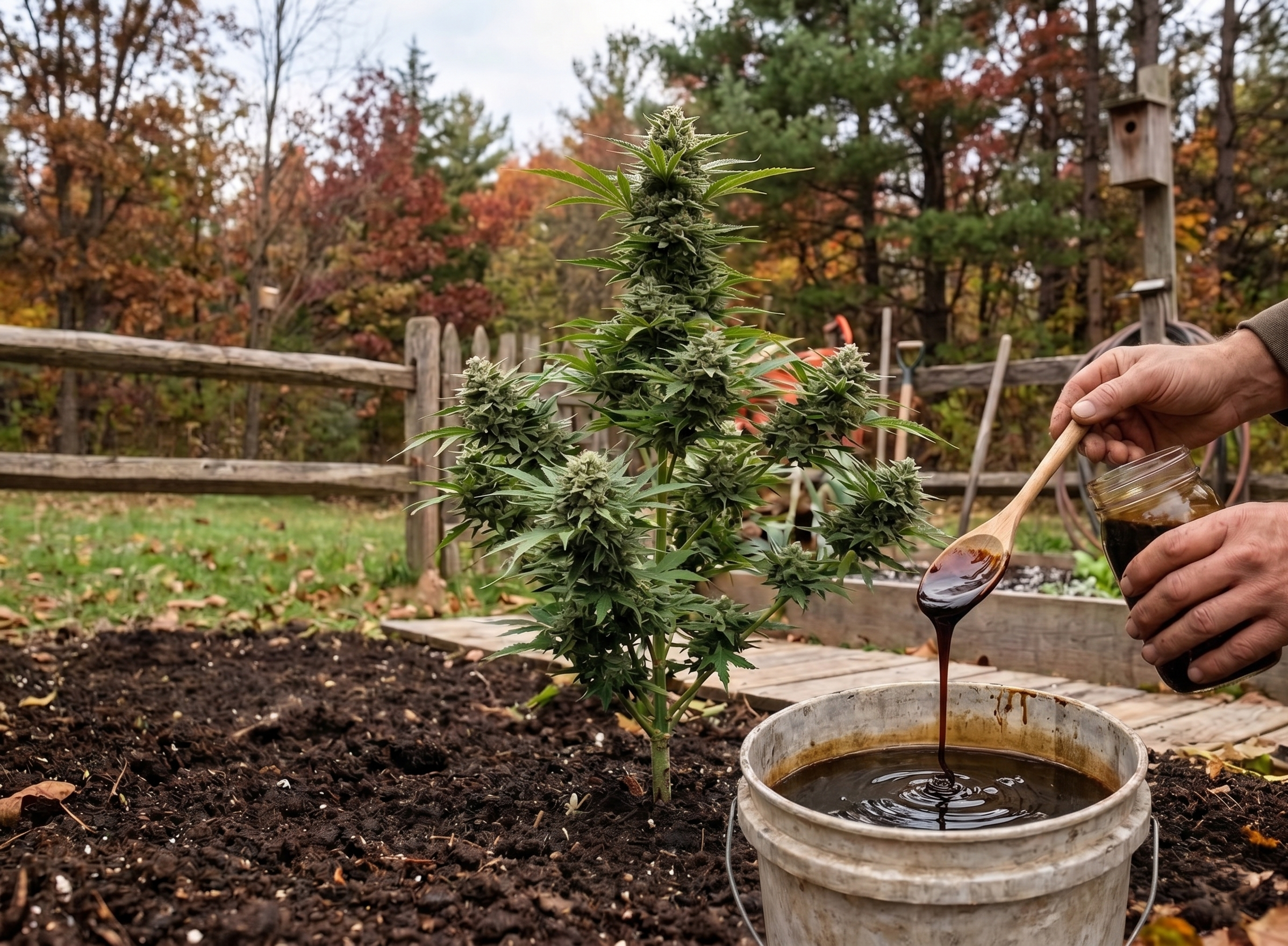
Does Molasses Fatten Up Buds?
Does Molasses Fatten Up Buds
The short version is no: molasses does not directly “fatten up” cannabis buds in the way the internet usually claims. The strongest cannabis nutrition studies do not show that sugar-rich additives are a direct flower-size lever, and they do show that flower yield is driven much more clearly by overall plant nutrition, especially nitrogen and phosphorus in soilless flowering systems, while extra potassium beyond adequate levels does not reliably increase inflorescence yield and can even reduce cannabinoid and terpene concentrations in some cases. Extension guidance is also notably cautious: there is no solid research base showing molasses itself functions as a proven fertilizer or magic bloom booster.
That does not mean molasses is useless. It means molasses is usually being misunderstood. In agronomic research outside cannabis, molasses acts primarily as a carbon source for microbes and, to a lesser extent, as a variable source of minerals. In biologically active soils it can stimulate microbial activity, enzyme activity, and nutrient cycling. In other words, its real value is indirect and rhizosphere-driven, not some mythical sugar pipe straight into flower tissue.
That distinction matters. If you are growing in an active living soil with compost, castings, mulch, or established microbial life, molasses may sometimes help the soil food web perform better. If you are in sterile or near-sterile hydro, drain-to-waste coco with mineral salts, or a tightly managed recirculating system, molasses usually makes far less agronomic sense and can introduce new problems such as biofilm, clogging, unstable pH or EC behavior, and oxygen stress in the root zone.
So the real answer is more precise than the myth. Molasses does not directly swell buds. It may help certain growers in certain biologically rich media by supporting microbial processes that improve nutrient turnover and root-zone ecology. That is a much smaller, more conditional, and much more honest claim.
Remember: If a product only looks powerful when described with folklore words like sweetens, fattens, or loads buds with sugar, but the evidence actually points to microbial stimulation, you are looking at a root-zone amendment, not a flower-size shortcut.
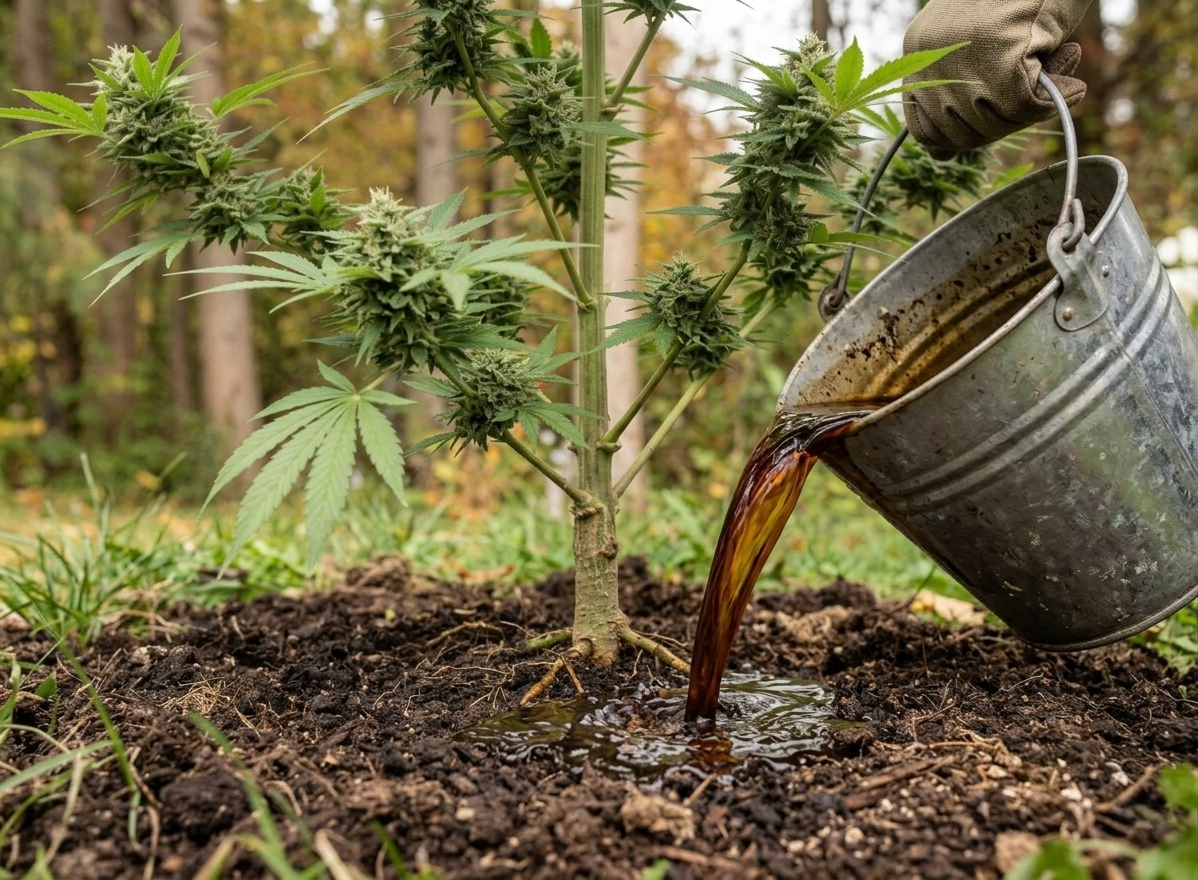
The Real Mechanism Behind Molasses in Cannabis Growing
Molasses is a byproduct of sugar processing, most commonly from sugarcane or sugar beet. Blackstrap molasses is the final, dark, viscous fraction remaining after a large amount of sugar has already been extracted. Extension and feed references note that molasses types vary widely, including cane, beet, citrus, starch molasses, and others, and that they are all fundamentally sugar-rich materials with composition that varies by source and processing.
That variability is important because many growers talk about “molasses” as if it were one chemically fixed input. It is not. UF/IFAS notes different molasses types and minimum sugar thresholds, while other guidance notes that nutrient content can vary widely among molasses-based mixtures and sources. A systematic review of liquid organic fertilizers likewise found extreme variability in nutrient concentrations depending on formulation and feedstock. So when growers speak about molasses as though it were a standard bloom formula, they are oversimplifying a highly variable material.
In soil systems, the most plausible reason molasses helps is that microbes love easy carbon. A maize pot study found that molasses increased labile carbon, dehydrogenase activity, and β-glucosidase activity in soil, meaning it clearly altered microbial and enzymatic behavior in the rhizosphere. But the same study also found that simply adding molasses did not provide sufficient nutrition to drive plant growth on its own. That is a crucial result for cannabis growers. Molasses may energize biology, but it is not a complete flowering feed.
Cannabis-specific microbiome research supports the broader principle that root-associated microbes matter. Reviews and controlled studies show that microbial communities can affect nutrient acquisition, plant performance, and secondary metabolite production in cannabis. One Frontiers study found that microbial inoculants increased biomass and increased production of select phytocannabinoids in several cannabis cultivars, while a review in the Journal of Cannabis Research concluded that manipulating cannabis-associated microbiomes could potentially improve cannabinoid yields. Those studies do not prove that molasses itself boosts buds, but they do support the broader indirect route: healthier, better-functioning microbial communities can matter in cannabis production.
This is where the internet often goes wrong. Plants do not absorb molasses from the roots and then deposit it into flowers as sweetness. In higher plants, sucrose is primarily produced in photosynthetic source tissues such as mature leaves and then transported through the phloem to sink tissues. That is the plant’s own carbohydrate economy. Cannabis terpene synthesis also depends on regulated biosynthetic pathways and on the plant’s photosynthetic carbon flow, not on dumping syrup into the medium and expecting the flavor to move upward intact.
In cannabis specifically, the link between carbon metabolism and terpene output is more about photosynthates, light, canopy exposure, and plant physiology than root-fed sugars. A major study on light spectra and flower position showed that terpene concentrations were significantly influenced by light quality, flower position, and strain, and explicitly linked terpene turnover to photosynthetic potential and shading effects. This is a better evidence-based framework for understanding aroma and resin than the folk claim that “molasses feeds the terps.”
There is another myth wrapped inside the molasses story: that its potassium content alone makes it a natural PK bloom booster. Cannabis research does not support turning that into a late-flower dogma. In a flowering-stage soilless cannabis study using response surface analysis, inflorescence yield responded mainly to nitrogen and phosphorus, while yield did not respond to potassium concentration within the tested range, suggesting commercial K supply can already be too high. In another cannabis study, the best-performing potassium range was adequate rather than extreme, and higher K supply did not improve plant function while secondary metabolite concentrations tended to decline as K increased.
The potassium story becomes even more important when you look at nutrient antagonism. A medical cannabis magnesium study showed that Mg interacts strongly with K and Ca in root uptake; higher K can suppress Mg accumulation, and elevated Mg can also restrict K and Ca. This is one reason the “just add more potassium in bloom” mindset can backfire. Nutrient balance matters more than folklore.
Note: Molasses contains sugars and some minerals, but that does not make it a complete flowering nutrient program. In practice, it is a carbon-rich amendment whose value depends on biology, balance, and context.
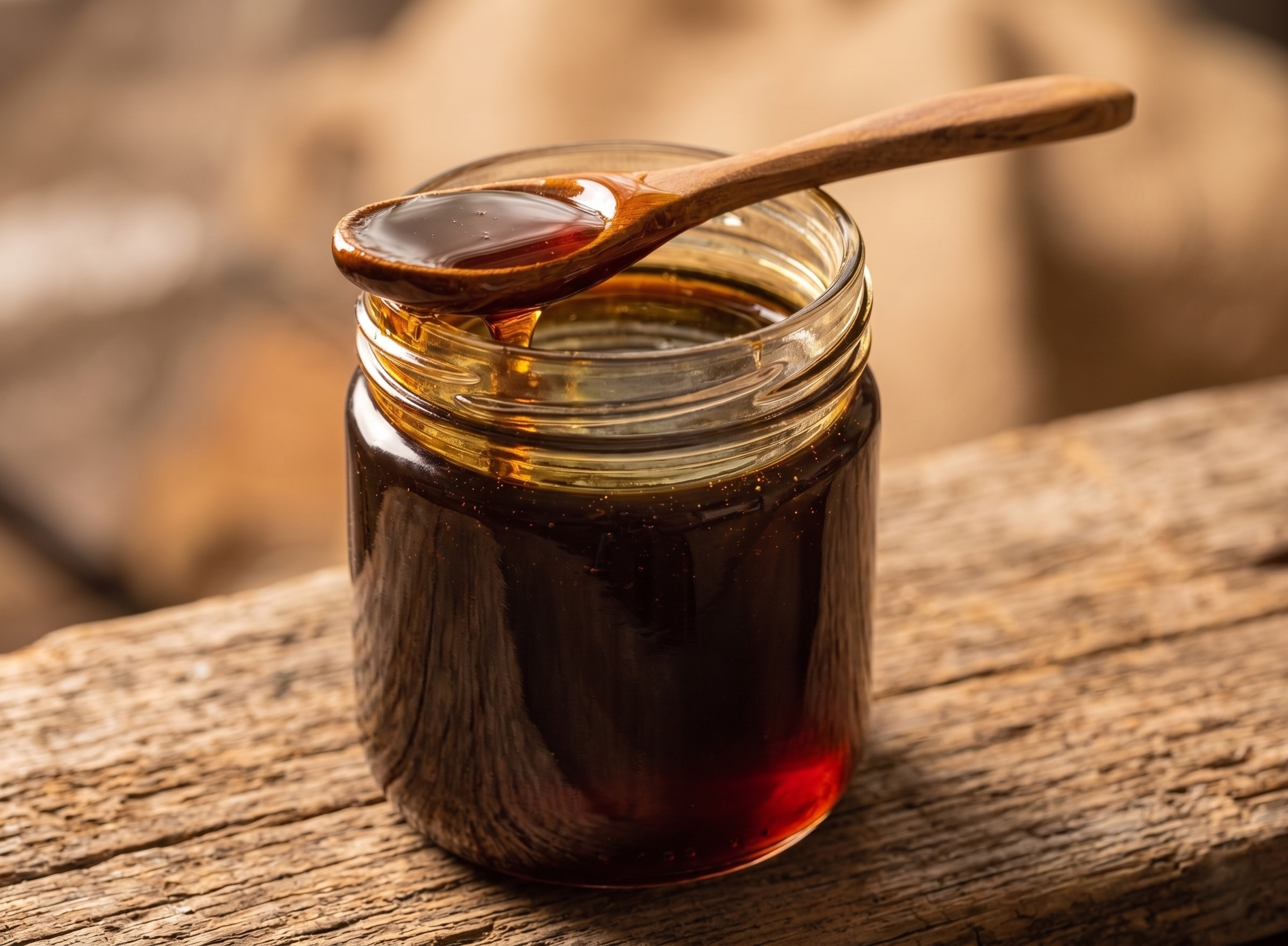
What Molasses Can Do Well and Where the Myth Overreaches
Molasses has a legitimate place in cultivation only when the grow system can actually use what molasses offers. Living soils, compost-amended beds, actively mulched outdoor plots, and rich indoor organic containers already host microbial communities that can respond to an easily available carbon source. In such systems, molasses can act like a microbial meal. If the medium already contains mineralizable nutrients locked inside organic matter, stimulating microbial turnover may indirectly improve nutrient availability, root health, and overall plant steadiness.
That is very different from saying molasses enlarges flowers by itself. The evidence for direct enlargement is weak, and outside cannabis, dose response data repeatedly shows that more molasses is not better. In rapeseed research, a low concentration of condensed molasses soluble improved biomass, root vigor, and root development, while a higher concentration inhibited plant growth, reduced root development, and produced biochemical signs of stress. In the maize pot study, higher molasses concentration tended to reduce some benefits and did not improve biomass. A tomato study reported that increasing molasses dosage reduced shoot and root weight and even caused phytotoxicity at the highest tested level.
That pattern should immediately kill the popular “late flower sugar loading” fantasy. If molasses worked like a harmless flower inflator, the logical expectation would be that more equals bigger. The literature does not support that. What it supports is a classic biological-amendment pattern: small amounts can sometimes help, while higher concentrations can create stress, imbalance, or diminishing returns.
This is exactly why experienced growers often report contradictory results. Some are seeing a modest indirect benefit because they grow in a healthy, fungal-bacterial medium that responds well to extra carbon. Others are seeing no benefit because their plants were already well-fed and their media did not need that input. Others are seeing problems because they added too much, too often, in a system with poor aeration, too much moisture, or little biological buffering. The amendment is not magically inconsistent. The contexts are.
The same nuance applies to claims about “resin production.” There are cannabis studies showing that environment, microbial inoculants, nutrient balance, and light can influence cannabinoids and terpenes. But there is no strong cannabis evidence showing that molasses by itself is a resin booster independent of those larger variables. When growers attribute better flowers to molasses, they are often bundling together many other improvements at the same time: healthier soil, better watering, better organics, better dry-back, better lighting, better genetics, or simply a smoother run overall.
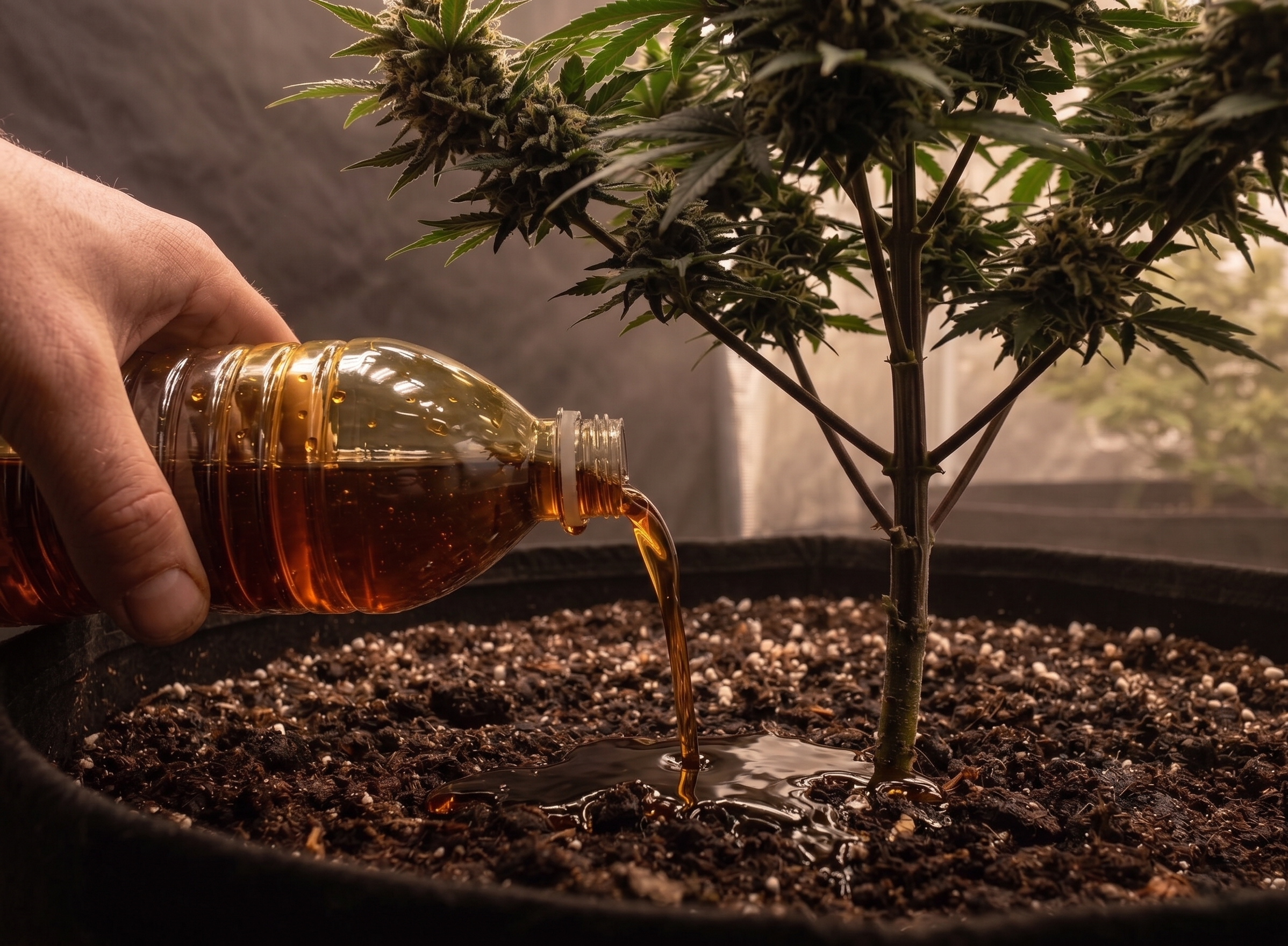
The myth also overreaches when it presents molasses as an all-purpose fertilizer. N.C. Cooperative Extension could not find research-based support for molasses as a fertilizer in the sense most gardeners mean it. The maize study likewise concluded that the sole application of molasses was not sufficient nutrition for plant growth. For cannabis growers, that means molasses should never be used as a substitute for a complete nutrient plan, tissue testing, substrate testing, or sound root-zone management.
The most honest way to frame molasses is this: it is a conditional support tool in biological cultivation, not a universal bud-building input. If your system can convert microbial stimulation into improved nutrient cycling, molasses may help a little. If your system cannot, then molasses is often just extra organic load.
| Grow system | Practical verdict |
|---|---|
| Living soil | Best fit, especially when the soil already has compost, castings, mulch, and active microbial life. |
| Organic containers | Use carefully, because smaller pots can become wet, sour, compacted, or oxygen-poor faster than outdoor beds. |
| Coco with mineral salts | Usually unnecessary, because the system is built around clean mineral feeding, runoff control, and root oxygenation. |
| Recirculating hydro | Usually avoid, because sugar-rich organic inputs can contribute to biofilm, clogging, oxygen stress, and unstable root-zone conditions. |
| Seedlings and fresh clones | Avoid as a routine input, because young roots need stability more than extra organic complexity. |
The Right Way to Use Molasses if You Still Want to Test It
If you choose to use molasses, the safest high-confidence recommendation is to treat it as a minor, diluted additive, not as a pour-straight-in bloom hack. The agronomic studies that tested molasses applied it as a dilute solution in water, and compost-tea recipes from extension sources also use very small diluted amounts. That matters because research on concentrated molasses-like inputs shows that higher concentrations can become inhibitory, not helpful.
The type that makes the most sense is plain unsulfured blackstrap cane molasses. Extension guidance distinguishes sulfured and unsulfured molasses, with sulfured molasses having sulfur dioxide added during refining, while unsulfured molasses is more common. A North Carolina State garden compost-tea recipe specifically uses unsulfured blackstrap because sulfur can suppress beneficial bacteria in that tea context. That does not mean all sulfur is bad for cannabis; it means if your purpose is microbial stimulation, adding a sulfur-treated syrup makes less sense than using the simpler version.
Which Molasses Types Do Cannabis Growers Actually Use?
In cannabis cultivation, most grower discussions center on unsulfured blackstrap cane molasses. That is the classic version used in living soil, compost teas, and organic-style grows. But in agriculture and food production, “molasses” is a broader category. It can come from sugarcane, sugar beet, citrus processing, starch processing, or it can be sold as dry horticultural molasses on a carrier material.
That does not mean every sweet syrup should be treated as the same input. Cannabis growers should separate “commonly used in cannabis” from “technically a type of molasses.” The first category is small. The second category is much wider and less predictable. For cannabis, the more unfamiliar the molasses source is, the more experimental it should be treated.
| Molasses Type | How It Fits Cannabis Growing |
|---|---|
| Unsulfured blackstrap cane molasses | The most common cannabis choice. Best suited for living soil or compost tea when used lightly and diluted. |
| Regular unsulfured cane molasses | Possible to use, but it is usually less discussed than blackstrap. Check for additives and avoid treating it as a bloom booster. |
| Sulfured molasses | Generally not recommended for microbial use because sulfur dioxide is added during processing. This is different from sulfur as a plant nutrient. |
| Beet molasses | An agricultural molasses type, but less common as a cannabis home-grow input. It can differ from cane molasses in sodium, potassium, and mineral balance. |
| Dry horticultural molasses | Usually liquid molasses sprayed onto a carrier such as grain meal or another dry material. Better suited to soil building or compost-style use than precise indoor liquid feeding. |
| Citrus or starch molasses | Recognized in agricultural and industrial molasses categories, but not a standard cannabis input. Treat as experimental unless the product is clearly designed for horticulture. |
| Carob molasses | Not a standard cannabis molasses. It may still affect microbial activity and soil behavior, but it should not be treated as a proven replacement for blackstrap cane molasses. |
| Date, grape, or other fruit molasses | Local food syrups rather than standard cannabis amendments. They may contain sugars and minerals, but their root-zone behavior is harder to predict. |
Grower Question
Are all molasses types the same for cannabis? No. They may all add some form of sugar-rich organic material, but they can differ in mineral balance, viscosity, additives, acidity, processing residues, and how they behave in the root zone. For cannabis, the safest general reference remains plain unsulfured blackstrap cane molasses, and even that should be treated as a small biological support input rather than a direct flower enhancer.
Dry molasses is a different category than liquid blackstrap. Extension notes that so-called “dry molasses” is usually molasses sprayed onto carriers like corn meal or soybean meal, then dried and pelletized. That can still act as a soil amendment, but it is not the same thing as dosing liquid blackstrap into irrigation water. In small indoor containers, dry molasses is also less precise and harder to control because you are adding both molasses and a carrier into a limited root volume.
The most defensible application method is dilution in water, or use in a carefully made aerated compost tea, never dumping syrup directly onto the soil surface. Research protocols apply molasses in solution, not as a neat direct pour. Extension compost-tea protocols also dissolve it into water and use aeration. The practical reason is obvious even before you get to plant physiology: concentrated syrup creates a localized organic hotspot, uneven distribution, and excessive substrate wetness. In a pot, that is asking for trouble.
Weedth Experience
In one early grow, I tested carob molasses instead of regular blackstrap-style molasses. The plant looked healthy for a while, but the soil told a different story. It became unusually hard, almost like a solid block, and deep cracks started forming across the surface. When I touched it, the medium felt compacted rather than alive and breathable.
Important: This was carob molasses, not standard blackstrap cane molasses. It should not be treated as a universal result for every molasses product. The real lesson is broader: sweet organic additives can change the root zone in ways growers may not expect, especially when they are used too heavily or in a medium with limited aeration.
That was the real warning. Even if the plant still looks healthy above the soil, a hardened root zone can quietly become a serious problem below the surface. Within a few days or a week, that kind of medium could reduce oxygen around the roots, create root stress, slow nutrient movement, or invite fungus gnats and other pests attracted to sweet organic residues. In a garden, that can become frustrating not only for the plant but also for the grower working around it.
I did notice a very slight aroma difference in that run, so I cannot say the experiment was completely useless. But the trade-off was not worth exaggerating. Never build big expectations around sweet additives. If they disturb the soil structure or attract pests, the small possible flavor change is not worth risking the whole plant.
If you are building an aerated compost tea, the clearest extension recipe in the sources I reviewed used a 5-gallon bucket, about 2 cups of compost, and 1 tablespoon of unsulfured blackstrap molasses, brewed for 24 to 36 hours with aeration, then used promptly. UConn Extension also warns that brews should be used quickly because as oxygen falls, desirable aerobic organisms are replaced by less desirable anaerobes. If it smells foul, sour, or off, it is no longer the tea you wanted.
There is an important caution here. UConn notes that food sources such as unsulfured molasses may encourage Salmonella or E. coli growth in compost teas, and USDA ARS reported that regrowth of Salmonella and E. coli O157:H7 was positively correlated with molasses concentration in compost-water extracts. Cannabis is not a leafy green eaten raw in the same way produce is, but these findings still matter because they remind growers that “feeding microbes” is not automatically the same as “feeding the right microbes.” Hygiene, clean water, and controlled brewing matter.
Grower Question
What about dosage for direct irrigation?
This is the point where a lot of articles become overconfident. There is no peer-reviewed cannabis-specific universal molasses dose I can responsibly present as optimal. The better-supported lesson from the literature is that low concentrations can help in some systems, while higher concentrations can inhibit growth or reduce physiological performance. So the evidence-based rule is not “use a lot in bloom.” It is “keep it dilute, keep it infrequent, and do not treat molasses like a primary nutrient.”
Weedth Experience
In my early growing years, I once used a heavy, fertilized soil mix during the seedling stage. The seedling collapsed within 24 hours. That experience taught me a simple rule that also applies here: young roots do not need aggressive inputs. They need a gentle, stable root zone.
For beginners, that means if you are in living soil and you want to experiment, do it modestly and only after the root zone is established. Do not use it on seedlings and fresh clones as a default routine. The strongest case for molasses is in a functioning medium with active biology, not in a fragile, low-mass root system that does not need extra organic complexity yet. That recommendation is an inference from how molasses behaves in biologically active systems and from the lack of direct evidence that it benefits early cannabis growth on its own.
For intermediate growers, the most reasonable testing window is from late vegetative growth into early-to-mid flower, when the plant is large enough to benefit from stable nutrient cycling and when your root zone biology is already established. The evidence does not support treating the final weeks of flower as a mandatory sugar-loading phase. In fact, studies in other crops found stage-dependent effects, and cannabis flowering research keeps pointing back to balanced nutrition, light, and postharvest handling rather than late-stage sugar additions as the main quality drivers.
For advanced growers, the right question is not “How much molasses can I get away with?” but “What measurement am I trying to improve?” If you are tracking substrate respiration, microbial counts, sap analysis, runoff pH and EC, dry-back curves, yield, terpene analytics, and post-dry sensory outcomes, then molasses can be tested as part of a real cultivation protocol. If you are not measuring anything, the amendment can easily become superstition in liquid form.
Master Advice
Do not use molasses to fix a problem that actually belongs to nutrition, irrigation, or environment. If a plant is hungry, underlit, overwatered, locked out, rootbound, or poorly dried after harvest, molasses will not rescue the run.
Indoor, Outdoor, Living Soil, Coco, and Hydro Are Not the Same Conversation
This is where most molasses advice online collapses. Growers talk as if “cannabis” were one cultivation system. It is not. Outdoor living soil, indoor no-till, bottled-organic peat, coco with mineral salts, drain-to-waste coco, DWC, RDWC, and rockwool all behave differently. Molasses cannot be evaluated honestly without system context.
In outdoor living soil, molasses has its best argument. The soil volume is larger, microbial diversity is usually broader, and the medium often contains organic matter that microbes can mineralize. If the ecosystem is already functioning, a modest carbon input may stimulate beneficial biological activity without destabilizing the system as easily as it would in a tiny indoor pot. Research in soil systems consistently shows that molasses can increase microbial or enzymatic activity, and cannabis microbiome work suggests those soil communities can matter for phytochemical outcomes.
In indoor living soil or well-built organic containers, molasses can still make sense, but the margin for error is narrower. The root volume is small, the wet-dry cycle matters more, and the room is often warmer and more controlled, which can amplify microbial metabolism in both good and bad directions. In these settings, less is more. The grower is not farming a field-sized biological buffer. They are farming a container ecosystem that can tip into sourness, oxygen stress, or imbalance much faster.
In coco with mineral salts, molasses usually offers far less. Coco can host biology, but many high-performance coco programs are essentially precision-fed mineral systems where yield and flower quality depend on clean nutrient delivery, strong root oxygenation, controlled runoff, and tight irrigation frequency. The strongest cannabis flowering evidence from soilless culture points to balanced N and P management rather than extra carbon loading, and potassium excess is clearly not a guaranteed bloom advantage.
In recirculating hydroponics, molasses is often a bad fit. A 2026 systematic review of liquid organic fertilizers in soilless systems found that organic-rich solutions can create biofilm formation, irrigation clogging, nutrient variability, and inconsistent nutrient release, and that substrate-based systems generally perform better than DWC or NFT under organic liquid programs. The review explicitly links organic carbon in solution to biofilm growth, dissolved oxygen depletion, blocked nutrient diffusion, and pathogen harboring. Separate hydroponic research also shows that dissolved oxygen is essential for root formation and root growth. In a system where oxygen is king, casually dumping sugar into the root zone is not sophisticated organic growing. It is usually root-zone sabotage wearing an “organic” label.
So the indoor versus outdoor question is not just about location. It is really about how biological the medium is and how much buffering capacity the system has. Outdoor living soil and large-volume beds can sometimes absorb and use molasses intelligently. Recirculating hydro and ultra-clean salt-fed systems often cannot. That conclusion is partly an inference, but it is a strong one built from the way molasses behaves in soil biology studies and the way organic carbon behaves in soilless and hydro systems.
There is also a quality angle here. A 2023 comparison of genetically identical cannabis grown indoors under artificial conditions versus outdoors in living soil under natural sunlight found that outdoor-grown samples showed greater terpene diversity and a stronger sesquiterpene presence. That finding is sometimes used as a pro-molasses argument, but that would be sloppy reasoning. Outdoor quality differences involve the entire cultivation package: light, soil ecology, temperature swings, root exploration, microbiome, and postharvest handling. You cannot take a whole-environment result and assign the credit to molasses alone.
The same caution applies indoors. A controlled cannabis study showed that light spectra and flower position significantly influenced terpene concentrations and CBDA distribution, with light-driven photosynthetic differences and shading effects helping explain variation. In plain English: if you want to improve aroma and flower quality indoors, your first levers are usually canopy management, light quality and intensity, nutrient balance, and postharvest control, not syrup.
Tip: The more “engineered” your root zone is, the less useful blanket molasses advice becomes. What helps a mulched outdoor bed can hurt a recirculating indoor reservoir.
Flavor, Aroma, and the Sweetness Myth
Grower Question
Does molasses make buds sweeter, noticeably change taste, or increase terpenes? The evidence says the direct claim is weak.
Cannabis aroma is primarily driven by volatile compounds, especially terpenes and terpenoids, and broader flavor diversity also involves other volatile and non-volatile compounds. Reviews on cannabis flavor and terpene chemistry consistently identify terpenes as major contributors to aroma characteristics, while more recent work on cannabis flavor diversity emphasizes that genetics, cultivation practices, and postharvest processing all modulate aroma and flavor chemistry. That is the real landscape of “taste.”
What the literature does not give us is a clean cannabis experiment showing that blackstrap molasses, used alone, measurably increases terpene content or creates a sweeter sensory profile at harvest. The strong cannabis evidence points elsewhere. Light spectrum significantly alters terpene concentrations. Flower position and canopy shading alter terpene distribution. Outdoor versus indoor conditions can alter terpene diversity. Drying and curing change flavor profiles and can preserve or lose volatile compounds depending on conditions. Those are real, measured effects. Molasses-based sweetness claims remain mostly anecdotal.
That does not mean growers are imagining every difference they notice. It means the mechanism is probably being mislabeled. If molasses improves the biological function of a living soil, and that in turn improves nutrient turnover, root health, water relations, or stress resilience, then the plant may finish stronger and produce better overall flower quality. A stronger finish can translate into better aroma retention simply because the plant and harvest were healthier. That would be an indirect systems effect, not the flower “tasting like molasses.”
There is a deeper plant-physiology reason to reject the sweetness myth. Sucrose transport in plants is a regulated source-to-sink process, with sugars produced in leaves and distributed internally via phloem. Cannabis terpene biosynthesis also depends on biosynthetic pathways such as MVA and MEP, and the cannabis light study ties terpene turnover to photosynthetic potential and illuminated flower position. Taken together, these findings strongly argue against the simplistic belief that adding syrup to the roots directly “loads flavor” into the buds.
Postharvest science strengthens this conclusion. A 2025 hemp drying and curing study described curing as a process intended to allow a change in flavor profiles, and found that drying and curing conditions significantly affected moisture, decarboxylation, color, and microbial behavior, even when total cannabinoid content stayed broadly stable. Other postharvest work and reviews emphasize terpene retention during drying as a major quality issue. This is one reason two growers can disagree violently about whether molasses “worked” when the real difference may have come from one drying too warm, curing too wet, or handling flowers too slowly.
Grower Question
How much can molasses actually change the taste of cannabis buds?
The most honest answer is this: there is no good evidence-based percentage I can give you. No credible cannabis paper I reviewed quantified a terpene increase or flavor shift attributable to molasses alone in the way light studies, environment studies, and postharvest studies quantify their effects. So any article claiming that molasses will make buds ten percent sweeter, noticeably fruitier, or measurably louder on its own is pretending to know more than the literature currently supports.
Advice: The smarter flavor strategy is brutally simple. Start with genetics. Build a healthy root zone. Keep nutrition balanced. Maximize canopy light without excess stress. Harvest at the right maturity. Dry gently. Cure with control. If you want to test molasses inside that framework, do it as a small biological support input, not as the hero of the terpene story.
Remember: Flavor is far more often won or lost in genetics, canopy microclimate, drying, and curing than in late-flower sugar folklore.
The Verdict Growers Can Actually Use
If you want the clean Weedth answer, it is this: molasses can be useful, but it is not a bud fattener. It is best understood as a conditional biological amendment for living media. It is least convincing in sterile or highly engineered soilless systems. It should be diluted, used modestly, and never treated as a replacement for complete nutrition or correct environmental control.
For beginners, the safest move is not to make molasses a pillar of your grow. If your soil is healthy and your nutrition is already balanced, you do not need molasses to finish quality flowers. If you still want to use it, think small, think dilute, and think microbial support rather than flower inflation. If your system is hydroponic, skip it unless you are running a deliberately designed organic bioponic strategy and you understand how to manage oxygen, filters, sanitation, and nutrient mineralization.
For intermediate growers, molasses is worth considering only if you can answer three questions clearly. Is the medium biologically active? Is there a reason to stimulate microbial cycling? Can you tell whether the result improved or worsened root-zone conditions? If the answer is no to any of those, molasses is probably not solving your limiting factor.
For advanced growers, molasses belongs in the category of controlled variable, not tradition. Run it in a side trial. Track runoff, dry-back, root health, and yield. If possible, use lab terpene analytics and standardized sensory notes after cure. That is the level at which molasses can be judged honestly. Anything else is story-sharing, not cultivation science.
Grower Question
Should you pour molasses directly onto the soil?
No. Use it diluted in water or as part of a properly managed tea; research and extension protocols use dilution, not direct syrup application.
Should you use sulfured molasses?
Better to choose unsulfured if your goal is to support microbes.
Should you use it in hydro?
Usually no, unless you deliberately designed the entire root-zone biology around organic liquid inputs.
Does it sweeten the buds?
There is no strong direct evidence for that.
Can it still be useful?
Yes, but mostly in living soils where microbial activity is part of the cultivation engine.
The deepest correction to internet folklore is probably this: molasses works, when it works, by helping the system work better. It does not work by bypassing plant physiology. That is why the same bottle can look brilliant in one garden, irrelevant in another, and harmful in a third. The bottle did not change. The biology did.
What remains uncertain is also worth saying clearly. We still lack a strong peer-reviewed cannabis study that isolates blackstrap molasses alone across multiple media types and growth stages while directly measuring flower size, cannabinoid yield, terpene profile, and blinded sensory outcomes. We also lack cultivar-specific dosing standards for direct molasses use in cannabis. Because of that gap, the highest-confidence conclusions today are mostly indirect: cannabis responds strongly to balanced nutrition, environment, microbiome management, and postharvest control; molasses may play a supporting role inside living systems, but the classic “fat buds, sweeter smoke” narrative is still ahead of the evidence.
Final Weedth Take
Molasses can support the right soil system, but it should never become the center of the grow. Good soil, balanced nutrition, proper watering, and a clean finish matter far more than adding something sweet near harvest.
Share this article
A quick overview of the topics covered in this article.
Follow us
Latest articles
October 24, 2026
October 24, 2026
October 24, 2026
October 24, 2026