
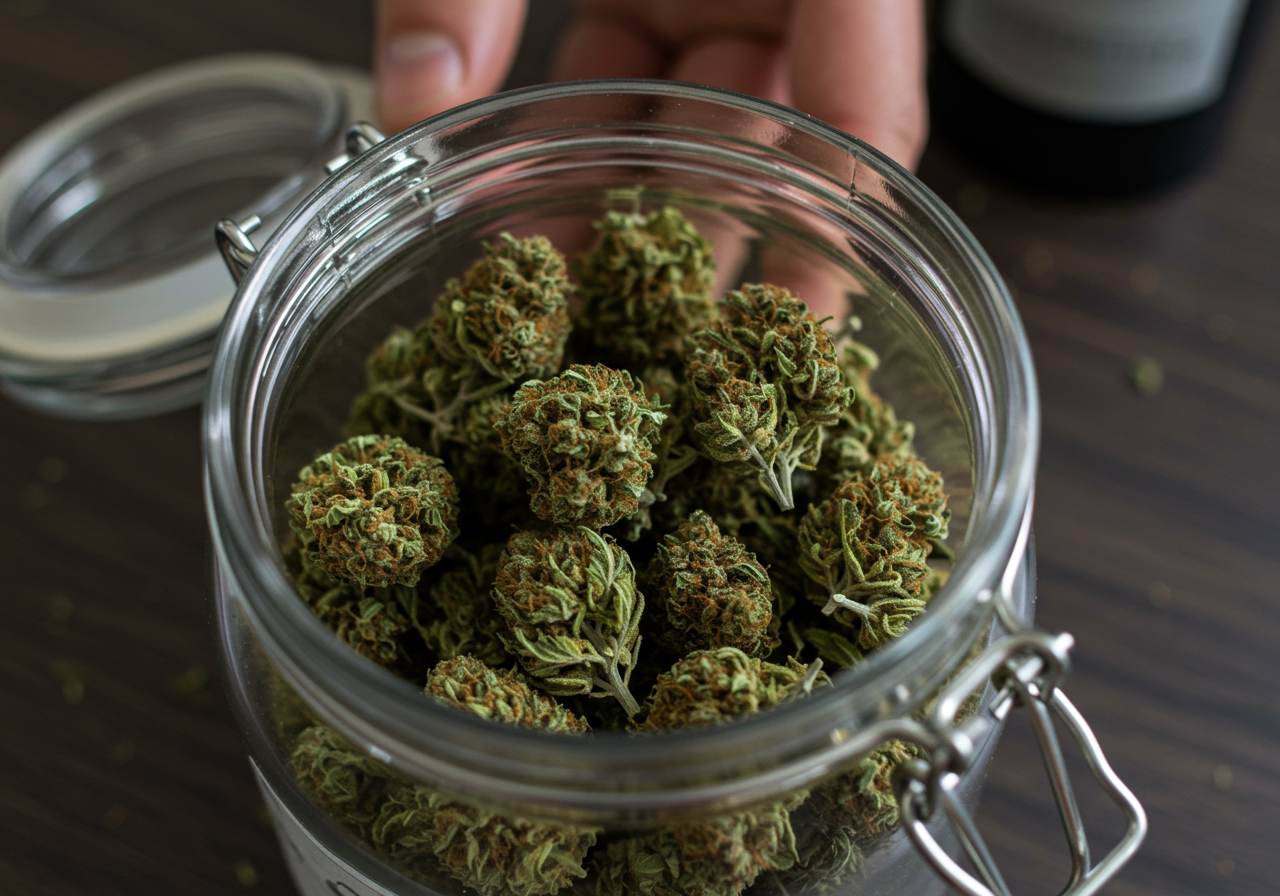
How Often Should You Burp Jars When Curing Cannabis
Burping jars is simple, but the timing matters. The goal is to let moisture and stale air leave the jar before they cause problems, and to keep enough humidity inside the buds to finish curing instead of drying them into a flat, dusty smoke.
A good burping routine is not a fixed schedule. It is a feedback loop. You seal, you wait, you read the jar humidity, you smell, and you adjust. If you learn that loop, you will stop guessing and you will stop opening jars out of anxiety.
Burping explained in plain terms
Burping means opening the jar on purpose to exchange the air inside. You are letting humid air out and bringing fresh air in. You are also giving the buds a chance to release moisture more evenly instead of staying wet in the center and dry on the outside.
What burping does for moisture balance
Freshly dried buds rarely have uniform moisture. The outside dries first, and the inside lags behind. Once you jar them, moisture keeps moving from the wetter inner areas toward the drier outer layers. That shift is normal and it is part of why curing works.
Here is the part many people miss. When you seal the jar, the jar does not “create” humidity. The buds do. If the buds are still holding too much water, the jar humidity will rise after sealing. If the buds are close to the right dryness, the jar humidity will settle and stay steady.
Burping helps in two ways.
First, it prevents the jar from sitting at high humidity for long stretches. High humidity is where musty smells and microbial growth start to show up. Once the jar crosses into that zone, the clock starts ticking.
Second, it encourages a smoother re-balancing. Instead of the outside getting crisp while the center stays damp, you are giving the whole bud more time to equalize.
A useful mental model is this.
- Drying removes free moisture from the surface.
- Curing is moisture re-distribution plus slow chemical change.
- Burping is moisture and air management so curing can happen safely.
Research on postharvest handling describes curing as a mild, extended step that allows moisture to re-equilibrate in the dried flower while chemical changes continue at low stress conditions.
Oxygen exchange and aroma preservation
Burping is not only about water. It is also about the air in the jar.
When buds first go into a sealed container, they can release plant volatiles and breakdown byproducts into the headspace. If the jar stays sealed while still too wet, the environment can turn “stale” and low-oxygen. That is when sharp off-notes can appear. People often describe it as ammonia, sourness, or a heavy fermented smell.
A little oxygen exchange helps keep the cure moving in the right direction. It also stops the headspace from becoming a concentrated soup of moisture and off-gassing.
At the same time, too much air exchange can hurt aroma. Terpenes are volatile. Light and higher temperatures speed up terpene loss, and frequent jar opening increases contact with oxygen and moving air. Studies on terpene stability in stored products show that light exposure and higher temperature can drive rapid terpene loss.
So the best strategy is controlled, short exchanges early, and fewer openings later. You want enough airflow to avoid stale conditions, but not so much that you strip the most delicate aromas.
What burping cannot fix
Burping is not magic. It cannot reverse certain mistakes.
It cannot bring back aroma that was lost during an overly fast or overly warm dry. Once volatile compounds evaporate, they are gone.
It cannot remove mold contamination. If mold is present, opening jars only spreads spores and increases exposure.
It cannot fully fix buds that were jarred far too wet. If the humidity is very high after sealing, you need to remove the buds and dry them further. Burping alone is too slow to reduce risk.
It also cannot “save” a cure that was started with inconsistent moisture. If you mix buds that were dried to different levels, the jar becomes unpredictable. Some buds rehydrate, others overdry, and the flavor becomes uneven.
The cure is built on the dry. Burping is a steering wheel, not an engine.
The ideal jar environment before you start
If your setup is wrong before you jar, no schedule will feel right. Get the starting conditions right and the burping schedule becomes simple.
Bud dryness requirements before jarring
The most important step is jarring at the correct dryness.
Relying only on the “stem snap” test is risky. It can mislead you with dense buds, thin stems, or strains that keep flexible fibers. Use touch, smell, and a jar humidity check together.
A practical dryness checkpoint looks like this.
The buds feel dry on the surface. The outside does not feel wet or cool. Smaller stems bend and then crack rather than folding like fresh plant material. When you squeeze a bud gently, it springs back instead of staying compressed. The smell is plant-forward but not sour.
Then you confirm with the jar test.
Put buds in the jar, seal it, and wait several hours. If the humidity rises high and stays high, the buds are still too wet for a safe cure. If the humidity settles in a stable curing range, you are ready to start a controlled burping routine.
A widely used storage standard links safe storage to water activity roughly between 0.55 and 0.65, which corresponds to about 55% to 65% relative humidity in a closed container.
Jar size and fill level
Jar size matters because headspace matters.
If the jar is too full, air cannot move around the buds, and moisture pockets form. That slows equalization and makes musty zones more likely.
If the jar is too empty, there is too much air relative to flower mass. The jar dries the buds faster and you can lose aroma early.
A good target is to fill the jar so buds sit loosely with some breathing room. Do not compress them. You should be able to roll the jar gently and see the buds shift.
In practical terms, aim for a jar that is around two-thirds to three-quarters full with loosely packed buds. That gives enough headspace for air exchange during burps, and it reduces the risk of overdrying from excess air volume.
Separate jars by bud size and dryness. Small airy buds cure faster than dense tops. If you cure them together, you will chase the jar humidity instead of controlling it.
Temperature and light control
Curing is slow chemistry. You want stability, darkness, and moderate temperatures.
Heat speeds up chemical reactions and evaporation. Light speeds up degradation reactions and can accelerate loss of sensitive compounds over time. Research on storage shows that light exposure and heat can accelerate cannabinoid degradation.
Keep jars in a cool, stable location. Avoid windowsills and areas that warm up during the day. Avoid opening jars under bright lights. Even if you are only burping for a few minutes, bright light plus warm air plus repeated opening adds up over weeks.
Drying literature commonly describes mild postharvest temperatures around the high teens to low twenties Celsius with controlled humidity as a typical approach for preserving quality during drying.
You are not trying to create a perfect laboratory. You are trying to avoid big swings. Stable conditions reduce humidity spikes and keep the cure predictable.
Week 1 burping schedule
Week 1 is where most cures are won or lost. This is when moisture is still redistributing. This is also when the risk is highest.
First 48 hours what to watch
The first two days are a diagnostic window.
Seal the jar and watch what the humidity does over the next several hours. In many jars, humidity rises after sealing because moisture moves outward from the bud center.
Also watch the sensory signs.
A clean cure smells like plant material moving toward sweetness. It may start grassy, but it should not smell sour, sharp, or like chemicals. If you ever smell a strong ammonia-like note, treat it as a warning sign of excess moisture and poor gas exchange.
Look for physical signals too.
If you see condensation on the jar walls, the buds are too wet for safe curing. If the buds feel tacky and cool and the humidity stays high, you are still in a drying stage, not a curing stage.
Use those first 48 hours to sort jars into two categories.
- Jars that settle into a safe curing range and respond well to short burps.
- Jars that spike high and stay high, which need more drying time.
This is also when you decide whether you need to remove buds from the jar at all. If the jar stays too humid, longer burps are not enough. You want to reduce moisture in the flower, not just in the headspace.
How many times per day and for how long
In week 1, most jars need multiple burps per day, but the exact number depends on the humidity response.
A practical starting point is two to four burps per day. Each burp is usually a few minutes, not an hour.
Start smaller than you think you need. Open the lid, let the headspace exchange, and close it again. Then read the humidity trend. If humidity keeps climbing after each seal, you need more time open or you need more drying outside the jar.
Here is a simple decision flow that avoids overthinking.
If the jar humidity is stable in the low 60s and drops quickly when opened, do shorter burps. If the jar humidity is creeping upward or staying above the mid 60s, increase burp time. If the jar humidity is far above safe range, remove buds and dry them further.
A storage-focused reference suggests that a container humidity around the low 60s is a preferred zone for maintaining quality, and it warns that mold risk increases above about 65% in a closed container.
The schedule is only a tool. The jar reading is the authority.
When to extend the lid-off time
Extend lid-off time when the jar is telling you it is too wet.
These are common triggers.
Humidity rises above the safe zone after sealing and does not settle down. The smell turns sharp, sour, or heavy. The buds feel wetter after a few hours sealed than they did when you jarred them. You see condensation.
In mild cases, extending the burp from a few minutes to fifteen minutes can be enough. In stronger cases, keeping the lid off for an hour can help, but it can also overdry the outside while the inside remains wet.
When you hit repeated high readings, the safer move is to remove the buds from the jar and let them breathe outside. Spread them in a thin layer in a dark, cool space with gentle airflow. Then re-jar and re-test.
This is the cleanest way to reduce moisture without wrecking aroma. It also lowers risk faster than repeated long burps.
Week 2 to 3 burping schedule
By week 2, the jar should feel calmer. Humidity swings should be smaller. The smell should start to round out.
Reducing frequency without trapping moisture
The shift from week 1 to week 2 is about reducing openings while keeping safety.
If your jar humidity is stable and staying in a safe zone after sealing, you can move from several burps per day to one burp per day. After that, you can move to every other day.
The key is stability.
You are looking for a jar that, after sealing, settles to the same humidity and stays there. If it stays stable, you can reduce frequency. If it keeps climbing, you are not ready.
Think in blocks.
Seal for 12 to 24 hours and see what happens. If humidity is steady and smell is clean, reduce burps. If humidity drifts up, keep the frequency higher for another week.
Curing is described in research as a mild process that allows moisture to re-equilibrate in the dried material over time. That implies you should expect the system to settle, not swing wildly, once the starting dryness is correct.
How to tell if you reduced too early
When you reduce too early, the jar starts to show it.
Humidity that used to be stable starts creeping up. The smell stops improving. A musty note can appear. Dense buds may feel slightly damp again inside even if the outside feels dry.
One subtle sign is slow humidity recovery.
If you open the jar and the humidity stays high for a long time, that is a signal that the buds are still releasing moisture faster than the jar can stabilize. In that case, fewer burps will trap moisture.
Another sign is that the buds start to feel dry on the outside but still spike humidity after sealing. That usually means the outside dried too far while the inner moisture is still migrating out. That situation needs patience. It also needs gentler burps, not aggressive lid-off sessions that make the outside even drier.
If you see these signs, increase frequency for several days. If the spikes persist, pull the buds out for a short re-dry.
When to switch to quick air swaps
Once the jar humidity is stable and the buds feel evenly cured, you can switch from longer burps to quick air swaps.
A quick air swap is opening the jar for 30 to 60 seconds, then closing it. You are refreshing the headspace, not drying the buds.
This is a good fit for week 3 and later when the main risk is gone but you still want to prevent stale air. It is also a good habit if you store jars for long periods and you open them occasionally to take flower out.
Quick swaps work best when the jar is already in a stable humidity range. If the jar is still trending high, quick swaps are too small. You need more active moisture control.
Week 4 and beyond maintenance mode
By week 4, most of the “management” is done. The work becomes storage discipline.
When you can stop burping
You can stop routine burping when the jar has been stable for at least a full week with minimal opening, and the smell has no signs of mustiness or sharpness.
Stable means this.
You seal the jar for 24 hours. The humidity does not climb. It stays in the same range each time you check. The buds feel consistent from one bud to the next.
A storage standard that targets roughly 55% to 65% relative humidity is designed to keep flower stable and reduce safety risk over time. Once you are consistently in that zone and not drifting upward, frequent burping stops being helpful.
At that point, every extra opening is more oxygen, more disturbance, and more aroma loss.
Long cure storage habits
Long cure storage is mostly about consistency.
Keep jars in the dark. Keep temperatures steady. Keep lids sealed. Avoid letting jars sit half-empty, because excess headspace can dry buds faster and change the cure feel.
If you need to store for months, treat the jar like a pantry item.
Open it only when you need something. Close it quickly. Do not leave it sitting open while you do other tasks. Avoid transferring buds from jar to jar repeatedly. Handling breaks trichomes and exposes more surface area to air.
Also, do not assume a perfect jar is “set and forget” if your room environment swings wildly. If the storage area heats up daily or gets sunlight, the jar conditions will drift. Heat and light both accelerate degradation pathways over time.
How often to check after the cure is stable
Once stable, check less often.
In the first month after stability, checking once a week is enough. You are verifying that nothing is drifting.
After that, once every few weeks is enough for most home storage, especially if jars are in a stable room and you are not opening them often.
The moment you notice a change in smell, humidity trend, or bud feel, increase checks again. Problems usually show up after a change. A heatwave. A jar left open. Buds mixed from another batch. Those are the triggers.
How to read your jar humidity without guessing
If you are still guessing, you will either burp too much or too little. Both hurt quality.
Target humidity range for flavor
For cured flower, a broadly accepted safe storage range is roughly 55% to 65% relative humidity in a closed container, tied to a water activity range that reduces mold risk and helps preserve aroma and texture.
Within that broad range, many people aim tighter for day-to-day curing. A common “flavor and texture” target is around the high 50s to low 60s. Some storage-focused sources suggest the low 60s as a preferred zone and note that mold risk increases once you move above about 65% for stored flower.
The practical take is this.
- Mid to high 50s tends to burn drier and can feel sharper if you go too low.
- Low 60s tends to feel smoother while still safe if the jar is stable.
- Above mid 60s is where risk and musty notes start to rise.
If you want one working target that balances safety and quality, aim for a stable reading around the upper 50s to low 60s.
How fast humidity should settle after sealing
There are two “settles” to understand.
The device reading settles quickly. Many small hygrometers stabilize in minutes once the lid is closed.
The jar system settles slowly. Moisture needs time to move from the bud interior to the headspace. That can take hours.
So the right way to read a jar is not to open, close, and stare at the number. Seal the jar and wait. Check a few hours later. Then check again at 12 to 24 hours. That is how you see the trend.
If humidity climbs steadily over many hours, the buds were too wet or not evenly dried. If humidity rises slightly and then holds, the moisture is equalizing and you are on track.
Temperature swings also matter because relative humidity changes with temperature even if moisture content stays the same. Keep that in mind if your room warms up during the day.
What repeated spikes mean
Repeated spikes usually mean one of three things.
First, the buds were jarred too wet, and they are still drying inside the jar. That is not a cure yet. That is slow drying in a risky container.
Second, the batch is uneven. Some buds are drier and some are wetter. The wetter ones drive the spike.
Third, your storage environment is swinging. If jars warm up and cool down daily, the relative humidity can fluctuate and make you chase a false problem.
When you see repeated spikes, do not keep “burping harder” without changing anything else. Confirm the cause.
Separate buds by size and density. Re-check dryness. Move jars to a more stable location. If spikes persist, take buds out for a short re-dry and restart the week 1 pattern.
Common burping mistakes that ruin flavor
Most curing disappointments come from a few predictable mistakes. Fixing them is usually simple once you spot them.
Burping too aggressively and drying the outer bud
Over-burping often creates a specific problem.
The outside becomes too dry while the center still holds moisture. The outside locks in. The bud feels dry and brittle on the surface, but the jar still spikes humidity after sealing. Smoke becomes harsh and thin. Aroma becomes muted.
This often happens when people leave lids off for long periods in the first week, or when they open jars many times per day out of habit.
The fix is counterintuitive.
Reduce the intensity of each burp. Keep them shorter. Give the buds time sealed so moisture can migrate outward. If the jar still spikes high, do a short re-dry outside the jar rather than long lid-off sessions.
A slower, more controlled process aligns with postharvest recommendations that emphasize mild temperature and humidity to protect quality compounds during drying and curing steps.
Burping too little and creating a musty note
Under-burping is usually a week 1 problem.
The jar humidity stays high for long stretches, and air exchange is limited. Smell shifts from fresh plant to musty, sour, or chemical. In worse cases, mold can develop.
If your jar sits above a safe range for days, the risk climbs. Storage guidance warns that mold risk increases once container humidity rises above about 65%.
The fix depends on severity.
If the humidity is only slightly high, increase burp frequency and extend burps modestly. If humidity is clearly high or you smell sharp off-notes, remove buds and re-dry outside the jar. Check carefully for any mold signs. Do not gamble with musty flower.
Mixing buds at different dryness levels
This one causes endless confusion.
You jar a batch together. Some buds were ready. Some were not. The jar reading becomes unstable, and the cure never feels consistent.
You will also see mixed textures. Some buds overdry as they donate moisture to the headspace, while wetter buds stay risky.
The best fix is separation.
Cure dense tops in one jar set, and smaller airy buds in another. If you have parts that dried faster, jar them first and let slower parts catch up. If you are unsure, do a short jar test on each group.
Mixing can work later once everything is fully stable. It rarely works well at the start.
What to do when humidity is too high
High humidity is not the end of the world if you act quickly. The goal is to lower risk without destroying aroma.
Short term steps to prevent mold risk
When jar humidity is too high, the priority is safety.
If the reading is above the safe zone, open the jar and inspect buds immediately. Look for any fuzzy growth, gray or white patches, or unusual wet spots. Smell for musty notes.
Then take action.
Remove the buds from the jar and spread them out in a thin layer in a dark, cool area. Use gentle airflow, not a fan blasting directly at them. Let them breathe for a short period, then re-jar and re-test.
This is faster and safer than repeated burps because it reduces moisture in the flower itself, not only in the headspace.
Standards and storage guidance connect higher container humidity with increased mold risk, which is why quick correction matters when you see readings above the mid 60s.
Paper bag method and when it works
The paper bag method can work when the problem is mild.
It is useful when buds are only slightly too wet, and you need a gentle way to wick off surface moisture without fast drying.
Put the buds in a clean paper bag in a cool, dark space. Fold the top loosely. Leave them for a short interval. Then check again.
This is not a set-and-forget method. Paper can dry faster than you expect. It can also dry unevenly if the bag is stuffed full.
Use it when jar humidity is slightly high and the buds feel close to ready. Avoid it when the jar is very humid, when buds feel clearly wet, or when smell suggests fermentation. In those cases, you need open-air re-drying where you can control and monitor the process directly.
Re-drying safely without killing aroma
Safe re-drying means slow and gentle.
Avoid heat. Avoid direct airflow. Avoid light. Those conditions speed evaporation and can strip aroma. Research on storage and stability shows that light and heat accelerate degradation processes over time, and terpene loss increases under harsh exposure.
Use a cool, dark space with mild air movement. Spread buds out. Rotate them lightly after some time so both sides breathe. Then re-jar and check humidity over several hours.
The moment the jar settles into a stable zone, restart the cure at week 1 intensity but with shorter burps, since you already corrected moisture.
What to do when buds overdry in the jar
Overdry buds can still be usable, but they will not cure the same way. Some quality changes are permanent.
How overdrying changes smoke and taste
When buds overdry, smoke often feels sharper and thinner. The aroma can flatten. Flavor can shift toward “dry plant” rather than sweet or complex notes.
There is also a point where curing slows down because the moisture level is too low for the slow chemical processes associated with curing to continue in the usual way.
Storage guidance ties quality preservation to keeping flower within a humidity band that avoids both excess moisture and excessive dryness. Below that band, texture suffers and aromatic impact can drop.
You can sometimes improve mouthfeel by rehydrating slightly, but you cannot rebuild what evaporated. Think of rehydration as texture correction, not time travel.
Controlled rehydration steps
If you decide to rehydrate, do it slowly and with control.
The safest approach is a two-way humidity control method that buffers the jar toward a target range. It is slower, and that is the point. Slow changes reduce mold risk and avoid soaking the outer bud.
If you do not have that option, you can still do controlled rehydration, but you must avoid common shortcuts. Do not add fruit peels or wet items directly into the jar. Those methods can spike humidity and invite mold.
A controlled approach looks like this.
Add a clean, slightly humid source separated from direct contact with the buds. Check the jar humidity after a few hours. Remove the source once you reach your target. Then allow the jar to stabilize for a full day before you decide if you need more.
Go in small steps. If you overshoot into high humidity, you create the exact problem you were trying to avoid.
When to accept the result and move on
Sometimes the best move is acceptance.
If the buds are extremely dry and aroma is already faint, rehydration will mostly make them feel less crispy. It will not restore a rich terpene profile.
If you rehydrate and the smell becomes dull or odd, stop and stabilize. Chasing perfection can create new problems.
A practical mindset helps here. The cure is a quality multiplier, but only within the limits of what the dry preserved. Once aroma is lost, your job shifts from “improve” to “avoid making it worse.”
Burping with humidity packs
Humidity packs can be useful, but they are often misunderstood. They do not replace good drying. They do not eliminate the need to monitor early cure.
Do you still need to burp
In the early stage, yes.
If buds are too wet, a humidity pack cannot pull moisture out fast enough to prevent risk. It is a buffer, not a dehumidifier. If you seal wet buds with a pack and never burp, you can trap the jar in a high humidity zone for too long.
Burping is still the fastest way to exchange headspace air. In the first week, that exchange matters.
Once the jar is stable, burping becomes less necessary. At that point, a pack can help maintain the jar in a narrow band and reduce drift from room changes.
When packs help and when they flatten aroma
Packs help most when you are already close to stable.
They can maintain texture for long storage. They can reduce small day-to-day fluctuations. They can prevent slow overdrying in jars that get opened occasionally.
The tradeoff is subtle.
Some growers feel aroma becomes less expressive when packs are used early or when the chosen target humidity does not match the flower. Evidence on this is not settled in a simple way, and part of it may be perception. A plausible explanation is that holding the jar at a higher moisture point can change how volatiles release when you open the jar, and frequent opening can also drive volatilization regardless. Light and temperature remain major drivers of terpene loss, so storage conditions still matter even with humidity control.
The practical conclusion is conservative.
Use packs as a stabilizer, not as a crutch. Introduce them after the jar is already behaving.
Best practices to avoid overcorrecting
Overcorrecting is what ruins the point of humidity packs.
Avoid adding a pack when jar humidity is clearly too high. Fix the moisture first.
Avoid trying to force a jar into a target number in one day. Stability is more important than precision.
Avoid opening the jar repeatedly to “check progress.” Every opening changes the system and increases aroma loss over time.
If you use a pack, combine it with good habits.
Keep jars cool and dark. Keep headspace reasonable by not storing tiny amounts in a huge jar. Seal tightly. Check occasionally, not obsessively.
Quick Answers for a Clean Cure
These are the moments that usually trigger panic. The cure gets easier when you know what each sign means and what to do next.
How long should each burp last for a typical jar
For a typical home jar, most burps should be short.
In the first week, a common starting point is 5 to 10 minutes per burp, two to four times per day. If jar humidity is stable and safe, keep burps shorter. If the jar trends high, extend burps modestly.
By weeks 2 and 3, many jars do well with one short burp per day or every other day. That can be 1 to 3 minutes, or even a quick 30 to 60 second air swap once the jar is stable.
By week 4, routine burping is often unnecessary. The jar should be stable in a safe storage band and smell clean. A recognized storage target is roughly 55% to 65% relative humidity, with higher risk above that range in closed containers.
If you want one rule that rarely fails, it is this. Let the jar reading decide. Do not let a calendar decide.
What if the buds feel dry outside but RH stays high
This is a classic case of uneven moisture.
The outside dried fast. The inside is still releasing moisture. Dense buds do this more often.
If you keep burping long and hard, you will make the outside even drier while the inside continues to leak moisture. That is how you get dry shells and wet cores.
Do this instead.
Reduce the intensity of burps. Give the jar time sealed so moisture can migrate outward. If the humidity remains above a safe zone after many hours sealed, remove the buds and do a short re-dry outside the jar. Spread them out and let the whole bud catch up.
Also consider separating dense buds from smaller ones. Mixing sizes makes this problem harder because the jar reading reflects the wettest pieces.
Should you rotate buds or leave them untouched
A little movement helps early. Too much handling hurts.
In the first week, gentle rotation can help buds cure evenly, especially if the jar is fairly full. You can roll the jar slowly or turn buds lightly so the same buds are not always in the same spot.
Do not shake aggressively. Trichomes are brittle when dry. Rough handling knocks them off.
By week 2 and beyond, you can leave buds mostly untouched. The system should be stable by then. At that point, handling is more likely to cause physical loss than curing improvement.
If you are seeing repeated humidity spikes, solve the moisture issue first. Rotation is not a fix for a jar that is too wet.
What does ammonia smell mean and what to do immediately
An ammonia-like smell is a warning. It usually points to an environment that is too wet, too sealed, and low in fresh air exchange.
Treat it as urgent.
Open the jar immediately. Remove the buds. Spread them out in a cool, dark place with gentle airflow. Inspect carefully for any mold. If you see mold, do not try to salvage it.
After a short breathing period, reassess dryness and re-jar only if the buds are back in a safer zone.
Curing is often described as involving enzymatic change and microbial activity under mild conditions. When conditions skew too wet and too closed, you can drift into unwanted byproducts and off-odors instead of a clean cure.
If the ammonia note returns quickly after re-jarring, the buds are still too wet. Continue re-drying before curing.
Can you cure without burping if your dry was perfect
If the dry was truly perfect and the buds are already at a stable container humidity, you can get away with very little burping.
In that scenario, burping becomes a safety check, not a daily routine. You seal the jar, wait, confirm stability, and then you only open when needed.
But “perfect dry” is rarer than people think, especially across an entire batch. Most home batches still have some internal moisture redistribution in the first week. Burping is your insurance policy.
A safe compromise is minimal burping with monitoring.
Seal jars. Check the trend after several hours and again after 24 hours. If humidity stays stable in a safe storage band, you can reduce burping sharply. If it rises, you need active management. Storage standards emphasize staying within a humidity band that avoids mold risk and excessive dryness, and that logic supports early monitoring even when you feel confident.
Practical wrap up
Burping is not about following a rigid calendar. It is about reading what the jar is doing and keeping the cure in a safe zone while the buds equalize.
Keep these points in mind.
Jar only when buds are ready and confirm with a sealed-jar humidity check. In week 1, burp more often and keep each burp controlled. If humidity stays high, remove buds and re-dry rather than trying to “burp it out.” Reduce burping in weeks 2 and 3 once humidity trends are stable. In week 4 and beyond, focus on cool, dark, stable storage and stop routine burping when the jar stays steady.
A good next step is to tighten your drying consistency, because a smooth cure starts there. If you can get your dry closer to uniform, your burping routine becomes simpler and your results become repeatable.
Share this article

Written by : alexbuck
A quick overview of the topics covered in this article.
- Burping explained in plain terms
- The ideal jar environment before you start
- Week 1 burping schedule
- Week 2 to 3 burping schedule
- Week 4 and beyond maintenance mode
- How to read your jar humidity without guessing
- Common burping mistakes that ruin flavor
- What to do when humidity is too high
- What to do when buds overdry in the jar
- Burping with humidity packs
- Quick Answers for a Clean Cure
- Practical wrap up
Follow us
Latest articles
March 25, 2026
March 25, 2026
March 25, 2026