What Are Feminized Cannabis Seeds?
Feminized cannabis seeds are seeds bred to produce female plants at a very high rate. They exist for one simple reason: most growers want flowers, and flowers come from female plants. Feminized seeds reduce wasted time, wasted space, and the risk of accidentally keeping a male long enough to pollinate your crop.
They are not a “different kind” of cannabis. They are a production format. You are choosing predictability.
Important: laws vary by region. Make sure seed possession and cultivation are legal where you live before acting on any guidance.
What “feminized” actually means
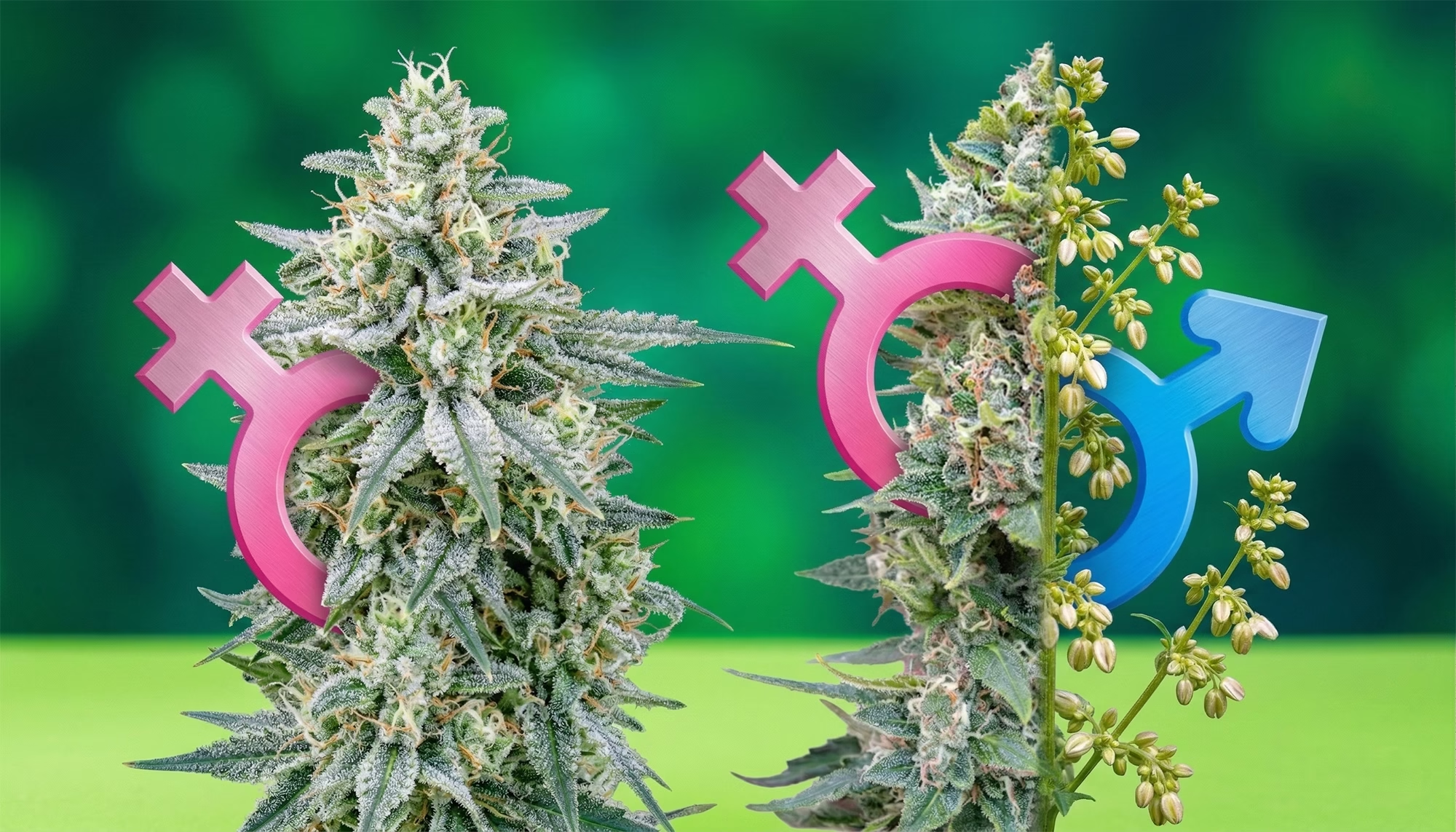
Cannabis has sex chromosomes. Females are typically XX and males are XY. Research on Cannabis sativa cytogenetics describes this XX female, XY male pattern. (pmc.ncbi.nlm.nih.gov)
Feminized seeds are produced so the offspring are overwhelmingly XX, which means they develop as females under normal conditions.
The key point is this: feminized seeds are about probability, not perfection. A well-made feminized line should yield mostly female plants, but genetics and stress still matter.
How feminized seeds are made in plain terms
To make feminized seeds, producers use a technique called sex reversal. A female plant is induced to produce male flowers. Pollen from those male flowers is then used to pollinate a female plant. Because the pollen donor is genetically female (XX), the resulting seeds are overwhelmingly female.
Scientific horticulture work shows that silver thiosulfate (STS) foliar spray can reliably induce male flowers on female cannabis plants under appropriate conditions. (journals.ashs.org)
You do not need to know the chemistry to buy feminized seeds wisely. You do need to understand what makes good feminized seed production different from bad production: selection and stability.
Feminized vs regular vs autoflower: quick clarity
These labels are commonly mixed up.
- Feminized vs regular is about sex probability.
- Autoflower vs photoperiod is about what triggers flowering.
So you can have:
- feminized photoperiod seeds
- feminized autoflower seeds
- regular photoperiod seeds
- regular autoflower seeds
Critical warning: feminized does not automatically mean autoflower, and autoflower does not automatically mean feminized. Confirm both.
Why feminized seeds are so popular
You do not pay the male tax
With regular seeds, you expect to remove males, which means you waste time and space before you even know what you are keeping.
With feminized seeds, almost every plant can be part of the final plan.
Indoors, that is a big deal because space is expensive and climate control is paid monthly.
Your canopy planning becomes clean
Feminized seeds make it easier to plan:
- how many plants you will actually flower
- how your canopy will fill
- your harvest expectations
- your timeline
With regular seeds, early planning often gets rewritten once sex shows.
Risk of pollination from your own plants drops
Accidental pollination is one of the fastest ways to turn a flower run into a seeded run. Feminized seeds reduce that risk because you are far less likely to have a male plant in the room.
This is especially important outdoors, where pollen control is hard.
The real tradeoffs of feminized seeds
Feminized seeds are not “better.” They are more convenient and more efficient for flower production. The tradeoffs come from two areas: selection freedom and stability.
You lose male selection options
If you want to breed, regular seeds are the direct path because you need males for traditional selection and crossing.
You can still create seeds using female-to-female techniques, but if your goal is future breeding and long-term line work, regular seeds are usually the better foundation.
Stability depends on the producer’s selection work
Poorly made feminized seeds can be unstable. That instability can show up as intersex expression.
Research and reviews discuss cannabis sex expression as complex and influenced by genetics and environment, with the plant capable of sex plasticity under some conditions. (pmc.ncbi.nlm.nih.gov)
The key point is not to fear feminized seeds. The key point is to treat them like a product where quality control matters.
Important: “feminized” is a label. It does not guarantee stability. Stability is earned through selection.
Feminized seeds and hermaphroditism: what is true and what is exaggerated
This topic gets repeated in shallow ways online. Here is the balanced view.
Feminized seeds do not automatically “herm”
Intersex expression can happen in cannabis due to:
- genetics
- stress
- the interaction between genetics and stress
Some lines are more sensitive. Some environments create chronic stress. A stable feminized line in a stable environment can perform extremely well.
Why the myth exists
The myth persists because:
- some producers used weak selection or rushed feminization
- some growers ran unstable environments and blamed the seeds
- people remember the one run that went wrong more than ten runs that went fine
If you want a simple rule:
- Choose stable lines and keep your environment stable.
- Do not use feminized seeds as an excuse to ignore stress cycles.
When feminized seeds are the right choice
Feminized seeds are usually ideal when:
- your goal is flower production, not breeding
- you have limited space
- you want a predictable plan and timeline
- you are trying to reduce early-run uncertainty
- you are growing outdoors and want to reduce self-inflicted pollination risk
They are especially strong for first-time indoor growers because they simplify the run.
When feminized seeds are not the best tool
Feminized seeds are not the best tool when:
- you want to breed with traditional male selection
- you want to select males for structure or vigor traits
- you want to build your own long-term genetic line
In those cases, regular seeds are the better foundation.
How to buy feminized seeds without getting fooled
A good feminized purchase is mostly about clarity and consistency.
Look for listings that give measurable expectations
A reliable listing usually gives:
- photoperiod or autoflower clearly stated
- feminized stated clearly
- expected finish window range
- structure notes and size range
- indoor and outdoor suitability notes
If it is mostly adjectives and hype, you are buying uncertainty.
Avoid the “everything at once” pack for your first run
Mixed packs can be fun, but they confuse learning.
If your goal is to learn and get a clean harvest, pick one cultivar and learn its behavior deeply.
Treat storage and shipping as quality signals
Seed vigor is affected by age, storage, and shipping stress. Seeds exposed to heat and humidity swings can lose vigor. Seed storage guidance emphasizes how strongly moisture and temperature drive longevity. (fao.org)
A seller who stores and ships like it matters is usually a better bet.
Indoor vs outdoor: feminized seeds in real use
Indoors
Feminized seeds usually maximize space efficiency. You can plan your canopy and you are not forced to cull males later.
Your main focus becomes stability and consistency rather than sex management.
Outdoors
Feminized seeds reduce the chance that your garden introduces pollen. Outdoors you cannot control wind, so removing the male variable is valuable.
Outdoors still carries pollination risk from other sources, but feminized reduces the risk you personally create.
The buying decision that prevents most regret
If your goal is flower, feminized seeds are usually the most practical choice.
If your goal includes future breeding, regular seeds are usually the better starting point.
The fastest way to decide is to answer one question honestly:
Are you trying to produce a clean harvest, or are you trying to build genetics?
Share this article

Written by : alexbuck
A quick overview of the topics covered in this article.
Follow us
Latest articles
March 27, 2026
March 27, 2026
March 27, 2026