
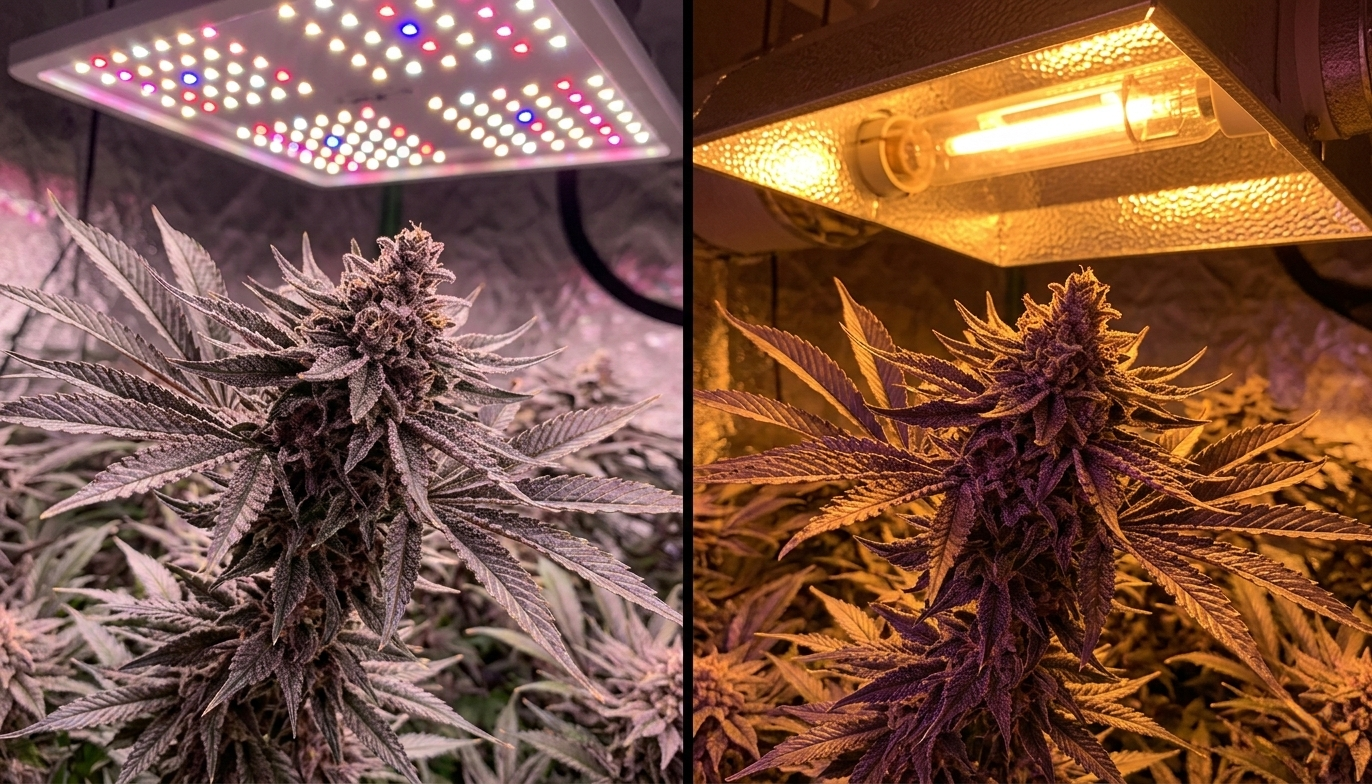
LED vs HPS Total Cost of Ownership: The 12-Month Reality
The LED vs HPS debate sounds like a lighting decision. In real grows, it behaves like a climate and operating-cost decision. The first 12 months are where that becomes obvious, because you pay for the same things every day: kWh, heat removal, moisture removal, and maintenance.
A light is never “just a light.” It is a heat source. It changes humidity behavior. It changes how hard your room has to work to stay stable.
1: The Real Answer in 60 Seconds
If your electricity rate is low, your room is naturally cool and dry, and you do not need heavy dehumidification or AC, HPS can look cost-effective in the first year because the upfront cost is often lower and the system is straightforward.
If your electricity rate is mid-to-high, or your room fights you on heat and humidity, LED often wins the 12-month reality because it usually delivers the same usable canopy light with less electricity and less heat burden. That reduces the downstream runtime of climate equipment.
Important: total cost of ownership is not “fixture price + light kWh.” It is fixture price + light kWh + climate kWh + maintenance + stability risk.
2: What Total Cost of Ownership Actually Includes
Most “LED vs HPS cost” comparisons miss the biggest line items because they stop at the fixture and the light schedule. A practical 12-month TCO has five buckets.
1) CapEx (upfront hardware)
Fixture cost and the parts the fixture requires to run safely and correctly.
2) Lighting OpEx (scheduled electricity)
The kWh driven by light watt draw and photoperiod.
3) Climate OpEx (demand-driven electricity)
Cooling, dehumidification, and sometimes heating. This is often where the surprise lives, especially in humid or hot conditions.
4) Maintenance and replacement
Lamp output depreciation and replacement cycles for HPS versus longer service life expectations for LED systems.
5) Risk cost
The cost of instability. Not only money, also quality. Heat spikes and humidity swings push you toward corrective behavior that can increase kWh and increase the chance of quality loss late in flower.
Here is the simplest way to visualize the difference without getting lost in details.
| Cost bucket | HPS 12-month reality | LED 12-month reality |
|---|---|---|
| Upfront (CapEx) | Often lower upfront | Often higher upfront |
| Lighting kWh | Often higher watts for similar canopy targets | Often lower watts for similar canopy targets |
| Climate kWh | Heat load often increases cooling and moisture-control burden | Lower heat burden often makes stability cheaper |
| Maintenance | Planned lamp replacement to maintain output is common | Longer service-life expectations, less frequent replacement |
| Quality risk | Stability can be harder in hot or humid rooms | Wider stability margin in many setups |
Tip: if you want a fair comparison, treat “climate kWh” as a core cost, not an optional add-on.
3: The First-Year Cost Drivers That Decide the Winner
Power rate multiplies everything
Electricity price is the multiplier on every watt-hour you use. When your rate is low, inefficiency hurts less. When your rate is high, inefficiency becomes the whole conversation.
A simple way to feel this is to price any 100 kWh block:
- At $0.10/kWh, 100 kWh is $10.
- At $0.35/kWh, the same 100 kWh is $35.
Your system does not change. The pressure on your budget does.
Your climate decides whether HPS heat is “helpful” or pure penalty
In cold rooms, heat from HPS can reduce the need for additional heating. In warm or humid rooms, that same heat usually becomes a penalty because it increases cooling demand and can worsen lights-off humidity behavior.
This climate dependence is not a small detail. In a large meta-analysis of indoor agriculture energy, dehumidification can represent more than half of total energy use for cannabis cultivation in hot and humid locations, while heating dominates in cold climates.
Your quality goals decide how tight your environment needs to be
If you are comfortable with wider day-night swings, you can often run a cheaper system. If you want tighter control for dense late flower, you pay for stability. Lighting choice changes how hard that stability is to buy.
Remember: the tighter your targets, the more expensive every inefficiency becomes.
4: Lighting Efficiency and What It Means in kWh
The best way to compare LED and HPS is not “wattage labels.” It is how many photons you get per joule and what that implies for heat and kWh.
A peer-reviewed cannabis lighting study reported fixture efficacies ranging from 1.7 μmol/J (HPS) to 2.5 μmol/J (LED) in that controlled comparison, and it concluded that fixture efficacy and initial fixture cost matter more for ROI than spectral distribution at high photon flux.
The clean “equal canopy light” way to compare
If you want to deliver the same photon output, the math starts here:
- Watts needed ≈ PPF ÷ efficacy
Example using a round number:
If you want roughly 1,500 μmol/s of photon output,
- HPS at 1.7 μmol/J needs about 882 W.
- LED at 2.5 μmol/J needs about 600 W.
That difference is not only lighting cost. It is also heat load difference, because every watt ends up as heat in the space.
Important: if you compare a dimmed LED to a full-power HPS, you are comparing strategies, not technologies. Compare equal canopy targets first.
5: The HVAC and Dehumidification Penalty
A lot of indoor cultivation energy is not the light itself. It is the equipment required to keep the room within a safe band.
A building-energy overview for indoor cannabis notes that lighting alone can account for nearly 40% of total energy use in a typical equipment breakdown, and it points directly to the rest of the system as major energy demand.
Industry and research discussions repeatedly highlight that dehumidification is not optional in many grows because plants release water vapor through transpiration and you need to hold RH in a workable range to avoid mold risk.
Why this matters for LED vs HPS
If your lighting choice increases heat load, you usually increase:
- cooling demand, and often
- dehumidification complexity, especially during lights-off recovery
If your lighting choice reduces heat load, you often reduce runtime on the devices that respond to heat and humidity swings.
Field note: a common pattern in cold spaces is that HPS can feel “cheaper than expected” in winter because it helps hold temperatures and can reduce heater runtime. The same footprint can flip in warmer or more humid conditions because the added heat pushes AC and dehumidification harder. The physics behind canopy temperature and radiation differences is well studied in horticulture, and it helps explain why results vary by room and season.
6: Maintenance and Replacement in Year One
Maintenance is part of TCO even if it does not show up every month.
HPS: lamp depreciation and planned replacement
HPS lamps lose output over time, and growers often replace lamps based on hours to maintain performance rather than waiting for failure.
A horticultural lighting maintenance reference recommends replacing HPS bulbs after about 10,000 hours for certain fixture types, with a range up to 10,000 to 15,000 hours for others under normal conditions.
Even if you do not hit 10,000 hours in a single year, output drift still matters because it pushes you toward compensating behaviors: raising power, lowering hang height, or accepting lower canopy light.
Advice: with HPS, plan lamp maintenance like you plan filter changes. Waiting until burnout is not the same as maintaining output.
LED: longer service-life expectations, different failure modes
LED systems are commonly discussed with much longer service-life expectations than HPS lamps. A review of horticultural LED lighting notes that current LED luminaires show roughly 10% and 30% output loss after about 45,000 and 60,000 working hours on average.
For a 12-month budget, that usually means less spend on replacement and less labor disruption. It does not mean zero maintenance. Dust, airflow, and thermal management still matter, and failures tend to be driver or component issues rather than lamp swaps.
7: A 12-Month TCO Calculator You Can Reuse
This is the framework that makes the decision stop being emotional.
Step 1: Define your real operating schedule
Write down:
- veg photoperiod you actually run
- flower photoperiod you actually run
- how many total days you expect the system to run in the year
Then list whether you run one room continuously or take breaks.
Step 2: Measure real watts at the wall
Use a plug-in power meter for:
- the light at the dimming level you actually use
- exhaust and circulation fans
- dehumidifier
- AC or heater if used
Tip: measure the dehumidifier over a 24-hour sample, not a single moment. Cycling is the whole story.
Step 3: Convert each device to monthly kWh
Use the same simple math:
- kWh = (watts ÷ 1000) × hours
Separate fixed schedule devices from demand-driven devices.
Fixed schedule:
- lights
- pumps on timers
Demand-driven:
- dehumidifier
- AC
- heater
Step 4: Price it with your real kWh rate
- Monthly cost = kWh × $/kWh
- Annual cost = monthly cost × 12 (or sum the actual months if you have seasonal swings)
Step 5: Add maintenance and replacement inside the year
For HPS, include planned lamp replacement if you follow hour-based replacement guidance.
For LED, include cleaning and basic preventive checks, and treat replacement as unlikely in the first year unless you are hard on equipment.
Step 6: Stress test the worst month
The month that breaks most budgets is late flower in a humid season. A meta-analysis of indoor agriculture energy shows how strongly end-use shares shift by climate, and it calls out cases where dehumidification dominates in hot and humid locations.
Build your buffer from that reality, not from an average month.
Remember: if the worst month is affordable, the year is affordable.
8: Quality and Aroma: The Cost People Forget
TCO is also what you keep in the jar. A lighting choice that forces bigger heat swings and harder humidity control can create a quality tax, even if the light itself is cheaper.
Why temperature stability shows up as “flavor” later
Terpenes contribute strongly to aroma and flavor and they are inherently volatile compounds.
Volatile compounds are more likely to evaporate or shift under higher heat, and storage and handling research repeatedly flags light, heat, and oxygen as drivers of chemical change over time.
In practice, higher canopy temperatures and bigger day-night swings can make delicate top-note profiles feel less crisp. The result is usually not an obvious “bad” flavor. It is a flatter flavor.
Why this is still not only about the grow room
Post-harvest is a huge part of terpene retention and final sensory clarity. Controlled post-harvest work shows that drying conditions influence terpene preservation and that better-controlled processes can preserve more volatile content.
So the honest model is:
- The grow environment sets what you have to preserve.
- Drying and curing decide how much you keep.
- Storage decides how fast it fades.
Important: if your drying and curing are weak, neither LED nor HPS will save flavor. If your drying and curing are strong, a more stable grow environment usually makes it easier to finish well.
9: Decision Points: When HPS Still Makes Sense and When LED Is the Obvious Move
HPS can make sense when
- you are in a colder environment where lamp heat reduces heater use
- your kWh rate is low enough that efficiency is not your main budget constraint
- you are prioritizing a low upfront entry and you can maintain the system properly
LED becomes the obvious move when
- your kWh rate is mid-to-high and monthly electricity dominates your cost
- you are in a hot or humid environment where dehumidification and cooling are major loads
- you want a system with fewer planned replacement interruptions in the first year
- you are trying to buy stability, not just intensity
Master advice: if dehumidification and cooling are already your biggest loads, reducing heat input is one of the cleanest ways to reduce total kWh.
10: If You Run HPS, How to Stop the Cost Bleeding
If you are committed to HPS right now, you can still run a smart 12-month plan.
Right-size intensity to canopy, not to the tent label
When canopy is small, running full output is mostly heating the room. Dimming and hang height discipline can reduce kWh without reducing results, especially in veg and early flower.
Treat ventilation as a cost decision, not a reflex
If outside air is humid, heavy air exchange can import moisture and increase dehumidifier runtime. This is exactly the type of system behavior indoor cultivation energy discussions warn about when they talk about the need for substantial dehumidification due to transpiration.
Plan lights-off behavior
Lights-off is where RH spikes and where many dehumidifiers run hardest. If you can reduce the size and duration of the nightly spike through smarter temperature stability and airflow, you often cut the longest runs.
Tip: measure one week of late-flower nights. That data is worth more than any spec sheet.
Maintain optics and lamps like performance gear
Dirty reflectors and aging bulbs reduce delivered light. Then you compensate by pushing the system harder. Planned replacement guidance exists because output drift is real.
11: The 12-Month Rule That Keeps You Out of Regret
Choose the option that makes late flower stability cheapest.
In cold, low-rate conditions, that can be HPS if the heat helps and the system is maintained. In hot, humid, or high-rate conditions, LED often wins because it reduces the size of the heat and humidity problem your room must solve.
A good next step is simple and practical. Measure real watts for your light, then log a week of dehumidifier and cooling kWh during your most demanding period. Once you see those hours, the 12-month reality stops being a debate and becomes a number you can trust.
Share this article
A quick overview of the topics covered in this article.
Follow us
Latest articles
September 25, 2026
September 25, 2026
September 25, 2026
September 25, 2026