
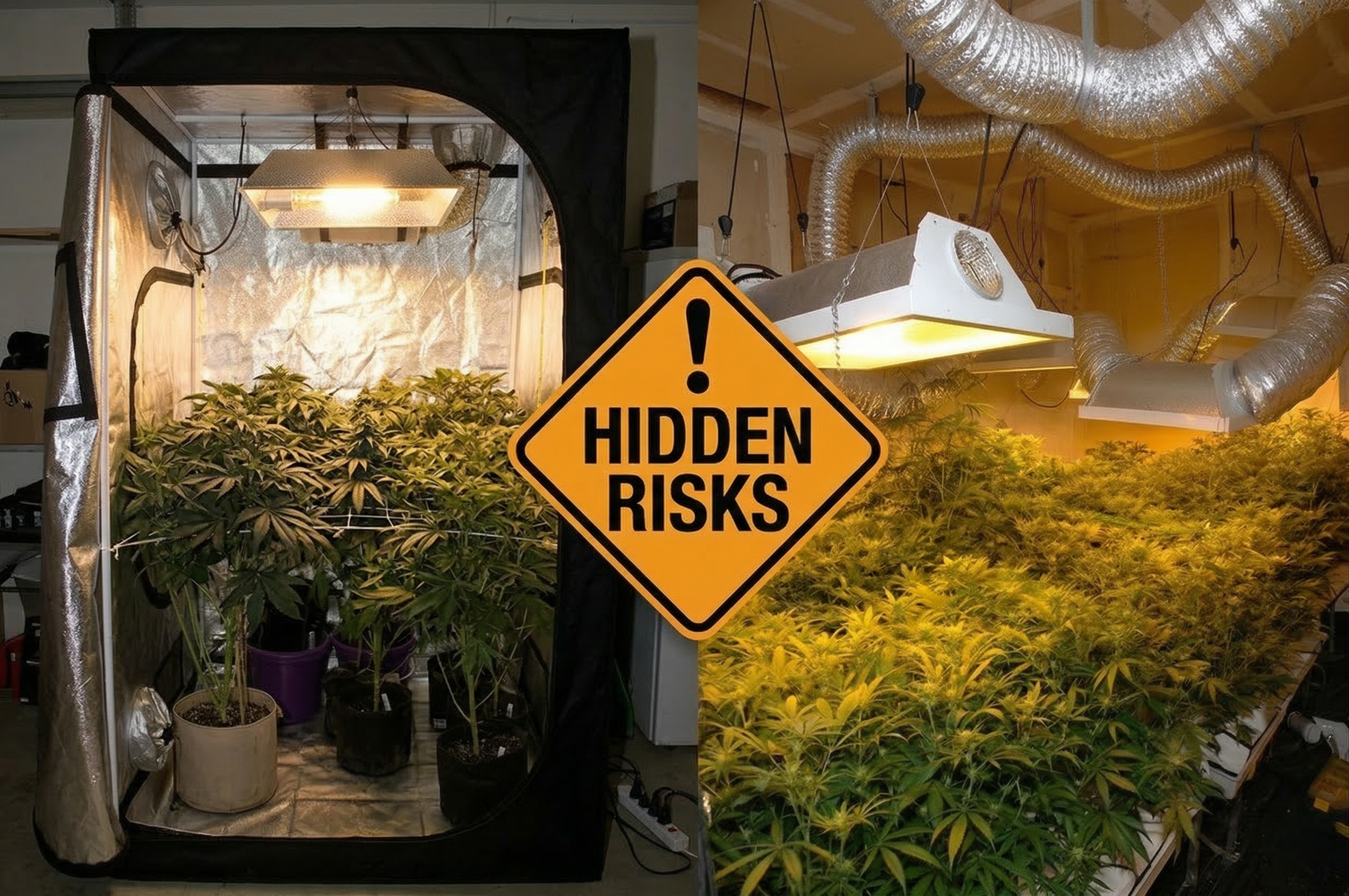
Grow Tent vs Grow Room: Cost Breakdown and Break-Even Comparison
A grow tent and a grow room can both produce great results. The cost difference is not about “which one grows better.” It is about how much control you are buying and how expensive it is to hold that control in your climate and your building.
A tent is a small controlled box inside a bigger room. A grow room is the building envelope itself. That single difference changes your startup cost, your monthly bill, and your risk profile.
The Real Answer Most People Need
If you want the cheapest safe path to consistent harvests, a tent wins for most home and small growers because it is modular, smaller in volume, and easier to stabilize.
If you want scale, workflow, and multi-zone control, a dedicated room can win, but only when you plan for moisture, electrical load, and HVAC from day one. Otherwise it becomes a trap where you spend more and still struggle to stay stable.
Important: the most expensive outcome is a half-built room that behaves like a leaky tent. You pay room-level costs and still get tent-level control.
What Total Cost of Ownership Actually Includes
You do not choose between “tent vs room.” You choose between two cost stacks.
CapEx (one-time or front-loaded)
- Grow envelope
- Electrical upgrades
- Ventilation paths and odor control
- HVAC and dehumidification capacity
- Monitoring and safety gear
OpEx (monthly, every cycle)
- Lighting kWh
- Fans and pumps kWh
- Dehumidification and cooling kWh
- Heating in cold months
- Replacement and maintenance
Then there is the hidden bucket.
Hidden costs (the ones that break budgets)
- Moisture damage risk to the building
- Noise and heat management
- Drying and curing space
- Downtime between runs because your only space is tied up
Remember: indoor cultivation is often dominated by lighting plus HVAC, and HVAC can become the bigger share in humid or hot situations.
The Two Envelopes Defined Clearly
Grow tent
A tent is a sealed fabric enclosure with reflective interior that sits inside a room. The room outside it is your “buffer zone,” and it matters.
A tent usually means:
- Lower upfront spend
- Easier odor control via a single exhaust path
- Smaller air volume to condition
- Easier to pause, move, or reconfigure
Grow room
A grow room is a built space where walls, ceiling, floor, and penetrations become part of the grow system.
A room usually means:
- Higher upfront spend
- More planning for vapor control, insulation, and sealing
- More electrical work
- More HVAC and dehumidification planning
- Better workflow once done correctly
Advice: if you cannot commit to moisture control details, start with a tent. Moisture problems damage buildings and are expensive to fix.
CapEx Breakdown: Where the Money Goes Up Front
Tent CapEx: what you actually pay for
Tents concentrate costs into a few essentials:
- The tent itself
- Lighting
- Exhaust fan and filter setup
- Circulation fans
- Basic monitoring and safe power distribution
You can build a functional tent without changing your home’s wiring, as long as you stay within circuit limits and avoid unsafe extensions.
Tip: the biggest tent CapEx mistake is buying cheap gear twice. A stable tent setup is cheaper than two “almost stable” rebuilds.
Room CapEx: the hidden build-out cost stack
A room build adds categories that tents avoid:
- Framing or surface finishing and sealing
- Vapor management and moisture control layers
- Insulation strategy
- Electrical upgrades and dedicated circuits
- Ducting and air pathways that do not leak odor or humidity
- Drainage planning if dehumidification is heavy
Moisture control guidance for buildings is clear on the core idea: if water vapor migrates into assemblies and condenses, you can get rot and decay.
Building science guidance also warns that vapor barriers can be misused and can trap moisture if installed incorrectly.
Important: a room is not “walls and a light.” It is a moisture-managed enclosure. If you skip that, you are paying for repairs later.
Electrical capacity: the upgrade most room builds cannot avoid
A tent can often run on existing circuits if you keep loads reasonable. A room build often pushes you into additional circuits because you add:
- More lighting
- More dehumidification
- More cooling
- More fans and control equipment
This is also where safety lives. A room build makes it easy to overload circuits if you do not plan.
Master advice: plan electrical like a grown-up first, then pick equipment. Every other decision depends on how much safe power you actually have.
OpEx Breakdown: Monthly Cost Reality
The simple rule: watts times hours
Your monthly bill is built from kWh:
kWh = (watts ÷ 1000) × hours
Tents usually have lower “room overhead” because you condition a smaller volume. Rooms can be cheaper per square foot at scale, but only when HVAC is designed correctly.
Why rooms often cost more per month in real life
Room builds tend to create these cost multipliers:
- More air volume to condition
- More surfaces that can swing temperature
- More infiltration points
- Higher moisture load because you grow more canopy
- More dehumidification runtime because you are protecting a larger harvest
Humidity control matters because plants turn irrigation into room moisture. A practical planning rule of thumb is that flowering canopy can demand up to around 1 liter of water per square foot per day under demanding conditions. That water ends up in the room unless you remove it.
An HVAC engineering presentation also notes that latent load persists even when sensible load drops, and plant moisture output does not vanish just because lights are off.
Important: in many grows, dehumidification becomes the bill, not the light.
Why tents can be surprisingly efficient
A tent lets you:
- Run a smaller dehumidifier and cycle it less often
- Exhaust a smaller volume for odor control
- Keep light leakage and humidity pockets easier to manage
- Use the surrounding room as a buffer
This does not mean tents are always cheaper. It means their cost is usually more predictable.
Hidden Costs: The Stuff That Changes the Decision
Moisture damage and building risk
A tent leaks humidity into the outer room if you vent poorly or if you run dehumidification in the wrong place, but the risk is often more contained.
A room, if misbuilt, can push vapor into wall cavities and create condensation problems and material damage. Moisture-control guidance emphasizes preventing water vapor movement into assemblies where it can condense and cause damage.
Advice: if you build a room, treat moisture management as structural, not optional.
Drying and curing infrastructure
Tents often force you to dry in the same space, which delays the next run. Rooms can be built with a dedicated dry zone, which can improve quality and improve throughput.
The cost angle is simple:
- If drying blocks production, you lose time.
- Lost time is a cost, even if it is not a utility line item.
Tip: if you cannot dedicate a dry area, a tent’s modularity can still win because you can add a second small space later without rebuilding a whole room.
Downtime and workflow
Room builds can reduce labor per gram because workflow is better:
- More space to work
- Better access
- Fixed infrastructure
- Cleaner cable and drainage routing
Tents can increase labor because everything is tighter, and maintenance is more awkward.
The economic tradeoff:
- Tents save money
- Rooms save time
- Time becomes money at scale
Break-Even Comparison: The Model That Actually Works
Break-even is not “how fast do I recover the tent cost.” It is “how many harvests until the cheaper option becomes the more expensive one.”
Here is a model you can reuse without lying to yourself.
Step 1: Define the two setups as systems
For each option, list:
- Total upfront cost
- Monthly electricity estimate
- Expected harvest cycles per year
- Expected yield per cycle
Remember: yield is not only genetics. Stability drives yield consistency.
Step 2: Convert monthly electricity to per-cycle electricity
If you run a typical cycle with veg plus flower:
- Estimate veg-month cost
- Estimate flower-month cost
- Multiply by how many months you spend in each stage
Then add your “peak week buffer” for late flower and tough weather.
A meta-analysis of indoor cultivation energy points out that end-use shares shift by climate and that dehumidification can dominate in hot and humid conditions.
This is why the buffer matters. Your budget breaks in the worst week, not the average week.
Step 3: Compute cost per gram
Cost per gram = (CapEx per cycle + OpEx per cycle) ÷ grams harvested
CapEx per cycle is simply your upfront cost spread across expected cycles before major replacement. Pick a conservative number. Ten cycles is a practical planning anchor for many home systems.
Step 4: Compare break-even in harvest count, not months
A room can take longer to break even because CapEx is higher. A room can still win if:
- It allows more harvests per year
- It increases yield consistency
- It reduces labor time enough to matter
- It avoids quality losses by stabilizing the environment
A tent usually wins if:
- You are not running continuously
- Your climate devices are minimal
- You want flexibility and low risk
Important: rooms only win on break-even when they are built correctly. A leaky room loses twice, once in CapEx and once in OpEx.
Realistic Scenarios That Make the Difference Obvious
Scenario: single-tent grow in a stable home
If your home already sits in a comfortable temperature range and humidity is manageable, a tent is often the best economic move. Your monthly bill is mostly light plus fans and your climate gear cycles lightly.
Break-even is fast because upfront cost is low and you learn quickly.
Scenario: multi-tent setup inside one “lung room”
This is the underused middle path.
You keep tent modularity and you also start building room-level advantages:
- Shared dehumidification in the outer room
- Shared cooling for multiple tents
- Better workflow without full construction
This approach often outperforms a rushed room build on both cost and stability.
Scenario: dedicated room in a humid or hot climate
A room can be worth it, but only when HVAC and moisture management are engineered as part of the plan.
If you skip that, dehumidifier and AC runtime can become the dominant cost. You might also fight lights-off spikes harder because the room has more air volume and more infiltration paths.
Scenario: dedicated room in a cold climate with long winters
Room builds can benefit from heat management and from being able to control airflow and insulation. In cold climates, heat generated by equipment can reduce heating needs, and that can change OpEx in winter.
Still, it only works when the room is properly sealed and moisture-managed.
The Decision Points That Matter More Than Equipment
Your kWh price
Electricity rates vary widely by region and can range from low teens to 40+ cents per kWh in some places, which changes the economics of scale.
High rates push you toward:
- Efficiency-first lighting
- Smaller footprints
- Better sealing and airflow strategy
- Avoiding unnecessary dehumidifier and AC runtime
Your humidity reality
If you live in a humid environment, the question is not “tent vs room.” The question becomes:
- What is my moisture removal plan
- How many hours per day will it run in late flower
Use canopy-based moisture thinking. The water has to go somewhere.
Your tolerance for permanent build-out
A room is not a hobby accessory. It is a construction project.
If you might move, or you might pause growing, or you need flexibility, a tent is the safer financial move.
Your true goal: output, quality, or workflow
If your goal is learning and quality, tents are usually enough. If your goal is throughput and repeatability at higher volume, a room can win, but only if it is designed like a system.
How to Lower Cost Without Lowering Control
For tents
- Right-size the light to the canopy, not the tent label.
- Keep 24/7 devices efficient, because constant loads add up.
- Improve airflow so canopy RH pockets do not force longer dehumidifier runs.
- Exhaust strategically. If outside air is humid, more exhaust can increase moisture load.
Tip: measure one week of late-flower nights. It will teach you more than any spreadsheet.
For rooms
- Seal and manage vapor correctly so you are not paying for infiltration.
- Plan drainage and maintenance access so dehumidification stays efficient.
- Separate day and night humidity strategy. Nights are where bills inflate.
- Build a buffer into your HVAC sizing for the peak week, not the average week.
Master advice: if your dehumidifier runs constantly and the room still spikes at night, the fix is often airflow, sealing, and target strategy before it is “buy a bigger unit.”
Common Mistakes That Make Both Options More Expensive
- Building a room without moisture control and then fighting the building, not the plants
- Assuming fewer light hours in flower means a cheaper month
- Underestimating lights-off humidity spikes
- Over-venting in humid weather and importing moisture you must remove
- Treating “pints per day” as cost instead of measuring kWh and runtime
Remember: you pay in kWh and hours, not in spec sheet words.
The Choice That Pays Off in Your Space
A tent is the best default because it buys control at low risk and low upfront cost, and it teaches you what your climate actually demands. A room can be the better long-term envelope when you need scale and workflow and you can commit to proper moisture management, electrical planning, and HVAC.
If you want the clean next step, do one simple thing before you decide. Track a one-week sample of your real kWh on the devices that decide the bill: light, dehumidification, cooling, and exhaust. Once you know those hours, break-even stops being a guess and becomes a decision you can trust.
Share this article
A quick overview of the topics covered in this article.
Follow us
Latest articles
September 25, 2026
September 25, 2026
September 25, 2026
September 25, 2026