
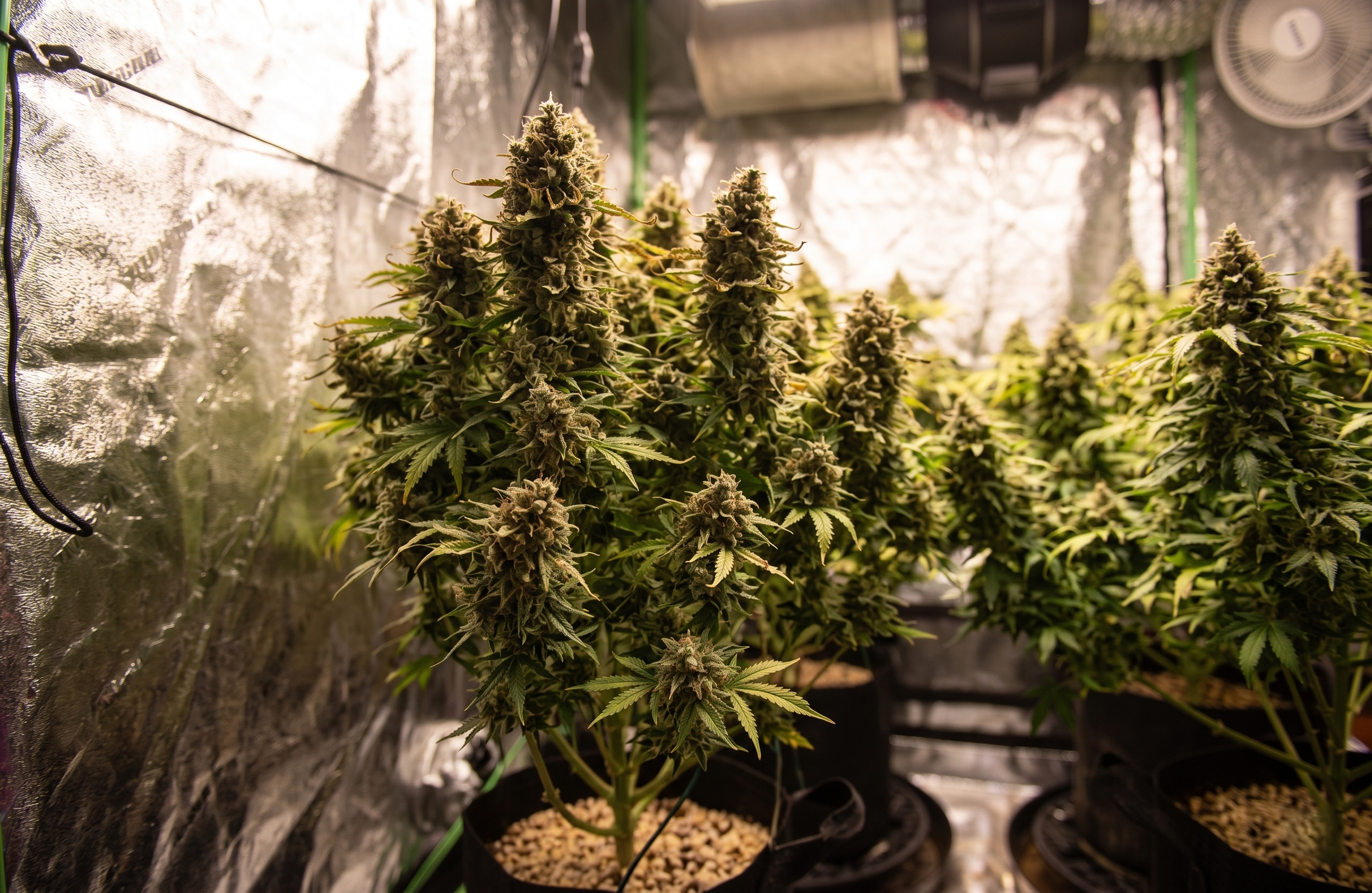
Advanced Training for Autoflowers
Why This Topic Confuses Even Experienced Growers
Autoflower training is one of those cannabis topics where the internet is loud, confident, and often far ahead of the evidence. The problem is not that canopy management is meaningless. The problem is that online advice routinely mixes together three very different evidence streams as if they were interchangeable: photoperiod-sensitive drug-type cannabis grown indoors, low-THC hemp grown in fields or greenhouses, and anecdotal grow-diary culture built around named techniques and strain folklore. The strongest peer-reviewed work does support important principles about plant architecture, light penetration, branching, density, flowering timing, and stress trade-offs. What it does not yet provide is a clean, modern, cultivar-by-cultivar answer to every autoflower question people ask online. In other words, there is more real science here than skeptics claim, but much less direct autoflower-specific proof than internet certainty implies.
That distinction matters. Most controlled studies with strong agronomic detail are on photoperiod-sensitive medicinal cannabis or on hemp types grown for floral biomass, fiber, seed, or cannabinoids under research conditions. Those studies are still highly useful because they tell us what canopy interventions tend to change: apical dominance, branch proliferation, light distribution, lower-canopy chemistry, water use, and the balance between biomass and secondary metabolites. But when a forum post says a named autoflower “loves topping” or “never touch autos,” that is usually a much stronger claim than the published evidence can currently justify.
That is the Weedth way to frame the subject: be ambitious, but do not pretend a weak data point is a law of nature. If the science is solid, we say so. If the science is thin, we say that too.
Remember: The best autoflower article is not the one that sounds most certain. It is the one that separates reproducible principles from grow-room mythology.
This report also stays away from two things on purpose. First, it does not turn into a step-by-step cultivation manual. Second, it does not invent a first-person “Weedth grow diary” or a strain-shopping list just to make the copy feel more personal. Where evidence is weak, we preserve credibility instead of filling the gap with fiction.
Autoflowers Are Not Just Smaller Photoperiod Plants
At the core of the autoflower conversation is one biological fact: autoflowers are day-neutral or photoperiod-insensitive. In peer-reviewed cannabis genetics literature, this trait is often referred to colloquially as “autoflower,” and work mapping the major flowering loci has shown that photoperiod insensitivity in cannabis is associated with major-effect loci including Autoflower1 and Early1. The literature also makes clear that “autoflower” is not a perfectly uniform biological package across all cannabis lines; researchers explicitly note that it remains unresolved whether the genetic mechanism for photoperiod insensitivity is the same in all cultivars. The same literature further notes that some high-cannabinoid autoflower cultivars differ phenotypically from older day-neutral hemp references such as ‘FINOLA.’
Why does that matter for training?
Because day-neutral flowering changes the grower’s margin for error. In photoperiod plants, time in vegetative growth can be extended by keeping the crop under long days. In autoflowers, the crop’s move toward reproductive development is not under the same sort of photoperiod control. That means the plant’s recovery window after severe canopy disruption is, in practical terms, less flexible. This is an inference from the biology rather than a single direct autoflower training trial, but it is strongly consistent with the broader evidence base: earlier or more precocious flowering reduces the time available to accumulate vegetative biomass, and reduced vegetative duration is repeatedly associated with reduced height, branching, and biomass in cannabis and hemp lines.
The flowering literature reinforces the same point from another angle. Comparative genomics work shows that early- and intermediate-flowering genotypes bred at northern latitudes tend to flower earlier than lower-latitude lines when moved into shorter-day environments, often with reduced branching, reduced plant height, and reduced biomass. Field and subtropical hemp studies similarly show that cultivars adapted to higher latitudes can flower earlier and lose biomass when grown where days are effectively shorter for their genetic background. In plain English: when the plant moves into reproduction sooner, you usually get less time to build the structure that later supports yield.
There is another nuance that many “veg versus flower” explanations oversimplify. In a detailed architectural study of female cannabis, researchers showed that cannabis cannot be reduced to a simplistic binary in which plants are entirely vegetative under long photoperiods and entirely reproductive only after a short-day switch. Solitary flowers can differentiate under long photoperiods, and the authors argue that flower induction in cannabis includes age-dependent components. That does not make standard indoor flowering protocols irrelevant for photoperiod crops, but it does remind us that cannabis development is more nuanced than internet diagrams often suggest. For autoflowers, that nuance matters because the plant is already strongly governed by age and ontogeny.
Tip: The smartest way to think about autoflower training is not “What technique is trending?” but “How much developmental time can this plant afford to lose and still convert light into flowers efficiently?”
The other major mistake people make is treating autoflowers as if “small size” is the defining issue. It is not. The real issue is developmental tempo. A fast crop with limited time to replace lost leaf area, rebuild damaged branches, and re-establish hormonal balance reacts differently to injury than a photoperiod crop that can simply be held longer in veg. That is why autoflower conversations live or die on recovery, not on slogans.
What Training Is Actually Trying to Change
Strip away the jargon and every training method is trying to do some combination of four things: weaken apical dominance, redistribute branch growth, improve light penetration into the canopy, and alter the microclimate around flowers and leaves. Those goals are not controversial. They are basic plant architecture biology. In wider plant science, branching is known to respond strongly to light intensity, light quality, photoperiod cues, sugars, hormones, and the dominance of the shoot apex. Reduced light and shade-like conditions suppress axillary bud outgrowth in many species, while stronger light environments and reduced apical control tend to encourage branching.
Cannabis does not escape those rules. A greenhouse lighting study on vegetative cannabis found that raising daily light integral from roughly 18 to 52 mol m⁻² d⁻¹ increased fresh mass, dry mass, node number, stem diameter, leaf area index, and branch number. The authors also note that increasing light quantity can reduce shade-avoidance responses such as internode extension and axillary bud dormancy, thereby promoting bud outgrowth and overall growth. That matters because a large amount of what growers hope to accomplish with training is, biologically, a light-distribution problem rather than a mystical “stress” effect.
This is where the best cannabis-specific architecture studies become extremely useful. In large medical cannabis plants, Nadav Danziger and Nirit Bernstein showed that lower inflorescences typically contain lower cannabinoid concentrations where light penetration is poor, and that increasing light penetration through defoliation or removal of branches and leaves from the lower canopy increased cannabinoid concentrations locally and improved spatial uniformity across the plant. In other words, canopy structure does not just influence how a plant looks. It can influence where quality accumulates and how consistent that quality is from top to bottom.
A later study on planting density sharpened the point further. When plant density increased from 1 to 2 plants per square meter, yield per plant fell but yield per area rose by 28–44% in most architecture treatments. However, higher density also reduced cannabinoid standardization, and treatments that improved light penetration to the lower canopy, such as defoliation or removal of lower branches and inflorescences, improved chemical uniformity. That is exactly the kind of result many growers misread. The lesson is not “always defoliate” or “always lollipop.” The lesson is that canopy architecture, density, and light penetration are interacting variables, and the best move depends on the production goal: per-plant beauty, per-area biomass, chemical uniformity, or labor efficiency.
Recent work on supplemental lighting inside the canopy shows that growers can sometimes solve the same biological problem without as much physical intervention. In a 2025 indoor study, subcanopy lighting and inter-canopy lighting both improved light distribution throughout the plant and increased yields of inflorescences, cannabinoids, and terpenes. Inter-canopy lighting produced nearly a 30% increase in dry inflorescence yield, about 24.4% more THC accumulation, and roughly a 12.5% increase in total terpene concentration, while both lighting strategies reduced variability in yield and chemistry by large margins. That does not make training obsolete. It does, however, prove an important point: part of what growers call “good training” may actually be “effective lower-canopy photon delivery.”
Master advice: Training is not a magic yield button. It is a canopy-management toolset for solving branch hierarchy, self-shading, and microclimate problems. When it works, it usually works for those reasons.
The final piece is genotype. Multiple studies now show that structural responses and chemistry responses vary by cultivar. The 2021 architecture standardization paper explicitly reported genotype-specific effects. A 2025 indoor study on LED spectra and defoliation found that defoliation increased cannabinoid concentrations in one low-THC cultivar while producing more variable responses in another, and the authors concluded that light and pruning regimes must be tailored to cultivar and production goals. This is one of the most important anti-myth findings in the entire subject. If genotype-specific response is real in controlled research, then “one-size-fits-all autoflower training rules” deserve immediate skepticism.
What the Evidence Actually Says About the Popular Interventions
Before looking at each technique, it helps to separate recovery cost from technique popularity. A method can be famous and still be a poor fit for a fast day-neutral plant if it removes too much tissue, breaks too much structure, or asks the plant to rebuild during the wrong stage.
Autoflower Training Risk Table
| Training Method | Recovery Cost | Best Use Case | Main Risk |
|---|---|---|---|
| Gentle bending / LST | Low | Spreading the canopy early without removing major tissue. | Stem damage if branches are forced too late or too sharply. |
| Leaf tucking | Low | Opening shaded bud sites without cutting leaves. | Limited effect in very dense plants. |
| Selective defoliation | Medium | Improving lower-canopy light and airflow where shade is genuinely limiting. | Biomass loss or slowed growth if overdone. |
| Topping | Medium to high | Strong, fast plants with enough early vigor and recovery time. | Lost recovery time if the plant is already moving quickly toward flower. |
| Lollipopping / lower cleanup | Medium | Dense indoor canopies with weak lower growth and poor airflow. | Removing tissue that might still have contributed to yield. |
| Supercropping | High | Usually better suited to photoperiod plants with longer recovery windows. | Stem injury, recovery delay, and unnecessary stress in fast autos. |
| Mainlining / manifolding | Very high | Usually a poor fit for most autoflowers. | Too much structural rebuilding for a plant with limited vegetative time. |
| SCROG-style netting | Variable | Canopy support and horizontal spread when used early and gently. | Can trap a fast plant into a structure that becomes hard to adjust later. |
Grower Question
Can training make autoflowers yield more? Sometimes, but not because stress itself creates bigger flowers. When training helps, it usually helps by improving light distribution, reducing shaded lower growth, and making the canopy easier to manage before the plant runs out of recovery time.
Topping and Apical Removal
Topping is one of the most polarizing interventions in the autoflower world, so it helps to start with what we actually know. In a controlled indoor study of chemotype III medicinal cannabis, researchers compared three pruning treatments: unpruned control, removal of side shoots, and apical cut or topping. Topped plants were shorter than controls, produced more and longer side shoots, and ended up with significantly more total inflorescence biomass than the control and lollipop-style side-shoot removal treatments. In that trial, total inflorescence dry matter averaged 18.5 g per plant in topped plants versus 16.3 g in controls and 15.7 g in lollipop plants, while side-shoot inflorescence biomass also rose significantly under topping.
That sounds like a simple pro-topping result, but the paper is more nuanced than internet summaries usually admit. Total CBD concentration itself was not significantly altered by pruning treatment. Total CBD yield was numerically highest in topped plants at the study’s defined optimum harvest point, but the main effect of pruning technique on total CBD yield did not clear conventional significance across the whole experiment. At nine weeks of flowering, topped plants produced 1431.6 mg CBD per plant versus 1234.3 mg in controls and 1133.9 mg in the lollipop treatment, but the overall pruning-technique effect on CBD yield had a p-value of 0.0923, meaning the strongest signal in the study was harvest timing rather than pruning alone.
This is precisely the kind of result that should cool down the online absolutism. Topping can reallocate growth and improve architecture in some cannabis genotypes. It can increase side-shoot floral biomass. It can produce numerically higher cannabinoid yield under some conditions. But it is not a universal law that topping is always better, and it is not supported by strong evidence as a guaranteed cannabinoid enhancer across all situations.
There is also an older field-hemp analogue worth noting. A 2019 seed-hemp study reported that apical bud removal increased seed yield, which is consistent with the basic physiology of releasing lateral shoot growth from apical dominance. But that was a seed-yield result in field hemp, not a flower-quality trial in modern autoflowering drug-type cannabis. It supports the mechanism, not the internet claim that topping any autoflower is automatically the best move.
So what should a serious reader conclude? Topping is biologically plausible and sometimes beneficial. But for autoflowers, the case is still indirect. The direct autoflower evidence is sparse, while the biological reason for caution is strong: a day-neutral plant has less flexibility to recover if apical removal costs too much development time. That caution is an inference from day-neutral flowering biology and flowering-time trade-off studies, but it is a reasonable one.
Grower Question
Can autoflowers be topped? Yes, but the better question is whether the plant has enough vigor and recovery time for topping to be worth the cost. Topping is not automatically wrong, but it is also not automatically better than a lower-injury canopy strategy.
Low-Stress Training and Gentle Bending
Low-stress training, often shortened to LST, deserves its own place in the autoflower conversation because it tries to solve the same canopy problem with less tissue removal. Instead of cutting the main growing point or stripping the plant aggressively, LST usually works by bending, tying, guiding, or repositioning branches so more growing sites receive useful light.
That makes LST biologically attractive for autoflowers. The evidence base does not give us a clean peer-reviewed trial comparing named autoflower LST systems across modern retail cultivars, so this should not be presented as settled cultivar-specific science. But the logic is consistent with the larger evidence: cannabis branching and lower-canopy chemistry respond to light distribution, apical dominance, canopy density, and microclimate. A method that improves light access while removing less tissue generally asks for less recovery than a high-injury method.
This is why LST often fits the autoflower risk profile better than aggressive topping, mainlining, or late heavy defoliation. It can open the plant, reduce self-shading, and encourage a more even canopy while preserving the leaves and growth tips the plant needs for photosynthesis. In a fast crop, that matters because lost time is harder to replace than lost shape.
The caution is timing. A soft, flexible branch in early structural growth is very different from a stiff, flowering branch that is already carrying weight. Late bending can split stems, interrupt vascular flow, or create stress at the exact moment the plant should be converting light into flowers. For autoflowers, LST should be understood as early guidance, not late correction.
Grower Question
Is LST safer than topping for autoflowers? Often, yes, because it changes branch position without removing the main growth tip. But “safer” does not mean risk-free. The plant still needs good timing, gentle handling, and enough vigor to respond without stalling.
Tip: If the goal is only to expose hidden bud sites, start with the least injurious option first. Leaf tucking, gentle bending, and small position changes usually cost the plant less than cutting, snapping, or rebuilding the whole structure.
Weedth Experience
One of the first autoflower training runs that worked well for us was on a Lemon Haze Auto. The goal was not to force the plant into a perfect shape. The goal was simpler: keep the main top from dominating everything, spread the side branches early, and let more bud sites receive direct light without removing too much living tissue.
The approach stayed gentle. We used low-stress bending first, then combined it with leaf tucking as the side branches started reaching upward. A few leaves were moved out of the way instead of being cut. Later, when the lower interior became crowded, we removed only the weakest shaded growth that was clearly unlikely to become productive.
What made the training work was restraint. We did not keep chasing the plant every day. Once the canopy opened and the main branches had found their direction, the plant was left to keep building. That was the main lesson from the run: with autoflowers, successful training is often less about doing more and more about stopping at the right time.
The result was not a miracle. It was simply a cleaner canopy, better light access, and less weak lower growth. The plant kept its pace, the top growth did not stall, and the final structure was easier to manage. That experience shaped the way we now think about autoflowers: LST, leaf tucking, and selective cleanup can work well together when they solve a real canopy problem without stealing too much recovery time.
Weedth Experience
A second useful lesson came from a more compact autoflower with tighter internodes. In that run, aggressive shaping would have made little sense because the plant was already naturally short and dense. Instead of topping or supercropping, the better move was to open the center slowly with gentle side bending, leaf tucking, and very selective lower cleanup only after the canopy started blocking airflow.
The plant responded better to small adjustments than to major intervention. The strongest branches received more even light, the center became easier to inspect, and the lower weak growth was reduced before it became a humid, shaded pocket. That run confirmed the same rule from a different plant shape: for autoflowers, early LST plus leaf tucking is the training approach I trust most when the plant is healthy enough to respond.
Strong advice: For most healthy autoflowers, my first choice is not topping, supercropping, or heavy stripping. Start with early LST, leaf tucking, and patient observation. Add selective cleanup only when the plant clearly needs it. This is the most reliable autoflower training approach because it improves light access without asking the plant to rebuild more structure than its short life cycle can afford.
Defoliation and Lower-Branch Removal
Defoliation is often sold online as if it merely “opens the plant up” with no real downside. The actual data say the truth is more conditional. In large drug-type medical cannabis plants, Danziger and Bernstein found that defoliation and lower-branch/lower-leaf removal increased light penetration into the lower canopy, raised cannabinoid concentrations in lower inflorescences, and improved uniformity across the plant. The logic is straightforward: if low flowers are chronically shaded, changing canopy density can improve the microenvironment and the chemistry of those lower sites.
But a newer indoor study complicates the usual bro-science narrative. In 2025, researchers evaluating LED spectra and defoliation in two indoor cannabis cultivars found that defoliation reduced plant height and floral biomass while increasing cannabinoid concentrations in one cultivar, with more variable effects in the other. They also observed a negative correlation between inflorescence weight and cannabinoid concentration, implying a biomass-versus-potency trade-off under some conditions. Again, this is a much more interesting and more honest result than slogans like “defol to increase frost.” Sometimes defoliation may improve concentration. Sometimes it may reduce biomass. Sometimes the outcome depends strongly on cultivar.
The same caution appears in density work. Under higher density, lower-canopy cleanup improved standardization, but the reason was not that the plant “liked stress.” The reason was improved lower-canopy light penetration and reduced development of low-value shaded tissue. That is a canopy-physics story, not a pain-and-gain story.
Pro tip: Whenever someone says a leaf-removal tactic “always increases quality,” ask a better question: did it increase lower-canopy light, improve uniformity, change biomass, alter humidity, or simply move the crop onto a different biomass-versus-concentration trade-off curve?
Grower Question
Should you defoliate autoflowers in flower? Only when there is a real lower-canopy light or airflow problem. Defoliation is not automatically a potency trick. In some situations it may improve exposure and uniformity, but in others it can reduce biomass or slow a plant that had very little recovery time left.
Density, Spacing, and the Hidden Architecture Variable
A remarkable amount of “training” discourse ignores the simplest canopy variable of all: how much space the plant actually has. In dense indoor production, the same plant can behave very differently than it does at lower density. The frontiers density study makes this clear: moving from 1 to 2 plants per square meter reduced yield per plant but increased yield per square meter in most architecture treatments, while also compromising chemical uniformity. That means some grow-room debates that sound like technique debates are really density debates in disguise.
Field floral hemp data tell a similar story from the outdoor side. In North Carolina trials, earlier transplant dates produced taller, wider plants, while larger in-row spacing produced wider plants. Individual plant biomass increased with earlier transplanting and larger spacing, but biomass per hectare increased with earlier transplanting and smaller spacing. The authors quantified one especially important result: delaying transplanting after 11 May reduced biomass by about 31.98 kg per hectare per day on average. That is a huge reminder that outdoor architecture is not just a matter of clips, ties, and pruning. Timing and spacing can move biomass much more than cosmetic intervention.
This is one of the biggest lessons Weedth readers should carry forward: if a crop is underperforming, do not jump straight to a surgical intervention. First ask whether the canopy was overfilled, underlit, too late-transplanted, too tightly spaced, too humid, or otherwise structurally disadvantaged before any “training technique” was even attempted. The literature strongly suggests that many growers over-credit technique while under-crediting system design.
Light as an Alternative to Injury
One of the most advanced takeaways from recent research is that some cultivation problems can be addressed with photons rather than with blades. The 2025 within-canopy lighting paper showed that subcanopy and inter-canopy lighting improved distribution of photosynthetically active radiation across apical, middle, and basal canopy zones, increased inflorescence and cannabinoid yields, and substantially improved uniformity. That directly overlaps with the goals often assigned to pruning systems.
Other light studies point in the same direction. High light levels indoors can continue to drive proportional gains in cannabis yield up to very high intensities, while greenhouse supplemental lighting increased branching, growth, and water-use efficiency in vegetative cannabis across the tested DLI range. White-light fraction, spectrum broadness, and red-peak composition can also influence architecture, light capture, and inflorescence yield, sometimes by making plant architecture more open and improving photon capture.
That does not mean “just add more light.” It means the serious cultivator should stop imagining that every architecture problem must be solved by stress-based manipulation. Sometimes the better question is whether the lower canopy is starved of light because of room design, fixture placement, density, or spectral strategy. Training can still be useful. But the newer science increasingly suggests that light management and canopy management should be treated as the same conversation, not separate ones.
High-Risk Techniques That Need Extra Caution
Some training methods are popular because they look dramatic, not because they are automatically the best fit for autoflowers. Supercropping, mainlining, heavy late defoliation, repeated topping, and aggressive manifolding all ask the plant to repair or rebuild structure. That may be manageable in a photoperiod plant that can be held longer in vegetative growth, but it becomes a much harder bargain in a day-neutral plant with a tighter developmental clock.
Supercropping is a good example. The idea is to soften or crush a stem enough to bend it while keeping it alive. In a flexible photoperiod plant with time to recover, growers may use it to control height or redirect growth. In autoflowers, the same move can become expensive because the plant may spend valuable time repairing damage instead of expanding canopy or building flowers.
Mainlining and manifolding carry an even higher recovery cost. They usually require repeated topping, symmetrical branch selection, and a longer structural rebuild. That makes them visually clean, but not automatically efficient. For most autoflowers, a perfectly shaped plant is not worth much if the plant spent too much of its short life recovering from the shaping process.
SCROG-style netting sits in a different category. A net can help spread and support the canopy, but it should not be confused with a guarantee of higher yield. If the plant is guided early and gently, a net can help organize growth. If the net locks a fast autoflower into a structure too late, it can make later adjustments, watering, inspection, and disease management harder.
Remember: High-risk training is not impossible, but it must earn its place. If a method creates more recovery cost than light-distribution benefit, it is not advanced. It is just expensive stress.
Indoor and Outdoor Are Not the Same Training Problem
The indoor version of this topic is fundamentally different from the outdoor version because the bottlenecks are different. Controlled environments offer year-round production and tighter control over light, temperature, humidity, and nutrient delivery, but they are also more energy- and resource-intensive. Research on indoor medicinal cannabis and greenhouse systems repeatedly emphasizes the degree of control available, the importance of microclimate management, and the large operational burden that comes with that control. In those environments, architecture matters because dense canopies can hurt light distribution, chemical uniformity, and labor efficiency.
That is why indoor literature gives us some of the clearest evidence for architecture interventions. In indoor or protected systems, growers can compare topping, branch removal, defoliation, density changes, and supplemental side-lighting under relatively stable conditions. The best-supported indoor lesson is not “use the harshest method.” It is “reduce lower-canopy disadvantage.” Improved light penetration, improved airflow, and more consistent canopy exposure repeatedly emerge as the real drivers of better standardization and, in some cases, higher per-area output.
Outdoor and field-grown systems change the priorities. A greenhouse-versus-field hemp study found that greenhouse production could generate greater cannabinoid production per square meter thanks to higher inflorescence biomass and the possibility of multiple cycles, but greenhouse operating costs were at least 13 to 15 times higher than field costs in that analysis, and expenditures per unit of dried flower remained dramatically higher indoors or under protected cultivation. The same study also attributed major phenotype differences between greenhouse and field plants to factors such as much lower crop density in the greenhouse, no wind stress, consistent fertility and irrigation, and protected environmental conditions. That means training decisions cannot be copied blindly from one environment to the other.
Open-field floral hemp studies push the point further. In North Carolina, early transplanting and spacing had major effects on plant size and biomass. In Georgia, day-neutral cultivars allowed earlier spring planting, but in that environment their average floral yields were still lower than those of the photoperiod-sensitive cultivars tested, and the yields of day-neutral cultivars declined as planting progressed. Those data do not prove that all autoflowers underperform outdoors. They do show that, in field settings, planting date, latitude, temperature, and the genotypic timing of flowering can dominate outcome. Outdoor structure is therefore shaped heavily by calendar biology as much as by grower intervention.
Humidity and airflow also become more decisive as soon as canopies thicken. A 2025 controlled study showed that elevated canopy-level relative humidity delayed flowering, reduced biomass, and lowered cannabinoid concentrations, particularly CBD and CBC, while worsening physiological stress symptoms. The authors concluded that consistent management of humidity and vapor-pressure deficit across growth stages is crucial, and they specifically pointed to plant spacing and airflow as practical levers. That is important for both indoor and outdoor readers: “advanced training” is not only about shape. It is also about the microclimate that shape creates.
The best synthesis is this: if you grow indoors, training is mainly an exercise in optimizing lower-canopy light, airflow, uniformity, and space efficiency. If you grow outdoors, the biggest moves may come from genetics, latitude adaptation, planting date, spacing, and weather exposure before pruning ever enters the chat. That is not a slogan; it is the pattern that emerges when you line up the evidence.
Note: This is why imported advice fails so often. An aggressive indoor canopy practice can become pointless or harmful outdoors, while an outdoor spacing or timing problem can never be fixed by a clever tie-down later.
The Myths That Need to Die
The first myth is that autoflowers must never be trained. The evidence does not support that absolute claim. Cannabis architecture modulation can absolutely alter branching, lower-canopy chemistry, yield distribution, and standardization. Topping increased side-shoot biomass in one indoor medicinal cannabis study, while defoliation and lower-branch removal improved lower-canopy chemistry and uniformity in large cannabis plants. The correct conclusion is not “never train.” The correct conclusion is that training responses are real but cultivar-specific, goal-specific, and tightly linked to canopy context.
The second myth is the mirror-image mistake: more stress always means more resin. That claim falls apart quickly once you look at controlled environment studies. Water stress during flowering reduced dry inflorescence weight in CBD-dominant cannabis and, in the 2025 trial, CBD concentration also declined as water stress intensified during flowering. Elevated relative humidity delayed flowering and reduced biomass and cannabinoid concentrations. Nutrient deprivation in flowering preserved much of CBD yield at lower fertilizer input in one study, but it still reduced inflorescence yield and shifted the crop onto a different efficiency trade-off. Stress is not a free potency hack. It is a production trade-off, and sometimes a very expensive one.
The third myth is that “sativa autos are better for training than indica autos.” Scientifically, that framing is much weaker than most consumers realize. A Nature Plants study pairing genomic and terpene/cannabinoid data with commercial labels found that principal components showed no clear clustering according to “Sativa” and “Indica” labels and that those labels explained only a limited amount of the observed variation. Clinical and pharmacological commentary has gone further, calling the vernacular “sativa/indica” nomenclature scientifically indefensible. For cultivation decisions, architecture, flowering behavior, branching pattern, and documented cultivar performance are better filters than a retail label.
The fourth myth is that strain names themselves are a reliable guide to training response. They are not. Reviews of medical cannabis complexity emphasize that cannabis is a chemically diverse plant, not a single, uniform product, and that secondary metabolite profiles shift with genotype, growth conditions, tissue position, harvest time, and storage. Even genetically identical plants grown in different greenhouses have shown substantial profile differences in many minor cannabinoids. If chemistry itself is that plastic, it should not surprise anyone that growth habit and response to canopy interventions are also context-sensitive.
The fifth myth is that 12/12 thinking explains autoflowers. It does not. Photoperiod-switch studies, photoperiod-threshold work, and meta-analyses of long-day to short-day timing are highly relevant for photoperiod-sensitive cannabis, particularly indoors, but autoflowers are day-neutral by definition. Those data still teach us something valuable, especially about developmental timing, vegetative duration, branching, and biomass trade-offs, but the grower does not control autoflower flowering onset in the same way by flipping a timer. That is why any advice copied straight from photoperiod canopy routines into the autoflower world deserves scrutiny.
Remember: The autoflower question is not “Can this technique work on cannabis?” It is “Can this day-neutral genotype recover fast enough for the trade-off to be worth it in this environment?”
A Stage-Based Evidence Framework for Autoflower Decisions
Because direct comparative trials on named autoflower training systems are still sparse, stage-based judgment is more reliable than memorizing internet recipes. The safest framework is to align intervention intensity with what we know about developmental timing, light capture, flowering sensitivity, and stress costs.
Seedling and Establishment
The early stage is where autoflower myths usually become expensive. At establishment, the plant’s most valuable asset is future time. Field and flowering studies consistently show that reduced or truncated vegetative duration lowers height, branching, and biomass potential. Earlier flowering genotypes and later-transplanted field crops both demonstrate the same structural consequence: less time to grow before reproductive demands intensify means less final structure. For a day-neutral crop, that makes the establishment phase especially poor territory for unnecessary damage.
That does not mean the plant should be “babied” into a crowded, self-shading mess. It means structural decisions made here should prioritize even exposure, root-zone stability, and uninterrupted early canopy expansion. In the literature, one of the strongest recurring signals is that larger and better-structured canopies intercept more light and support more biomass later, but lost time is hard to recover.
Early Structural Phase
If there is any phase in which architecture interventions are most biologically defensible, this is it. Branch hierarchy is still forming. Light interception is still ramping. The relationship between apical control and lateral outgrowth is still highly consequential. Cannabis and broader plant branching literature both support the principle that light and apical dominance regulate branching outcomes, and controlled cannabis studies confirm that early architecture changes can reshape side-shoot development and lower-canopy chemistry.
This is the stage where the “what is my goal?” question becomes central. If the goal is a more even canopy and less lower-canopy waste, then modest structural redirection may be sensible. If the goal is maximal simplicity and minimal recovery penalty, then less injurious architecture management may be the better fit. What the evidence does not support is the online fantasy that every autoflower should be put through the same training template regardless of branch vigor, canopy density, and developmental speed. Genotype-specific response is a recurring result, not a detail.
Tip: In fast crops, the best intervention is usually the one that solves the light-distribution problem with the smallest recovery cost.
Active Flowering
Flowering is where bad advice becomes most visible because many growers confuse visible resin with successful crop economics. The controlled evidence says flowering-stage conditions are highly consequential. In the 2025 water-stress study, flowering-stage drought reduced inflorescence biomass, and in the humidity study, elevated RH delayed flowering, reduced biomass, and lowered cannabinoid concentrations. If the crop is already allocating heavily to reproductive tissues, adding major stress late in the cycle is not a clever hack; it is a risk.
At the same time, flowering does not erase all value from canopy management. The large-plant architecture work shows that lower-canopy cleanup and defoliation can improve light penetration and standardization in dense canopies, particularly where the lower third is genuinely disadvantaged. But the newer indoor work also shows that the outcome can be cultivar-dependent and may come with a biomass penalty. So the flowering-stage question should never be “Should I strip for more frost?” It should be “Is there a measurable lower-canopy problem severe enough that selective canopy correction is worth the trade-off?”
Late Flower and Finish
Late structural heroics have the weakest evidence case of all. In the pruning-and-harvest study, harvest timing was a much stronger determinant of CBD yield than pruning itself. Total CBD concentration changed far less over time than inflorescence dry weight, and the optimum total CBD yield for the genotype studied was associated primarily with harvest timing around nine weeks of flowering, while pruning technique exerted a much weaker effect. More broadly, reviews of cannabis chemistry emphasize that harvest time, storage, light exposure, heat, and postharvest handling all influence final chemistry, including decarboxylation and terpene loss.
That leads to a mature conclusion that a lot of cultivation media still undersell: once the crop is in its finishing phase, the highest-value decisions may no longer be about shape at all. They may be about environmental consistency, disease avoidance, harvest timing, and preserving chemistry rather than chasing last-minute canopy transformations.
What This Means for Beginner, Intermediate, and Advanced Readers
For beginners, the evidence-based answer is almost boring in the best possible way: do less, but do it earlier and more intentionally. The science does not reward random damage. It rewards canopies that are evenly lit, not excessively dense, and not chronically stressed in flowering.
For intermediate growers, the next step is to stop evaluating methods by aesthetics alone. A visually “open” plant is not automatically a better-yielding or more potent plant. The real questions are whether lower-canopy light improved, whether biomass shifted, whether chemistry became more uniform, and whether the cultivar tolerated the intervention. Those are exactly the variables the strongest studies measure.
For advanced growers, the real frontier is systems thinking. Modern evidence suggests that canopy architecture should be optimized alongside density, fixture design, spectral strategy, humidity control, and per-area economics. Advanced cultivation is less about finding one “best” training trick and more about choosing the least costly way to solve a specific structural problem. In some rooms that will mean selective pruning. In others it may mean lower density or inter-canopy lighting. In outdoor settings it may mean genetics, transplant timing, and spacing first, training second.
Master advice: The smartest autoflower grower is usually the one who treats training as one variable in a production system, not as the star of the system.
Final Take
Autoflower training is not about forcing the plant into a perfect shape. It is about making the canopy easier to light without stealing more recovery time than the plant can afford. Gentle early guidance, clean airflow, smart spacing, and strong light distribution usually matter more than dramatic interventions.
The best growers do not ask, “What is the most advanced technique I can use?” They ask, “What is the smallest intervention that solves the real canopy problem?”
Educational note: This content is for educational purposes only. Always follow your local laws and regulations before growing cannabis.
Share this article
A quick overview of the topics covered in this article.
Follow us
Latest articles
October 24, 2026
October 24, 2026
October 24, 2026
October 24, 2026
