Balcony Cannabis: The Science of Light Pollution, Heat, Wind, and Living Soil in a City Microclimate
Balcony growing sits in a weird middle zone. It’s not indoor (you don’t control the atmosphere). It’s not outdoor (you’re surrounded by concrete, glass, reflected heat, and artificial light at night). If you treat a balcony like “a smaller outdoor grow,” you’ll usually learn the hard way which variable you forgot: the dark cycle, the root-zone temperature, or the wind-driven water loss.
This piece is written for jurisdictions where home cultivation is legal and for education. It does not cover concealment tactics or ways to evade enforcement. If your goal is top-shelf quality, your job is simple: build a stable microclimate, keep the roots healthy, and don’t let urban lighting and urban heat wreck the plant’s timing.
A balcony is a microclimate project, not a “small grow”
A balcony creates a localized climate that can swing faster and harder than a yard.
Concrete and tile surfaces soak heat all day, then radiate it back at night. Glass and light-colored walls bounce photons into the canopy in ways that can be helpful by day and disruptive by night. Wind shear around buildings can be gentle one hour and brutal the next. None of this is “mystery”—it’s physics and plant physiology. The catch is that cannabis is especially sensitive to two kinds of signals: night length and stress at the leaf and root level.
On the light side, plants use light both as energy and as information, and the spread of outdoor electric lighting has disrupted natural 24‑hour light–dark cycles at many scales. On the stress side, cannabis physiology research shows temperature and light intensity can push the plant into lower photosynthetic performance and reduced water-use efficiency when conditions get too hot.
So in practice, balcony success is less about “buying gear” and more about removing the specific urban stressors that sabotage growth and quality.
Legal and safety constraints you cannot ignore in a city
The first “balcony variable” isn’t the plant—it’s your environment.
Some jurisdictions allow home cultivation; many do not, and rules can change. Even where legal, leases, building rules, and nuisance laws (odor, safety hazards) still apply. A serious, responsible approach is to treat this as you would any regulated home activity: understand the rules, avoid endangering neighbors, and avoid practices that increase the risk of contamination.
This matters for quality. For example, research on organically grown cannabis has documented that microbial communities in growing facilities and soils can show up on inflorescences, and the authors note that some species may negatively affect product quality and can include opportunistic human pathogens. If you’re growing in a dense urban setting where airflow and humidity are already tricky, “clean process” isn’t a vibe—it’s the difference between usable flower and a disposal problem.
Light pollution and the dark cycle are the balcony’s hidden yield killer
If there’s one balcony issue that blindsides beginners, it’s artificial light at night.
Darkness controls flowering more than most people realize
Controlled environment horticulture has repeated this point for decades: for photoperiodic plants, it is the uninterrupted period of darkness that drives flowering responses, not just “how bright your day is.” That is why horticulture uses day-extension and night-interruption lighting to deliberately manipulate flowering, and why the required intensities can be surprisingly low in some contexts.
Cannabis-specific work lines up with that principle.
A 2025 peer-reviewed cannabis paper discussing the “night break” method describes using a 12‑hour photoperiod followed by a one-hour night interruption to break up the dark cycle so plants continue vegetative growth—explicitly underscoring how precisely light timing can control developmental phase.
A separate peer-reviewed study on Cannabis sativa ‘Suver Haze’ tested daylength-extension light at very low intensities (down to 1.0 μmol·m⁻²·s⁻¹ PPFD) to extend a 9‑hour day to a 15‑hour photoperiod; the authors report that all day-extension treatments stopped the full transition to flowering compared to the 9‑hour control, though incomplete inflorescences still appeared under day-extension, and that an 18‑hour photoperiod was sufficient to prevent incomplete inflorescences in their second experiment.
The balcony implication is straightforward: urban light that seems “minor to humans” can still be biologically meaningful to a photoperiod-sensitive plant, especially when it hits at the wrong time of night.
Artificial light at night is not just a cannabis problem
The broader plant literature is clear that artificial light at night disrupts natural light cycles at scales relevant to plant physiology. In some photoperiodic systems, even extremely low photon flux densities can produce measurable effects on flowering and growth responses, and spectral quality (red vs white) can matter because phytochrome signaling is involved.
For a balcony grower, the useful mindset is: if you cannot control your night environment, you’re not running a stable photoperiod. You’re running an uncontrolled lighting experiment.
Root-zone heat is why balconies “randomly” fail in summer
Most balcony growers watch the leaves. The pros watch the roots.
Black containers can turn into root ovens
Container horticulture data shows just how extreme root-zone heating can become. A horticulture industry analysis summarizes data indicating that summer soil temperatures in a black nursery container can reach about 126°F (52°C), while “optimal” root temperature for many temperate plants is around 77°F (25°C), with increasing stress and mortality above ~86°F (30°C).
The same source lists the downstream impacts you’d expect: lower photosynthesis, rapid substrate drying, reduced nutrient and water uptake, and higher susceptibility to pathogens in stressed roots.
This isn’t just theory. Peer-reviewed container temperature research in multiple U.S. locations showed that black plastic containers accumulated the highest substrate temperatures, while porous containers (including fabric) stayed cooler; the authors used a “critical root zone temperature” criterion defined as exceeding 100°F (37.7°C) for at least three consecutive hours and reported that this critical threshold was not observed for fabric containers at any location in their study.
In balcony terms: if your container is sitting on a heat-sink surface (tile, concrete) and the sun is hitting the container wall, the roots can be under severe stress even when the air temperature feels tolerable.
Cannabis physiology supports why heat hurts quality
Cannabis photosynthetic response literature shows that higher temperature can have adverse effects on key physiological parameters. A frequently cited cannabis gas-exchange study reports stomatal conductance increased with temperature up to about 30°C but temperatures above 30°C had an adverse effect, with high temperature and high PPFD showing an adverse effect on net photosynthesis and water-use efficiency.
On balconies, high PPFD can happen fast through direct sun plus reflected light. Combine that with root-zone heat and wind-driven transpiration, and you get a plant that is working harder to survive than to build quality flower.
Wind, water loss, and “city stress” reshape the plant
Balconies are wind tunnels. Sometimes that’s a gift. Sometimes it’s an extraction fan you didn’t ask for.
Mechanical stress can strengthen plants, but it changes growth
Plant response to touch and mechanical disturbance is a well-studied phenomenon (thigmomorphogenesis). A recent open review describes the typical pattern as reduced height and leaf area paired with increased stem thickness and changes in root architecture—an adaptive strategy for unstable environments like wind exposure.
This explains two balcony realities growers routinely see:
First, plants on windy balconies often grow shorter and sturdier. That can be helpful when space is limited.
Second, chronic hard wind can push water loss to a level that triggers stress responses and reduces productive growth. A 2025 Frontiers review on crop stress detection explicitly notes that strong winds can impose mechanical stress and heighten water loss due to accelerated transpiration.
Cannabis and hemp close stomata under water stress
Hemp-focused horticulture research notes that Cannabis sativa (industrial hemp) is sensitive to root-zone water stress and can respond by closing stomata in the short term and defoliating under longer stress to reduce transpiration demand.
Put those pieces together and the balcony logic becomes clear: wind stress and heat stress are often the hidden drivers behind “random” nutrient symptoms, slowed growth, and inconsistent flowering.
Living soil on a balcony can improve resilience, but it is not a free pass
The user narrative around living soil usually goes like this: “Go organic and everything becomes easier.”
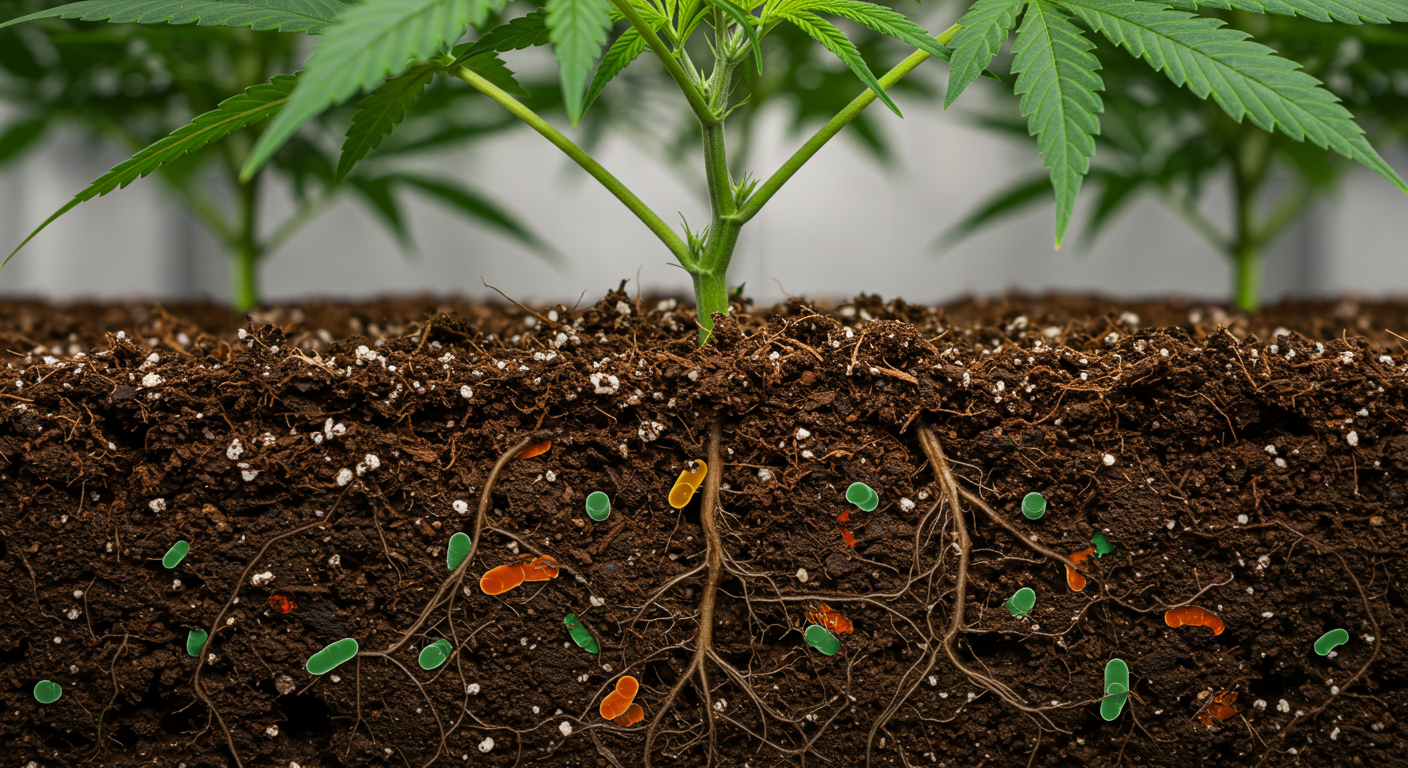
The deeper truth is: living soil can increase the system’s buffering capacity, but it also increases biological complexity. You benefit if you manage it well, and you get burned if you neglect hygiene and moisture discipline.
Microbial partners can replace some fertilizer pressure
Peer-reviewed cannabis/hemp research supports the idea that microbial partnerships can improve plant performance. A Frontiers study on hemp (Cannabis sativa KKU05) reported that plants inoculated with one arbuscular mycorrhizal fungi treatment performed best in biomass and in CBD/THC concentrations; another mycorrhizal treatment produced biomass and cannabinoid concentrations not significantly different from non-mycorrhizal plants receiving synthetic fertilizer, suggesting microbes can substitute for part of the fertilizer input under some conditions.
That matters on balconies because container systems have limited buffering volume. Anything that stabilizes nutrient acquisition and root function is a structural advantage.
Organic systems can carry higher microbial loads on flowers
At the same time, organic systems are not sterile, and research has documented that organically grown cannabis can carry diverse fungal communities on inflorescences, with many species traced to air and organic soil sources; the authors note that these organisms may increase colony counts and negatively affect product quality, and some species could contribute to allergies or secondary infections in humans.
In other words: a living soil approach can support resilience, but it raises the bar on moisture control, sanitation, and post-harvest handling—especially in small urban spaces where airflow can be constrained.
Share this article

Written by : alexbuck
A quick overview of the topics covered in this article.
Follow us
Latest articles

March 15, 2026
March 15, 2026
March 15, 2026