
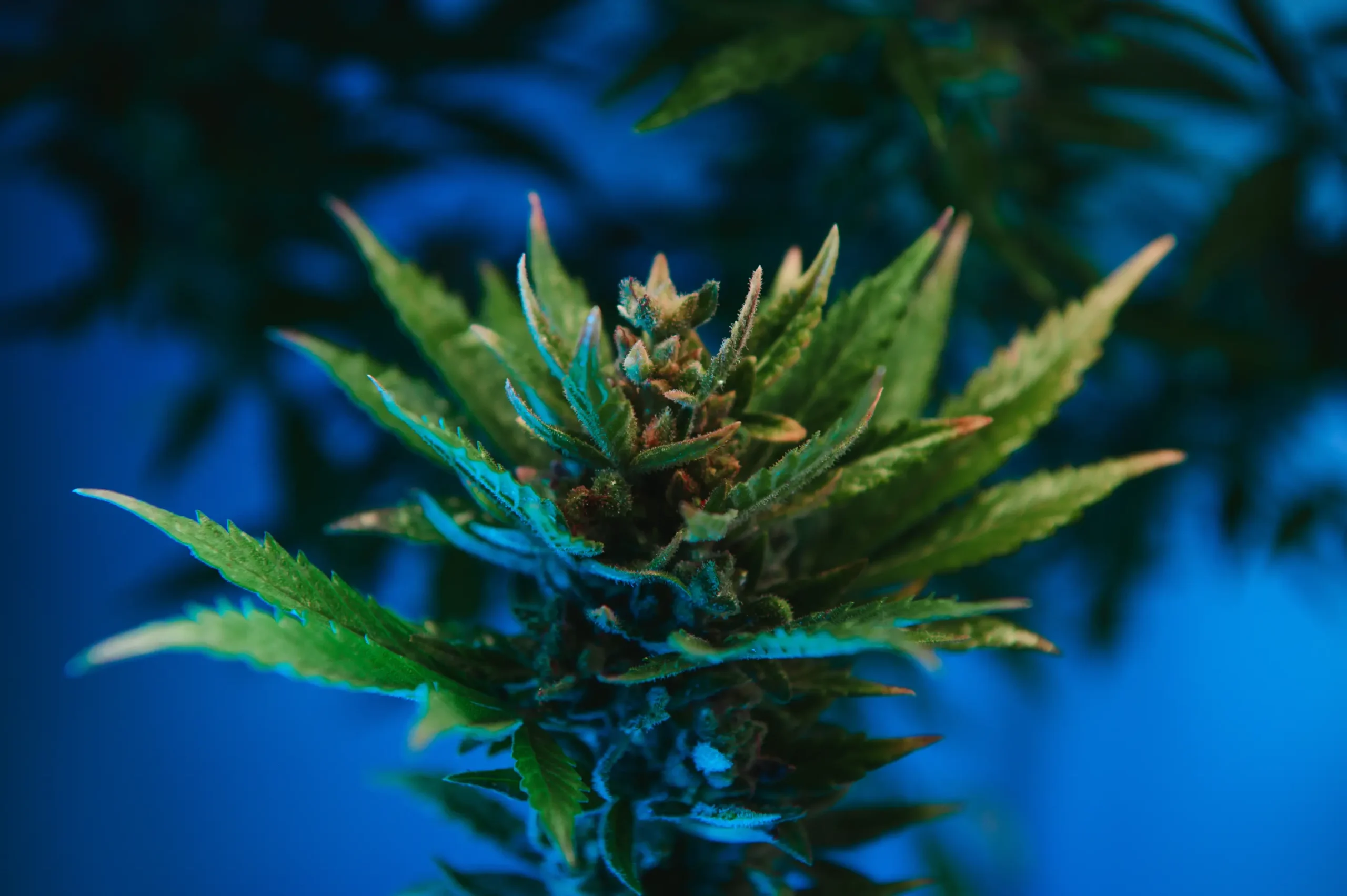
Skywalker OG
Skywalker OG is a dense, bushy OG-family hybrid that can produce more weight than its moderate height suggests. Its cultivation challenge is not extreme vertical stretch. The challenge is managing a plant that branches well, responds strongly to topping, and then fills those branches with dense resinous flower that becomes increasingly sensitive to humidity, support, and root-zone mistakes.
The lineage is most consistently described as Skywalker crossed with OG Kush, with Skywalker itself tracing back to Mazar and Blueberry. That ancestry explains the cultivar's mix of traits: earthy pine and fuel from the OG side, sweeter fruit from the Skywalker side, broad indica-influenced growth, and an effect that becomes strongly physical.
Grow information usually places flowering around nine weeks, sometimes extending toward ten. The plant can yield well indoors or outdoors and generally responds positively to topping, low-stress training, and a trellis. The common mistake is assuming its manageable height means the canopy can be packed tightly.
The central cultivation question is: how can a grower use Skywalker OG's bushy high-yield structure without creating a dense humid canopy that weakens lower flower, increases disease risk, and makes late support difficult? The answer is selective branch count, wide spacing between major tops, healthy root-zone aeration, and enough support for the final heavy colas.
Flavor quality depends on preserving pungent earth, pine, spice, diesel, mild citrus, and the softer sweet-fruit background. The heavy OG notes survive rough post-harvest handling more easily than the brighter pine, citrus, and fruit. A carefully grown Skywalker OG should taste layered rather than merely strong.
Strain Features
| Feature | Details |
|---|---|
| Strain Type | Indica-dominant OG-family hybrid |
| Genetic Profile | Skywalker × OG Kush; Skywalker is commonly associated with Mazar × Blueberry ancestry |
| THC | Commonly high, often in the 20% range with stronger batches possible |
| CBD | Usually low |
| Dominant Terpenes | Myrcene, limonene, and beta-caryophyllene recur frequently |
| Flavor / Aroma | Pungent earth, pine, diesel, spice, herbs, mild citrus and sweet fruit |
| Effect Character | Relaxed, tingly, euphoric, physically heavy, sleepy at larger doses |
| Flowering Time | Usually around 9 to 10 weeks |
| Grow Difficulty | Moderate |
| Stretch | Low to moderate in many phenotypes |
| Plant Architecture | Short-to-medium, bushy, strong side branching |
| Yield | Medium-high to high under good canopy management |
| Bud Density | Dense to very dense |
| Training Compatibility | Topping, LST, open SCROG, trellis support |
| Feeding Behavior | Can use substantial nutrition when vigorous, but heavy-feeding claims should be treated cautiously |
| Humidity Risk | Moderate to high in dense mature flowers and crowded bushes |
| Root-Zone Sensitivity | Chronic overwatering can reduce vigor and complicate feeding |
| Best Time of Use | Evening and nighttime |
Genetic Lineage
Skywalker OG is generally described as Skywalker crossed with OG Kush. Skywalker itself is commonly traced to Mazar and Blueberry, which gives the hybrid a deeper family tree than the name alone suggests.
The OG Kush side contributes pine, earth, diesel, resin, and a heavy body finish. The Skywalker side adds sweeter fruit, broad indica structure, and a relaxed character that blends naturally with the OG influence.
Modern Skywalker OG can vary in exact plant shape. Some phenotypes remain compact and squat. Others stretch more after topping and can fill a screen aggressively during transition. The common identity is still a bushy, resinous, indica-dominant plant rather than a long open sativa.
The Blueberry influence is most noticeable in softer sweetness or fruit behind the OG pungency. The Mazar ancestry helps explain the stout structure and dense flower tendency. These parent traits are useful as context, but they should not be used to claim one exact terpene or effect percentage.
A keeper should combine dense resinous flower with enough branch spacing to remain healthy late. The most compact plant is not automatically the best if its interior becomes too humid and shaded.
Effect Breakdown
Skywalker OG usually begins with a strong calming mental shift. Euphoria can appear quickly, but it is less stimulating than the opening of a Diesel or Haze. The user often feels mentally quieter before the full physical effect arrives.
Tingling and body relaxation are common. The effect can spread from the head and face through the body, creating a warm weighted feeling that makes stillness increasingly appealing.
At moderate doses, experienced users may remain social and mentally comfortable while physical tension drops. The strain can work well for films, music, food, or quiet conversation.
Larger doses are much heavier. Movement slows, eyelids become heavier, and sleep becomes likely. This is one reason the cultivar is usually treated as a nighttime strain despite its euphoric component.
Dry mouth and dry eyes are common. Anxiety can still appear at excessive doses, particularly because the THC content may be high even when the body feels deeply relaxed.
The overall arc is more physical than mental. Skywalker OG's identity is a strong OG body landing with enough euphoria to keep the experience pleasant rather than simply sedating.
Tolerance strongly changes the perceived heaviness. An experienced user may notice a calm euphoric headspace before the body settles, while a low-tolerance user can move almost directly into physical heaviness and sleepiness.
The tingly body sensation is a recurring subjective report and can make the strain feel more physically immediate than some other OGs. It should be treated as a user experience rather than a guaranteed pharmacological marker.
Flavor & Aroma Profile
Skywalker OG's aroma is built around pungent earth and pine. Diesel, pepper, dry herbs, wood, citrus peel, and soft sweet fruit can appear underneath.
The intact bud may smell more earthy than flavorful. Grinding exposes the sharper fuel and pine layer and can reveal a faint Blueberry-like sweetness in some phenotypes.
On inhale, pine and mild sweetness often appear first. The middle becomes earthy and herbal. The exhale carries diesel, spice, pepper, and a dry woody finish.
The cultivar is not as sharply lemon-driven as some OG relatives. Its profile is generally broader, darker, and more pungent, with fruit acting as a secondary accent rather than the main identity.
Late-flower heat can flatten the bright pine and citrus while leaving the heavy earth and fuel intact. This creates flower that still smells powerful but feels much less dimensional.
A careful cure should soften raw plant harshness and allow the sweet-fruit background to become more noticeable without reducing the strain's pungent OG character.
Dominant Terpenes
| Terpene | Aroma Role | Cultivar Relevance | Scientific Caution |
|---|---|---|---|
| Myrcene | Earth, herbs, musk | Commonly dominant and consistent with the heavy earthy base | Does not independently determine sedation |
| Limonene | Citrus peel, fresh brightness | Can lift the dark OG profile and support mild citrus notes | Does not guarantee euphoria or stimulation |
| Beta-caryophyllene | Pepper, dry spice, wood | Fits the peppery herbal finish and classic Kush character | CB2 activity does not prove strain-specific medical effects |
| Pinene / humulene | Pine, wood, dry herbs | May contribute to conifer and hop-like accents in some batches | Presence and dominance vary by sample |
Skywalker OG's pungent aroma should not be reduced to myrcene alone. Pine, fuel, earth, spice, and minor sweet-fruit notes arise from a broader volatile mixture.
Terpenes are most useful for flavor interpretation. The strong body effect reflects the whole chemotype, actual THC concentration, dose, and user tolerance.
Indoor vs. Outdoor Growing
| Decision Point | Indoor | Outdoor |
|---|---|---|
| Primary Challenge | Keeping a bushy high-yield canopy open enough for dense OG flowers | Protecting dense buds from outdoor humidity and rain |
| Plant Size | Short-to-medium and easy to contain vertically | Can become broad and heavy with root space |
| Training | Topping, LST, and a loose screen improve light distribution | Early topping plus wide branch spacing works well |
| Bud Density | Excellent under controlled humidity | Dense flower raises mold risk in humid climates |
| Feeding | Can use strong nutrition when vigorous, but root condition must support it | Large roots can support demand but native soil varies |
| Support | Trellis helps keep large buds separated | Cages or stakes protect heavy branches |
| Flavor Control | Stable late-flower temperature protects pine and sweet fruit | Hot harvest weather can flatten brighter notes |
| Best Fit | Growers wanting strong yield from a manageable-height OG | Warm, dry climates with enough airflow |
Skywalker OG fits indoor rooms well because it does not require extreme height and responds strongly to topping. The grower can build a broad productive canopy without a very long vegetative period.
That same bushiness can become the problem. A room filled edge-to-edge with overlapping Skywalker OG plants creates dense foliage before the flowers have even reached full size. Plant count and branch count should be conservative enough that air still moves through the mature crop.
Outdoors, the cultivar can produce strong yields when sunlight reaches all sides. Wide plant spacing is important because dense bushes placed too close together lose airflow in the center.
Humidity is the main outdoor caution. The plant can be vigorous and healthy while its mature buds remain physically vulnerable to trapped moisture. A dry finish matters more than general toughness.
Strain-Specific Grow Guidance
Top Early to Create a Wide, Strong Framework
Skywalker OG responds well to topping. The first cut should produce a few main laterals that can be spread outward and allowed to thicken before flower.
Do not keep topping simply because the plant recovers well. Once the selected branches occupy the footprint, additional cuts usually create more interior competition.
Leave Horizontal Space Between Plants
A bushy cultivar can fill side space rapidly after the flip. If several plants are packed together, the middle of the room can become one continuous canopy.
Wider pot spacing gives each plant a side-light path and reduces the need for aggressive leaf removal later.
Use LST to Maintain a Shallow Productive Zone
Low-stress training can hold the main branches near one light plane and improve the quality of flowers farther down each branch.
The goal is not perfect flatness. A slightly tiered canopy with visible space between tops can be healthier than a completely compressed screen.
Treat the Lower Interior Differently From the Outer Branches
The deep center under a broad Skywalker OG can become shaded and humid. Remove weak inward shoots after stretch once the final canopy map is clear.
Strong outer laterals should be kept when they receive direct light. Outdoor plants can support even more lower branch mass because the sun changes angle through the day.
Defoliate for Airflow, Not for Appearance
Broad leaves can block several sites at once, so selective removal is useful. Remove buried leaves, repeated overlaps, and leaves pressed against developing flowers.
Avoid severe stripping. A healthy bush still needs exposed leaf area, and excessive removal can reduce vigor without fixing poor plant spacing.
Do Not Turn Heavy-Feeding Advice Into a Fixed Recipe
Some cultivation guides describe Skywalker OG as capable of heavy feeding. That should be interpreted as potential demand under strong roots and light, not a requirement for every plant.
Increase input only when growth rate, water use, and leaf condition support it. A wet root zone or burned tips are reasons to stop pushing.
Keep the Root Zone Aerated
Dense bushy growth above the medium depends on healthy roots below it. Chronic overwatering can slow the plant, reduce oxygen, and make nutrient symptoms difficult to interpret.
Use container weight, plant demand, and medium behavior to time irrigation rather than a rigid schedule.
Keep Major Tops Physically Separated
Skywalker OG buds can become large enough that neighboring colas touch late in flower. The contact point receives less air and becomes harder to inspect.
Use ties or a screen early enough that each major flower has its own space before the buds become sticky and rigid.
Trellis Before the Buds Become Heavy
The plant's high-yield potential can create substantial late weight on lateral branches. Install support while branches are still easy to move.
A trellis should support from below or around the flower without bundling several colas together.
Humidity Control Should Reach the Center of the Bush
The room sensor does not describe every microclimate. Dense leaves and flowers around the central branches can remain more humid than the open top canopy.
Inspect inner sugar-leaf bases and hidden branch junctions, especially after lights-out or any period of unusually high humidity.
Harvest After the Pungent Aroma Becomes Complete
Skywalker OG can look mature because the buds become dense and frosty relatively early. Wait for full calyx development, mature flower trichomes, reduced fresh pistils, and a complete earth-pine-diesel aroma.
A slightly earlier mature harvest preserves more mental euphoria and fresh pine. A later window generally deepens physical heaviness and sleepiness.
Plant Count Should Be Lower Than the Bushy Veg Canopy Suggests
Skywalker OG can create a broad plant quickly after topping, which makes a room look efficiently filled in veg. The problem is that dense flower adds much more physical volume than the leaves suggest. A high plant count can turn manageable bushes into one continuous late-flower canopy.
Fewer plants with clear side space often produce a higher percentage of premium flower because every bush can be inspected, ventilated, and supported independently.
Use Branch Angle to Keep the Center Open
After topping, some laterals rise almost vertically toward the center while others travel outward. Tie inward branches away from the trunk early so the plant forms a low open bowl rather than a solid dome.
This creates permanent airflow routes that remain useful after dense flowers form. Leaf removal alone cannot replace branch geometry.
Do Not Use Root-Rot Reputation as a Catch-All Diagnosis
The root zone can hide the first mistake
Dense broad-leaf cultivars are often overwatered in oversized containers, which can create the impression that the genetics are uniquely prone to root failure. Skywalker OG is not destined for root disease. The risk comes from chronic saturation, low oxygen, cold media, and poor drainage.
Diagnose the root environment from water use, smell, root appearance when accessible, and plant response. Avoid treating every slow plant as if infection is the cause.
The Middle of the Bush Needs Its Own Light Strategy
A wide plant under overhead light can develop excellent top flowers while the inner sides remain soft. Spacing the primary branches allows light to reach the vertical faces of the colas and improves mid-canopy quality.
This structural solution is more reliable than increasing fixture intensity after the canopy has already become too dense.
Support Should Hold Branches Outward, Not Pull Them In
Heavy laterals can lean toward the center late in flower. A support net or tie system should preserve the open branch angle created during training.
Tying all heavy branches toward one central stake can prevent breakage while simultaneously destroying airflow. Support geometry should solve both problems.
Outdoor Bushes Need Sun Around the Sides
Skywalker OG can become a broad outdoor plant, and side flowers benefit from direct sun as the angle changes through the day. Plant spacing should account for the final width of neighboring bushes, not just early-season pot distance.
A lower outer branch receiving several hours of direct sun can produce useful flower much deeper than the same branch would indoors.
Late-Flower Water Demand May Fall Before Buds Stop Swelling
After stretch, the plant may stop producing much new leaf tissue while flowers continue maturing. Water demand can decline gradually even though buds are still gaining density.
Adjust irrigation frequency to actual dryback. Keeping the root zone as wet as it was during peak stretch can reduce oxygen at exactly the stage when dense flowers need stable plant function.
The Final Week Should Protect the Pine and Fruit Layer
Skywalker OG's heavy earth and diesel survive heat better than fresh pine and sweet fruit. If the final canopy becomes hot, the plant can remain visibly healthy while the brighter aroma weakens.
A stable cooler finish is often more valuable than pushing extra intensity into already mature dense flowers.
Defoliate in Two Small Decisions Rather Than One Large Strip
A bushy plant can benefit from leaf removal, but the useful leaves are not all obvious before stretch. Remove the most persistent blockers during transition, then reassess once the final flower positions are clear.
A second small cleanup after stretch is usually more precise than one severe stripping event that removes exposed leaves the plant could have used.
Use the Second Run to Refine Canopy Depth
After harvest, compare the best top flowers with typical inner and mid-level buds. If quality drops sharply toward the center, the next cycle needs fewer branches or more spacing rather than a stronger nutrient program.
This cultivar can yield strongly without turning every interior shoot into a flowering site. Premium percentage is a more useful metric than branch count.
Weedth Bud Flavor Tips
Skywalker OG's brighter pine, citrus, and soft fruit notes are easier to lose than earth and diesel. Protect those top notes with controlled late-flower temperature and gentle drying.
Do not judge quality only by how pungent the drying room smells. Heavy OG aromatics can remain strong even while the finer sweet and pine layer is being lost.
Dry dense tops evenly. If a very large flower retains a wet center, divide the branch rather than preserving an unsafe visual size.
Avoid direct fan air. A crisp exterior and wet center produce inconsistent cure and can mute flavor.
During cure, the raw earth should become cleaner and the sweeter fruit or citrus background may become easier to notice.
Keep phenotypes separate. One plant may emphasize pine and diesel while another carries more sweetness. Mixing them prevents useful keeper comparison.
Store cool and airtight. Over-dry Skywalker OG remains pungent but can become sharper and less flavorful through the full smoke.
The sweet side can be easy to miss in a fuel-heavy phenotype. Evaluate the flower after grinding and again during cure, when raw earth may soften enough for Blueberry-derived sweetness to become more noticeable.
If the top canopy tastes significantly harsher or less fruity than protected mid-canopy flower, examine late heat and light intensity before blaming the phenotype.
Dense OG buds should not be sealed while the center is still cool and wet. A slow even dry protects flavor more effectively than repeated container opening after an overly wet cure begins.
Pine is one of the more useful quality markers because it is obvious enough to recognize but more fragile than the heavy earthy base. A well-finished jar should still open with resinous freshness rather than only dry soil and fuel.
Skywalker OG's heavier aroma can remain strong through storage, but the softer sweetness is a better indicator of careful post-harvest handling. If the jar still contains a mild fruit note after several weeks, the dry and storage conditions probably protected more than the most durable earth and fuel compounds.
Trim the flower according to actual leafiness rather than chasing a perfectly naked nug. Small resinous sugar leaves close to the calyx can carry aroma, while large dry leaves add harsh plant material. Clean selective trimming preserves both appearance and sensory quality.
Weedth Bud Boost Tips
Skywalker OG's yield comes naturally from bushy branching and dense flower. The grower does not need to maximize the number of tops beyond what the room can illuminate.
One early topping plus LST can create enough primary leaders for a strong canopy. Extra topping should solve a real footprint problem rather than chase branch count.
Use wider plant spacing than the vegetative canopy seems to require. The final flower volume will occupy much of that air later.
Remove weak shaded interior shoots after stretch. A smaller number of well-lit dense flowers usually produces a higher premium-bud percentage.
Install support before late swelling. Upright colas remain in the light and maintain airflow.
Feed strongly only when the roots are healthy and the plant is clearly using the nutrition. High yield does not require overfeeding.
The best Skywalker OG yield is dense mature flower spread through an open bush, not maximum canopy mass packed into the smallest possible space.
A useful second-run metric is canopy depth. Compare the best top flowers with typical inner branches after cure. If quality drops sharply toward the center, the plant needs fewer branches or more spacing rather than more fertilizer.
When several phenotypes are grown, group similar stretch and width together. A compact plant can be shaded by a more vigorous sister even when both share the same cultivar name.
Outdoor growers can protect usable yield by supporting branches before storms. Wet flower adds temporary weight, and wide bushes can split where laterals meet the trunk.
Do not use excessive leaf removal to compensate for too many plants. If every bush has been stripped heavily just to create air, the more effective solution on the next run may be lower plant density.
Medical Uses & Benefits
Skywalker OG is commonly chosen by users seeking sleep, stress relief, physical relaxation, appetite, and pain distraction. These are user-reported patterns rather than clinical evidence.
The strong body phase may make muscular tension and discomfort feel less intrusive, particularly at night when the user is already trying to rest.
The euphoric mental opening can improve mood for some users before sedation becomes dominant.
High THC can still produce anxiety, dizziness, dry mouth, and cognitive impairment. A sedating reputation does not guarantee a calm response for every user.
Most Skywalker OG flower is THC-dominant and low in CBD, so it should not be presented as a low-intoxication medical option.
Anyone using cannabis for a diagnosed condition or alongside prescription medications should consult a qualified healthcare professional.
Ideal User Profile
Skywalker OG suits users who enjoy pungent earthy-pine OG flavor and want a strong physical evening effect.
It fits films, food, music, stretching, quiet social settings, and sleep preparation better than detailed daytime work.
Experienced users may appreciate the euphoric opening before the heavy body phase. Beginners should start low because potency can be substantial.
For growers, the cultivar is a strong fit when vertical space is limited but horizontal canopy room and humidity control are available.
It is less ideal for crowded tents, wet outdoor climates, or growers who routinely overwater dense indica-style plants.
Grower Notes and Feedback
Grow information consistently recommends topping and wide plant spacing because the cultivar responds with a broad bushy structure.
A flowering window around nine weeks is common, with some plants extending toward ten. The actual plant should still be harvested from maturity rather than the shortest published estimate.
Dense buds and high yield are repeated positive traits. The same structure creates mold and support concerns when the canopy is crowded.
Heavy-feeding recommendations appear in cultivation guides, but this advice should be moderated by root health and actual plant demand.
User reports emphasize pungent earth, pine, spice, diesel, and a heavy physical effect. The sweet-fruit contribution is usually secondary rather than dominant.
The best repeat runs come from recording actual stretch and branch count. A selected clone becomes easier once the grower knows how much horizontal room it occupies after topping.
Grow discussions show that Skywalker OG can react strongly to topping and occupy more horizontal room than expected even when vertical stretch remains modest. That combination explains why height alone is a poor planning metric.
Another recurring theme is overwatering during early growth. A compact broad-leaf plant may not dry a large pot as quickly as a tall sativa, especially before the root system fills the container.
The high-yield reputation should therefore be paired with root patience. A healthy bush can become productive quickly once roots are established, but a wet early root zone delays that advantage.
Aroma after cure can also separate phenotypes more clearly than late-flower smell. Some plants retain sweet pine, while others become much more diesel-earth dominant after drying.
Repeated clone runs also make irrigation easier to refine. Once final plant width and root volume are known, the grower can distinguish a genuinely thirsty high-yield plant from one that was simply placed in too much wet medium during the first cycle.
The highest-yielding phenotype is not automatically the best one for a small room. A slightly less vigorous sister that keeps clearer air channels and produces a higher proportion of dense mid-canopy flower can deliver more usable quality with less labor.
Weedth Editor's Note
The tradeoff I would plan around
I would give Skywalker OG more horizontal space than a short plant seems to need. The final bush can become dense enough that empty air early is useful insurance later.
My first training move would be one topping followed by wide LST. I would stop adding branches when the footprint is covered, not when I reached a target number of tops.
I would pay close attention to irrigation because a slow wet root zone can make an otherwise vigorous plant look like it needs more nutrients. I would solve oxygen and dryback before increasing feed.
At harvest, I would choose the point where the pine and pungent earth still feel fresh while the flowers are fully mature. I would not wait for extreme amber if humidity risk was increasing.
The keeper for me would be the Skywalker OG that produces a broad but breathable canopy and keeps enough sweet pine behind the heavy earth and diesel after cure.
I would measure Skywalker OG by final width as carefully as final height. In a small room, horizontal crowding is the more likely reason the plant becomes difficult.
I would set the support system before the buds became sticky. If a branch has to be pushed through a net late in flower, the grow plan was already behind the plant.
On a second run, I would remove whichever inner branches produced leafy or less aromatic flower. The cultivar can yield strongly without asking every shoot to become a cola.
The final goal for me would be a bush where I can still reach the center in week nine. If I can inspect every major flower and the cured buds retain pine, earth, and a touch of sweetness, the canopy was built correctly.
I would also keep a note on where the best-smelling flowers formed. If outer branches consistently preserve more pine and sweetness than the humid center, that is direct evidence that canopy openness is affecting more than disease risk. It is affecting flavor quality.
The cured effect is part of that evaluation. I want the first few minutes to keep enough mental lift that the heavy physical settling feels gradual rather than blunt. Harvesting every phenotype by the same amber target can erase that balance. I would compare a small early sample with the main harvest, then let the better expression define the next run. Skywalker OG becomes much easier to understand once the grower treats structure, aroma and effect as one connected decision rather than three separate scores.
A useful final check is to open the jar after several weeks and compare the first aroma with the last flavor on the exhale. If pine is loud at first but disappears into flat earth, the dry or storage was too aggressive. If pine, fuel and restrained sweetness remain recognizable in sequence, the crop retained the tension that gives this cultivar its identity. That is the version I would clone and refine.
Weedth Score
Growing Experience 8.3/10 Manageable height and strong response to topping make it approachable, while dense canopy humidity and root-zone discipline still matter.
Bud Structure & Visual Appeal 9.0/10 Dense frosty OG flowers and strong yield potential create excellent classic bag appeal.
Aroma Complexity 8.7/10 Pungent earth, pine, diesel, spice, herbs, citrus, and mild fruit form a layered OG profile.
Flavor & Smoothness 8.5/10 Very satisfying when bright pine and sweetness survive drying; over-dry flower becomes blunt and earthy.
Effects & High Experience 9.0/10 Deep physical relaxation and sleepiness are highly effective for experienced nighttime users.
Overall Satisfaction & Recommendation 8.7/10 A strong high-yield OG for growers who can keep a bushy canopy open and dry.
Personal closer: I would keep the Skywalker OG that stays bushy without sealing its center and still carries sweet pine behind the heavy earth after cure.
FAQ
What is Skywalker OG's lineage?
It is most commonly described as Skywalker crossed with OG Kush, with Skywalker associated with Mazar and Blueberry ancestry.
How long does Skywalker OG flower?
About nine to ten weeks is a practical range for many photoperiod lines.
How much does Skywalker OG stretch?
Usually low to moderate, though individual phenotypes can move more after topping.
Does Skywalker OG respond well to topping?
Yes. Topping is one of the most consistently recommended ways to promote a broad productive bush.
Is SCROG good for Skywalker OG?
Yes when the screen remains open enough for dense buds to stay separated.
Should Skywalker OG plants be spaced widely?
Yes. Bushy lateral growth and dense flowers benefit from more side space than the early plant suggests.
Is Skywalker OG a heavy feeder?
Some grow guides describe strong feeding tolerance, but actual demand should be judged from roots, water use, and leaf condition.
Why is my Skywalker OG growing slowly?
Overwatering, a poorly aerated root zone, excess salts, or cool conditions can reduce vigor. Do not assume slow growth means more fertilizer is needed.
Is Skywalker OG prone to mold?
Dense buds and a crowded bushy canopy create meaningful mold risk under high humidity.
Does Skywalker OG need a trellis?
A trellis or soft support is useful because heavy late flowers can pull side branches downward.
Why are my Skywalker OG lower buds small?
The center of the bush may be too shaded. Remove weak interior growth after stretch and improve branch spacing.
When should Skywalker OG be harvested?
Use full calyx development, mature flower trichomes, reduced fresh pistils, and a complete earth-pine-diesel aroma.
Can Skywalker OG grow outdoors?
Yes, especially in warm dry climates with wide plant spacing and a relatively dry autumn.
Is Skywalker OG beginner-friendly?
A careful beginner can succeed, but overwatering and dense-canopy humidity are common quality problems.
Is Skywalker OG good for sleep?
Many users describe it as strongly relaxing and sleepy, particularly at moderate-to-high doses.
Similar Strains
OG Kush: Shares the earthy-pine-fuel foundation with a broader range of stretch and phenotype behavior.
Blueberry: Represents the sweeter fruit side of the family with a slower, more berry-focused indica character.
Tahoe OG: A sharper lemon-pine OG comparison with similar dense flower and support needs.
Fire OG: A more lemon-forward OG relative with strong potency and similar humidity concerns.
Northern Lights: A compact nighttime alternative with easier canopy control and less pungent fuel.
Bubba Kush: A slower compact heavy option with coffee-earth flavor and strong evening effects.
Share this article
A quick overview of the topics covered in this article.
Follow us
Latest articles
October 24, 2026
October 24, 2026
October 24, 2026
October 24, 2026
