
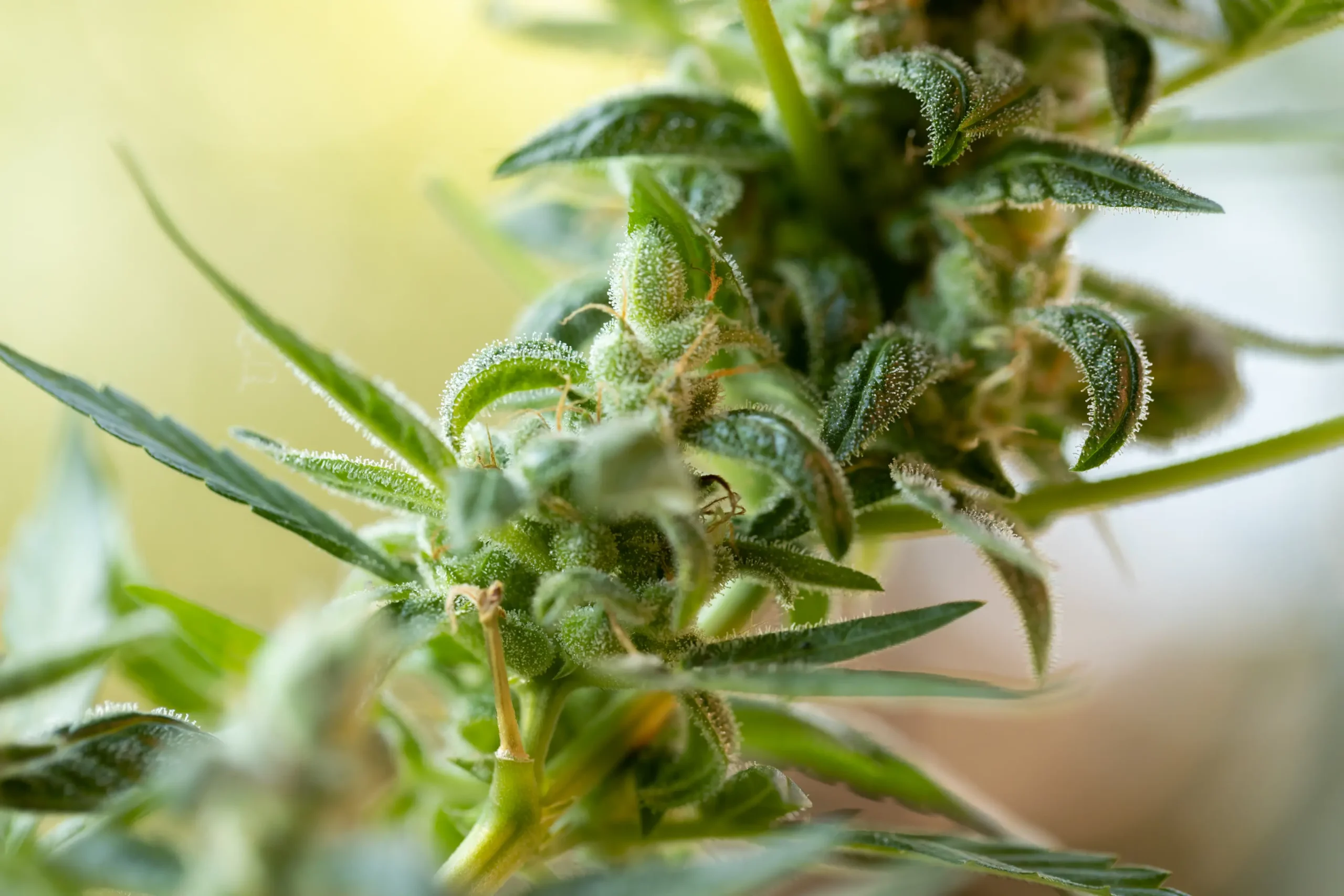
Sunset Sherbet
Sunset Sherbet is often treated as a flavor strain first and a cultivation strain second. That is a mistake. Its dessert reputation comes from a plant that can grow quickly, branch strongly, and finish with dense resinous flowers that punish an overcrowded canopy. The fruit, cream, citrus, cookie, earth, and skunk profile is easiest to preserve when the plant is kept open enough to mature evenly rather than pushed into a wall of sweet-smelling tops.
The most consistently reported lineage is GSC crossed with Pink Panties. That pairing explains the hybrid's broad sensory range: creamy cookie sweetness, berry or citrus fruit, earth, nuts, herbs, and a mild skunky base. It also explains why the plant can show both compact indica influence and noticeable transition stretch.
Grow reports do not fully agree on shape. Some describe Sunset Sherbet as a manageable bush that spreads evenly and stays within medium height. Other grow diaries warn that certain lines stretch more than expected. The practical conclusion is that Sunset Sherbet is bushy in veg but phenotype-dependent in flower stretch. The grower should leave some vertical reserve without treating it like a long sativa.
The cultivar responds well to topping and training, but the purpose is light penetration rather than maximum complexity. Strong lateral branches can become productive quickly. If every branch is retained, dense flowers and broad leaves create a humid interior at exactly the stage when resin and flavor are becoming most valuable.
Sunset Sherbet also illustrates why color should not become the target. Purple, pink, and darker anthocyanin expression can appear in genetically capable plants, but the quality standard is mature resin, smooth flavor, and preserved fruit-cream aroma. A green phenotype can be outstanding. A purple plant can still be overfed, overheated, or dried badly.
Strain Features
| Feature | Details |
|---|---|
| Strain Type | Indica-leaning dessert hybrid |
| Genetic Profile | GSC × Pink Panties |
| THC | Commonly around the high teens to low 20% range, with stronger batches possible |
| CBD | Usually very low |
| Dominant Terpenes | Beta-caryophyllene, limonene, and myrcene recur frequently |
| Flavor / Aroma | Berry, citrus, cream, sweet herbs, cookie, earth, nuts, skunk |
| Effect Character | Happy, relaxed, euphoric, creative or social early, with a warmer body finish |
| Flowering Time | Commonly about 8 to 9 weeks, though some phenotypes run longer |
| Outdoor Harvest | Often early October in suitable Northern Hemisphere climates |
| Grow Difficulty | Moderate |
| Stretch | Low-to-moderate in some lines, stronger in others; phenotype dependent |
| Plant Architecture | Fast-growing, bushy, productive laterals, broad hybrid canopy |
| Bud Density | Dense and resinous |
| Training Compatibility | Topping, LST, selective pruning, open SCROG |
| Feeding Behavior | Can grow vigorously, but heavy-feeding claims should be interpreted cautiously |
| Color Expression | Purple or darker tones are possible but not guaranteed |
| Mold Risk | Moderate when dense flowers and a full bushy canopy overlap |
| Best Time of Use | Afternoon through evening for many users |
Genetic Lineage
Sunset Sherbet is most consistently documented as GSC crossed with Pink Panties. The cultivar became influential because it combined Cookie-family density and resin with a softer fruit-cream aromatic direction.
The GSC side contributes dense flower, resin, earth, cookie sweetness, and a strong hybrid effect. Pink Panties is associated with fruitier, sweeter, and sometimes floral or berry-like notes. The child can emphasize either side.
Phenotype variation explains why one grower describes a compact bush and another reports substantial stretch. Some lines stay short and spread laterally. Others push more vertical growth during the first weeks of flower.
Color also varies. Anthocyanin-capable plants may develop purple or darker tones as they mature, especially under conditions that favor pigment visibility. Color does not verify potency, terpene content, or genetic authenticity.
Keeper selection should therefore use cured flavor, branch behavior, flower density, and effect together. The darkest plant is not automatically the best Sherbet expression, and the most compact plant may not preserve the strongest citrus-berry flavor.
Effect Breakdown
Sunset Sherbet usually begins with a positive mental shift. Mood lifts, sensory details feel more interesting, and users often report feeling creative, social, or simply comfortable.
At a moderate dose, the effect can remain balanced. The body relaxes without immediately becoming heavy, while the mind stays engaged enough for conversation, games, music, or creative activity.
The physical side becomes more obvious as the session continues. Shoulders loosen, appetite may increase, and the user becomes increasingly content to remain in one place.
Higher doses reduce functionality. Mental focus becomes softer, the body can feel warm and heavy, and the strain may move into evening or sleep territory even though the first phase felt upbeat.
Dry mouth and dry eyes are common. Anxiety or dizziness can occur with excessive THC, particularly in users who assume a sweet smooth flavor means the dose is mild.
The balanced arc is one reason Sunset Sherbet became so influential. It can feel cheerful and modern without becoming a purely energetic sativa or a one-dimensional sedating indica.
Tolerance strongly affects whether Sunset Sherbet feels daytime-friendly. A frequent user may notice uplift and creativity at a dose that makes a low-tolerance user physically heavy. The strain's balanced reputation should therefore be treated as dose dependent rather than universal.
The smooth transition from head to body is part of the cultivar's appeal. The user often notices relaxation accumulating instead of arriving as a sudden drop, which can make the effect feel more controlled than a strong nighttime indica.
Flavor & Aroma Profile
Sunset Sherbet's aroma is broad enough that different phenotypes can sound like different strains. Berry, citrus, sweet cream, cookie dough, earth, nuts, herbs, and skunk all appear regularly.
The fruit is often softer than the name suggests. Excellent flower may smell like citrus-berry cream rather than literal frozen dessert. Nutty cookie and earthy notes from the GSC side keep the sweetness from becoming candy-like.
Grinding usually releases more skunk, spice, and earth. Unbroken buds can feel sweeter and creamier, while the inner resin exposes the darker base.
On inhale, fruit and cream often lead. The mid-palate becomes earthy and herbal. The exhale can bring cookie, nuts, pepper, citrus peel, and a mild skunky finish.
The fragile notes are fruit, citrus, and cream. Earth and skunk survive rough drying more easily. A hot dry can leave a potent aromatic flower that no longer tastes like Sherbet.
A careful cure makes the layers more coherent. Green plant smell should recede, fruit should become clearer, and the cookie-earth base should feel smoother. The best Sunset Sherbet tastes colorful even when the bud itself stays green.
The nutty and cookie-like side is easy to overlook because strain descriptions focus on fruit and cream. In well-cured flower, that dry baked-earth layer can be the feature that keeps the sweetness from becoming one-dimensional.
Some phenotypes also show a more obvious skunky finish after grinding. That deeper note can be valuable because it adds contrast to the citrus and berry rather than indicating that the plant has lost its Sherbet identity.
Dominant Terpenes
| Terpene | Aroma Role | Cultivar Relevance | Scientific Caution |
|---|---|---|---|
| Beta-caryophyllene | Pepper, spice, wood | Frequently prominent and fits the peppery cookie-earth base | CB2 activity does not prove strain-specific therapeutic effects |
| Limonene | Citrus peel, bright sweetness | Supports the orange, lemon, or fruit-sherbet top notes | Does not guarantee an uplifting effect |
| Myrcene | Earth, herbs, musk | Fits the relaxed earthy background and may be stronger in heavier phenotypes | Does not independently create sedation |
| Linalool / minor floral terpenes | Floral, soft sweetness | May contribute to perfume-like notes in some colorful phenotypes | Not consistently dominant across all Sunset Sherbet samples |
Sunset Sherbet's berry, cream, and dessert perception cannot be reduced to the three most common terpenes. Minor volatiles and their ratios strongly affect whether a phenotype reads as citrus, berry, cookie, floral, or skunky.
Laboratory terpene rankings vary. Caryophyllene, limonene, and myrcene are useful recurring anchors, but cured sensory quality remains essential for phenotype selection.
Indoor vs. Outdoor Growing
| Decision Point | Indoor | Outdoor |
|---|---|---|
| Canopy Behavior | Bushy lateral growth can fill a room quickly | Broad natural branching can produce a large plant with enough space |
| Stretch | Usually manageable but phenotype dependent | Vertical variation matters less outdoors |
| Training | Topping and LST improve light penetration; open SCROG works well | Early topping and outward branch spacing are usually enough |
| Bud Density | Dense flowers reward controlled humidity | Autumn rain can create risk in packed tops |
| Color | Stable conditions reveal natural pigment without forcing stress | Cooler nights may deepen genetically supported color |
| Flavor Control | Indoor temperature and drying control strongly protect fruit and cream | Sun-grown aroma can be rich, but hot harvest weather strips top notes |
| Feeding | Vigorous growth can use substantial nutrition, but demand must be observed | Large root zones support vigor but do not justify automatic heavy feeding |
| Best Fit | Growers wanting modern dessert quality with manageable height | Warm temperate climates with a relatively dry autumn |
Sunset Sherbet is well suited to indoor cultivation because the grower can control the two factors that most affect final quality: canopy density and post-harvest temperature. The plant does not require extreme height, but it can use horizontal space rapidly.
A screen is useful when it separates strong laterals and maintains access. It becomes counterproductive when every square is filled before stretch because the final dense buds will need more space than the vegetative shoots suggest.
Outdoors, the plant can become larger and use sunlight from multiple angles. Strong outer laterals can remain productive far down the plant when they receive direct sun.
The main outdoor limitation is late moisture. Dense resinous flowers should not be kept in repeated rain simply to deepen color or add a few more days of maturity.
Strain-Specific Grow Guidance
Use the Bushy Veg Structure, but Leave Room for Flower Stretch
Sunset Sherbet often builds strong lateral growth naturally. Top a healthy plant early enough that the branches can establish, then use ties to spread the strongest leaders outward.
Do not let the stretch make the decisions
Do not completely fill the horizontal footprint in veg. Some lines stay compact, but others stretch more than expected. A partially open canopy gives both phenotypes room to finish.
Let the First Topping Reveal the Phenotype
The response to topping can show whether the plant is naturally branch-dominant or more apical. If several laterals accelerate quickly, further topping may not be necessary.
If the plant remains strongly central, one additional structural cut may help. The objective is even productive branches, not a predetermined number of tops.
Keep the Interior From Becoming a Dessert-Strain Thicket
Broad leaves, strong laterals, and dense flowers can create a closed center. Remove weak inward shoots and individual leaves that remain permanently layered or press against flower sites.
Do not use aggressive defoliation as a substitute for spacing. A plant that is simply too crowded will regrow leaves and remain crowded.
Use SCROG as a Spacing Tool
A screen can help organize Sunset Sherbet's laterals and keep the canopy even. Leave some openings so the grower can reach between tops and air can move through the flower zone.
Once flower stacking begins, reduce active tucking. The net should transition from training to support.
Feed Vigorous Growth Without Chasing Darkness
Some cultivation reports describe Sunset Sherbet as a strong feeder, especially in vegetative growth. The more defensible approach is to increase nutrition only when water use and growth justify it.
Dark glossy leaves, clawing, slow dryback, or tip burn are signs that the plant does not need more simply because the cultivar is vigorous.
Do Not Use Stress to Manufacture Purple
Purple coloration depends on genetics and pigment expression. Cooler conditions can influence anthocyanin visibility in capable plants, but severe cold or root stress is not a quality technique.
A healthy green plant with excellent resin and flavor is more successful than a damaged purple plant with weaker aroma or stalled flower development.
Keep Root-Zone Moisture Predictable
A bushy plant can transpire strongly under good light, but the root zone still needs oxygen. Chronic saturation slows growth and makes feeding problems harder to diagnose.
Adjust irrigation as the plant changes from stretch to dense flower. Water demand can shift even while the buds continue gaining weight.
Light Penetration Should Be Solved With Structure
The upper canopy can become so full that lower flowers remain shaded. More light intensity at the top does not fix a physically closed plant.
Branch spacing and selective leaf removal create side-light paths that help mid-canopy flowers finish with better density and resin.
Support Before Dense Sherbet Tops Lean Together
Sunset Sherbet can produce heavy resinous colas on strong laterals. A loose support net or soft ties can keep those branches upright late in flower.
The support system should preserve gaps between flowers. Bud-to-bud contact is a humidity problem and a trimming problem.
Watch Heat Because Flavor Is the Main Asset
A warm climate can support vigorous growth, but excessive late-flower heat works against fruit, cream, and citrus retention.
If the canopy is already mature and resinous, reducing unnecessary heat load can preserve more finished quality than forcing maximum light or temperature for marginal extra biomass.
Harvest for the Phenotype's Flavor Direction
A citrus-cream plant and a berry-cookie plant may reach their sensory peak slightly differently. Use full calyx development, mature flower trichomes, reduced fresh pistils, and the completeness of the aroma.
Very late harvest can deepen body relaxation and earthy notes while muting bright fruit. Very early harvest can preserve brightness but leave flavor green and flower density incomplete.
Plant Count Changes How Much Training Sunset Sherbet Needs
With many plants, Sunset Sherbet can be kept structurally simple because natural lateral growth will already fill the room. With fewer plants, topping and LST can spread each plant into a larger footprint.
The mistake is giving a high plant count the same long vegetative training used for a low plant count. The result is horizontal crowding before the flowering stretch has even started.
Phenotype Variation Should Be Recorded Before Color Appears
Node spacing, leaf width, branch angle, and early stretch are more useful phenotype information than late purple color. Recording these traits helps predict how the same clone should be vegged on the next run.
A plant that is easy to keep open can be a better keeper than a more colorful plant that constantly closes its own canopy.
Dense Sherbet Flowers Can Hide Uneven Maturity
The top surface of a dense bud may look fully resinous while the lower portion of the same branch remains leafier and less developed. Evaluate the entire flowering run rather than only the most photogenic tip.
If lower sections repeatedly lag, improve side light and branch spacing in the next cycle instead of simply waiting longer for the whole plant.
Do Not Force Cold Nights for Bag Appeal
A moderate natural temperature drop can reveal pigment in genetically capable plants, but deliberately pushing the room into stressful cold can slow metabolism and root activity.
Color that develops on a healthy plant is useful phenotype information. Color created at the expense of aroma, water use, or flower growth is not a quality improvement.
Late-Flower Feeding Should Protect Flavor as Much as Weight
A vigorously fed plant can remain extremely leafy late in bloom. That leaf mass may be acceptable if the canopy stays open, but excess nitrogen around dense dessert flowers can increase green flavor and drying complexity.
The goal is steady healthy flower development, not keeping the plant in peak vegetative color until harvest.
Outdoor Plants Need Space for the Bush Before They Need Support
Sunset Sherbet can broaden considerably outdoors. Early spacing between main branches gives sun and wind access to the interior, reducing the need for late aggressive pruning.
Once flowers are dense, support can be added around that open framework. A wide cage is usually better than pulling every branch inward toward one stake.
The Plant Can Be Wide Without Being Truly Productive
Sunset Sherbet's lateral vigor can create an impressive footprint in vegetative growth, but width alone does not guarantee an efficient flowering canopy. Some branches remain thin, inward-facing, or positioned beneath dominant leaves even though they occupy space.
Before the flip, identify which laterals have enough branch strength and direct light to justify becoming primary flower sites. Removing weak structural clutter early allows the remaining branches to use the same footprint more effectively.
Late Resin Production Can Make Branches Heavier Than Their Size Suggests
Sherbet flowers do not need to become enormous to create leverage. Dense calyxes and a heavy trichome coat can add surprising weight to medium-sized tops. A branch may stay upright through most of bloom and begin leaning only in the last part of the cycle.
Install support while the canopy is still easy to handle. A loose second net can preserve the spacing established during training without forcing sticky flowers together.
Aroma Should Influence Keeper Selection More Than Late Color
A purple phenotype can be visually memorable while a greener sibling carries clearer citrus, berry, or cream after cure. If the purpose is to preserve Sunset Sherbet's sensory identity, cured aroma should outrank pigment in the final decision.
Record late-flower aroma and then repeat the evaluation after drying and several weeks of storage. The phenotype that remains recognizable through every stage is more valuable than the one that peaks only on the live plant.
Weedth Bud Flavor Tips
Sunset Sherbet should be dried for fruit and cream, not simply for potency. The sweet top layer is easier to lose than earth, pepper, and skunk.
Harvest after the live plant clearly expresses its fruit, citrus, cookie, or cream direction. Curing refines mature aromatics; it does not create them from immature flower.
Dry dense buds evenly and without excess heat. Large tops can be separated into sensible branch sections if necessary so the center does not stay wet after the surface crisps.
Avoid direct fan air. Fruit-forward flowers can lose their brightest volatile notes quickly when the surface dries too fast.
During cure, expect berry or citrus to become more recognizable as green odors recede. Cookie, nut, and earth notes may become clearer without overtaking the sweetness.
Keep phenotypes separate. The grower cannot accurately decide whether a berry-heavy or cream-heavy plant is the better keeper if they are mixed during cure.
Store cool, dark, and airtight. Over-dry Sunset Sherbet can remain frosty and strong while losing much of the sensory reason to grow it.
Sherbet's creamy impression often becomes more obvious after the first stage of cure, when fresh green moisture has redistributed and the fruit no longer feels as sharp. Judge the flower after it stabilizes, not only on drying day.
A berry-heavy phenotype and a citrus-heavy phenotype can require the same grow but deserve separate post-harvest evaluation. The better keeper is the one whose identity remains distinct through storage.
Very dry buds can keep visual frost while losing the soft mouthfeel associated with well-cured dessert flower. Moisture preservation is part of flavor quality, not only storage convenience.
Weedth Bud Boost Tips
Sunset Sherbet produces its best quality yield when natural lateral vigor is organized rather than multiplied indefinitely. The plant already wants to branch.
One early topping plus branch spreading is usually enough to create several productive tops. Further cuts should solve real spacing problems rather than chase a number.
After stretch, remove weak interior shoots that remain below useful light. Strong edge laterals can produce excellent mid-canopy flower and should be kept when they have air and light.
Do not overfill the screen before flower. Moderate stretch and dense bud expansion will use more room than a flat vegetative canopy suggests.
Support major branches before the late resin push. Upright separated flowers finish more uniformly and stay easier to inspect.
Outdoors, broad spacing between branches and between plants increases usable yield by helping sunlight and air reach the interior.
Premium Sherbet yield is mature resinous flower that still tastes like fruit and cream after cure, not the most crowded canopy or darkest purple harvest.
A fuller canopy is not always a more productive Sherbet canopy. If mid-canopy flowers remain airy or leafy, the next run should reduce depth or branch count rather than increase light intensity indiscriminately.
Compare premium dry flower per plant rather than wet plant size. A compact phenotype with high resin and excellent flavor may outperform a larger leafy phenotype in actual usable quality.
If one phenotype stretches significantly more, place it where the room has more vertical reserve or flip it slightly smaller on the next cycle. Managing phenotypes individually can improve total canopy uniformity.
Veg duration should be shortened when plant count rises. Sunset Sherbet can fill horizontal space quickly, so several plants trained as if they were isolated specimens create unnecessary overlap before the stretch begins.
A practical target is to finish flower with clearly separated tops and a mid-canopy that still receives direct or strong side light. If the middle is consistently soft, reduce canopy depth on the next run rather than pushing the fixture harder.
Medical Uses & Benefits
Sunset Sherbet is commonly chosen by users seeking stress relief, mood improvement, physical relaxation, and a manageable transition from daytime activity into evening calm. These are user-reported patterns rather than clinical proof.
The early happy or creative phase may appeal to users who want relaxation without immediate sedation. The body effect can make tension feel less intrusive as the session continues.
Higher doses may become more sedating and appetite stimulating. Phenotype and THC content influence how quickly that transition occurs.
Anxiety, dizziness, dry mouth, and dry eyes can occur with excessive THC. A dessert aroma does not make the strain low potency.
Sunset Sherbet is generally THC-dominant and low in CBD, so it should not be treated as a non-intoxicating medical option.
Anyone using cannabis for a medical condition or alongside prescription medication should consult a qualified healthcare professional.
Ideal User Profile
Sunset Sherbet suits users who want modern sweet flavor but a more balanced effect than a heavy dessert indica. It can fit afternoons, social evenings, creative activity, games, music, and relaxed conversation.
Flavor preference should include berry, citrus, cream, cookie, earth, and mild skunk. People who prefer straight fuel or old-school hash may find it too soft and sweet.
Experienced users can often keep moderate doses functional. New users should start low because the smooth flavor and happy onset can encourage quick redosing.
For growers, the cultivar fits people who enjoy topping and branch organization but do not want an extreme long-flowering sativa.
It is less ideal for growers who equate maximum purple color with quality or who cannot manage dense flowers in a bushy canopy.
Grower Notes and Feedback
Grow reports agree that Sunset Sherbet responds well to topping and training. Strong laterals are one of the most useful traits for building an even indoor canopy.
Stretch reports conflict. Some lines stay compact and even, while others show enough transition movement to surprise growers. The safest interpretation is phenotype-dependent moderate stretch.
Flowering-time descriptions commonly cluster around eight to nine weeks, though individual plants can run longer. Harvest should follow maturity rather than the shortest published estimate.
Dense resinous buds are repeatedly reported. This supports treating canopy spacing and late humidity as important even though the plant is not exceptionally tall.
Flavor descriptions are broad but recognizable: citrus, berry, cream, cookie, earth, nuts, herbs, and skunk. The proportion changes strongly among phenotypes.
Color is inconsistent enough that it should never be used as a primary authenticity or quality test.
Another recurring observation is that Sherbet can look easy in vegetative growth because the plant is vigorous and attractive. The quality challenge appears later when dense buds and a bushy framework occupy the same space.
Growers who evaluate only color may miss better keepers. Aroma retention, branch efficiency, and the percentage of dense mature flower are more useful long-term selection traits.
Growers also describe the plant as capable of finishing relatively quickly for the density it produces. That speed is useful, but it can encourage premature harvest when the flowers look frosty before the fruit-and-cream aroma has fully settled.
A repeat run should compare how the phenotype changes between the live plant, drying day, and four weeks of cure. Sherbet's final identity is a post-harvest trait as much as a late-flower trait, and the plant that remains distinctive through all three stages deserves the strongest keeper consideration.
The cultivar's strong visual appeal can make growers reluctant to remove lower flower sites. Yet the frosty surface of a small shaded bud does not mean the interior reached the same density, flavor, or maturity as the top canopy.
For a repeat grow, compare trim time as well as yield. A phenotype that creates slightly less raw mass but far fewer leafy lowers may produce more premium finished flower per hour of work.
Weedth Editor's Note
Where Sunset Sherbet earns its space
I would give Sunset Sherbet less veg canopy than my eye wants. A bushy plant can make empty screen space look wasteful, but transition growth and dense flowers will use that space later.
My first topping would be early, then I would watch the branch response. If the plant already releases several strong laterals, I would stop cutting and start spacing.
I would remove only the leaves and shoots that actually close the center. A naturally open phenotype does not need aggressive defoliation just because another Sherbet plant did.
Color would be a bonus, never the goal. I would rather finish a green plant with excellent fruit-cream aroma than stress a purple-capable phenotype until the flavor becomes flat.
The keeper for me would be the plant whose cured flower still carries both a bright fruit note and a creamy cookie-earth base while remaining easy enough to keep open in late flower.
I would compare phenotypes after at least a few weeks of cure before deciding which one deserves permanent space. Dessert strains can change dramatically after the green edge disappears.
If two plants taste equally good, I would choose the one that naturally keeps more air between its branches. That structural trait improves every later step from humidity control to trimming and drying.
I would also look at how the phenotype handles storage. A beautiful berry smell that disappears after a month is less useful to me than a slightly quieter plant whose fruit and cream remain stable.
The second run would be about reducing whatever part of the canopy produced leafy or less aromatic flower. Sherbet is a cultivar where a small improvement in premium-bud percentage can matter more than a visible increase in plant size.
What I would not do is chase color with stress after the plant has already shown me a strong aromatic direction. Purple can improve presentation, but it cannot replace the layered fruit, cream and earthy cookie finish that makes a Sherbet jar convincing. My notes would therefore rank aroma retention, inner-flower cleanliness and smoke texture ahead of leaf color. A green keeper with a stable creamy finish is more valuable than a dramatic purple phenotype that dries into a generic sweet profile.
Weedth Score
Growing Experience 8.4/10 Vigorous, trainable, and manageable in height, with the main challenge being phenotype-dependent stretch and canopy density.
Bud Structure & Visual Appeal 9.0/10 Dense frosty flowers with possible purple coloration and excellent modern bag appeal.
Aroma Complexity 9.0/10 Berry, citrus, cream, cookie, earth, nuts, herbs, and skunk provide excellent range.
Flavor & Smoothness 9.0/10 One of the cultivar's strongest categories when the fruit and cream survive drying.
Effects & High Experience 8.6/10 Happy balanced hybrid effects work well from afternoon into evening.
Overall Satisfaction & Recommendation 8.8/10 A highly rewarding dessert hybrid for flavor-focused growers who can keep the bushy canopy open.
Personal closer: I would keep the Sunset Sherbet that still tastes creamy and citrus-bright after cure, even if a darker phenotype looks more dramatic in photographs.
FAQ
What is Sunset Sherbet's lineage?
The most consistently reported lineage is GSC crossed with Pink Panties.
Is Sunset Sherbet indica or sativa?
It is generally indica-leaning, but some phenotypes show enough stretch and mental brightness to feel more balanced.
How long does Sunset Sherbet flower?
About eight to nine weeks is common, though some plants need longer.
How much does Sunset Sherbet stretch?
Reports vary. Some lines stay compact while others stretch noticeably, so leave moderate reserve height.
Does Sunset Sherbet respond well to topping?
Yes. Topping often releases strong laterals and helps light penetrate the bushy canopy.
Is SCROG good for Sunset Sherbet?
Yes when the screen remains open. It is best used for spacing and later support rather than maximum fill.
Should Sunset Sherbet be heavily defoliated?
Not automatically. Remove leaves that create real shade or moisture problems and adjust to the phenotype.
Is Sunset Sherbet a heavy feeder?
Vigorous plants can use substantial nutrition, but demand should be judged from water use, growth, and leaf condition.
Why is my Sunset Sherbet not purple?
Color is phenotype dependent. Green plants can still be authentic, potent, and highly flavorful.
Is Sunset Sherbet prone to mold?
Dense flowers and a crowded bushy canopy create moderate risk under high humidity.
Does Sunset Sherbet need support?
Heavy laterals may benefit from a net or soft ties late in flower.
Why does my Sunset Sherbet smell earthy instead of fruity?
Phenotype variation is common. Early harvest, hot drying, and over-dry storage can also remove citrus and berry top notes.
When should Sunset Sherbet be harvested for flavor?
Harvest when flower trichomes are mature, calyxes are fully developed, fresh pistil production has slowed, and the phenotype's fruit-cream-cookie aroma is complete.
Can Sunset Sherbet grow outdoors?
Yes in warm temperate climates with a relatively dry autumn.
Is Sunset Sherbet good for daytime use?
Many users find moderate doses happy and functional, while higher doses become more physically relaxing.
Similar Strains
Gelato: Shares Sunset Sherbet ancestry, dense resin, creamy fruit, and balanced dessert-hybrid effects.
Girl Scout Cookies / GSC: Provides the cookie-earth-resin side with more pepper and less fruit cream.
Wedding Crasher: Combines dessert sweetness, strong laterals, and dense hybrid flower with more grape and vanilla.
Forbidden Fruit: A fruitier darker evening alternative with stronger tropical and berry character.
Rainbow Sherbet / RS11: A modern Sherbet-family relative with candy fruit and a more contemporary gas-sweet profile.
Ice Cream Cake: A heavier dessert comparison with more vanilla-cream and stronger nighttime sedation.
Share this article
A quick overview of the topics covered in this article.
Follow us
Latest articles
October 24, 2026
October 24, 2026
October 24, 2026
October 24, 2026