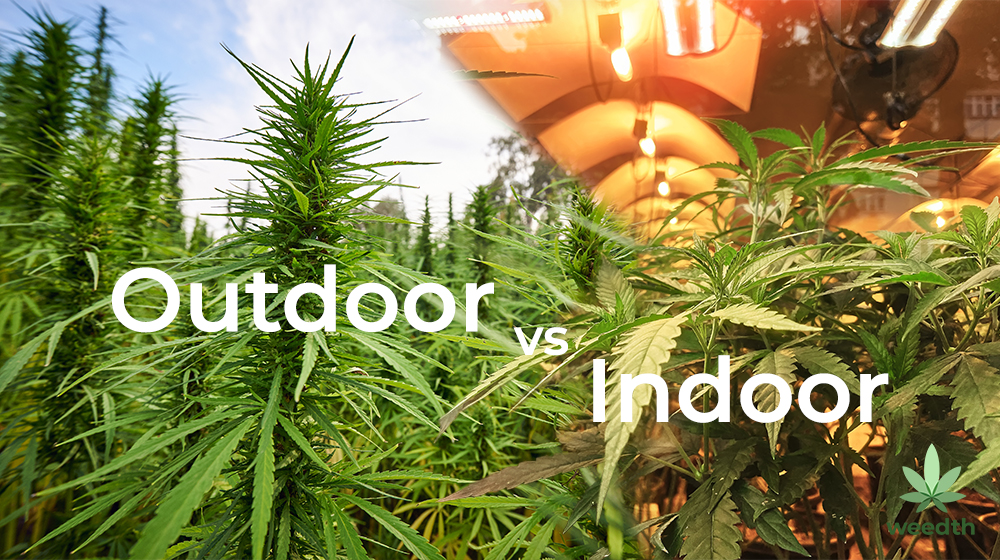
Outdoor vs Indoor Cannabis: Control, Cost, Risk, and Labor
Choosing between outdoor and indoor cannabis is not really a choice between a simple method and an advanced one. Both can be simple. Both can become complicated. The real difference is where the grower chooses to place control, cost, risk, and labor.
Outdoors, the sun supplies the light and the atmosphere supplies most of the air movement. A suitable site may provide enormous root volume and enough space for a plant to become much larger than anything that would fit comfortably in a normal grow room. The tradeoff is that weather, season, pests, wind, rain, humidity, visibility, and local site conditions are not fully under your control.
Indoors, you can set the photoperiod, choose the light intensity, move air through the canopy, dehumidify the room, and run another crop when winter arrives outside. But every layer of control has to come from equipment, electricity, monitoring, and maintenance. The room does not give you a stable environment for free. You build that stability, power it, and keep it working.
That is the decision we are going to make in this resource. We are not going to declare indoor or outdoor universally better. Instead, we will compare the two systems through the conditions that actually change a grower’s day: how much control you need, what you can spend, which risks you can tolerate, and how much labor you are willing to give the crop.
If you already know which method you want and need the complete cultivation process, use the complete outdoor cannabis growing guide or the complete indoor cannabis growing guide. This page stays focused on the decision between the two.
Resource Navigation
In This Resource
- Define the outdoor decision in terms of site, season, climate, legal access, and plant risk
- Measure the site: sun path, shade, temperature, humidity, wind, drainage, water access, cold pockets, or contamination as relevant
- Seasonal timing: latitude, photoperiod, weather windows, and cultivar behavior
- Practical setup/response plan with materials, placement, inspection points, and a backup option
- Failure modes: stagnant air, trapped moisture, heat load, frost, wind damage, water shortage, security, or neighbor impact
- Legal/safety boundary without guessing local rules or recommending dangerous traps
- Pre-season and weekly checklist that turns the article into a repeatable field procedure
Define the outdoor decision in terms of site, season, climate, legal access, and plant risk
If you are still deciding between outdoor and indoor cannabis, start by forgetting equipment for a moment. Do not begin with a tent size, a light wattage, a fabric pot, or a bag of soil. Begin with the environment you already have.
Walk outside and look at the space that is realistically available to you. Then look at the indoor space you could realistically dedicate to the crop. The word realistically matters. A perfect south-facing garden that you are not legally allowed to use is not an outdoor option. A spare bedroom that must remain a bedroom is not an indoor option. A garage that reaches dangerous temperatures in summer is not automatically a controlled environment simply because it has walls.
The first decision is therefore not, “Which method grows better cannabis?” It is, “Which environment can I actually manage well from the first week to harvest?”
Outdoor gives you natural resources, but you inherit the site
Outdoors, sunlight is the largest advantage and the largest reminder that you are not in control. You do not pay an electric bill to produce it, and you do not need to hang a fixture over every square meter of canopy. On a good site, a mature cannabis plant can receive powerful sunlight across a broad, changing spectrum for many hours per day.
At the same time, you inherit everything that comes with the site. A tree can remove afternoon light. A wall can trap heat. A low point can collect cold air. A wet autumn can arrive while dense flowers are still maturing. A dry summer can turn water access into the most important part of the grow. You can manage these things, but you cannot turn the garden into a room with a thermostat.
This is why outdoor works best when the site already does most of the difficult work for you. If the sun path is strong, the root zone drains, water is nearby, the finish window suits the cultivar, and the plant can remain lawful and reasonably secure, the grower can use surprisingly little infrastructure.
Indoor gives you control, but you have to manufacture the environment
Now step inside. An indoor grow reverses the problem.
You no longer have to accept the sun path because you create the light schedule. You do not have to wait for autumn nights to lengthen because you control the photoperiod. Rain cannot soak the flowers unless water enters the room through some other failure. Strong wind will not snap a branch. Frost is irrelevant if the building itself remains within a safe operating range.
But those advantages come from systems. Light comes from fixtures. Heat has to be removed or managed. Humidity created by plant transpiration must go somewhere. Fresh air has to enter or air must be conditioned and recirculated. Irrigation runoff has to be handled. Odor may need filtration. Every fan, controller, pump, light, air conditioner, heater, and dehumidifier adds another point that can fail.
Controlled environment
A controlled environment does not mean a perfectly stable room. It means the grower has practical mechanisms for changing variables such as light, temperature, humidity, air movement, irrigation, and photoperiod. The more variables you choose to control, the more equipment, monitoring, energy, and maintenance the system usually requires.
Control is not free, and exposure is not automatically cheap
This is the first tradeoff to understand clearly.
Indoor cultivation usually carries higher initial and recurring costs because environmental control consumes equipment and energy. Recent life-cycle research continues to identify lighting, HVAC, heating, cooling, and dehumidification as major contributors to indoor cannabis energy demand. Outdoor production avoids most of those direct energy loads, which is why its energy and carbon footprint can be dramatically lower under suitable conditions.
That does not mean every outdoor grow costs almost nothing. Poor native soil may push you toward large quantities of growing medium. Remote water access may require tanks, pumps, irrigation lines, or transport. Wildlife pressure may justify fencing. Severe wind may require structural support. A wet climate may make a simple shelter or greenhouse-like protection attractive.
The difference is that outdoor spending tends to be site-specific. Indoor spending tends to be system-specific. The indoor environment must work whether the day outside is perfect or terrible.
Compare the environments you can actually operate
Compare your real garden, balcony, yard, room, tent, garage, or other lawful space. Include the actual climate, electricity, water access, privacy, and time you have available.
Comparing idealized versions of indoor and outdoor
A perfect outdoor farm and a perfect climate-controlled room are not useful comparisons if neither resembles the space you will really grow in.
The four questions that usually decide it
Most growers can narrow the choice by answering four questions honestly.
How much environmental control do you need? If your climate is poorly matched to the cultivar, your outdoor site is heavily shaded, or you need year-round scheduling, indoor gains value quickly.
How much recurring cost can you accept? If electricity, cooling, dehumidification, or heating would place the grow under financial pressure, a suitable outdoor site may be much more forgiving.
Which risks bother you more? Outdoor risk is often weather and exposure. Indoor risk is often equipment dependence, electrical load, heat, humidity accumulation, and human error.
Where do you want to spend your labor? Outdoor asks you to scout and respond to changing natural conditions. Indoor asks you to operate and maintain the system that creates the conditions.
I have a sunny backyard, but I like the idea of having full control indoors. Is control alone a good reason to move inside?
Question sent by: Ethan Brooks, via email.
It can be, but first ask what problem you are trying to control. If the backyard has strong light, reliable water, a suitable finish window, and manageable privacy, moving indoors means paying to replace several resources the site already gives you. Indoor makes more sense when the added control solves a real limitation, such as a short season, unreliable autumn weather, severe visibility concerns, or the need for repeatable year-round cycles.
A simple first comparison
| Aspect | Indoor Grow | Outdoor Grow |
|---|---|---|
| Light | Grower controls intensity, duration, spectrum choice, placement, and schedule within equipment limits. | Sunlight is free and powerful, but duration, angle, clouds, shade, and seasonal change are outside direct control. |
| Temperature and humidity | Can be actively managed with ventilation, HVAC, heating, dehumidification, and controls. | Determined mainly by regional weather and local microclimate; management is partial rather than complete. |
| Season | Year-round production is possible if the room and power system can support it. | Production is tied to climate, latitude, frost, day length, and the cultivar’s finishing behavior. |
| Upfront cost | Usually higher because light and environmental-control equipment must be installed. | Can be very low on a good site, but poor sites may require containers, soil, fencing, irrigation, or protection. |
| Recurring cost | Electricity and equipment operation can remain substantial throughout every crop. | Usually lower direct energy cost; water, amendments, pest management, and site maintenance become more important. |
| Main risk | System failure, electrical problems, heat accumulation, humidity, irrigation errors, pests introduced into a closed space. | Weather, wildlife, pests, disease pressure, theft, visibility, drought, wind, rain, frost, and seasonal mismatch. |
| Labor pattern | Frequent monitoring plus equipment cleaning, adjustment, environmental management, and crop work. | Frequent scouting plus irrigation, weather preparation, support, pest checks, and larger seasonal harvest work. |
| Plant size | Constrained by room height, light footprint, container size, plant density, and ventilation capacity. | Potentially very large when root space, sun, season, water, and law allow it. |
| Consistency | Potentially high when the room is stable and procedures are repeatable. | More dependent on year-to-year weather and site conditions. |
That table gives us the direction. The rest of the article is about finding out which side of those tradeoffs matters most in your situation.
Measure the site: sun path, shade, temperature, humidity, wind, drainage, water access, cold pockets, or contamination as relevant
Outdoor versus indoor becomes much easier to decide once you measure both spaces instead of describing them with words like “good,” “bright,” “cool,” or “private.”
Let us measure the outdoor site first, then translate each question into its indoor equivalent.
Measure outdoor light as a path, not a single moment
A backyard can look excellent at noon and still lose several useful hours of direct sunlight because of a building, fence, or tree. The easiest check is to return to the proposed plant position several times through a clear day and record when direct sunlight actually reaches the future canopy.
You do not need a laboratory-grade solar instrument to make the first decision. A simple time log will tell you whether the site is genuinely open or merely bright.
If the location receives strong direct light for a long part of the usable day, outdoor earns a major advantage. If it spends much of the day in shade and there is no better lawful location, indoor begins to look less like an expensive luxury and more like a way to solve a fundamental light limitation.
Field Advice: Compare the outdoor site with the indoor light footprint, not with the sun in general. The question is not whether sunlight is stronger than a grow light. The question is whether your actual plant position receives enough usable sunlight for enough of the season.
Indoor light is measurable in a different way
Inside, the sun path disappears, but you inherit another job: distributing artificial light across the canopy.
Here the useful measurements become fixture coverage, hanging distance, canopy-level light intensity, photoperiod, and daily light integral. Indoor cannabis research has repeatedly shown that light level can strongly affect photosynthesis and inflorescence yield. More light is not automatically better forever, but indoor gives the grower something outdoor cannot provide easily: the ability to change the light environment deliberately and repeat it.
That repeatability is valuable for a grower who wants several crops to behave similarly. It is less valuable if the extra equipment cost is solving a problem you do not actually have outdoors.
Temperature: weather exposure versus heat removal
Outdoors, measure the temperature where the plant will live rather than trusting only the regional forecast. A wall, paved surface, enclosed garden, slope, or low hollow can create a microclimate several degrees different from the surrounding area.
Indoor temperature appears more controllable, and it is, but indoor growers often underestimate how much heat their own equipment creates. Lighting energy eventually becomes heat in the room. Fans, pumps, dehumidifiers, and other devices contribute additional heat. In warm weather, an indoor room may need active cooling simply to remove the heat created by producing the crop.
This leads to a useful rule: outdoor growers ask whether the climate will become too hot; indoor growers ask whether the room can remove the heat the system creates.
Humidity: outdoor weather versus indoor transpiration
Humidity tells a similar story.
Outdoors, rain, dew, fog, local vegetation, air movement, and regional weather determine how quickly leaves and flowers dry. Cornell field guidance for hemp emphasizes the connection between prolonged leaf wetness, humidity, rainfall, standing water, and disease progression. You cannot set outdoor relative humidity to a target, but you can choose spacing, site exposure, canopy access, and other practices that help moisture leave the plant.
Indoors, the problem is more mechanical. Plants transpire water into a finite volume of air. That moisture has to be exhausted, condensed, or otherwise removed. The more leaf area and irrigation the room supports, the more water eventually enters the air.
So indoor control does not remove the humidity problem. It gives you equipment that can fight it.
An indoor room is only as controlled as the equipment can handle
A thermostat set to a desired temperature does not guarantee that temperature if the cooling system is undersized. The same is true of humidity. A dehumidifier that cannot keep up with plant transpiration does not create a controlled environment just because it is switched on.
Wind outdoors becomes airflow engineering indoors
Outdoor wind is variable. A light breeze can help surfaces dry. A storm can break branches or uproot poorly anchored plants.
Indoors, there is no natural wind unless you create air movement with fans and ventilation. That sounds easier because the fans are predictable, but the canopy changes as plants grow. A fan that moves air well across small vegetative plants may leave stagnant pockets inside a dense flowering canopy later.
Outdoor growers therefore watch prevailing wind, storm exposure, and shelter. Indoor growers watch air pathways, fan placement, dead zones, exhaust capacity, and whether dense foliage is actually moving air through the crop.
Drainage and water access can decide the method before anything else
A strong outdoor site still needs a root zone that drains and a water source that remains practical through dry weather. If native soil stays saturated after rain, or if the plant would depend on carrying water a long distance during summer, outdoor labor can become much greater than expected.
Indoors, water access is usually physically close, but drainage can become the awkward part. Where does runoff go? Can a tray overflow? Is water being carried through living space? Are electrical connections protected from irrigation and spills?
For a few containers, hand management may be easy. As plant count or irrigation frequency increases, the room begins to need a real water-handling plan rather than a collection of saucers.
Cold pockets have an indoor equivalent: building conditions
Outdoors, cold air can collect in low areas and create frost pockets. A slightly elevated site may stay safer on the same night.
Indoors, the building itself becomes the climate boundary. An unheated garage, attic, basement, shed, or poorly insulated room may experience large seasonal swings. In winter you may pay to heat it. In summer you may pay to cool it. Condensation can appear on cold surfaces. A room that looks suitable in spring may become expensive in a different season.
Measure the room before plants go in, especially if the space is not part of the home’s normal conditioned area.
Contamination and cleanliness take different forms
Outdoor native soil deserves caution when the site’s history is unknown. Cannabis has been studied for its ability to take up certain metals from contaminated soils, so vigorous growth is not proof that the site is suitable for consumable flower.
Indoor growing separates the root zone from native soil, but the room still has contamination risks. Old building dust, mold, pests, dirty intake air, pet hair, standing water, pesticide residues, and poorly cleaned equipment can all enter the crop environment.
Neither method is automatically clean. The contamination source simply changes.
Measure labor distance, not only physical distance
This is one of the most useful measurements and one of the least discussed.
How far is the grow from the place you spend most of your day?
A backyard plant may be thirty seconds away. A rural outdoor site may take an hour to reach. An indoor tent may be in the next room. A basement grow may require carrying water down stairs every day.
Distance changes whether you notice a problem early. It changes how annoying each irrigation becomes. It changes whether a forecasted storm can be prepared for quickly. It changes how much labor a supposedly simple system really demands.
My outdoor site is good, but it is about forty minutes away. Does that make indoor easier even if my home setup costs more?
Question sent by: Madison Clarke, via contact form.
Possibly. Count the travel as part of labor. A remote site that needs two visits during hot weather can consume more time than a nearby indoor room, even though the outdoor system uses less equipment. Also think about emergency response. If a storm, irrigation failure, or animal problem develops, how quickly can you physically inspect the plants? Convenience is not a small factor when repeated for an entire season.
A measurement sheet for both options
| What to Measure | How to Compare Outdoor and Indoor |
|---|---|
| Usable light | Outdoor: record direct sun through the day and seasonal shade. Indoor: map fixture coverage, canopy intensity, photoperiod, and whether the electrical system can support the target light load. |
| Temperature | Outdoor: log local highs, lows, and heat-reflective microclimates. Indoor: measure the empty room and then calculate whether lighting and climate equipment can maintain conditions when operating together. |
| Humidity and drying | Outdoor: observe dew, rain, airflow, and drying time. Indoor: estimate transpiration load and verify ventilation or dehumidification capacity. |
| Water | Outdoor: test source reliability, distance, pressure, and drought backup. Indoor: confirm source quality, irrigation workflow, runoff collection, spill protection, and drainage. |
| Root zone | Outdoor: test native soil, drainage, contamination history, or container feasibility. Indoor: choose a medium and container system that can be irrigated and drained consistently. |
| Access | Outdoor: consider travel, weather access, security, and inspection frequency. Indoor: consider stairs, carrying water, working clearance, maintenance access, and how equipment can be serviced. |
| Power | Outdoor: often minimal unless pumps or security systems are used. Indoor: confirm electrical capacity, circuit safety, continuous load, backup planning, and climate-control demand. |
Once you have these observations, the indoor-versus-outdoor argument becomes much less abstract. You are comparing two operating systems with real constraints.
Seasonal timing: latitude, photoperiod, weather windows, and cultivar behavior
Seasonal timing may be the single biggest reason a grower chooses indoor over outdoor even when a garden is available.
Outdoors, the calendar is shared with the climate. Indoors, you create much of the calendar yourself.
Outdoor cannabis must finish inside a real weather window
Photoperiod-sensitive cannabis responds to changing day length and uninterrupted darkness, but cultivars do not all share exactly the same critical photoperiod. Research has shown meaningful cultivar differences, which helps explain why two plants grown side by side can begin flowering at different times.
This matters because the real outdoor question is not simply when flowering begins. It is whether the plant can finish while weather remains suitable.
A long-season cultivar in a climate with wet, cold autumns may enter flowering beautifully and still become difficult to finish. Dense flowers that mature during repeated rain and high humidity face a very different disease environment from flowers finishing under warm, dry conditions.
Outdoor planning therefore works best backward. Find the part of the season when your local climate usually becomes risky, then ask whether the cultivar has enough time to mature before that window closes.
Indoor growing turns season into scheduling
Indoors, you can run vegetative and flowering schedules without waiting for seasonal day length. A common indoor production practice is to use a long-day vegetative photoperiod and then shorten the light period to trigger flowering in photoperiod-sensitive cultivars.
This creates a major operational advantage: you can plan crop turnover around room availability instead of latitude.
Recent controlled-environment research also shows why indoor photoperiod should not be treated as a rigid biological law. Some cultivars can flower strongly under daily light periods longer than the traditional 12-hour flowering schedule, and studies have reported increased inflorescence yield under slightly longer photoperiods in particular cultivars. The practical lesson is not that every grower should abandon 12/12. It is that indoor gives you the ability to test and standardize a light schedule that outdoor growers cannot impose on the sun.
Year-round production is an indoor advantage, but only if the room works year-round
It is easy to say that indoor growing allows multiple harvests per year. That is true in principle. But the room has to survive all four seasons too.
A winter crop may need more heating. A summer crop may demand much more cooling. In a humid climate, dehumidification can become a major energy load. In a cold climate, heating may dominate instead. Large reviews of controlled-environment agriculture show just how strongly climate can change the energy breakdown of indoor production.
So before you count annual indoor harvests, ask whether your climate-control costs remain acceptable in the most difficult season.
Remember: Indoor removes the crop from the outdoor season, but it does not remove the building from the outdoor climate. The room still exchanges heat and moisture with the structure around it.
Outdoor has fewer crop cycles but may support much larger individual plants
Outdoor growers often trade crop frequency for plant scale.
A long vegetative season, abundant root space, and unrestricted headroom can support very large plants where law, water, genetics, and climate allow it. A normal indoor room has a ceiling, a fixed light footprint, a fixed ventilation capacity, and a limited area.
That does not guarantee outdoor will produce more usable flower per square meter, per year, or per hour of labor. It simply means the plant has fewer architectural limits.
This distinction matters when comparing yield claims. “Yield per plant” can make outdoor look overwhelming because one plant may become enormous. “Yield per square meter per year” can favor systems with multiple indoor cycles. “Yield per kilowatt-hour” tells a different story again. Always ask which denominator is being used.
Cultivar behavior matters more outdoors because you cannot reset the weather
Indoor growers can adapt a room to many cultivars by changing plant density, vegetative duration, training, light distribution, and flowering schedule. The room still has limits, but the grower has several levers.
Outdoor growers should place more weight on whether the cultivar matches the season. A cultivar that reliably finishes before cold rain can be more valuable than a theoretically higher-yielding cultivar that repeatedly reaches peak flower density after the climate has deteriorated.
If you live where autumn is short and wet, flowering time is not a catalog detail. It is part of risk management.
Is indoor automatically better in a northern climate because the outdoor season is shorter?
Question sent by: SoilAndSun, via email.
No. A northern climate can still support excellent outdoor cultivation when genetics and finish timing match the season. Indoor becomes more attractive when you want cultivars that consistently finish too late outside, when autumn disease pressure is high, or when you want repeatable crops through winter. The decision should follow your real finish window, not latitude alone.
Photoperiod control also creates a labor responsibility
Indoors, the light schedule is only useful if it remains reliable. Timers, controllers, power supply, and light-proofing have to work. A room that unintentionally receives light during the dark period can create plant responses the grower did not intend.
Outdoors, you do not program sunset, but artificial nighttime lighting can still matter. Security lights, windows, street lighting, or patio lights may reach the canopy. Whether they are strong enough to alter flowering depends on intensity, duration, cultivar response, and distance, but the issue is worth noticing.
Both systems therefore involve photoperiod management. Indoors you create the cycle. Outdoors you make sure your site is compatible with the natural one.
Seasonal labor comes in different shapes
Outdoor labor tends to rise and fall with the season. Early setup may be moderate. Vegetative maintenance may be manageable. Then irrigation demand climbs, support work increases, flowering inspections become more important, and harvest can arrive as one large labor event.
Indoor labor is often more continuous. The crop is always inside a machine-like environment that needs checking. Filters clog. reservoirs need cleaning. irrigation equipment needs inspection. environmental sensors drift. plants need training. harvest may happen more often because crop cycles repeat.
Neither method is “low labor” by default. They distribute labor differently.
Practical setup/response plan with materials, placement, inspection points, and a backup option
Now we can build the comparison around what you would actually need to operate each system.
The most useful way to do this is to separate required systems from optional upgrades. Indoor growing becomes expensive quickly when every possible device is treated as mandatory. Outdoor becomes unnecessarily complicated when every site risk is solved with infrastructure before you know whether the risk exists.
The minimum outdoor system
A lawful outdoor site with good sunlight, suitable soil or containers, dependable water, basic support, and regular inspection can be enough.
You may add fencing if wildlife, access, or local rules justify it. You may add irrigation if hand watering becomes too labor intensive. You may add rain protection in a wet climate. You may use shade during exceptional heat. But these are responses to specific site problems.
Outdoor can therefore begin with a relatively small equipment footprint when nature is already supplying what the plant needs.
The minimum indoor system
Indoor has a longer list because the room has to replace the functions the outdoor environment normally provides.
You need an appropriate enclosed or dedicated space, a suitable grow light, safe electrical supply, air movement, ventilation or climate management, a root-zone system, water, drainage, environmental monitoring, and a plan for humidity and odor where relevant.
That does not mean you need the most expensive version of each component. It means every component must be adequate for the load placed on it.
| System | Indoor Grow | Outdoor Grow |
|---|---|---|
| Primary light | Artificial grow lighting sized to canopy area and production target. | Direct sunlight at a site with a useful daily and seasonal sun path. |
| Air movement | Circulation fans plus ventilation or HVAC strategy. | Natural airflow, spacing, pruning access, and shelter only where exposure is excessive. |
| Humidity control | Ventilation and often active dehumidification as plant mass increases. | Site selection, spacing, canopy access, drainage, weather awareness, and sometimes rain protection. |
| Temperature control | Heating and/or cooling capacity depending on room and climate. | Mainly site choice, irrigation timing, shade or shelter during extremes, and cultivar/season matching. |
| Root zone | Containers, beds, coco, soil, hydroponic or other controlled media/system. | Native ground, raised beds, or containers depending on drainage and contamination risk. |
| Water handling | Source, irrigation, runoff collection, spill protection, and drainage. | Source reliability, hose or irrigation reach, drought backup, and runoff/erosion awareness. |
| Support | Training and trellis systems designed around room geometry and light footprint. | Stakes, cages, trellis, or structural support designed around wind and potentially large plants. |
| Monitoring | Temperature, humidity, light, timers, irrigation, electrical and equipment status. | Weather forecast, temperature, root-zone moisture, wind, rainfall, pest and disease scouting. |
Indoor cost: think CapEx and OpEx separately
Indoor cost makes much more sense when you separate initial investment from recurring operation.
CapEx and OpEx
CapEx is the equipment and infrastructure you purchase to build the system, such as lights, tents, fans, climate equipment, electrical work, irrigation hardware, and controllers. OpEx is the cost of operating it, including electricity, water, nutrients, replacement filters, media, maintenance, and other recurring inputs.
Indoor growers often focus on the purchase price of the light because it is visible. The harder cost can be what happens every month after the light is turned on. Electricity does not stop at the fixture. Heat from lighting may increase cooling demand. Transpiration may increase dehumidification demand. Additional fans and pumps contribute their own consumption.
This is one reason published environmental analyses repeatedly find indoor cannabis to be energy intensive compared with outdoor cultivation. The exact cost to the grower depends on local electricity rates, climate, building efficiency, equipment efficiency, and how aggressively the environment is controlled.
Do not copy somebody else’s monthly electricity bill and treat it as your forecast. Calculate your own connected loads and expected operating hours.
Outdoor cost: ask what the site fails to provide
Outdoor cost is often easier to understand by starting at zero and adding only what the site lacks.
Does the native soil work? If yes, you may avoid buying large volumes of medium. Does the garden have water nearby? If yes, you may not need tanks or pumps. Is wildlife pressure low? You may not need fencing. Does the site get destructive wind? If not, a simple support system may be enough.
This is why two outdoor grows can have completely different budgets. One grower may use prepared ground, a hose, stakes, and basic nutrition. Another may need imported soil, irrigation infrastructure, a fence, rain protection, and a large water-storage system.
Outdoor is cheaper when the site is already doing the expensive jobs.
Labor should be counted in hours, not feelings
It is easy to describe outdoor as relaxed and indoor as technical. That language hides the hours.
For two weeks, record how much time each task actually requires in your planned system. Include travel. Include filling water. Include mixing nutrients. Include cleaning. Include weather preparation. Include plant training. Include equipment checks.
Cannabis production is labor intensive in commercial research as well. Recent greenhouse economic work from New York found labor to be one of the largest variable cost categories, and earlier economic work has also identified cultivation and post-harvest labor as major expenses. Those commercial numbers should not be copied directly into a home grow budget, but they reinforce an important point: labor is a real input even when no money changes hands.
Pro Tip: If you are choosing a method because it seems easier, write down the weekly tasks before you commit. “Easy” often means “the work happens in a form I personally do not mind.”
Placement matters more than equipment count
A poorly placed outdoor plant can lose light, trap humidity, or become difficult to reach. A poorly arranged indoor room can have dead airflow zones, inaccessible equipment, unsafe cords, and containers you cannot remove without moving half the garden.
In either system, leave enough space to inspect the back of the canopy, the lower stems, the root-zone surface, and the equipment that can fail.
If you cannot reach something, you will inspect it less often. That is how small maintenance problems become plant problems.
Build a backup around the most expensive failure
For outdoor, the backup might be water storage, storm support, a movable container position, temporary frost protection, or a plan for a severe rain event.
For indoor, the backup might be an alarm, spare circulation fan, safe response to a failed exhaust system, overflow protection, backup irrigation parts, or a clear plan for a power outage.
You do not need to duplicate every piece of equipment. Start with the failure that could damage the crop fastest.
Indoor control can disappear very quickly during a power or equipment failure
Lighting, ventilation, circulation, cooling, dehumidification, irrigation, and monitoring may all depend on electricity. A highly controlled room can become unstable faster than an outdoor garden when several systems stop together. Build the response around your room’s real heat and humidity load rather than assuming plants can simply wait.
The practical decision: which system can you keep boring?
The best cultivation system is often the one that becomes boring in a good way.
Watering is predictable. Temperatures do not surprise you every afternoon. The root zone behaves consistently. You can inspect the plant without rearranging the entire setup. When a problem appears, you have enough information to identify it rather than guessing.
If your outdoor site can become that predictable with very little infrastructure, outdoor has a strong case. If the outdoor site remains a weekly battle with weather, shade, security, and a short finish window, indoor control may be worth paying for.
Failure modes: stagnant air, trapped moisture, heat load, frost, wind damage, water shortage, security, or neighbor impact
One of the best ways to compare indoor and outdoor cannabis is to ask how each system fails.
Indoor does not eliminate risk. Outdoor does not mean constant danger. They simply fail in different directions.
Stagnant air: natural site problem versus mechanical design problem
Outdoors, stagnant air usually appears because the site is enclosed, vegetation is crowded, a solid fence blocks movement, or the plant becomes so dense that moisture remains trapped inside the canopy.
Indoors, stagnant air appears because air circulation is underdesigned or because the canopy grew beyond the pattern the fans were originally arranged for.
The symptoms can look similar: damp interior foliage, slow drying, localized disease pressure, and uneven leaf movement.
The response differs. Outdoors, you often improve spacing, access, or site airflow. Indoors, you may change fan placement, exhaust strategy, canopy density, or climate equipment.
Trapped moisture: rain outside, transpiration inside
Outdoor moisture can arrive in one storm. Indoor moisture arrives gradually from the plants themselves.
A large indoor canopy can transpire a surprising amount of water into the room. If the dehumidification and ventilation strategy was designed around small vegetative plants, flowering can expose that weakness.
Outdoors, repeated dew and rain may keep flowers wet even if irrigation is perfect. Cornell field guidance for hemp specifically emphasizes reducing leaf wetness and monitoring humidity and rainfall because these conditions strongly influence disease progression.
In both systems, the lesson is the same: measure drying behavior where the flowers actually are, not only the humidity number at one convenient sensor.
Heat load: weather versus equipment
Outdoors, heat risk often comes from regional heat, radiant surfaces, low wind, hot containers, and insufficient water availability.
Indoors, heat is partly self-generated. Even efficient lights add heat to the room. Cooling equipment may then consume additional energy to remove it. In some climates and facility types, dehumidification or cooling can become a major share of total energy demand.
This is an important cost-risk connection. The more aggressively you control temperature, the more dependent you become on the equipment that maintains it.
Frost is mainly outdoor; cold-room failure is the indoor version
Frost can damage outdoor cannabis, especially when tender tissues or unfinished flowers encounter sufficiently cold conditions. Site elevation, cold-air drainage, cultivar timing, and seasonal planning matter.
Indoor plants do not experience frost from a normal weather event, but a poorly insulated outbuilding can still become too cold if heating fails. The practical difference is that indoor cold is usually a building or equipment problem rather than a natural crop-season boundary.
Wind damage is outdoor; fan damage and mechanical stress are indoor
Outdoor plants can experience branch breakage, lodging, root-ball movement, or complete structural failure during strong wind.
Indoor fans rarely reproduce storm force, but badly positioned airflow can still stress foliage, dry one side of the canopy faster, or create uneven transpiration. Trellis and branch support are also important indoors because dense flowers can become heavy even without wind.
Outdoor support is built for weather. Indoor support is built mainly for architecture and flower weight.
Water shortage versus irrigation failure
Outdoor water risk often becomes a supply problem. A drought arrives, rain disappears, the plant becomes large, and a once-convenient watering routine is no longer enough.
Indoor water risk is frequently a delivery problem. The water exists, but a pump fails, an emitter clogs, a reservoir empties, a timer is wrong, runoff floods a tray, or the grower waters the wrong volume for the medium.
In both cases, the root zone only knows that the water balance has changed.
Security and privacy reverse in interesting ways
Outdoor plants may become visible as they grow, and aroma can travel beyond the property. Theft, unauthorized access, wildlife, children, pets, and neighbors may all influence site design.
Indoor offers greater visual privacy, but it may create other signals: odor exhaust, equipment noise, bright light leaks, electrical use, or frequent ventilation. Privacy is not automatically solved by moving inside. It is managed differently.
I mainly care about privacy. Does that make indoor the obvious choice?
Question sent by: Emma, via X.
Indoor usually gives you more visual separation, but look at the whole setup. Odor management, fan noise, light leaks, electrical safety, and who has access to the building still matter. If your outdoor garden is lawful, private, and naturally screened without trapping humidity, it may already solve the visibility issue with far less infrastructure.
Neighbor impact exists in both systems
Outdoor neighbor impact is obvious: visibility, odor, water runoff, fencing, and property boundaries.
Indoor neighbor impact can include exhaust odor, fan or compressor noise, window light, structural modifications, and the consequences of unsafe electrical work or water leaks in shared buildings.
If you live in an apartment, duplex, or other shared structure, this may become one of the strongest arguments against a large indoor system even when the plants themselves are hidden.
Pests: exposure outside, introduction inside
Outdoor plants are part of an ecosystem. Insects, birds, mammals, fungi, and other organisms are already present. Regular scouting is part of the job.
Indoor growers sometimes assume pests are no longer relevant. They are. The difference is that pests have to be introduced through plants, media, clothing, tools, intake air, or other pathways. Once established in a warm room with no winter and few natural enemies, some pests can reproduce rapidly.
Indoor therefore rewards sanitation and quarantine. Outdoor rewards identification, monitoring, physical prevention, and an integrated pest management approach that accepts that finding an insect is not the same as losing the crop.
Equipment failure is an indoor risk category of its own
Outdoor systems can use equipment, but many basic outdoor grows can continue photosynthesizing and exchanging air even if a pump or controller fails. The sun still rises. Wind still moves. The atmosphere does not shut down because a breaker trips.
Indoor is different. A single electrical failure can affect several environmental systems at once. This is why control and risk are connected. The more functions the grower mechanizes, the more important monitoring and backup procedures become.
Do not treat electrical capacity as a grow-equipment specification
High-power lighting, HVAC, heaters, dehumidifiers, pumps, and fans can create substantial continuous electrical loads. Safe circuit design, suitable equipment, moisture protection, and applicable electrical codes matter more than fitting one more device onto a power strip.
Weather failure is an outdoor risk category of its own
Outdoor plants can be healthy and well managed and still meet hail, smoke, flooding, severe wind, heatwaves, unexpected frost, or several days of cold rain.
This is why good outdoor growing is not a promise that nature will cooperate. It is the practice of choosing a site and cultivar that reduce the probability of catastrophic mismatch and preparing for the events that are normal enough to expect.
Quality risk: consistency versus expression
Indoor cultivation is often chosen for consistency. If the same genetics are grown under repeatable light, temperature, humidity, irrigation, and harvest procedures, the grower has a better chance of reproducing similar conditions from crop to crop.
Outdoor conditions vary more. Sunlight, temperature swings, soil biology, water, wind, and seasonal progression may create a crop that is less uniform between years.
But consistency is not the same thing as maximum quality. Flower quality still depends on genetics, plant health, light availability, nutrition, disease pressure, harvest timing, drying, curing, and storage. Controlled conditions can support quality. They do not guarantee it.
Likewise, sunlight and outdoor scale can support exceptional flower. They do not guarantee that either.
Weedth Grower Note: Do not award quality to the address. Judge the flower. Indoor gives the grower more levers for consistency. Outdoor gives the plant more natural light and often more physical space. The final result still depends on how well the entire crop was managed.
Risk comparison matrix
| Risk | Indoor Grow | Outdoor Grow |
|---|---|---|
| Power failure | Potentially severe because light, airflow, climate control, irrigation, and monitoring may fail together. | Usually limited unless irrigation pumps, greenhouse systems, or security depend on power. |
| Heat | Can build rapidly from lighting and equipment if cooling or ventilation fails. | Driven by weather and microclimate; containers and reflective surfaces can intensify stress. |
| Humidity | Generated by transpiration inside a finite room and must be removed. | Driven by weather, dew, rainfall, drainage, canopy density, and local airflow. |
| Pests | Lower exposure but outbreaks can accelerate in a stable enclosed environment once introduced. | Higher ecosystem exposure; requires routine scouting and proportionate IPM. |
| Weather | Mostly transferred into building heating/cooling demand. | Direct crop exposure to wind, rain, hail, frost, drought, heat, and smoke. |
| Security | Greater concealment but building access, odor, sound, and electrical safety remain concerns. | Visibility, theft, wildlife, children, pets, fencing, and neighbor impact may need active planning. |
| System complexity | Higher. More control usually means more interacting components. | Can remain low on a good site, though irrigation and protective infrastructure can increase complexity. |
Legal/safety boundary without guessing local rules or recommending dangerous traps
The indoor-versus-outdoor decision is sometimes made by law before horticulture gets a vote.
Cannabis cultivation rules differ between countries and can also differ between states, provinces, territories, municipalities, rental agreements, shared buildings, and other property arrangements. Some places permit home cultivation but restrict visibility. Others impose locked-area requirements. Some prohibit cultivation entirely.
A global resource should not guess which rule applies to you.
Check whether the law treats indoor and outdoor differently
If home cultivation is lawful where you live, verify whether the rules distinguish between indoor and outdoor plants. Look for current official information about plant count, visibility, locked access, age, possession after harvest, structures, odors, shared spaces, and property permission.
Do this before building the setup.
A beautiful outdoor site is irrelevant if local rules prohibit using it. A technically perfect indoor room is not valid if the building, tenancy, or local law does not allow cultivation there.
Property permission remains separate from cannabis law
Do not assume legal home cultivation means any available space can be used.
Rental agreements, shared yards, balconies, homeowners’ associations, building rules, insurance conditions, fire codes, and electrical rules may still apply.
Grow only where you have the legal right and permission to use the space.
Indoor safety centers on electricity, heat, water, and air quality
Indoor cultivation combines electrical equipment with irrigation and elevated humidity. That combination deserves conservative design.
Use equipment rated for the environment and do not overload circuits. Keep water away from electrical connections. Do not route irrigation where leaks can reach power strips. Make sure high-heat equipment has adequate clearance. Keep exits and access paths open.
If electrical work beyond normal plug-in equipment is required, use qualified help and follow the standards that apply where you live.
Outdoor safety centers on access, weather, structures, and water
Outdoor growers should think about fencing, gates, stakes, trellises, temporary shelters, irrigation lines, slippery surfaces, tools, chemicals, and who can enter the growing area.
Do not create traps or dangerous barriers for security. Do not use concealed wires, improvised electrification, sharp hidden objects, or devices intended to injure someone or an animal.
Ordinary lawful property security is the right direction.
Design for safe failure
Use appropriate circuits, water containment, stable supports, lawful fencing, equipment alarms, and clear access so a failure does not immediately become a fire, flood, fall, or injury hazard.
Solving crop problems with dangerous improvisation
Do not use overloaded extension cords, improvised heaters, unsafe electrical repairs, booby traps, concealed hazards, or unapproved chemicals simply to protect a crop.
Water and runoff matter in both systems
Outdoor nutrient runoff can leave the growing area and enter drains, waterways, or neighboring property. Indoor runoff can enter floors, walls, electrical areas, or shared building spaces.
In either system, know where irrigation water goes after it leaves the root zone.
Worker and household exposure changes by environment
Indoor growers spend time inside a concentrated cultivation environment. Humidity, aerosols, plant material, dust, pesticides where legally used, cleaning agents, heat, noise, and repetitive work all deserve attention.
Outdoor growers face sun exposure, heat, cold, uneven ground, insects, tools, lifting, and weather.
For a home grow, this may simply mean wearing appropriate protection, storing products safely, ventilating work areas, and avoiding unnecessary exposure. The principle is the same in both systems: the plant should not make the growing environment unsafe for the people around it.
Privacy is not permission
An indoor grow can be completely hidden and still unlawful. An outdoor grow can be visible and still lawful depending on local rules. Privacy and legality are separate questions.
Verify both.
Safety Note: If either cultivation method requires you to ignore electrical safety, building rules, property permission, local cultivation law, or safe access, that method is not the right setup for the location.
Pre-season and weekly checklist that turns the article into a repeatable field procedure
We have compared the systems from almost every angle. Now let us turn it into a decision you can actually make.
The easiest way is to perform two short audits: one for the outdoor site and one for the indoor space. Do not score the system you wish you had. Score the one you can build and maintain.
Step 1: audit the outdoor option
Walk the site through a normal day. Check direct sun, access, water, drainage, privacy, prevailing wind, likely plant size, and whether the cultivar can finish in your climate.
Then imagine the worst normal part of the season. Not a once-in-a-century event. Think about the heatwave you get most summers, the autumn rain that returns most years, the windstorm season, the period when water becomes scarce, or the first frost window.
Ask whether you can manage those conditions without turning the outdoor grow into a permanent construction project.
Step 2: audit the indoor option
Measure the grow area. Determine the real canopy footprint and ceiling height. Identify electrical circuits. Think about where air enters and leaves. Decide where heat goes. Decide where irrigation runoff goes. Check whether noise and odor management are realistic.
Then imagine the room at peak flowering, not empty.
The canopy is larger. The light is running at full output. Plants are transpiring heavily. Irrigation demand is higher. Humidity rises. Equipment has dust on it. The filter has aged. Summer or winter may be testing the building.
Can the system still hold the environment?
Step 3: estimate cost in categories
Do not start with one total number. Break the costs into categories so you can see why one method is more expensive for you.
| Cost Category | Indoor Grow | Outdoor Grow |
|---|---|---|
| Light production | Major recurring electrical load plus fixture purchase. | Sunlight generally has no direct energy charge. |
| Climate control | Fans, HVAC, heating, cooling, dehumidification, controls, and their energy use. | Mostly site selection and weather response; protective structures may add cost. |
| Water system | Usually close to source, but runoff and irrigation automation may add equipment. | Can be simple near a hose or expensive where tanks, pumps, long lines, or transport are needed. |
| Growing medium | Usually purchased or deliberately prepared because the root zone is constructed. | Can use suitable native ground, raised beds, or purchased container media. |
| Security/privacy | Room, tent, locks, odor control, light control, and building access. | Fencing, screening, locks, site placement, and property access where needed. |
| Maintenance | Filters, fans, pumps, sensors, irrigation parts, lights, climate equipment, cleaning. | Irrigation parts, stakes, trellis, fencing, soil maintenance, pest management, weather repairs. |
Step 4: estimate labor by task
Now do the same with time.
How many minutes does watering take? How often? How much travel is involved? How long does training take? How often do you clean equipment? How long will storm preparation take? How often must filters, pumps, reservoirs, or sensors be checked?
Do not forget harvest. Large outdoor plants may concentrate a great deal of cutting, carrying, trimming, and drying preparation into a short window. Indoor crops may be smaller but repeat more often.
If your free time is limited, this can decide the system before electricity cost does.
Step 5: identify the risk you are least willing to accept
Some growers can tolerate weather uncertainty but hate the idea of a room full of electrical equipment. Others are comfortable with technical systems but cannot risk a wet autumn destroying flowers close to harvest.
This is personal, and that is fine.
Write down the failure you most want to avoid. Then ask which system gives you the strongest practical defense against it.
Step 6: make the decision with a simple rule
Your site already supplies most of what the crop needs
Outdoor is usually the stronger practical choice when cultivation is lawful, sunlight is good, water is dependable, the root zone works, the cultivar can finish inside the local season, privacy is manageable, and you prefer lower recurring energy cost over maximum environmental control.
Control solves a limitation that matters to you
Indoor is usually the stronger practical choice when the outdoor site is poor or unavailable, the season is unreliable, you need year-round scheduling, privacy is better indoors, or you are willing to pay for equipment and energy in exchange for greater environmental repeatability.
Neither side of that box is a judgment about skill. A good outdoor grower reads the site extremely well. A good indoor grower reads the room extremely well. They are different forms of environmental management.
Pre-season or pre-build comparison checklist
Outdoor vs Indoor: Check Before You Commit
- Confirm that cultivation is legal in the location and that you have permission to use the property or room.
- Measure the outdoor sun path instead of judging the site at one time of day.
- Check outdoor drainage, water access, wind, frost risk, summer heat, autumn moisture, and contamination history.
- Compare cultivar flowering behavior with the real outdoor finish window.
- Measure the indoor floor area, usable canopy area, and ceiling clearance.
- Confirm safe electrical capacity before choosing lighting and climate equipment.
- Plan indoor heat removal and humidity control for peak flowering rather than for an empty room.
- Decide where indoor irrigation runoff and accidental spills will go.
- Estimate outdoor water logistics during the hottest normal part of the season.
- List indoor CapEx separately from recurring electricity and maintenance costs.
- List outdoor site-improvement costs separately from normal seasonal inputs.
- Estimate weekly labor, including travel, watering, equipment cleaning, weather preparation, training, and inspection.
- Identify the fastest serious failure in each system and create one realistic backup response.
- Consider privacy, odor, noise, visibility, neighbors, children, pets, and unauthorized access.
- Choose the system you can inspect and maintain consistently, not the one that looks most impressive online.
Weekly outdoor verification
If you choose outdoor, your weekly inspection should begin with the weather and the site.
Look at the coming temperature, rainfall, wind, and humidity pattern. Walk around the plant. Check whether new shade has appeared. Inspect support points. Look into the inner canopy after wet weather. Check the soil or container moisture pattern. Confirm that irrigation still reaches the root zone evenly.
Then ask what changed since last week.
Outdoor growing rewards growers who notice trends early.
Weekly indoor verification
If you choose indoor, begin with the system before the leaves.
Check temperature and humidity records. Look for unexplained changes. Inspect fan operation and intake/exhaust airflow. Confirm timers. Look for leaks. Check irrigation delivery. Clean standing water. Inspect electrical connections visually without disturbing live systems. Make sure filters and vents are not becoming restricted.
Then inspect the canopy and root zone.
Indoor growing rewards growers who notice system drift before plants become the alarm.
Use observe, measure, change one variable, and verify
The same diagnostic habit works in both environments.
You notice something unusual. Maybe an outdoor plant droops every afternoon. Maybe an indoor canopy develops a damp lower zone.
Observe first.
Measure what you can. Check root-zone moisture, temperature, airflow, recent irrigation, or environmental records.
Change one variable if possible.
Then allow enough time for the system to respond and check whether the next comparable event improves.
This matters because both indoor and outdoor growers can overcorrect. Outdoor growers may water a heat-stressed plant whose root zone is already wet. Indoor growers may change irrigation, nutrient strength, fan placement, temperature, and light intensity at the same time, then have no idea which change mattered.
Master Advice: Control is useful only when you know which control to move. Observation comes before adjustment in both systems.
What if both options are imperfect?
That is normal.
Your outdoor site may have great sun but a short finish window. Your indoor room may have adequate space but expensive summer cooling. The decision is rarely between perfection and failure.
Choose the system whose weaknesses are more manageable for your budget, schedule, climate, and skills.
If the outdoor problem is one week of predictable frost risk, that may be easier to manage than a year of high indoor electricity cost. If the outdoor problem is six weeks of cold rain during flowering, indoor may solve a much larger problem. If the indoor room requires major electrical upgrades and active cooling but your backyard is excellent, outdoor may be the obvious answer.
Make the choice from your bottleneck.
Control, cost, risk, and labor: the final comparison
If we reduce the entire article to four lines, this is where we land.
Control: Indoor wins when you need to set and repeat environmental conditions. Outdoor wins when the natural environment already fits the crop well enough that extra control provides little practical value.
Cost: Outdoor usually has the lower direct energy burden. Indoor asks you to buy and operate the systems that replace sunlight and climate. A difficult outdoor site can still become expensive, so compare the real site rather than the category.
Risk: Outdoor accepts weather and exposure risk. Indoor converts much of that uncertainty into equipment, power, building, humidity, and management risk.
Labor: Outdoor labor follows the site and season. Indoor labor follows the crop and the machinery around it. The easier system is the one whose repeated tasks fit your life.
That is the practical decision. Choose outdoor when your environment is already an asset. Choose indoor when environmental control solves a problem valuable enough to justify the additional system.