

Outdoor Cannabis Branch Support and Storm Preparation
Outdoor cannabis can look structurally strong right up until flower weight, rain, and wind arrive at the same time. The problem is not simply that branches get heavier. A large plant becomes a moving load: wind pushes the canopy sideways, wet flowers add mass, long branches create leverage at their unions, and a support that seemed adequate in vegetative growth may start rubbing, slipping, or pulling the plant in the wrong direction.
The practical answer is to build support before the plant becomes difficult to move. Map the branches that carry the greatest load, choose a support system that transfers that load into stable stakes, posts, cages, or trellis lines, use soft ties that do not constrict expanding stems, and leave enough access to inspect flowers after rain. Before a storm, the goal is not to immobilize every branch. It is to reduce destructive movement while preserving airflow and allowing the plant to flex without being cut by its own support system.
This resource stays focused on branch support and storm preparation. For broader outdoor planning, site selection, irrigation, seasonal timing, pests, and flowering management, use the Outdoor Grow Comprehensive Guide rather than trying to make a support system solve every outdoor risk.
Read Structural Load Before Choosing a Support
Start with the plant in front of you, not with a favorite trellis method. Cannabis architecture varies widely. Some plants carry a compact canopy close to the main stem. Others develop long laterals, wide branch angles, long internodes, and large upper canopies that behave like sails. Research on field-grown Cannabis sativa has documented meaningful differences in plant height, branch angle, canopy size, and branch breakage under strong winds. In one hemp architecture study, broken branches occurred at collars along the main stem after lateral movement from strong wind, and larger plants with longer internodes were more prone to breakage.
That does not give you a universal branch-angle cutoff. It gives you a better way to inspect the plant. The branch most likely to fail is often the branch carrying a large mass far from its union, especially when that branch can swing through a wide arc. Wet inflorescences add temporary weight. A gust then adds acceleration. The branch union has to absorb both.
Load path
The route by which branch weight and wind force move through the support system into a stable anchor. A useful support does not merely touch a branch. It transfers load from a vulnerable point to a stake, post, cage, trellis line, or ground anchor that can resist that force without damaging the plant.
Read the plant from the base upward
Begin at the root ball or trunk base. A support system cannot protect the canopy if the entire container can tip or if the root plate is moving in saturated soil. Push gently on the main stem and watch what moves. The goal is observation, not a strength test. If the root ball rocks before the upper plant flexes, the support problem starts lower than the branches.
Move upward and identify the main branch unions. Look for very long laterals, branches that already hang below their normal angle, narrow unions carrying a lot of flower mass, previous training bends, old wounds, and branches that collide with each other when the wind moves them. Then look at the top third of the canopy. A tall, wide plant can create substantial wind drag even when individual stems look thick.
Separate permanent structure from seasonal load
A branch can be perfectly healthy and still need support late in the season. Flowering changes the mechanical problem. Inflorescences develop on higher-order branchlets and increase mass away from the branch union. Rain may temporarily increase that load again. What supported itself in July may sag in September without any disease or nutrient problem.
That is why support should be evaluated as the plant changes. A stake installed early may eventually be too short. A loose trellis that worked during stretch may become too low once heavy flowers form above it. A cage can support the outside of the plant while leaving one central branch overloaded. The support system is not finished because it was installed once.
Use three practical risk zones
You do not need an engineering model to make a useful map. Mark branches as low, moderate, or high structural concern. Low-concern branches have short leverage, stable unions, and no unusual movement. Moderate branches carry growing flower weight or move more than neighboring branches. High-concern branches show pronounced sag, repeated rubbing, an old split, a long unsupported lever, or movement that pulls hard at the branch collar.
Photograph the plant from two directions. Repeat those photographs after major rain, after a strong wind event, and as flowers gain mass. A slowly changing branch angle is easier to recognize when you compare images than when you look at the same plant every day.
Field Advice: Support the load that is developing, not the branch shape you remember from two weeks ago. Late-season structure is dynamic.
Account for wet flower mass, not only dry branch weight
Rain changes the load quickly. Dense flowers can hold surface water and the branch may remain wet long after the upper leaves begin to dry. You do not need to calculate the exact added mass to plan around it. Instead, use a simple field comparison: photograph or mark the resting angle of several heavy branches when dry, then look at the same branches after a normal rain. If they repeatedly drop farther under water load, those are priority support points before a severe storm arrives.
Do not shake dense flowers violently to remove water. Sudden whipping can turn a branch that survived the rain into a branch that fails from handling. Improve support first, restore airflow around the flower, and allow normal drainage and drying. If a branch is already touching another branch or support when wet, create clearance while the load is controlled.
Watch for leverage at old training sites
Previous bends, topping points, supercropped sections, and old split repairs deserve a separate mark on the structural map. A healed area may function normally for months and still become the point where late-season leverage concentrates. The risk is not that every old wound will fail. The risk is assuming that a thickened repair automatically makes the branch invulnerable.
Support should normally bypass the vulnerable point rather than pull directly on it. If the branch has an old bend, place the tie so the load is carried by a stronger section on either side. After a storm, inspect the old injury before you conclude that the support system worked simply because the branch remains attached.
Flower Support and Nutrition Are Different Problems
A branch leaning under flower weight is not evidence that the plant needs more phosphorus, potassium, calcium, silica, or any other nutrient. Nutrition can influence plant growth and tissue development over time, but a branch that is already carrying more mechanical load than its geometry can comfortably support needs a structural answer. Adding fertilizer does not shorten the lever arm, anchor the branch, or stop a gust from twisting the union.
This distinction matters because support problems often appear late in flowering, when growers are already watching nutrition closely. A branch may droop because it is heavy, while the leaves remain healthy and the root zone is functioning normally. Treating that mechanical load as a feeding deficiency can create a second problem without solving the first.
Support a heavy branch as a mechanical load
Transfer weight into a stable stake, trellis, cage, or post and then verify that the branch can still move slightly without rubbing or being pinched.
Trying to feed a branch upright
Do not interpret every late-flower lean as a nutrient shortage. Confirm root-zone and leaf symptoms separately before changing nutrition.
Install Support Before Flower Weight and Weather Turn It Into an Emergency
The easiest time to build structural support is before the plant needs it. Early support lets branches grow into the system. Late support asks you to gather long, rigid, flower-bearing branches and move them through stakes, netting, or cages when they are least forgiving.
General horticultural guidance follows the same principle. Supports for tall or heavy herbaceous plants are typically installed early, and large trellises are best placed before plants become difficult to handle. This is especially relevant outdoors because roots, irrigation lines, and branch positions become harder to avoid later.
Best timing is based on structure, not a calendar date
Install the main framework when you can already see the final footprint of the plant but the branches still have enough flexibility to position without cracking. For many outdoor plants, that means the permanent stakes or outer cage should exist before heavy flowering begins. Secondary ties and branch-specific supports can be added later as the actual load becomes visible.
If the plant is still rapidly expanding, leave adjustment range. Do not trap a young branch tightly against a fixed support. Use ties that can be moved. Keep future flower sites away from sharp stake edges. Leave a path for hands, inspection, and pruning tools.
Use weather as a support trigger
The forecast should change the urgency of work, not the basic design. If several days of rain, strong wind, or thunderstorms are approaching, inspect all supports in daylight before the event. Do not wait until branches are wet and moving. A branch that is only mildly overloaded in dry calm weather can become a high-risk branch after flowers absorb rain and the canopy starts oscillating.
Use the forecast to ask practical questions: Is the wind direction different from the usual prevailing wind? Will heavy rain arrive before the strongest gusts? Will the soil become saturated enough that stakes loosen? Is the plant in a container that can move? Is hail possible? Is there safe access after the storm?
Do not begin high-stress training because a storm is coming
Storm preparation is not the time to start topping, supercropping, hard bending, or major canopy restructuring. Those techniques create fresh stress or wounds. Support work should reduce movement and preserve structure. If a branch needs a new angle to fit the support, move it only within the range it accepts comfortably.
Fresh pruning can sometimes be necessary to remove an obviously broken, diseased, or dangerous branch, but preventative storm preparation should not become a last-minute training session. The closer the plant is to heavy flowering, the more conservative that principle becomes.
“My plant is still standing fine. Should I wait until the branches start leaning before I stake it?”
Question sent by: NorthernGarden, via email.
Do not wait for obvious failure if the plant already has long laterals, increasing flower mass, or an exposed wind position. Install the main support while branches are still easy to work around, then add targeted ties only where the plant actually develops load. Early structure is easier to adjust than emergency support on a wet flowering plant.
Set a pre-flower structural checkpoint
Before flowers become dense, walk around the entire plant. Check that the main support system is anchored, branch corridors are open, ties are visible, and no important branch will end up trapped behind netting that prevents inspection. This is also the time to decide whether one branch is carrying so much future leverage that a second independent support point is sensible.
Think about access as part of structure. If a trellis makes it impossible to reach the center of the plant, you may gain support while losing the ability to inspect for pests, rot, or split unions. A good support system improves late-season access rather than closing the canopy into a cage you cannot work inside.
Choose Stakes, Trellis, Cages, and Ties by Load Path
No single support system is best for every outdoor cannabis plant. The useful question is where the load needs to go. One heavy lateral may need an individual stake. A broad, multi-branch plant may work better with a perimeter cage or horizontal trellis. A very large plant may use more than one layer: a strong primary frame for the whole canopy and softer secondary ties for individual branches.
Cannabis Trellis, Stakes, and Support Systems
Individual stakes are useful when a small number of branches carry most of the risk. They preserve access and let you adjust each branch independently. Their weakness is that a stake can become a pivot if it is too shallow, too flexible, or placed in loose wet soil.
Perimeter stakes with horizontal lines distribute support across several branches. This can work well on bushy plants if the lines are arranged at more than one height and remain visible. The system needs enough anchor strength to resist the combined pull of many branches during gusts.
Horizontal trellis or wide mesh can distribute branches across a broader area and reduce the chance that one stem carries all upper weight. The openings must be large enough for inspection and harvest access. Very fine mesh can trap flowers, make branch removal difficult, and become a problem if the plant must be moved or repaired after a storm.
Rigid cages or frames can protect the outer footprint of a plant and provide many tie points. They are especially useful when the support must resist movement from several directions. Their limitation is access. A frame that cannot be opened or reached through may make late-season inspection unnecessarily difficult.
| Support choice | How to use it |
|---|---|
| Single stake | Best for one or a few high-load branches. Anchor deeply enough for the soil and expected wind, place it where it will not damage major roots, and connect the branch with a soft adjustable tie. |
| Perimeter stakes and lines | Useful for wide plants with many laterals. Build multiple support levels rather than one tight belt around the canopy. Keep lines visible and accessible for adjustment. |
| Horizontal trellis | Useful when many branches need distributed support. Choose openings large enough for flowers, hands, inspection, and eventual harvest. Anchor the trellis independently of the branches. |
| Rigid cage or frame | Useful where storms arrive from several directions. Make sure the frame is anchored and does not create rigid contact points that branches strike repeatedly in wind. |
| Hybrid system | Use a primary frame for the plant and targeted branch ties for the heaviest laterals. This usually provides better load distribution than trying to make one tie or one stake carry everything. |
Anchor supports into something that can actually resist the load
A tall stake in loose surface soil is not automatically strong. The deeper question is whether the anchor can resist sideways and upward movement when the branch pulls on it. After heavy rain, the soil around a stake can soften. A container stake may pull against the same pot that the plant is trying to tip. A trellis post may look solid but lean once the entire wet canopy pushes on it.
Test the support before the storm. Apply modest hand pressure in the directions the branch normally moves. Watch the ground line, connections, and ties. If the post rocks significantly or the cage lifts, improve the anchor while conditions are calm. Do not test by wrenching the plant itself.
Use soft, wide, adjustable ties
The tie should hold position without becoming a cutting edge. General horticultural staking guidance consistently favors flexible or wide ties over bare wire or narrow rigid material against living stems. A figure-eight arrangement can keep the branch from rubbing directly on the stake while preserving a small amount of movement.
Leave room for stem expansion. Check every tie after rapid growth and after storms. A tie that was safe three weeks ago can constrict a swelling branch later. Adhesive tape wrapped tightly around healthy living tissue is not a substitute for a properly positioned support tie.
Use more than one support point on long heavy branches
A very long lateral supported only at its tip can still lever hard at the branch union. A support point near the middle of the loaded section often reduces leverage more effectively. The exact placement depends on branch geometry, but the principle is simple: support the mass without forcing the branch into an unnatural bend.
If two support points are needed, they should share the load rather than pull against each other. One tie should not lift while another tie drags the branch sideways. Stand back after installation and make sure the branch follows a natural curve.
How to Support Heavy Cannabis Branches
For a branch that is already sagging but not damaged, first lift it only enough to return toward a comfortable natural angle. Do not force it to the position it had in early vegetative growth. Add support under or beside the loaded portion, then secure it with a soft tie that prevents further drop without making the branch rigid.
Observe the branch for several hours and again the next day. Check leaf posture above the supported point, tie pressure, and the union at the main stem. If the support causes a new kink or rotates the branch at its collar, reposition it. Successful support should make the plant look less strained, not more engineered.
Remember: The strongest support is not the tightest one. A little controlled movement is usually safer than a hard contact point that saws into the branch every time the wind shifts.
Support does not guarantee more yield
Structural support can prevent loss. It can keep flowers off the soil, prevent a branch from breaking, maintain inspection access, and preserve a canopy position that still receives light. Those are meaningful benefits. They are not the same as a guaranteed percentage increase in yield.
A support system redistributes mechanical load. A trellis may also change canopy spacing and light distribution, but those effects depend on the plant and the way the system is used. Do not turn branch support into a numerical yield claim. The honest comparison is between a plant that maintains functional branches through weather and a plant that loses productive structure to breakage or lodging.
Prepare the Whole Plant for a Storm
Storm preparation should begin before the first strong gust. The plant, the support frame, the container or root zone, the surrounding objects, and the drainage path all matter. Supporting one branch while leaving a loose panel, unstable pot, water-filled saucer, or flapping cover next to the plant does not create a storm-ready garden.
How to Support Cannabis Before a Storm
Start by checking the forecast type. A fast thunderstorm with violent gusts creates a different load from twelve hours of steady rain. Hail adds impact. Saturated ground can loosen anchors. Wind direction may expose a side of the plant that rarely receives strong pressure.
Then inspect the plant from the base upward. Confirm container stability or root-ball stability, primary posts, trellis anchors, branch ties, and the heaviest flowering laterals. Remove or secure loose garden objects that could strike the canopy. Make sure irrigation hoses cannot whip against stems. If a temporary rain or hail cover is used, its frame must be independent and strong enough that it cannot collapse onto the plant.
Reduce sail problems without stripping the plant
A dense outdoor canopy catches wind, but aggressive last-minute defoliation is not a safe storm strategy. Leaves are active photosynthetic tissue, and sudden heavy removal is another stress. If a branch is clearly dead, broken, diseased, or hanging dangerously, address it. Otherwise, use support and spacing rather than trying to make the plant aerodynamic hours before a storm.
Long-term canopy architecture can be planned earlier in the season. Cannabis research shows that architecture, branch order, canopy density, and light penetration influence plant function. But a storm forecast is not a reason to perform a new high-stress architecture treatment.
Support from more than one direction
One-sided staking can solve a prevailing-wind problem and still fail when a storm reverses direction. Large plants often benefit from a support geometry that resists movement from several sides. This can mean three or four perimeter posts, a cage, or a trellis frame tied to stable anchors rather than one stake next to the trunk.
Check the windward and leeward sides separately. The windward side receives direct pressure. The leeward side may experience branches pulling away from supports or snapping back. A tie that only prevents inward movement may not control rebound.
Recheck anchors after the soil becomes saturated
A post can pass a dry-weather test and become loose after prolonged rain. This is especially common in recently disturbed soil, raised beds with light mixes, and containers where the support is anchored only inside the same movable root zone. After heavy rain but before the strongest wind arrives, check whether the stake can rotate or pull upward more easily than it did when the soil was dry.
If the anchor has weakened, do not compensate by tightening the plant tie. That transfers more force into the stem while leaving the weak point unchanged. Strengthen or relocate the anchor, add an independent ground point where appropriate, or distribute the load across more than one post. The support should fail safely away from living tissue rather than becoming a rigid hook attached to the plant.
Plan for rebound as well as the first gust
Branches do not experience wind as one steady push. They bend, pause, and rebound. A tie that protects a branch from moving one direction can become the damaging edge when the branch springs back. Watch the plant during ordinary breezy weather and note where it naturally travels. The safe support envelope should limit the extremes without stopping the branch abruptly at a hard point.
This is one reason soft ties and distributed trellis contact are useful. They create a broader deceleration zone than a narrow rigid loop. If you hear repeated tapping, snapping, or scraping during normal wind, inspect the contact point before a storm amplifies it.
Protect flower access before the rain arrives
Do not close the plant inside such a dense net that you cannot inspect flowers after the storm. Wet late-season flowers need access for visual inspection and drying. Leave hand-sized or larger working openings appropriate to the plant. Keep major branch unions visible. Make sure you can reach any repaired branch without cutting through the support system.
This is especially important when support is added in layers. An inner trellis plus outer string plus temporary cover can become a trap. Every layer should have a clear job and a removal path.
Do not work inside a plant support structure during active lightning or dangerous wind
Storm preparation belongs in the calm period before the event. Stakes, metal frames, wet ground, falling branches, and lightning are not conditions for emergency garden work. If the storm has already become unsafe, protect yourself first and inspect the plant after conditions settle.
Use a final pre-storm pull test
With the weather still calm, gently test each primary anchor and major tie. Pull in the expected direction of load and then release. The support should settle back without loosening, cutting, or dramatically shifting the branch. Test the support, not the plant’s breaking strength.
Photograph the support geometry. After the storm, those photos become your baseline. You will see whether a post leaned, a tie slipped, a branch rotated, or the entire plant shifted.
“A storm is coming tonight. Should I tie every flowering branch tightly to the trellis?”
Question sent by: CedarLaneGrower, via email.
No. Secure the branches that need load control, but do not turn the whole canopy into a rigid bundle. Tight ties can constrict stems and create hard rubbing points. Use soft adjustable ties, support the heaviest laterals, confirm the main frame is anchored, and preserve enough movement and access for the plant to flex and dry after the storm.
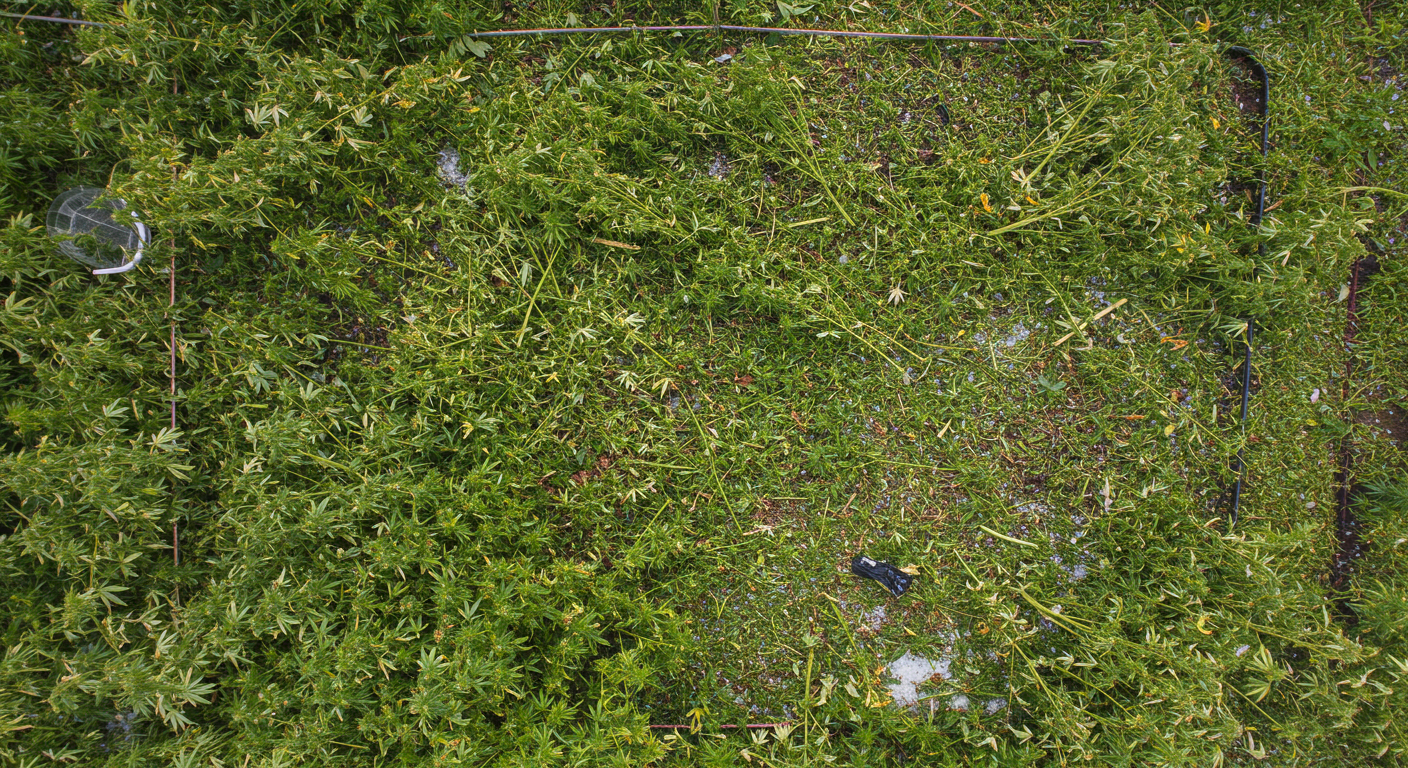
Stabilize Split or Partially Failed Branches and Verify Recovery
After a storm, do not decide the fate of a branch while the plant is still being pushed around. Wait until conditions are safe. Then inspect from the base upward and separate three categories: branches that are only displaced, branches that are partially split but still connected and functional, and branches that are crushed, contaminated, or almost completely detached.
Supporting Split Branches After Wind
If a branch is partially split and still has substantial living tissue connecting it to the plant, gently return it toward its normal position and support the branch so the wound is no longer opening under its own weight. The support should carry the load. Do not repeatedly bend the split open to inspect the inside.
Use a clean splint or adjacent stake when needed. Secure above and below the damaged area without putting adhesive directly on flowers or wrapping the entire branch so tightly that moisture is trapped. The objective is mechanical stability, not an airtight seal.
Decide whether the branch is salvageable before spending hours on it
A partially split branch with green, normally hydrated foliage above the injury may still be functioning. A branch that is crushed through most of its diameter, heavily contaminated with soil, hanging by a small strip, foul-smelling, rapidly darkening, or impossible to support without tearing farther has a poorer outlook.
There is no reliable universal percentage of stem connection that guarantees recovery. Use plant response. If the tissue above the injury stays turgid, color remains normal, and the split stops widening after support, those are useful signs. If the entire branch wilts despite adequate root-zone moisture and the connection continues to fail, continued attachment may not be helping.
Make clean removal cuts when tissue cannot be retained safely
When a broken branch must be removed, use clean, sharp tools and avoid leaving a ragged hanging stub. General storm-damage pruning guidance favors clean cuts over torn wounds. Cannabis is herbaceous rather than a woody landscape tree, so the exact pruning geometry differs, but the practical principle is the same: do not leave crushed tissue swinging and repeatedly tearing at the plant.
Sanitize tools before moving between damaged or diseased areas. Keep removed wet flower material away from healthy branches. Do not smear soil, tape adhesive, or dirty hands into fresh injuries.
Do not coat every wound with a homemade sealant
The internet is full of improvised wound recipes. This article does not recommend honey, wax, glue, paint, soil, powders, or kitchen ingredients as universal cannabis branch dressings. The priority is clean handling, stable support, airflow, and observation. If a repair material is used as a mechanical splint or wrap, it should not create a wet pocket around flower tissue or constrict the branch.
Keep the repair area dry enough to inspect
A structural repair can create a moisture problem if the wrap, splint, or neighboring flowers stay compressed and wet. After rain, check whether water is trapped at the split or under the support material. The repair should stabilize the branch while still allowing the surrounding surface to dry. If a wrap is soaked, dirty, or slipping, replace it carefully rather than leaving a wet band in place because the branch still looks upright.
Flower clusters near the damaged union need the same attention. A repaired branch that is pulled tightly into the center of the canopy may have less airflow than before the storm. Stability is only one part of recovery. The tissue also needs a clean environment and enough access for you to see whether the wound is changing.
Separate delayed structural failure from immediate wilting
Some storm damage declares itself immediately. Other damage appears later. Agricultural hail research in other crops shows that bruised stems can remain standing after the event and fail later under load. The exact response cannot be transferred directly to cannabis, but the field lesson is useful: a stem that looks acceptable on the first morning may still deserve support and repeated inspection.
Mark bruised, flattened, or sharply creased stems even when foliage remains green. Do not keep flexing them to see whether they are strong. Let ordinary plant posture and later weather reveal whether the section is stable. If a suspicious branch is carrying substantial flower weight, temporary support is cheaper than waiting for the next gust to perform the test.
Build a 24-hour and 72-hour recovery check
At the first check, look for leaf posture above the wound, branch angle, tie pressure, new tearing, and obvious color change. At the later check, look for stable tissue, drying of the wound surface, resumed normal posture, and whether the support still carries the branch. Storm-damaged stems can remain weak even when they initially survive, so keep them supported through the period of greatest load.
A recovered branch does not need to be perfectly straight. It needs to remain functional and structurally stable. If a callused or thickened area develops later, treat it as repaired tissue, not proof that the injury increased yield or made the plant stronger than it was before.
“The branch split but the leaves above it still look normal. Do I need to cut it off immediately?”
Question sent by: Paige Carter, via Facebook page.
Not automatically. If the branch still has a substantial living connection, remains hydrated, and can be stabilized without reopening the split, support it and monitor it closely. Remove tissue that is crushed, contaminated, rapidly failing, or impossible to keep structurally safe. The plant’s response over the next checks is more useful than a fixed percentage rule.
Know When More Support Stops Helping
Support has limits. Adding more string, more stakes, and more layers can eventually make the plant harder to inspect and can transfer load into new weak points. The purpose is not to build a rigid sculpture. It is to keep productive branches in a stable, accessible position through weather and flower weight.
Stop tightening when the branch is stable
If a branch is no longer sagging, the tie is not cutting, and storm movement is controlled, more tension is not an improvement. Excess tension can pull the union sideways, flatten the branch against a stake, or create a constriction that becomes more serious as the stem expands.
Stop adding netting when access begins to disappear
Every new layer of mesh can make harvest and disease inspection harder. If you cannot reach the center of a dense flower cluster, see a branch union, or remove a damaged branch without cutting multiple support lines, the system has become too complicated. Simplify or create access openings before the next storm.
Stop structural manipulation as stems become rigid and heavily loaded
Late flowering is the time for support, not experimental bending. Woody-feeling or rigid stems, heavy flower clusters, old training injuries, and shortened recovery time all increase the cost of forcing a branch into a new shape. Support the branch where it is rather than insisting that it fit a predetermined canopy geometry.
Do not confuse support with training
Training changes plant architecture. Support preserves architecture under load. They can use some of the same materials, but the intent and timing are different. A tie that gently holds a heavy branch is support. A tie that deliberately bends a vigorous branch to redistribute the canopy is training. Storm week is not the time to blur those goals.
Do not use support to hide a root or container stability problem
If the whole plant leans because a container is too light, the root ball is loose, or the soil has become saturated and unstable, branch ties are treating the symptom. Stabilize the base first. Otherwise, the support frame can act as a lever and increase strain on the root zone.
Do not attach support lines to unsafe structures
Do not use electrical service hardware, unstable fences, weak gutters, overhead utility structures, dead branches, or anything that could fail and fall into the garden. A cannabis branch is not worth creating a larger property or electrical hazard.
Yield claims vs reality
A well-supported branch can continue functioning instead of breaking. A trellis can maintain canopy spacing and prevent flowers from lying on the ground. Better access can help you detect pests and wet spots earlier. These benefits can preserve harvestable flower.
None of that means a stake or trellis creates a fixed increase in biomass. Cannabis architecture studies show that plant shape, canopy density, and light distribution matter, but support is one part of a much larger system. Sunlight, healthy roots, water, nutrition, genetics, disease pressure, and season length still limit production. Treat support as risk management and canopy organization, not a guaranteed yield multiplier.
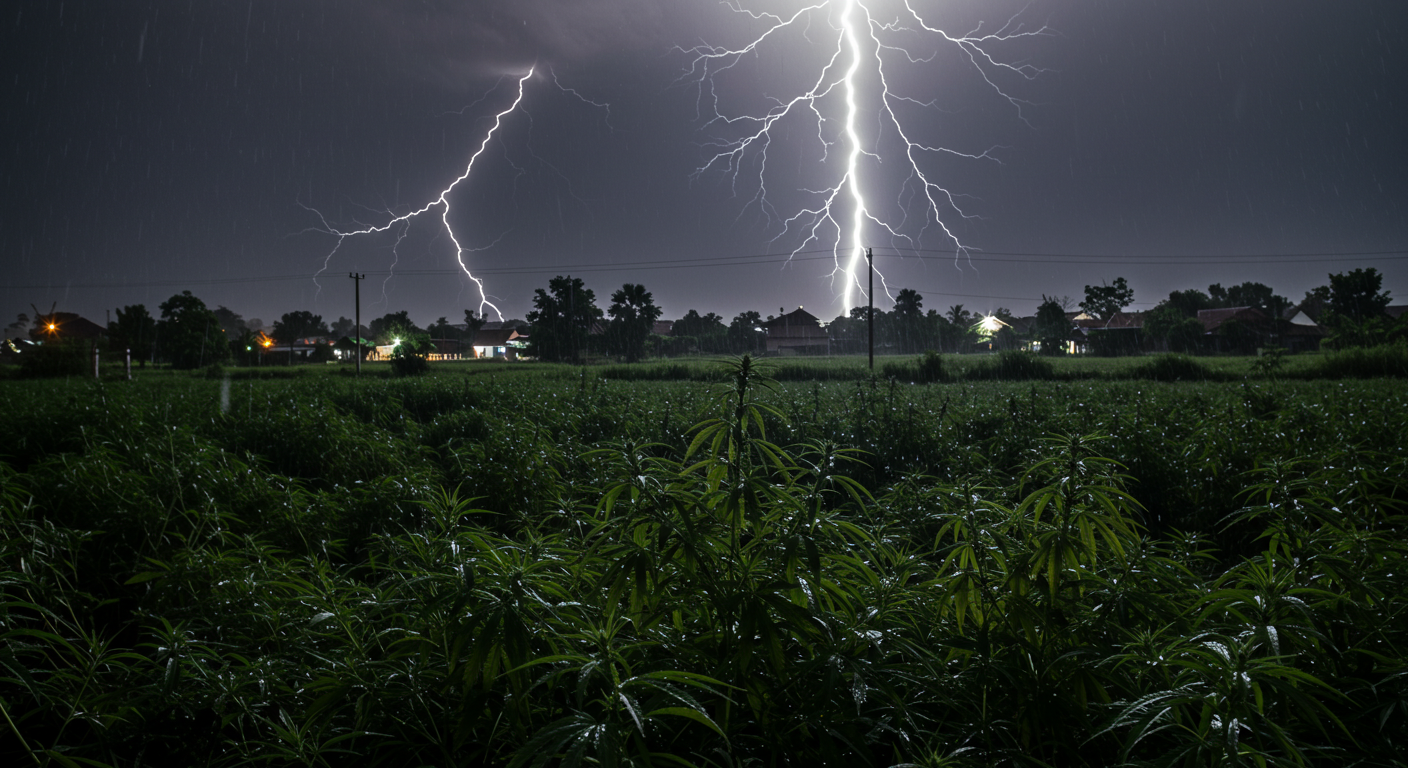
Late-Season Support, Inspection Access, and the Storm Checklist
Late-season support should become a routine rather than a rescue job. The plant is changing quickly, flowers are gaining mass, nights may be wetter, storms can arrive with less useful recovery time, and every repaired branch carries a history that deserves another look.
Inspect support after every meaningful load event
Recheck after heavy rain, strong wind, hail, rapid flower swelling, major pruning, irrigation that softens the soil around posts, or any event that shifts the plant. A support that passed inspection last week may fail after the anchor soil changes or the branch becomes heavier.
Look for tie marks, rubbing, mesh cutting into flowers, bent stakes, loosened knots, root-ball movement, branch rotation, and flowers resting on other wet surfaces. Photograph high-risk branches so you can see progression.
Keep repaired branches on a separate watch list
Do not treat a repaired split as forgotten once the leaves stand up again. That location has already demonstrated structural weakness. Keep it supported and inspect after storms. Watch for renewed cracking, darkening tissue, trapped moisture around any wrap, or a branch above the repair that suddenly droops.
Keep pathways open for harvest and sanitation
As harvest approaches, imagine removing each supported branch. If the plant is woven through a fine permanent net, plan how you will free branches without dragging flowers through dirty material. If ties must be cut, make them easy to see. Do not leave hidden loops around stems where they can be missed.
Use the same post-storm inspection order every time
Consistency prevents you from focusing only on the most dramatic visible branch. Start with personal safety and site hazards. Then check the root base or container, primary posts, main stem, branch unions, support ties, flower interiors, and drainage. Finish by recording what changed and when you will recheck repaired areas.
Storm and branch-support checklist
- Forecast: Check expected wind direction, gust potential, rain duration, hail risk, and safe access.
- Base: Confirm the container, root ball, and primary support posts do not rock excessively.
- High-load branches: Identify long laterals, heavy flower clusters, old wounds, and branches already sagging.
- Ties: Use soft adjustable material and confirm no loop is tight enough to constrict an expanding stem.
- Anchors: Test posts, cages, trellis frames, and perimeter lines before the storm begins.
- Access: Keep branch unions and dense flowers reachable for post-rain inspection.
- Loose objects: Secure covers, hoses, tools, panels, and anything that can strike the canopy.
- After the storm: Wait for safe conditions, inspect from the base upward, stabilize salvageable splits, and remove crushed or contaminated tissue cleanly.
- Recovery: Recheck repaired branches at roughly 24 hours, again over the next several days, and after the next load event.
- Stop rule: Do not keep adding tension or netting once stability is achieved and access begins to suffer.
Record what actually failed in the storm
After every meaningful weather event, write down the failure mode instead of only recording that a branch broke. Was the anchor pulled out? Did the tie slide? Did the branch snap at the collar? Did the root ball shift? Did wet flowers drag the branch through a trellis opening? Did the support itself strike the plant? These details tell you which part of the system needs redesign.
Do not automatically add more material after each storm. If a single tie was too tight, more ties of the same type will repeat the problem. If a post loosened because the soil saturated, the solution is anchor design. If a branch failed beyond the last support point, the spacing or load path needs revision. A short failure log turns storm preparation into a system that improves through the season.
Retire support components that have become hazards
Twine frays, plastic ties become brittle in sun, bamboo can split, wooden stakes can soften at the soil line, and metal edges can become exposed as coatings wear. Inspect the support materials themselves, especially after a storm. Replace anything that has become sharp, unstable, or difficult to adjust.
Do not leave old cut loops hidden in the canopy. Remove discarded ties and broken line sections. Loose material can wrap around branches, collect wet plant debris, or become difficult to find at harvest. A clean support system is easier to inspect and safer to dismantle.
Build one backup option before you need it
Keep a few clean stakes, soft ties, cutting tools, and a simple splint material available. The backup should be compatible with the support system you already use. Emergency materials are much easier to handle when they are clean, visible, and stored together rather than improvised from wire, dirty rope, or adhesive found after the storm.
Know when the safest action is to remove one branch
Saving every damaged branch is not always the best outcome. A severely crushed branch can keep reopening, hold wet tissue, rub against neighboring flowers, and consume time while still failing. If it cannot be supported in a stable and clean position, a controlled removal may protect the remaining plant better than an elaborate repair.
Master Advice: Build the support system so you can inspect it. A hidden tie, inaccessible flower cluster, or unreachable split is not truly supported because you cannot verify what the system is doing.
What reliable branch support looks like at the end of the season
A good system is visually simple. Primary anchors remain upright. Heavy branches are held near natural positions. Ties are loose enough for stem expansion and easy to find. Flowers do not rest on soil, stakes, or wet netting. The canopy still has airflow and inspection access. Repaired branches remain on a watch list, and storm preparation takes minutes because the framework already exists.
The goal is not to prevent every leaf from moving. It is to prevent destructive leverage from turning healthy flowering branches into storm losses. When support is installed early, checked after load events, and adjusted with the plant rather than against it, late-season weather becomes a manageable structural problem instead of a last-minute emergency.
FAQ: Outdoor Cannabis Branch Support and Storm Preparation
Should every outdoor cannabis plant be trellised?
No. Compact plants in sheltered positions may need little or no additional structure. Larger plants, long laterals, exposed sites, and heavy flowering can justify more support. Choose the system from the plant’s load and site exposure rather than assuming every plant needs the same trellis.
Is bamboo strong enough for cannabis branches?
Sometimes. Bamboo can be useful for individual branches, but diameter, depth, soil condition, branch load, and wind exposure matter. A thin bamboo stake in wet loose soil can fail even if the material itself is intact. Test the installed stake rather than trusting the material name.
Can I use wire to tie branches?
Bare narrow wire directly against a living stem is a poor default because it can cut or girdle tissue. Use a soft, wide, adjustable tie between the plant and the support. Wire may be part of the support frame when it does not contact or constrict living stems.
How long should I keep a split branch supported?
Keep it supported through the period in which the damaged area is still carrying meaningful load and remains vulnerable to reopening. Use repeated inspections rather than a fixed number of days. Stable leaf posture, no widening split, and a branch that remains secure after ordinary movement are better indicators than a calendar alone.
Should I cut off a branch that broke during a storm?
Not automatically. A partially connected branch that stays hydrated and can be stabilized may remain functional. Remove branches that are crushed, heavily contaminated, rapidly failing, nearly detached, or impossible to support without creating additional damage.
Does supporting heavy branches increase bud size?
Support can preserve productive branches and maintain good canopy position, but it does not directly create flower mass. Bud development still depends on genetics, light, root function, water, nutrition, environment, and time. Treat support as structural risk management.
Share this article
A quick overview of the topics covered in this article.
Follow us
Latest articles
September 2, 2026
September 2, 2026
September 2, 2026

September 2, 2026
