
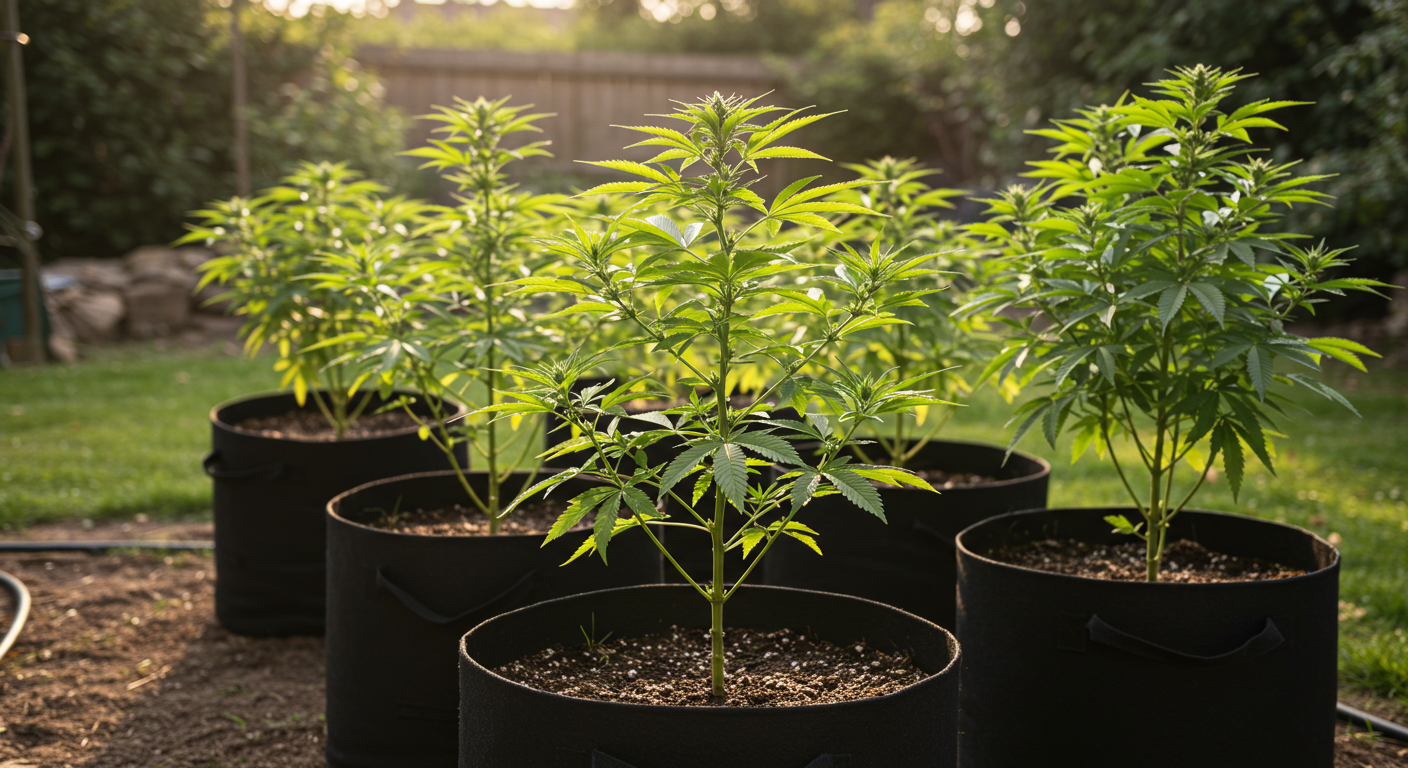
Does Cannabis Grow More at Night or Day
Why This Question Is Harder Than It Sounds
If you ask ten growers whether cannabis grows more at night or during the day, you will usually hear two confident answers that seem to cancel each other out. One camp says, “Plants grow at night.” The other says, “No light, no growth.” The truth is that both sides are touching part of the same biological story, but neither slogan is complete on its own. Cannabis, like other C3 plants, gains most of the carbon that becomes new biomass during the light period through photosynthesis. At the same time, the plant continues to develop, redistribute sugars, maintain metabolism, and often expand tissues during darkness, especially when nighttime water status is more favorable and transpiration pressure is lower. In other words, the plant earns most of its carbon budget by day, then spends and reallocates that budget across the full 24-hour cycle.
That is why the cleanest scientific answer is not “day” or “night” in isolation. If by “grow more” you mean where the raw material for growth comes from, the answer leans strongly toward the day, because photosynthesis fixes carbon only when light is available. If by “grow more” you mean when you most notice stretching, swelling, or overnight movement, the answer can lean toward the night, because plants often expand tissues when water relations are favorable and the carbohydrates made earlier are being mobilized. Those are different biological processes, and growers often mix them together under one word: growth.
Photoperiod-sensitive
A photoperiod-sensitive cannabis plant responds to the length of light and darkness across a 24-hour cycle. In practical terms, that usually matters most when the plant is deciding whether to stay in a vegetative pattern or move harder toward flowering. It does not mean the plant is only counting total light hours. It is also responding to the pattern of uninterrupted darkness.
So before we go deeper, let’s kill the biggest myth early: cannabis does not magically “do all its growth at night,” and it does not purely grow only when lights are on. The science points to a split reality. Daytime is when the plant captures energy and carbon. Nighttime is when that stored carbon is still actively used for maintenance, repair, signaling, and often visible growth responses. If you understand that split, the indoor-versus-outdoor debate, the 18/6-versus-24/0 debate, and the whole mother-plant conversation become much easier to understand.
Why Do Cannabis Plants Sometimes Look Bigger in the Morning?
A reader once emailed us with a simple version of this question: if most biomass comes from daylight, why do plants often look taller or more alive the next morning?
The short answer is that visible overnight expansion and better nighttime water status can make growth look dramatic even when most of the plant’s carbon budget was built during the light period.
What Growth Means in Cannabis Biology
The word growth sounds simple, but in plant biology it hides several different processes. A cannabis plant can increase dry mass, expand leaf area, elongate stems, thicken stems, build roots, initiate flowers, mature inflorescences, or shift chemistry. Those things do not all peak at the same time of day, and they are not all controlled by the same mechanism. That is why the day-versus-night question feels deceptively basic but is actually a systems question involving carbon fixation, circadian timing, water status, developmental phase, and sink strength.
At the highest level, cannabis growth depends on three linked steps. First, leaves intercept light and fix carbon through photosynthesis. Second, some of that carbon is used immediately, while some is stored as carbohydrates, especially starch and soluble sugars. Third, those resources are transported and used to build new tissues over time, including during the dark period. Studies in plants broadly show that starch is synthesized in the light and then degraded at night to support maintenance and growth until dawn. When that nighttime carbohydrate supply is impaired, plants grow more slowly and can enter carbon starvation early. That framework is not cannabis-specific in every mechanistic detail, but it is central to understanding why “growth” never belongs entirely to either half of the day.
For cannabis specifically, photosynthetic studies have shown robust daytime responses to light intensity, temperature, and CO2. One well-known cannabis photosynthesis study reported that the maximum photosynthetic rate in cannabis occurred at about 30°C and around 1500 µmol m−2 s−1 PPFD in the tested conditions, with adverse effects appearing when temperature climbed above 30°C and light pressure became excessive. In another influential indoor flowering study, dry inflorescence yield increased linearly with increasing canopy light intensity up to 1800 µmol m−2 s−1 even though leaf-level photosynthesis saturated well below that level. That matters because it shows two things at once: light is absolutely central to biomass production, and whole-canopy growth cannot be reduced to a single leaf measurement or a single moment in the day.
There is also a timing system sitting on top of all this: the plant circadian clock. Plant circadian systems help organisms anticipate daily cycles and coordinate growth, metabolism, flowering signals, and stress responses. Reviews in plant chronobiology and experimental work on rhythmic growth show that plants often grow better when their internal circadian period is aligned with the external day-night cycle. Researchers have also shown that growth oscillations can persist under continuous light under some conditions, which means turning lights on for 24 hours does not simply erase the plant’s internal clock. The clock keeps generating timing information, even when the environment becomes less natural.
This is the most beginner-friendly way to picture it: cannabis is running a 24-hour economic system. The day shift is when the plant runs its big income stream through photosynthesis. The night shift is when it keeps paying bills, moving inventory, and often investing those stored resources into tissue expansion and development. If you only watch the plant visually, night can look dramatic. If you measure where the carbon came from, the day usually wins. If you track flowering behavior, the length of the night can matter more than the brightness of the day. All three of those statements can be true at once, and that is exactly why this topic confuses so many beginners.
There is one more cannabis-specific nuance worth stating clearly. A well-known plant architecture paper argued that long-photoperiod cannabis is not perfectly “vegetative” in the classical sense, because solitary flowers and bracts can still appear under long-day conditions in some cultivars. In that framing, what short photoperiod really triggers is not flower induction from absolute zero, but a dramatic architectural shift toward compound inflorescence formation. That is a subtle point, but an important one. It means the usual grower language of “veg” and “flower” is useful shorthand, not perfect biology.
What Daylight Contributes
If your question is really about where cannabis gets the raw material for growth, then daylight is the main answer. Light drives photosynthesis, which turns atmospheric carbon dioxide into sugars that become stems, leaves, roots, and flowers. Reviews on cannabis photobiology describe light as both the plant’s energy source and a powerful developmental signal, and controlled-environment cannabis studies consistently show that increasing light intensity within tested ranges can increase productivity, biomass accumulation, or cannabinoid yield, depending on the stage and genotype. In plain English: the more usable light a healthy plant can productively capture, the more potential it has to build plant matter.
One of the strongest modern studies on this point showed that indoor cannabis dry inflorescence yield rose linearly as canopy PPFD increased up to 1800 µmol m−2 s−1 in the flowering stage, even though leaf-level photosynthesis saturated sooner. That finding helps explain why a beginner can be misled by what they “see” on an individual leaf while the canopy as a whole is still converting more light into more marketable flower. It also undercuts the lazy myth that if leaves are photosynthesizing at some decent rate, the job is done. Canopy architecture, light interception, sink demand, and developmental timing still matter. Daytime growth potential is not just about the existence of light. It is about how much productive carbon the whole plant system can capture and use over time.
Daylight also shapes the plant as a signal. Cannabis is highly responsive to photoperiod and light spectrum. Recent reviews have emphasized that light parameters such as quality, intensity, composition, and photoperiod strongly influence cannabis morphology, physiology, and secondary metabolite production. So when growers talk about “the plant loving more daytime,” they are partly right, but what the plant is reading is not just brightness. It is the entire light environment.
Outdoor growers feel this every season. In long summer days, cannabis typically continues into vigorous vegetative development, building height, branching, and leaf area while nights remain too short to strongly trigger flowering in photoperiod-sensitive cultivars. A major propagation review describes cannabis in nature as sprouting in spring, growing vegetatively through long days, and then flowering as days shorten before winter. That seasonal pattern is the reason outdoor plants can become large: not because night is unimportant, but because long bright days repeatedly refill the plant’s carbon pipeline while short summer nights delay reproductive commitment.
But daytime is not always a clean win. More day does not mean infinitely more productive growth. Cannabis photosynthesis can suffer when temperature gets too high, when light becomes excessive relative to the plant’s ability to use it, or when environmental stress disrupts stomatal behavior and water balance. Research has shown adverse effects on photosynthesis and water-use efficiency at higher temperatures and very high PPFD, and more recent work has connected elevated temperatures with disrupted inflorescence development and reduced biomass in some genotypes. So the beginner simplification should be: daylight drives biomass gain, but productive daylight is not the same thing as endless light or stressful heat.
This is also why the phrase “more light equals more growth” is too crude. In micropropagated cannabis plantlets, a recent study reported the best performance at 16- or 20-hour photoperiods, while continuous lighting caused growth inhibition. Separate work on prolonged photoperiod in hemp warned that continuous light can trigger photooxidative damage and altered photosynthetic reactions. So the daytime side of the equation is powerful, but it has diminishing returns and, in some contexts, real physiological penalties. Cannabis wants light, but it does not benefit from every possible hour of light in every possible context.
Tip: When you judge cannabis “growth,” separate visible stretch from real dry-mass gain. They can overlap, but they are not the same thing.
What Darkness Contributes
Darkness matters much more than beginners are usually told. Not because the plant is magically “charging up” in a mystical way, but because nighttime is when the carbon captured during the day is rationed, mobilized, and used to keep metabolism going until the next dawn. Research on starch turnover in plants shows that starch produced in the light is degraded at night to support maintenance and growth. If the nighttime carbohydrate supply is mismanaged or insufficient, plant growth slows. In other words, nighttime is not a pause button. It is an active metabolic interval.
This is the key reason the old grower phrase “plants sleep at night” is only half useful. Plants do not sleep the way animals do. They do, however, shift into a different metabolic mode. Without photosynthesis, the plant must rely on reserves and on carefully timed regulation of respiration, sugar availability, hormone signaling, and maintenance pathways. Reviews on darkness as a plant signal make exactly this point: darkness is not just the absence of light; it is a physiological condition that changes development, signaling, and resource use. So when growers say the dark cycle matters, that part is scientifically legitimate. The problem comes when they turn that into the claim that all real growth happens only after lights-out.
There is also the visible side of nighttime growth. In many plants, tissue expansion can become more noticeable at night because transpiration usually drops, water status improves, and cells can maintain turgor more easily. A rhythmic growth study showed that hydraulic behavior and growth can stay strongly tied to daily timing, while another widely cited tree-growth study argued that stem growth increases overnight because daytime transpiration reduces water potential and turgor pressure in growth tissues, whereas nighttime recovery favors expansion. Those studies are not simplistic one-to-one proof that “cannabis stretches most at night,” but they give a strong physiological explanation for why many growers feel their plants “moved overnight.”
Do
Separate posture from biomass
Judge overnight movement and true dry-mass gain as related but different processes when you read what the plant is doing.
Avoid
Do not treat morning stretch as proof
Do not assume every morning jump in height means the plant grew more at night in the dry-mass sense.
Critical night length
Critical night length is the approximate amount of uninterrupted darkness a photoperiod-sensitive cultivar needs before flowering signals become strong enough to change development. That threshold is not identical in every cultivar, which is one reason flowering timing can vary even when the schedule looks almost the same on paper.
This also helps explain why some old-school rules are too blunt. Saying “cannabis needs darkness to grow” is not precise enough. A better statement is: cannabis needs darkness for normal 24-hour metabolic cycling, and photoperiod-sensitive cannabis also uses uninterrupted darkness as a major seasonal cue for flowering. Those are related but not identical ideas. One is about how the plant operates across the diurnal cycle. The other is about how it decides what stage of life it is in. Beginners often mash those together and end up with a lot of confusion about whether darkness is for “rest,” “stretch,” “flowering,” or “yield.” In reality, it plays different roles at once.
Remember: Darkness is not just “plant bedtime.” In cannabis, darkness supports metabolic cycling, carbohydrate use, and in photoperiod-sensitive cultivars, flowering control.
Outdoor Cannabis
Outdoor cannabis makes the day-versus-night story feel intuitive because the seasons do so much of the talking. In spring and early summer, long days and relatively short nights encourage sustained vegetative development in many photoperiod-sensitive cultivars. The plant keeps making leaves, nodes, branches, and root mass while the nights remain below the critical length for strong flowering responses. As the season moves toward late summer and the nights become longer, flowering begins or accelerates. That basic seasonal behavior is described in reviews of cannabis propagation and is confirmed by cultivar-level photoperiod studies in essential oil and fiber/grain hemp.
Outdoor plants therefore answer the core question in a very elegant way. They get big in summer because long bright days keep refilling the carbon tank, while relatively short nights delay reproductive turnover. When the nights lengthen enough, the plant’s developmental program starts shifting. So if an outdoor grower asks, “When is the bulk of the size being built?” the answer is mostly the day-driven vegetative window of the season. If that same grower asks, “What seasonal signal tells the plant to stop just bulking and start committing harder to flower?” the answer points right back to the night.
Recent cultivar work makes the outdoor picture even more interesting. A hemp photoperiod study found that critical day length thresholds varied by cultivar and that even a photoperiod difference as small as 15 minutes could significantly influence floral initiation in some cultivars. The same line of work also reported that even civil twilight could be biologically effective in regulating flowering. That means outdoor cannabis is not responding only to the clean block of “sun above the horizon.” Weak dawn and dusk photons can still count enough to matter.
For beginners, this corrects one of the most common outdoor misconceptions: the plant is not always reading “day” the same way humans do. A human says sunset happened, so nighttime started. The plant says, “I am still receiving biologically meaningful light.”
Can a Porch Light or Street Light Disrupt Outdoor Flowering?
One of our readers emailed us asking whether a porch light, security light, or nearby street light can mess with outdoor flowering.
The short answer is yes. Cannabis does not respond only to bright daytime sun. Low levels of light at dusk or during the night can still be biologically meaningful, especially in photoperiod-sensitive plants. That is why stray nighttime light can sometimes delay or confuse flowering outdoors.
Outdoor conditions also show why nighttime can feel so important visually. In a field or backyard, daytime heat, wind, and high vapor pressure deficit can push transpiration hard. Even though the plant is photosynthesizing and building its carbon reserves, daytime water stress can temporarily suppress the look of growth. Then nighttime arrives, air temperatures often soften, transpiration eases, tissues rehydrate, and the plant may present a noticeable morning jump in posture or extension. That does not mean the night “beat” the day in biomass formation; it means the dark period gave the plant a better hydraulic window for visible expansion.
Do Cold Nights and Warm Nights Change Cannabis Growth?
One of our readers emailed us asking whether cold nights and warm nights can change how cannabis grows outdoors.
The short answer is yes. Night temperature changes how the plant recovers, respires, and manages water after the light period ends. Mildly cooler nights can sometimes support recovery from daytime stress, but nights that are too cold can slow metabolism and reduce growth. Very warm nights can raise respiration and make the plant use sugars less efficiently. So weather absolutely matters, but it works through temperature, humidity, and stress together, not through night temperature alone.
This is the outdoor summary in one sentence: cannabis gets its seasonal size mostly because summer days supply repeated carbon gain, but outdoor flowering timing and a lot of visible overnight movement are heavily shaped by the dark side of the daily cycle. If you understand both halves, you stop asking the question like it is a fight between day and night and start seeing the plant as a 24-hour system that changes priorities as the season changes.
Indoor Cannabis and the Mother Plant Paradox
Indoor cultivation is where this question gets really juicy, because indoor cannabis lets humans bend the calendar. Outdoors, the sun and the season do the scheduling. Indoors, people decide how long the “day” is, how dark the dark period is, how warm the canopy stays, and whether the plant gets pushed toward flower or held in a vegetative production mode. That is why the mother-plant conversation sits right in the middle of the “night or day?” debate.
Mother plant
A mother plant is a cannabis plant kept in a long-day vegetative state so growers can repeatedly take clones from the same genotype. The goal is consistency and propagation, not necessarily maximum speed or maximum yield from that one plant.
That simple fact already answers a major beginner question: how can a cannabis mother plant sit under very long light periods and keep growing without flowering? Because in photoperiod-sensitive cannabis, flowering is less about the plant “needing bedtime” in some vague sense and more about whether the dark interval becomes long enough to trigger the reproductive program. If you keep nights too short for that signal, the plant can stay in a mother-stock or vegetative maintenance mode for extended periods. Recent work on cannabis photoperiod sensitivity and night-break methods reinforces the same principle by focusing on critical night length and on the effectiveness of interrupting the dark period to prevent or delay flowering.
This is where 24-hour lighting enters the chat. Long-day or continuous-light regimes can keep cannabis in a vegetative state because they never provide the long uninterrupted dark interval that many photoperiod-sensitive cultivars need to commit strongly to flowering. That is the real mechanism behind the “mother under 24/0” idea. It is not that the plant found a secret infinite-growth cheat code. It is that the flowering signal tied to dark duration is being withheld. The plant remains in a long-day management regime, and that lets growers continue harvesting cuttings from the same donor genotype over time.
24/0 Is Not Automatically the Healthiest Choice
Do not treat a 24/0 mother-room setup as proof that nonstop light is automatically the healthiest choice. Keeping a plant vegetative and maximizing long-term healthy growth are not the same thing.
This is one of the most important corrections for beginners. A mother plant is a management category, not proof of a universal biological optimum. A mother is being kept as a donor resource. The aim is stable vegetative maintenance and repeated propagation, not necessarily the fastest possible dry-mass accumulation per day or the most natural circadian experience. Once you see that, the mystery disappears. The plant keeps producing because cannabis can remain in a long-day managed state, but that does not mean every cultivar loves 24/0 or that darkness has no value.
There is an even cooler layer. Research on cannabis architecture showed that long-photoperiod cannabis is not perfectly “vegetative” in the classical botanical sense, because solitary flowers can still appear under long-day conditions and may be age dependent rather than strictly photoperiod induced. That means the grower term “veg” is useful for production, but the plant’s underlying biology is more nuanced. A mother plant can be horticulturally maintained in a vegetative regime while still not being a permanently juvenile, flower-blind organism. Biology stays messier than room rules.
Night interruption studies take this one step further. A research brief reported that night interruption lighting was as effective as daylength extension for retaining the vegetative state of cannabis mother plants, and a university extension summary stated that growing cannabis with 16 hours of lighting in a 24-hour period, delivered either by daylength extension or by night interruption, was effective for keeping mother stock vegetative. That matters because it shows the plant is responding not just to total photons, but to the temporal pattern in which light and darkness are arranged. Again, the night signal is central.
There is another indoor myth worth correcting here: the idea that 12/12 is a universal law. A series of modern studies has shown that this is too rigid. Some indoor-grown cannabis cultivars can initiate strong flowering responses under daily photoperiods longer than 12 hours, and in some cases longer flowering photoperiods increased yield or maintained cannabinoid concentration while raising daily light integral. The upshot is not “throw out darkness,” but cultivar response is more nuanced than the internet mantra.
So what does the mother-plant paradox really teach us? It teaches that cannabis does not simply “need night to grow” in the simplistic sense people mean online. It also teaches that cannabis cannot be reduced to “more hours of light equals more growth.” Mother plants prove that long-day management can hold a plant in a donor state for a long time. The continuous-light cautions prove that withholding darkness is not automatically optimal physiology. And the newer flowering photoperiod studies prove that even the old 12/12 flower rule is more cultivar-dependent than many people realized.
What a Fast Seedling Loss Taught Me About Reading Plants Too Quickly
This was not a perfect day-versus-night test, but it taught me an important lesson about reading plants too quickly. In my early years, I lost a seedling in less than a day after starting it in a mix that was too heavy and too hot for that stage. The plant did not give me much warning time.
That mistake stayed with me because it taught me that surface appearance can mislead you. The same caution applies here. A plant looking more upright or slightly taller in the morning does not automatically mean the night did most of the real growth. Sometimes what you are seeing is recovery, water balance, or tissue expansion built from energy captured earlier.
The Myths and FAQs Growers Bring Into This Topic
Myth 1: “Cannabis Only Grows at Night”
The first myth is the bluntest one: “Cannabis only grows at night.” That is not how the plant works. Daylight powers the photosynthetic capture of carbon that becomes biomass, and cannabis productivity responds strongly to light intensity in controlled studies. Nighttime absolutely matters, but it is largely metabolically downstream from carbon fixed during the day. Saying the plant “only grows at night” confuses visible expansion with total biomass production.
Myth 2: “The Dark Period Is Just Wasted Time”
The second myth is the mirror-image version: “The dark period is just wasted time.” Also wrong. Darkness is when starch and sugars are mobilized, when the plant continues respiration and maintenance, and when photoperiod-sensitive developmental signaling is heavily shaped by uninterrupted night length. In many plants, better nighttime hydration status also supports expansion growth. For cannabis, night length is especially important for flowering control in photoperiod-sensitive cultivars. So darkness is not wasted time. It is a different kind of work.
Myth 3: “If 18 Hours Works, 24 Hours Must Work Better”
The third myth is one every beginner sees online: “If 18 hours works, 24 hours must work better.” Not necessarily. Continuous light can indeed hold many photoperiod cultivars in a vegetative regime by eliminating the long dark interval associated with flowering, but studies in cannabis micropropagation have found better performance under 16 or 20 hours than under continuous light, and hemp research has warned that prolonged photoperiod or continuous light can cause photooxidative stress. A mother stock plant being maintained under very long days is not the same as evidence that continuous light is always an upgrade.
Myth 4: “Flowering Cannabis Always Needs Exactly 12 Hours of Light”
The fourth myth is the sacred cow: “Flowering cannabis always needs exactly 12 hours of light.” That is still a useful commercial convention, but recent studies show it is not a law of physics. Some cultivars can initiate strong flowering responses under more than 12 hours of daily light, and in some experiments longer flowering photoperiods substantially increased yield without harming major cannabinoid concentrations. That does not mean every cultivar should be treated the same way. It means the blanket rule is too simple.
Does Cannabis Need Darkness to Grow, or Only to Flower?
A common beginner question is: Does cannabis need darkness to grow, or only to flower? The scientifically honest answer is “both, but in different ways.” It does not need darkness in the sense that every second of biomass gain pauses without it; long-day regimes clearly allow continued vegetative production. But darkness remains important for normal carbon turnover, circadian organization, and, in photoperiod-sensitive types, flowering control tied to critical night length. A better phrasing is that darkness is part of how the plant stays physiologically organized, and for many cultivars it is also part of how the plant knows what season it is.
Does Cannabis Stretch More at Night?
Another frequent question is: Does cannabis stretch more at night? The careful answer is that visible extension can often seem stronger overnight because cell expansion is favored when daytime transpiration pressure eases and tissues regain turgor, but that does not mean the night created those tissues from nothing. The carbon and energy supporting that growth were still largely accumulated during the light period. So if a grower says, “I swear she stretched overnight,” that observation can be physiologically reasonable, but it should not be turned into the claim that the plant does not depend on daytime carbon gain.
Are Outdoor Plants Different From Indoor Plants on This Question?
People also ask: Are outdoor plants different from indoor plants on this question? The core physiology is the same, but the emphasis changes. Outdoor plants make the seasonal photoperiod signal obvious because summer days support vegetative bulk and lengthening late-season nights encourage flowering. Indoor plants make the management side obvious because growers can manipulate photoperiod to keep plants in a mother-stock state, delay flowering, or alter flowering responses. Outdoor teaches you seasonality. Indoor teaches you signal control. Both teach that you cannot answer the question with a one-line slogan.
Are Mother Plants Proof That Cannabis Can Just Grow Forever Under Light?
Another good question is: Are mother plants proof that cannabis can just grow forever under light? Not exactly. Cannabis is still an annual species in nature. What indoor mother-stock systems prove is that long-day management can hold photoperiod-sensitive cannabis in a vegetative maintenance regime for extended periods while growers repeatedly take cuttings. That is a horticultural use of the plant’s developmental flexibility, not evidence that the species has become a true evergreen perennial under room lights.
Why Do Some Long-Day Plants Still Show Preflowers or Solitary Flowers?
One more question belongs here because it causes endless confusion: If long-day mother plants can persist, why do some long-day plants still show preflowers or solitary flowers? Because cannabis developmental biology is more nuanced than the room labels suggest. Long-day conditions do not make the plant classically non-inductive in every floral sense; solitary flowers can still appear and may be influenced by age-dependent internal signals rather than only by photoperiod. That is why “veg” is a horticultural shorthand, not a perfect botanical description.
High-Clarity Answer
Cannabis builds most of the carbon for growth during the light period, but it continues meaningful metabolic work and often visible tissue expansion at night. Outdoors, long summer days usually drive size while lengthening nights drive flowering. Indoors, long-day or continuous-light regimes can keep mother plants in a vegetative management state, but continuous light is not automatically the healthiest or most productive choice in every context. That is the answer most beginners were actually looking for all along.
References
- Chandra, S. et al. Photosynthetic response of Cannabis sativa L. to variations in photosynthetic photon flux densities, temperature and CO2 conditions
https://pmc.ncbi.nlm.nih.gov/articles/PMC3550641/ - Frontiers – Architecture and Florogenesis in Female Cannabis sativa Plants
https://www.frontiersin.org/journals/plant-science/articles/10.3389/fpls.2019.00350/full - Frontiers – Cannabis Yield, Potency, and Leaf Photosynthesis Respond Differently to Increasing Light Levels in an Indoor Environment
https://www.frontiersin.org/journals/plant-science/articles/10.3389/fpls.2021.646020/full - Nature Communications – Circadian rhythms of hydraulic conductance and growth are enhanced by drought and improve plant fitness in cyclical environments
https://www.nature.com/articles/ncomms6365 - Frontiers – Photoperiodic Flowering Response of Essential Oil, Grain, and Fiber Hemp (Cannabis sativa L.) Cultivars
https://www.frontiersin.org/journals/plant-science/articles/10.3389/fpls.2021.694153/full - University of Guelph – Ashleigh Ahrens thesis on cannabis flowering photoperiod and light intensity
https://atrium.lib.uoguelph.ca/server/api/core/bitstreams/ad6c8f74-5e18-4990-be0d-4babd6c95a62/content - NCSU e-GRO Cannabis – Research publications page, including the mother-plant night interruption summary
https://sites.google.com/ncsu.edu/e-gro-cannabis/publications/research-publications
Share this article
A quick overview of the topics covered in this article.
Follow us
Latest articles
October 24, 2026
October 24, 2026
October 24, 2026
October 24, 2026