
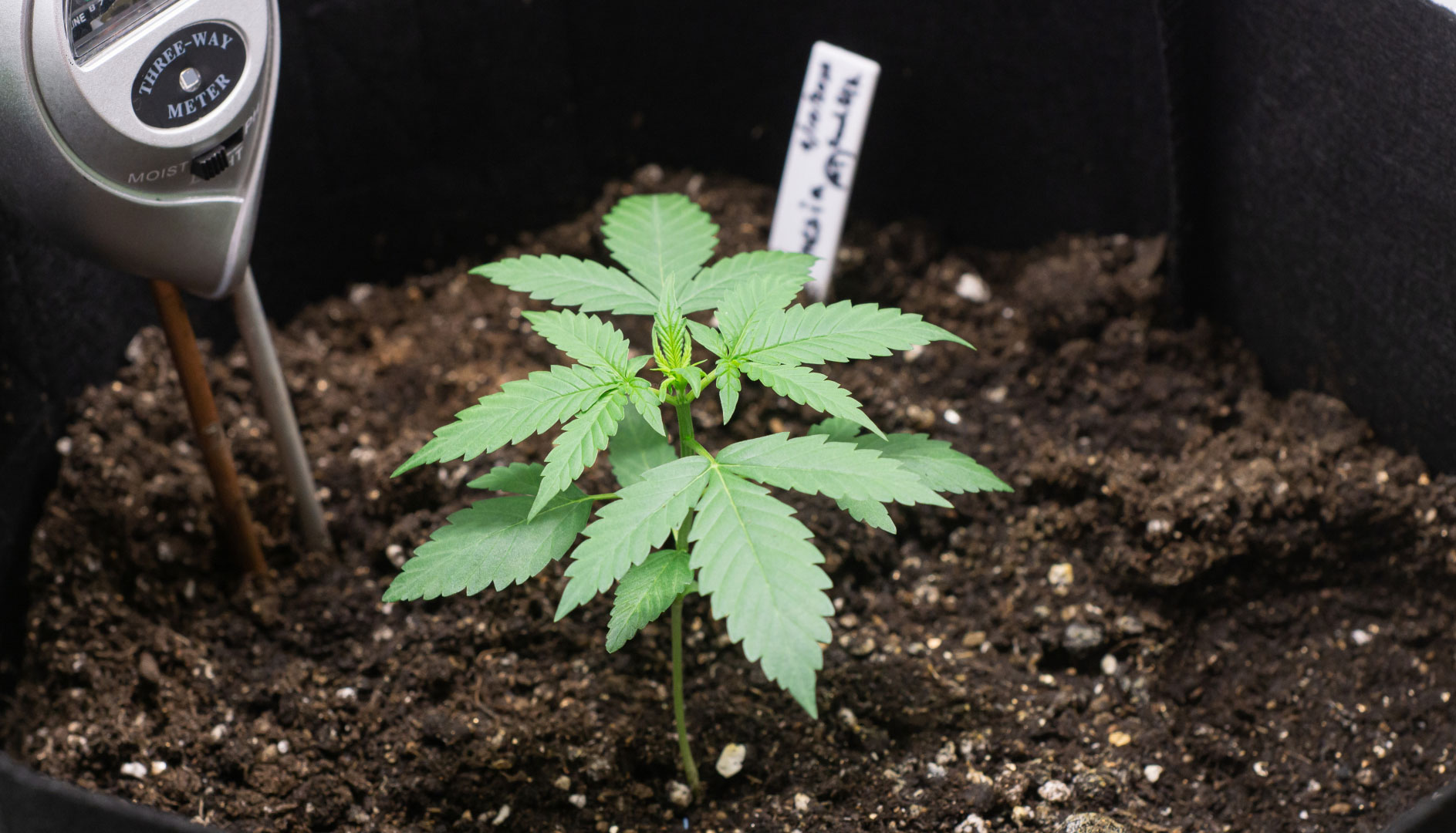
How to Grow a Cannabis Seedling
A cannabis seedling is easy to keep alive and surprisingly easy to stunt. Those are not the same thing. The real job during this stage is not “getting green growth fast.” It is building a small but functional root system, keeping the stem compact, avoiding early stress, and moving the plant into vegetative growth without shock. In practice, that means starting with mature seed, a clean and airy seed-starting medium, warm but not hot root-zone conditions, moderate light instead of blasting, humidity that helps the young plant breathe without turning the space stagnant, and a watering routine based on root-zone oxygen rather than habit. Mature hemp seeds outperform semi-mature and immature seeds in both germination and emergence, and germination is fastest and most uniform within a moderate temperature band rather than at the extremes.
If you want the shortest version of the entire article, here it is: direct sow or use a starter plug, keep the medium moist but never swampy, give seedlings moderate light for a long day, feed lightly only when the medium and root system actually call for it, and transplant when roots tell you they’re ready—not when a calendar does. Extension and young-plant research consistently show that low light, chronic overwatering, cool media, and excess salts are exactly the combination that slows root development and opens the door to damping-off and stunted growth.
A practical indoor default for most beginners is simple: a clean soilless starter mix or starter plug, drainage holes in every container, a long-day photoperiod around 16–18 hours, a seedling DLI in the moderate zone rather than the aggressive one, air temperatures in the warm room-temperature range, relative humidity around the intermediate zone, and a fertilizer plan that starts gentle and ramps only after cotyledons open and the first true leaves begin doing real work. That framework is not trendy. It is just repeatable.
What a cannabis seedling really is
A seedling begins the moment a viable seed has absorbed water and resumed metabolism. Seed germination is driven first by imbibition—the physical uptake of water—followed by metabolic activation and then radicle emergence. After that first root breaks free, the hypocotyl pushes upward, cotyledons open, and only then do the first true leaves start contributing meaningfully to photosynthesis. That sequence matters because each stage changes what the plant can tolerate. Before emergence, warmth, moisture, and oxygen are everything. After emergence, light intensity, air movement, humidity, and salt concentration suddenly matter much more.
This is also why so many new growers make the same mistake: they care for a just-emerged sprout like a miniature vegetative plant. It is not one. A fresh seedling still runs heavily on seed reserves. University seedling-fertility guidance notes that fertility is not critical during germination because many seeds carry enough stored nutrients to complete that phase, and that many early disorders arise not from underfeeding but from soluble salts, poor moisture management, pH drift, or environmental stress. In other words, the first week is usually lost to too much intervention, not too little.
Seed choice changes seedling management more than many guides admit. Cannabis is usually dioecious, with XX female plants and XY male plants. Regular seed therefore preserves natural sex segregation. Feminized seed is produced so that the progeny are female, which is why it is widely used when the goal is female flower production. Autoflowering or day-neutral cannabis is different again: it initiates flowering based on maturity rather than daylength, which means a seedling setback costs relatively more because there is less time to recover before reproductive development begins.
That makes seed-type selection straightforward for most readers. If the goal is learning, simplicity, and predictable flower-oriented production, photoperiod feminized seed is the lowest-friction path. If the goal is breeding, selection, or maintaining natural genetic segregation, regular seed still has a place. If space is tight or lifecycle speed matters more than recovery flexibility, autoflowers are useful—but their seedling phase punishes mistakes more harshly because they do not wait around for you to fix them.
One more point matters before you even germinate: seed maturity. Hemp research comparing mature, semi-mature, and immature seeds found the highest values for all measured germination and emergence traits in mature seeds, while semi-mature seeds could germinate yet fail to develop properly. That is a reminder to stop romanticizing weak seed. A bad start is often already baked into the material.
What to prepare before germination
The best seedling setup is boring on purpose. You want clean containers, reliable drainage, an airy medium, and as few failure points as possible. Extension guidance consistently recommends starting seeds in individual containers or divided cells with drainage holes, because shared flats lead to tangled roots and transplant damage later. Clear domes are useful only as microclimate tools for retaining moisture and warmth during germination; they are not a permanent habitat. Commercial soilless seed-starting mixes are recommended because they are sterile, lightweight, and physically suited to germination and early seedling development. Garden soil is a poor substitute because it can carry pathogens and weed seeds and often has the wrong texture for tiny roots.
The medium matters because seedlings live or die by the balance between water and air. The best seed-starting media hold enough moisture for germination while leaving enough pore space for oxygen. That same balance is highlighted in greenhouse seedling-fertility guidance: temperature in the medium and the balance between moisture and aeration are the critical early drivers. When growers overwater, they do not just “make the plant sit in water.” They physically reduce oxygen in the root zone, which slows metabolism, favors disease, and weakens root exploration.
The comparison below synthesizes extension seed-starting guidance, greenhouse propagation resources, and cannabis/soilless growing media literature.
| Medium type | What it does well | Where it goes wrong | Best fit |
|---|---|---|---|
| Soilless seed-starting mix | Clean, light, airy, easy to germinate in, usually beginner-friendly | Can stay too wet if packed too tightly or watered like a houseplant | Best all-around choice for most first-time growers |
| Rich potting soil or heavily amended mix | Can carry early nutrition and reduce immediate feeding pressure | Often too “hot,” too dense, or too inconsistent for fragile roots | Better after the seedling stage than during it |
| Inert soilless media | Precise control over irrigation and nutrition | Requires earlier and more accurate fertigation; mistakes show up fast | Better for growers who already understand pH, EC, and watering discipline |
| Starter plugs or cubes | Easy sowing, easy transplanting, roots are easy to judge | Can stay overly saturated and suffocate roots if left constantly wet | Excellent for clean workflows and low-disturbance transplanting |
Water chemistry deserves attention before the seed is even sown. Cannabis-specific experimental work is still catching up, and one review explicitly notes that optimal EC and pH values for cannabis in soil or hydroponics have not been fully established through experimentation. Still, the practical direction is clear: keep the root zone mildly acidic rather than strongly acidic or alkaline, because low substrate pH harms hemp growth and elevated pH reduces micronutrient availability. For seedlings in small volumes of medium, wildly variable water is often more damaging than slightly suboptimal fertilizer.
In plain terms, a sensible target zone is this: for peat- or soil-style starter media, stay roughly around the upper mildly acidic range; for purely inert hydro-style media, stay a little lower. If you think in EC, remember that young seedlings need low salts. Plug-production guidance considers raw irrigation water around 0.2–0.5 mS/cm acceptable before fertilizer is even added, and Purdue’s greenhouse seedling work showed that 50 ppm nitrogen corresponded to roughly 0.33 mS/cm while 130 ppm nitrogen corresponded to about 0.86 mS/cm with that formulation. That is why “gentle” really means gentle.
Germination methods that work
There are several workable germination methods, but they are not equal in risk. The seed itself mainly needs moisture, oxygen, and temperature in the right band. Hemp germination studies place the optimal temperature range for high percentage and speed roughly between 19 and 30°C, while field observations show slower emergence when soil temperatures are too cold or too hot. That means the method matters less than the consistency of the environment and how much physical handling you force on the seed after it cracks.
The table below compares the methods most growers actually use. It combines extension seed-starting practice, seed physiology, starter-plug guidance, and real-world grower failure modes seen in community threads.
| Germination method | Main upside | Main risk | Best use case |
|---|---|---|---|
| Direct sow into final or starter container | No taproot handling, simplest workflow, least transplant damage at germination | Harder to see whether an ungerminated seed was nonviable or just slow | Best overall default, especially for new growers |
| Soak then sow | Speeds water uptake and can shorten the wait for cracking | Easy to overdo; prolonged soaking reduces oxygen access | Useful with older or slower seed, but only briefly |
| Paper towel then sow | Easy to confirm cracking and viability | Taproot can snag, break, or stay too long in a low-oxygen, overly wet environment | Best treated as a viability-check method, not the “pro” method |
| Starter plug or cube | Clean, low-disturbance transplanting; roots tell you when to move | Stagnant wet plugs can suffocate roots and invite disease | Excellent when you want tidy transplant timing |
If you want the safest practical protocol, here it is. Pre-moisten the medium so it feels like a wrung-out sponge, not mud. Sow shallowly rather than burying the seed deep. Cover lightly so the seed has moisture contact without being sealed in a compact layer. Keep the medium warm and evenly moist, not drenched. If you use a dome, use it as a temporary humidity-retention tool, not a terrarium. As soon as emergence happens, think less about “keeping everything wet” and more about “keeping the root zone alive.”
The question a lot of growers still ask is whether the paper towel method is “better” than sowing directly in medium. The honest answer is no—not categorically. A wet paper towel is a fine home germination test for seed viability, and it is useful when you want visual confirmation that a seed has cracked. But once the radicle emerges, the paper towel becomes a timing trap. Community threads are full of growers damaging roots because they waited too long or tried to peel delicate radicles off fibers. If your seed is viable and your medium is prepared correctly, direct sowing or sowing into a starter plug is usually the smoother route.
The seedling environment
This is where most seedling problems are born. Not in bad genetics. Not in bad luck. In the environment being just slightly wrong for slightly too long. Young-plant research shows that daily light integrals below about 10 mol·m⁻²·d⁻¹ reduce root and shoot growth, increase elongation, and can delay readiness for transplant dramatically. On the other end, a seedling does not need flowering-level intensity. The goal is compact, steady growth—not speed-running the plant into stress.
The at-a-glance targets below synthesize university seed-starting guidance, greenhouse young-plant work, hemp germination studies, and cannabis photoperiod research. Where cannabis-specific seedling evidence is still thin, these are practical inference ranges rather than absolute laws.
| Parameter | Practical seedling target | Why it works |
|---|---|---|
| Seed type | Photoperiod feminized for easiest learning curve; regular for breeding; autos only if you accept lower recovery margin | Seed type changes how forgiving the lifecycle is |
| Photoperiod | 16–18 hours is a clean default | Long enough for moderate DLI without forcing continuous light |
| DLI | About 10–15 mol·m⁻²·d⁻¹ | Enough to avoid stretch without blasting a newborn plant |
| PPFD at 18 hours | Roughly 150–230 µmol·m⁻²·s⁻¹ | That is the DLI above, converted into intensity |
| Spectrum | Broad white or mixed spectrum with some blue present | White works at all stages; blue helps suppress stretch |
| Light distance | Fixture-specific; judge by PPFD and plant response, not internet inches | Distance is only a proxy for intensity |
| Temperature | Warm, stable room-to-low-mid 20s °C; warm root zone, not chilly media | Germination and early root activity fall off at extremes |
| Relative humidity | About 60–75% after emergence | Supports young plants without pushing disease pressure too high |
| Airflow | Gentle, continuous air movement, never a hard blast | Reduces stagnant humidity and helps stem strength |
| Fertility in charged mix | Stage 1 none; Stage 2 about 25–50 ppm N; Stage 3 about 50–100 ppm N | Seedlings need low salts early and only gradual feeding |
| Solution EC | Very low to low; often about 0.3–0.8 mS/cm total depending on source water and formulation | Young roots are salt-sensitive |
| Watering | No fixed schedule; irrigate by medium moisture and container weight | Root oxygen matters as much as water presence |
Light: the biggest myth in seedling growing is that distance is the metric. It is not. Intensity is the metric. University guidance for ordinary seed-starting fixtures says keep lights very close—often just a few inches above the canopy—because weak seed-starting lights lose effectiveness fast with distance. But high-output horticultural fixtures can still overdrive or underdrive a canopy from much farther away. The right question is not “How many inches?” It is “What PPFD and DLI is the seedling actually receiving?” At an 18-hour photoperiod, 12 mol·m⁻²·d⁻¹ works out to about 185 µmol·m⁻²·s⁻¹, and that is a very reasonable midpoint for a healthy seedling target.
Spectrum: seedlings do not need a flower-biased spectrum. White or mixed spectra are suitable throughout the plant lifecycle, and blue light is particularly useful during early growth because it suppresses extension growth, shortens internodes, and encourages a more compact architecture under indoor conditions. That is one reason seedlings raised under balanced white light usually look sturdier than seedlings stretched under insufficient or poorly distributed light.
Watering: this is the part new growers most often get wrong. Most seedling failures are really watering failures disguised as nutrient or genetics problems. Extension guidance is clear that overwatering deprives roots of oxygen, and that partial dryback allows oxygen to re-enter the medium. In greenhouse practice, weighing or simply “learning the weight” of a wet versus drying container is one of the most common ways to decide when irrigation is actually needed. For seedlings, that means small, deliberate irrigations and patience—not drenching the whole container on instinct every day.
In a charged peat-style mix, a useful rhythm is to pre-moisten the whole medium at sowing, then apply only enough water afterward to maintain an even root-zone moisture level while allowing the top layer to flirt with dryness between events. In more inert media, the strategy eventually shifts toward smaller and more frequent fertigations, but only after roots have started colonizing the container. Either way, watering a seedling “to runoff” as if it were an established plant is usually unnecessary early on. Watering just away from the stem to encourage root exploration is one of those bits of community wisdom that actually matches root-zone logic.
Nutrition: if your medium has a starter charge, begin with restraint. UMass seedling-fertility guidance puts germination at Stage 1 with no fertilizer, Stage 2 at cotyledon opening with about 25–50 ppm N, and Stage 3 at first true leaves with about 50–100 ppm N. Later, moderate nutrition around 100–150 ppm N is often the sweet spot between starvation and overpushed soft growth. That progression matters because high salts in the seedling window are strongly associated with damping-off risk and distorted growth.
If you prefer EC over ppm, the same idea holds. Plug guidance considers source water around 0.2–0.5 mS/cm acceptable before fertilizer is added, while greenhouse seedling work showed that 50 ppm N was around 0.33 mS/cm and 130 ppm N around 0.86 mS/cm in that setup. For cannabis seedlings, the practical takeaway is not “hit a magic number.” It is “stay in the low range until roots and true leaves prove the plant can use more.”
Humidity and airflow: seedlings like more humidity than older plants, but not swampy stagnation. Indoor propagation guidance from Michigan State places seedlings and plants with an initial root system in an intermediate humidity band around 60–75%. Too low and water demand rises fast; too high and root systems can be less developed while disease pressure rises. Separate greenhouse guidance warns that relative humidity above roughly 85% is conducive to fungal pathogens. This is why a dome can help at germination but becomes a liability if left on too long after emergence.
The timeline below reflects typical indoor seedling development under stable conditions. It is intentionally broad because seed age, maturity, temperature, medium, and lighting all change the pace. Germination may happen in as little as a few days or take a week or more, and transplant timing is usually driven by root development instead of a fixed date.
Common problems and the questions growers keep asking
When you read grower communities closely, the same questions keep resurfacing. On community threads and grow forums, people repeatedly ask how much to water, how close the light should be, whether a humidity dome is necessary, when seedlings should get nutrients, when to transplant out of small cups or plugs, whether yellow cotyledons are normal, and what to do when the shell gets stuck. The repetition is revealing: most seedling confusion is not about exotic pathology. It is about ordinary environmental management.
How often should you water a cannabis seedling? Not on a fixed calendar. Watering frequency depends on container size, medium composition, air movement, light load, and humidity. The better rule is to water by medium condition and container weight. If the container still feels heavy and cool, the seedling probably does not need more water yet. This is one of the most reliable ways to avoid the oxygen starvation that masquerades as “mystery deficiency.”
Do seedlings need a humidity dome? Usually only during germination or very briefly after emergence. A dome helps keep moisture from escaping and can retain root-zone warmth, but once seedlings are up, too much trapped humidity pushes you toward rot and damping-off. Extension guidance says to remove clear domes when seedlings reach them, and other seed-starting guidance says to vent or remove the cover once seedlings emerge to prevent failure from excess humidity. In short: a dome is a tool, not a lifestyle.
Why is my seedling stretching? Almost always because the plant is chasing light or because the environment is too warm for the light level provided. University guidance notes that lack of light is a major cause of elongated, skinny stems, and young-plant research shows that low DLI reduces root growth while increasing elongation. Community threads usually describe this in inches and dimmer percentages, but the underlying problem is almost always the same: the seedling is underlit for the temperature and photoperiod you are running.
When should you start nutrients? In a charged seed-starting mix, later than anxious growers think. Extension seedling guidance begins feeding lightly only after cotyledons open, then increases at first true leaves. In inert media, growers often start a dilute feed earlier because the medium contributes little or no nutrition of its own. The mistake is not usually waiting a few days too long. It is jumping to a vegetative feed strength before the root system can buffer it.
Are yellow cotyledons normal? Eventually, yes. Immediately, no. Cotyledons are temporary storage leaves and they do fade as the plant transitions onto its true leaves. But if they yellow fast before new growth is underway, that points more toward stress—often overwatering, pH issues, or poor medium conditions—than natural progression. This is one of those symptoms that only makes sense in context. A seedling with healthy new leaves and slowly fading cotyledons is usually fine. A stalled seedling with yellow cotyledons is not.
What if the seed shell is stuck? Do less, more patiently. Community “helmet head” threads are full of growers damaging cotyledons by forcing the shell off too early. The safer move is to briefly raise local humidity, soften the shell with a drop or two of water, and only help if it slides rather than resists. If it is not ready to come off easily, the problem is usually impatience, not the shell itself.
What diseases and pests show up first? Damping-off is the classic seedling killer, especially under low light, overwatering, cool media, and excess salts. Soilborne pathogens such as Pythium, Rhizoctonia, Fusarium, and others can persist in media, trays, crop debris, and equipment, which is why sanitation matters so much more than many hobby growers think. Fungus gnats are another early-stage problem worth taking seriously: larvae can damage roots and stems, and adults may vector fungal spores in greenhouse settings. On hemp, greenhouse pests like aphids and twospotted spider mites also show up often enough that regular scouting is worth the tiny time investment.
A healthy seedling, by contrast, looks almost boring. Cotyledons open flat and green. The stem is short, upright, and not threadlike. The first true leaves emerge without severe twisting, burn, or chlorosis. The root system is white and fibrous rather than brown, black, or sour-smelling. If you remember one thing, remember this: healthy seedlings are compact, not dramatic.
When to transplant into veg
Transplant on roots, not on the calendar. That is the cleanest rule. Community growers often describe the cue as roots poking out of cup drainage holes or fuzzy white tips showing at the base of the container; extension guidance for seed-started annuals says seedlings are ready for transplant when the first pair of identifiable true leaves appears; hydroponic starter-plug guidance says roots emerging through the bottom of the cube are the transplant signal. These are all versions of the same truth: the seedling is ready when it can hold the medium together and immediately resume growth after the move.
For most indoor cannabis seedlings, that usually lands somewhere around the later seedling window rather than a fixed day count. In a small cup or cell, that can be around 10–21 days under good conditions, but growth rate changes with genetics, medium, temperature, and light load. If the seedling is still tiny, pale, or stalled, transplanting it into a bigger container does not solve the real problem. If the rootball is beginning to circle the base and watering demand is rising, waiting too long only invites root binding and uneven recovery.
The handling rule is simple and worth following literally: lift by the rootball, or steady the plant gently by a leaf if you must, but do not grab the stem. Extension guidance also recommends moving seedlings into containers only modestly larger than the starter cell rather than jumping straight into a vast wet volume the roots cannot use yet. Bigger is not automatically kinder. For seedlings, oversized containers often become oversized reservoirs of stale moisture.
After transplant, the plant is not “in veg” just because it is in a bigger pot. It enters vegetative growth smoothly when the environment ramps with it. Increase light gradually instead of doubling intensity overnight. Reduce humidity modestly rather than crashing it. Increase feed strength only when the seedling is actually drinking and growing. If the plant is moving outdoors or into a much harsher light environment, hardening off over about a week or two is still the right move: extension guidance shows that gradual adaptation improves tolerance to temperature swings, water stress, sun, and wind and reduces transplant shock.
If you want one final master rule from this whole guide, it is this: seedling growing is root management disguised as leaf management. If the roots have oxygen, warmth, moderate light demand, low salt pressure, and a clean medium, the top usually follows. If the roots are cold, overwatered, underlit, or sitting in stale humidity, nothing you do above the medium line really fixes the problem for long.
Share this article
A quick overview of the topics covered in this article.
Follow us
Latest articles
September 25, 2026
September 25, 2026
September 25, 2026
September 25, 2026