Are Coffee Grounds Good Fertilizer for Cannabis
The honest verdict
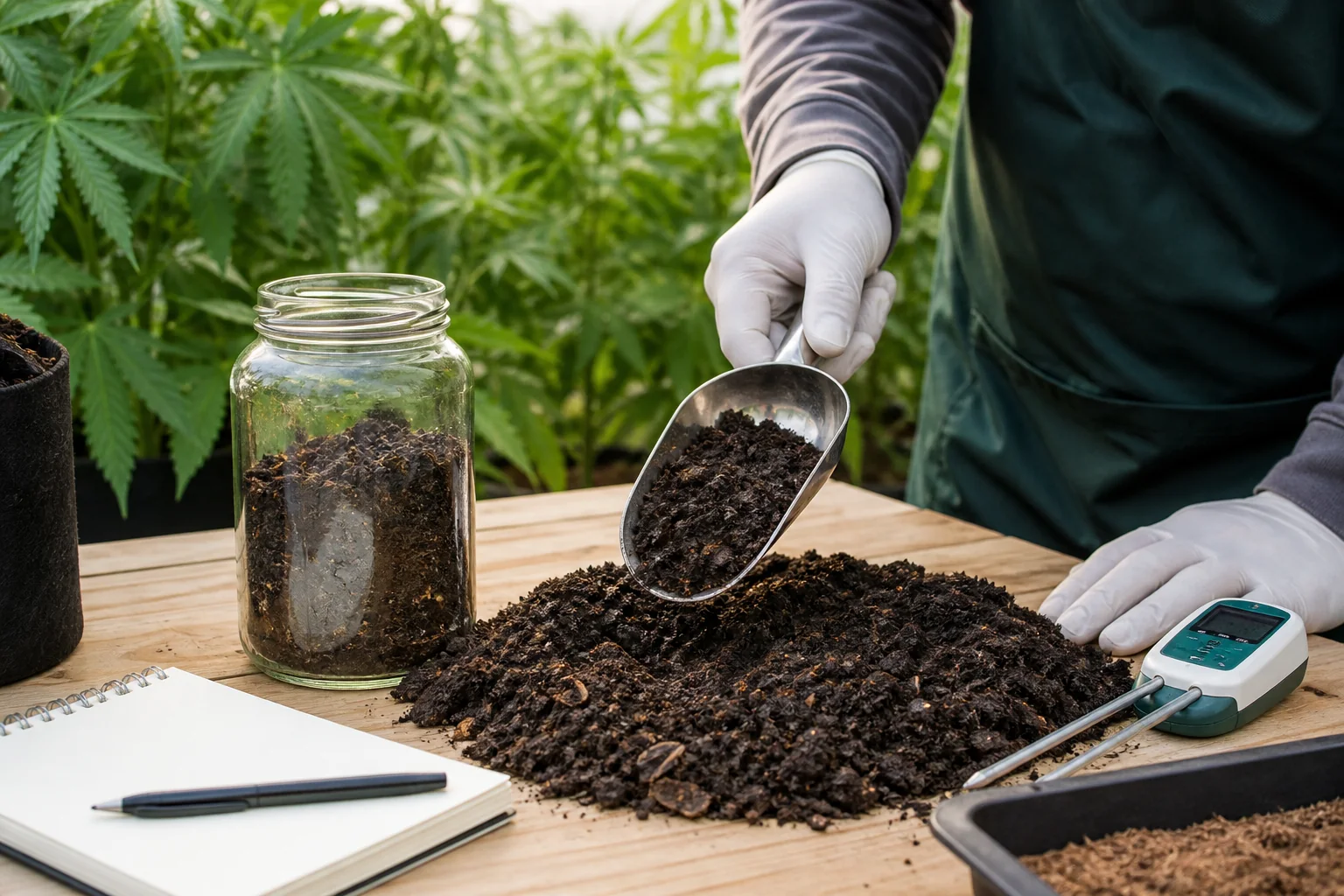
If you want the cleanest evidence-based answer, it is this: coffee grounds are not a good stand-alone fertilizer for cannabis, and raw or freshly spent grounds are usually a poor direct amendment for beginner growers. They can be useful indirectly—mainly as a compost ingredient, a vermicompost feedstock, or a small part of a mature organic soil system—but the internet habit of dumping espresso pucks straight into cannabis pots is not supported by the better horticultural literature. Peer-reviewed reviews on spent coffee grounds repeatedly note the same tension: they can improve some soil properties, yet raw grounds often limit plant growth because of phytotoxic compounds and nitrogen immobilization. Extension guidance from Oregon State and Washington State also warns that uncomposted grounds can tie up nitrogen, inhibit germination, slow growth, and create compaction or water-repellent layers when overapplied.
That distinction matters more with cannabis than many people realize. Cannabis is a fast-growing, nutrient-responsive crop, but modern research also shows that more fertilizer is not automatically better. In controlled-environment studies, pushing nutrient concentrations higher did not increase flower yield or cannabinoid content, and excess phosphorus or excessive fertigation mostly raised nutrient accumulation in the root zone instead of performance. In field guidance, hemp grown for flowers still has meaningful nitrogen demand, so a weak, slow, biologically mediated input like coffee grounds cannot realistically function as a complete feeding program on its own.
So here’s how I’d put it simply: coffee grounds can help the soil food web when handled properly, but they are not a magic cannabis fertilizer. For most home growers, the safest rule is: compost first, grow second. If you are using salts in coco or hydro, coffee grounds are almost always the wrong tool. If you are building outdoor living soil or a compost pile, they can be useful—just not in the lazy, myth-heavy way they are usually promoted online.
One more scientific note before we go deeper: in the literature I reviewed, the coffee-grounds evidence comes from general horticulture and soil science, while the cannabis evidence comes from hemp nutrient guides and controlled-environment cannabis studies. I did not find a peer-reviewed study directly testing spent coffee grounds on drug-type cannabis under production conditions, so the best answer here is a careful synthesis rather than a crop-specific trial report. That is exactly why this topic gets so muddy online: growers are borrowing gardening advice from tomatoes, roses, and compost forums, then stretching it into cannabis certainty.
Important: Coffee grounds make more sense as a compost ingredient or soil-building input than as a direct cannabis feed. The closer a grow gets to a precision system, the less room there is for loose, unprocessed amendments.
What coffee grounds really do in soil
When people say “coffee grounds,” they usually mean used or spent coffee grounds left after brewing. That detail matters. The most common garden advice is not talking about dry, unbrewed coffee from your bag; it is talking about spent grounds after extraction. Oregon State notes that after brewing, spent grounds are close to pH neutral, around 6.5 to 6.8, which is why the popular claim that they are a reliable acidifier is mostly wrong. Washington State says experimental work on coffee-ground composting and decomposition shows pH can range from mildly acidic to somewhat alkaline, and whatever change occurs tends to stay close to the grounds rather than transforming the entire root zone.
Nutritionally, coffee grounds are not empty. Oregon State says they contain roughly 1% to 2% nitrogen plus minor amounts of potassium, phosphorus, calcium, magnesium, and trace elements, but also emphasizes that they are not a major source of plant nutrition and do not supply nutrients in quantities large enough to satisfy crop needs by themselves. Washington State’s extension bulletin likewise shows spent grounds and espresso waste contain protein and meaningful mineral fractions, with potassium often the largest mineral component, followed by phosphorus, magnesium, and calcium. That is why coffee grounds feel plausible as a fertilizer: there really is plant nutrition in there. The problem is that presence of nutrients is not the same thing as reliable availability to cannabis roots on grower timescales.
So what do coffee grounds do well? Mostly, they behave like an organic amendment rather than a precision fertilizer. Reviews report improved water retention, lower bulk density, and better aggregate formation in some soils after spent coffee ground addition. Washington State notes that the decomposition of grounds can eventually improve nutrient availability and that earthworms readily consume them in open soil systems. Oregon State similarly frames coffee grounds as something that can improve soil structure because they support microbial activity, which then produces “microbial glues” that help soil aggregate and drain better. In other words, coffee grounds often work best when they are helping the soil ecosystem, not when they are trying to impersonate bottled veg nutrients.
Remember: A material can contain nutrients on paper and still behave badly in a pot. Availability, timing, texture, and root-zone conditions matter more than the label myth.
Now for the part the myths skip: raw spent coffee grounds can suppress plant growth. A 2024 review in Agronomy concluded that raw spent coffee grounds may improve certain soil-health attributes but that plant growth is often limited by phytotoxicity and nitrogen immobilization. A 2023 mini-review in Clean Technologies and Environmental Policy went even harder, concluding that raw SCG may help soil properties but not plant growth, and that even low-rate use for plant production is not recommended, with composting, vermicomposting, or pyrolysis needed to overcome the negative effects.
That is not just review-level caution. The frequently cited Hardgrove and Livesley study tested five horticultural plants across multiple soils and spent coffee ground rates and found that all horticultural plants grew poorly in response to SCG, regardless of soil type and even when fertilizer was added. The authors found better water-holding capacity, but also reduced plant growth, evidence of nitrate immobilization, and reason to suspect phytotoxic effects rather than simple pH problems. This is exactly the kind of result that confuses gardeners: the soil can look “richer” on paper while the plant performs worse in real life.
Why does that happen? The best-supported explanations are twofold. First, as the grounds decompose, microbes temporarily grab nitrogen for their own metabolism, reducing what the plant can access in the short term. Oregon State explicitly warns that as uncomposted grounds break down, nitrogen gets tied up by soil microorganisms, which is why the university recommends adding another nitrogen source if they are incorporated raw. Second, retained compounds such as caffeine, phenolics, tannins, and related phytotoxic substances can reduce germination and growth in sensitive contexts. The 2024 review summarizes this as low-rate benefits in some cases but inhibition at higher rates, likely because of phytotoxic substances plus induced N immobilization.
Definition
Nitrogen immobilization
This is the short-term lock-up that happens when microbes pull available nitrogen out of the medium while breaking down fresh organic material, leaving less nitrogen available to the plant.
There is one important nuance here, because the science is not a cartoon. Coffee grounds are not always evil. Some reviews note that low application rates can improve yield or quality in some crops, and results can vary by climate, crop species, and management. The 2024 Agronomy review notes that low raw-SCG rates below roughly 10% by weight sometimes enhanced crop performance, but higher rates led to inhibition; it also highlights climate effects, with one field study improving lettuce and radish productivity in warm, drier conditions while reducing productivity in cooler, wetter conditions for other crops. That means coffee grounds should be understood as a variable organic amendment with a narrow margin for misuse, not as a universally toxic waste or a universally beneficial “natural fertilizer.”
Still, for cannabis advice, that nuance should not tempt growers into direct application. A crop can be theoretically responsive to small, carefully managed SCG inputs and still be a bad candidate for trial-and-error in a 3-gallon fabric pot under expensive lights. That is especially true because cannabis growers often work in small containers, peat-based mixes, coco blends, or high-input systems where the downsides of compaction, surface crusting, and temporary nutrient tie-up show up quickly and dramatically. Washington State warns that fresh grounds are demonstrably phytotoxic to multiple plants and specifically says they are not recommended as a direct amendment or mulch; it also warns not to use them around seeds because reduced germination and reduced early growth are well documented.
Composting changes the story. Washington State says composted coffee grounds can provide a rich nutrient supply once applied to soil and recommends keeping grounds at no more than 20% of compost volume. Oregon State gives similar guidance and warns that higher proportions can be toxic to plants. A 2024 study on sunflower seedlings found that raw SCG at 35% or higher strongly reduced germination and seedling development, while SCG composted for six months was non-toxic and effective at high inclusion rates. A 2025 report on mineralization further suggests that both composted and non-composted SCG may immobilize nitrogen for a substantial initial period, which reinforces the idea that coffee grounds are not a fast-release feed even after treatment.
QuestionQuestion sent by: Emma, by email.
If I already compost my coffee grounds with leaves and yard waste, can that compost go into an outdoor cannabis bed?
Yes, that is the safer way to use them. The key is that the coffee grounds should arrive as one processed ingredient inside finished compost, not as a fresh, heavy amendment dumped straight into the bed.
The real scientific takeaway is not “coffee grounds are bad.” It is: coffee grounds need processing, dilution, and context. When growers skip those three things, the myth machine takes over. They see “contains nitrogen” and forget to ask whether that nitrogen is plant-available now, whether the rate is safe, whether the medium can buffer the input, and whether their crop actually benefits from slow, microbially mediated release. Cannabis makes all of those questions more important, not less.
Why cannabis makes this trick more complicated
Cannabis is not a generic houseplant, and that is the core reason coffee-ground folk wisdom gets messy fast. University and controlled-environment research consistently show that cannabis and hemp are strongly responsive to nutrient management, but they are also vulnerable to imbalance, root-zone chemistry errors, and wasted input. University of Florida guidance summarizes regional recommendations of about 100–150 lb N/acre for CBD/flower production under field conditions, while also emphasizing soil and tissue testing and warning against overapplication. In controlled hydroponic cannabis, researchers have shown that yield responds to N and P optimization but not endlessly higher feeding, and later work found that elevating phosphorus and overall nutrient concentration did not improve yield or quality.
That matters because coffee grounds are the opposite of a controlled nutrient program. They are slow, variable, organic, and microbially mediated. Cannabis can absolutely thrive in organic systems, but organic cannabis still depends on predictable mineralization, stable pH, good aeration, and balanced inputs. Coffee grounds do not give you a clean NPK ratio, a known release curve, or a reliable correction for a visible deficiency. Oregon State is blunt on this point: grounds contain some nitrogen and micronutrients, but they are not a major source of plant nutrition and are best at improving soil rather than feeding plants directly. For a crop as valuable and unforgiving as cannabis, “minor source of nutrition” is not enough to justify using them as a primary fertilizer.
Cannabis also lives and dies by the root-zone environment. Field hemp guides repeatedly place ideal soil pH in the 6.0 to 7.0 range, while controlled-environment and soilless studies often work in the roughly 5.5 to 6.5 range, depending on substrate. A 2025 review of cannabis soilless media notes substrate pH commonly around 5.8 to 6.8, and NCSU-related hemp work cited recommended ranges around 5.5 to 6.5 for substrate management. So when a grower says, “I’ll use coffee grounds to lower pH for my weed,” they are usually trying to solve the wrong problem with the wrong tool. Coffee grounds do not reliably acidify the medium, and even if they did, they would do so in a messy, localized, biologically variable way rather than as a precision adjustment.
That is before we even get to nutrient antagonism. Utah State’s hemp deficiency guidance says magnesium deficiency may appear when there is excess potassium or calcium, or where soils are acidic, cold, overly irrigated, or otherwise stressful. Rutgers likewise notes that hemp is sensitive to Mg deficiency and that imbalance between magnesium and calcium can induce deficiency symptoms. In the medical cannabis genotype study by Saloner and colleagues, potassium supply interacted with calcium and magnesium uptake, showing direct competition in nutrient acquisition. That means a grower can see deficiency-like symptoms in cannabis even when “food is present,” simply because the root zone is chemically out of balance. Coffee grounds are a poor rescue tool in that scenario because they add an unquantified, slow-release organic input instead of solving the real root-zone issue.
Definition
Nutrient antagonism
This is when one nutrient is present in excess and interferes with the uptake of another, so a plant can show deficiency symptoms even when nutrients are technically present in the root zone.
There is another cannabis-specific reason to be skeptical: modern cannabis often does not reward excess fertilization. Hershkowitz’s controlled-environment thesis found that excessive nutrient supply did not increase flower or cannabinoid yield, and nutrient deprivation before harvest did not improve flower quality or total cannabinoid yield either. The 2025 Frontiers paper on elevated root-zone phosphorus reached a similar conclusion: cannabis tolerated higher nutrient concentrations, but extra P and heavier fertigation did not translate to better output. That means cannabis growers already have a tendency to spend money and effort pushing inputs past the point of return. Coffee grounds, then, are not just “an organic option”; they can become one more input added on top of a root zone that may already be overcomplicated.
A lot of growers misread this entire category. A plant gets pale lower leaves, and the internet says “coffee grounds for nitrogen.” A flowering plant gets weird interveinal chlorosis, and the internet says “Epsom salt.” A sluggish container gets poor water penetration, and the grower responds by top-dressing more organic matter. But cannabis is not a crop where symptom-chasing works well. The same visual symptom can reflect pH drift, excess EC, low root oxygen, antagonistic nutrient ratios, cold wet media, overliming, salt buildup, or actual deficiency. The literature on coffee grounds and cannabis together points to the same core discipline: test first, diagnose second, amend last.
Advice: When a cannabis plant looks off, slow down before adding household fixes. The medium, watering pattern, pH, EC, and nutrient ratios usually tell the real story faster than internet shortcuts do.
So if you are looking for a one-line rule, here it is: coffee grounds are at their best in broad, biology-rich soil management, and at their worst as a “quick fix” inside a precision cannabis grow. That is why a compost pile loves them more than a flowering tent does.
Strains, chemovars, indoor, outdoor
Let’s clean up one piece of vocabulary first, because it helps the entire discussion. In popular cannabis culture, people say “strains.” In the scientific literature, the better terms are usually cultivar or chemovar. A 2020 peer-reviewed article notes that “strain” is common vernacular but not the correct scientific term for plant varieties in this context, and a 2025 review defines chemovar as cannabis germplasm categorized by cannabinoid dominance and then differentiated further by terpene profile. That distinction matters because when growers ask, “Do some strains like coffee grounds more than others?” the scientific version of the question is really: Do different cannabis genotypes or chemovars handle nutrient environments differently? The answer to that broader question is yes.
Definition
Chemovar
A chemovar is a cannabis type grouped more by its chemical profile, especially cannabinoids and terpenes, than by the loose commercial labels people often use in everyday strain talk.
We now have good evidence that cannabis genotypes respond differently to mineral nutrition. In the 2019 Frontiers study on potassium supply, two medical cannabis genotypes responded differently across the same K treatments: one genotype showed damage at 240 ppm K while another was stimulated, and the researchers explicitly concluded that growth responses varied between genotypes, revealing genetic differences in cannabis mineral nutrition. In a 2025 Journal of Experimental Botany paper, THC-dominant and CBD-dominant drug-type chemovars differed in sink strength, biomass partitioning, phosphorus handling, and nutrient-assimilation behavior, with the THC-dominant chemovar producing higher flower biomass and the CBD-dominant chemovar hyperaccumulating phosphate in sink organs under the tested conditions.
So yes, cannabis is not nutritionally uniform across cultivars and chemovars. But that does not mean there is evidence that one named cultivar “loves coffee grounds” while another “hates coffee grounds.” The genotype research is telling us something subtler and more useful: different cannabis plants can have different uptake patterns, sensitivities, partitioning strategies, and tolerance windows under the same nutrient regime. That is precisely why a blunt, variable amendment like raw coffee grounds is such a risky experiment. If named cultivars already respond differently to carefully measured potassium or phosphorus treatments, it is hard to justify assuming that unmeasured coffee waste will behave predictably across “Gelato,” “Blue Dream,” “Runtz,” or a CBD cultivar in the same soil.
In practice, the medium and environment matter more than the strain name when you are deciding whether coffee grounds belong in the grow. Outdoor mineral soil, established raised beds, and biologically active living soils have more buffering capacity. They contain larger microbial and faunal communities, more total volume, and more physical room for a small mistake to disappear. In those settings, composted or properly diluted coffee-ground inputs can become one small part of a broader organic fertility program. Even then, reviews and extension documents still favor composting first and warn against heavy raw application.
Indoor container culture is a different world. A 3-gallon or 5-gallon fabric pot is a tiny artificial ecosystem. Oxygen, moisture distribution, pH, and nutrient availability can swing quickly. Finely textured coffee grounds can compact, mat together, and interfere with air and water movement if used as a thick stand-alone surface layer, which Washington State warns against directly. For a cannabis plant in a constrained indoor root zone, that physical problem is often just as important as the nutritional one. When a grower says, “My soil looks rich but the plant seems sad,” the answer is often in the physics of the medium, not just the chemistry.
High tunnels and greenhouse soils deserve their own warning label. Cornell’s hemp guidance says high-tunnel soil management should limit calcium, phosphorus, and magnesium inputs because these nutrients often become excessive and then suppress uptake of other key elements like potassium and manganese. Minnesota Extension reports that in a 2023 study of 100 farms, half of high tunnels had pH high enough to limit nutrient uptake, and nearly half had some salt accumulation. That means a grower working in protected culture is often fighting pH rise and nutrient accumulation already. In that context, untested “natural” amendments are not automatically safer; they can become one more blind addition to a root zone that needs soil tests, irrigation-water awareness, and restraint.
Soilless indoor systems are the least friendly place for coffee grounds. The soilless cannabis literature emphasizes substrate choice, nutrient formulation, pH management, EC control, and reproducibility. A 2025 review of soilless media notes that standardized cultivation increasingly relies on inert or semi-inert systems precisely for control and repeatability, and the University of Guelph response-surface work shows how tightly yield can be tied to nutrient solution optimization in deep-water culture. From that evidence, the logical inference is straightforward: coffee grounds are a poor fit for hydro, coco, rockwool, and precision fertigation systems, because these systems are built around measurable soluble nutrition, not decomposing organic particles.
QuestionQuestion sent by: Nolan, by email.
Does this mean coffee grounds are safer in a big outdoor bed than in coco or a small indoor fabric pot?
Usually yes, because larger outdoor soil systems have more buffering capacity and more biological activity. Even there, the safer move is compost first rather than using raw grounds as a direct amendment.
What about “indica vs sativa” style thinking? It is probably less useful than growers hope. Those labels are already blunt and often commercially inconsistent, while the nutrient literature is pointing toward cultivar- and chemovar-specific physiology rather than simplistic category rules. The smarter answer is not, “sativas hate coffee grounds and indicas love them.” It is: the more precise and high-value your production system is, the less sense raw coffee grounds make; the more compost-driven and biologically buffered your system is, the more room there is for coffee grounds as a processed ingredient rather than a direct fertilizer.
How to use coffee grounds without wrecking a grow
If you still want to use coffee grounds around cannabis, the best way is to stop thinking of them as a primary fertilizer and start treating them as a managed organic input. There is a hierarchy here, and it is worth respecting.
The safest route is composting. Washington State recommends using no more than 20% coffee grounds by volume in a compost pile, and Oregon State gives the same ceiling while noting that higher amounts can be phytotoxic. Oregon State suggests a compost mix of three parts leaves, one part fresh grass clippings, and one part coffee grounds by volume, with weekly turning and a composting period of roughly three to six months. That is not glamorous advice, but it is the most defensible one in the literature. A finished compost made with a sensible proportion of coffee grounds is far more compatible with cannabis than direct raw grounds.
The next-best route is vermicomposting or mature biological processing, but with care. The broad story in the coffee-ground literature is that pretreatments such as composting and vermicomposting reduce phenolics and other phytotoxic components and make the material more usable in plant production. At the same time, WSU warns against simply dumping coffee grounds into a confined worm bin because excessive coffee-ground additions can injure or kill earthworms in vermicomposting bins. That is a great example of how internet gardening collapses nuance: “worms love coffee grounds” is true in some open-soil contexts, yet “therefore fill the worm bin with espresso sludge” is bad advice. Small, mixed, well-balanced additions work better than heavy single-material loads.
A third route, acceptable mainly outdoors, is thin mulch under a coarser mulch. Washington State advises that if nutrients are low according to a soil test, coffee grounds can be applied in a thin layer no more than half an inch, then covered with a thicker coarse mulch such as wood chips. The reason is practical: finely textured grounds compact easily. Arizona Extension gives similar guidance, warning that pure coffee-ground mulch can limit moisture and air movement and recommending a thin coffee-ground layer covered with a coarser mulch. For cannabis, this approach makes the most sense in outdoor beds, around established soil-grown plants, and only where you are not relying on the grounds to do the heavy lifting nutritionally.
What I would not recommend in a cannabis grow is the popular “top-dress the pot with coffee grounds every morning” move. In small containers, that can create exactly the problems the extension literature describes: surface compaction, impaired infiltration, patches of prolonged moisture, and uneven decomposition. It also makes diagnosis harder. When you have coffee crust, worm castings, bloom top dress, mulch, and runoff salts all happening at once, you lose your clean read on what the medium is actually doing.
Warning
Fresh coffee grounds can quietly turn a small pot into a messy root-zone problem
In tight indoor containers, the damage often shows up as crusting, uneven water penetration, excess moisture in the wrong places, and slower growth before the grower realizes the medium itself is part of the issue.
For seedlings and clones, the answer is easier: don’t do it. Washington State explicitly says not to use coffee grounds in areas where you are growing plants from seed because reduced germination and early growth suppression are well documented. Cannabis seedlings and cuttings are already delicate with respect to moisture, EC, and oxygen around the root zone. There is no good reason to bring coffee-ground variability into that stage unless you are conducting a controlled experiment and are happy to lose plants.
For flowering plants, I would still avoid raw grounds. Not because flowering cannabis is uniquely allergic to coffee, but because the crop is already transitioning away from a strong vegetative nitrogen emphasis, and coffee grounds still do not offer a predictable bloom-stage nutrient profile. They may eventually contribute some mineral nutrition through decomposition, but that is not the same thing as a bloom strategy. Modern cannabis studies are already showing that excessive nutrient loading does not improve cannabinoids or yield, so there is little rationale for adding another poorly quantified amendment in late flower.
Here’s the simplest way I’d break it down:
If you grow in hydro, DWC, coco, rockwool, or drain-to-waste, skip coffee grounds entirely and keep your system clean, soluble, and measurable. That follows directly from the logic of soilless cannabis production and nutrient optimization research.
If you grow in indoor organic soil in pots, only use coffee grounds after they have been processed into finished compost or mature vermicompost, and even then treat them as a minor ingredient, not the center of the fertility plan.
If you grow in outdoor living soil or raised beds, coffee grounds can have a place as part of the compost stream or as a thin layered mulch under coarse material, especially when your soil test actually shows you need more organic matter rather than more random nutrients.
If your goal is to fix a visible cannabis deficiency quickly, coffee grounds are almost never the right answer. They are too slow, too variable, and too indirect. Diagnose the deficiency, test pH and EC, review irrigation and recent feed history, and then use a targeted correction if needed.
Do
Use coffee grounds as a processed input
Route them through compost, mature vermicompost, or a buffered outdoor soil system where biology and volume can absorb the material more gracefully.
Avoid
Do not use them like a quick cannabis fix
Avoid raw top-dressing, seedling use, small-pot guesswork, and deficiency chasing with coffee grounds when the real issue may be pH, EC, watering, or nutrient balance.
That is the part worth keeping in mind: coffee grounds belong in system design, not symptom panic. If you want faster greener growth next week, use a real feeding plan. If you want healthier organic soil over months, coffee grounds can have a supporting role.
Master Tip: If coffee grounds are going anywhere near cannabis, they should usually be entering the grow through compost, mature vermicompost, or a well-buffered outdoor soil system, not as a fresh top dress.
My experience with coffee grounds and Epsom salt
I had two cannabis plants that looked like sisters at the start: same age, same light schedule, same room, same ambition. One was in a mature organic soil blend that already had compost, aeration, and enough biological life to smell alive when I watered it. The other was in a smaller container with a lighter base mix, and I got a little too clever with the “free fertilizer” idea. Every morning coffee turned into a little puck of grounds, and instead of sending that material into the compost, I started top-dressing the pot directly because, on paper, it sounded harmless: organic matter, trace minerals, a tiny bit of nitrogen, what could go wrong? The science says quite a lot, actually. Spent grounds do contain nutrients, but they are a weak direct nutrient source, and uncomposted grounds can tie up nitrogen and physically compact when overused.
At first nothing dramatic happened. That is one reason coffee-ground mistakes are sneaky. They rarely hit like a bottle-nutrient overdose where the leaves taco overnight. Instead, the grow started getting “off.” The coffee-ground pot dried strangely on top but stayed weirdly damp underneath. Water stopped soaking in evenly. The plant did not crash, but it looked less eager than its sister. Internode spacing got awkward. Lower leaves lost that healthy confident green. The stem did not scream disaster, but the whole plant stopped looking like it wanted to race. That is exactly the kind of slow underperformance you would expect from a medium issue plus temporary nutrient tie-up rather than from a clean deficiency. WSU and Arizona extension both warn that thick coffee-ground layers can compact and restrict air and water movement, while Oregon State warns that direct, uncomposted grounds can temporarily immobilize nitrogen and slow growth.
Meanwhile, the other plant—the one that only “saw” coffee through finished compost already integrated into the soil—did not get magical superpowers. It just behaved normally. That is the whole point. The coffee-ground hype online is often framed as if cannabis will suddenly explode with vigor. But the realistic upside of coffee, when processed properly, is not fireworks. It is support for a stable soil-food-web environment over time. The literature is much more supportive of composted coffee grounds than direct raw application, and that difference lined up with what I was seeing.
So I backed off the hero move. I scraped away the crusting top layer, stopped feeding the pot caffeine cosplay, and went back to basics: clean irrigation, gentler wet-dry cycles, better airflow in the medium surface, and a compost-driven approach instead of direct grounds. Once you stop asking the wrong amendment to solve the wrong problem, cannabis often tells you the truth pretty quickly. The pot began wetting more evenly, the new growth looked less stressed, and the plant started to behave more like a cannabis plant and less like a confused mushroom bed. That outcome fits the research better than the myth does. Coffee grounds can support soil biology after processing, but in direct use they can hurt plant performance despite improving some soil metrics on paper.
Later in the same cycle, the conversation changed from coffee to magnesium. The older fan leaves on one plant started showing the kind of interveinal chlorosis that makes growers grab their phones and type “mag deficiency weed” at 2 a.m. That response is understandable, because Rutgers says hemp is quite sensitive to magnesium deficiency, and Utah State notes that magnesium problems can show up when there is too much potassium or calcium, or when the root zone is cold, acidic, overly irrigated, or otherwise limiting uptake. In the cannabis genotype literature, potassium also competes with calcium and magnesium uptake. So the first move in a serious grow is not “add random Epsom.” The first move is “what changed in the root zone?”
The clue was not just the leaf symptom. The clue was the context. I was using very soft water, the bloom feed had leaned a little too hard toward PK confidence, and the runoff picture suggested the plant was not in a beautifully balanced root-zone chemistry moment. That is exactly where Epsom salt can look like a miracle when it is actually just a targeted correction. Epsom salt is magnesium sulfate, not a universal cannabis enhancer. University of Minnesota says it can be a good magnesium source only when a magnesium deficiency is actually present, and warns that adding too much magnesium can inhibit calcium uptake. WSU’s classic myth-busting bulletin makes the same broader point: Epsom salts mainly help intensively produced crops suffering from magnesium deficiency, and excessive use can scorch foliage or pollute leachate.
So I took the boring-but-right route. I corrected the underlying feed balance, used a light magnesium sulfate correction rather than a dramatic internet dose, and watched the plant rather than congratulating myself immediately. New growth did not suddenly become emerald royalty overnight, but the symptom progression slowed, the leaf color stabilized, and the plant stopped sliding backward. That is the realistic Epsom experience growers should understand. It is not wizard dust. It is a conditional magnesium-and-sulfur supplement that can be useful in the right situation and counterproductive in the wrong one.
QuestionQuestion sent by: Mason, by Facebook.
If Epsom salt helped once, can I keep using it every time a plant starts looking pale?
No. Epsom salt makes sense only when magnesium deficiency is actually part of the problem. If the real issue is pH drift, excess potassium, overwatering, or root-zone imbalance, repeating Epsom will not solve the cause.
And that brings me back to coffee grounds. Both the coffee-ground myth and the Epsom-salt myth are powered by the same grower impulse: see symptom, throw household item, hope for redemption. The science points to a more sober process. Coffee grounds are best as compost ingredients. Epsom salt is best as a specific Mg/S correction when deficiency is supported by symptoms and root-zone logic. Cannabis rewards growers who can separate “organic” from “appropriate.” A folk remedy can be natural and still be the wrong move.
The myths growers keep repeating
Coffee grounds make cannabis soil acidic
This is one of the biggest and most persistent misses. Oregon State says spent coffee grounds are close to pH neutral after brewing, around 6.5 to 6.8, and specifically calls it a myth that they will lower soil pH in a useful way. Washington State adds that decomposing grounds can test mildly acidic to somewhat alkaline depending on conditions, and any pH change stays local and unstable rather than acting like a dependable acidifying amendment. So if your cannabis medium is drifting alkaline, don’t expect coffee grounds to do the job that proper water management, fertilizer choice, or sulfur-based pH correction was built to do.
Coffee grounds are basically free nitrogen fertilizer for weed
They do contain nitrogen, but that does not make them a good nitrogen fertilizer in the way growers mean it. Oregon State states clearly that grounds contain about 1%–2% nitrogen, yet they are not a major plant nutrient source and can actually lead to temporary N tie-up as microbes decompose them. Recent reviews also identify induced nitrogen immobilization as one of the main reasons raw SCG often suppresses plant growth. That means coffee grounds are not the cannabis equivalent of a clean veg feed. They are an organic residue with some nitrogen content and a potentially awkward release pattern.
If coffee grounds are good in compost, they must be good straight in the pot
That leap is exactly where a lot of grows go sideways. Composting transforms materials. It dilutes them, heats them, decomposes them, changes their chemistry, and hands the final product back as a more biologically stable amendment. Washington State and Oregon State both recommend keeping coffee grounds to 20% or less of compost volume, which is already a sign that even in compost they need moderation. The coffee-ground literature then goes further: raw grounds can be phytotoxic, while composting or vermicomposting can remove or reduce the compounds responsible for growth inhibition. Good compost is not just “the same material later.” It is a processed product with a different agronomic personality.
Coffee grounds are great for seedlings, clones, and tiny pots
This one deserves a hard no. Washington State specifically warns against using coffee grounds anywhere seeds are being grown because reduced germination and suppressed early growth have been observed in multiple experiments. The 2024 sunflower work also showed severe damage to germination and seedling development at higher raw-SCG concentrations. Cannabis seedlings and rooted cuttings already need stable moisture and oxygen. Coffee grounds add unnecessary variability at the most vulnerable stage of the crop.
A thick coffee-ground top dress works like mulch
Only in the “technically yes, until it wrecks water movement” sense. Washington State says thick stand-alone layers of grounds are a bad idea because the fine texture compacts and interferes with moisture and air movement. Cornell and Arizona guidance echo the same principle: if coffee grounds are used as mulch, they should be a thin layer and ideally covered with coarser mulch. That advice becomes even more important in cannabis containers, where the root zone is small and top-layer physics can affect the entire watering pattern.
One cannabis strain just loves coffee grounds
There is no good peer-reviewed evidence for that kind of claim. What the research does show is that cannabis genotypes can differ in nutrient responses, nutrient uptake, and biomass partitioning. That means cultivar-specific or chemovar-specific fertility management is real, but it does not justify folklore like “this Kush line loves espresso.” The scientifically safe statement is: different cannabis genotypes respond differently to nutrition, so unquantified inputs become more risky, not less.
Epsom salt is a universal cannabis fix
No. Epsom salt is magnesium sulfate, and it should be treated like a specific supplement, not a spiritual ritual. Minnesota Extension says there is no evidence it increases productivity unless the soil is actually magnesium deficient, and warns that excess magnesium can inhibit calcium uptake and even worsen problems. WSU’s review similarly points out that the documented benefits occur mainly in magnesium-deficient, intensively produced crops, while excessive application can cause leaf scorch or contribute to pollution. In cannabis terms: use it when the plant and root-zone logic point to Mg deficiency, not because the internet told you yellow leaves deserve spa salts.
The grower questions that matter most
Are coffee grounds good fertilizer for cannabis
Not as a primary fertilizer, and not in their raw, freshly spent form for most grows. The evidence supports them far more strongly as a compost ingredient or processed organic amendment than as a direct cannabis feed. If you want a high-confidence recommendation, use them in compost at moderate proportions and let the finished compost do the real work.
Can coffee grounds make cannabis stronger, bigger, or more potent
There is no direct cannabis evidence showing that coffee grounds themselves increase potency. At best, they may improve soil structure or microbial function in certain organic systems, which can indirectly support healthier growth. But controlled cannabis research shows that even high nutrient concentrations do not automatically improve yield or cannabinoids, so the idea that coffee grounds create “stronger weed” is more marketing vibe than demonstrated agronomy.
Are coffee grounds better for vegetative growth than flowering
If they are going to help at all, they make more conceptual sense in long-horizon soil building than in late-stage flowering management, because their benefits depend on decomposition and soil biology. But since raw grounds can immobilize nitrogen and suppress growth, even vegetative use should be through compost or another processed route. In flowering, they are simply too slow and too imprecise to be a dependable strategy.
Are coffee grounds better outdoors than indoors
Usually, yes—but only in the sense that outdoor beds and large living-soil volumes are more buffered and more forgiving. Outdoor or raised-bed systems can process small, compost-driven coffee inputs more gracefully than small indoor containers. Indoors, the risks of compaction, uneven watering, and root-zone imbalance become much sharper. High tunnels complicate the story further because pH and salts can already accumulate over time.
Do coffee grounds work the same for every cannabis plant
No. Cannabis genotypes and chemovars differ in nutrient response, but that does not translate into a validated coffee-ground preference list. The useful lesson is not to hunt for a “coffee-friendly strain.” The useful lesson is to avoid variable direct amendments in a crop where nutrient sensitivity can already differ genetically.
Should I use coffee grounds in coco, hydro, or DWC
No. That is the wrong category of input for those systems. Soilless and hydroponic cannabis production depends on precise soluble nutrition, stable pH, and repeatable root-zone chemistry. Decomposing coffee particles do not fit that logic.
Should I use Epsom salt when I see yellow leaves
Only if the symptom pattern and root-zone context support magnesium deficiency. Minnesota Extension and WSU both advise against casual use without evidence of deficiency, and cannabis nutrient guides emphasize that Mg deficiency can be induced by nutrient imbalance, irrigation, temperature, or pH rather than simple absence of Mg itself. Diagnose first. Supplement second.
What is the best rule to remember
If I had to reduce it to one line, it would be this: put coffee grounds in the compost, not in the panic. That single habit will save more cannabis grows than any viral trick. It respects both the soil science and the reality that cannabis is an expensive crop to freestyle.
Tip: If a household fix sounds easier than testing, it is usually less precise than testing too.
Checklist
Quick recap before you use coffee grounds around cannabis
- Compost coffee grounds before using them.
- Do not use raw grounds as a daily top dress.
- Do not use coffee grounds to fix pH fast.
- Keep coffee grounds out of coco, hydro, and DWC.
- Diagnose the problem before reaching for Epsom salt.
Share this article
A quick overview of the topics covered in this article.
Follow us
Latest articles
October 25, 2026
October 25, 2026