
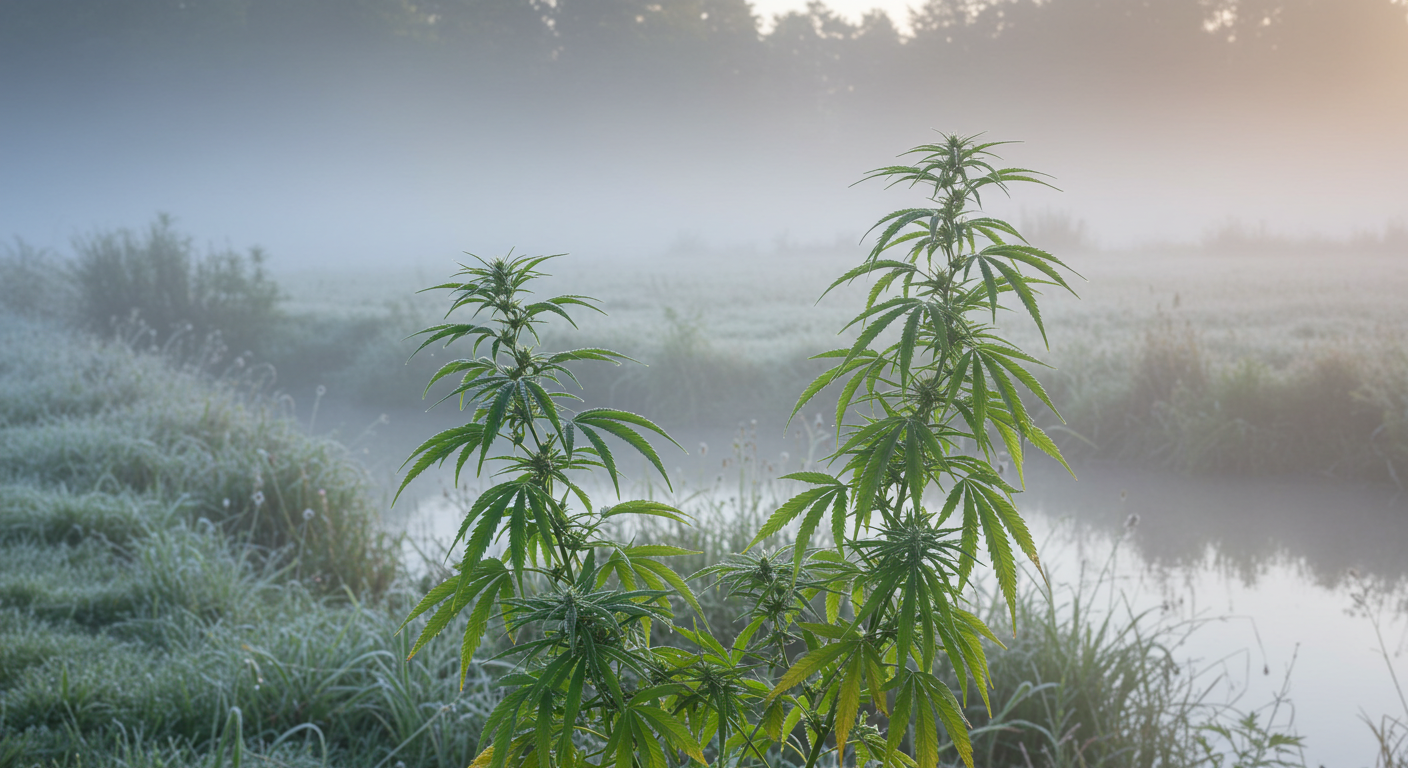
Surviving the Cold: How Frost Affects Outdoor Cannabis Maturation
A single chilly night does not automatically ruin outdoor cannabis. Mature, well-established plants often tolerate a light frost better than new growers expect, especially if the event is brief and the following day is dry and sunny. But the margin is narrow: seedlings and soft vegetative growth are far more vulnerable, repeated freeze-thaw cycles are worse than one passing frost, and once temperatures move from “light frost” into a true hard freeze, injury escalates fast. Extension guidance built around hemp repeatedly lands in the same neighborhood: mature plants may get through roughly 29–32°F for a short period, 25–28°F can injure vegetation, and 24°F or colder can cause heavy damage.
At the tissue level, frost is not just “cold air on leaves.” It is a freezing event in which water turns to ice, first outside cells or in apoplastic spaces and then, in more severe cases, inside cells themselves. That process dehydrates tissues, distorts membranes, and can physically rupture cellular structures. The most destructive injury often happens not when the frost first appears, but when the event is severe enough, long enough, or repeated enough that membranes fail and tissues cannot rehydrate after thaw.
For growers, the biggest post-frost problem is often not an instant collapse in THC or CBD. The real losses usually come indirectly: frozen or bruised tissue, stalled maturation, forced early harvest, trichome damage, trapped moisture, and a rising risk of bud rot and microbial contamination. Dense, late-flower buds are especially exposed because cool temperatures, high humidity, and free water favor Botrytis and other fungi.
There is also no strong scientific basis for the popular idea that frost reliably “boosts potency.” Short-term cold exposure around 4°C did not significantly change four major cannabinoids in one recent hemp study, and a University of Vermont cold-tolerance trial found that light frosts did not correlate with lower total potential CBD. On the other hand, more severe cold acclimation and cold stress conditions in other hemp work were associated with reduced total CBD and total THC. In plain English: light cold can change color and appearance, but frost is not a dependable potency hack.
The practical takeaway is simple. If the frost was light, brief, and your flowers dried quickly after sunrise, you may be able to keep maturing the crop. If the event was hard, repeated, windy, or wet—and especially if buds are already dense and near finish—your decision shifts from “Can the plant survive?” to “Can I preserve clean, usable flower before rot sets in?” That is the lens this article uses from here on out.
What Frost Actually Does to a Cannabis Plant
The first thing to understand is that frost and freeze are related but not identical. A freeze is when the surrounding air itself reaches 32°F or lower. Frost can form even when the air is a bit warmer, because exposed plant surfaces radiate heat to the night sky and drop below freezing first. That distinction matters outdoors: under still, clear, dry skies, your buds can get colder than the air your weather app reports.
At the cellular level, freezing injury usually starts with the formation of extracellular ice. Once ice forms outside a cell, liquid water is pulled outward by a strong water-potential gradient, which leaves the cell dehydrated. Membranes are stretched, compressed, and destabilized. If cooling continues, or happens too fast, or persists too long, intracellular ice can form. That is the catastrophic scenario: ice crystals inside the cell destroy the protoplast, rupture membranes, and cause irreversible death. Pearce’s classic review describes freezing injury as fundamentally a dehydration-and-membrane problem, while newer freezing work emphasizes that both duration and rate of cooling change the damage pattern. A controlled potato study shows how a first freezing event can be non-lethal, but a later secondary event can become intracellular and lethal.
This is why one grower can report “my plants saw 30°F and were fine,” while another loses tops after a very similar forecast. Temperature alone is not the whole story. Exposure length, dew load, wind, humidity, canopy density, plant hydration, acclimation, and how quickly the canopy thaws all influence the outcome. UC IPM guidance also notes that age, hydration, acclimation, and the rate at which temperatures fall all affect severity.
Cannabis-specific field evidence is still thinner than many growers assume, and a lot of the best real-world guidance comes from high-cannabinoid hemp rather than THC-dominant outdoor flower. Even so, those data are useful: a cold-weather note from University of Vermont Extension reports that mature hemp commonly tolerates 29–32°F, that 25–28°F can damage vegetation, and that 24°F or below causes heavy damage; a summary from Purdue University echoes those thresholds; and a cannabis FAQ from Utah State University Extension says light frosts generally cause little to no change in CBD or THC, while harder frosts can drive senescence and quality loss. Those are not universal drug-cannabis guarantees, but they are the most grounded field benchmarks we have.
Now zoom in on the resin layer. Cannabinoids and essential oils are produced and concentrated in glandular trichomes, especially capitate-stalked trichomes. Those structures are the part growers prize most, and they are physically delicate. Trichome biology papers describe them as major sites of cannabinoid and terpene production, while freeze-drying research on cannabis shows that cold-temperature processing and ice-crystal formation can damage trichome microstructure and increase volatile losses. That does not mean every light field frost instantly destroys resin heads. It does mean frost-exposed flower becomes more vulnerable to a bad chain reaction: tissue damage, handling damage, volatile loss, and oxidation later.
Color change adds another layer of confusion. Growers often see purple hues after cold nights and assume the plant “got stronger.” In reality, cold can stimulate anthocyanin-related pigmentation, and cannabis anthocyanin research has identified cyanidin-based pigments as major contributors to purple floral and vegetative coloration. UVM and Purdue frost observations also note that plants can turn purple or red without a corresponding loss in CBD quality under mild frost. Purple is a color response, not a lab report.
| Frost severity | Typical field pattern | What is probably happening inside the plant | What growers usually see | Likely outcome for outdoor flower |
|---|---|---|---|---|
| Light frost | Brief dip near 29–32°F, often clear and calm | Mostly surface frosting and extracellular ice; mild dehydration | Sparkly frost, slight droop after thaw, occasional color shift | Often survivable in mature late flower if buds dry quickly |
| Moderate freeze | Roughly 25–28°F and/or several hours below freezing | Greater membrane stress, localized cell death, faster dehydration | Wilt, water-soaked tissue, browned sugar leaves or pistils | Quality risk rises, especially in dense or wet flowers |
| Hard freeze | Around 24–25°F, repeated nights, or windy cold | Widespread membrane failure, possible intracellular freezing in vulnerable tissues | Blackening, collapse, necrosis, soft areas in buds, stem injury | Marketable quality drops fast; harvest decision becomes urgent |
| Killing freeze | Well below 24°F and/or prolonged exposure | Major tissue death across the canopy | Mushy colas, severe wilt, widespread browning/blackening | Salvage only sound, clean material; discard moldy tissue |
This table is a synthesis of hemp extension thresholds and general freezing-injury physiology; cultivar-specific drug-cannabis limits remain unspecified in the literature.
This is not a direct lab-measured THC/CBD dataset. It is a decision-support synthesis of tissue injury, forced early harvest, oxidation risk, and mold pressure after frost.
What You Will See in the Field
Across grower threads on Reddit, the same questions keep repeating: “Will one frost ruin my buds?”, “Should I chop immediately after frost?”, “Does frost make buds stronger?”, and “How cold is too cold?” The consistent answer from both extension data and better grower reports is that one light frost is not automatically a death sentence, but back-to-back freezes, wet buds, and late dense colas dramatically change the math.
Symptoms also do not always show up the moment the sun rises. General frost-damage guidance from Michigan State and UC IPM notes that it can take several hours—or even days—for the true extent of injury to declare itself. Early tissues may look just slightly limp or glassy, then darken, curl, or blacken after thaw. That timing matters a lot in cannabis, because buds that look “mostly okay” at breakfast can show necrotic sugar leaves, browned calyx tissue, or mushy pockets by the next day.
This timeline is a synthesis of extension symptom timing, freezing-injury physiology, and cannabis disease literature rather than a single cultivar-specific experiment.
Leaf symptoms usually appear first. Expect wilt, curl, a dark glossy or water-soaked look after thaw, then browning or blackening if cells were killed. Sugar leaves near exposed tops often show it before larger fans lower in the canopy. Young tissue is generally more vulnerable than mature tissue.
Bud symptoms are more consequential. In light events, flowers may look superficially normal apart from a bit of droop or color change. In more serious events, pistils darken suddenly, bracts soften, and parts of the cola begin to feel damp, collapsed, or strangely hollow. Once tissue is weak, damaged, or senescing, Botrytis has a much easier entry point. The Pacific Northwest hemp disease handbook explicitly notes that the pathogen readily invades weak, damaged, or senescing tissue, and that cool temperatures, high humidity, and free water drive infections.
Stem symptoms trail behind but matter. You may see limp petioles, softened stem tissue, or later cracking and split areas in heavily stressed tops. General frost guidance notes that bark and wood can crack or split under severe cold; in cannabis, heavily loaded late-flower branches are already under mechanical stress, so post-frost weakening can translate into snapped or collapsing tops.
| Plant stage | Frost vulnerability | Typical result | What that means for the grower |
|---|---|---|---|
| Seedling | Extremely high | Light frost may kill outright | Protect aggressively or move immediately |
| Vegetative | High | Burned leaves, stalled growth, delayed development | Recovery is possible if the root zone and stems stay alive |
| Early flower | Moderate to high | Flower initiation slows, pistils may burn, growth stalls | More time lost, more yield still on the table |
| Mid flower | Moderate | Bud tissue can be injured and hidden moisture starts to matter | Scout hard for internal bud damage over the next 72 hours |
| Late flower | Often most field-tolerant to light frost, but most disease-prone | Chemistry may be mostly formed, but rot risk spikes in dense colas | The decision is less about survival and more about preserving clean, saleable flower |
This stage table combines extension frost-hardiness principles with hemp frost notes and cannabis disease pressure data; precise cultivar-level thresholds remain unspecified.
What Frost Means for Potency, Aroma, Yield, and Safety
Let’s separate direct chemistry effects from real-world quality effects, because growers often mix them up.
On the direct chemistry side, the strongest evidence we have says mild cold does not reliably transform the cannabinoid profile in some magical way. In one 2025 hemp study, exposing leaf discs to 4°C for up to 48 hours did not significantly change THCA, CBDA, CBD, or CBN. The UVM cold-tolerance trial likewise reported that temperatures down to 27.8°F in uncovered plants did not appear to affect total potential CBD. But a 2022 cold-tolerance study also found that cold acclimation conditions were associated with decreased total CBD and total THC compared with non-acclimated plants. The cleanest interpretation is this: light cold can be surprisingly tolerated, but deeper or more sustained cold stress is not chemistry-neutral forever.
That directly challenges one of the most common forum myths: “Frost increases THC.” Some growers report that flower looks frostier, smells sharper, or colors up after a cold snap. That is real as an observation, but it is not the same as a lab-confirmed cannabinoid increase. What often changes first is visual contrast—purple anthocyanins, clearer leaf cuticles after wilt, or more noticeable resin against darkened tissue—not necessarily a higher cannabinoid concentration.
Where frost really hurts potency and aroma is indirectly. Once tissues are damaged, trichomes are easier to bruise or shear during handling. Once cells collapse, oxygen, water, enzymes, and damaged membranes are in abnormal contact. Once harvest is forced early, you are locking in a chemistry profile that may not yet have reached the point you wanted. Storage and accelerated stability studies show that THC degradation is strongly influenced by temperature, oxygen, and light exposure, with oxidation producing CBN and other degradants. In a bad post-frost chain of events, you are not losing value because “cold ate the THC overnight”; you are losing value because frost destabilized the flower and the next several days finished the job.
Terpenes deserve special attention. They are volatile, physically exposed in the resin layer, and easy to lose when tissues are damaged or when drying/storage are poorly controlled. Freeze-drying work in cannabis reports that cold temperature and ice-crystal formation can damage trichome microstructure and may increase the immediate availability and loss of aromatic volatiles during processing. That is not the same thing as saying every outdoor frost strips your bouquet, but it does support what growers smell in the field: frost-damaged flowers can move from “loud” to “flat” quickly if they stay wet, get handled roughly, or go into sloppy drying.
Yield is its own category. Late in flower, a plant may survive a light frost and still keep packing on usable mass for a bit. But harvest-date work in floral hemp shows that biomass and cannabinoid accumulation follow time-dependent curves, and that harvesting too early can leave yield and desired chemistry on the table. At the same time, leaving plants out too long can invite weather loss or compliance problems in hemp. That is the real late-season tension: cold weather can force a suboptimal harvest from either direction—too early for full maturity, or too late for clean, safe flower.
Then comes the part too many growers underestimate: microbial risk. Total yeast and mold in cannabis inflorescences is influenced by genotype, environment, pre-harvest conditions, and post-harvest handling. Punja’s work found that higher temperature and relative humidity inside the inflorescence microclimate, inadequate drying, and drying method all significantly affected microbial counts. The broader fungal review on cannabis and hemp flowers warns that fungi such as Aspergillus, Penicillium, Fusarium, and Mucor are relevant consumer-health concerns, especially for immunocompromised users. Frost matters here because cold mornings often arrive with dew, fog, and long wet periods inside dense buds. That is where flower goes from stressed to unsafe.
| Climate pattern | What frost usually looks like | Main risk to cannabis | Practical interpretation |
|---|---|---|---|
| Dry continental / high desert | Clear-sky radiational frosts, large day-night swings, quick morning drying | Physical cold injury more than persistent fungal wetness | Light frost can be survivable, but repeated cold minima still stall maturation |
| Humid continental | Cold nights plus dew, fog, and slower canopy drying | Bud rot and hidden moisture | Even modest frost can become a mold problem in dense late flower |
| Maritime / coastal cool season | Fewer brutal lows, more damp chill | Repeated wetting and slow finishing | Quality attrition can beat outright freeze death |
| Mountain / high-elevation | Early frosts, wind exposure, repeated freeze-thaw | Combined cold shock and exposure | Protection and timing matter more than trying to “ride it out” |
This climate table is a field-practical synthesis of frost physics, extension protection literature, and cannabis fungal risk rather than a single controlled trial.
How to Decide Whether to Protect, Wait, or Harvest
Before the frost arrives, prevention still beats rescue. Covers work by trapping heat radiating from the soil and reducing convective and radiative losses. Extension sources consistently recommend cloth or row-cover style materials, keeping the cover off foliage where possible, taking it all the way to the ground, and removing or venting it the next day. Row covers can provide anything from a couple of degrees of protection to substantially more, depending on weight and setup, but once you get into deeper or prolonged freezes, covers alone become much less effective.
That means your decision framework should depend on five variables, not one: plant stage, forecast low, hours below freezing, moisture already in the buds, and your maturity window. A light one-off frost on a plant with mostly clear trichomes is different from the same temperature on a nearly finished plant with dense wet tops and three more freezing nights forecast behind it. Weather pattern beats single-number panic.
This is a field decision tool built from extension frost thresholds, symptom timing, and fungal-risk data.
Here is the prioritized 24–72 hour action plan after a frost event:
- Do not make the final call in the dark or on frozen tissue. Wait until the canopy has thawed and you can see true wilt, water-soaking, or blackening. Extension guidance on freeze injury repeatedly notes that symptoms often need hours to declare themselves.
- Inspect top colas, inner buds, and low-airflow pockets first. Frost and rot damage are rarely uniform across the plant. The most exposed tops and the densest wettest sites usually tell the truth earliest.
- Separate “cosmetic stress” from “tissue death.” A little droop or sudden purple coloring is not the same thing as mushy bracts, brown wet pockets, or gray sporulation. The latter is a harvest-or-remove-now problem.
- Improve airflow immediately. If plants remain standing, open the canopy, reduce trapped moisture, and avoid any practice that keeps flowers wet for extended periods. Hemp Botrytis guidance specifically warns against long wet periods during and after bloom.
- Do not apply improvised “rescue sprays” into dense late flower unless you have a clearly justified sanitation protocol and local legality on your side. Forum advice often suggests all kinds of post-frost sprays, but the disease literature consistently points the other way: less prolonged wetness, not more.
- If only the most exposed tops are injured, consider a split harvest. Remove mature or compromised tops first and give protected lower flowers another 48–72 hours to show whether they are stable. That is especially useful when damage is uneven across the canopy.
- If a hard freeze is followed by more hard freezes, do not wait for a miracle. At that point your working goal is to salvage the cleanest material before necrosis and mold compound the loss.
Here is the follow-up plan for the next 1–4 weeks if you decide not to harvest immediately:
- Scout every day for internal bud rot. Botrytis can move fast in weakened flower; extension guidance notes cannabis can be killed within one week under favorable disease conditions.
- Track ripening honestly. Cold can slow development and bring maturation close to a crawl. Do not assume the plant is “finishing hard” just because the weather turned cold.
- Recheck floral density and moisture after every damp morning. Repeated light frosts plus fog or dew may be worse than one colder but dry event.
- Avoid aggressive pruning of borderline tissue on day one. General freeze guidance prefers waiting until damage is clearly expressed before heavy pruning; for cannabis, that translates to removing only clearly dead or infected tissue while you monitor the rest.
- Update the weather-based exit plan. If another event below the high 20s is forecast and buds are already mature enough, the balance often shifts toward harvest. Covers help most during lighter events, not prolonged severe freezes.
Recovery, Drying, Curing, and Lab Verification
If you choose to harvest after a frost, treat the crop like weather-compromised flower, not business as usual. The best practice is to harvest once tissues are thawed and the flower surface is no longer physically frozen, then sort aggressively: clean, sound flower in one stream; suspicious, soft, browned, or mushy flower in another; visible Botrytis or mold out of the workflow entirely. Do not pack damp colas tightly into bins or bags and hope drying will fix them later. That approach turns hidden moisture into contamination.
Drying becomes more important after frost, not less. Cannabis postharvest reviews generally describe ambient-temperature drying near 18–21°C with roughly 50–55% relative humidity as standard practice, and they emphasize that drying is the major defense against postharvest degradation and microbial growth. A water-activity target around 0.55–0.65 aw is commonly cited as the safe shelf-stable window that balances flower quality with mold risk. The moment frost-exposed flower stays too wet for too long, you are stacking two losses at once: volatile loss and microbial risk.
For frost-affected harvests, make these drying adjustments:
- Reduce pile depth and crowding. More space, less touching, fewer hidden wet pockets. This is an evidence-based inference from mold-risk literature and postharvest handling studies.
- Hang or rack smaller units if tops are dense. You are trying to shorten the time those internal buds stay above safe water activity.
- Use stronger air exchange, not aggressive blast directly on flowers. You want moisture removal without shredding trichomes or over-drying the exterior while the center stays wet. This is standard postharvest logic in cannabis and an inference from trichome fragility research.
- Inspect daily for new brown pockets or gray sporulation. Frost injury and Botrytis can reveal themselves after harvest too.
- Do not over-cure questionable flower. A long leisurely cure is for clean flower, not for stressed buds with a moisture problem. A 2025 cannabis postharvest thesis found higher-humidity curing pushed some samples toward mold, while lower humidity reduced moisture more safely; it recommended curing around 62% RH to balance smoke quality and contamination risk.
If you are a serious home grower, a medical patient, or a licensed operator, post-frost flower is exactly the material worth testing. The minimum useful panel is:
- Cannabinoid profile: THCA, THC, CBDA, CBD, and CBN, because oxidation risk makes CBN especially informative after damage and storage.
- Terpene profile: because aroma loss may be more dramatic than cannabinoid loss after weather stress and poor postharvest handling.
- Moisture content and water activity: because a flower can look dry outside and still be unsafe within.
- Total yeast and mold, plus targeted microbial/mycotoxin screening where appropriate: especially if any bud zones were wet, brown, or compromised.
There are also hard safety and legal realities here. Do not consume, gift, or sell visibly moldy flower. The cannabis fungal literature is clear that floral contaminants can include organisms and toxins relevant to consumer health, and regulated markets frequently impose microbiological limits or pathogen testing requirements. The exact limits are jurisdiction-specific and change over time, so they are intentionally left unspecified here unless you are looking at your own regulator’s current rules. As one example of how formalized this can be, the Colorado Department of Public Health and Environment provides technical guidance for cannabis microbial testing methods.
If you are growing hemp rather than drug-type cannabis, add one more layer: regulatory THC compliance. Harvest-date research shows that total THC thresholds can be crossed before peak biomass or peak CBD, so frost-season decisions can put growers in a squeeze. Early harvest may reduce economic return, while leaving the crop standing may increase the risk of weather damage or legal non-compliance. Frost does not give you a reliable chemical “reset button.”
The most honest final answer to the title question is this: weed after a frost can be fine, compromised, or unsalvageable, and the difference usually comes down to severity, wetness, and what you do next. A light frost on a mature dry crop is often survivable. A hard or repeated frost on dense, wet buds is a mold-and-quality emergency. The plant may survive either one; the flower quality may not.
Share this article
A quick overview of the topics covered in this article.
Follow us
Latest articles
September 25, 2026
September 25, 2026
September 25, 2026
September 25, 2026