
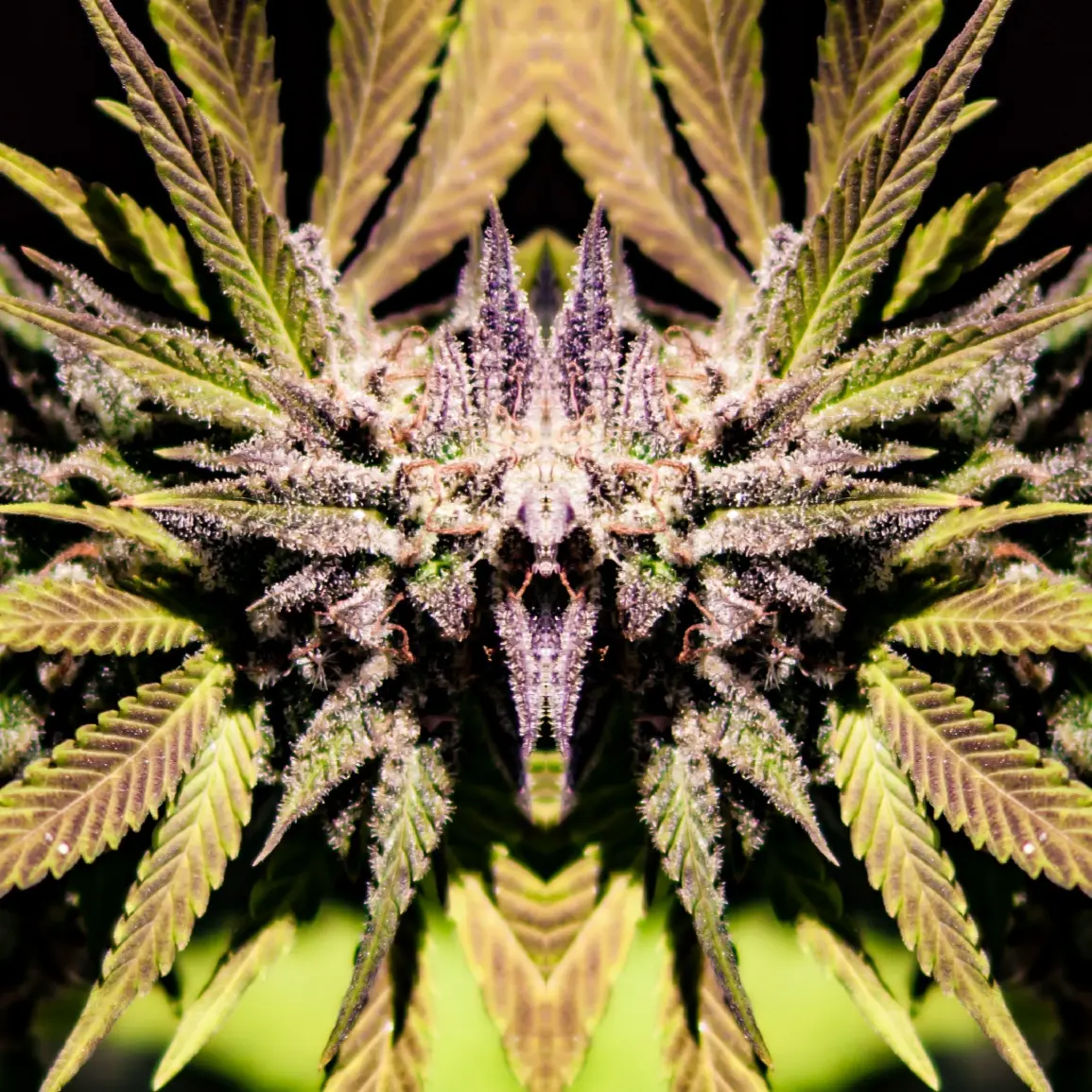
Vortex
Vortex is a strain where the grower should distrust a simple silhouette description. One record calls it short and wide. Another describes thin, vine-like branches and vigorous stretch. The original grow notes explicitly acknowledge substantial phenotype variation. That disagreement is not a reason to abandon the cultivar. It is the central cultivation fact. Vortex should be grown as a phenotype-mapping project first and a repeatable production plant second.
The lineage is much clearer than the morphology: Apollo 13 x Space Queen. This gives Vortex a fast-for-sativa flowering tendency, strong resin production, tropical and lemon-driven aroma and an effect that can be highly energetic, euphoric and mentally disorienting at stronger doses. The plant often develops multiple resin-heavy colas on branches that may be too flexible to hold them without support. Some expressions behave like a wide sagging bush. Others reach and vine. Either way, early support and careful canopy spacing are more important than forcing a particular training style.
Vortex also has a flavor problem worth understanding. The best flowers can carry mango-like tropical sweetness, lemon, sharp fruit, spice and a slightly sour or metallic edge. Those bright volatile notes are vulnerable to warm drying and long oxygen exposure. The heavy resin can make the flower look finished even when aroma maturity is still changing, so harvest should be based on calyx development, trichome maturity and sensory peak together.
Strain Features
| Feature | Vortex |
|---|---|
| Type | Strongly sativa-dominant hybrid |
| Genetics | Apollo 13 x Space Queen |
| Effect direction | Fast euphoria, energy and creativity; higher doses can become racy, confusing or physically heavy |
| THC | Commonly moderate-to-high; laboratory values vary by sample and phenotype |
| CBD | Usually low |
| Common aroma | Lemon, mango, tropical fruit, sweet-sour citrus, spice, occasional metallic or fermented-fruit edge |
| Reported terpenes | Terpinolene, myrcene and caryophyllene frequently appear; exact profiles vary |
| Indoor flowering | Commonly around 8-9 weeks; some selected cuts finish faster |
| Plant structure | Highly phenotype-dependent: short-wide bushes and more vine-like/stretchy expressions are both documented |
| Stretch | Variable; measure the actual plant rather than using a fixed ratio |
| Branch strength | Often flexible relative to final flower weight |
| Yield tendency | Moderate to good, highly dependent on support and canopy organization |
| Bud structure | Resin-heavy elongated or spear-like flowers, generally less blocky than dense Kush types |
| Training response | Good with early LST, topping and SCROG when matched to phenotype |
| Main cultivation risk | Unmanaged stretch/branch sag, phenotype inconsistency and terpene loss from warm post-harvest handling |
| Disease risk | More open flowers can ventilate better than rock-hard indica buds, but high humidity is still unsafe |
| Difficulty | Moderate, easier after the first run identifies the phenotype |
| Best environment | Controlled indoor room or warm, dry outdoor climate with support |
| Flavor priority | Preserve mango, lemon and bright sweet-sour fruit before the darker spice develops |
| Typical use window | Daytime or early evening for experienced users; not ideal before precise or safety-sensitive work |
Vortex should not be judged by whether it matches one database's height description. The strain's own historical documentation emphasizes phenotypic variation. The better question is whether the individual plant converts its architecture into well-supported, evenly lit, resin-rich flowers with the intended citrus-tropical profile.
Genetic Lineage
Vortex is a direct cross of Apollo 13 and Space Queen, two lines with strong Cinderella-family influence in their deeper ancestry.
Apollo 13 contributes fast flowering for a mentally stimulating hybrid, pungent aroma, resin and a cerebral effect that can feel almost immediate. It is also associated with vigorous growth and a tendency for some offspring to express unusual structure rather than textbook uniformity.
Space Queen contributes tropical fruit, sweetness and heavy trichome production. Its background combines Romulan with Cinderella 99, a pairing that helps explain the strange coexistence of strong resin, bright fruit and a body component underneath the energetic surface.
Together, these parents produce Vortex's defining sensory identity: lemon and tropical fruit with a sharp, sometimes rotten-fruit or fermented edge. The name fits the effect better than the plant morphology. A modest amount can feel bright and creatively fast. A strong dose can become mentally circular, disorienting or overwhelmingly intense.
For the grower, lineage matters because both sides can produce fast, vigorous transitions without requiring a 12-to-14-week tropical-sativa flowering period. Vortex can therefore deliver a sativa-leaning effect within a relatively manageable flowering window. That is one of its major cultivation advantages.
The tradeoff is uniformity. Historical descriptions acknowledge expressions that resemble either parent. One plant may form a broad bush with numerous bud sites. Another may show longer internodes, more vertical reach and thinner branches. A single grow strategy should not be forced on both.
During selection, I would rank Vortex phenotypes by four practical traits: support requirement, stretch predictability, cured fruit clarity and flower-to-leaf ratio. A plant that produces spectacular live aroma but collapses under its own weight or cures into vague sweetness may be less useful than a slightly less dramatic plant with stable structure and persistent mango-lemon flavor.
Effect Breakdown
Vortex is known for a rapid cerebral experience, and the word "energetic" does not fully describe it. The better distinction is between speed, direction and dose.
Fast onset
The initial effect can arrive quickly, with a pronounced change in mental pace. Thoughts may feel more associative and sensory input becomes more interesting. Music, visual work and conversation can gain momentum. Many users describe euphoria and an urge to engage rather than withdraw.
This is not necessarily calm focus. The same mental acceleration that feels creative at a small dose can feel scattered at a larger dose. A person who expects a gentle daytime sativa may find Vortex much more intense.
Productive middle at the right dose
At a moderate level, the high can support brainstorming, art, gaming, walking or social activity. The body is usually lighter than with Kush-dominant strains, although Space Queen ancestry can add a relaxing undertone that prevents the experience from feeling purely stimulant-like.
Some users report that the middle phase feels euphoric and almost silly. Attention may jump between ideas. This can be excellent for creative exploration and poor for detail-oriented tasks. Vortex is more likely to make a person enjoy the process than to improve accuracy.
High-dose disorientation
Historical descriptions of the cultivar use language such as confusing, heart-racing or intensely stoned. That is worth taking seriously. High THC combined with an energetic terpene profile can produce anxiety, dizziness or mental overload in sensitive users.
A novice should start very low and wait. The strain's fast onset does not mean its full effect has peaked immediately.
Late phase
As the main cerebral peak softens, some phenotypes leave a mild body relaxation. Others remain mentally active for longer. The finish is generally less sedating than Death Bubba or Obama Kush, but a large dose can still produce fatigue once the intense phase ends.
Harvest maturity and experience
For a grower who wants the classic bright Vortex character, I would favor a fully mature but not overripe harvest. The cultivar's appeal is the combination of strong resin and lively aromatic top notes. Extending the crop deep into ambering simply to make the effect heavier risks losing what makes the strain distinctive.
Flavor & Aroma Profile
Vortex can be spectacular aromatically because the fruit does not smell polished or one-dimensional. The most interesting expressions combine mango, lemon, sweet tropical fruit and a strange sour, fermented or metallic edge.
On the live plant, early resin may smell citrusy and herbal. Mid flower often brings the recognizable tropical character. Mango-like sweetness can become strong enough that the plant smells almost beverage-like, while some phenotypes carry a rotten-fruit or overripe note that sounds unpleasant in writing but adds complexity in the jar.
Late flower develops sharper edges. Lemon peel, sweet-sour fruit, spice and occasional fuel can sit behind the mango. The aroma can be greasy and penetrating when flowers are handled, which is consistent with the cultivar's reputation for heavy resin.
The inhale from well-cured flower is usually sweeter than the raw nose. Lemonade-like citrus and tropical fruit appear first. The exhale can reveal pepper, spice, sour fruit and a slightly metallic or resinous finish. The best samples feel bright but not thin.
The weak point is post-harvest volatility. Terpinolene-rich and citrus-forward profiles are easy to flatten. If the drying room is hot or aggressively ventilated, the jar may retain generic sweetness and spice while losing the mango-lemon signature.
For this reason, Vortex should be evaluated at three aroma checkpoints: the living plant one week before harvest, the flower at the end of drying and the jar after at least three weeks. If the mango and lemon vanish between checkpoint one and two, the process is too harsh. If they survive drying but disappear rapidly in storage, the cure or storage protocol needs work.
Dominant Terpenes
Vortex samples are commonly associated with terpinolene, myrcene and beta-caryophyllene, though the exact ranking is phenotype-dependent.
Terpinolene
Terpinolene is central to the strain's bright, complex identity. It can smell sweet, citrusy, fresh, woody and slightly herbal at the same time. In Vortex, it likely contributes to the combination of lemon and tropical fruit that feels more perfumed than a simple limonene-dominant lemon strain.
Terpinolene is also a useful post-harvest marker. Scientific storage studies show that volatile profiles change over time and some compounds decline under all storage methods. A grower should therefore protect the entire volatilome rather than assuming a jar will preserve living-plant aroma indefinitely.
Myrcene
Myrcene adds ripe fruit, musk and herb. In a mango-forward Vortex phenotype, it can deepen the tropical impression and prevent the aroma from becoming sharp like household citrus cleaner.
Beta-caryophyllene
Caryophyllene provides pepper and dry spice. It becomes more noticeable in the exhale and after cure. This compound can interact with CB2 receptors, but that does not establish Vortex as a medical treatment.
Limonene, pinene and secondary compounds
Some samples may show limonene or pinene as important secondary terpenes. Limonene strengthens the lemon peel impression. Pinene can add a fresh resinous edge. Esters and other volatile compounds may also contribute to tropical-fruit perception, which is why terpene percentage alone does not fully explain aroma.
Selecting for flavor stability
The best keeper is not necessarily the phenotype with the highest total terpene number at harvest. It is the one whose signature remains recognizable after the drying and curing process used in the real garden. If a slightly less intense plant holds mango and lemon for months while a louder plant collapses quickly, the stable phenotype has greater practical quality.
Indoor vs. Outdoor Growing
Indoor cultivation
Indoor growing gives the clearest advantage for phenotype management. Because Vortex can vary in stretch, a controlled room lets the grower flip different plants at different sizes or use separate trellis zones.
The first indoor run should leave more headroom than a short-wide description would suggest. It is easier to have unused space than to discover a vine-like phenotype has reached the fixture during week three.
A trellis is highly valuable because it solves two problems at once: stretch can be redirected horizontally, and flexible branches receive support before the resin-heavy flowers cause sagging.
Outdoor cultivation
Outdoors, Vortex can use its vigor fully. The more open flower structure of many phenotypes can ventilate better than rock-hard indica buds, but the plant still benefits from dry autumn conditions. Long flexible branches can whip in wind and may split where they join the main stem if heavy flowers are unsupported.
Use stakes or a perimeter support cage early. Waiting until branches lean makes correction harder and can compress flowers together.
Outdoor wind management
Vortex is unusual because an open outdoor site solves one problem while creating another. Air movement helps keep flowers dry, yet flexible branches can be damaged by persistent wind. The answer is not to hide the plant in a stagnant corner. Build support that lets it live in the open site.
A perimeter cage or several stakes connected by soft horizontal lines can support branches without tying each one rigidly. The plant should still move slightly. Completely immobilizing long branches can move stress to the branch union or main stem.
Inspect after storms. A branch can remain attached while developing a partial split near the trunk. Supporting it early with a soft tie may preserve the flower, but a severely damaged or contaminated branch should not be kept simply for yield.
Outdoor Vortex can also expose phenotype differences more dramatically because unrestricted root volume and sun allow vigor to express. Leave more spacing than an indoor height estimate would suggest. A plant that looked modest in a small container can become a large lateral structure in native soil or a large outdoor pot.
Harvesting different phenotypes together
If multiple Vortex phenotypes finish at different times, do not compromise all of them for one harvest date. Separate drying batches when practical. A fast plant harvested late may lose bright flavor, while a slower plant cut early may never develop full calyx mass.
Label every branch batch. Vortex is exactly the kind of cultivar where anonymous drying turns useful phenotype research into memory and guesswork. After cure, you should be able to connect the best jar to the plant that produced it.
Greenhouse
A greenhouse works well when height is controlled and ventilation is strong. A vigorous phenotype can reach roof space quickly. Top or train before the plant becomes woody, and keep horizontal lanes between branches so air can move.
Climate decision
Vortex is a better outdoor candidate than many dense Kush cultivars because it often has more open floral geometry and a relatively fast finish. However, an exposed windy site may punish its flexible stems. The ideal outdoor location is sunny, warm and ventilated without repeated severe wind.
Strain-Specific Grow Guidance
The first-run rule: measure before you assume
Vortex should be measured at flip and at least twice during stretch. Record plant height, canopy width and branch angle. If possible, mark one untreated reference branch so training does not hide the natural extension pattern.
Grower descriptions conflict because different phenotypes genuinely exist. One cut may remain compact. Another may stretch dramatically. Your own data is the correct input for the second run.
Topping
Topping can be very useful on the more vertical phenotype. Perform it while the plant is healthy and actively growing, leaving enough time for the new leaders to establish. A wide phenotype may need only one top or even simple LST.
Do not top by habit. If a plant naturally creates many equal laterals, an additional cut may only increase congestion.
LST
Low-stress training is the safest universal technique. Bend dominant branches outward and use soft ties. Vortex branches can be flexible, which makes early shaping easy but also means they may not stiffen enough later to support heavy flowers unaided.
SCROG
A screen suits both major phenotype types for different reasons. On a stretchy plant, it controls height. On a wide plant, it organizes a large number of bud sites and prevents the canopy from becoming a pile of crossing branches.
Do not fill every square before transition. Leave enough room to tuck during the first part of stretch. Historical descriptions of wide Vortex bushes emphasize abundant bud sites. Overfilling the net turns that strength into shade.
Branch support
Support is not optional on many phenotypes. Install stakes, strings or a second net before the flowers become heavy. The strain's greasy resin and elongated flowers can create more weight than thin branches suggest.
Support should maintain spacing rather than pull stems together. A sagging branch tied tightly against another creates a local humidity pocket.
Defoliation
Vortex usually needs less aggressive defoliation than a compact broadleaf indica because leaf and internode spacing can be more open. Remove leaves that genuinely block interior airflow or sit in a dense overlap. Avoid turning the plant into bare stems.
Scientific cannabis studies show that pruning effects depend on genotype and production goal. The plant should be trained according to its actual architecture, not a social-media calendar.
Lower canopy
Remove weak shoots that remain far below the productive surface. The more open phenotype may produce usable lower flowers if light penetrates, so do not lollipop to an arbitrary height. Judge whether the site has enough light and branch strength to mature.
A two-phenotype canopy strategy
If a seed run reveals clearly different growth types, forcing every plant into one trellis height can reduce quality. Separate the canopy mentally into zones. Put the faster-stretching plants where they can be bent farther outward or placed under the higher-light portion of the room. Keep squat, wide plants where they have enough horizontal space to spread without being buried by taller neighbors.
The most common mixed-canopy error is solving the tall phenotype by raising the entire light. That protects the tall tops but starves the shorter plants. A better response is to lower the tall branch through tucking, bending or early supercropping and keep the overall canopy surface level.
When running clones from a selected mother, the grow becomes much simpler because plant spacing can finally be standardized. That is one reason Vortex can improve dramatically between the first and second cycles. The genetics did not change; the grower stopped treating uncertainty as uniformity.
Tracking branch strength
Branch strength should be recorded before the flower weight arrives. During late veg, gently assess how quickly a bent branch returns upright and how thick the base becomes relative to its length. Long thin laterals that remain flexible should receive a support point early. Shorter, thicker branches may hold themselves until late flower but still benefit from a net that keeps colas separated.
Build support before the flowers demand it
Do not wait for visible droop to decide support is necessary. By then, the flower surface is sticky and the branch angle has already altered light distribution. Pre-positioning support also reduces the amount of touching and squeezing required later, which protects trichomes.
When supercropping makes sense
A vigorous Vortex phenotype can respond well to a carefully timed supercrop during late vegetative growth or the earliest stretch. Use it on flexible stems that are clearly outrunning the canopy. The purpose is to redirect height and strengthen a bend, not to stress every branch.
Avoid repeated hard supercropping after flowers are established. Late wounds can create weak mechanical points exactly when the plant is adding weight. If the canopy was planned early, most late height correction should be possible with soft ties and trellis positioning.
Reading the fast finish correctly
The strain's relatively short flowering window can mislead growers into expecting rapid visual senescence. Some plants remain green while the flowers are chemically and structurally mature. Others fade quickly. Use the flower itself as the primary indicator.
Track calyx expansion week to week. A phone macro photo taken from the same flower position every three or four days is useful. When calyx size has largely stabilized, new pistil production is low and gland heads are predominantly mature, the crop is close. If the plant is still building obvious fresh calyx towers, it may not be finished even if the calendar is at day 56.
The aroma curve matters just as much. Vortex can reach a point where mango and lemon are extremely clear before the plant looks old. If those notes begin to dull while only small amounts of additional weight are appearing, the quality-first harvest window may have arrived.
Nutrition
Vortex is usually better with steady moderate feeding than aggressive nitrogen. Excess nitrogen before or during transition can exaggerate stretch and produce soft vegetative growth. The plant should enter flower healthy, not dark and overfed.
In hydro or coco, watch EC trends and respond to actual uptake. In soil, avoid chasing rapid growth with repeated concentrated feeds. A vigorous plant can be growing quickly because the genetics are doing their job.
Watering
Fast-growing phenotypes can drink aggressively during stretch. Root volume and airflow should match that demand. However, the plant can reduce water use as flowering finishes. Adjust irrigation rather than keeping a fixed volume.
Light
A uniform canopy lets Vortex use strong light effectively. The resinous tops do not need to be pushed directly against fixtures. Controlled cannabis research demonstrates that increasing light can raise yield when the environment supports it, but potency does not necessarily increase with light in the same way.
Flower microclimate
Vortex flowers are often more open than Death Bubba, but resin and leaf overlap can still create humid pockets. Keep late-flower RH controlled and ensure air moves around each cola. Open flowers reduce risk; they do not eliminate it.
Flowering progression
Many Vortex expressions finish in roughly 55-63 days, with some selected cuts reported faster. The transition can be surprisingly quick for a sativa-dominant plant. Resin appears early and can make the plant look mature before calyx swelling is complete.
Do not harvest because the sugar leaves are frosty. Inspect trichomes on calyxes and watch whether flower mass is still developing.
Harvest window
The ideal Vortex harvest preserves brightness. Look for mature cloudy gland heads, fully developed calyxes, slowing new pistil production and peak mango-lemon aroma. A small amber fraction is normal. Extensive ambering is not required to validate maturity.
A keeper should be selected after support demand is visible
Vortex selection should include mechanical behavior, not only aroma and resin. Two plants can finish with similarly attractive flowers while one requires constant tying and another holds its canopy with much less intervention. Record how many support points each phenotype needs by the final two weeks. A plant that carries greasy spear-shaped flowers on branches that remain separated and upright is easier to repeat at quality scale.
The keeper decision should also include cured tropical clarity. Some expressions smell intensely fruity while alive but lose definition after drying. Others retain mango, lemon and sweet fermented fruit for weeks. I would favor the plant that combines predictable stretch, manageable branch strength and persistent cured aroma, even if another phenotype is slightly heavier. That is the expression most likely to improve on the second run rather than merely impress once.
Weedth Bud Flavor Tips
Treat the tropical top notes as perishable
Mango and lemon are the flavor identity. Protect them from heat, light and unnecessary oxygen exposure.
Harvest clean and cool
Do not leave cut branches in a warm room or direct light while the entire crop is processed. Move material into the prepared drying environment promptly.
Branch drying over wet piles
Vortex's longer flowers and flexible branches are easy to hang individually. Avoid piling fresh flowers in bins or on trays where they heat and compress before drying begins.
Use gentle air exchange
The drying room needs enough air movement to remove moisture, but direct fan blast can dry the exterior too quickly. Aim circulation around the hanging branches.
Scientific post-harvest studies confirm that cannabis volatile profiles can change significantly with drying method and storage. The goal is to manage those changes rather than assume all aroma is retained automatically.
Do not overdry for crispness
A crisp flower is not necessarily a well-dried flower. Trichome-rich Vortex buds can become fragile quickly. Once the flower surface is dry and internal moisture is close to equilibrium, move into controlled curing rather than waiting for the entire flower to become brittle.
Drying diagnostics for a terpinolene-forward phenotype
A bright Vortex phenotype can change aroma rapidly during drying, so use smell as a diagnostic tool. The first day or two may smell green and intensely fruity. As moisture leaves, the raw green component should fall while lemon and mango remain. If the room suddenly smells mostly like dry hay while the flowers are still losing large amounts of weight, conditions may be too hot or dry.
Do not try to correct an overly fast dry by sealing obviously wet flowers immediately. That can trap excess moisture. Instead, correct the room environment and let moisture equalize gradually. Once flowers are genuinely ready for curing, enclosed storage should make the aroma feel more concentrated, not swampy.
The trichome texture also gives information. Vortex resin is often described as greasy. Overdrying can make the entire flower feel brittle and cause more trichome heads to break away during trimming. Handle the crop by stems and minimize unnecessary agitation.
Flavor-focused trim timing
Because the cultivar can have an open flower structure, excessive wet trimming is often unnecessary unless room humidity is high. Leaving some sugar leaf during the first part of drying can slow surface moisture loss and protect resin. In a humid room, remove more leaf to prevent trapped moisture.
There is no single trimming rule that is best for every room. Recent cannabis research shows trimming timing can influence measured secondary metabolites and that genotype interacts with post-harvest method. The practical conclusion is to make trim intensity serve the drying environment and the specific flower structure.
Cure for clarity
After two to four weeks, the mango and lemon should feel cleaner, while spice and sour fruit become integrated. A good cure makes the profile more legible. It should not erase the top notes.
Storage
Use clean airtight glass in darkness and cool conditions. Minimize container headspace when practical without crushing flowers. Open containers only as needed for moisture management.
Weedth Bud Boost Tips
Build a support system before a yield system
Vortex can produce abundant bud sites, but unsupported sites are not useful. Install the trellis early and decide how many branches the room can actually hold.
Match training to phenotype
Stretchy phenotype: top earlier, flip smaller, use stronger horizontal training.
Wide phenotype: reduce branch count, use the screen for spacing and avoid excessive veg.
The same cultivar can require opposite decisions depending on expression.
Do not maximize site count
A wide Vortex plant can present hundreds of potential flower sites. Only a subset will receive enough light to become premium. Remove weak lower shoots and crossing branches before the plant commits heavily to flower.
Protect the root system during stretch
The rapid transition phase can create a sudden demand for water and nutrients. Make sure container volume and irrigation frequency can support it. Root restriction during stretch can produce uneven growth and weak branch development.
Use light to fill the canopy, not punish it
If upper tops bleach while lower tops remain shaded, the solution is canopy geometry. Lower the tallest branches and expose the weaker ones rather than simply increasing intensity.
CO2 only in a sealed, balanced room
Supplemental CO2 can support high-light photosynthesis, but Vortex does not need it to express quality. Correct branch spacing, irrigation and environment first.
Quality-yield evaluation
Record not just grams but the percentage of flowers with mature resin, good density and retained tropical aroma. If one phenotype yields more but requires heavy trimming and loses flavor quickly, it may be a worse production keeper.
Extraction-minded selection
Vortex is known for greasy resin. If solventless or resin quality is a goal, evaluate trichome texture and post-harvest aroma, not only visible frost. A flower covered in trichomes does not automatically wash or press well. Test the actual material before making claims about extraction yield.
Medical Uses & Benefits
Vortex has no cultivar-specific clinical evidence establishing it as a treatment. The following reflects user-reported effects and broader cannabis research.
Fatigue and low motivation
The energetic onset can feel useful to people seeking temporary relief from fatigue or low motivation. High-THC sativa-dominant flower can also cause anxiety or a crash later, so it should not be treated as a substitute for evaluating persistent fatigue medically.
Mood
Euphoria and uplift are common reports. A small amount may temporarily interrupt low mood or stress. Larger doses can become confusing or racy, especially in anxiety-prone users.
Pain and discomfort
Some users report relief while remaining more mentally active than with heavy indica strains. Broader cannabinoid evidence suggests modest pain benefit in some contexts, but a named Vortex flower product is not standardized medicine.
Appetite
Effects vary. Some users become hungry, while the energetic phase can distract others from eating. Do not rely on one strain for medically significant appetite loss.
Anxiety caution
This is the most important caution. Vortex can feel fast and mentally intense. People with panic sensitivity, psychosis risk or a history of strong adverse reactions to THC should be especially careful.
Functional impairment
An energetic high is still impairment. Driving, operating machinery and safety-critical work remain inappropriate.
Ideal User Profile
Vortex suits an experienced consumer who enjoys fast, unusual cerebral effects and bright tropical flavor. It is a poor match for someone who wants predictable tranquil sedation.
The ideal session might involve music production, visual art, a walk, gaming, conversation or brainstorming. Precision work is a different matter. The same associative thinking that feels creative can reduce accuracy.
Flavor chasers who enjoy mango, lemon and sour fruit are a natural audience. People who prefer gas-heavy, earthy or dessert profiles may find it less satisfying.
The ideal grower is comfortable documenting phenotype behavior. Vortex becomes easier after the first run because the actual stretch and branch pattern are known. A grower who wants every seed plant to behave identically may find the variation frustrating.
Grower Notes and Feedback
The most consistent grower note is variation. Historical descriptions say phenotypes can resemble either parent. Some documentation describes short, wide plants with many sites. Other reports describe more vine-like, stretchy growth. Treat both as plausible.
Support is another repeated theme. Even wide plants can develop flexible branches that sag under elongated resinous flowers. Stakes and strings appear repeatedly in historical cultivation notes.
Vortex's flowering time is notably short for the effect style. Many records place maturity in the 8-9 week range, with some selected plants closer to the mid-50-day window. That speed should not be used as an excuse to cut early.
The aroma can be strange in the best way. "Rotten fruit" descriptions are not necessarily defects. Overripe tropical notes can sit beside clean lemon and sweetness. The grower should learn the phenotype's normal smell so a genuine post-harvest mustiness is not confused with genetic funk.
The second run should change plant spacing based on branch type. A vine-like cut needs more horizontal training and earlier support. A wide bush may need fewer retained branches. Keeping the same plant count after learning the phenotype wastes information.
Another useful note is how evenly the flowers mature from top to bottom. If upper Vortex flowers are ready while the lower productive layer is still building fresh pistils, the first run may have carried too deep a canopy. On the next cycle, raise the lower cleanup line or improve early branch positioning rather than simply increasing light intensity. Uniform maturity is one of the clearest signs that canopy design matched the cultivar.
Growers should also record how the aroma changes on individual branches exposed to different temperatures. A top flower close to the light may be larger but less tropical than a slightly cooler side flower. If that pattern repeats, canopy temperature is a quality variable worth correcting before the next run.
Weedth Editor's Note
What this cultivar asks from the room
Vortex is one of the strains where I would put a ruler next to the plants before I put confidence in any grow guide. The first three weeks after flip tell me what version I actually have.
If the plant starts running upward, I want it under a net before I need the net. If it stays wide and throws sites everywhere, I want to remove the branches that will never become premium. The common decision is not "train harder." It is create space early.
I would also prepare support before resin becomes heavy. Thin flexible branches are easy to position in veg and unpleasant to rescue in week seven. A branch leaning onto its neighbor is not just a structural issue; it creates shade and a local humidity pocket.
For flavor, I would treat mango and lemon as the fragile part. I would rather preserve a slightly softer flower with clear tropical aroma than overdry it into a hard nug that smells mostly of spice.
As a user, I consider Vortex a dose-respect strain. At the right amount it can feel bright and creative. Too much can turn the same speed into confusion. That tension is part of its personality.
Weedth Score
Growing Experience – 8.0/10: Fast flowering and strong vigor are attractive, but phenotype variation and branch support make the first run less predictable.
Bud Structure & Visual Appeal – 8.8/10: Elongated, greasy, resin-heavy flowers are distinctive. Flexible stems can reduce presentation if unsupported.
Aroma Complexity – 9.3/10: Mango, lemon, sweet-sour fruit, spice and odd fermented edges create a memorable profile.
Flavor & Smoothness – 9.0/10: Excellent when the bright volatiles survive drying. Warm post-harvest handling can reduce it dramatically.
Effects & High Experience – 9.0/10: Intense euphoria and creative energy are distinctive, but the same potency can become racy for sensitive users.
Overall Satisfaction & Recommendation – 8.8/10: A rewarding old-school sativa-dominant hybrid for growers who enjoy phenotype work and flavor preservation.
"With Vortex, I want the trellis ready before the plant proves why it needed one."
FAQ
Is Vortex always a tall plant?
No. Some documented expressions are short and wide, while others are more vine-like and stretchy. Phenotype variation is a defining trait.
How much does Vortex stretch?
There is no reliable single percentage. Measure your plant from flip through the end of week three and use that data for the next cycle.
Does Vortex need support?
Usually yes. Flexible branches can sag under resinous spear-like flowers. A trellis, stakes or strings are best installed early.
Is SCROG a good method?
Yes. It controls vertical phenotypes and organizes wide phenotypes. Leave open screen space for transition growth.
How long does Vortex flower?
Most records place it around 8-9 weeks, with some selected cuts finishing in the mid-to-late 50-day range. Harvest by maturity, not label.
Is it difficult to grow?
Moderate. The plant is vigorous, but the grower needs to manage variation, support and canopy spacing. A known clone is easier than a first seed run.
Does it need heavy feeding?
Not necessarily. Moderate stable nutrition is safer. Excess nitrogen can exaggerate stretch and soft growth.
What aroma should I expect?
Mango, lemon, tropical fruit and sweet-sour citrus are common, sometimes with spice, fuel or a strange overripe-fruit edge.
Why did my Vortex lose its mango smell after drying?
Warm air, low humidity, direct fan exposure or a very rapid dry can remove bright volatiles. Phenotype also matters. Compare living-plant aroma to post-dry checkpoints.
Is Vortex good for beginners?
A beginner can grow it, but it is easier for someone comfortable with trellis training and observation. The variability between plants is the main challenge.
Is it a daytime strain?
Often, but it can be very intense. Start low. An energetic effect can still impair judgment and coordination.
Similar Strains
Apollo 13: One direct parent and the clearest comparison for fast flowering, pungency and a bright cerebral effect. Apollo 13 is generally simpler aromatically and may be easier to predict structurally.
Space Queen: The other direct parent, similar in tropical fruit, resin and euphoric complexity. Space Queen can show a stronger body component and its own phenotype variation.
Cinderella 99: Shares deeper family influence and a fast, energetic, fruit-forward style. Cinderella 99 often has more pineapple/citrus and can be more uniformly compact.
Jack Herer: Comparable for energetic cerebral use and resin, but Jack Herer usually leans pine-spice rather than mango and may require a longer flowering window depending on phenotype.
Super Lemon Haze: Similar bright citrus and mental stimulation, but it generally flowers longer and stretches more consistently than Vortex.
Tangie: A useful comparison for volatile citrus and daytime energy. Tangie is more orange-peel driven, while Vortex has mango, sour fruit and heavier greasy resin.
Among these comparisons, Vortex remains the better choice for a grower who specifically wants rapid-flowering sativa-like effect combined with unusual tropical resin. Its variability is a cost, but it is also the reason keeper selection can produce a genuinely distinctive plant rather than a generic daytime hybrid.
A known clone makes that distinction much easier to repeat consistently.
Consistency is where Vortex becomes much more valuable for a quality-focused home grower.
Share this article
A quick overview of the topics covered in this article.
Follow us
Latest articles
September 8, 2026
September 8, 2026

September 8, 2026

September 8, 2026