

Root-Zone Oxygen: Why Wet Soil Can Look Like Hunger
A cannabis plant can sit in wet soil, have fertilizer available around its roots, and still look as though it is starving. The missing resource may be oxygen rather than nutrients. When too much of the root zone stays saturated for too long, water occupies pore spaces that normally carry air. Oxygen delivery slows, root respiration loses efficiency, active ion transport weakens, and the canopy can respond with drooping, pale leaves, stalled growth, or deficiency-like patterns.
That does not mean every wet, yellow plant has an oxygen problem. Root disease, salinity, cold soil, unsuitable pH, genuine nutrient shortage, damaged roots, and several environmental stresses can look similar from above. The practical goal is therefore not to diagnose hypoxia from leaf color. It is to connect the canopy symptom to measurable root-zone behavior before adding fertilizer or changing several variables at once.
This resource focuses on that decision. It explains why wet soil can interrupt nutrient and water uptake, how to distinguish root-zone oxygen stress from common look-alikes, how to inspect containers and outdoor soil, what corrections actually address the cause, and how to verify recovery. For broader background on soil structure, growing media, amendments, pH, and root-zone design, use the Cannabis Soil and Growing Media Guide.
In This Resource
Root-Zone Oxygen and Wet-Soil Diagnosis
- What Root-Zone Oxygen Actually Does
- How Water Changes Air Space and Oxygen Supply
- Why Wet Soil Can Look Like Nutrient Deficiency
- How to Confirm a Root-Zone Oxygen Problem
- How the Grow System Changes the Risk
- Failure Modes and Look-Alikes
- Correct the Root Zone Before Adding More Feed
- Reinspection and Verification
What Root-Zone Oxygen Actually Does
Roots are living tissues with a continuous energy demand. They use oxygen in aerobic respiration to produce ATP, the usable chemical energy that supports cell maintenance, root growth, membrane function, and much of the active transport involved in mineral nutrition. Water and dissolved nutrients can be physically present in the root zone while the root system becomes less capable of using them.
This is the first reason oxygen stress can be mistaken for hunger. A nutrient analysis may show that nitrogen, potassium, calcium, magnesium, or other ions are present, yet uptake and transport can decline when root metabolism is oxygen-limited. Research on waterlogged crops shows that oxygen deficiency can inhibit respiration and membrane-based ion transport, producing nutrient deficiencies in shoots even when the problem did not begin as inadequate fertilization.
Hypoxia and anoxia are not the same condition
Hypoxia means oxygen is present but too limited to meet biological demand. Anoxia means oxygen is effectively absent. A cannabis root zone can become functionally hypoxic before every pore is completely saturated or the soil reaches true anoxia.
Root respiration supports nutrient uptake
Plants do not absorb every ion passively. Root cells maintain electrochemical gradients across their membranes, and these gradients help drive the transport of mineral ions. That process depends heavily on cellular energy. Under severe oxygen deficiency, energy production falls and the machinery that normally moves ions across root membranes becomes less effective.
The exact nutrient pattern is not universal. Waterlogging can change root metabolism, microbial activity, soil redox chemistry, pH around roots, and the chemical form or availability of specific nutrients. Some elements may become less available to the plant, while reduced forms of iron or manganese can accumulate under strongly reducing conditions. This is why oxygen stress should not be simplified into one predictable deficiency pattern.
Important: A hungry-looking canopy does not prove the soil lacks fertilizer. Before increasing feed strength, confirm that the root system can actually function in the medium it already has.
Root oxygen also affects water uptake
A plant can wilt in wet soil. That sounds contradictory until the root system is treated as a living hydraulic organ rather than a drinking straw. Oxygen deficiency can reduce root hydraulic conductance and damage fine roots. The canopy may therefore lose water faster than the impaired root system can replace it, even though plenty of water surrounds the roots.
This is why adding another irrigation to a wet, drooping plant can extend the problem. The water deficit is occurring at the level of root function, not necessarily because the medium contains too little moisture.
“How can my cannabis plant wilt when the soil is still soaked?”
Question sent by: Ethan Brooks, via email.
Wet soil and effective water uptake are different things. If the root zone remains oxygen-limited, roots can lose metabolic and hydraulic function. The plant may wilt because the roots cannot supply the canopy efficiently, not because the pot needs more water. Check moisture at depth, pot weight, drainage, root condition, and the time since the last irrigation before watering again.
Microorganisms are using oxygen too
Roots are not the only organisms respiring in soil. Aerobic microorganisms also consume oxygen as they decompose organic matter. A warm, biologically active, wet root zone can therefore use its remaining oxygen quickly. High microbial activity is not inherently bad, but biological demand matters when oxygen replacement through the pore network becomes slow.
Temperature adds another layer. Warmer roots and microbes generally have higher metabolic demand, while water itself carries far less oxygen than open air-filled pore space can supply through gaseous diffusion. A wet root zone that seems acceptable under cool, low-demand conditions may become much less forgiving after plant size, light intensity, temperature, or microbial activity increases.
How Water Changes Air Space and Oxygen Supply
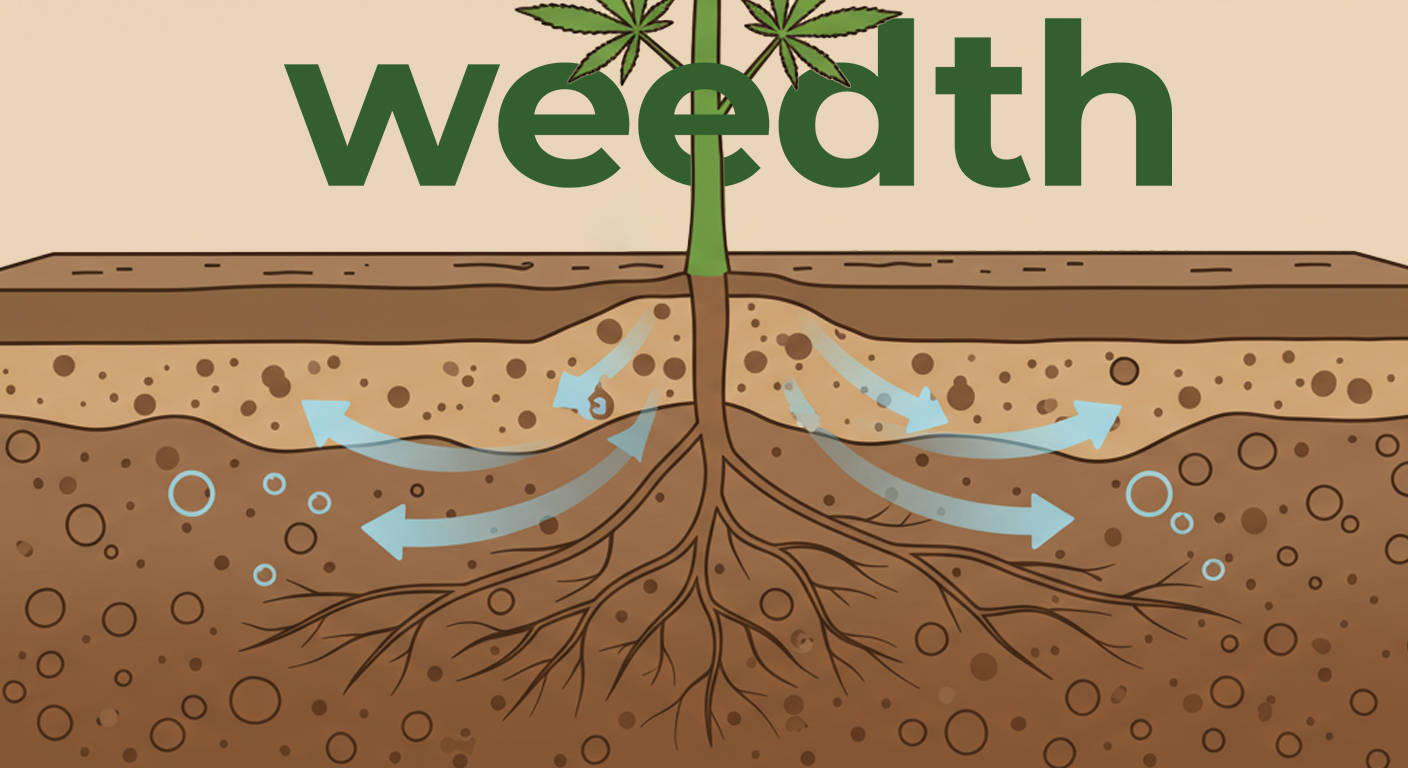
Soil and growing media contain solids plus pore space. Some pores retain water after irrigation, while larger connected pores drain and refill with air. Productive root zones need both. Water supplies hydration and dissolved ions; air-filled pores provide the faster pathway for oxygen to enter and carbon dioxide to leave.
The physical difference is large. Oxygen diffusion through water is roughly four orders of magnitude slower than through air. When water replaces gas in connected pores, oxygen delivery can fall sharply even though the medium still looks structurally intact from the surface. Roots and microbes continue consuming oxygen, so the concentration around active roots can decline faster than the atmosphere can replace it.
Judge the wet root zone after drainage
Look at how much moisture remains, how quickly pot weight falls, whether deeper layers stay saturated, and whether air can return through the medium after an irrigation.
Assuming fast runoff means good aeration
Water can rush through cracks, side gaps, or hydrophobic channels while dense sections of the root zone remain wet and poorly aerated.
Wet is not automatically hypoxic
A recently irrigated medium can be very wet and still recover air space quickly. The critical issue is how much of the pore network remains water-filled and for how long relative to oxygen demand. A well-structured container may drain promptly after a thorough watering and regain useful air-filled porosity. A compact or excessively fine medium may remain nearly saturated much longer.
This distinction also explains why hydroponic roots can live in water while waterlogged soil roots decline. Hydroponic systems can maintain dissolved oxygen through aeration, circulation, temperature control, and frequent solution exchange. A saturated soil pot does not automatically receive that oxygen supply. The question is not whether roots touch water. It is whether oxygen delivery keeps pace with root and microbial respiration.
Air-filled porosity matters more than a dry-looking surface
The top centimeter of a container may dry while the center and lower profile remain wet. Strong airflow can exaggerate this effect. A grower sees a dry surface, adds another small irrigation, and gradually keeps the deeper root zone saturated. Surface appearance is therefore a weak standalone signal.
Air-filled porosity is the portion of the pore volume that contains air after the medium has been saturated and allowed to drain under defined conditions. It is a useful physical concept, but there is no single cannabis-specific air-filled porosity percentage that guarantees healthy roots across every soil, substrate, container, temperature, and irrigation system. Particle size distribution, compaction, decomposition, roots, and container geometry all change the result.
Drainage and aeration are related, but they are not synonyms
Drainage describes excess water leaving the relevant root zone. Aeration describes gas exchange and oxygen availability. A drain hole can remove free water without creating enough connected air space inside a compact medium.
Container height changes the wet profile
Container media retain water through capillary forces. In the same medium, a shallower container generally has a larger proportion of its profile close to the wetter lower zone than a taller container. This is one reason a small plant in a wide, shallow, oversized pot can remain wet for surprisingly long periods.
Adding gravel, stones, or a thick LECA layer to the bottom does not create a universal drainage fix. The finer medium above can still retain a saturated zone at the textural interface. A better correction is to choose an appropriate medium structure, container geometry, drainage path, root volume, and irrigation rhythm from the start.
Field Advice: If a pot dries on top but stays heavy for days, treat pot weight and deeper moisture as stronger evidence than surface color.
Outdoor soil has a different water pathway
In native ground, water must enter the surface, move through the profile, and eventually leave or redistribute beyond the active root zone. Fast infiltration at the surface does not prove that deeper soil drains well. Cracks, worm channels, old root channels, or coarse backfill can move water rapidly through one path while another layer remains saturated.
Clayey horizons, compacted subsoil, a shallow water table, low landscape position, and sharply amended planting holes can all hold water near roots. The broader mechanics are covered in the cannabis clay-soil guide and the resource on the amended planting-hole bathtub effect. This page stays focused on what that prolonged wetness does to root function and how to recognize it.
Why Wet Soil Can Look Like Nutrient Deficiency
The canopy cannot tell you the cause directly. Yellowing, stalled growth, weak new leaves, drooping, and reduced vigor are outcomes shared by many stresses. Oxygen-limited roots can produce them because the root system is losing the energy, membrane function, hydraulic capacity, and healthy tissue needed to absorb and transport nutrients.
At the same time, waterlogging changes the chemistry around the roots. Microbial processes shift as oxygen declines. Redox conditions can change the chemical state of iron, manganese, nitrogen compounds, sulfur compounds, and other constituents. Root damage can also create opportunities for pathogens. What begins as a physical aeration problem can therefore become a combined physical, chemical, and biological root-zone problem if it persists.
Common canopy signs are suggestive, not diagnostic
Root-zone oxygen stress becomes more plausible when several observations line up:
- The medium remains wet or the pot remains heavy much longer than normal.
- Drooping or slowed growth begins after repeated irrigation, prolonged rain, flooding, or a drainage change.
- Water use falls rather than rises as the canopy becomes weaker.
- Yellowing appears while fertilizer is already present.
- New growth slows even though light and temperature remain adequate.
- Roots visible at a container edge or during a necessary transplant look less vigorous, darker, or damaged.
- A sour, stagnant, or decaying odor develops in severe cases.
None of these signs proves hypoxia alone. The strength comes from the pattern and the timing.
Do not diagnose a nutrient deficiency from leaf color while the root zone is saturated
Adding fertilizer to an oxygen-limited root zone can raise soluble salts without restoring root function. Confirm moisture, drainage, pH/EC when relevant, and root condition before increasing feed concentration.
Why nitrogen-like yellowing can appear
Lower-leaf yellowing often pushes growers toward nitrogen. That response can be correct when nitrogen supply is genuinely inadequate, but root stress can reduce nutrient uptake and accelerate senescence without a shortage in the soil. If the medium is already fertile and has remained wet for days, the first question should be whether roots are functioning well enough to use what is available.
Why calcium and magnesium symptoms can be misleading
Calcium transport is closely tied to active root uptake and transpiration, while magnesium uptake can be influenced by root health, pH, ion competition, and total nutrient balance. Adding a calcium-magnesium supplement every time leaves show spots or interveinal chlorosis bypasses the diagnostic step. A damaged or oxygen-limited root system may not respond predictably to more ions in solution.
The same logic applies to potassium and phosphorus. If root metabolism, pH, salinity, or physical access is limiting uptake, increasing the fertilizer dose can produce a stronger root-zone solution without correcting the original bottleneck.
Waterlogging can alter redox chemistry
As oxygen is depleted, microorganisms begin using alternative electron acceptors. The chemical environment becomes more reducing. In strongly waterlogged soils, reduced forms such as Fe2+ and Mn2+ can increase, and nitrogen transformations can shift. These changes are one reason prolonged saturation can create a more complex nutrient picture than simple deficiency charts suggest.
Remember: A deficiency symptom describes what the canopy is experiencing. It does not automatically identify why the nutrient is unavailable to the plant.
| Symptom | Possible Cause | How to Confirm | Corrective Action | Prevention |
|---|---|---|---|---|
| Droop in a heavy, wet pot | Persistent saturation and low root-zone oxygen | Check moisture at depth, pot weight trend, drainage, irrigation timing, and roots if safely visible | Pause unnecessary irrigation, remove standing runoff, restore drainage and normal dry-back | Match irrigation frequency to plant demand and medium structure |
| Lower-leaf yellowing | True nitrogen shortage, root stress, pH problem, salinity, normal senescence, or low oxygen | Compare fertility history with root-zone moisture, pH/EC where appropriate, and timing of symptoms | Correct the verified limiting factor rather than feeding by color alone | Track irrigation and fertility together |
| Brown or weak roots | Oxygen stress, physical injury, pathogen involvement, salinity, or prolonged saturation | Inspect root distribution, smell, texture, environmental history, and use laboratory diagnosis when disease confirmation matters | Correct the root-zone environment and treat confirmed disease according to crop-legal guidance | Use clean media, drainage, sanitation, and appropriate irrigation |
| Plant looks thirsty in wet soil | Reduced root hydraulic function from hypoxia or root damage | Verify that the medium is actually wet at root depth and observe whether more water fails to improve the plant | Restore root-zone function rather than adding water | Avoid repeated irrigation before adequate recovery |
| Wet surface but dry root ball | Hydrophobic channels or uneven irrigation, not necessarily oxygen stress | Probe center and edges and inspect irrigation distribution | Rehydrate evenly in controlled passes | Prevent severe dry-back and channeling |
How to Confirm a Root-Zone Oxygen Problem
Confirmation begins below the canopy. You are looking for a chain of evidence showing that water is occupying the root zone longer than the system normally tolerates and that root function changed at the same time. Start with simple observations before reaching for specialized meters.
Step 1: Reconstruct the irrigation and weather history
Ask what happened immediately before symptoms began. Was irrigation frequency increased? Did the plant move into a larger container? Did temperature or light fall, reducing water demand? Did several days of rain arrive? Was a saucer left full? Did a drip emitter move? Did a medium batch contain more fine peat, compost, or sediment? Did roots recently suffer transplant damage?
Timing is powerful evidence. A pale leaf by itself is ambiguous. A plant that begins drooping after the root zone stays saturated three times longer than its previous pattern gives you a much stronger lead.
Step 2: Check moisture at root depth, not only at the surface
In containers, combine more than one method. Lift the pot if practical. Compare its current weight with a known fully watered state and a normal ready-to-irrigate state. Use a clean finger, skewer, probe, or moisture sensor at consistent positions if the container allows it. Compare the center, edge, and lower profile because containers often dry unevenly.
Outdoors, inspect the root-zone depth rather than only the crust. A shallow dry layer can cover saturated soil below. Avoid repeatedly digging into the active root zone because the diagnostic method should not become another source of root injury.
“The top two inches are dry. Can the roots still be too wet?”
Question sent by: Julia Schneider, via contact form.
Yes. Surface evaporation can dry the upper layer while the center or lower root zone remains wet. Strong airflow, mulch gaps, heat at the pot wall, and dense media can all create vertical moisture differences. Check deeper moisture and pot-weight change before deciding that the plant needs another irrigation.
Step 3: Observe drainage and recovery
During the next appropriate irrigation, note how water enters and exits. Does it infiltrate evenly or run down one side? Does runoff begin immediately from a channel while the center remains dry? Does the pot sit in drainage afterward? In native ground, does water pond, disappear into cracks, or remain around the planting zone long after nearby soil has recovered?
Do not convert a simple hole test into a universal drainage threshold. Soil layering, antecedent moisture, crack flow, root channels, test geometry, and local recommendations all affect interpretation. The practical question is whether the planted root zone repeatedly remains saturated beyond the plant’s normal recovery pattern.
Step 4: Inspect roots when access is justified
Healthy roots are not always bright white. Color varies with medium, organic matter, staining, age, and cultivar. Focus on vigor, distribution, new root tips, texture, odor, and whether the root system is actively colonizing the medium.
Dark, soft, sloughing, foul-smelling, or collapsing roots deserve concern, but those signs still do not identify a pathogen by sight. Severe oxygen stress and root pathogens can overlap. If disease identification will change treatment, sanitation, disposal, or quarantine decisions, use appropriate laboratory testing rather than naming a pathogen from appearance alone.
Do not tear apart a weak root ball just to prove it is wet
Diagnosis should minimize injury. Use pot weight, moisture measurements, drainage behavior, odor, accessible roots, and recent history first. Destructive inspection is justified only when the information will change the decision.
Step 5: Check pH and EC when the symptom pattern justifies it
Low oxygen and nutrient problems can coexist. If the grow is fertigated or salts may have accumulated, use the measurement method appropriate to the medium. A high EC can create osmotic stress that also makes a wet plant look thirsty. An unsuitable pH can limit nutrient availability without any oxygen shortage.
Do not treat runoff pH or EC as interchangeable with a laboratory soil test, saturated media extract, direct substrate method, or irrigation-water test. The value only makes sense when its method and sample type are known.
Step 6: Use advanced oxygen measurements only when they answer a real question
Researchers can measure oxygen concentration, oxygen diffusion rate, redox potential, and related root-zone variables with specialized sensors. These tools are valuable in experiments and production systems, but most home growers do not need them to recognize a persistent saturation problem.
A dissolved oxygen meter in runoff does not directly tell you the oxygen concentration at the root surface inside a soil aggregate. A redox reading is also not a simple universal cannabis oxygen target. For practical diagnosis, repeated moisture behavior, root condition, irrigation history, and recovery after correction are usually more useful.
Pro Tip: Build a normal baseline before problems occur. A few records of wet pot weight, ready-to-irrigate weight, irrigation volume, and time to normal dry-back make future oxygen problems much easier to spot.
How the Grow System Changes the Risk
There is no single wetness rule for every cannabis root zone. Soil, peat-based mixes, coco, living soil beds, hydroponic systems, raised beds, and native ground manage water and oxygen differently. The same irrigation interval can be appropriate in one system and damaging in another.
Container soil and peat-based mixes
Fine particles and decomposed organic matter can retain substantial water. If the mix contains enough connected coarse pores, it can still drain and re-aerate effectively. If it compacts, settles, or contains too many fines, air-filled porosity can decline over repeated irrigations.
Aeration amendments such as perlite, pumice, rice hulls, bark, or coarse coco can change pore structure, but they should be chosen as part of the entire mix. Adding a handful to the surface of an already saturated pot will not repair the internal profile. Compare material tradeoffs in Perlite, Pumice, Rice Hulls, and Aeration Amendments.
Coco and high-frequency fertigation
Coco can support frequent irrigation when particle structure, drainage, root density, container size, and fertigation strategy are designed for it. High irrigation frequency in a well-rooted, coarse, managed coco system should not be confused with repeatedly wetting a dense soil mix that cannot recover air space.
The difference is why generic advice such as “never water more than every three days” is unreliable. Frequency is a system output. Plant demand, medium water capacity, air-filled porosity, container geometry, climate, and irrigation volume determine whether the interval is appropriate.
Living soil beds
Living soil should not be forced through extreme drought cycles in an attempt to “give roots oxygen.” Microbes and fine roots benefit from moisture continuity. The goal is a moist, structured, biologically active profile that still contains connected air space, not a repeating cycle of saturation followed by bone-dry soil.
Large beds can develop wet and dry zones around emitters. Mulch reduces evaporation and can hide deep moisture from surface inspection. Irrigation distribution therefore matters as much as total volume.
Fabric and plastic containers
Fabric sidewalls can increase evaporation and gas exchange near the perimeter, while rigid plastic generally loses less water through the wall. Neither material guarantees an oxygenated root zone. A compact medium inside a fabric pot can remain wet in the center, and a well-structured medium in plastic can perform well.
Container selection, drainage, and root volume are covered in more detail in Cannabis Containers and Pots Basics. The key oxygen lesson is simple: container material modifies the system; it does not replace correct medium structure and irrigation.
Native outdoor ground
Outdoor soil introduces landscape position, soil horizons, rainfall, groundwater, compaction, and subsurface drainage. A plant on a slope may drain quickly while a nearby low spot remains saturated. Clay-rich subsoil may restrict downward movement even when the surface loam looks excellent.
Do not respond to a chronically wet site by digging a small hole and filling it with very loose potting soil. A sharp hydraulic contrast can create a wetter pocket rather than solve the drainage limitation. Raised beds, mounding, surface drainage, site selection, or a different planting position may be more effective depending on the cause.
Hydroponic systems
Hydroponics demonstrates why “roots in water” and “waterlogged soil” are not equivalent. Dissolved oxygen, solution temperature, circulation, nutrient concentration, sanitation, and root health are managed deliberately. Pump failure, excessively warm solution, biofilm, dense root mats, or disease can still create oxygen stress, but the diagnostic framework differs from soil.
Failure Modes and Look-Alikes
The phrase “overwatering” often hides several different failures. Separating them makes the correction much more precise.
Overwatering by frequency
The medium may be physically capable of good aeration, but the grower irrigates again before enough water has been used or drained. This is common after transplanting a small root system into a large container or after environmental demand drops.
Poor drainage
The irrigation interval may be reasonable, but water cannot leave the root zone fast enough. Blocked drainage holes, standing saucers, compact subsoil, a shallow water table, and hydraulic discontinuities can all create this pattern. Waiting longer between irrigations may reduce symptoms without fixing the underlying site problem.
Compaction and loss of pore structure
A medium can drain from the bottom yet still contain too little connected air space internally. Fine particles settle, organic components decompose, repeated handling compresses the mix, or traffic compacts native soil. This is a structural problem, not merely a schedule problem.
Oversized containers
A large container is not inherently bad, but a small root system cannot remove water from the entire volume quickly. Repeatedly wetting the whole container can leave distant zones saturated for long periods. The solution is not a universal smaller pot. It is to match root volume, irrigation distribution, medium structure, and expected growth.
Hydrophobic channeling
A very dry peat-based or organic medium may repel water. Irrigation runs down gaps or sidewalls and exits quickly, creating the appearance of excellent drainage while the inner root ball remains dry. This is the opposite water problem, but the canopy may droop in either case. Check actual moisture distribution.
Salt stress
High soluble salts reduce the plant’s ability to take up water and can damage roots. A pot can be moist while the plant behaves drought-stressed. If fertigation concentration, evaporation, source water, manure, compost, or accumulated fertilizer may be involved, evaluate EC with a method suited to the medium.
Cold root zones
Low root-zone temperature can slow metabolic activity and water use. The medium then stays wet longer, making the same irrigation schedule excessive. Cold root stress can therefore be both a look-alike and a contributor to later oxygen problems.
Root pathogens
Persistent saturation can favor some root diseases, but wet soil does not automatically mean “root rot,” and dark roots do not identify a pathogen. Root disease and oxygen stress can reinforce each other. Use sanitation, source history, root inspection, and laboratory confirmation when a pathogen-specific decision is required.
Separate the cause from the symptom
Ask whether the root zone is wet because of irrigation frequency, structure, drainage, climate, container size, or root damage before choosing a correction.
Using one rescue recipe for every wet plant
Extra fertilizer, peroxide, stronger fans, surface perlite, and emergency transplanting do different things and can add stress when the actual failure has not been identified.
“Can I fix low root oxygen by pointing a strong fan at the soil?”
Question sent by: CedarRoute, via Facebook page.
A fan can increase surface evaporation, but it may dry the top while the center remains saturated. Gentle environmental airflow is useful, yet it does not repair compact structure, blocked drainage, an oversized wet volume, or a perched outdoor water problem. Correct the water pathway and irrigation rhythm first.
Correct the Root Zone Before Adding More Feed
The safest correction is the smallest change that directly addresses the verified cause. Avoid changing nutrient strength, pH products, container, lighting, humidity, amendments, and irrigation at the same time. Multiple simultaneous changes erase the evidence you need to learn from the response.
Immediate step: stop unnecessary irrigation
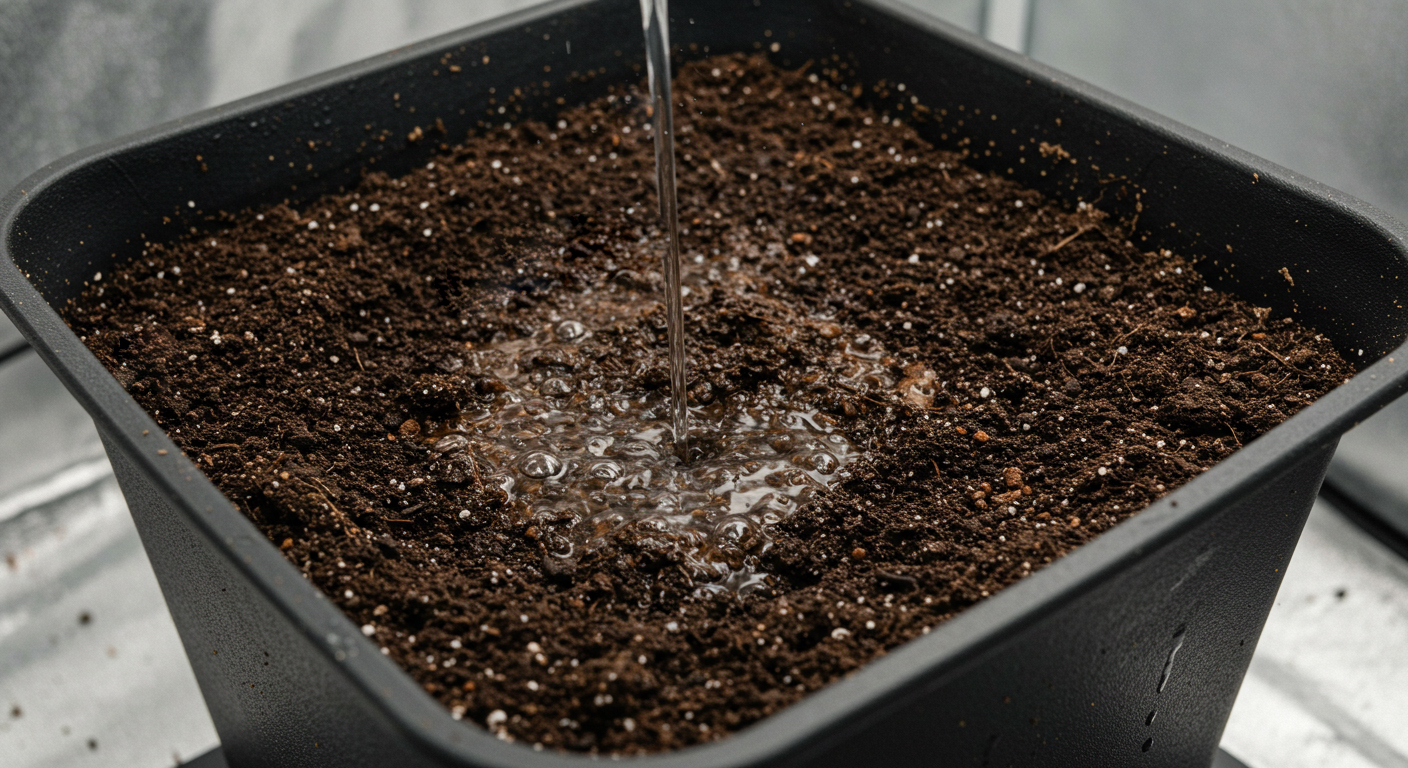
If the root zone is already saturated, do not add another “small drink” to test the plant. Remove standing runoff from saucers or trays. Confirm that drainage openings are unobstructed. If an automated system is involved, pause or reduce pulses until measurements show that the root zone has returned toward its intended moisture range.
Do not force rapid drying with excessive heat or a harsh fan. Extreme drying can damage already stressed fine roots and create a surface-dry, center-wet profile that makes the next decision harder.
Restore normal environmental demand
Check root-zone and room temperature, humidity, light intensity, and airflow. A sudden drop in light or temperature can reduce transpiration and water use, leaving the old irrigation schedule too aggressive. Correct the environmental mismatch rather than merely extending the calendar interval without understanding why demand changed.
Correct the drainage path
Empty standing saucers, clear blocked holes, level containers that drain unevenly, and make sure fabric pots are not sitting on an impermeable wet surface that blocks lower gas exchange. Outdoors, identify where excess water can actually move. A drainage intervention needs a destination for the water.
Do not place random rocks or gravel in the root zone as an emergency oxygen treatment. In containers, a coarse bottom layer does not guarantee better drainage from the fine medium above. Outdoors, buried rubble can create uneven rooting, contamination, and unpredictable water movement.
Correct irrigation distribution
If only part of the container is wet, change emitter placement or hand-watering pattern. If the entire oversized volume remains saturated, reduce how much of that volume is rewetted until root colonization and plant demand increase. If a mature root ball is drying evenly but simply receives water too frequently, increase the interval based on observed dry-back.
The full irrigation framework is covered in Cannabis Watering Basics. This resource focuses on the oxygen consequence rather than repeating the entire watering guide.
Master Advice: Change the variable that caused the saturation. A calendar delay is not a complete fix if blocked drainage or poor structure guarantees that the next irrigation will create the same condition.
When medium structure is the real problem
A compact, decomposed, or excessively fine medium may not recover enough air even with a better schedule. If the plant is stable and transplanting is appropriate for its stage, moving into a structurally suitable medium can solve a problem that irrigation timing alone cannot. However, transplanting a severely stressed plant also damages roots and can worsen the short-term response.
Use transplanting when the existing root zone cannot reasonably be corrected in place, not as the first reaction to every drooping plant. Do not aggressively shake or wash soil from oxygen-stressed roots unless a specific disease or contamination protocol requires it.
Outdoor correction must address the site
If repeated rainfall creates saturation, consider the physical site before adding amendments. A raised or mounded root zone, redirected surface water, improved drainage outlet, different planting position, or container cultivation may be safer than repeatedly modifying a hole inside a poorly drained area.
Mechanical work in wet clay can worsen compaction. Wait until the soil condition is suitable for cultivation or excavation. A saturated clay profile should not be aggressively tilled simply because roots need oxygen.
Do not feed your way out of hypoxia
If nutrient supply is already adequate, stronger feeding cannot replace oxygen. It can increase EC and osmotic stress around impaired roots. Resume or adjust fertility only after the root-zone limitation is corrected and the plant demonstrates that water use and new growth are recovering.
If testing confirms a real deficiency at the same time, correct it conservatively within the nutrient program. The important sequence is still diagnosis first.
Reinspection and Verification
A correction is not complete when the pot looks drier. You need evidence that the root system and water cycle are returning toward normal. Reinspection also helps distinguish a temporary oxygen problem from root disease, chronic structural failure, or an unrelated nutrient issue.
First 24 hours: confirm that the problem is no longer being extended
Use 24 hours as an operational checkpoint, not a biological recovery deadline. Confirm that no unnecessary irrigation is entering the system, standing water has been removed, drainage paths are open, and environmental conditions are not suppressing water use. Record pot weight or root-zone moisture at the same location used during diagnosis.
Do not expect damaged leaves to become green or roots to rebuild immediately. The first success is simply that saturation is no longer worsening.
About 3 days: look for directional change
Again, three days is a practical observation point rather than a universal threshold. Compare the moisture or weight trend with the original pattern. Is the root zone losing water more normally? Is the plant using more water instead of less? Are leaves becoming more responsive? Has the sour odor reduced? Is new wilting still developing?
If the medium remains saturated despite withholding irrigation, the main problem is likely structural or drainage-related. Waiting longer may not solve it.
One to two weeks: judge new growth, not damaged leaves
Established chlorosis, necrosis, and damaged root tissue may not reverse. Recovery is better judged by new root tips where visible, new leaf development, normalized water use, restored growth rate, and the absence of expanding symptoms.
If the plant remains weak after the root zone has returned to a normal moisture cycle, investigate the look-alikes again. pH, salinity, nutrient supply, root disease, temperature, pests, and other stresses may now be the dominant limitation.
| Stage / Period | Plant Status | Main Task | Risk / Check |
|---|---|---|---|
| Initial diagnosis | Wet root zone with deficiency-like or wilt symptoms | Confirm moisture at depth, irrigation history, drainage, temperature, and root condition | Do not add water or fertilizer based on canopy appearance alone |
| First 24 hours | Stress may still be visible | Stop extending saturation and record the moisture or weight trend | No improvement is not automatically treatment failure this early |
| About 3 days | Directional recovery may begin if the cause was reversible | Compare water use, posture, odor, and root-zone drying with baseline | Persistent saturation points to a structural or drainage failure |
| 1 to 2 weeks | New tissue should provide clearer evidence | Judge new growth and repeat pH/EC or disease checks when indicated | Old leaf damage may remain even after root function improves |
Before planting, transplanting, or reusing a medium
- Confirm that the medium holds water without remaining saturated through the expected irrigation cycle.
- Use enough stable coarse structure to preserve connected air space after repeated watering.
- Match container volume and geometry to the current root system and expected plant duration.
- Keep drainage openings unobstructed and provide a real path for runoff or excess rainfall.
- Do not rely on gravel or stones at the bottom of a pot as the primary drainage strategy.
- Check reused media for compaction, decomposition, fine-particle buildup, salts, pests, and root residues.
- Plan irrigation around measured dry-back and plant demand rather than a fixed calendar.
- For outdoor sites, inspect landscape position, soil layers, ponding, and drainage before planting.
- Record a normal wet weight or moisture baseline so later oxygen problems are easier to recognize.
- When symptoms appear, correct root-zone function before increasing fertilizer strength.
What Cannabis Research Can and Cannot Tell Us About Waterlogging
Cannabis-specific waterlogging research is still much smaller than the general literature on crop hypoxia. A 2025 Cannabis sativa study compared water shortage and waterlogging during vegetative and reproductive stages. Waterlogging affected growth and physiological performance, and prolonged water stress during reproduction reduced cannabinoid accumulation relative to control plants.
The study is useful because it confirms that Cannabis sativa is not immune to waterlogging stress. It does not establish a universal rule that a cannabis root zone is safe for a specific number of wet days. The experiments used defined treatment durations of 7, 14, and 21 days. Those are experimental conditions, not field thresholds.
A container can become oxygen-limited much sooner if it is warm, densely rooted, compacted, nearly saturated, and biologically active. Another root zone may recover quickly after a large irrigation because its pore network drains and re-aerates well. Growth stage, cultivar, temperature, root density, media structure, and degree of saturation all change the biological response.
Weedth Verdict: Use cannabis waterlogging research to understand the mechanism and the risk, not to create a countdown timer. Your verification target is recovery of root-zone function.
FAQ: Root-Zone Oxygen and Wet Cannabis Soil
Can cannabis roots get oxygen through the water in wet soil?
Some oxygen is dissolved in soil water, but oxygen moves far more slowly through water than through connected air-filled pores. Roots and microorganisms also consume it. A wet medium therefore depends on how rapidly air space returns and how well oxygen supply matches biological demand.
Is one heavy watering enough to suffocate roots?
Not necessarily. A well-structured, appropriately rooted container can often handle a thorough irrigation because excess water drains and air returns. Problems become more likely when the medium stays saturated, drainage is blocked, the pot is oversized for the root system, environmental demand is low, or the soil structure is dense.
Should I add perlite after overwatering?
Sprinkling perlite on the surface will not change the pore structure around roots deeper in the pot. Mixing amendment into a planted root ball can cause severe root damage. If structure is fundamentally unsuitable, correct it at the next appropriate transplant or rebuild, unless the current root zone is failing badly enough to justify careful intervention.
Will a fabric pot prevent root-zone oxygen problems?
No. Fabric can increase sidewall evaporation and air exchange, but the center can still remain wet if the medium is compact, the container is oversized, or irrigation is too frequent. Fabric is one design variable, not a substitute for correct structure and watering.
Can root rot and low oxygen happen at the same time?
Yes. Persistent wetness can weaken roots and create environmental conditions favorable to some pathogens. The resulting symptoms overlap. Do not identify a specific pathogen from root color or odor alone when laboratory confirmation would change management.
Should I increase airflow around the plant to dry the soil faster?
Maintain appropriate room airflow, but avoid blasting the medium with a fan as the primary treatment. Rapid surface drying can hide deeper saturation. Correct irrigation frequency, drainage, container design, root-zone temperature, and medium structure.
Can low root oxygen reduce flower quality?
Severe or prolonged root stress can reduce plant growth and physiological performance. Cannabis-specific waterlogging research has also reported reductions in cannabinoid accumulation under prolonged water stress in the tested conditions. That does not support a simple formula connecting a certain number of wet days to potency or terpene loss. The most defensible goal is to prevent repeated root stress during productive growth and flowering.
Fix the Root Zone Before Chasing Deficiencies
When cannabis looks hungry in wet soil, the most useful first question is not “Which nutrient bottle should I add?” It is “Can these roots breathe and function normally?” Root-zone oxygen links physical soil structure to water uptake, nutrient transport, microbial activity, and ultimately canopy performance.
Use the plant and the root zone together. Confirm moisture at depth, pot-weight trend, drainage, recent irrigation, temperature, root condition, and pH or EC when the system calls for those measurements. Then correct the verified cause: irrigation frequency, drainage, medium structure, container sizing, outdoor site design, or root health.
Most importantly, verify the correction. Healthy new growth, renewed water use, stable root-zone moisture cycling, and an end to expanding symptoms are stronger evidence than trying to make old damaged leaves look perfect. A functioning root system makes the nutrient program predictable again.
Share this article
A quick overview of the topics covered in this article.
Follow us
Latest articles
September 5, 2026
September 5, 2026
September 5, 2026
September 5, 2026