
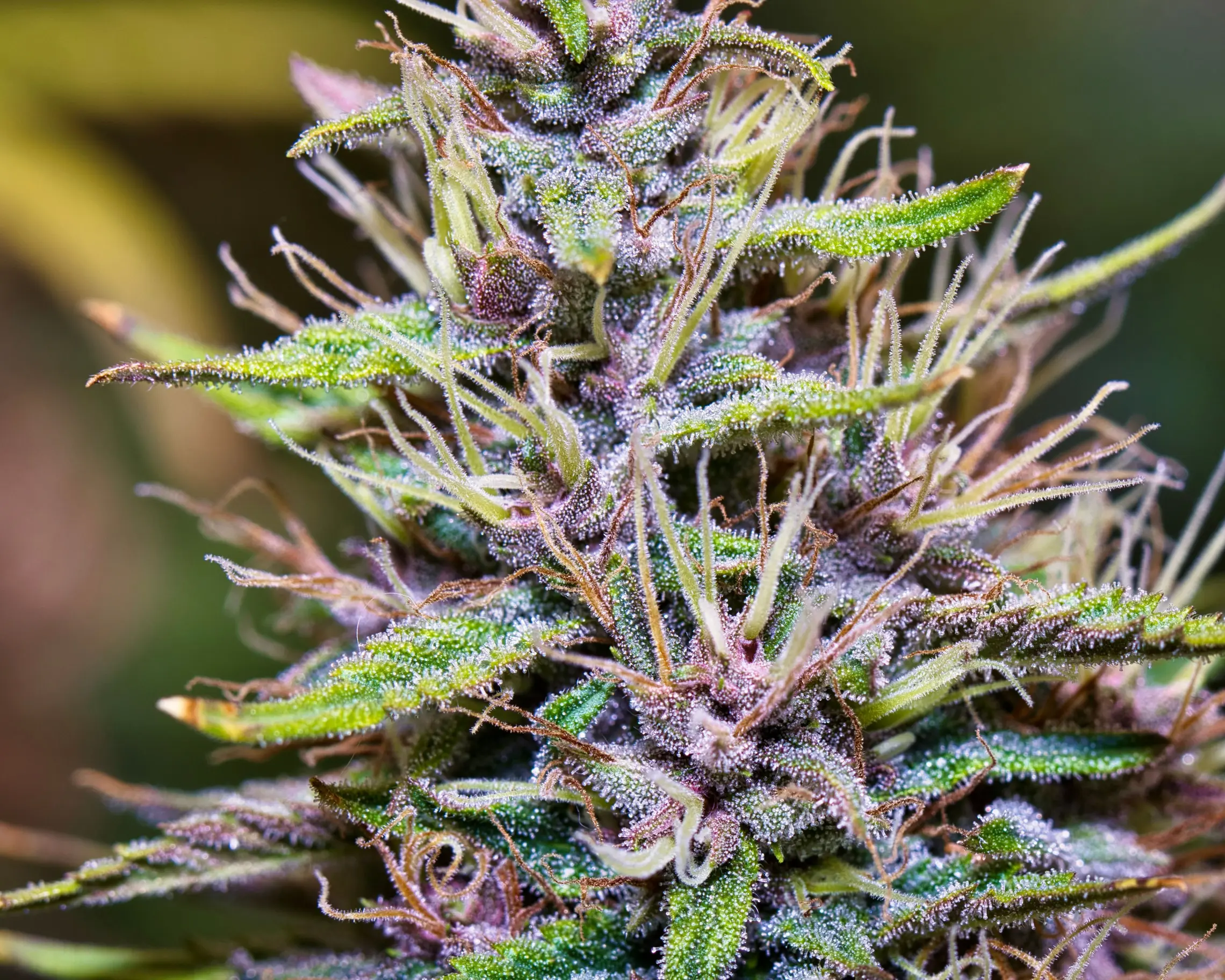
White Cookies
White Cookies is an indica-leaning hybrid most commonly associated with a White Widow x Girl Scout Cookies lineage. It brings together two very different ideas of quality. White Widow contributes vigorous hybrid structure, heavy resin production, pine-earth-spice character, and a balanced mental-to-body progression. Girl Scout Cookies contributes dense flowers, sweet dough-like depth, mint, pepper, and a stronger tendency toward evening relaxation. The resulting cultivar is often compact enough for ordinary indoor spaces but can build flowers dense enough that humidity management becomes more important than height control.
The name needs one clarification before cultivation advice begins. White Cookies is sometimes confused with similarly named cultivars, including material called Wookies or White Oreos in some markets. Those names can represent different genetics. This Weedth profile uses White Cookies as the White Widow x Girl Scout Cookies-type cultivar. If a plant comes from another documented cross, its actual genetics should take priority over the name on a menu or package.
White Cookies is appealing to growers because it can produce highly resinous, visually finished flowers without becoming an enormous plant. That compactness is also its hidden challenge. A short plant can still become crowded. Broad leaves, closely spaced branches, and dense flowering sites can create a canopy that looks manageable from above while holding stagnant humid air underneath. The best run therefore focuses on opening the structure without over-defoliating, keeping root moisture steady, supporting heavy tops, and drying dense flowers slowly enough for flavor but safely enough to prevent internal moisture problems.
Strain Features
| Feature | Details |
|---|---|
| Type | Indica-leaning hybrid |
| Common Lineage | White Widow x Girl Scout Cookies |
| THC | Commonly moderate to high, with substantial phenotype and cultivation variation |
| CBD | Usually low |
| Dominant Terpenes | Limonene, myrcene, caryophyllene are commonly reported; linalool, ocimene, and camphene may contribute in some material |
| Aroma | Sweet earth, vanilla, mint, pepper, citrus, pine, cookie-like spice |
| Flavor | Creamy-sweet and earthy with mint, citrus, pepper, vanilla, and resinous pine |
| Effects | Relaxed, happy, giggly, euphoric; increasingly sleepy or body-heavy at larger doses |
| Flowering Time | Commonly around 9 weeks indoors |
| Indoor Structure | Compact to medium, bushy, broad-leaved, dense canopy possible |
| Outdoor Structure | Medium-sized plant with strong branching under full sun |
| Yield | Moderate, with quality depending heavily on canopy depth and flower density |
| Grow Difficulty | Moderate |
| Training Response | Good response to topping, LST, selective lower cleanup, and controlled SCROG |
| Bud Structure | Dense, resin-heavy flowers with strong trichome coverage and relatively high visual appeal |
| Main Grow Risk | Interior humidity, overwatering compact root zones, branch crowding, and late flower density |
| Main Flavor Risk | Sweet vanilla-mint detail flattening into generic earth/spice during hot flowering or rapid drying |
| Best Environment | Controlled indoor grow or sunny outdoor climate with dry late season |
| Ideal User | Evening-oriented consumers wanting sweet resinous flavor and substantial relaxation |
White Cookies does not need to become a large plant to become a difficult microclimate. The grower's most useful skill is learning to see inside the canopy before the flowers become dense.
Genetic Lineage
The most commonly accepted White Cookies identity combines White Widow with Girl Scout Cookies. Both parents are resin-famous, but they express that resin on different structures and with different sensory emphasis.
White Widow is generally associated with hybrid vigor, substantial branching, strong trichome coverage, pine, earth, spice, and a balanced cerebral-to-physical effect. Its contribution helps explain why White Cookies can remain functional enough early in the experience even though the finished flower often leans toward evening use.
Girl Scout Cookies contributes a denser, sweeter, more modern flower identity. Its family is associated with cookie dough, mint, pepper, sweet earth, and a powerful body component. It also helps explain why White Cookies can produce compact, visually heavy buds that need stronger humidity management than the plant's overall height might suggest.
Why the lineage matters to morphology
A White Widow-leaning phenotype may branch more freely, show more moderate internodal spacing, and carry a clearer pine-earth or floral-spice aroma. It may also feel slightly more balanced in effect.
A Cookies-leaning phenotype may stay more compact, develop darker foliage, stack flowers more tightly, and emphasize sweet earth, vanilla, mint, and pepper. These plants can be attractive in a small room but require better interior airflow because dense branching and dense flowers arrive together.
Balanced phenotypes are often the most practical keepers. They can maintain the resin and sweetness associated with the Cookies side while inheriting enough vigor and branch spacing from White Widow to be easier to manage.
Naming confusion
Growers should not assume that every product called White Cookies shares the same lineage. Similar names have been used for genetically different cultivars. Wookies, for example, is widely associated with a different Cookies-related cross and should not automatically be treated as White Cookies. Some menus also use White Oreos as an alternate market name, which can create further ambiguity.
The cultivation solution is straightforward: document the actual source lineage whenever possible. If the genetics are unavailable, use morphology, aroma, flowering time, and plant behavior as evidence. A label is less useful than a grow log.
Keeper selection
For White Cookies, a good keeper should score well in five areas:
- predictable compact structure without excessive interior congestion,
- strong calyx development and trichome coverage,
- sweet-mint-vanilla aroma that remains after cure,
- acceptable resistance to the grower's humidity pattern,
- and a smooth transition from euphoric uplift into physical relaxation.
The frostiest plant is not automatically the best one. Resin coverage matters, but flavor retention and growability decide whether the phenotype deserves another cycle.
Effect Breakdown
White Cookies usually begins more pleasantly than its heavy-looking flowers suggest. The experience often develops in stages rather than dropping immediately into sedation.
Initial emotional phase
The opening can feel warm, positive, amused, and socially relaxed. Users commonly describe happiness, giggles, and a sense that ordinary pressure becomes less urgent. This emotional lightness is one reason the strain can work well at the end of a demanding day.
Mental phase
At a moderate dose, the mind can remain engaged. Conversation, familiar entertainment, gaming, music, or casual creative activities may feel more immersive. The effect is not usually as sharp or task-oriented as a strongly sativa-leaning cultivar, but it does not necessarily shut the mind down immediately.
White Widow influence can make some phenotypes feel clearer and more balanced. Cookies-leaning material may become more inward and dreamy sooner.
Physical phase
The body effect becomes more obvious with time. Shoulders loosen, movement feels less urgent, and sitting becomes increasingly appealing. Larger doses can create a much heavier result and may lead to sleepiness.
This dose dependence is important. A small evening amount can feel relaxed and sociable. A large amount may turn the same flower into a couch-oriented experience.
Late phase
As the strongest psychoactive peak fades, White Cookies often leaves a soft physical calm. This can make the strain more suitable for late afternoon or evening than for the start of a demanding workday.
Harvest maturity and effect
Growers can influence the finished character through harvest timing. A plant harvested when trichomes are mature but not heavily amber may preserve more of the balanced White Widow-like side. Extending ripeness can increase the perception of heaviness, although cannabinoid and terpene changes are more complex than a simple clear-cloudy-amber rule.
The best approach is to choose the harvest window by the intended experience, aroma, and flower maturity together.
Flavor & Aroma Profile
White Cookies is not simply a sweeter White Widow. The most interesting samples show a layered transition from sweet and creamy notes into resinous earth, pine, pepper, and mint.
Live flower aroma
During flowering, the plant may smell earthy and resinous before its sweeter notes become obvious. As flowers mature, vanilla, cookie dough, mint, citrus, and pepper can build over that base. Some phenotypes keep a clear White Widow-style pine or herbal sharpness underneath.
The aroma is often stronger than the plant's compact size suggests. Indoor growers should plan odor control early rather than waiting for the final two weeks.
Jar aroma
After a careful cure, a good jar should open with sweet earth, vanilla, mint, and citrus before deeper pepper and pine appear. The Cookies influence can create a creamy impression, but the White Widow side prevents the profile from becoming purely dessert-like.
If the jar becomes mainly dry earth and pepper, the most delicate sweet notes may have been lost. That can happen through heat late in flower or through fast post-harvest moisture loss.
Inhale
The inhale is often the sweetest part. Vanilla, cream, mild dough, citrus sweetness, and mint can appear together. A clean sample should taste rich without feeling artificially sugary.
Exhale
The finish often becomes more peppery, earthy, herbal, and pine-like. Caryophyllene and the older White Widow side of the family can become more noticeable here. The contrast between sweet inhale and resinous exhale is part of the strain's appeal.
Flavor vulnerabilities
The most fragile elements are usually:
- vanilla-like sweetness,
- fresh mint,
- light citrus,
- and any floral lift.
The more robust elements, such as earth, pepper, and heavy resinous notes, tend to survive handling better. This means poor drying can leave White Cookies tasting stronger but less complex.
Bud density and flavor
Dense flowers dry differently from loose flowers. The outside may feel ready while the center still holds substantial moisture. If they are sealed too early, the cure becomes unstable. If they are dried aggressively until the center is safe, the outer tissue can become over-dry and lose aroma.
The solution is a controlled, gradual dry with enough room between branches and regular inspection of the thickest flowers.
Dominant Terpenes
White Cookies is commonly associated with limonene, myrcene, and caryophyllene, while some reported material also contains linalool, ocimene, camphene, and other minor terpenes. Because naming and phenotype variation exist, terpene percentages should never be treated as fixed for the cultivar.
Limonene
Limonene contributes citrus brightness and helps lift the sweet profile. In some flowers it can present more like lemon peel than fresh orange. It is especially noticeable when the cure has preserved top notes well.
For growers, limonene is a reminder to control late heat. A citrus note that is clear on the live plant can disappear rapidly when the flowers are dried in a warm room.
Myrcene
Myrcene adds earthy, musky, herbal depth. It helps explain why White Cookies can smell sweet at first but still finish with a heavier cannabis character. It is also commonly associated with the relaxed physical character of many THC-rich cultivars, though human effects cannot be assigned to one terpene alone.
Caryophyllene
Caryophyllene adds black pepper, warm spice, and dry wood. It can become clearer after combustion or on the finish of vapor. In White Cookies it connects the Cookies spice with the more resinous White Widow side.
Linalool
When present at meaningful levels, linalool can add a floral softness. It may help make vanilla and mint feel more rounded. It is usually a supporting note rather than the dominant identity.
Ocimene
Ocimene can contribute sweet herbal brightness and a lighter tropical or green quality. It is volatile and can be difficult to preserve through rough post-harvest handling.
Camphene and pine-like notes
Some profiles list camphene or other terpenes that can reinforce sharp herbal, pine, or resinous impressions. These notes can make White Cookies feel more complex than a typical dessert cultivar.
Grower interpretation
The best practical use of terpene information is not to predict the entire high. It is to identify what needs protection. With White Cookies, protect the light sweet, mint, citrus, and floral layers because the heavier earth and pepper will often survive even when those top notes do not.
Indoor vs. Outdoor Growing
White Cookies is well suited to indoor production because its compact frame makes environmental control efficient. Outdoor cultivation is possible, but dense flowers create a strong preference for dry finishing weather.
Indoor growing
Indoors, the plant usually remains compact to medium and can fit comfortably beneath a low or moderate ceiling. The risk is assuming that short equals simple. White Cookies may create a dense canopy of broad leaves and side branches that reduce air movement through the middle of the plant.
Early topping and LST can produce multiple strong tops. The grower should then remove weak inner shoots rather than allowing every branch to remain. This keeps the final canopy easier to inspect and reduces the percentage of small shaded flowers.
Outdoor growing
Outdoors, the plant can become wider and more productive with increased root space. Full sun helps develop strong branches and resin. The finishing season is decisive. Cool nights with persistent dew or repeated rain can create risk inside tight flowers.
Outdoor growers should begin with wider branch spacing and avoid building an impenetrable center. If plants are movable, temporary protection from prolonged rain can be useful, but any cover must maintain side ventilation.
Height comparison
White Cookies is rarely chosen for extreme vertical size. Indoor plants can often be kept under control with one topping and horizontal training. Outdoor plants can still become substantial if started early, but their form is more likely to be broad and branched than narrowly towering.
Yield comparison
Indoor yields are usually moderate and depend heavily on canopy efficiency. A compact plant with ten well-lit tops can outperform a larger tangled plant with many low-quality sites.
Outdoors, individual plants can produce more simply because root space and canopy area are larger. The quality percentage still depends on light penetration, support, and late-season weather.
Flavor comparison
Indoor control gives the grower an advantage in preserving vanilla, mint, and citrus. Outdoor flower can be equally complex when the plant finishes under mild dry weather and is moved promptly into a controlled drying environment.
Strain-Specific Grow Guidance
The central White Cookies cultivation problem is density at multiple levels: dense foliage, dense branch intersections, and dense flowers. Solve those layers gradually rather than with one late aggressive defoliation.
Seedling and early veg
Young plants may begin with broad leaves and fairly tight nodes. Avoid overwatering small root systems simply because the foliage looks vigorous. Let the root zone develop in a medium with good drainage and oxygen.
If using rich soil, pay attention to leaf color. Very dark young leaves and clawing can indicate excess nitrogen before the plant needs additional feeding.
Topping strategy
One topping after the plant is established can be very effective. It encourages the natural lateral structure and reduces the chance that a single central cola becomes disproportionately dense.
After topping, select the strongest branches. Do not preserve every new shoot. White Cookies can produce enough interior growth that branch selection matters more than repeated topping.
LST
Pull the main branches outward while stems are flexible. The goal is to create an open bowl or shallow table rather than a tight bush. This gives later flower sites their own air and light space.
Tie points should be adjusted as stems thicken. A forgotten tight tie can damage bark and restrict a branch just as flowering begins.
SCROG
White Cookies can work well under a screen, especially with a small number of plants. The best screen is not fully packed. Leave open squares around future colas and use the net to separate branches.
A dense screen with broad leaves can create severe interior shading. If the net becomes visually solid in early flower, remove redundant shoots before flowers gain weight.
Lower cleanup
After stretch, identify branches that remain below the productive light zone. Remove weak flowering sites and tiny shoots that will never develop premium density.
This improves trimming efficiency and allows more air to move under the canopy. It also makes irrigation and pest inspection easier.
Defoliation
White Cookies often benefits from selective leaf removal, but it is easy to overdo because the broad leaves make the canopy look crowded. Remove leaves based on function:
- persistent overlap,
- blocked airflow,
- blocked primary flower sites,
- damaged or unhealthy tissue.
Keep healthy exposed leaves that are not causing a problem. They remain important photosynthetic organs.
Stretch management
Stretch is usually manageable, but individual phenotypes can differ. Record height at the flip and again after the main stretch. This ratio tells the grower how long to vegetate clones on the second run.
Do not wait for a surprise stretch before adding a net. Install support while branches are still easy to position.
Feeding
Moderate feeding is generally appropriate. Dense dark leaves are not a target. Excess nitrogen can keep the plant overly vegetative and increase leaf mass inside a canopy that is already inclined to crowding.
During flowering, reduce nitrogen pressure gradually and supply balanced bloom nutrition according to actual demand. Avoid stacking multiple bloom boosters in an attempt to force density. White Cookies already has the genetics to make dense flower; environmental health matters more.
Root-zone moisture
Compact plants in large containers are easy to overwater because their pots may dry more slowly than taller, high-transpiration cultivars. Irrigate by root-zone demand, not by a fixed room schedule.
A plant that remains wet longer than its neighbors should not receive the same volume simply for consistency. Chronic saturation can reduce vigor and create nutrient symptoms that are mistaken for deficiency.
Temperature
Keep vegetative and early flower conditions comfortably warm but avoid sustained excessive canopy heat. During late flower, stable moderate temperatures help preserve sweet and minty top notes.
The grower should measure temperature at canopy level, not only near the floor or intake.
Humidity
Humidity becomes the major risk as buds densify. Gradually reduce RH through flowering and pay attention to lights-off spikes. Good air exchange below the canopy is as important as circulation above it.
Large central flowers should be inspected from the inside. Any unusual soft area, brown tissue, or musty smell requires immediate attention.
Light
White Cookies can use strong flowering light, but light should be distributed evenly across a flat canopy. The compact plant shape makes it easy to place the lamp too close because the tops do not look tall. Watch for bleaching, upward leaf curl, or loss of aroma near the highest flowers.
Weeks one to three
Use the stretch period to finish canopy organization. Continue gentle tucking, remove weak lower growth, and separate branches that are stacking directly over one another. Stop major high-stress work as flower sites become established.
Weeks four to six
Flowers begin gaining weight and resin. Increase attention to support and airflow. This is a good period to record phenotype aroma: which plant is more vanilla, mint, citrus, pine, or pepper?
Avoid allowing irrigation runoff or standing water to raise room humidity unnecessarily.
Weeks seven to finish
More feed is not automatically more quality
The final phase should be calm. Avoid late foliar sprays, major pruning, excessive nitrogen, and heat stress. Support colas, monitor internal flower health, and allow the plant to ripen without forcing it.
Harvest timing
Judge trichomes across multiple flowers, not only the top cola. Combine resin maturity with calyx swelling, pistil behavior, leaf senescence, and aroma.
A balanced harvest can preserve more of the clear euphoric opening. A later harvest may feel heavier, but extending the plant simply to create sedation can reduce the sweet top notes.
Phenotype matrix
For every plant, score:
- stretch,
- branch spacing,
- leaf density,
- flower density,
- branch strength,
- trichome coverage,
- calyx-to-leaf ratio,
- vanilla/mint intensity,
- pine/pepper intensity,
- cure retention,
- and effect.
This information is more valuable than generic strain averages.
Second-run strategy
Once a keeper is known, set veg duration to its actual stretch, place the support net at the correct height, remove the same weak branch zones earlier, and reproduce the drying method that best preserved aroma. White Cookies becomes significantly easier when it is treated as a known clone rather than an unknown name.
Weedth Bud Flavor Tips
White Cookies can lose its most interesting details during drying because the heavy earth and spice remain while lighter sweetness disappears.
Harvest by aroma and maturity together
During the final week, smell individual flowers before touching them. If vanilla, mint, or citrus is at its clearest and the resin is mature, the plant may be in its best sensory window.
Do not extend the harvest only because more amber is possible.
Keep harvest handling cool
Cut branches during a cooler period if possible. Move outdoor harvests out of direct sun immediately. Do not pile dense flowers in warm containers where heat and humidity can build.
Trim carefully
White Cookies is resin-heavy. Rough wet trimming can smear trichomes and increase surface damage. Many growers will prefer removing large fan leaves and doing a more detailed trim after drying, provided the drying climate is controlled.
Slow but safe drying
The flowers need a gradual dry, but their density means the process must remain hygienic. Hang branches with space between them and maintain gentle room circulation. Do not point fans directly at buds.
In a humid room, whole-plant drying may be too slow for very dense expressions. Smaller branches can improve safety. In a dry room, leaving more plant material attached can slow moisture loss and preserve aroma.
Test the thickest flowers
Do not judge dryness only by small buds. The largest colas contain more internal moisture. Before curing, break down or inspect a representative dense flower and make sure the center is not noticeably wet.
Cure gradually
Place dried flower into clean airtight containers and monitor humidity. Early in cure, release excess moisture as needed. As the flower equalizes, reduce opening frequency.
A few weeks of cure can integrate the sweet, earthy, minty, and peppery layers. White Cookies often tastes more coherent after the initial green edge has softened.
Never use fruit peels to restore flavor
Adding citrus peel or other fresh organic material can introduce microbial risk and foreign aroma. It does not restore lost cultivar terpenes. If flavor was lost, improve the next harvest and dry.
Storage
Use airtight containers, darkness, and cool stable temperature. Open bulk storage infrequently. Portion frequently used flower into a smaller container so the main jar is not repeatedly exposed to fresh air.
Aroma loss diagnostic
If live flowers smelled sweet but cured flowers smell mainly earthy and peppery, review:
- late flower temperature,
- harvest heat,
- drying speed,
- direct airflow,
- whether small buds determined the drying endpoint,
- and storage conditions.
Weedth Bud Boost Tips
White Cookies already knows how to make dense resinous flowers. The grower's job is to create more well-lit safe flowers, not to force density chemically.
Use a small number of strong branches
After topping, keep branches that can reach the canopy and carry weight. Remove redundant interior branches. This converts plant energy and grower attention into a higher percentage of premium flowers.
Flatten early
LST and a loose screen can create an even canopy before flowers become rigid. The more uniform the tops, the easier it is to run useful light intensity without overheating one central cola.
Control canopy depth
Do not allow productive flowering to extend too deep below the light. Lower branches that remain shaded usually create small leafy flowers. Remove them after stretch.
Support before weight arrives
Install netting or stakes early. Resin-heavy flowers can make side branches lean late in bloom. Good support prevents branches from resting on one another and protects airflow.
Keep roots aerobic
A healthy root zone is a real bud booster. Use appropriate container size, drainage, and irrigation intervals. Overwatered roots cannot use high nutrient concentrations efficiently.
Feed the plant, not the schedule
Watch plant response. Increase nutrients only when growth, light, and root health justify demand. Avoid adding multiple supplements simply because flowering has started.
Use strong light responsibly
Higher photon delivery can increase cannabis yield when the plant has adequate environmental support, but the relationship is not unlimited. A flat canopy and stable temperature are prerequisites. If the tops bleach or aroma weakens, more light is not helping quality.
Avoid late stress tricks
Extended darkness, extreme drought, intentional stem injury, and aggressive late pruning are not reliable substitutes for good cultivation. White Cookies has abundant resin potential without theatrical stress.
Protect lower-canopy quality
If the setup uses supplemental side or under-canopy light, apply it only where there is healthy leaf and flower tissue capable of using it. Do not keep unnecessary interior branches just because additional light exists.
Premium-bud percentage
At trimming, separate premium, secondary, and larfy flowers. Weigh or estimate each category. If too much material falls into the lowest category, reduce canopy depth and branch count next cycle.
This is a more useful production metric than total wet plant weight.
Medical Uses & Benefits
White Cookies is commonly chosen for relaxation, mood improvement, and evening comfort, but strain descriptions should not be treated as clinical evidence that it treats a disease.
Stress
The early euphoric phase may help some users feel less mentally occupied by daily stress. The later body relaxation can reinforce that sense of unwinding.
Sleep support
At larger doses, many users find White Cookies sleepy. This may make it useful as part of an evening routine for some people. It is not a guaranteed insomnia treatment, and dose timing can affect the result.
Mild aches and tension
The heavier physical phase may reduce awareness of everyday muscle tension or soreness. Serious or persistent pain requires appropriate medical evaluation rather than reliance on a strain label.
Appetite
THC-rich flower can stimulate appetite for some consumers. White Cookies may do so as the high settles into the body. Other users may notice little effect.
Mood
The happy or giggly opening can be appealing to people seeking temporary mood elevation. THC can also increase anxiety in sensitive users, so lower doses are more appropriate for anyone uncertain of tolerance.
Main caution
White Cookies can become substantially more sedating as dose rises. Users who need to drive, operate equipment, or remain highly alert should not treat its pleasant opening as proof that impairment is mild.
Ideal User Profile
White Cookies is best suited to a consumer who enjoys sweet resinous flavor and a progressively relaxing high.
Best time
Late afternoon and evening are the most natural windows. Smaller doses may remain social and functional, while larger doses fit quiet entertainment or pre-sleep relaxation better.
Flavor preference
The ideal user likes vanilla, sweet earth, mint, citrus, pepper, and pine. Someone seeking pure fruit candy may find the earthy-spicy base too prominent.
Tolerance
Intermediate users are likely to appreciate the balance most easily. Beginners should start small because the physical heaviness can build after the pleasant first phase.
Grower profile
White Cookies suits a grower with basic control over humidity and airflow. It is not extraordinarily difficult, but dense flowers and compact foliage punish neglect late in bloom.
Small-space growers
The compact frame is useful in tents and low ceilings. The key is horizontal organization. A small plant can still fill its footprint efficiently when trained early.
Outdoor growers
A grower with a dry, sunny finishing season can produce excellent flower outdoors. Repeated autumn rain or persistent morning dew makes the strain less forgiving.
Grower Notes and Feedback
Several cultivation patterns are worth expecting even before the first run.
Compact does not mean weak
White Cookies can remain relatively short while producing heavy flowers. Growers should judge support needs by branch loading, not plant height.
Broad leaves can hide the center
From above, the plant may look healthy and orderly while small shoots and overlapping leaves create congestion below. Periodically inspect the canopy from underneath.
The plant can be overfed visually
Because broad dark leaves look impressive, growers sometimes push nitrogen to maintain that appearance. Very dark color and clawed tips should be treated as a warning, not a quality goal.
Flower density arrives late
Branches that appear capable of holding themselves in week five may lean significantly later. Support should be ready before the final swelling phase.
Aroma changes through cure
Fresh flowers may smell sharper, greener, or more citrus-pine. Cure can bring vanilla, mint, sweet earth, and pepper into a more integrated profile. Judge the keeper after the jar stabilizes.
Mold prevention is easier than rescue
Once internal flower rot is visible, quality is already lost. The better strategy is lower late-flower humidity, branch separation, good circulation, and regular inspection.
Phenotype variation deserves respect
Some plants will show more White Widow vigor and spice, others more Cookies density and dessert character. Record those differences rather than forcing all plants onto one feeding and training expectation.
Weedth Editor's Note
What this cultivar asks from the room
If I were running White Cookies again, the first thing I would change from a typical compact-hybrid grow would be how early I look inside the plant. Short strains make people comfortable. You see a manageable height and assume the canopy is under control. White Cookies can prove otherwise once the broad leaves and side branches begin occupying the same interior space.
I would top once, then spread the strongest branches outward. I do not want a perfectly symmetrical plant if symmetry creates too many identical branches in the center. I want space between the future flowers. When I look down through the canopy, I should be able to see some of the medium and lower stems. If I see only leaf surface, I know I am building a humidity problem for week seven.
I would also feed it more conservatively than its dark green appearance might tempt me to. Dense foliage is already part of the genetics. I do not need extra nitrogen encouraging even more leaf mass. I want healthy green leaves with responsive posture, not a thick glossy canopy that stays dark until harvest.
The stretch would tell me how much of White Widow I am seeing. If one plant begins rising more aggressively and opening its branch spacing, I would give that phenotype more room in the net. If another stays tight and stocky, I would focus more on opening the center and preventing flower sites from stacking against each other.
Once the buds begin frosting, I would resist the urge to touch them constantly. White Cookies can be visually satisfying, but every squeeze and unnecessary inspection transfers resin. I would support the branches, monitor the center of the largest flowers, and leave the trichomes where they belong.
The last two weeks would be about climate. I would pay more attention to lights-off humidity than to almost any additive bottle. A dense Cookies-influenced flower sitting in a humid nighttime canopy is a much bigger threat to final quality than missing one extra bloom supplement.
At harvest, I would smell for the light notes. Vanilla and mint are the clues I do not want to lose. Earth and pepper are durable. If the jar still has only the heavy notes after cure, I know the process was too aggressive somewhere.
For drying, I would choose branch size according to the room. In a dry winter environment, I would leave larger sections intact to slow the process. In a humid room, I would separate the densest branches earlier and give them safe space. I would never use the same drying method blindly just because it worked for a looser-flowered strain.
My keeper would be the plant that gives me the best compromise: enough White Widow vigor to stay easy to grow, enough Cookies influence to create dense frosty flowers, and enough sweet mint-vanilla character to remain recognizable after a month of cure.
That is where White Cookies makes sense to me. It is not about pushing one trait to an extreme. It is about preserving the balance between old-school resinous spice and newer dessert-like density.
Weedth Score
Growing Experience – 8.2/10
Compact height and good training response are convenient, but interior humidity and dense late flowers require attention. It is manageable for an informed beginner and rewarding for experienced growers.
Bud Structure & Visual Appeal – 9.1/10
This is a strong category. Dense flowers and heavy trichome coverage can create excellent visual quality when the canopy receives even light.
Aroma Complexity – 8.8/10
Vanilla, mint, sweet earth, citrus, pepper, and pine give the strain more depth than a simple dessert profile.
Flavor & Smoothness – 8.7/10
A careful dry produces a creamy-sweet opening and resinous spicy finish. Over-drying quickly reduces the distinction between layers.
Effects & High Experience – 8.8/10
The happy, giggly opening and progressively heavier body finish create a versatile evening profile.
Overall Satisfaction & Recommendation – 8.7/10
White Cookies is a strong choice for growers who want compact plants and resinous dessert-leaning flower without losing the spice and pine of older hybrid genetics.
"The frost gets your attention first, but the keeper is the jar that still has vanilla, mint, pepper, and pine after the cure settles."
FAQ
What is the lineage of White Cookies?
The most commonly accepted identity is White Widow x Girl Scout Cookies. Similar names can refer to different genetics, so growers should verify the actual source lineage whenever possible.
Is White Cookies the same as Wookies?
No, they should not automatically be treated as the same cultivar. Wookies is associated with a different Cookies-related cross. Naming can be inconsistent in cannabis markets, so documented genetics are more reliable than similar names.
How long does White Cookies flower?
Around nine weeks is a common indoor expectation, but phenotype and environment can shift the exact finish. Harvest by flower maturity and trichomes rather than calendar alone.
Is White Cookies good for small grow tents?
Yes. Its compact to medium height makes it practical in limited vertical space. Horizontal branch management is still important because the plant can become wide and dense.
Does White Cookies need topping?
It does not require topping, but one early topping is often useful for creating multiple evenly lit tops and reducing the size of a single dense central cola.
Is SCROG appropriate?
Yes, provided the screen is not overfilled. Use the net to separate branches and create airflow rather than maximizing the number of shoots in every square.
Does White Cookies need heavy nutrients?
No. It generally performs better with balanced nutrition based on plant demand. Excess nitrogen can create overly dark foliage and worsen canopy density.
What is the biggest cultivation risk?
Late-flower humidity inside dense flowers and a crowded interior canopy. The plant can look manageable while hidden microclimates become risky.
What does White Cookies taste like?
Expect sweet earth, vanilla, mint, citrus, pepper, and pine in varying proportions. Some phenotypes lean more creamy and dessert-like while others show more resinous spice.
How can I preserve the vanilla and mint flavor?
Avoid excessive late heat, harvest within the correct maturity window, dry gradually in cool darkness, keep direct fan air off the flowers, and store cured buds airtight and cool.
Should I dry White Cookies whole-plant?
Only if the drying environment is dry enough to handle the density safely. In humid conditions, separating large branches can reduce internal moisture risk. Drying method should match the room, not a fixed rule.
Is White Cookies a daytime strain?
Small doses may remain social and uplifting, but the body effect often becomes heavier with time and dose. Many users will prefer it later in the day.
When should I select a keeper?
After at least several weeks of cure. Choose the phenotype that combines manageable growth, healthy flower density, good aroma retention, smooth consumption, and the desired effect.
Similar Strains
White Widow
The direct parent reference for growers who like White Cookies' resin and pine-spice foundation but want a more balanced, less dessert-oriented experience.
Girl Scout Cookies
The other major lineage reference. It emphasizes sweet earth, mint, spice, dense flowers, and a stronger Cookies-family body effect.
Animal Mints
A useful comparison for users who enjoy minty, sweet, resin-heavy Cookies-family flower. Animal Mints often leans more modern and more intensely mint-gas in sensory character.
Ice Cream Cake
For consumers seeking an even heavier dessert direction with dense flowers and evening relaxation. It generally pushes further toward cream, vanilla, and sedative body effect.
White Truffle
A resin-focused alternative with darker earthy, nutty, and savory qualities. It shares visual frost and evening appeal but moves away from the vanilla-mint balance.
Biscotti
Another dense Cookies-family option that combines sweet bakery notes with spice and fuel. It is relevant to growers who enjoy White Cookies but want a stronger gas and cookie-dough direction.
Share this article
A quick overview of the topics covered in this article.
Follow us
Latest articles

September 8, 2026

September 8, 2026
September 8, 2026

September 8, 2026