
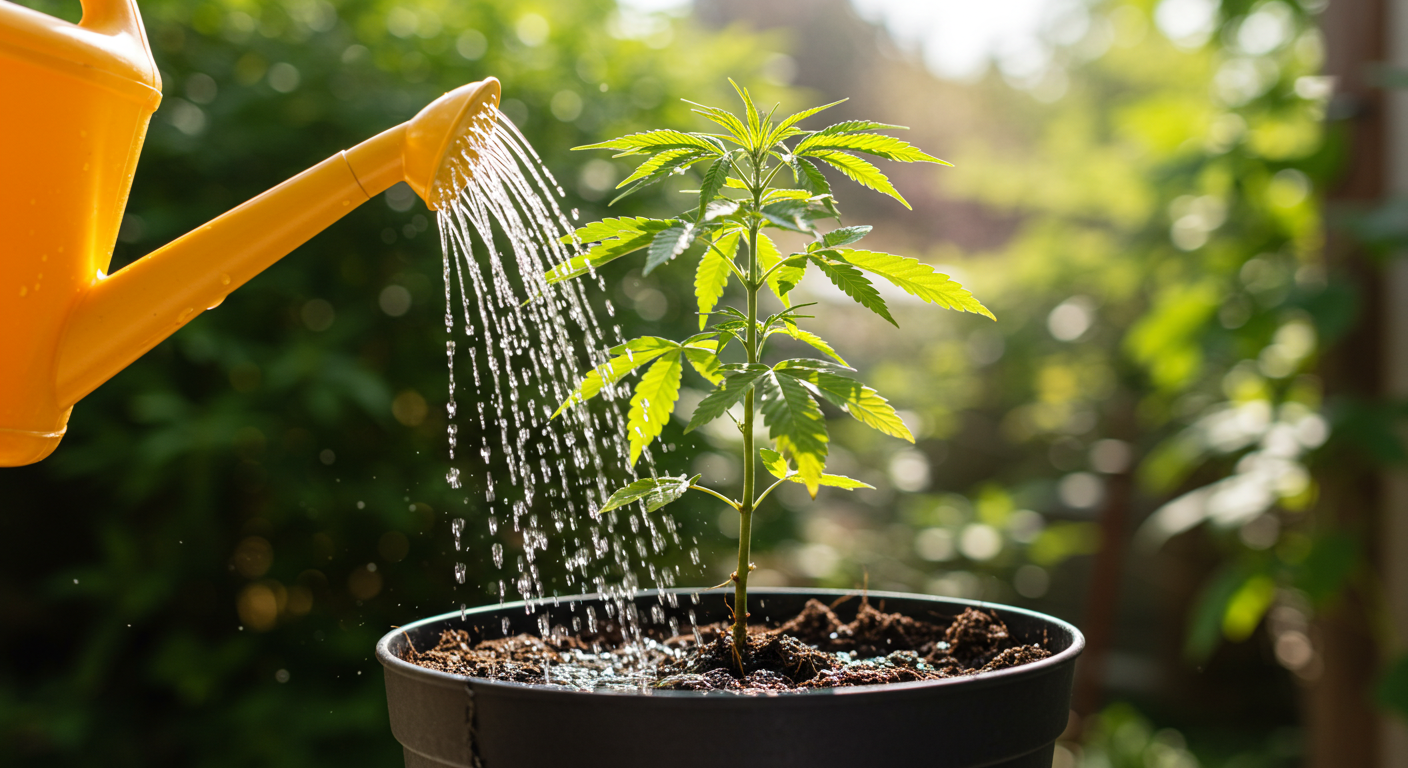
Hand Watering vs Drip Irrigation Outdoors
Hand watering and drip irrigation can both grow excellent outdoor cannabis. The better choice is not the one that looks more professional, and it is not automatically the one that uses more automation. The useful question is simpler: which method lets you wet the active root zone evenly, deliver the intended volume and nutrient strength, notice failures early, and repeat the result as the plant and weather change?
For a small outdoor garden, hand watering is often hard to beat. You can slow down around a dry container, give a thirsty plant more than its neighbor, notice runoff beginning from one side, and catch root-zone problems while you are standing there. Drip irrigation starts to earn its place when the garden becomes repetitive, irrigation frequency increases, containers dry quickly, or hand watering takes enough time that consistency begins to slip.
There is also a middle ground. Many growers hand water while plants are young and variable, then move mature containers to a tested drip system once their demand becomes more predictable. Others keep drip irrigation for routine delivery but still hand water individual containers when one plant falls out of rhythm. Automation should reduce repetitive labor without removing observation.
Weedth Verdict: Choose hand watering when plant-to-plant control and direct observation matter more than labor. Choose drip irrigation when repeatability, frequency, or scale has become the limiting factor. If you cannot measure what reaches the root zone, neither method is truly controlled.
This resource stays on that decision. It does not repeat the full outdoor cultivation process or the entire subject of cannabis watering. For broader background, use the complete outdoor cannabis growing guide and the cannabis watering basics guide.
Resource Navigation
In This Resource
- Identify the exact water/root-zone question and the measurements that matter: volume, frequency, moisture, pH, EC, alkalinity, hardness, sodium, chloride, or temperature
- How soil, coco, rockwool, hydroponics, container size, root mass, light, temperature, humidity, and plant stage change the answer
- Repeatable test or irrigation procedure with sampling points, meter calibration, collection method, and recordkeeping
- Separate source-water chemistry from fertilizer strength and root-zone accumulation
- Diagnose uneven wetting, hydrophobic channels, clogged emitters, high EC, misleading runoff, or overcorrection
- Correction sequence: observe, measure, change one variable, allow recovery, and verify the next irrigation event
- Practical thresholds/checklist and the next internal resource to link
Identify the exact water/root-zone question and the measurements that matter: volume, frequency, moisture, pH, EC, alkalinity, hardness, sodium, chloride, or temperature
The easiest way to make this comparison confusing is to begin with equipment. Put the watering can and drip tubing aside for a moment. First decide what you are trying to control.
Maybe your problem is labor. Ten large containers take too long to water evenly by hand. Maybe the problem is not labor at all. One side of a fabric pot keeps drying while water escapes from the other side. Perhaps you are fertigating coco and the plants now need several smaller irrigations on hot days. Or perhaps your soil bed holds moisture for days and installing automated drip simply risks making an already wet root zone wetter.
The delivery method only makes sense after the root-zone question is clear.
Volume and frequency are separate decisions
Growers often talk about watering as if volume alone answers the question: “I give this plant four liters.” That number is incomplete. Four liters applied in five minutes is not the same root-zone event as four liters applied gradually over an hour. Four liters once every four days is not the same strategy as four one-liter pulses in a fast-draining medium.
Volume tells you how much solution enters the system. Frequency tells you how that volume is divided across time. The medium, root mass, weather, and drainage decide whether the combination works.
Hand watering naturally favors fewer, larger events because you have to be present. Drip makes small repeated events easier. That is one of drip irrigation’s strongest advantages in coco, rockwool, and other fast-draining root zones. It is much less useful if the plant is in heavy soil that already stays wet for too long.
Moisture tells you what the previous irrigation actually accomplished
You can measure input perfectly and still water poorly. Water may run down a gap beside the container, follow one coarse channel through the medium, or wet only a narrow cylinder beneath a single emitter. That is why moisture distribution matters as much as total volume.
With hand watering, you can change your pour pattern while you work. You can move around the container, apply a first pass, pause, and come back to areas that resisted water. With drip, the system repeats whatever placement you gave it. If the emitter is poorly positioned, the system repeats that mistake beautifully.
When evaluating either method, check more than the top centimeter of medium. Look at the center and outer root zone where practical. In containers, compare weight before and after irrigation. In beds, probe moisture at more than one point. If you use substrate sensors, remember that the sensor only describes the volume around the probe. A perfectly calibrated sensor in the wrong place can still tell an incomplete story.
Electrical Conductivity, or EC
EC measures how strongly a solution conducts electricity and is used as a practical estimate of dissolved ionic concentration. In a fertilizer solution, higher EC usually means more dissolved nutrient salts. In source water, EC may come from calcium, magnesium, sodium, chloride, bicarbonates, or other dissolved ions. EC tells you how concentrated the solution is, but not which ions created that concentration.
pH does not tell you the same thing as alkalinity
This distinction is worth learning early because it prevents a lot of unnecessary pH chasing. Source-water pH describes the water’s current acidity or basicity. Alkalinity describes its capacity to neutralize acid and resist a change in pH, largely because of bicarbonates and carbonates.
Two water sources can show a similar pH on your meter while behaving very differently after repeated irrigation. A source with high alkalinity can steadily push the root-zone pH upward even if you adjust each batch to a seemingly reasonable number. A low-alkalinity source may change pH easily and provide very little buffering.
For general greenhouse and nursery irrigation, Penn State uses roughly 30 to 100 mg/L as CaCO3 as a useful alkalinity range and flags higher values for closer management. That is general horticultural screening guidance, not a cannabis-specific target. The practical lesson for outdoor cannabis is that recurring pH drift deserves a look at alkalinity, not just another dose of pH-down.
Hardness is not simply “bad water”
Hardness mainly reflects dissolved calcium and magnesium. Moderate hardness can contribute useful minerals. Very hard water can scale equipment and small emitters, especially when high alkalinity and incompatible fertilizer chemistry are also involved.
This matters more in drip than hand watering because the smallest passages become part of the crop’s reliability. A hand-watered plant does not care if a small amount of calcium scale appears on the inside of your watering can. A 1 or 2 L/h emitter may care very much if precipitates slowly narrow its flow path.
Do not solve hard water automatically with a sodium-based household water softener. That can exchange calcium and magnesium for sodium and create a different irrigation problem. Test the source and choose treatment for the problem you actually have.
Sodium and chloride deserve attention when they are already in the source
Sodium and chloride can accumulate when irrigation repeatedly adds them faster than rainfall or planned leaching removes them. This becomes more important in containers, covered areas, and systems where drainage is limited.
General irrigation guidance from Penn State flags sodium above about 50 mg/L for concern in sensitive crops and chloride above about 30 mg/L for sensitive plants, with many plants tolerating chloride closer to 100 mg/L. Cannabis-specific tolerance depends on cultivar, root-zone conditions, irrigation pattern, and total salinity, so those numbers should be used as screening points for further investigation rather than universal cannabis toxicity thresholds.
Water temperature is a supporting measurement, not an obsession
Outdoor irrigation water can become unexpectedly hot when a hose lies in direct sun. Before you soak the root zone on a hot afternoon, let stagnant heated water leave the hose. At the opposite extreme, very cold reservoir or well water can temporarily cool a small container root zone.
You do not need to chase one perfect water temperature every time you irrigate outdoors. You do need to avoid obvious extremes and remember that meter readings can also shift with temperature if your instrument lacks reliable automatic temperature compensation.
If I can hand water every evening, is there any reason to install drip?
Question sent by: Ethan Brooks, via email.
Not necessarily. If you have a small number of plants, can water each root zone evenly, and your current routine stays consistent during hot weather, hand watering may give you more useful plant-by-plant feedback than automation. Drip becomes attractive when the job is taking too long, plants need more than one irrigation event in a day, or your hand-applied volume and coverage are becoming inconsistent. Do not automate a process that is already easy to perform and verify unless automation solves a real limitation.
The comparison is really feedback versus repeatability
Hand watering gives immediate feedback. You feel the container, see the surface accept water, watch drainage begin, and notice which plant is behaving differently. Its weakness is human variation. You may pour faster when you are in a hurry, give slightly different volumes, or skip the far corner of a large bed.
Drip gives repeatability. Once pressure, emitter flow, placement, duration, and schedule are correct, the same system can reproduce a root-zone event with much less labor. Its weakness is silent failure. A clogged emitter can under-water one plant while the rest of the zone looks perfect. A timer can run exactly on schedule while a kinked line delivers almost nothing.
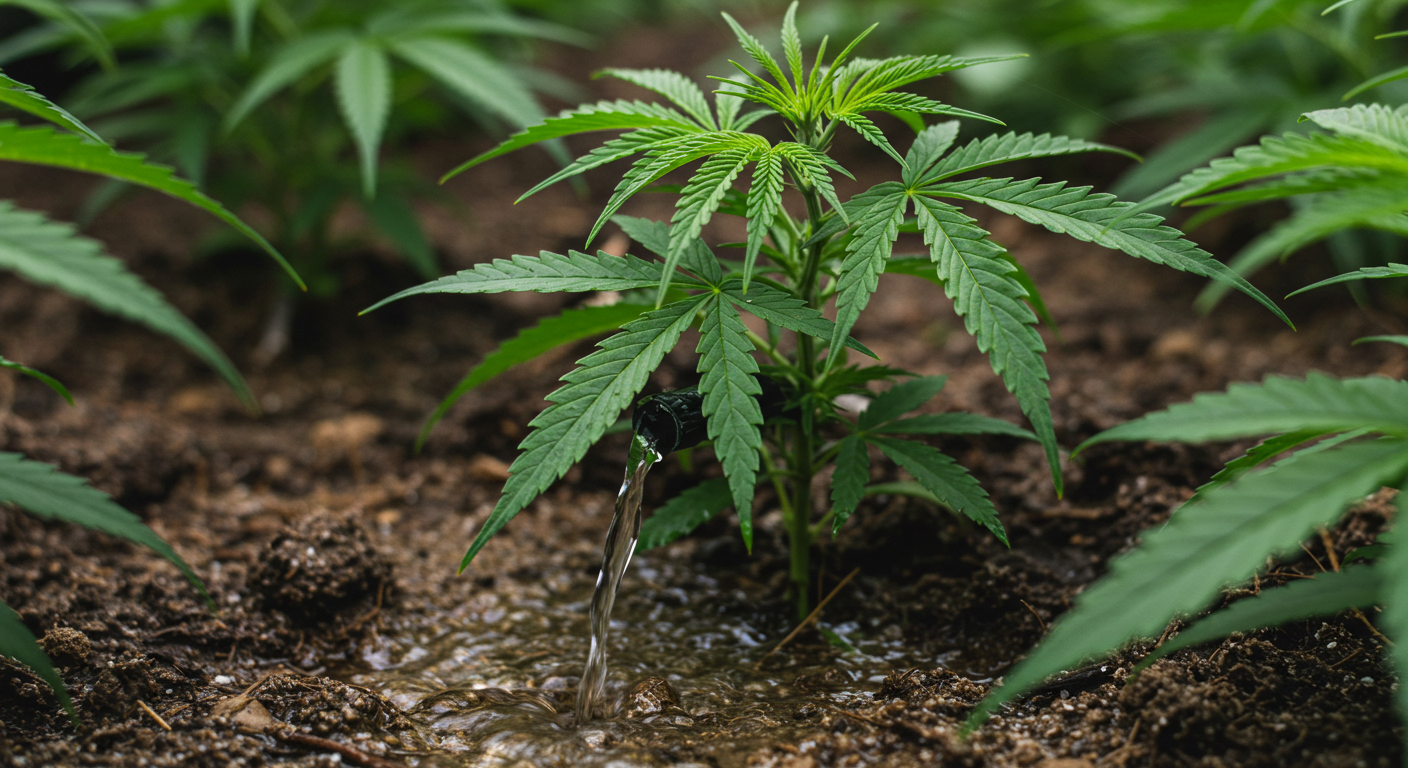
| Decision point | What changes between hand watering and drip |
|---|---|
| Plant-to-plant adjustment | Hand watering: excellent. You can change volume and pace immediately. Drip: good only if zones, emitters, or run times allow different demand to be managed. |
| Repeatability | Hand watering: depends on measuring and technique. Drip: excellent after flow and placement have been verified. |
| Frequent small irrigations | Hand watering: labor intensive. Drip: one of its strongest use cases. |
| Failure visibility | Hand watering: failures are usually obvious because you are present. Drip: partial clogs and pressure problems can stay hidden unless output is tested. |
| Uneven plants | Hand watering: easy to respond to individual demand. Drip: one schedule can over-water weak plants while under-serving stronger ones if everything is tied to one zone. |
| Large repetitive garden | Hand watering: labor increases quickly. Drip: usually becomes more practical if the system is maintained. |
How soil, coco, rockwool, hydroponics, container size, root mass, light, temperature, humidity, and plant stage change the answer
No irrigation method exists independently of the root zone. If you change the medium, the same watering event behaves differently. If you double the root mass, yesterday’s schedule may stop making sense. If a heatwave arrives, the same container can move from comfortable moisture buffering to rapid daily dry-back.
This is why copying another grower’s drip timer or hand-watering volume is rarely enough. Let us match the method to the medium first.
Native soil and large outdoor beds usually reward slower, deeper irrigation
In ground soil, the active root zone can spread far beyond the original planting hole. A single point emitter beside the stem may wet only a small portion of that soil, especially in coarse ground. Hand watering with a hose wand, watering rose, or slow open flow can cover a broad area, but it requires you to think about where the roots have expanded rather than repeatedly soaking the stem base.
Drip can work very well in soil beds when the layout follows the expanding root zone. That may mean multiple emitters, a dripline loop, or line-source tubing rather than one point source. The objective is to develop overlapping wetting patterns instead of a permanent wet column surrounded by dry soil.
Soil texture changes the pattern. Fine-textured soils tend to move water laterally more readily while coarse sandy soils often allow faster downward movement. That means emitter spacing that works in one garden may not produce the same wetting shape in another.
Field Advice: After installing drip in native ground, run it once and inspect the wetting pattern below the surface. Do not judge coverage only by the small wet circle you can see from above.
Soil containers favor hand watering until the demand becomes repetitive
For a few soil containers, hand watering remains extremely practical. You can use container weight, surface appearance, and moisture at depth to decide when each plant is ready. You can apply water in overlapping passes and pause when a peat-heavy mix initially resists wetting.
Drip becomes useful when containers are large, numerous, or difficult to reach. But soil containers usually do not need the same pulse frequency as coco or rockwool. If a timer is set too aggressively, automation can keep the medium chronically wet simply because it is easy to schedule another event.
The drip system should therefore reproduce the moisture cycle the root zone needs, not the maximum number of irrigations the timer can provide.
Coco changes the comparison because irrigation is usually also fertigation
Established coco is one of the clearest cases where drip irrigation can outperform hand watering on labor and repeatability. Coco holds useful air even when moist, and mineral-fed coco is commonly managed with frequent nutrient solution delivery. As plant demand increases, several smaller irrigation events can be easier to manage than one large hand watering.
That does not mean drip is required. A small number of coco containers can be hand fertigated very successfully. The difference appears when frequency rises. If a hot flowering plant needs multiple events and you cannot be present for each one, drip stops being a convenience and starts becoming a practical control tool.
Coco also punishes uneven delivery. If one emitter provides less solution, that container can dry farther and concentrate salts while its neighbors remain comfortable. This is why output testing matters more as irrigation frequency becomes part of nutrient management.
Match irrigation frequency to the medium
Let soil, coco, rockwool, root density, drainage, and weather determine how often water returns. Automation should reproduce a good moisture cycle.
Copying a timer schedule from another grow
The same minutes per event can deliver a different volume with another emitter, pressure, container, or substrate. Measure the system you actually have.
Rockwool makes small repeated irrigations easy, but precision matters
Rockwool has a small, defined root-zone volume compared with an outdoor bed. That makes it highly responsive to changes in irrigation volume and frequency. In research and commercial controlled-environment cannabis systems, pressure-compensating drip emitters and repeated irrigation pulses are commonly used because water content and root-zone EC can be steered precisely.
Outdoors, rockwool also has less environmental buffering. Sun, wind, and high temperature can shift daily demand quickly. A hand-watered rockwool block may be manageable when plants are small, but repeated events become labor intensive as roots fill the block.
If rockwool is part of your outdoor system, drip usually makes more sense once the plant is established. The tradeoff is that emitter failure becomes a high-consequence event because the root zone holds less reserve than a large soil container.
Outdoor hydroponics makes water delivery part of system operation
“Hydroponics outdoors” can describe several very different systems. Deep water culture, recirculating drip, drain-to-waste slabs, and other designs do not share one irrigation pattern. In some hydroponic systems, hand watering is not really an alternative because solution movement is built into the system itself.
For the purpose of this comparison, the key point is that the less buffering your root zone provides, the more valuable reliable automation becomes. If a pump or emitter is responsible for delivering almost all available water, backup planning and inspection become just as important as the irrigation schedule.
Container size changes how expensive a mistake becomes
A large container usually changes moisture more slowly. It can tolerate a missed hour or a slightly imperfect irrigation much better than a small root-filled pot on a hot day. A small container may require more frequent irrigation and therefore favors drip earlier.
But oversized containers have another issue. A young plant occupying only a small portion of a large wet soil volume can be over-watered if the entire container is repeatedly saturated. Hand watering gives you an easy way to expand the wetted zone gradually as the root system grows.
Drip can do the same if emitter number and placement change with plant development, but a fixed system often gets installed once and forgotten. The wetting pattern should expand with the roots.
Root mass matters more than calendar age
Two plants planted on the same day may not use water at the same rate. One may have filled the container with roots while another is still recovering from transplant stress. If both are attached to one timer zone with identical emitters, equal irrigation can become unequal root-zone moisture.
This is a strong argument for hand watering during establishment or for separating obviously different plants into different drip zones. Drip works best when the plants sharing a schedule also share reasonably similar demand.
I have six fabric pots but one plant is much smaller. Can they all stay on the same drip timer?
Question sent by: MapleGrower, via Facebook page.
They can share the system only if you can prevent the smaller plant from receiving more water than its root mass can use. That may mean a lower-flow emitter, shorter exposure, a separate valve, or temporarily hand watering that plant. Equal timer duration is not the goal. Similar root-zone moisture response is the goal. If one pot stays heavy while the others dry normally, treat it as a separate irrigation problem.
Light and temperature raise demand together
Bright summer sun increases transpiration potential. High temperature can increase demand further, especially when the air is dry and wind keeps replacing the humid boundary layer around leaves. A large outdoor plant can therefore use substantially more water during a hot, bright, breezy period than it did one week earlier.
Hand watering responds well if you are present and watching. Drip responds well if the schedule can be changed deliberately. Neither method should be left on an unchanged calendar while environmental demand shifts around it.
Humidity and wind can pull the answer in opposite directions
High humidity generally slows atmospheric demand, while hot dry wind can accelerate water loss. This is one reason a timer based only on temperature is incomplete. A 30°C day with dry wind may pull far more water from a container than a humid, still 30°C day.
Instead of building a complicated model for a small garden, use practical feedback. Watch dry-back, container weight, moisture readings, and plant behavior. Adjust from the root zone outward.
Plant stage changes both demand and the cost of inconsistency
Young plants have small root systems and modest transpiration. Large vegetative plants and flowering plants can use water rapidly. Later in flowering, heavy canopies also make it less convenient to reach every container by hand, especially if stakes and trellis lines block access.
This is why a system that felt unnecessary in early vegetative growth can become valuable later. If you expect drip to carry the mature crop, install and test it before the canopy makes access difficult. You can still hand water during establishment while the system waits in place.
Repeatable test or irrigation procedure with sampling points, meter calibration, collection method, and recordkeeping
Choosing between hand watering and drip is much easier when you test both as measurable procedures instead of habits. You do not need laboratory equipment. A measuring jug, several identical collection cups, a timer, a calibrated pH/EC meter when fertigation is involved, and a simple record are enough to answer most of the useful questions.
Calibrate before you troubleshoot
A meter that is wrong can send a perfectly healthy irrigation program in the wrong direction. Before diagnosing a strange pH or EC trend, calibrate according to the meter manufacturer’s instructions.
For pH, use fresh standard buffer solutions appropriate to the range you normally measure. Two-point calibration around pH 4 and 7 is commonly used for acidic horticultural solutions. Rinse the probe with distilled or deionized water between standards and samples, then store it exactly as the manufacturer specifies. Do not let a glass pH electrode dry out unless the manufacturer explicitly allows it.
For EC, use the correct conductivity standard for your meter. Check that the standard is in date and that you know the meter’s units. EC may be displayed as mS/cm, dS/m, or µS/cm. A meter showing “1500” µS/cm is reading 1.5 mS/cm, not 1500 mS/cm.
Remember: Write the calibration date in your irrigation record. If a reading suddenly looks impossible, you want to know whether the plant changed or the instrument did.
Establish the source-water baseline first
Before nutrients, acids, biological additives, or anything else enters the water, sample the source. If it comes through a hose or plumbing line that has been sitting unused, run the water long enough to clear stagnant water and collect a representative sample.
Record source EC and pH. If the source is new, problematic, or likely to vary seasonally, obtain a laboratory irrigation-water analysis that includes alkalinity, hardness, sodium, chloride, calcium, magnesium, and other locally relevant parameters. Surface water and wells deserve periodic rechecking because their chemistry can change.
Once you know the source baseline, you can tell the difference between “my fertilizer raised EC” and “my water already started high.”
A repeatable hand-watering test
For hand watering, the most useful improvement is simply measuring what you do. Use a marked jug or container. Do not rely on “one watering can” unless you know its exact volume.
Start with a plant that is actually ready for irrigation. Record the approximate starting condition: container weight, moisture reading, or a consistent physical check at depth. Then apply water slowly over the active root zone rather than dumping it into one point.
For dry peat-heavy or water-repellent media, divide the application into passes. Apply a small first pass, wait a few minutes, then return. The pause gives capillary movement time to begin spreading water into areas that initially resisted it.
Record:
- Starting root-zone condition
- Total input volume
- Whether nutrients were included
- Input pH and EC when relevant
- Time until drainage began
- Drainage volume if runoff is part of the system
- Where drainage appeared first
- How long the container took to reach the next irrigation point
You do not need to collect runoff from every soil watering. The point is to establish a known pattern and investigate when the pattern changes.
A repeatable drip output test
Drip needs a different kind of verification because water delivery is easy to miss once it disappears into the medium.
Before relying on a new system, disconnect or position representative emitters over identical measuring cups. Sample at least the beginning, middle, and end of each important lateral line. If the system has several branches or elevation changes, include them too.
Run the system for a fixed time such as five or ten minutes. Measure the output from each sampled emitter. Convert that volume to flow per hour if useful, or simply compare the collected volumes directly.
For example, if a nominal 2 L/h emitter is run for 15 minutes, you would expect about 0.5 L under its rated operating conditions. Do not assume the label guarantees your field output. Pressure, elevation, line length, manufacturing variation, partial clogging, and regulator performance can all change what reaches the cup.
Oklahoma State irrigation guidance recommends keeping discharge variation between the highest- and lowest-output emitters within about 10% in a well-designed system. Larger systems are often evaluated with distribution uniformity calculations, but a small cannabis garden can learn a lot simply by collecting timed output from several emitters and looking for meaningful outliers.
A running pump does not prove every plant was watered
A partially clogged emitter can keep flowing while delivering much less than its neighbors. UC Agriculture and Natural Resources specifically recommends timed discharge collection because partial clogging is difficult to detect visually. Check output, not just whether the line appears wet.
Test the wetting pattern as well as emitter flow
Equal emitter flow still does not guarantee equal root-zone moisture. Placement matters.
Run the system until a normal irrigation event is complete. Then check the medium at several points: near the emitter, midway toward the container edge, and on the opposite side. In a bed, look both between and beyond emitters. If practical, carefully inspect moisture below the surface rather than disturbing roots repeatedly.
If one emitter creates a narrow wet column in a large pot, either add another emitter, move the emitter between events, use a distribution ring or line that spreads water more broadly, or alter the application rate so the wetting front has time to move laterally.
Do not solve poor distribution by simply increasing total volume. You can create heavy runoff through the wet column while the rest of the root ball remains too dry.
Sampling points for input, root zone, and drainage
When pH or EC is part of the diagnosis, keep your sample locations consistent.
Source sample: raw irrigation water before fertilizer or adjustment.
Input sample: the final solution that actually reaches the plant after nutrients and pH adjustment.
Drip-end sample: on a fertigated drip system, collect solution from a representative emitter at the far end as well as near the start. This helps confirm that the solution reaching the crop resembles what you mixed.
Root-zone or leachate sample: collect with a consistent extraction method. Do not compare random runoff collected at different stages of an irrigation and expect it to behave like a laboratory test.
Use a consistent root-zone extraction method when you need comparable EC or pH
The horticultural industry uses standardized methods such as the PourThru procedure for container substrates. The important lesson is not that every home grower must follow a nursery protocol perfectly. It is that sampling method changes the number you obtain.
PourThru-style sampling typically irrigates the crop normally, allows time for drainage and equilibration, then applies a controlled amount of clear water to displace pore solution into a collection saucer. Purdue guidance emphasizes keeping timing and added volume consistent because dry pots or excessive displacement water can distort EC results.
If you instead collect the first drainage that leaves a coco pot during fertigation, call it what it is: irrigation runoff from that event. It can still be useful for trends, but do not compare it directly with interpretive ranges developed for another extraction method.
My drip emitters all look like they are dripping. Do I still need to measure them?
Question sent by: Olivia Carter, via contact form.
Yes, at least when the system is installed and periodically afterward. Your eyes are good at spotting a completely blocked emitter, but partial clogging is harder. Put several emitters into measuring cups for the same amount of time and compare the volumes. If one container is consistently drying faster, include its emitter in the next test even if the drip looks normal.
Keep records short enough that you will continue using them
A complicated irrigation spreadsheet is useless if you stop entering data after four days. For a home outdoor grow, one line per irrigation event can be enough:
| Record | Example of what to capture |
|---|---|
| Date and time | Aug 12, 07:30 |
| Weather context | Hot, dry, windy; previous day 33°C |
| Method | Drip, 4 emitters per container |
| Input | 6.5 L per plant estimated from measured flow |
| Input chemistry | pH 6.1, EC 1.8 mS/cm |
| Root-zone response | Even moisture; light drainage after 38 min |
| Exceptions | Plant 4 remained heavier; reduced next event |
After a few weeks, this record can tell you whether water use is increasing, whether one emitter repeatedly drifts, whether higher source EC appears during dry weather, and whether a change actually improved the root zone.
Separate source-water chemistry from fertilizer strength and root-zone accumulation
Many irrigation mistakes happen because three different measurements get mixed together: the water you started with, the fertilizer solution you created, and the solution that has accumulated around the roots.
If you only measure runoff, you are looking at the final result without knowing what entered the system. If you only measure the reservoir, you know what you intended to deliver but not what remained in the root zone.
Source-water EC is the starting load
Suppose your raw water reads 0.7 mS/cm. You add nutrients and the final feed reads 2.0 mS/cm. The fertilizer did not create the whole 2.0. Part of that conductivity was already present in the source.
If another grower starts with reverse-osmosis water near 0.05 mS/cm and mixes to the same 2.0 mS/cm, the two nutrient solutions can contain different proportions of useful nutrients and background minerals even though the meters show the same final EC.
This is why EC is a concentration indicator, not a chemical analysis.
Fertilizer EC tells you solution strength after mixing
Measure final EC after all fertilizers and supplements that contribute ions have been mixed. Follow the nutrient program appropriate to your medium and plant stage rather than trying to force every cannabis plant toward one universal EC.
Research on medical cannabis reinforces the point that “more EC” is not automatically “more yield.” In one root-zone nutrient study, increasing solution EC substantially above an adequate treatment increased nutrient accumulation without improving yield or cannabinoid production. The practical takeaway is familiar to experienced growers: excess concentration can increase root-zone burden without creating a quality benefit.
Root-zone EC tells you what the plant is actually living in
When water leaves the root zone through transpiration, many dissolved salts remain behind. If irrigation volume is too low, distribution is uneven, or dry-back becomes extreme, salts can concentrate even when the input solution has not changed.
This is common in coco, rockwool, and mineral-fed containers, but it can also happen in outdoor soil containers under repeated fertilizer use. Natural rainfall may sometimes provide leaching outdoors, but do not rely on rain to correct a container that stays under cover or receives highly concentrated fertigation.
The trend matters more than one isolated reading. If input EC remains stable while comparable root-zone samples steadily climb and plants show tip burn or slowed water uptake, accumulation becomes a stronger hypothesis.
Alkalinity explains long-term pH pressure
Source water with high alkalinity can push media pH upward over repeated irrigations. Simply adjusting each batch to a lower pH may require progressively more acid and may still leave a large bicarbonate load if the treatment is not designed around alkalinity.
Hand watering and drip do not change that chemistry. Drip can make the effect more consistent because the same source is delivered repeatedly to the same wetted volume. If high alkalinity is a real issue, solve it at the water-management level rather than repeatedly correcting leaf symptoms with more fertilizer.
Hardness can become a mechanical drip problem as well as a nutrient issue
Very hard water may leave mineral scale. In drip systems, precipitates can contribute to narrowing and clogging of small flow passages. Fertilizer compatibility matters too. Concentrated stock solutions that meet too early or incompatible salts mixed at high concentration can precipitate material before it ever reaches the roots.
This is one reason drip fertigation systems need filtration, flushing, and correct stock-solution mixing. The system is only as reliable as its smallest opening.
Sodium and chloride do not disappear when you add fertilizer
If source water contains unwanted sodium or chloride, adding a complete nutrient formula raises total dissolved ion concentration without removing those background salts. In a high-EC source, dilution with cleaner water or suitable treatment may make more sense than continuously pushing the fertilizer formula downward until the EC meter reaches a preferred number.
Laboratory water analysis is particularly valuable here because an EC meter cannot tell whether the starting 0.8 mS/cm is mostly calcium and magnesium or contains problematic sodium and chloride.
| Water Source | Typical Profile | Main Risk | Recommended Treatment | Best Use |
|---|---|---|---|---|
| Municipal tap | Usually consistent; chemistry depends on local supply and treatment | High alkalinity, hardness, sodium, chloride, or disinfectant concerns in some regions | Read the water report, measure EC, obtain lab analysis if root-zone issues persist | Often suitable for hand watering or drip once chemistry is known |
| Well water | Can be mineral rich and seasonally stable, but geology controls chemistry | Hardness, alkalinity, iron, manganese, sodium, salinity, or scale | Laboratory irrigation-water analysis; treatment based on the actual parameter | Usable when chemistry and clogging risk are understood |
| Surface water | Can vary with rainfall, algae, sediment, and surrounding land use | Physical debris, biological clogging, pathogens, variable chemistry | Appropriate filtration, periodic testing, and system sanitation strategy | Possible for larger outdoor systems when properly managed |
| Rainwater | Often low EC and low alkalinity | Roof contamination, storage hygiene, low buffering, inconsistent supply | Collect from suitable surfaces, keep storage clean, test before relying on it | Useful low-mineral source or dilution water when collected safely |
| Reverse osmosis | Very low dissolved minerals and low buffering | Requires remineralization/nutrient planning; reject water and maintenance | Use when a measured source-water problem justifies treatment | Precise fertigation where source chemistry is otherwise difficult to manage |
Hand watering does not protect you from chemistry mistakes
It is easy to think of chemistry as an “automated fertigation” problem, but a watering can can deliver excessive salts just as effectively as a pump. Hand watering simply makes it easier to alter individual plants and notice the response.
If you use mineral nutrients by hand, keep the same discipline: know source EC, mix accurately, measure final solution when appropriate, and watch the root zone over time.
Drip does not create precision unless the solution is homogeneous
A timer can be exact while the reservoir is poorly mixed. Fertilizer can settle, pH can drift, or an injector can deliver a different concentration than expected. When fertigating through drip, occasionally collect a sample at the emitter and compare it with the reservoir or injector output.
If the numbers differ unexpectedly, troubleshoot the delivery system before changing the plant’s nutrient program.
Diagnose uneven wetting, hydrophobic channels, clogged emitters, high EC, misleading runoff, or overcorrection
This is where the hand-versus-drip comparison becomes practical. The two methods fail differently. If you learn those failure patterns, you can usually diagnose the irrigation system before the plant develops severe symptoms.
Uneven hand watering usually begins with speed or coverage
Watch what happens when water touches the surface. Does it soak in gradually or immediately run toward the container edge? Does one side begin draining while the other side still looks dry? Are you always pouring into the same convenient spot?

Hand watering can produce excellent coverage, but only when you use the freedom it gives you. Move around the root zone. Slow down. Divide large volumes into passes. If a medium is very dry, use a smaller first pass to begin rewetting before the main irrigation.
If water races out of a fabric pot within seconds, do not celebrate “great drainage” until you verify that the root ball actually became wet.
Hydrophobic media can make runoff lie to you
Peat-based mixes and other organic media can become difficult to rewet after severe drying. Water may take the easiest route down cracks between the root ball and container wall or through old channels.
The grower sees drainage and assumes the container is saturated. The roots may still be sitting beside dry pockets.
Hand watering gives you a direct fix: slow the first pass, pause, and return. Drip can rehydrate dry media effectively too, but very low-flow point application may still wet only the area around the emitter unless the wetting pattern has time to spread.
Early runoff does not prove the whole container was irrigated
Water can channel through one wet pathway while much of the root ball remains dry. If runoff appears unusually fast, inspect moisture distribution before increasing nutrient strength or irrigation frequency. The problem may be where the water moved, not how little water you applied.
Clogged emitters can create one-plant mysteries
When one plant on a drip system repeatedly wilts while its neighbors remain healthy, look at the emitter before reaching for a nutrient bottle. Partial clogging can reduce discharge gradually enough that the line still looks active.
Common causes include physical particles, mineral precipitation, biological slime, algae, and debris introduced during repairs. Surface water and nutrient-rich reservoirs can increase biological clogging risk. Hard water and incompatible chemistry can increase scaling and precipitate problems.
Collect timed output from the suspect emitter and compare it with known-good emitters. If the problem follows the emitter rather than the plant, you have found a system fault.
Pressure problems often show up at the end of a run or across elevation changes
If emitters near the water source produce more than those far away, check pressure, line length, total flow, tubing diameter, and elevation. Pressure-compensating emitters can reduce variation within their operating range, but they cannot compensate for a system that never reaches adequate pressure.
For a small garden, collect from the first, middle, and last emitter. If the end is consistently low, do not simply extend the timer until the last plant receives enough. That over-waters everything upstream. Fix the hydraulic problem.
High root-zone EC can come from too little water, too much fertilizer, or both
If input EC is stable but root-zone EC rises, ask how much water is leaving through transpiration and drainage. High heat and large dry-backs remove water while leaving many salts behind. Low irrigation volume can compound the concentration.
That does not mean the answer is automatically a huge flush. First confirm the trend with a consistent sampling method. Check input EC. Check source water. Look at moisture distribution. A dry pocket can produce a concentrated local solution even when average runoff looks reasonable.
Runoff EC is useful only when you know what sample you collected
The first drops leaving a container can be more concentrated than later drainage. A large volume of clean water can dilute the sample. A pot sampled bone dry may give a different result from the same pot sampled at a consistent moisture state.
Use runoff as a trend tool, not a magic truth machine. Compare like with like. Same stage of irrigation, similar starting moisture, similar collection method, and preferably the same marked plants.
If you need a more standardized root-zone reading, use a recognized extraction method and its matching interpretive ranges.
Overcorrection turns one irrigation problem into several
A common pattern goes like this: a plant looks pale, so feed strength rises. The plant looks worse, so the grower flushes heavily. The pot stays wet for days, so watering stops completely. The medium dries too far, then the next irrigation channels through it. Now pH, moisture, EC, and oxygen have all changed at once.
You cannot tell which correction worked because none of the variables stayed still long enough to observe.
My runoff EC is high. Should I immediately flush until it matches the input?
Question sent by: Emma, via X.
Not from one reading alone. First confirm that your meter is calibrated, the input EC is what you think it is, and the runoff sample was collected consistently. Then check whether the root ball is evenly wet. If EC is genuinely accumulating, reduce the cause and use controlled leaching appropriate to the medium. Trying to force runoff to equal input in one aggressive event can over-saturate the root zone and make the next measurement difficult to interpret.
Hand watering failure pattern: too much human variation
If several plants show different moisture levels despite similar size and containers, observe your technique. Are you measuring each application? Are some pots easier to reach? Do you stop when the first runoff appears even if it always appears from the same side?
A measured jug and a simple sequence can make hand watering much more repeatable without adding automation.
Drip failure pattern: perfect repetition of a bad setup
If all pots are drying too slowly, the timer may simply be too generous. If one zone stays wetter, the flow rate may be higher there. If only the farthest plants are dry, pressure may be falling. If one plant is dry, suspect emitter flow or placement.
Drip is excellent at repeating. That is why the initial calibration matters so much.
| Symptom | What to verify before changing the irrigation program |
|---|---|
| One drip-fed plant dries faster | Timed emitter output, kinked tubing, emitter placement, root mass, container exposure, and drainage. |
| All drip-fed pots remain heavy | Total delivered volume, event frequency, weather change, root health, and whether the timer was adjusted after cooler conditions. |
| Hand-watered pot drains immediately | Hydrophobic media, wall channeling, application speed, and moisture in the center of the root ball. |
| High runoff EC | Meter calibration, input EC, source EC, sampling method, starting moisture, dry-back, and fertilizer history. |
| White scale near emitters | Hardness, alkalinity, precipitation from fertilizer chemistry, filter condition, and flushing history. |
| Several emitters gradually lose flow | Physical debris, biological slime, mineral precipitation, pressure, filter performance, and reservoir cleanliness. |
Correction sequence: observe, measure, change one variable, allow recovery, and verify the next irrigation event
Good irrigation troubleshooting is often less about knowing more treatments and more about resisting the urge to use all of them at once.
The sequence below works for both hand watering and drip because it keeps the diagnosis readable.
1. Observe the pattern before touching anything
Ask where the problem appears. One plant or every plant? One side of the container or the whole root zone? Only the end of a drip line? Only after hot windy days? Only after feeding?
Patterns point toward causes.
One dry plant on a uniform drip zone suggests a local problem. Every plant staying wet suggests schedule or environmental demand. High EC only in the driest containers suggests concentration linked with dry-back. A symptom that follows one water source suggests chemistry deserves attention.
2. Measure the smallest useful set of variables
You do not need every possible measurement. Choose the ones that can separate your likely causes.
If drip flow is suspicious, measure emitter discharge. If nutrient accumulation is suspicious, measure source, input, and a consistent root-zone sample. If overwatering is suspected, check moisture and drying time before adding more chemistry.
When possible, measure before the correction. Once you flush, feed, move emitters, and change timer duration, the original evidence is gone.
3. Change one meaningful variable
If the emitter is clogged, replace or clean the emitter and flush the line according to the system’s maintenance method. Do not simultaneously double feed strength.
If hand watering is channeling through dry peat, change application pace and rewetting method. Do not immediately change container size and pH too.
If root-zone EC is rising because input is too strong, lower feed strength appropriately and correct irrigation distribution. Do not strip every nutrient from the program unless the evidence supports it.
Master Advice: The cleanest correction is usually the smallest change that directly addresses the measured failure. Big resets feel decisive, but they often erase the evidence you needed to learn from the problem.
4. Allow the root zone and plant enough time to respond
Irrigation changes can alter root-zone moisture immediately, but leaves do not always recover on the same timeline. Damaged tissue may never return to normal. Judge recovery from new growth, water use, posture, and the next irrigation cycle rather than expecting old leaf damage to disappear.
If the plant had a saturated root zone, do not “test” recovery by watering again several hours later. Let oxygen return. If a dry hydrophobic container was rehydrated, give the moisture time to distribute before deciding it still needs more.
5. Verify at the next irrigation event
This is the step that turns an adjustment into a procedure.
If you changed hand-watering technique, check whether runoff starts more evenly and whether the center of the root ball is moist.
If you replaced an emitter, collect its timed output again.
If you changed irrigation frequency, compare dry-back before the next event.
If you reduced nutrient strength, measure the next input and follow the root-zone EC trend rather than expecting one event to rewrite weeks of accumulation.
When to move from hand watering to drip
The decision becomes much easier after you have records.
Consider moving toward drip when hand watering repeatedly fails for practical reasons rather than horticultural ones. Maybe the plants need more frequent irrigation than your schedule allows. Maybe you have enough containers that measured hand watering is taking too long and you are beginning to rush. Maybe the root zones are similar enough that one or two well-designed zones can reproduce the same event reliably.
Do not move to drip simply because the plants are “advanced.” A small, irregular garden may remain easier to manage by hand for the entire season.
When to move back toward hand control
Even a drip garden sometimes needs temporary manual control. A recovering plant, newly transplanted container, clogged zone, or unusually wet plant may need to be taken off the common schedule until its demand matches the group again.
A hybrid system is not a failure. It is often the most practical way to combine repeatability with observation.
Automate a process you have already measured
Know emitter flow, root-zone coverage, and the normal drying pattern first. Then let the timer repeat that tested event.
Using the timer to diagnose the root zone
A timer only controls duration. It does not know whether the emitter clogged, rain arrived, roots slowed down, or a container stayed wet.
Practical thresholds/checklist and the next internal resource to link
No single table can give every outdoor cannabis grow a perfect watering target. Soil and coco do not behave the same. A large bed and a three-liter rockwool block cannot share one dry-back number. Source-water chemistry also changes what EC means before fertilizer is added.
Still, a few practical thresholds are useful when they are labeled correctly. The values below are mainly screening and system-check references, not universal cannabis prescriptions.
| Parameter | Target Range | Warning Zone | What It Means |
|---|---|---|---|
| Drip emitter output variation | Keep measured emitters close to one another; about 10% max high-to-low variation is a strong small-system goal | One or more emitters repeatedly outside the group | Check pressure, clogs, line length, elevation, regulator, and emitter condition before changing run time |
| Distribution uniformity | New well-designed point-source systems are commonly designed around roughly 85-95% EU depending on layout | DU below 70% deserves corrective investigation | Low uniformity means some plants receive substantially less water than others |
| Source-water alkalinity | General greenhouse/nursery screening: roughly 30-100 mg/L as CaCO3 | Above 100-150 mg/L or below 30 mg/L warrants closer management | High alkalinity can push media pH upward; very low alkalinity gives little buffering |
| Hardness | General horticultural reference: about 100-150 mg/L as CaCO3 is moderate | Above about 150 mg/L increases scaling risk | Important for emitter scale and Ca/Mg contribution; not automatically a plant toxicity issue |
| Sodium | Lower is generally easier to manage | General irrigation screening often flags above about 50 mg/L | Potential plant and soil-structure concern; interpret with calcium, magnesium, SAR, and total salinity |
| Chloride | Lower is generally easier to manage | About 30 mg/L can affect sensitive plants; around 100 mg/L is a broader horticultural concern point | Can accumulate through repeated irrigation; cannabis-specific tolerance is not defined by one universal threshold |
| Raw-water EC | Know and record your baseline | Above about 1.0 mS/cm is a general horticultural salinity warning that deserves analysis | EC alone cannot identify whether ions are useful minerals or problematic salts |
| pH meter calibration | Meter should read fresh standards correctly before diagnosis | Meter will not stabilize or cannot pass calibration | Replace or service the probe before changing the crop based on suspect readings |
These references should make you ask better questions. They should not encourage you to acidify, flush, soften, or replace water simply because one value moved slightly outside a generic range.
The practical decision: hand watering, drip, or hybrid?
Choose hand watering when you have a small number of plants, containers do not need multiple daily events, plant demand varies noticeably, and you value direct feedback more than automation. It is especially strong during establishment and troubleshooting because you can change pace and volume immediately.
Choose drip irrigation when plants share similar root-zone demand, you need repeated measured applications, labor is becoming inconsistent, or coco, rockwool, small containers, and hot weather require irrigation more often than you can reasonably provide by hand.
Choose a hybrid approach when routine plants can share a verified drip schedule but individual containers sometimes need different treatment. This is often the most flexible outdoor solution because nature rarely keeps every plant perfectly synchronized.
Before switching to drip, prove these five things
First, know the flow rate. Second, check high and low output across the zone. Third, confirm the wetting pattern reaches the active root zone. Fourth, make sure the water is filtered and the system can be flushed. Fifth, know what you will do if an emitter stops working during hot weather.
If those five answers are clear, drip is no longer just tubing and a timer. It is a controlled irrigation method.
Before deciding to stay with hand watering, prove these five things
Know how much you apply. Know how long the root zone takes to dry back. Confirm that water reaches the whole active root volume. Make sure your schedule can still handle peak summer demand. And check that the job remains careful rather than rushed as plants become larger.
If those answers are clear, there is nothing primitive about hand watering. It is a precise method when the person holding the hose is consistent.
Hand Watering vs Drip Irrigation Checklist
- Measure the source-water EC before fertilizer is added.
- Test alkalinity, hardness, sodium, and chloride when source-water quality is uncertain or recurring pH/scale problems appear.
- Calibrate pH and EC meters before using them to diagnose the crop.
- Measure hand-watering volume instead of relying on an unmarked can or hose time.
- Apply hand watering in overlapping passes when the medium wets unevenly.
- Do not treat immediate runoff as proof that the whole root ball is saturated.
- When installing drip, collect output from the beginning, middle, and end of each important lateral.
- Investigate emitter output that is meaningfully different from the rest of the zone.
- Confirm that the emitter wetting pattern expands across the active root zone.
- Use filtration appropriate to the emitter and water source.
- Flush lines periodically and after repairs or contamination events.
- Inspect for mineral scale, sediment, algae, slime, and physical damage.
- Keep source-water chemistry separate from final fertilizer EC in your records.
- Use a consistent method when comparing root-zone or runoff EC over time.
- Do not compare random runoff samples with published ranges from another extraction method.
- Match irrigation frequency to soil, coco, rockwool, container size, and root mass.
- Adjust for hot, dry, windy weather rather than leaving the same timer schedule all season.
- Take weak or unusually wet plants off a common drip schedule when necessary.
- Change one major variable at a time during troubleshooting.
- Verify every correction at the next irrigation event.
What to watch during the next irrigation
If you hand water, watch how the surface accepts water and where drainage begins. Slow down enough to notice whether the root zone is actually becoming evenly moist.
If you use drip, do not spend the entire irrigation event looking at the plant. Look at the system. Check the first and last emitters. Walk the line. Touch the containers afterward. A quiet inspection is how automation stays trustworthy.
The best outdoor irrigation method is not the one that needs the least human involvement. It is the one that gives the root system a repeatable moisture and nutrient environment while leaving you enough information to notice when conditions change.
For a few plants, that may be your hands and a measuring jug. For a larger or high-frequency garden, it may be a calibrated drip system. Both can be precise. Both can fail. The difference is whether you have built a way to verify what actually reached the roots.
Share this article
A quick overview of the topics covered in this article.
Follow us
Latest articles

September 4, 2026
September 4, 2026
September 4, 2026
September 4, 2026