Compost Quality and Maturity Tests
Finished compost should not be approved because it is dark, crumbly, or smells earthy. Those are useful clues, but they do not tell you whether the material is biologically stable, whether immature compounds can injure roots, whether soluble salts are excessive, or whether the batch carries contaminants that have nothing to do with maturity.
A reliable compost check uses several lines of evidence. Start with source and batch information, collect a representative sample, screen the material physically, then use a plant bioassay and laboratory tests when the intended use or risk level justifies them. For a cannabis root zone, this matters most when compost will make up a meaningful share of a container mix, touch young roots, enter an indoor garden, or come from manure, hay, municipal, or otherwise uncertain feedstocks.
This resource stays focused on evaluating compost before use. Broader decisions about soil composition belong in the Cannabis Soil and Growing Media guide. Container construction and amendment balance belong in Containers and Pots Basics. For outdoor-ground context, use Outdoor Growing Basics. Here, the goal is narrower: decide whether a compost batch is ready, suitable, questionable, or inappropriate for the use you have planned.
In This Resource
- Separate Maturity, Stability, and Overall Compost Quality
- Sample the Compost Batch Before You Test It
- Run the Home Screening Checks Before the Laboratory Tests
- Use a Plant Bioassay to Look for Phytotoxicity
- Read Laboratory Compost Tests as a Group
- Test Contamination Risks Separately From Maturity
- Use a Repeatable Pass, Investigate, or Reject Procedure
- Recheck the Batch Before It Reaches Cannabis Roots
Separate Maturity, Stability, and Overall Compost Quality
Three words are often blended together in compost discussions: maturity, stability, and quality. They overlap, but they answer different questions. A useful testing system begins by separating them.
Maturity asks whether the compost is suitable for a particular plant use without a high risk of phytotoxicity from incomplete decomposition products, excessive ammonium or ammonia, volatile organic acids, or other immature conditions. Stability asks how strongly the material is still decomposing. A stable compost has a relatively low biological respiration rate and is less likely to reheat, shrink rapidly, consume oxygen, or generate strong odors during storage or after incorporation.
Overall quality is broader. A compost can be mature and stable but still be too salty for a sensitive container mix, contain excessive nutrients for the planned application, include plastic or glass fragments, carry persistent herbicide residues, or have a feedstock-related pathogen or trace-metal concern. Maturity is therefore one part of acceptance, not the entire acceptance decision.
Mature does not mean perfect
A mature compost has progressed far enough that its biological and chemical condition is suitable for the intended plant use. It does not automatically mean the compost has low salts, ideal pH, no contaminants, no pathogens, or the correct nutrient profile for cannabis.
| Question | Main Concept | What a Good Result Suggests | What It Does Not Prove |
|---|---|---|---|
| Is decomposition still very active? | Stability | Low respiration, limited self-heating, lower risk of shrinkage and renewed odor. | Absence of salts, herbicides, pathogens, metals, or foreign material. |
| Is the material suitable for plant use? | Maturity | Low phytotoxicity risk for the tested use and method. | That every crop, rate, or container system will tolerate it. |
| Is this batch appropriate for my garden? | Overall quality | The batch fits the intended rate, crop stage, root-zone system, and contamination tolerance. | That another batch from the same source will behave identically. |
Important: Do not treat one number as a compost certificate. A low C:N ratio, an earthy smell, or a good germination result can support a decision, but each can miss a different failure mode.
Why immature compost can disturb a root zone
Active decomposition changes the chemical and physical environment around roots. Microorganisms can continue consuming readily degradable carbon and oxygen. Nitrogen can remain in ammonium-rich forms, and under some conditions ammonia can become damaging. Organic acids or other decomposition products can suppress germination or root growth. Unstable organic material can also shrink as decomposition continues, changing porosity and water behavior in a container.
These mechanisms are not unique to cannabis. They are general plant-root and compost processes. Cannabis-specific universal maturity thresholds have not been established, so the safer method is to evaluate the compost with validated compost tests and then match the batch to the sensitivity of the intended root-zone system.
Remember: The closer compost will sit to young roots, the larger its share of a container mix, and the less soil volume available to dilute a problem, the more conservative the acceptance standard should be.
Sample the Compost Batch Before You Test It
A perfect laboratory method cannot rescue a poor sample. Compost is heterogeneous. The surface can be dry while the center is wet. Fine material can settle. Coarse pieces can segregate. One part of a pile may have cured longer than another. If you scoop only the cleanest handful from the top, the result may describe that handful rather than the batch you plan to use.
Define the batch you are actually trying to approve
Before sampling, decide what counts as one batch. A sealed bag with one lot code is easy. A home pile, bulk delivery, windrow, or several totes requires a boundary. Do not combine materials that were made from different feedstocks, finished at different times, or stored under different conditions unless you truly intend to use them as one blended batch.
Record the source, date received or finished, known feedstocks, storage conditions, lot number when available, and planned use. The same compost can be acceptable as a modest outdoor soil amendment and unsuitable as a large fraction of a seedling or container mix. Testing has meaning only when the intended use is written down.
“The bag says finished compost and it smells earthy. Is there any reason to test it?”
Question sent by: Amber, via email.
Yes, especially if the compost will be a major part of a container mix or the source is new to you. Smell and appearance are useful screening clues, not full quality tests. They cannot show soluble salts, nutrient concentration, herbicide residues, heavy metals, or every maturity problem. If a supplier provides a current compost analysis, start there. If not, at minimum run a representative sample, a small plant test, and the measurements that match your intended use.
Collect several subsamples, then combine them
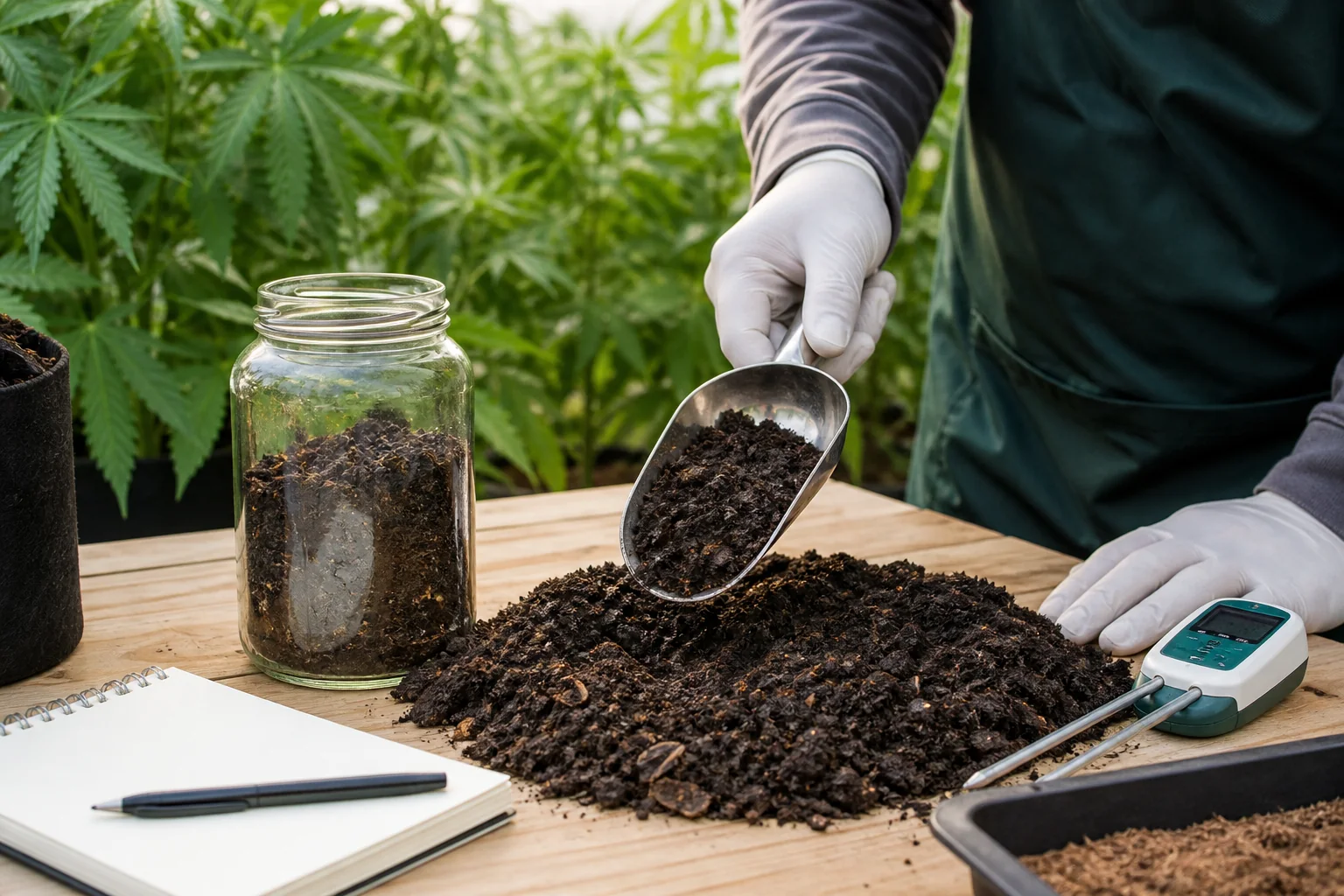
For a pile or bulk delivery, collect small portions from several locations rather than one large scoop. Include different sides and, where safe and practical, material from below the immediate surface. Mix those portions in a clean container to create a composite sample. Remove only obviously non-representative debris that you would also remove before use, and note what you removed.
For bagged compost, sampling several bags from the same lot is more informative than testing one bag when you are buying or using a large quantity. If different lot codes are present, treat them as different batches until evidence supports combining them.
Build a composite sample that represents what you will actually use
Take several small portions across the batch, mix them in a clean container, and record the batch identity before dividing material for home or laboratory tests.
Choose the darkest, finest handful and call it representative
Surface appearance and particle size can vary within a pile. Selective sampling can make a poor batch look better than the material that reaches the garden.
Ask the laboratory how it wants the sample handled
Do not air-dry, refrigerate, freeze, or seal every compost sample by habit. The correct handling depends on the test. Moisture, respiration, pathogen, nutrient, and other analyses may require different preparation and shipping conditions. Follow the laboratory’s current instructions rather than applying a soil-test routine automatically to compost.
Field Advice: Split one well-mixed composite sample into labeled portions only after you know which tests are being run. This keeps the different analyses tied to the same batch while allowing each portion to be handled correctly.
Remember: Sample handling is part of the test method. A correctly collected sample can still produce misleading data if it is dried, chilled, sealed, or delayed in a way the laboratory did not request.
Run the Home Screening Checks Before the Laboratory Tests
Home checks are valuable because they are fast and inexpensive. Their job is to catch obvious reasons to stop, cure longer, or investigate further. Their job is not to certify compost as safe.
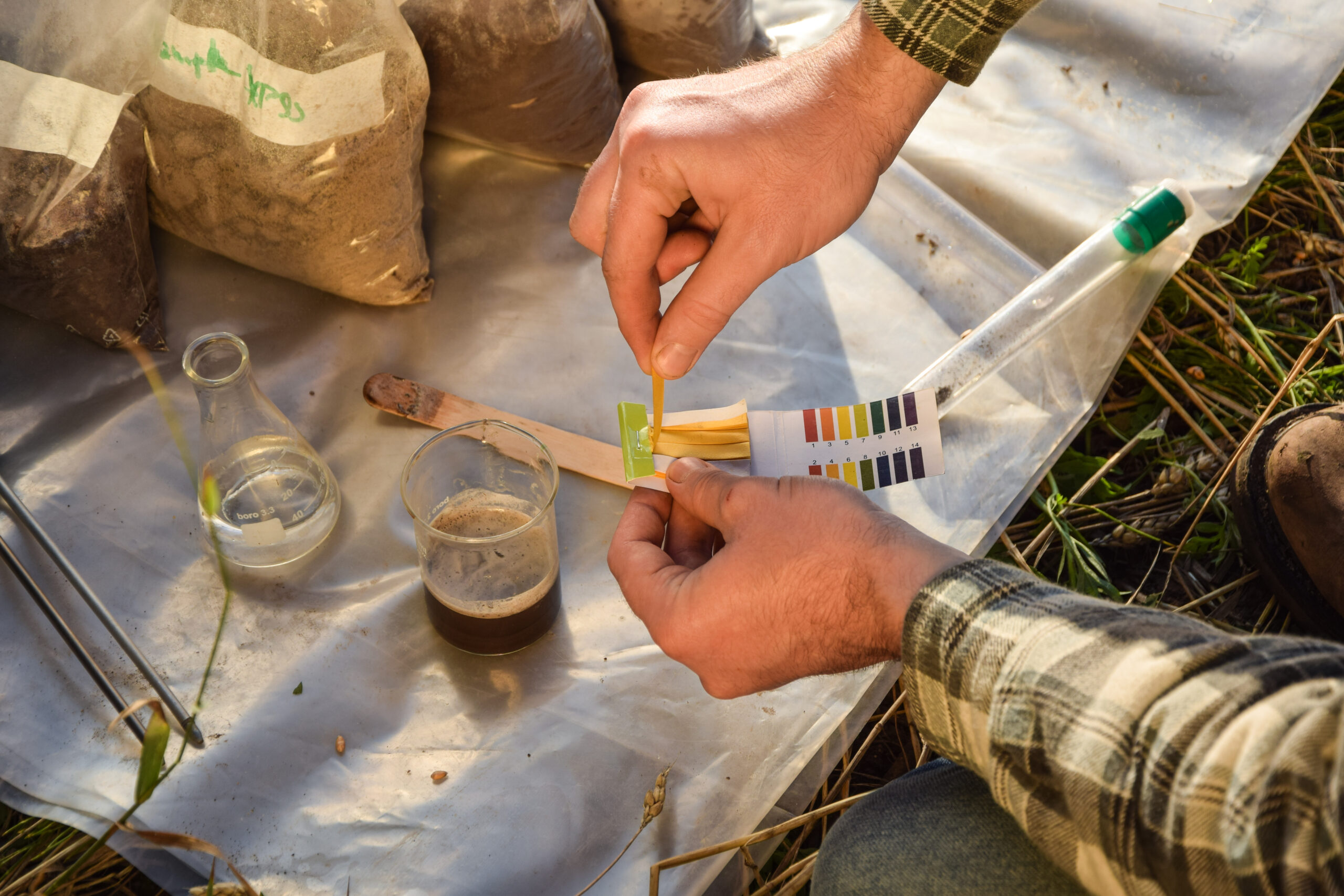
Inspect odor, texture, and recognizable feedstock
Finished compost commonly has an earthy or forest-soil-like odor. Strong ammonia, sour fermentation, sewage-like odor, rancid odor, or another persistent off-odor deserves investigation. Large amounts of fresh food scraps, intact grass clumps, slimy pockets, or material that clearly has not passed through the process may also indicate uneven decomposition.
Some recognizable woody pieces can remain in otherwise mature compost, especially when feedstock includes bark or coarse bulking material. Their presence alone does not prove immaturity. The question is whether the bulk material behaves like a cured compost rather than an actively decomposing pile of raw ingredients.
Tip: Break open several clumps. A surface that looks finished can hide wet, anaerobic, or incompletely processed pockets inside.
Use temperature as a trend, not a magic number
A large compost pile that remains substantially warmer than ambient conditions because of internal biological activity may still be actively decomposing. During curing, temperatures usually decline as easily degradable material is consumed. If a pile reheats strongly after turning, mixing, or moisture correction, that is evidence that the material still contains significant biological activity.
Temperature alone is weak evidence in a small sample. Sun exposure, pile size, insulation, ambient weather, moisture, and recent turning can all change the reading. A compost that is cool because it dried out completely is not necessarily stable. Rewetting and aeration can restart activity.
Do not use a cool pile as your only maturity test
Compost can stop heating because it is dry, oxygen-limited, too small to retain heat, or simply cold outside. Temperature trends are useful only when moisture, aeration, pile size, and recent management are understood.
Check for excessive foreign material
Plastic film, glass, metal fragments, sharp objects, treated-wood pieces, and other inert contamination are quality failures even if the compost is biologically mature. Screen a representative volume and inspect what remains. A few tiny fragments and a visibly contaminated product are not equivalent, but a batch intended for containers or hand-worked garden soil should be clean enough to handle safely and use repeatedly.
Particle size also matters more in container mixes than in open field soil. Very fine compost can reduce air-filled pore space when used at high rates. Very coarse compost may create uneven water distribution in small pots. Maturity does not correct a physical mismatch.
Master Advice: Home screening should answer one question: is there enough evidence to proceed to testing? It should not answer the final question: is this compost definitely safe and appropriate?

Use a Plant Bioassay to Look for Phytotoxicity
A plant bioassay asks the organism that matters most: can a sensitive plant germinate and grow normally when exposed to this compost under a defined comparison? Bioassays can reveal phytotoxicity that a smell test or nutrient panel can miss. They can also help screen for some persistent herbicide residues when a sensitive species and an appropriate control are used.
Always use a clean control
Do not plant seeds in questionable compost, see poor growth, and assume the compost caused it. Use the same seed lot, container size, light, temperature, watering method, and clean base medium for a control group. The test group should differ only by the compost exposure you are trying to evaluate.
For general compost phytotoxicity, laboratories use standardized emergence and seedling-vigor methods. At home, a comparative plant test can serve as a screening tool, but the exact compost percentage should reflect how you plan to use the material. Testing straight compost can create false concern because many perfectly usable composts are not designed to function as a 100 percent seed-starting medium.
A bioassay is a response test, not a chemical identification test
A bioassay shows whether a living test plant responds abnormally under the test conditions. It does not automatically identify which salt, acid, nutrient, herbicide, or other factor caused the response.
Build a simple comparative plant test
Prepare several small containers of a known clean potting medium as the control. Prepare the same number of containers with the same base medium plus the proportion of compost you expect to use, or another documented test proportion appropriate to the question. Plant the same number of seeds from one uniform lot at the same depth. Keep light, temperature, watering, and observation timing the same.
Track emergence percentage, time to emergence, leaf expansion, root or shoot vigor when visible, discoloration, distortion, and obvious stunting. A single failed seed is weak evidence. A repeatable pattern across several test containers compared with healthy controls is much more useful.
Pro Tip: Photograph control and test plants from the same angle on the same days. Visual memory is poor at detecting slow differences in vigor.
Use a separate sensitive-plant bioassay when herbicide carryover is plausible
Persistent growth-regulator herbicides can survive through manure and compost pathways when contaminated hay, grass, bedding, or feedstock enters the process. When that history is plausible, use a bioassay designed for persistent herbicide screening rather than assuming a generic germination test is enough. Extension protocols commonly use peas or other sensitive broadleaf plants and compare them with a clean control.
Look for cupping, curling, twisted new growth, abnormal stem development, or consistent stunting in the compost treatment compared with the control. If the pattern is suspicious, stop. Do not try to dilute the evidence away in a valuable cannabis bed.
“If radish seeds germinate normally, can I assume a manure-based compost is safe for my indoor pots?”
Question sent by: Colin Fraser, via contact form.
No. Normal germination is encouraging, but it answers only part of the question. A manure-based compost can still have high soluble salts, excessive nutrients, persistent herbicide residues, pathogen concerns, or physical properties that do not suit a container mix. For indoor use, where one bad amendment can affect the entire room, review the source and analysis, use an appropriate sensitive-plant bioassay when herbicide carryover is plausible, and keep the first application conservative.
Do not turn a home bioassay into a universal maturity score
Species differ in sensitivity. Compost concentration changes the result. Salinity, pH, nutrient level, immature compounds, and herbicide residues can all reduce growth for different reasons. Laboratory maturity ratings control these variables more carefully. A home trial is best used as a pass-to-the-next-step or investigate signal, not as a numerical certification.
Field Advice: If the test plants fail, preserve both the compost sample and the control record. Do not immediately change the compost. Pair the failed bioassay with EC, pH, nitrogen forms, source history, or targeted contamination testing so you can identify the mechanism.
If a laboratory reports a germination index, read the method before the number
Some compost laboratories report a germination index or another combined phytotoxicity score. These methods often compare seed germination and root growth in a compost extract with a control. The concept is useful because a treatment can allow seeds to emerge while still suppressing early root elongation.
The numerical result is method-dependent. Test species, extract preparation, compost concentration, incubation time, and calculation method matter. Do not transfer a germination-index cutoff from one published method to a different laboratory report unless the methods match. Use the laboratory interpretation and ask what species and protocol were used when the report is unclear.
Read Laboratory Compost Tests as a Group
Laboratory testing becomes most useful when the results are interpreted together. Standard compost programs can report pH, soluble salts, nutrients, moisture, organic matter, particle size, stability, maturity bioassays, pathogens, and trace metals. Not every batch needs every test, but the panel should match the intended use and feedstock risk.
Respiration tests measure stability more directly than appearance
Respirometry measures biological activity through carbon dioxide evolution or oxygen consumption. Higher respiration generally means more active decomposition and lower stability. Oregon State University Extension summarizes an industry interpretation in which very stable compost is below 2 mg CO2-C per gram of organic matter per day and stable compost is below 8 using a specific three-day respiration method.
Those values are method-specific compost interpretations, not cannabis root-zone thresholds. Use the laboratory’s method and rating rather than transferring the numbers to a different test protocol or home device.
Important: Stability is one of the strongest reasons to use a compost-specific laboratory. A respiration result measures current biological activity more directly than color, age, or C:N ratio alone.
Self-heating tests offer another stability check
Standardized self-heating methods place a prepared compost sample in an insulated test vessel and measure how much the sample warms from microbial activity. A material that produces little additional heat under the specified conditions is generally more stable than one that reheats strongly.
This is more controlled than touching a backyard pile or checking one thermometer reading. The vessel, sample moisture, sample mass, incubation time, and rating system matter, so use the method-specific interpretation rather than inventing a home pass/fail temperature.
Ammonium and nitrate help describe curing progress
During active high-temperature composting, ammonium can accumulate. As the compost cools and cures under aerobic conditions, nitrification can convert more ammonium to nitrate. Oregon State notes that ammonium above about 500 ppm and an ammonium-to-nitrate ratio above 10:1 are indicators of immature or incompletely composted material in its interpretation framework. It also warns that ammonium above about 1,000 ppm combined with pH above 7.5 increases the likelihood of damaging ammonia conditions.
These are useful diagnostic examples, but they still belong inside a full analysis. Low ammonium does not prove the material is mature if other problems remain, and very low nitrate and ammonium values can make the ratio itself less informative.
C:N ratio is useful, but weaker than many growers assume
The carbon-to-nitrogen ratio describes the balance of total carbon and nitrogen. Finished compost often falls into a much narrower range than the starting pile, but C:N is not a reliable stand-alone maturity test. A manure-rich or green-feedstock compost can have a low C:N ratio before it is fully cured. A woody compost can remain higher even when it is usable for some applications.
Use C:N to understand nitrogen behavior and as one piece of the maturity picture. Do not approve compost because the ratio looks textbook-perfect.
A low C:N ratio does not cancel high ammonium, salts, or phytotoxicity
If a batch fails another meaningful test, do not use a favorable C:N number to explain the failure away. Maturity decisions should rely on multiple independent signals.
Electrical conductivity shows soluble salt pressure
Electrical conductivity, or EC, estimates the concentration of dissolved ions in a compost extract. High EC can injure salt-sensitive seedlings and can make a compost inappropriate at high rates in containers even when the material is mature. Feedstock has a major influence. Manure-based composts and composts receiving salty inputs can carry substantially more soluble salts than leaf or yard-waste composts.
Do not use one universal compost EC cutoff for cannabis without considering the extraction method, application rate, base medium, irrigation water, plant stage, and total root-zone salinity. Compare the laboratory result with its interpretation and the amount of compost you plan to add.
Field Advice: In a container, the compost EC is only one contributor. Irrigation-water salts, fertilizers, previous amendments, container dry-back, and leaching behavior determine the final root-zone EC.
Pro Tip: When a new compost is responsible for a large share of a container mix, record both the compost EC and the finished blend result. That separates a salty input from salts created later by fertilizer or irrigation management.
pH helps predict behavior but does not measure maturity
Many finished composts are near neutral to moderately alkaline, but feedstock and process can shift pH. A compost pH result helps you anticipate how the material may interact with an existing mix. It does not tell you whether the compost is biologically finished.
Do not acidify or lime a compost batch simply to force its standalone pH toward a cannabis soil target. The meaningful question is how the compost affects the complete root-zone blend at the actual application rate.
| Test | What It Helps Answer | Useful Warning Signal | Main Limitation |
|---|---|---|---|
| Respiration / CO2 evolution | How biologically stable is the compost? | High ongoing respiration or poor stability rating. | Does not screen every toxicity or contamination problem. |
| NH4-N and NO3-N | Has nitrogen chemistry progressed through curing? | High ammonium or a strongly ammonium-dominant result. | Interpretation depends on concentrations, pH, feedstock, and method. |
| C:N ratio | What is the broad carbon-to-nitrogen balance? | Very high values can indicate nitrogen immobilization risk. | A low ratio does not prove maturity. |
| EC / soluble salts | How much soluble ion load does the compost contribute? | High EC relative to the intended use and application rate. | Extraction methods and root-zone dilution matter. |
| pH | How acidic or alkaline is the tested extract? | Extreme values that conflict with the intended blend. | Not a direct maturity test. |
| Emergence / vigor bioassay | Does the test plant show phytotoxicity under the specified method? | Reduced emergence or vigor relative to the control. | Does not identify the cause of injury. |
| Nutrients | What fertility does the compost add? | Nutrient load that exceeds the planned soil or mix requirement. | Total nutrient content is not the same as immediate plant availability. |
Use a current technical data sheet when buying commercial compost
Standardized compost testing programs can provide a technical data sheet with comparable analytical fields rather than relying on marketing terms such as premium, living, organic-rich, or fully aged. When such a report is available, review the actual batch or recent production data, not only a generic example on a website.
For a cannabis grower, the most useful numbers are the ones that change a decision: stability, maturity bioassay, soluble salts, pH, nutrients, moisture, particle size, contaminants, and feedstock description where available.
Microbial counts are not a shortcut to maturity or crop performance
Some laboratories offer counts or profiles of bacteria, fungi, actinomycetes, or other microbial groups. These can be useful for research or specialized quality programs, but they do not replace maturity, stability, salinity, or contamination testing. Compost communities are dynamic, and a higher count of a broad microbial group does not automatically mean better cannabis growth.
Remember: A compost analysis should answer a management question. Do not pay for a biological number simply because it sounds advanced if there is no validated interpretation for the decision you need to make.
Test Contamination Risks Separately From Maturity
Some of the most serious compost failures have little to do with whether decomposition is finished. Persistent herbicides, excessive trace metals, pathogens, foreign materials, weed seeds, and unsuitable feedstocks require their own evidence.
Persistent herbicide residues need source history and a sensitive bioassay
Growth-regulator herbicides such as aminopyralid and clopyralid can persist through some manure, hay, grass, and compost pathways. They can injure sensitive broadleaf plants at very low concentrations. A normal compost maturity panel may not automatically rule them out.
If feedstock history includes hay, pasture manure, grass clippings, or bedding of uncertain treatment history, ask the supplier what it accepts and how herbicide risk is managed. Use a sensitive comparative bioassay before applying a large quantity. If test plants show consistent cupping, twisting, or abnormal new growth compared with the control, stop and investigate rather than planting cannabis into the material.
Do not try to fix suspected persistent-herbicide compost by adding more amendments
Dilution can make symptoms harder to interpret without making the material appropriate. Isolate the batch, preserve a sample, document the source, and confirm the problem before it reaches valuable soil or containers.
Pathogen reduction is a process and testing question
Compost containing manure, biosolids, food residuals, or other pathogen-relevant feedstocks may require documented process controls or microbiological testing depending on jurisdiction and intended use. U.S. biosolids rules, for example, use specific time-temperature and pathogen criteria for regulated materials. Those rules should not be casually applied as a universal home-compost certificate, but they show why pathogen safety is separate from visual maturity.
Smell cannot verify pathogen reduction. If the material’s feedstock or use creates a meaningful food, worker, indoor-garden, or crop-safety concern, use an appropriate laboratory and follow local requirements.
Heavy metals and other chemical contaminants require targeted testing
Trace-metal testing becomes more important when compost includes biosolids, industrial residuals, demolition-associated material, contaminated soil, ash, or another feedstock with a plausible metal source. A home grower cannot reliably detect arsenic, cadmium, lead, mercury, nickel, selenium, or similar contaminants by color or plant smell.
The same logic applies to unknown chemical contamination. If provenance is poor and the consequence of contamination is high, the correct response may be to reject the material rather than create an increasingly complicated home test program.
Safety Note: Plant-health recovery and product safety are different decisions. If a root zone is contaminated with a hazardous chemical or pathogen, do not assume that healthy-looking cannabis flowers make the harvested product safe.
Master Advice: The cheapest contamination test is often provenance. If the source cannot explain its feedstocks, process, lot identity, or relevant quality controls, treat that uncertainty as part of the risk rather than assuming laboratory testing can economically screen for everything.
Foreign material is a quality problem you can often see
Unlike metals or pathogens, physical contamination is partly visible. Glass shards, sharp metal, plastic film, synthetic fibers, and treated-wood fragments can make a compost inappropriate even when every maturity number looks acceptable. Inspect enough material to represent the batch, especially before spreading bulk compost into a garden where removal will be difficult.
“My compost passed a lab maturity test, but I keep finding bits of plastic. Should I still use it?”
Question sent by: NorthRoomNotes, via Facebook page.
Maturity does not override physical contamination. Decide whether the amount and type of foreign material are acceptable for the intended use. In a cannabis container or carefully managed bed, repeated plastic, glass, or sharp debris is a strong reason to reject the batch or return it to the supplier. A mature contaminated product is still contaminated.
Use a Repeatable Pass, Investigate, or Reject Procedure
A useful compost procedure should produce the same decision when you repeat it on a similar batch. The following sequence is designed to prevent one attractive feature from outweighing several warning signs.
Step 1: Define the intended use
Write down whether the compost will be used as a low-rate outdoor amendment, top-dress, raised-bed ingredient, living-soil input, or meaningful fraction of a container mix. Note whether seedlings, established vegetative plants, or mature outdoor plants will contact it. The more concentrated and confined the use, the tighter the acceptance standard should be.
Step 2: Record source and feedstock risk
Record the supplier or pile, lot, known ingredients, manure or biosolids content, hay or grass inputs, storage history, and any available process records. Unknown provenance is itself information. It should lower your confidence, not disappear from the decision.
Step 3: Create a representative composite sample
Collect several subsamples across the batch, combine and mix them, then split portions for the tests you actually need. Label every portion with the same batch ID.
Step 4: Run physical and odor screening
Inspect for raw pockets, persistent ammonia or sour odor, slimy material, excessive foreign objects, extreme fineness, or other obvious mismatch. A serious failure here can justify stopping before you spend money on laboratory testing.
Step 5: Review temperature and curing history
If the material is home-composted or stored in bulk, review whether the pile is still reheating strongly, whether it was recently turned, and how long it has been curing under aerobic conditions. Do not confuse dry inactivity with finished stability.
Step 6: Run the appropriate plant bioassay
Use a control and enough replication to distinguish a pattern from random seed failure. If persistent herbicide carryover is plausible, use a sensitive broadleaf assay designed for that problem.
Step 7: Order laboratory tests that can change the decision
For a new bulk compost or a compost that will form a substantial part of a cannabis container mix, a compost-specific panel can be more valuable than guessing from home measurements. Prioritize stability, maturity bioassay, EC, pH, nutrients, ammonium/nitrate, and any contamination tests justified by feedstock or regulation.
Step 8: Classify the batch
| Decision | Evidence Pattern | Next Action |
|---|---|---|
| Pass for the planned use | Source is acceptable, home screen is clean, plant test is normal, and relevant laboratory results fit the application. | Use at the measured application rate and record the batch in the soil or mix recipe. |
| Investigate / cure longer | One or more maturity or stability signals are questionable, but there is no confirmed contamination that makes the batch inappropriate. | Keep the batch separate, correct curing conditions if needed, allow more time, then repeat the same failed test. |
| Reject or isolate | Suspected persistent herbicide injury, unacceptable foreign matter, hazardous contamination, failed pathogen requirement, or another high-consequence problem. | Do not blend it into valuable cannabis soil. Preserve records and a sample, and use supplier, laboratory, or local disposal guidance. |
Weedth Verdict: A batch passes when several independent signals agree that it is suitable for the specific use. It does not pass because one favorite test looks good.
Common Compost Testing Mistakes and Look-Alikes
Compost testing often fails at interpretation rather than measurement. A grower sees one clue, assigns one cause, and changes the material before confirming what the clue actually means.
Cold compost can be dry, not mature
A dry pile may stop microbial activity and cool even though significant decomposable material remains. Restore appropriate moisture and aeration before interpreting lack of heating as stability.
Warm compost can be solar-heated, not biologically unstable
A dark pile, black tote, or sealed bag in sun can become warm without microbial self-heating. Compare internal temperature trends with ambient conditions and storage exposure rather than reading one afternoon number.
Low C:N can come from feedstock, not curing
Manure-rich and green-feedstock composts can begin with lower C:N ratios. A low final number supports the picture but cannot replace respiration, nitrogen-form, or bioassay evidence.
Poor germination can be caused by salts rather than immaturity
A plant assay measures biological response. High EC, unsuitable pH, excessive nutrients, immature compounds, or a contaminant can all suppress growth. Pair a failed bioassay with chemical data before deciding what correction is appropriate.
Healthy germination can miss a contamination that affects another plant
Different species have different sensitivity. A general germination screen can look normal while a sensitive broadleaf species reacts to a persistent herbicide. Choose the bioassay for the question.
An earthy smell does not measure EC
Salty compost can smell excellent. Odor is mainly a screening tool for active anaerobic or ammonia-like problems. It is not a salinity meter.
Investigate the mechanism behind a failed result
Pair plant response with EC, nitrogen forms, source history, respiration, pH, or contamination testing so the correction addresses the actual problem.
Fix every failed test by adding lime, fertilizer, or more compost
Those additions can hide the original signal and create a second problem. Change one meaningful variable when possible, then repeat the test that originally failed.
Match Compost Acceptance to the Cannabis Root-Zone System
Compost that is acceptable for one horticultural use can be poorly matched to another. Cannabis does not create a separate set of compost laws, but its cultivation systems can amplify the consequences of a bad batch.
Containers have less dilution and less room for correction
A container has a finite volume. If compost contributes excessive salts, high nutrient load, unstable fine organic matter, or contamination, the entire active root zone can be affected. There is also less unaffected soil for roots to explore while the problem is corrected.
That makes stability, EC, particle size, and source confidence especially important when compost will form a meaningful fraction of a container blend. Start from the complete mix behavior, not from the assumption that more compost means more biological activity and therefore a better cannabis soil.
Field Advice: After blending a new container mix, test the blend itself when the compost contribution is large. Compost data predicts input behavior; the finished root zone is what the plant will experience.
Outdoor ground offers more buffering, but not immunity
Native soil and raised beds can dilute some compost properties across a larger mass, but contamination and excessive application can still create long-lived problems. Persistent herbicide residues can damage sensitive plants at low concentrations, and repeated high-phosphorus or high-salt compost applications can accumulate beyond crop need.
Use soil testing to decide whether compost is actually needed. The Weedth guide on reusing soil after an outdoor cannabis season makes the same point: compost is not neutral filler. It changes nutrients, salts, organic matter, biology, and physical structure.
Young plants justify a more conservative threshold
Seeds, rooted cuttings, and recently transplanted plants have smaller root systems and less capacity to avoid a localized problem. A compost that performs well as a modest amendment around established outdoor plants may still be too nutrient-dense, salty, or biologically active for a young-root mix.
If the intended use is sensitive propagation, use a purpose-designed medium or a tested blend rather than assuming mature compost should be used straight.
Remember: Compost maturity tells you whether decomposition has progressed far enough for plant use. Application rate tells you how much of that compost the root zone must actually handle. You need both decisions.
Recheck the Batch Before It Reaches Cannabis Roots
Testing is most useful when it leads to a verification step. If a batch is questionable, do not change three things and then retest with a different method. Keep the batch separate, correct the identified curing condition when appropriate, and repeat the measurement that failed.
If the compost is unstable, improve curing rather than fertilizing it
When instability is the problem, the usual needs are time, appropriate moisture, oxygen, and curing conditions. Do not add fertilizer to force maturity. Do not add lime simply because an intermediate pH looks unfamiliar. Those additions change the chemistry without proving that decomposition has stabilized.
If the pile was too dry, restore moisture carefully and watch for renewed activity
Dry compost can appear inactive. If the material is otherwise appropriate for curing, restore moisture gradually, mix for even distribution, and monitor temperature and odor. Strong renewed heating shows that the previous cool state was not strong evidence of stability.
If a bioassay failed, repeat it after the relevant correction
If high salts appear to explain poor growth, curing alone may not solve the problem. If immature nitrogen chemistry is the likely cause, more curing may help. If herbicide injury is suspected, do not keep experimenting with valuable crop soil. Isolate the batch and follow contamination guidance.
| Checkpoint | What to Recheck | What Counts as Progress | What Should Stop the Batch |
|---|---|---|---|
| Immediately after a failed screen | Batch identity, source, moisture, odor, temperature context, visible contamination, and the exact test that failed. | A clear, correctable cause is identified without mixing the batch into other soil. | Confirmed or strongly suspected hazardous contamination. |
| After several days of corrected curing conditions | Temperature trend, odor, moisture distribution, and whether biological activity restarted. | Heating and odor become less pronounced after active decomposition subsides. | Persistent anaerobic conditions or contamination evidence. |
| After 1 to 2 weeks or another meaningful curing interval | The same failed home screen or lab parameter when scientifically appropriate. | Independent maturity and stability signals move in the expected direction. | No improvement, worsening phytotoxicity, or an unresolved high-consequence risk. |
| Before blending or planting | Final analysis, plant bioassay, application rate, and finished root-zone plan. | Pass criteria agree and the compost fits the intended mix or soil. | The only argument for use is that the material has already been purchased or stored for a long time. |
The time intervals above are operational checkpoints, not promises that immature compost will become mature in one or two weeks. A batch can require substantially more curing depending on feedstock, particle size, moisture, aeration, temperature, and the stage at which the process stalled.
Pro Tip: Keep a small labeled archive sample from any bulk batch you use. If an unexpected root-zone problem appears later, you still have material tied to the original lot for comparison or laboratory testing.
Frequently Asked Questions About Compost Quality and Maturity
How can I tell if homemade compost is finished without a laboratory?
You can build reasonable confidence from several observations: the pile no longer reheats strongly under proper moisture and aeration, off-odors are absent, raw feedstock has largely transformed, the material has a consistent structure, and a comparative plant test performs normally. These are screening tools. If the compost will be used heavily in containers or the feedstock creates contamination concerns, laboratory testing provides much stronger evidence.
Is dark color proof that compost is mature?
No. Color depends on feedstock, moisture, particle size, and storage. Dark material can still be unstable, salty, contaminated, or unevenly processed.
What is the best single compost maturity test?
There is no single test that answers every part of maturity and quality. Respiration is a strong stability measure. Plant bioassays measure phytotoxic response. Ammonium and nitrate describe nitrogen-form changes during curing. A reliable acceptance decision combines several tests.
Is C:N below 20 enough to call compost finished?
No. A low C:N ratio can occur because of feedstock composition, especially manure-rich or nitrogen-rich materials. Use it with respiration, nitrogen forms, bioassays, and the rest of the quality data.
Can I lower high compost EC by curing it longer?
Not necessarily. Stability and salinity are different problems. Some soluble salts can change with leaching, mineralization, or further processing, but simply waiting does not guarantee that EC will become appropriate for your intended root zone. Measure again rather than assuming.
Should cannabis growers sterilize finished compost before use?
Sterilization is not a maturity test and can fundamentally change the biological character of compost. The better decision is to use clean, appropriately processed material, verify relevant pathogen or contamination risks when needed, and match the compost to the cultivation system. Indoor pest exclusion may justify a stricter sourcing standard than an outdoor bed.
Can I use 100 percent compost as a cannabis growing medium if it passes the tests?
Passing compost tests does not mean the material has the physical structure, water-air balance, nutrient concentration, or salinity profile required as a standalone cannabis medium. Compost is usually evaluated as an amendment or blend component. Test the finished root-zone mix separately when compost makes up a large proportion.
Approve the Compost Batch Only After Multiple Signals Agree
Good compost testing is not complicated because compost is mysterious. It is complicated because different failures require different tests. One test measures stability. Another measures plant response. Another measures salt load. Another checks contamination. The safest system is to keep those questions separate until they support the same decision.
For a cannabis grower, that discipline prevents a common and expensive mistake: improving a carefully built root zone with a compost that was never truly evaluated. Use appearance to screen, bioassays to challenge the material, laboratory data to measure what you cannot see, and a final root-zone check to confirm that the compost fits the way you actually plan to grow.
Important: If the compost is going into an existing high-value soil system, keep enough untreated soil or unused mix aside for comparison. A reference makes later diagnosis much easier than trying to reconstruct what the root zone looked like before the amendment.
Before compost enters the cannabis root zone, confirm:
- The source, lot, feedstocks, storage history, and intended use are recorded.
- The sample represents the batch rather than one convenient handful.
- The material has no persistent ammonia, sour, sewage-like, or strongly anaerobic odor.
- Temperature history is consistent with curing and is not being misread because the pile is dry or solar-heated.
- Visible foreign material is acceptable for the intended use.
- A comparative plant bioassay does not show a repeatable phytotoxicity pattern.
- Persistent herbicide risk has been considered when manure, hay, grass, or bedding feedstocks are involved.
- Relevant laboratory results for stability, maturity, EC, pH, nitrogen forms, and nutrients fit the application.
- Pathogen, trace-metal, or other contamination testing has been added when feedstock or local requirements justify it.
- No single favorable result is being used to override a meaningful failure elsewhere.
- The planned compost rate fits the complete soil or container mix rather than treating compost as neutral filler.
- The batch will be rechecked if curing, storage, or another condition changes before use.
Weedth Verdict: Finished compost is a conclusion built from evidence. Approve the batch when stability, plant response, chemistry, cleanliness, and intended use agree, not when the pile simply looks finished.
Share this article
A quick overview of the topics covered in this article.
Follow us
Latest articles
October 25, 2026
October 25, 2026
October 25, 2026