Soil pH, Buffering, and Lime Requirement
A soil pH reading tells you how acidic or alkaline the soil solution is at the time of testing. It does not tell you, by itself, how much lime the soil needs. Lime requirement depends on the acidity stored on clay and organic matter, the soil’s buffering capacity, the target pH, the depth represented by the sample, and the neutralizing value of the lime product that will actually be applied.
This is why two cannabis beds can both test at pH 5.4 and still need very different amounts of lime. A coarse, low-organic-matter soil may change relatively easily. A clay-rich or organic soil can hold a much larger reserve of acidity and resist the same pH change. The active pH number looks similar, but the chemical reservoir behind it is not.
For a grower, the practical sequence is simple: measure the current condition, determine whether pH correction is actually needed, use a laboratory lime-requirement method that is calibrated for the soil and region, convert that recommendation to the real lime product, then re-test after the reaction period. Do not calculate a cannabis lime dose from pH alone, and do not copy a field recommendation into peat, coco, or another container substrate without changing the testing method.
In This Resource
Soil pH and Lime Requirement Decision Guide
- Soil pH Is Not the Same as Lime Requirement
- Why Soils Buffer pH Differently
- How Lime Requirement Is Actually Measured
- How to Sample and Test the Root Zone
- Turn a Lime Recommendation Into a Real Application
- Containers and Soilless Media Need a Different Method
- Common Failure Modes and Misleading Readings
- Correct the Root Zone and Verify the Result
Soil pH Is Not the Same as Lime Requirement
Soil pH describes the activity of hydrogen ions in the soil solution. On the familiar pH scale, lower values indicate greater acidity and higher values indicate greater alkalinity. Because the scale is logarithmic, a one-unit change represents a tenfold change in hydrogen ion activity. That makes pH useful for describing the chemical environment around roots, but it still represents only the active portion of soil acidity.
In the broader Cannabis Soil and Growing Media Guide, pH is treated as an availability gate because it influences nutrient solubility and root access to elements already present in the root zone. This resource has a narrower job: explaining why the pH number alone cannot tell you how much lime to add.
Active acidity and reserve acidity are different pools
Active acidity is the acidity measured in the soil solution and reflected by the routine pH test. Reserve acidity is acidity held on exchange sites and other reactive surfaces in the soil. When lime neutralizes acidity in solution, reserve acidity can move back into solution. That reservoir is why the same starting pH can require very different lime rates in different soils.
pH answers one question: how acidic is the measured soil solution?
A routine soil pH result is the first checkpoint. It can show that the soil is more acidic than the management target, close to the intended range, or already high enough that liming would be unnecessary or risky. What it cannot do is quantify the total acidity that must be neutralized to reach the target.
Imagine two soils that both read pH 5.3. One is a sandy soil with little organic matter. The other contains much more clay and organic matter. Their soil solutions can have similar active acidity while the second soil holds far more acidity on exchange sites. Add the same amount of lime to each and the sandy soil may move much farther.
Important: A low pH can indicate that liming deserves investigation. It does not provide a safe universal lime rate. The rate must account for the soil’s resistance to pH change.
Lime requirement answers a different question: how much acidity must be neutralized?
Lime requirement is an estimate of the neutralizing material needed to move a defined soil layer toward a chosen target pH. Laboratories may estimate it with buffer pH, lime buffer capacity, neutralizable acidity, incubation calibrations, or other regionally validated methods. Those methods are related in purpose but are not interchangeable formulas.
This distinction prevents one of the most common amendment errors. A grower sees pH 5.5, finds a lime chart online, and applies a volume of limestone per container or per square foot. The chart may have been calibrated for a completely different soil texture, sampling depth, crop target, laboratory method, or lime quality. The number looks scientific while the assumptions are wrong.
| Measurement | What It Tells You |
|---|---|
| Routine soil pH | The active acidity or alkalinity of the tested soil suspension. Useful for deciding whether the root zone is outside the desired management range, but not enough to calculate lime rate. |
| Buffer pH or lime buffer capacity | How strongly an acid soil resists a pH increase, or how much neutralizable acidity is present under the laboratory’s calibrated method. |
| Lime requirement | The amount of effective neutralizing material estimated to move the sampled soil toward a specified target pH under the assumptions of that laboratory recommendation. |
| CCE, ECCE, ENV, ENM, or local lime score | A measure or rating used to adjust the recommendation for the neutralizing value and, in many systems, the fineness or reactivity of the actual liming material. |
The target pH is part of the calculation
Lime requirement does not exist without a target. The amount needed to raise a soil from its starting condition to pH 5.8 is not the amount needed to move it to 6.4. A laboratory recommendation therefore combines a soil measurement with a management target and a calibration.
Weedth generally treats roughly pH 6.0 to 7.0 as a practical soil working range for cannabis, but that editorial range is not a cannabis-specific lime-requirement calibration. If a laboratory has no validated cannabis recommendation, do not disguise the crop as another species simply to force a prescription. Use the soil chemistry results, the broader horticultural evidence, and a conservative management target appropriate to the root zone while keeping the evidence boundary clear.
“My soil is pH 5.4. How much lime do I add per plant?”
Question sent by: Ethan Brooks, via email.
You cannot calculate a responsible rate from pH 5.4 alone. First confirm that the sample represents the management zone, then request a lime-requirement or buffer test appropriate to that soil. The result must still be adjusted for the actual lime product and the soil depth or volume being treated.
Why Soils Buffer pH Differently
Buffering is the soil’s resistance to pH change. In an acid soil, clay minerals, organic matter, aluminum chemistry, hydrogen on exchange sites, and other reactive surfaces can store acidity outside the soil solution. As lime removes hydrogen ions from solution, chemical equilibria release additional acidity from those reserves. A strongly buffered soil therefore needs more neutralizing material to produce the same pH change.
Buffering is not automatically good or bad. Strong buffering can protect a root zone from sudden swings, but it also means a correction takes more material and often more time. Weak buffering makes a soil easier to change, but it also means repeated fertilizer, irrigation, and leaching effects can move pH more quickly.
Clay content often increases the size of the chemical reservoir
Clay particles have large reactive surface areas and carry exchange sites that can hold cations. In acid soils, hydrogen and aluminum associated with those surfaces contribute to reserve acidity. A clay-rich soil can therefore have a larger acidity reservoir than a coarse sandy soil at the same measured pH.
This does not mean every clay has identical buffering. Clay mineralogy matters. Different clay minerals carry different amounts and kinds of charge. The practical point is that texture gives useful context, but the laboratory response is more informative than guessing from how sticky the soil feels.
Organic matter can also increase buffering
Humified organic matter contains many reactive functional groups. These sites contribute to cation exchange and pH buffering, which is one reason compost-rich beds can resist chemical change more strongly than low-organic-matter sand. The effect depends on the type and decomposition state of the organic material, not simply on how dark the soil looks.
Highly amended garden beds deserve special attention because their chemistry may no longer behave like the native mineral soil underneath. If years of compost, manure, peat, biochar, or other organic amendments have changed the root zone substantially, a fresh laboratory test is more reliable than an old soil-type assumption.
Two soils with the same pH can therefore require different lime rates
This is the central mechanism behind the entire article. The pH meter measures the active condition after a defined extraction or slurry procedure. It does not directly count every acidic site in the soil. Buffer methods deliberately challenge the soil with a known chemical system and observe how strongly the soil resists the change.
A soil that depresses the buffer more strongly contains more neutralizable acidity under that method and generally receives a larger lime recommendation. A soil that shifts more easily receives a smaller one. That is why buffer pH often appears numerically higher than the routine water pH while still indicating a substantial lime requirement.
Field Advice: If two beds have the same pH but very different texture, organic matter, or management history, do not assume one lime rate can be copied to the other. Keep them as separate sampling and management zones.
CEC and buffering are related, but they are not identical measurements
High CEC often accompanies stronger buffering because clay and organic matter create many exchange sites. However, CEC alone does not tell you the exact lime requirement. It describes the capacity to hold exchangeable cations, while lime requirement focuses on the acidity that must be neutralized to reach a defined target under a calibrated method.
A CEC result is therefore context, not a substitute for a buffer test. The CEC resource is useful for understanding nutrient retention and chemical resilience, but liming should still follow the laboratory system used to determine neutralizable acidity.
Water and fertilizer can move pH over time without changing the soil’s basic texture
Root zones do not stay chemically frozen after the lime is applied. Acidifying fertilizers, nitrification, crop uptake, rainfall, leaching, organic matter decomposition, irrigation-water alkalinity, and amendment history can all influence the long-term pH trend.
That is why a one-time correction is not a lifetime prescription. A bed that was limed correctly several years ago can acidify again. A container substrate receiving high-alkalinity water can move upward in pH even if the irrigation water’s pH number does not look extreme. Monitoring should follow the mechanism that is actually driving the change.
How Lime Requirement Is Actually Measured
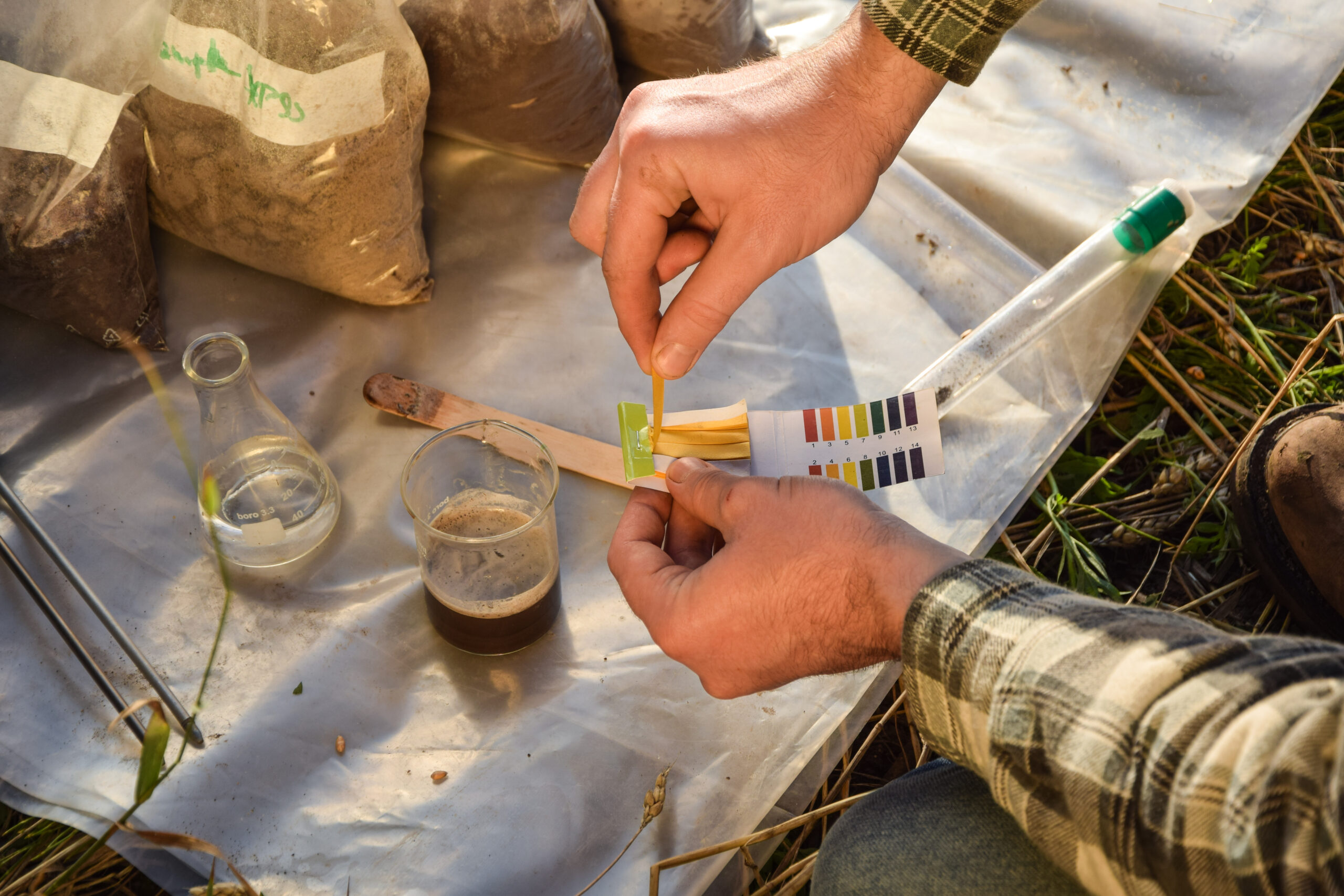
Laboratories use different buffer systems because soil properties and regional calibrations differ. Common names include SMP, Sikora, Woodruff, Adams-Evans, and equilibrium lime buffer capacity methods. The important point for the grower is not memorizing every chemistry. It is knowing that a buffer value only has meaning inside the recommendation system calibrated for that method.
Buffer pH is not a second version of the same pH test
A laboratory first measures routine soil pH using its defined soil-to-solution method. If the soil is acidic enough to justify a lime-requirement test, a buffer solution may then be added. The soil’s acidity consumes some of the buffer’s neutralizing capacity and changes the measured buffer pH.
The resulting number is interpreted through a calibration table or equation developed against known lime responses. A low buffer pH generally indicates a larger acidity reservoir and a larger lime requirement, but the exact relationship belongs to the laboratory method. A Sikora value should not be inserted into an SMP table, and a Woodruff result should not be converted by intuition.
Buffer pH is a method-specific estimate of resistance to pH change
The laboratory exposes an acid soil to a known buffer and measures the response. The result is then interpreted with a regional calibration to estimate neutralizable acidity or lime requirement. It is not the pH that cannabis roots experience in the field.
Some laboratories report neutralizable acidity or lime buffer capacity instead
Other systems report the acidity reservoir more directly. Equilibrium lime buffer capacity, for example, expresses how much pure calcium carbonate equivalent would be needed to raise a defined mass of soil by a pH unit under the method’s assumptions. Laboratories then combine that value with the target pH, sampling depth, bulk soil assumptions, and product correction to produce a field recommendation.
The mathematics can look universal even when the calibration is not. A formula developed for one laboratory and sampling depth should not be copied into another region without confirming that the test method and recommendation system match.
Do not mix buffer methods and recommendation tables
SMP, Sikora, Woodruff, and other buffer systems do not share one universal numerical scale. Use the recommendation that belongs to the laboratory method that produced your result. If the report is unclear, ask the laboratory which calibration and target pH were used.
Sampling depth is built into field lime recommendations
Many agricultural lime recommendations assume that a known mass of soil is being treated across a defined depth, often the cultivated surface layer. The exact depth varies by laboratory and production system. If a recommendation assumes a 6-inch layer and you actually incorporate lime through 12 inches, the same amount of material is being distributed through roughly twice the soil volume.
The opposite error also matters. Taking a deeper sample than the calibrated layer can dilute surface acidity and nutrient concentrations with subsoil, producing a report that does not match the management zone. The Weedth guide on How to Take a Soil Sample for Laboratory Testing covers representative depth and composite sampling in detail.
The crop target matters, but cannabis-specific field calibration is limited
University lime tables are calibrated for crops and soils in their own regions. They are useful for explaining the mechanism and showing how target pH changes the recommendation, but they should not be relabeled as cannabis-specific dose charts.
For Weedth, the safest approach is to use the laboratory to characterize the soil, keep the practical cannabis pH range as a management reference rather than a lime-rate formula, and avoid false precision where cannabis-specific calibration does not exist. The larger the correction, the more valuable professional laboratory interpretation becomes.
| Laboratory Detail | Why It Matters Before You Apply Lime |
|---|---|
| Routine pH method | Water, salt solution, soil-to-liquid ratio, and extraction procedure can change the numerical result. Compare repeated tests using the same method. |
| Buffer method | The buffer value must be interpreted through the matching calibration. Different buffer systems are not interchangeable. |
| Target pH | A higher target normally increases the calculated lime requirement. Confirm what target the laboratory used. |
| Sampling depth | Field recommendations assume a defined soil mass and depth. Sampling and incorporation depth must match the interpretation. |
| Reference lime quality | Recommendations may be expressed as pure CaCO3 equivalent, ECCE, ENV, ENM, lime score, or another local standard. The product rate must be adjusted accordingly. |
“My lab reports a buffer pH of 6.1. Is that good or bad?”
Question sent by: Julia Schneider, via contact form.
By itself, the number is incomplete. You need the method and the laboratory’s interpretation table. A buffer pH is not a root-zone target and should not be compared with the 6.0 to 7.0 soil range used for routine cannabis pH management. Ask what buffer system was used and what lime requirement the lab calculated from it.
How to Sample and Test the Root Zone
The best lime calculation can still fail if the sample does not represent the soil you intend to manage. A laboratory can measure a handful of soil with excellent precision, but it cannot know whether that handful came from a fertilizer band, a low wet corner, a compost pocket, or the average root zone.
Define the management zone before collecting soil
Do not mix unlike areas merely to create one convenient sample. Separate raised beds from native ground. Separate a heavily composted zone from an unimproved area. Separate a chronically wet clay pocket from a well-drained slope if you would treat those places differently.
Within one reasonably uniform zone, take multiple subsamples at a consistent depth and combine them into a composite sample according to the laboratory’s instructions. This reduces the influence of one unusual spot and gives the recommendation a better chance of describing the real bed.
Use the laboratory’s sampling depth, not a guessed cannabis root depth
Cannabis can root deeper than many routine garden sampling depths, especially outdoors. That does not mean the routine fertility sample should automatically be deeper. Laboratory recommendations are often calibrated to the cultivated surface layer. A deeper sample can dilute the signal the recommendation was designed to interpret.
If you need to investigate a subsoil acidity problem, collect a separate depth rather than silently mixing it into the surface sample. This preserves the distinction between the zone you can incorporate lime into and the deeper layer where lime movement may be slower.
Pro Tip: Write the exact sampling depth, bed identity, amendment history, and date on the sample record. Re-testing is far more useful when you can reproduce the original method.
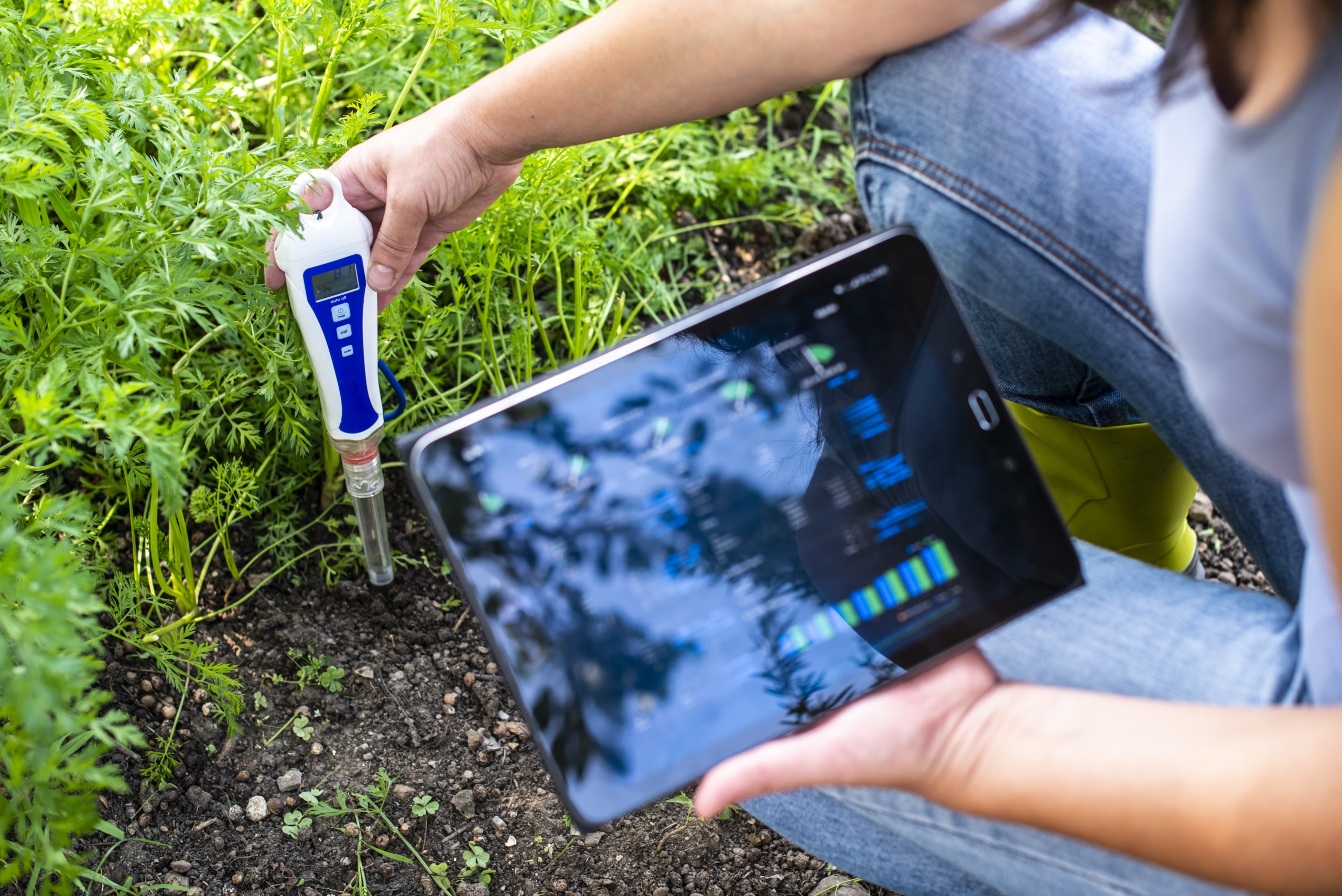
A calibrated handheld meter can screen soil, but it does not replace lime-requirement testing
Home pH meters, test strips, and slurry methods can help detect trends when the method is consistent. They are useful for checking whether a bed is moving in the expected direction or identifying a clearly abnormal zone. Their result should not be converted directly into a field lime rate.
Probe-style meters inserted directly into variable-moisture soil can be especially misleading. Contact quality, moisture, salt concentration, temperature, and calibration influence the reading. If the result will trigger a major amendment, confirm it with a representative laboratory sample.
Runoff is not a substitute for a soil pH and lime-requirement test
Container growers often measure runoff because it is easy to collect, but runoff chemistry reflects irrigation water, fertilizer, preferential flow, salts, and the most recently mobilized solution. It does not measure reserve acidity or tell you how much limestone the medium requires.
In mineral soil, the problem is even larger because runoff may never contact the full root zone. Use runoff as a troubleshooting clue where appropriate, not as a liming prescription.
Repeat the same sampling method
Use the same management zone, depth, laboratory, and analytical method when possible. That makes the before-and-after trend much easier to interpret.
Converting one runoff or probe reading into a lime dose
A quick pH reading can identify a question. It cannot measure the reserve acidity needed to calculate how much lime a mineral soil requires.
Test calcium and magnesium with the pH decision, not after it
Lime choice affects more than pH. Calcitic limestone supplies calcium. Dolomitic limestone supplies calcium and magnesium. If the soil needs liming and magnesium is also low, dolomitic material may solve both needs. If magnesium is already sufficient or high, adding more solely because dolomite is familiar can be unnecessary.
This is where the previous Weedth comparison, Gypsum vs Lime: They Do Different Jobs, becomes a logical planned link once its live URL is confirmed. The central principle is the same: choose the amendment for the actual chemical job, not for the nutrient name printed on the bag.
Turn a Lime Recommendation Into a Real Application
A laboratory recommendation is often expressed in terms of a standard neutralizing material. The bag you buy is rarely identical to that reference. The product’s neutralizing value, fineness, form, and incorporation depth determine how much of the recommendation is actually delivered.
Calcium carbonate equivalent describes chemical neutralizing power
Pure calcium carbonate is commonly used as the reference material for neutralizing acidity. Calcium carbonate equivalent, or CCE, compares a liming material’s acid-neutralizing capacity with that standard. A product with lower CCE requires more material to deliver the same theoretical neutralizing capacity.
Different regions use different labels and regulatory systems. You may see CCE, effective calcium carbonate equivalent (ECCE), effective neutralizing value (ENV), effective neutralizing material (ENM), or a lime score. Do not assume the numbers are calculated identically. Use the conversion recommended by the laboratory or local extension system.
Particle size changes reaction speed
Even chemically suitable limestone reacts slowly if the particles are coarse. Finer particles expose more surface area and generally react faster. This is why many effective-lime ratings combine purity with particle-size efficiency instead of judging the material by calcium percentage alone.
Pelletized lime can be easier to handle and spread, but pelleting does not create extra neutralizing capacity. Once the pellets break apart, the underlying limestone chemistry and particle fineness still determine the reaction.
| Label Term | Practical Meaning |
|---|---|
| CCE | Chemical neutralizing value compared with pure calcium carbonate. |
| ECCE / ENV / ENM | Regional systems that account for effective neutralization, often combining purity and fineness. Use the local definition rather than treating the abbreviations as universal equivalents. |
| Calcitic lime | Primarily supplies calcium while neutralizing acidity. |
| Dolomitic lime | Neutralizes acidity while supplying calcium and a meaningful magnesium component. |
| Pelletized lime | A physical product form that can improve handling. It does not bypass the chemical amount of neutralizing material required. |
Incorporation depth changes the treated soil mass
Ground limestone does not instantly move through the entire soil profile. Its strongest effect occurs where it is mixed with acidic soil and moisture. Pre-plant incorporation therefore produces a different result from surface application, especially when a large correction is needed.
If the lab recommendation assumes a specific depth, treat that assumption as part of the calculation. A rate calibrated for the top 6 inches should not be described as a universal amount for every raised bed depth or root zone.
Large corrections are easier before planting
Pre-plant liming gives the grower room to distribute the material evenly and allows time for the reaction before the root system occupies the bed. Once a cannabis plant is established, aggressive top-dressing is harder to mix evenly and harder to reverse if the dose is excessive.
For established beds, smaller staged corrections guided by testing are often more controllable than one large surface application. This is especially true when the current pH is only moderately outside the management range and the plant is not showing severe root-zone stress.
“Is pelletized lime safer because it works more slowly?”
Question sent by: CedarRoute, via Facebook page.
Pelletized lime is mainly a handling form. Its neutralizing capacity still comes from the limestone inside the pellet. Product quality, CCE or effective rating, fineness, rate, and placement matter more than the fact that it arrives as pellets. Do not use pellet form as permission to exceed the soil-test requirement.
Calcitic versus dolomitic lime should follow magnesium status
If an acidic soil needs lime and magnesium is low, dolomitic limestone can supply magnesium while correcting acidity. If magnesium is already adequate, calcitic limestone may be more appropriate. The decision should come from the combined pH, lime requirement, and nutrient test rather than a blanket cannabis recipe.
Remember: Lime is an acidity correction tool first. The calcium and magnesium it supplies are useful, but nutrient supply should not be used to justify liming a soil whose pH is already where you want it.
Containers and Soilless Media Need a Different Method
Field soil and soilless substrate are not interchangeable testing systems. Peat, coco, bark, compost blends, perlite mixes, and manufactured potting media have different bulk density, buffering chemistry, pore structure, and water management. A field soil lime table is therefore the wrong tool for a peat-based cannabis pot.
The Cannabis Indoor Growing Mediums guide separates mineral soil, soilless media, coco, and hydroponic systems. That distinction is especially important here because the phrase “soil pH” is often used casually for every root zone.
Peat-based media are commonly limed during manufacturing
Sphagnum peat is naturally acidic, so commercial peat-based substrates are commonly formulated with limestone before sale. The manufacturer balances lime type, particle size, peat chemistry, other components, fertilizer, and the expected irrigation program to create a usable starting pH.
Adding another generic dose of dolomitic lime to a finished mix can therefore double-correct a medium that was already formulated. If you build your own peat mix, use a tested substrate recipe or laboratory substrate analysis rather than borrowing an agricultural field rate.
Use greenhouse or soilless-media extraction methods for containers
Accepted horticultural methods include saturated media extract, 1:2 dilution, and PourThru-type tests. Each method produces its own pH and EC interpretation ranges. Results are not interchangeable, and a container-medium result should not be judged with the calibration used for mineral field soil.
If you send a potting mix to a laboratory, identify it as greenhouse, nursery, or soilless media rather than ordinary soil. Some laboratories use different extraction procedures and reporting systems for each sample type. Sending the right material under the wrong test can produce numbers that look precise but are difficult to interpret.
Do not apply a field lime-requirement table to peat or coco
Agricultural buffer-pH recommendations assume mineral soil, a defined sampling depth, and a large soil mass. Container substrates require their own extraction methods and recipes. Treating a 20 L pot as a miniature acre can produce severe overliming.
Irrigation-water alkalinity can push substrate pH over time
Water pH and water alkalinity are different measurements. The pH value shows the current hydrogen ion condition of the water. Alkalinity describes the water’s acid-neutralizing capacity, largely from bicarbonates and carbonates in many water sources.
High-alkalinity irrigation can act like a repeated small lime application to a container substrate. A water source can have a surprisingly high pH but low alkalinity and have limited long-term effect, while water with a less dramatic pH but high alkalinity can push substrate pH upward over repeated irrigation.
This is one reason a container pH problem should not always be solved by adding or removing limestone. The ongoing water source may be driving the trend. The How to Water Cannabis Indoors guide discusses medium pH, water chemistry, and why blanket lime recipes can fail in containers.
Test the system you actually grow in
Use field-soil testing for mineral soil and a greenhouse or soilless-media method for peat, bark, coco, and potting mixes. Add irrigation-water alkalinity when long-term substrate pH keeps drifting.
Using one pH number for soil, runoff, water, and substrate
Those measurements answer different questions. A value only becomes useful when you know what was sampled and which analytical method produced it.
Coco and hydroponics are not limed like soil
Coco has cation exchange behavior, but growers usually manage its pH and calcium-magnesium balance through processing, buffering, irrigation chemistry, and nutrient formulation. Hydroponic systems manage the nutrient solution directly. Agricultural lime is not a default pH-control tool for either system.
If the root zone is not mineral soil, first identify the medium and the appropriate testing framework. The more accurately you name the system, the less likely you are to solve the wrong problem.
Common Failure Modes and Misleading Readings
Most lime mistakes begin with a correct observation followed by the wrong interpretation. The soil tests acidic, a plant shows chlorosis, or a grower reads that cannabis likes a certain pH. The failure happens when that clue is converted directly into an amendment dose without checking buffering, method, or the rest of the root zone.
Mistake 1: treating every low pH as the same lime requirement
The same pH can sit on top of very different reserve acidity. A sandy bed and a high-organic-matter clay bed can therefore need different rates. The correction is to use a calibrated lime-requirement test rather than a pH-only chart.
Mistake 2: chasing a perfect cannabis pH number
Healthy root zones operate across a range. Repeatedly adding lime, sulfur, pH-up, or pH-down to chase a single decimal can create oscillation, salt loading, and nutrient imbalance. A stable trend within a suitable range is more valuable than forcing every test to read exactly the same.
If one reading is unexpected, repeat the measurement with a clean representative sample and calibrated equipment before making a large correction.
Mistake 3: confusing nutrient symptoms with proof of low soil pH
Chlorosis, weak growth, necrotic margins, and apparent calcium or magnesium problems can result from pH, but they can also come from high EC, saturated soil, damaged roots, nutrient imbalance, temperature stress, disease, or irrigation problems. Leaf appearance tells you what to investigate, not which amendment to pour in.
Before changing lime, confirm the root-zone chemistry. If pH is already suitable, more lime can reduce availability of some micronutrients and move the plant farther from balance.
Mistake 4: assuming high pH water is the same as high alkalinity
Water pH and alkalinity are related but different. Alkalinity is the better indicator of how strongly irrigation water can neutralize acidity over time. This matters most in containers and protected cultivation, where repeated irrigation applies the same water chemistry to a limited substrate volume.
Mistake 5: using hydrated or quick lime like agricultural limestone
Hydrated lime and quicklime are much more reactive than ordinary ground agricultural limestone and can be hazardous to handle and easy to misuse around roots. A soil-test recommendation written for agricultural limestone should not be substituted casually with a more caustic material.
Use products intended and labeled for the horticultural job you are performing, follow local regulations and label directions, and match the neutralizing rating to the laboratory recommendation.
Mistake 6: assuming pelletized lime requires less chemistry
Pellets improve handling. They do not eliminate the stoichiometric requirement to neutralize acidity. A smaller mass of low-neutralizing-value lime cannot replace a larger required amount merely because the product is pelletized or marketed as fast acting.
Mistake 7: ignoring incorporation and reaction time
Limestone needs moisture and contact with acidic soil. A surface application to a large outdoor bed will not instantly correct deeper acidity. Large pre-plant corrections work better when the material can be distributed through the intended treatment depth and given time to react.
Mistake 8: forgetting that overliming is also a problem
Once too much lime is mixed through a root zone, correction is slow. Excessive pH can reduce availability of iron, manganese, zinc, and other nutrients. Overapplication of dolomitic lime can also add more magnesium than the system needs.
Overliming is harder to reverse than a cautious under-correction
Do not add an extra margin “for safety.” Apply the amount supported by the test and product rating. When uncertainty is high, especially in an established container or small bed, staged correction plus re-testing preserves more control.
Mistake 9: interpreting pH without EC and moisture context
High soluble salts and severe moisture stress can distort root function even when pH looks acceptable. A plant can appear nutrient deficient because roots are unable to acquire or transport nutrients efficiently. Correcting pH will not repair oxygen stress, extreme salinity, or a collapsed medium.
This is why the root zone should be treated as a system. pH, EC, moisture, drainage, irrigation history, and nutrient balance often need to be read together.
Master Advice: Do not ask “What raises pH?” until you have answered “Why is this root zone acidic, how strongly is it buffered, and which testing method supports the correction?”
Correct the Root Zone and Verify the Result
Role A guidance is incomplete if it ends with “apply lime.” The correction must include a way to determine whether the amendment changed the intended condition without creating a new problem. A useful sequence is: observe → sample → measure → calculate → apply → allow reaction → re-sample → compare.
Step 1: confirm the problem before changing anything
Review the history. Was the bed previously limed? Has it received repeated ammonium-based fertilizer, sulfur, compost, manure, or high-alkalinity irrigation? Is the strange pH result from one pot, one corner, or the entire management zone?
Then repeat or confirm the pH with a representative sample. If the correction will be large, use a laboratory test rather than relying on a handheld screen.
Step 2: obtain the lime requirement, not only the pH
If the soil is acidic enough that correction is justified, request the laboratory’s lime-requirement procedure. Record the buffer method, target pH, sample depth, and reported amount of effective lime.
If the laboratory does not offer a cannabis recommendation, ask for the underlying soil measurements and the interpretation method rather than pretending that another crop is cannabis. The chemistry still helps you understand the soil even when the crop calibration is incomplete.
Step 3: choose the lime product from the nutrient status
If magnesium is low and liming is needed, dolomitic limestone may be useful. If magnesium is already adequate, calcitic limestone can raise pH without deliberately adding more magnesium. Check the product’s neutralizing rating and particle-size information.
Step 4: convert the laboratory recommendation to the product
Use the local conversion system specified by the lab, extension service, or label. Do not improvise between CCE, ECCE, ENV, ENM, and lime score. Confirm whether the recommendation is expressed per area, per soil mass, or under a defined incorporation depth.
Step 5: apply evenly through the intended treatment zone
Uniform distribution matters. Pockets of concentrated lime can create local chemistry that differs from the rest of the bed. Pre-plant incorporation is the easiest time to correct a large volume. In an established bed, work conservatively and avoid damaging roots merely to mix the amendment deeper.
Step 6: allow the chemistry time to react
Lime reaction depends on moisture, temperature, particle size, soil acidity, and mixing. Do not expect a large field-soil correction to show its full effect the next morning. The appropriate re-test interval should come from the product, local extension guidance, and the scale of the correction rather than a universal cannabis timetable.
Step 7: re-sample the same way
Use the same management zone, depth, and laboratory method so the comparison is meaningful. Record both pH and relevant nutrient results. If the pH moved less than expected, do not automatically add another full dose before checking product quality, incorporation, sample consistency, and the lab assumptions.
Step 8: monitor what can drive pH after correction
Once the target is reached, future pH direction depends on management. Acidifying fertilizer programs, heavy rainfall and leaching, decomposition, repeated organic amendments, or water alkalinity can gradually change the root zone again. Monitoring frequency should match how quickly that system is likely to change.
Before You Lime a Cannabis Soil
- Confirm that you are managing mineral soil rather than coco, hydroponics, or a manufactured soilless substrate.
- Define one reasonably uniform sampling and management zone.
- Follow the laboratory’s required sampling depth and composite-sampling procedure.
- Record routine soil pH, not a runoff value used as a substitute.
- Request buffer pH, lime buffer capacity, neutralizable acidity, or the laboratory’s calibrated lime-requirement test when correction is needed.
- Confirm the target pH used in the recommendation.
- Check calcium and magnesium before choosing calcitic or dolomitic limestone.
- Read the lime label for CCE, ECCE, ENV, ENM, lime score, or the regional neutralizing-value system.
- Match the product conversion to the laboratory’s reference standard.
- Account for the treatment depth or soil volume represented by the recommendation.
- Apply and incorporate uniformly when the system allows it.
- Avoid adding an extra safety margin beyond the calculated requirement.
- Allow a realistic reaction period before judging the correction.
- Re-sample the same zone and depth using the same analytical method.
- Track irrigation-water alkalinity, fertilizer acidification, and other forces that may move pH again.
What a successful correction looks like
Success is not one perfect pH reading. The root zone should move toward the intended range without a large overshoot, and repeated measurements should show a stable direction rather than rapid oscillation. Nutrient symptoms caused by acidity may stop progressing as new growth develops under better conditions, but old damaged tissue does not need to become green again for the correction to be working.
If the pH is corrected but plant performance does not improve, return to the diagnosis. EC, moisture, oxygen, root disease, nutrient supply, temperature, and irrigation chemistry may still be limiting the plant. A pH correction can remove one barrier without proving that pH was the only barrier.
Use pH to Identify the Problem and Buffering to Size the Correction
The central rule is straightforward: soil pH tells you the active condition; buffering and lime-requirement testing tell you how hard that condition will be to change. A grower who uses only the pH number knows where the soil is, but not how much neutralizing material it will take to move it.
For native ground and mineral-soil beds, use a representative laboratory sample, keep the method and depth attached to the result, and follow the laboratory’s calibrated lime-requirement system. Choose calcitic or dolomitic limestone from the magnesium status, then correct the product rate for its actual neutralizing value. For peat, coco, and other container media, switch to a substrate-testing framework instead of shrinking a field recommendation down to pot size.
The safest liming decisions are usually the least dramatic. Test before changing the root zone, correct only the acidity that actually needs to be neutralized, and verify the response before applying more.
Share this article
A quick overview of the topics covered in this article.
Follow us
Latest articles
October 24, 2026
October 24, 2026
October 24, 2026