Soil Texture vs. Soil Structure: A Cannabis Root-Zone Guide
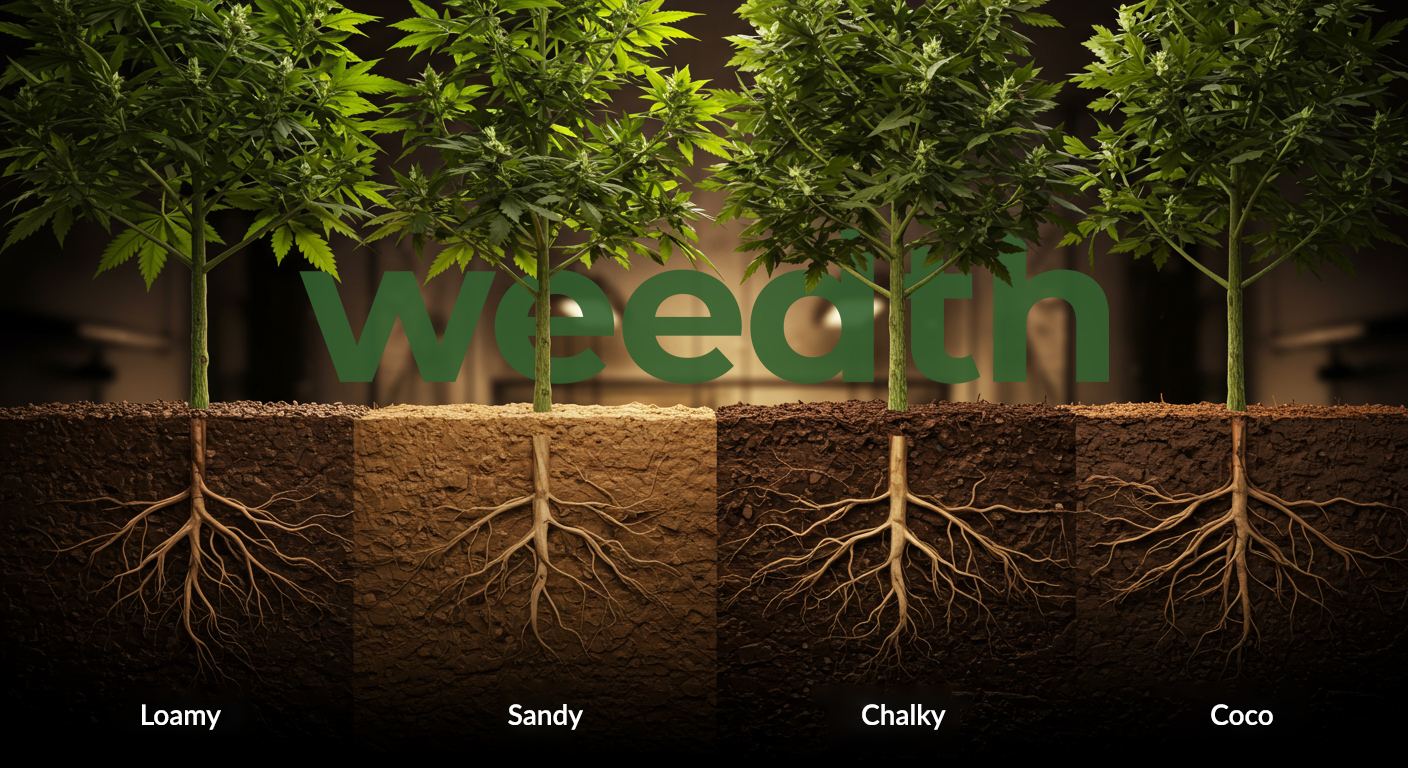
Soil texture tells you the proportions of sand, silt, and clay. Soil structure tells you how those particles are arranged into aggregates and pore spaces. That distinction sounds small until a garden is watered. Texture helps predict the soil’s basic tendency to drain, store water, and hold nutrients. Structure decides whether those tendencies can actually work for the roots.
A clay loam with stable crumbs and continuous pores can accept water, exchange air, and support deep roots. Another clay loam can be smeared, compacted, and nearly airless after rain. Their texture may be almost identical, yet they are not the same root zone. The same principle applies to sandy ground: loose sand and compacted, crusted sand share a particle-size class but do not offer the same rooting conditions.
This guide separates the two properties, shows how to assess them without confusing one test for another, and explains what can realistically be improved. It also draws a firm line between native mineral soil and a container growing medium. They may both be called “soil” in casual grow-room language, but their physical behavior and the tests used to judge them are not interchangeable.
Important: Texture is a relatively permanent mineral property. Structure is a condition that management can protect, damage, or rebuild. If you diagnose a structural problem as “bad texture,” you may spend money on amendments without fixing compaction, drainage, traffic, or irrigation.
Soil Texture vs. Soil Structure in One Comparison
Think of texture as the ingredient proportions and structure as the architecture built from those ingredients. Both influence water and air, but they do so in different ways. Texture sets the broad physical possibilities. Structure controls how connected and usable the pore network is at this moment.
| Question | Soil texture | Soil structure | Practical meaning |
|---|---|---|---|
| What is measured? | Relative proportions of sand, silt, and clay in the mineral fraction | The size, shape, stability, and arrangement of aggregates and the pores around them | Texture describes composition; structure describes organization |
| How quickly does it change? | Usually changes only when large quantities of mineral material are added or removed | Can decline rapidly through wet traffic, puddling, intensive tillage, or compression | Structure is the more responsive management target |
| How is it checked? | Laboratory particle-size analysis, texture-by-feel, ribbon test, or a careful screening jar test | Spade observation, aggregate stability, pore continuity, infiltration, bulk density, penetration resistance, and root patterns | One test cannot accurately diagnose both |
| What does it predict? | General water-holding, drainage, nutrient-retention, and workability tendencies | Actual infiltration, aeration, drainage pathways, root penetration, crusting, and resistance to erosion | Texture predicts tendencies; structure helps explain present performance |
| What can a grower improve? | Usually choose around it, import a suitable root zone, or use a raised bed or container | Protect aggregates, reduce compaction, maintain living roots, add suitable organic matter, mulch, and correct water management | Improve the architecture before trying to replace the mineral base |
Soil texture
Soil texture is the relative proportion of sand, silt, and clay in the mineral portion of a soil. Organic matter can change how that soil behaves, but it is not a fourth side of the soil texture triangle.
Soil structure
Soil structure is the way primary particles and organic materials associate into larger units called aggregates or peds. Their arrangement creates pores that move and store water, exchange gases, shelter organisms, and give roots pathways through the soil.
What Soil Texture Actually Describes
The mineral fraction of fine earth is grouped into sand, silt, and clay according to particle size. Sand is the largest of the three, silt is intermediate, and clay is extremely fine. Gravel and larger fragments affect a site, but they are not plotted as part of the fine-earth texture triangle.
A laboratory can measure the particle-size distribution and report percentages that add up to 100. Those percentages are placed on a texture triangle to assign a class such as sandy loam, loam, silt loam, clay loam, or clay. The class is useful because particle size influences the kinds of pores a soil tends to form, the surface area available for chemical reactions, and the speed at which water can move.
Sand: Rapid Movement, Limited Storage
Sandy soils commonly contain more large pores between individual grains. Water can infiltrate and drain quickly when those pores remain open. Oxygen returns readily after irrigation, but the root zone may dry fast and may retain fewer nutrients than a finer-textured soil.
That does not make sand automatically “well drained” in every location. A sandy surface can sit over a compacted layer, shallow rock, or a high water table. Fine material can also wash into the larger pores and reduce infiltration. Always examine the profile below the surface before trusting the feel of the top few centimeters.
Silt: Productive but Vulnerable to Crusting
Silt feels smooth or flour-like when dry and slippery when wet. Silt-rich soils can hold useful amounts of water and nutrients, but weakly aggregated silt is prone to surface sealing, erosion, and compaction. A hard crust after rain can limit gas exchange and slow the emergence of small plants even when the soil beneath it remains moist.
Silt therefore illustrates why texture alone is not a verdict. Stable aggregation, surface cover, root activity, and gentle irrigation can make a silt loam highly workable. Bare, repeatedly disturbed silt can behave very differently.
Clay: High Surface Area, Small Pores
Clay particles carry a large surface area relative to their size and can contribute strong water and nutrient retention. Clay soils may have more total pore space than sandy soils, yet much of that space consists of small pores. Water moves more slowly through these pores and may be held tightly as the soil dries.
Heavy clay becomes especially difficult when structure is poor. Wet traffic and digging can smear pore walls, compress aggregates, and create dense plates. Once dry, the same soil may become hard enough to resist roots and tools. This is a structural failure acting on a fine texture, not proof that clay is infertile.
Loam Is a Texture Class, Not a Quality Guarantee
Loam contains a balance of particle sizes, but the word does not promise ideal drainage, fertility, organic matter, pH, contamination status, or structure. A compacted loam can be a poor root zone. A carefully managed clay loam can outperform it.
Remember: A texture name is not a soil-health score. “Loam” cannot tell you whether water ponds, roots meet a hardpan, the site contains contaminants, or the topsoil has been compressed by years of traffic.
| Texture tendency | Water behavior | Root-zone advantage | Management pressure |
|---|---|---|---|
| Sandy | Fast infiltration and dry-down when the profile is open | Rapid aeration and easy physical penetration | Moisture and nutrients may need smaller, better-timed applications |
| Silty | Moderate to strong storage with a risk of surface sealing | Can offer a productive balance of water and nutrient retention | Protect the surface from raindrop impact, erosion, and unnecessary disturbance |
| Clayey | Slow movement, high storage, and tightly held water as drying progresses | Strong nutrient-holding potential and useful drought buffering when structured | Prevent wet compaction, maintain aggregates, and provide a reliable drainage route |
| Loamy | Often balanced, but still dependent on aggregation and profile drainage | Broadly workable physical potential | Do not allow the favorable texture to hide compaction or a restrictive subsoil |
What Soil Structure Adds to the Picture
Individual mineral particles rarely function as a perfectly loose pile in healthy topsoil. Clay, organic compounds, fungal hyphae, root exudates, microbial products, carbonates, iron oxides, and the activity of soil animals help bind particles into aggregates. The spaces inside and between those aggregates create a network of pores.
Large connected pores allow rapid drainage, air exchange, and root exploration. Smaller pores retain water against gravity. A useful root zone needs both. If the large pores collapse, the soil can remain wet while roots become oxygen limited. If almost every pore is large, water and dissolved nutrients may leave too quickly.
Aggregate stability
Aggregate stability describes how well soil crumbs resist falling apart when wetted or disturbed. Stable aggregates preserve pore space during rain and irrigation; unstable aggregates can slake, seal the surface, and clog pores.
Common Forms of Soil Structure
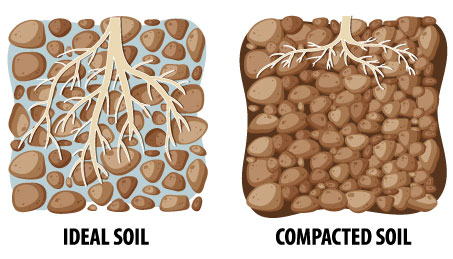
Granular or crumb structure is common in biologically active surface soil and is usually favorable for roots. Blocky structures form angular or rounded blocks and often occur deeper in the profile. Prismatic or columnar units are vertically oriented. Platy structure forms horizontal sheets and often signals compaction or repeated pressure. Massive soil shows little visible aggregation, while single-grain material is dominated by unbound particles such as loose sand.
These names help describe a profile, but shape alone is not the whole diagnosis. Size, strength, friability, pore continuity, moisture condition, and the depth of each layer matter. A few attractive crumbs at the surface cannot compensate for a dense plate 15 cm below.
How Two Soils With the Same Texture Behave Differently
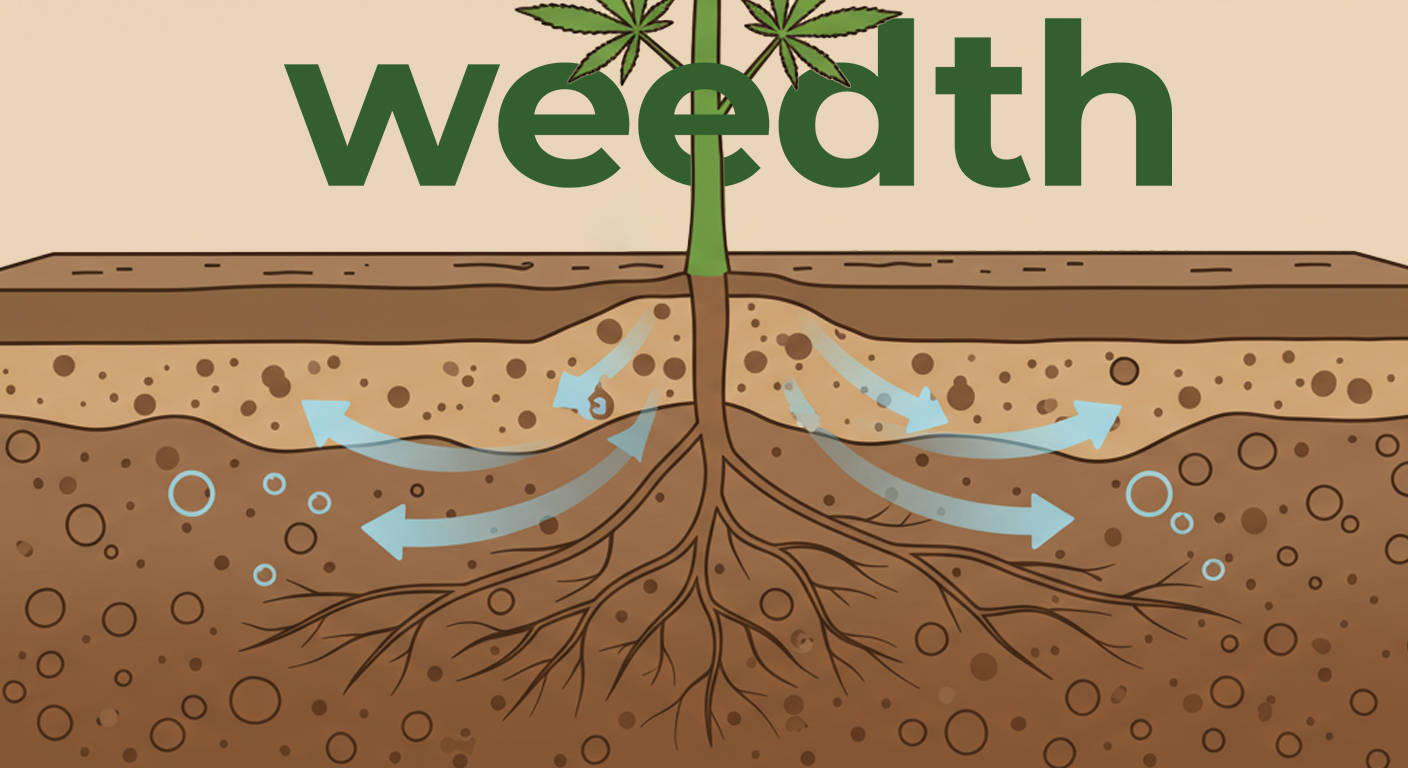
Imagine two beds that both test as clay loam. The first has been kept covered, receives mature compost at sensible rates, supports roots through much of the year, and is not walked on when wet. A spade lifts aggregates that break apart with gentle pressure. Water enters without immediate ponding, and fine roots follow old root channels downward.
The second bed is left bare, repeatedly tilled to the same depth, and crossed after rain. Its surface seals, the tilled layer becomes powdery when dry, and a compacted pan develops below it. Water pauses above the dense layer. Roots spread sideways because they cannot penetrate it.
Their texture has not changed. Their structure, pore continuity, bulk density, biological activity, and rooting depth have. This is why adding fertilizer to a structurally damaged bed often disappoints. Nutrients cannot compensate for low oxygen, restricted roots, or water that cannot move through the profile.
Read the whole profile.
Check the surface, active root depth, transition layers, and drainage below. Roots experience the profile vertically, not as a handful taken from the top.
Do not diagnose by color alone.
Dark soil may contain organic matter, but it can also be wet, compacted, saline, contaminated, or poorly drained. Appearance is a clue, not clearance to plant.
What Cannabis Roots Experience Below the Surface
Roots do not experience a label such as “sandy loam.” They encounter mechanical resistance, water films, oxygen availability, temperature, salt concentration, nutrient surfaces, microbes, and continuous or blocked pathways. Texture and structure influence each of these conditions, but neither acts alone.
Oxygen and Root Respiration
Roots require oxygen for respiration. After watering, large pores should drain and refill with air. When a structurally poor soil remains saturated, oxygen diffusion slows sharply. Root function can decline before the leaves show a clear symptom, and prolonged saturation can favor root pathogens.
A plant can therefore look thirsty while its root zone is wet. The leaves are responding to impaired root function, not asking for another irrigation. Adding more water or fertilizer at that moment deepens the problem.
Water Storage and Availability
More stored water does not always mean more plant-available water. Fine pores may hold water strongly. Large pores drain rapidly. Available water lies between these extremes and varies with texture, structure, organic matter, rooting depth, and soil chemistry.
Good structure expands the useful range by maintaining both storage pores and aeration pores. It also helps water enter more evenly. A crusted surface or compacted layer can cause runoff and ponding even when the underlying texture could hold useful moisture.
Mechanical Resistance and Root Architecture
As bulk density and penetration resistance rise, roots spend more energy pushing through the soil. They may thicken, branch abnormally, turn along the surface of a dense layer, or remain shallow. Shallow roots make a large outdoor plant more vulnerable to heat, drought, wind, and uneven nutrient access.
Cannabis can develop a substantial root system when the profile is deep and open. Industrial hemp research also shows that fine-textured soil combined with subsurface compaction can divert roots and limit access to deeper water and nutrients. The practical lesson is not that every cannabis garden needs deep tillage. It is that a hidden restrictive layer deserves diagnosis before the season is committed.
Field Advice: When the top 10 cm looks loose but roots repeatedly turn sideways at the same depth, examine the boundary. A compacted layer, abrupt texture change, construction fill, or perched water zone may be controlling the entire plant.
Native Soil, Raised Beds, and Container Media Are Not the Same System
In-ground mineral soil has a profile that connects to deeper layers. It may contain horizons formed over long periods, channels created by roots and animals, stones, and a water table far below the surface. A container has a hard boundary and a drainage opening only a short distance from the top. The same material can hold a much larger fraction of water in a shallow pot than in open ground.
Bagged potting mixes are commonly soilless substrates based on peat, coco coir, bark, compost, wood fiber, perlite, pumice, or other components. Growers may call them soil, but the mineral texture triangle is usually the wrong tool for describing them. Their performance is better assessed through particle-size distribution, total porosity, air-filled porosity, water-holding capacity, shrinkage, wettability, stability, and container geometry.
Native Ground
Use texture and structure together when assessing a lawful outdoor site. Examine the full rooting depth, slope, drainage outlet, evidence of seasonal saturation, compaction, site history, and contamination risk. A single planting-hole test cannot represent an entire garden, especially on filled or disturbed land.
Raised Beds and Mounds
A raised bed can create a controlled root zone above slow-draining or compacted ground, but the interface still matters. Water must have somewhere to move, and roots should not meet an abrupt, smeared boundary. Loosen the surface without creating a glazed bowl, use materials compatible with the underlying soil, and observe the bed through a full wet season.
Containers and Living-Soil Beds
Container structure changes over time. Fine particles migrate, organic components decompose, peat or coco may shrink, roots occupy pore space, and repeated watering settles the mix. A medium that begins fluffy can become slow and uneven if its coarse fraction is inadequate or if it is packed firmly into the pot.
Large living-soil containers usually offer more buffering and a more stable moisture gradient than small pots, but they are not immune to compaction or saturation. The irrigation volume, application speed, mulch, biological activity, and drainage design still need to match the bed.
How to Test Soil Texture Without Confusing It With Structure
A good assessment starts by asking one question at a time. If you want mineral particle proportions, use a texture method. If you want to know how the soil is aggregated, compacted, or draining, use structural and functional observations.
Laboratory Particle-Size Analysis
A laboratory particle-size analysis is the strongest route when the texture class will influence a permanent bed, drainage project, or major amendment decision. Ask how the sample should be collected and whether coarse fragments and organic material require separate reporting. Combine the result with pH, organic matter, salinity, and relevant contaminant tests rather than assuming texture explains fertility.
The Texture-by-Feel and Ribbon Test
Remove gravel and obvious organic debris, moisten the sample gradually, and knead it until the moisture is even. Grittiness suggests sand, smooth flour-like material suggests silt, and stickiness and plasticity suggest clay. Press the moist soil between thumb and forefinger to form a ribbon. A longer, stronger ribbon generally indicates more clay.
The ribbon test is an estimate, not a laboratory percentage. Organic matter, salts, mineralogy, moisture, and the operator’s experience can alter the feel. Use a recognized texture-by-feel flow chart and test more than one location and depth.
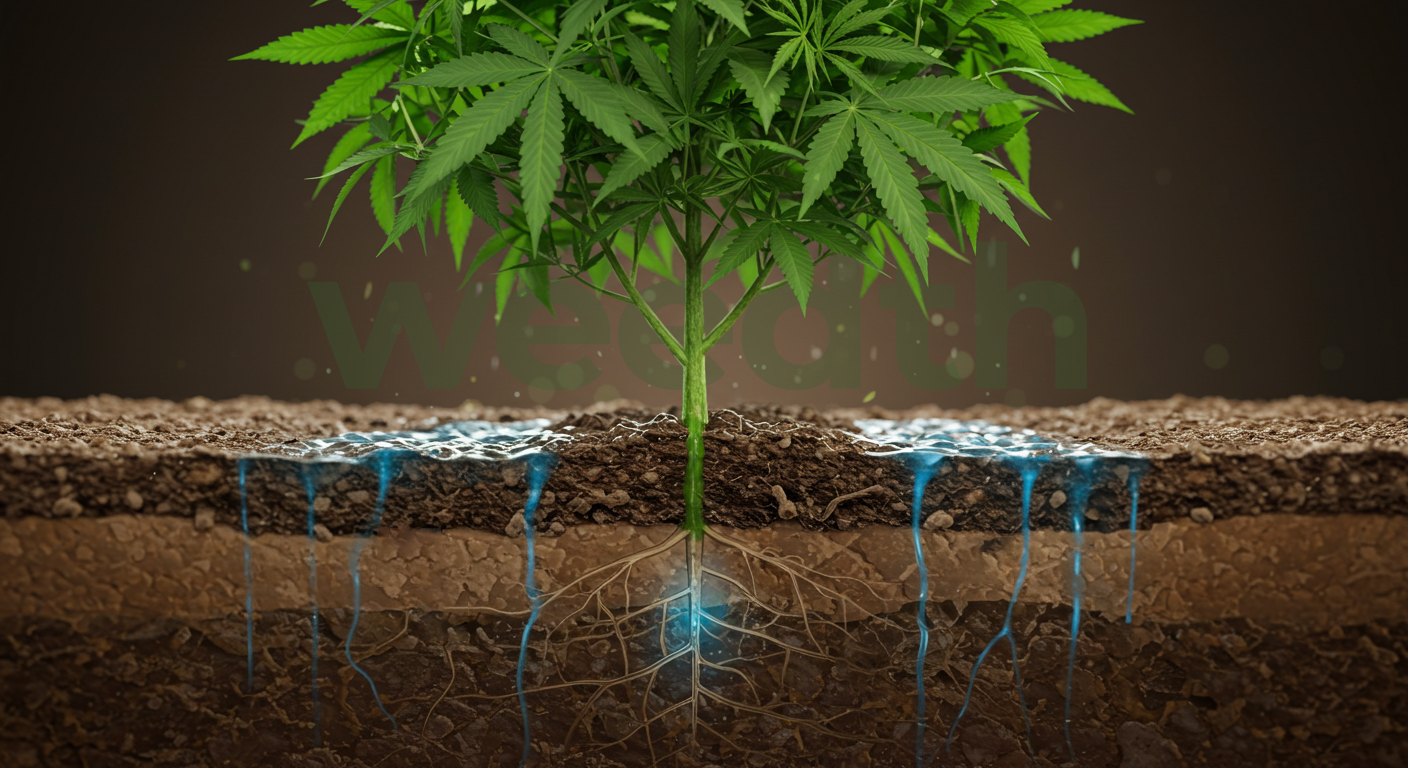
The Jar Test: Useful Screening With Limits
A settling jar can make particle-size differences visible, but household jar tests are often treated as more precise than they are. Complete dispersion, settling time, organic matter, particle shape, and measurement error affect the layers. Use the jar as a teaching and screening tool. Use a laboratory when the percentages will drive an expensive or permanent decision.
Do not import unknown outdoor soil into an indoor garden.
Texture and structure do not reveal pesticide residues, heavy metals, petroleum contamination, weed seeds, insects, nematodes, or pathogens. Use tested material or a clean commercial substrate instead of treating a pleasant texture as proof of safety.
How to Assess Soil Structure and Compaction
Structure is best judged with several observations made under realistic moisture conditions. Soil that is saturated will smear; soil that is extremely dry may appear hard even when it is not unusually compacted. Compare suspect areas with a nearby area that has similar texture but different traffic or management history.
The Spade Test
Dig a block that includes the surface and the expected root depth. Look at how it separates. Stable topsoil tends to break into aggregates with visible pores and fine roots. Mechanically produced clods may have sharp, smeared faces and little internal porosity. Horizontal plates, abrupt dense layers, and roots running along a boundary deserve attention.
Infiltration and Ponding
Observe what happens during a measured irrigation or steady rain. Does water enter evenly, run off, collect in depressions, or disappear through a few cracks? Fast surface entry does not prove deep drainage. Check moisture below the surface later and determine whether water stopped above a restrictive layer.
Penetration Resistance
A soil probe or sturdy rod can help map resistance when soils are at similar moisture. A sudden, repeatable increase at one depth suggests a restrictive layer. Professional penetrometers provide more consistent data, but readings still depend strongly on water content and texture.
Bulk Density and Root Evidence
Bulk density measures dry soil mass per unit volume and can support a compaction diagnosis. Interpretation must account for texture because a density that restricts roots in a clay soil may not carry the same meaning in sand. Root distribution often provides the most direct biological evidence: look for flattened roots, abrupt turns, shallow concentration, few fine roots, and uncolonized dense zones.
| Method | What it reveals | What it cannot prove | Best use |
|---|---|---|---|
| Laboratory texture analysis | Sand, silt, and clay proportions | Current aggregation, pore continuity, drainage, or contamination | Permanent site planning and accurate texture classification |
| Ribbon test | Field estimate of texture and clay influence | Exact percentages or structure quality | Rapid comparison across locations and depths |
| Spade profile | Aggregates, layers, pores, roots, color changes, and visible compaction | Chemical fertility or contaminant safety | Connecting surface behavior to the rooting profile |
| Infiltration observation | How readily water enters at the test point | Drainage throughout the entire profile or through every season | Finding sealing, runoff, and spatial differences |
| Probe or penetrometer | Relative resistance and possible dense layers | Cause of resistance without texture, moisture, and profile context | Mapping compaction depth consistently |
| Root inspection | The pathways roots actually used or avoided | Whether genetics, disease, irrigation, or chemistry also contributed | Confirming that a physical restriction affected the plant |
Pro Tip: Photograph the intact spade face before breaking it apart. Once the soil is crumbled by hand, the original plates, channels, cracks, and root turns are easy to lose.
Improve Soil Structure Without Pretending to Change Texture
Most garden-scale improvement should focus on structure, organic matter management, drainage, and root access. Trying to convert clay into loam with a few bags of sand or compost is rarely realistic. The amount required to alter the mineral percentages through a meaningful depth is enormous, and a poorly chosen amendment can create new problems.
Keep Pressure Off Wet Soil
Wet soil is vulnerable because water reduces the friction and strength that help pores resist pressure. Foot traffic, machinery, repeated digging, and even working the same narrow path can collapse macropores. Define permanent paths and keep containers, tools, and workers off the growing zone when it is wet.
Use Mature, Suitable Organic Matter
Compost and other stable organic materials can support aggregation, lower bulk density, feed soil organisms, improve water storage in sandy soil, and help fine-textured soil maintain workable pores. Apply a tested material at a rate suited to the soil and crop. More is not automatically better. Immature compost, high salts, persistent herbicide residues, excessive phosphorus, or unstable carbon can create a different root-zone problem.
Maintain Living Roots and Surface Cover
Roots create channels and release compounds that feed organisms involved in aggregation. Cover crops and companion groundcover can help maintain these processes when they fit the legal garden, climate, water supply, and competition plan. Mulch cushions raindrop impact, reduces crusting, moderates temperature, and slows evaporation.
Keep mulch away from a persistently wet stem base, and use clean materials with a known source. Do not move unverified forest litter, roadside material, or pest-infested plant debris into a controlled garden.
Reduce Unnecessary Tillage
Tillage can temporarily loosen a compacted layer, but repeated disturbance breaks aggregates, exposes organic matter to faster decomposition, and may form a new pan at the working depth. When mechanical correction is justified, combine it with prevention: remove the cause of traffic, add suitable organic inputs, establish roots, and avoid repeating the operation on wet soil.
Manage Water So Pores Can Recover
High-intensity watering can seal bare soil, erode aggregates, and send water across the surface. Apply water at a rate the soil can accept, protect the surface, and allow air to return between irrigations. If water repeatedly ponds because of a dense subsoil or high water table, changing the watering can is not enough. The site, elevation, bed design, or drainage route may need to change.
Improve the condition you can manage.
Protect pores, build aggregation, reduce traffic, keep suitable roots active, and correct the movement of water through the profile.
Do not chase a new texture class by guesswork.
A few amendment bags cannot reliably transform the mineral fraction of a deep bed. Test first and choose a raised bed or imported root zone when replacement is more sensible.
Why Adding Sand to Clay Can Make the Problem Worse
“Add sand for drainage” is one of the most persistent soil shortcuts. A small quantity of fine sand mixed into clay may fill existing pores and create a denser mass. Research summarized by university extension services shows that very large sand proportions may be required before the material begins to behave as sandy soil. That is not a practical correction for most gardens.
If a clay site is unsuitable, focus on aggregation, surface organic matter, traffic control, drainage, raised beds, or a new location. Coarse mineral amendments can have specific uses in engineered mixes, but they should be chosen from measured proportions and tested behavior, not from the belief that any gritty material creates oxygen.
Never amend clay with random sand.
Beach sand may carry salts, roadside material may be contaminated, and fine construction or play sand can reduce pore space. If a designed mineral amendment is being considered, verify its grading, cleanliness, volume requirement, and effect in a small test area first.
Clay, Silt, and Sand Need Different Management Priorities
For Clay-Heavy Ground
Prevent wet compaction before trying to repair it. Keep the surface covered, maintain organic inputs, use permanent access paths, and examine whether the subsoil or landscape position traps water. Raised beds or broad mounds can be more reliable than isolated planting holes that act like buckets.
Gypsum is not a universal clay loosener. It is most useful under particular chemical conditions, including some sodic soils. Apply it only when a soil test and local agronomic guidance support the treatment. Calcium cannot repair a drainage outlet that does not exist.
For Silt-Rich Ground
Protect the surface from crusting and erosion. Mulch, living cover, lower-impact irrigation, and minimal disturbance preserve aggregates. Avoid pulverizing the bed into a fine powder, which can seal rapidly under rain.
For Sandy Ground
Build water and nutrient retention with stable organic matter while preserving rapid aeration. Mulch can reduce evaporative loss. Irrigation often works better in smaller, measured applications that match the root depth instead of large doses that carry nutrients below the active zone.
Do not assume every sandy site is droughty. Check for a shallow water table, compacted interface, or finer layer beneath the sand. Abrupt layers can slow movement and create unexpected saturation.
Container Structure: The Part Indoor Growers Can Control
Container growers usually choose the entire root-zone material, so physical design should happen before planting. A reliable mix maintains enough air after drainage, distributes water evenly, resists rapid collapse, and rewets without severe channeling. It should also suit the irrigation frequency and container depth you can manage.
Do Not Pack the Pot
Fill evenly and settle the medium gently. Firming with heavy hand pressure removes large pores and creates inconsistent zones. Water will settle a loose mix naturally. If the level drops substantially, top it up rather than compressing the original fill.
Choose Aeration by Function, Not by Appearance
Perlite, pumice, coarse bark, rice hulls, and other materials can increase coarse pore space when they are clean, compatible, and used in a suitable particle range. Their effects are not identical. Some break down or decompose, some float, some add weight, and some hold internal water. Build the mix around measured or well-documented physical behavior rather than a universal percentage.
Container Shape Changes Air and Water Balance
The same medium behaves differently in a shallow tray and a tall pot. After drainage, a similar saturated zone can represent a much larger percentage of a shallow container. This is why changing pot geometry can alter air-filled porosity even when the substrate recipe remains unchanged.
Bottom Rocks Do Not Repair a Dense Mix
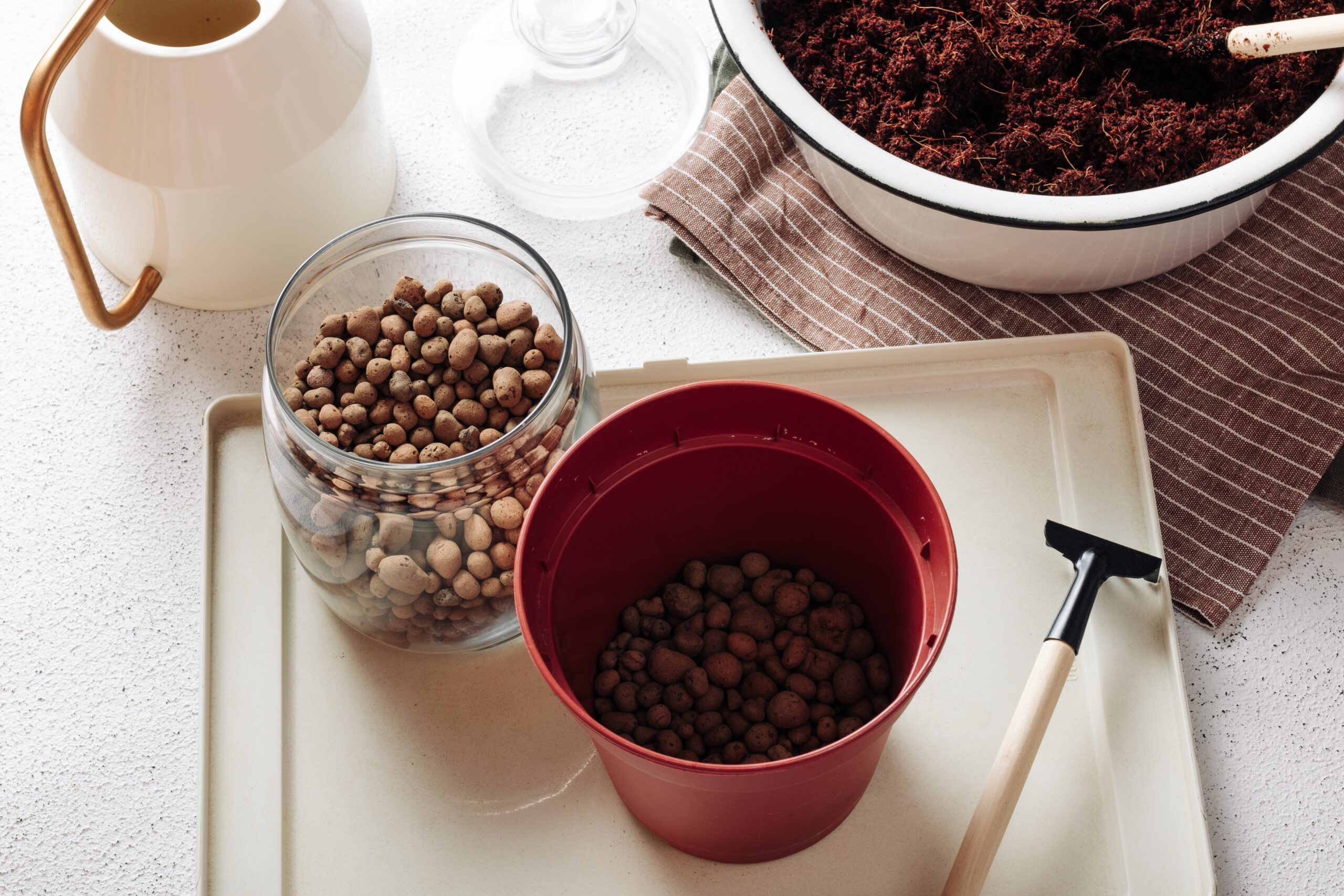
A layer of stones, gravel, or clay pebbles at the bottom reduces the volume available to roots and creates an abrupt interface. It does not turn compact material above it into an aerated medium. Use containers with adequate drainage openings and build the desired porosity throughout the root zone.
Master Advice: In a container, design structure before the roots arrive. Once a dense mix is fully colonized, aggressive mixing causes more damage than benefit. Adjust irrigation, improve the next transplant mix, or move to a better-prepared container.
Diagnosing a Texture or Structure Problem From Plant Behavior
Plant symptoms rarely identify a soil property on their own. Slow growth, yellowing, wilting, nutrient imbalance, and weak roots can come from irrigation, disease, salinity, temperature, pH, or restricted root volume. Use the symptom to choose an inspection, not to declare the cause.
| Observation | Physical possibility | How to check | First response |
|---|---|---|---|
| Plant wilts while soil remains wet | Low oxygen, slow drainage, compaction, or a perched saturated layer | Inspect moisture at depth, drainage path, root color and odor, and restrictive layers | Stop automatic watering and diagnose before adding fertilizer |
| Water runs off or exits one side immediately | Surface crust, hydrophobic substrate, cracks, or channeling | Compare center and edge moisture after a slow test application | Rewet gradually and correct application rate; rebuild the mix next cycle if channels persist |
| Roots turn sideways at one depth | Compacted pan, abrupt texture boundary, dense fill, or seasonal saturation | Expose a vertical profile beyond one planting hole | Correct the restriction only when soil moisture and site conditions permit, or raise the root zone |
| Surface becomes hard after rain | Weak aggregates, silt-rich crusting, bare soil, or high-impact irrigation | Observe slaking, sealing, infiltration, and surface cover | Protect the surface, reduce impact, and rebuild aggregation over time |
| Container stays heavy much longer than expected | Fine or decomposed mix, oversized pot, cool low-demand conditions, or blocked drainage | Compare wet and drying weight, lower-zone moisture, holes, and root occupancy | Lengthen the interval and correct environment; do not add a bottom rock layer |
| Plant dries rapidly despite frequent irrigation | Sandy ground, small pot, hydrophobic channels, limited rooting depth, or extreme demand | Measure the wetted depth and inspect roots and profile continuity | Improve distribution, storage, mulch, or root volume according to the confirmed cause |
Common Soil Texture and Structure Myths
“Clay Soil Has Less Pore Space Than Sand”
Clay can have more total pore space, but the pores are often smaller and water moves through them slowly. Sand tends to have fewer total pores but a larger proportion of big, rapidly draining pores. Pore size and connectivity are more useful than total porosity alone.
“Dark Soil Is Automatically Rich and Healthy”
Dark color may reflect organic matter, moisture, or mineral conditions. It does not verify nutrient balance, drainage, oxygen, pH, salinity, or contaminant safety.
“A Fluffy Bagged Mix Will Stay Fluffy”
Organic components decompose and shrink. Fine particles migrate. Roots and irrigation reorganize pore space. Evaluate the expected stability of a container medium over the full cultivation period.
“More Perlite Fixes Every Watering Problem”
An aeration amendment can improve a suitable mix, but it cannot correct blocked drainage, an oversized wet pot, poor watering distribution, root disease, or an unsuitable container shape by itself. It is also difficult to mix evenly after roots fill the container.
“Tilling Always Adds Air”
Tillage creates temporary looseness, but repeated passes can destroy aggregates, speed organic-matter loss, and form a compacted layer beneath the worked depth. Airiness immediately after cultivation is not proof of durable structure.
Choose the Right Root-Zone Strategy
The best response depends on scale, time, and the severity of the limitation. A mild surface crust can be managed. A contaminated urban fill site or seasonally flooded clay basin may be a poor investment. Cannabis has a finite season outdoors, so a correction that takes years may not serve the current crop.
| Situation | Best direction | Why | Do not rely on |
|---|---|---|---|
| Workable native soil with weak surface structure | Protect the surface, add suitable organic matter, reduce traffic, and improve irrigation impact | The mineral base is usable and the structural limitation is manageable | Extra fertilizer or frequent shallow tilling |
| Heavy soil with slow profile drainage | Use a broad raised bed or mound, improve aggregation, and verify an outlet for water | Elevation and structure address root oxygen more directly than an isolated hole | A handful of sand, bottom gravel, or gypsum without a soil test |
| Sandy soil that dries too rapidly | Build stable organic matter, mulch, expand rooting depth, and use measured irrigation | The goal is additional storage without sealing the large pores | One oversized irrigation that leaches below the roots |
| Compacted disturbed or urban soil | Test contaminants and profile restrictions; consider a lined raised bed or clean containers | Unknown history adds chemical and physical risks | Color, weeds, earthworms, or texture alone |
| Indoor or balcony container | Use a clean container substrate engineered for air and water balance | Native topsoil commonly becomes dense and pest-prone in confined spaces | The field texture triangle or a stone drainage layer |
| Large living-soil bed | Maintain mulch, biological activity, suitable structure, even watering, and long-term nutrient balance | Large volume buffers change but still depends on pore continuity | A permanently wet bed or repeated aggressive mixing |
How Root-Zone Physics Can Influence Final Flower Quality
Texture and structure do not directly create a specific aroma, cannabinoid level, or flower density. Their effect is indirect but meaningful. A root zone that alternates between oxygen limitation and severe drought can reduce growth, destabilize nutrient uptake, and make irrigation timing harder to control. Restricted roots can also limit the water and mineral supply needed to support a large canopy.
A stable, breathable soil does not guarantee premium flower because genetics, light, climate, plant health, harvest timing, drying, and curing remain major variables. It does give the plant a more consistent physical foundation. That consistency is especially useful during flowering, when heavy irrigation corrections, root disease, or prolonged saturation can be difficult to reverse.
Advice: Treat soil structure as risk management for the whole crop. The benefit is not a magical increase in flavor. It is a root zone that makes water, nutrition, and environmental decisions more predictable.
Frequently Asked Questions About Soil Texture and Structure
Can compost change soil texture?
Compost can substantially improve behavior and structure, but it does not normally change the mineral sand, silt, and clay percentages enough to assign a new texture class. It can improve aggregation, water storage, workability, biological activity, and resistance to compaction when the material and rate are appropriate.
Is loam a texture or a structure?
Loam is a texture class based on sand, silt, and clay proportions. Granular, blocky, platy, prismatic, massive, and single-grain are structural descriptions. Loam can have good or poor structure.
Can a sandy soil become compacted?
Yes. Traffic, vibration, particle-size distribution, fine material, low organic matter, and repeated pressure can reduce large pores and increase resistance. Sand is often easier to penetrate than clay, but “sandy” does not mean immune to compaction.
What soil structure is best for cannabis?
In mineral topsoil, a stable granular or crumb structure with connected pores is generally favorable. The full profile must also drain, provide sufficient rooting depth, and avoid contamination and salinity. In containers, focus on stable air and water balance rather than assigning a natural-soil structural type.
How can I tell whether drainage or overwatering is the real problem?
Measure moisture at root depth, inspect how water enters and exits, track container weight or soil drying, and examine the drainage path. Overwatering describes a root zone that remains too wet for too long. Poor structure, a dense medium, blocked holes, a high water table, cool weather, or excessive irrigation frequency can all create that condition.
Should I break up every soil clod?
No. Natural aggregates are not the same as hard clods produced by mechanical disturbance. Crushing stable crumbs destroys structure. Examine whether the unit is porous and friable or dense with smeared faces before deciding that every lump is a problem.
Does a jar test show soil structure?
No. The test intentionally disperses particles so they can settle by size. It estimates texture. Structure is the arrangement and stability of particles and aggregates before they are dispersed.
Can structure be repaired in one season?
Surface crusting and mild compaction may respond visibly within a season when the cause is removed and roots, mulch, and suitable organic matter are used. Deep compaction, degraded subsoil, or poor drainage may require several seasons or a different root-zone strategy. Do not promise a rapid repair before inspecting the depth and cause.
Before you plant into native soil or fill a container
- Identify whether the material is mineral soil or a soilless container substrate.
- Use a texture test only for sand, silt, and clay proportions.
- Inspect aggregates, pores, roots, layers, and compaction separately.
- Check drainage below the surface instead of judging one handful.
- Review site history and test unknown ground for relevant contaminants.
- Keep foot and equipment traffic away from wet planting zones.
- Use clean, mature amendments at measured rates.
- Do not mix small amounts of random sand into clay.
- Do not use bottom rocks to compensate for a dense container mix.
- Match the root zone to the container depth and irrigation frequency.
- Record how long the soil remains wet after a thorough irrigation.
- Choose a raised bed, container, or better site when correction is unrealistic.
Build Structure Around the Texture You Have
The most useful answer to soil texture versus soil structure is not choosing one as more important. Texture explains the mineral foundation. Structure explains how that foundation is functioning now. Cannabis roots need both pieces of information because water, oxygen, resistance, and rooting depth emerge from their interaction.
Test texture when you need to classify the soil. Inspect structure when you need to understand infiltration, compaction, drainage, and root access. Then improve the condition you can realistically manage. Protect the soil when it is wet, maintain cover and living roots where appropriate, use suitable organic matter, and move the crop into a raised or contained root zone when the native profile cannot be corrected safely within the season.
Scientific and Official References
- USDA Natural Resources Conservation Service: What Is Soil?
- USDA NRCS: Field Book for Describing and Sampling Soils, Version 4.0
- USDA NRCS: Soil Structure and Macropores
- Oregon State University Extension: Soil, the Dirty Secrets of a Living Landscape
- Oregon State University Extension: Improving Garden Soils With Organic Matter
- University of Minnesota Extension: Soil Compaction
- Penn State Extension: Soil Quality Information
- Agronomy: Growing Mediums for Medical Cannabis Production in North America
- Plant and Soil: Water Availability in Substrates for Cannabis Cultivation in Relation to CBD Yield
- GCB Bioenergy: Adapting the Cultivation of Industrial Hemp to Marginal Lands
Share this article
A quick overview of the topics covered in this article.
Follow us
Latest articles

August 3, 2026
August 3, 2026
August 3, 2026
August 3, 2026