
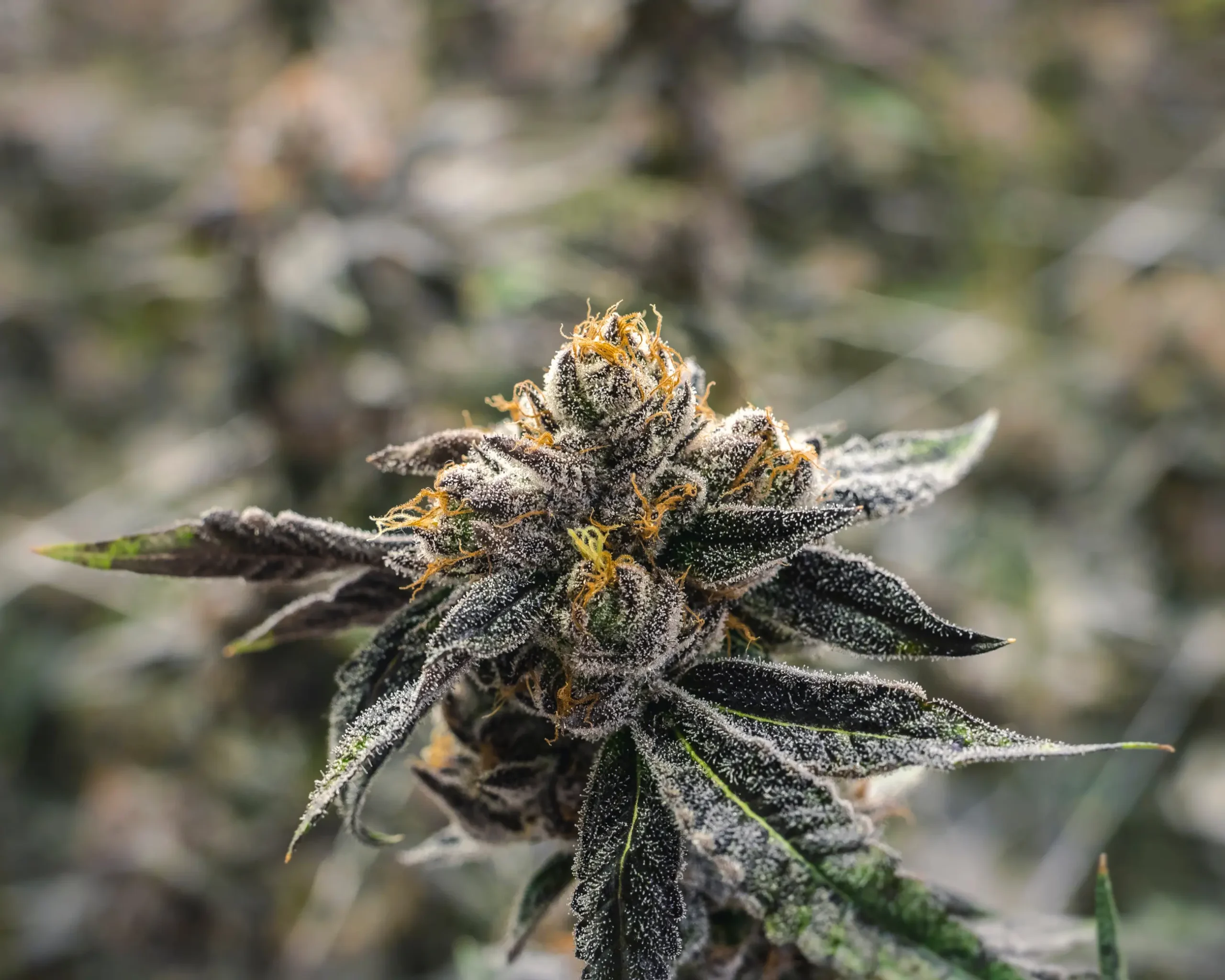
9 Pound Hammer
9 Pound Hammer is famous for a short flowering window and a heavy nighttime effect, but those two facts can make growers simplify the plant too aggressively. It is not merely a fast indica that can be placed in a corner and harvested on a calendar. The cultivar combines Gooberry, Hell's OG, and Jack the Ripper, and that three-way background creates more variation than the name's reputation suggests. Some expressions remain compact and Gooberry-dominant, with large calyxes and dense grape-lime flowers. Others show more vertical energy, citrus sharpness, or uneven branching.
The plant's most consistent strengths are early resin, a relatively fast finish, and flowers that become dense enough to demand moisture discipline. Early topping usually produces a productive bush. Lower cleanup can increase the proportion of stacked top flower. The cultivar is often described as mildew resistant, but resistance should not be confused with immunity. Hard buds still create a risk when the canopy is crowded or the drying room moves moisture unevenly.
The grower's central challenge is not keeping the plant alive. It is deciding when a fast-finishing plant is actually mature. Trichomes appear early, autumn colors may arrive quickly, and the first aroma can be strong enough to suggest that harvest is close. Yet some expressions continue expanding their calyxes after the plant already looks finished. Taking every plant at day fifty because a guide lists a short range can produce a brighter, thinner, less complete version of the cultivar.
9 Pound Hammer is best approached as a compact production plant with a quality checkpoint at the end. Build a strong frame, remove lower growth before it becomes sticky, preserve airflow around the dense tops, then let maturity decide whether the crop finishes at the early or late end of the window. After harvest, separate the largest flowers from smaller branches. The cultivar's speed in bloom should not be repeated as speed in drying.
Strain Features
| Feature | Details |
|---|---|
| Strain Type | Strongly indica-dominant hybrid |
| Genetic Profile | Gooberry x Hell's OG x Jack the Ripper |
| THC | Commonly reported around the high teens to low-20% range, with stronger batches possible |
| CBD | Usually very low |
| CBG | Some tested batches show measurable CBG, but this is not universal |
| Dominant Terpenes | Myrcene, beta-caryophyllene, limonene, and pinene commonly recur |
| Flavor and Aroma | Grape, berry, lime, sweet earth, pine, diesel, and light tropical or candy notes |
| Effect Character | Brief euphoria followed by strong physical relaxation, appetite, and sleepiness |
| Flowering Time | Commonly 50 to 60 days, though some plants need longer to reach complete maturity |
| Stretch | Usually low to moderate; phenotype dependent |
| Plant Architecture | Bushy, sturdy, and responsive to early topping |
| Bud Structure | Large calyxes, dense stacked flowers, and heavy resin coverage |
| Resin Timing | Often begins early and can mislead growers about harvest readiness |
| Mold and Mildew | Frequently described as resistant, but dense late flowers still require dry air |
| Training Compatibility | Early topping, branch spreading, lower cleanup, and a shallow screen work well |
| Yield Character | Medium to high under a uniform canopy; premium percentage improves with lollipopping |
| Odor Intensity | Moderate to high, with fruit and lime over an earthy OG base |
| Primary Cultivation Risk | Premature harvest, touching dense flowers, and uneven post-harvest moisture |
| Grow Difficulty | Easy to moderate for general cultivation, intermediate for best flower quality |
| Best Time of Use | Nighttime, low-demand evenings, or sleep preparation |
Genetic Lineage
9 Pound Hammer brings together three parents with very different jobs. Gooberry contributes dense fruit, large calyxes, color, resin, and an indica-style frame. Hell's OG adds earthy fuel, physical weight, and the structural influence of the broader OG family. Jack the Ripper contributes citrus, vigor, and a brighter edge that can keep the plant from behaving like a completely slow, compact broad-leaf cultivar.
The result is commonly described as Gooberry-dominant, especially in plants that produce hard grape-scented buds and early resin. That expression is the source of the cultivar's reputation for large calyxes surrounded by autumn-colored leaves. It is also the expression most likely to convince a grower that the crop is ready before the flowers have finished expanding.
Other phenotypes may lean toward lime, lemon, pine, or sharper fuel. They can show slightly more stretch and a less compact canopy. A Jack the Ripper-influenced plant may feel more euphoric at first and smell brighter. A Hell's OG-leaning plant may be earthier, more sedating, and slower to reveal fruit. The name therefore describes a family of related expressions rather than one exact sensory formula.
The lineage also explains why the cultivar can be fast without being weak. Early flowering speed comes with active resin production and rapid flower stacking. The plant does not necessarily need a long ten-week period to create density. It does need enough root health and leaf function to complete the last portion of its shorter cycle.
For selection, a good keeper should combine fast completion with stable flower interiors. A plant that finishes early but develops loose or moisture-prone buds is less useful than one that takes several extra days and cures cleanly. Flavor should remain recognizable after drying. Grape and lime are especially valuable because they separate 9 Pound Hammer from heavier generic indica hybrids.
The cultivar's descendants and related hybrids often use it for sleep-oriented effects, fast resin, and fruit. That influence is meaningful, but the original plant is best understood through the relationship between speed and weight. It moves quickly, then lands heavily.
Effect Breakdown
What happens before the hammer falls
The first stage can be more cheerful than the name suggests. Users often report a short period of euphoria, mood lift, or mental stimulation. Conversation may feel easier, music more engaging, and physical tension begins to soften. This opening is usually not as long or directional as a sativa effect. It feels like the mind is being cleared before the body becomes the main focus.
The center of gravity shifts
Relaxation builds steadily. The body becomes warm, appetite can increase, and movement feels less necessary. At a moderate dose, the user may remain awake and content but lose interest in demanding activity. The experience becomes ideal for a film, quiet music, or a low-pressure evening.
At this stage, harvest maturity becomes noticeable. Earlier flower can preserve more brightness and a lighter physical finish. Later-matured flower commonly produces stronger heaviness and a longer descent toward sleep.
The heavy end
At larger doses, 9 Pound Hammer earns its name. Sedation, couch-lock, and sleepiness become likely. Coordination and short-term concentration decline. The user may move from pleasant euphoria to a strong desire to remain still. Dry mouth and dry eyes are common, and dizziness can occur when the dose exceeds tolerance.
The cultivar is generally not suited to work, driving, or complicated social settings. Even when the opening feels manageable, the direction of the experience is toward physical shutdown. Low-tolerance users should wait before consuming more because the heaviest phase may arrive after the first mental effects have already encouraged another dose.
The next stage
Residual body calm can remain after the strongest effect fades. Some users wake feeling rested, while others experience grogginess. Dose, time of use, and personal response determine the outcome. For many people, the strain is most useful when the schedule already allows sleep.
Flavor & Aroma Profile
The defining flavor relationship is grape and lime. Grape provides the dark sweet body, while lime cuts through it with acidity. Earth, pine, and diesel keep the profile from becoming candy. In some flowers, the first impression is berry jam over soil. In others, lime peel and resin appear before the grape becomes obvious.
The intact bud may smell sweet and earthy. Breaking it releases sharper fruit, citrus, and a faint OG fuel note. Large calyxes can hold concentrated resin in the interior, so the aroma often becomes stronger after grinding.
On inhalation, grape and berry usually lead. The sweetness can resemble dark fruit rather than syrup. Lime appears on the middle or exhale, sometimes with pine and pepper. A clean sample leaves a sweet-sour aftertaste. A poorly cured sample becomes earthy and flat, with the lime reduced to bitterness.
The fruit profile is vulnerable to warm drying. Grape can remain as a vague sweetness while lime and fresh berry disappear. Direct fan air creates a similar imbalance. The flower may still smell strong because earth and fuel are persistent, but the cultivar's defining contrast is gone.
The density of the flower creates another flavor issue. When the outside dries faster than the core, the cure becomes unstable. Moisture moves outward after the flower is sealed, which can produce a grassy smell, repeated wetness, or microbial risk. The solution is not constant jar opening after the problem begins. It is a more even dry before storage.
Outdoor flower may add more pine, herbs, and dark earth. Indoor flower can preserve clearer grape and lime. Color varies, and autumn tones should not be mistaken for stronger flavor. The keeper should be judged by the cured jar.
Dominant Terpenes
| Terpene | Sensory Contribution | Practical Relevance |
|---|---|---|
| Myrcene | Ripe fruit, earth, herbs, and musk | Helps build the grape-earth base and heavy physical finish |
| Beta-Caryophyllene | Pepper, dry spice, wood, and warm fuel | Adds structure to the exhale and keeps sweetness from becoming flat |
| Limonene | Lime peel, citrus brightness, and fruit lift | Creates the sharp contrast that defines the best expressions |
| Pinene | Pine resin, green wood, and fresh sharpness | Reinforces the OG side and brightens the earthy aroma |
| Humulene | Dry wood, hops, and savory earth | May deepen the darker finish in some phenotypes |
| Linalool | Floral softness and sweet spice | Can appear behind berry notes and round the sedating aroma |
Myrcene is often associated with the cultivar's body-centered character, but no terpene alone explains the effect. The table is most useful for understanding flavor preservation. Limonene and fresh pinene notes are more easily damaged by heat than the heavier earthy base. A harsh, dark sample may retain potency while losing the sensory balance that made the plant worth growing.
Indoor vs. Outdoor Growing
| Aspect | Indoor Growing | Outdoor Growing |
|---|---|---|
| Cycle Speed | Short flowering time allows efficient room turnover | Early finish can help avoid deep autumn weather |
| Plant Shape | Early topping creates a manageable bush | Can become wider and heavier with unrestricted roots |
| Canopy | A shallow, open screen improves uniformity | Broad branch spacing helps sun and wind reach the center |
| Flower Density | Climate control supports hard flowers but requires late humidity reduction | Dense tops remain vulnerable after rain despite reported resistance |
| Yield | Medium to high when lower growth is removed and light is even | Large root volume can create substantial per-plant output |
| Color | Stable late conditions may reveal autumn tones | Natural cooling can deepen color, but cold wet nights are risky |
| Flavor | Cleaner grape and lime separation | More earth, pine, and herbal complexity |
| Harvest Flexibility | Easy to compare early and late branches | Weather may decide whether the plant reaches the late end of the window |
| Drying | Branch sorting is essential because dense tops dry slowly | Outdoor colas may need to be divided before drying |
| Best Fit | Growers seeking fast, heavy nighttime flower | Dry climates with good late-season airflow |
The indoor advantage is control over the final ten days. A fast cultivar can be allowed to finish by maturity rather than harvested simply because another crop is waiting. The grower can also reduce humidity before the largest flowers become dangerous.
Outdoor cultivation benefits from the early finish. In many climates, 9 Pound Hammer can complete before very late autumn. That advantage should not encourage neglect. Dense flowers can trap moisture after dew or rain. A broad plant with separated tops is safer than one huge central cola.
The cultivar's mildew-resistant reputation is useful but limited. Leaf and flower architecture still matter. Resistance may reduce the likelihood of disease under moderate pressure; it does not protect a wet, crowded canopy indefinitely.
Strain-Specific Grow Guidance
Establish the frame early
9 Pound Hammer usually responds well to topping. Cut the main tip after the plant has developed enough healthy nodes, then allow the side branches to establish. One topping often creates the right number of mains. A second can be used when the room is wide and the vegetative period is long, but repeated topping can make the interior unnecessarily dense.
Low-stress branch spreading helps expose the center. The plant tends to become bushy, so the goal is to create outward direction before woody stems resist movement. A screen can hold the branches in separate lanes without forcing the canopy completely flat.
Lower cleanup is part of the cultivar's yield strategy
The plant can produce many small sites below the canopy. Early resin makes those sites look valuable, but shaded flowers remain less dense and require the same trimming and drying labor. Remove the lower branches and inner shoots that cannot reach useful light.
Complete the main cleanup before the flowers become sticky. A smaller adjustment can be made after stretch if hidden shoots remain. Avoid late aggressive removal that shocks a plant moving through a short flowering schedule.
Phenotype observation
Gooberry-dominant expressions often show compact growth, large calyxes, strong grape aroma, and early color. Jack the Ripper influence may increase citrus and vertical energy. Hell's OG influence may deepen fuel and body weight. Group plants by behavior rather than keeping one irrigation and canopy plan for every seed plant.
A more vigorous expression may need an earlier flip and wider spacing. A compact plant may require a slightly longer vegetative period. The fast flowering time does not mean all phenotypes enter flower with the same size.
Managing a mixed phenotype room
A seed-grown group should be sorted by behavior before the canopy becomes fixed. Compact Gooberry-leaning plants can remain closer to the center of the light and may need more vegetative time. Taller citrus-forward plants should be moved toward open screen areas or flipped earlier. When every plant is tied to the same grid before these differences appear, the vigorous expressions shade the compact ones and the compact plants are over-pruned to imitate the taller structure.
Irrigation should also be observed by phenotype. A broad plant with a large leaf area may dry the container faster than a narrow plant of the same height. Watering them as one unit can leave one dry and another saturated. Individual container weight or moisture behavior is more useful than a single room schedule during the first run.
Keep harvest labels attached through drying and cure. 9 Pound Hammer phenotypes can converge visually while remaining different in effect and aroma. One plant may provide the best grape-lime flavor, another the heaviest sleep effect, and a third the strongest structure. Mixing the crop before evaluation removes the information needed for a meaningful keeper decision.
Nutrition during a short cycle
A short cycle leaves less time to correct severe mistakes. Use moderate, consistent nutrition rather than alternating weak and aggressive feedings. The plant should enter flower healthy, with enough nitrogen to support transition but not so much that the leaves remain dark and clawed.
As flowers stack, reduce the vegetative emphasis. The cultivar can produce dense buds without extreme bloom strength. Overfeeding may increase leaf mass, reduce smoothness, and complicate root-zone moisture.
The fast timeline also means that premature flushing or starvation can remove support during the most important bulking period. One grow report of airy flowers described feed being stopped around week five, even though fresh pistils and late swelling remained. The lesson is to follow plant development, not a generic finishing calendar.
Watering and root behavior
Bushy plants can drink actively, but the container should still regain oxygen. Irrigate fully, then allow an appropriate dryback based on medium and root volume. Avoid maintaining a small plant in a large permanently wet pot.
During late flower, water demand may decline quickly. Adjust volume and frequency. A fixed schedule can create saturation exactly when dense buds and cooler nights increase humidity risk.
Flower density and airflow
9 Pound Hammer can stack dense buds along the upper branches. Keep those branches separated. Remove leaves that remain pressed against forming colas. Air should cross the plant at multiple levels.
Do not place a fan close enough to harden one side of the flower. The goal is air exchange around the canopy. Strong direct air can stress leaves and later create uneven drying if the habit continues after harvest.
Support
Branches are often sturdy, but dense flowers add weight quickly. Install support before the final swell. A second loose net or soft ties prevent tops from leaning together. Outdoors, a cage supports the broad shape and reduces breakage after wind or rain.
Reading maturity in a fast cultivar
The listed 50-to-60-day window is a guide. Some plants are ready at the early end; others need more time. Examine calyx expansion, pistil production, aroma, water use, and trichomes on the calyxes.
Early resin is not the same as mature resin. A frosty plant at day forty-five may still be actively building flower. A side-by-side branch comparison can be useful: an early sample shows the current effect and flavor, while the remaining plant continues to mature.
The last week is not a universal countdown
A fast cultivar encourages growers to create a fixed sequence: stop feeding, reduce irrigation, wait a set number of days, then harvest. 9 Pound Hammer benefits from a more responsive finish. If fresh pistils remain abundant, calyxes are still expanding, and the plant is using water normally, an aggressive shutdown can reduce the density that the final days were about to create. If water demand has fallen, leaves are naturally fading, and flower growth has slowed, the finish should become lighter and more conservative.
This difference is especially important in soil and other buffered media, where nutrient availability does not stop immediately when inputs change. The grower should avoid treating plain water as a magic flavor treatment. Smoothness depends on balanced nutrition throughout the run, complete maturation, and proper drying. Late decisions can protect quality, but they cannot erase chronic overfeeding from earlier weeks.
The correct end point is a plant that has completed its work without being kept excessively green or deliberately starved too early. That balance produces a stronger comparison between phenotypes and a more reliable repeat run.
Harvest and sanitation
Dense buds should be inspected before cutting. Remove damaged material separately and clean tools between suspicious areas. Outdoor plants exposed to rain need special attention at stem junctions and inside the largest flowers.
Dense flowers change the airflow plan
Fast flowering does not justify fast drying. The cultivar may complete bloom quickly, but its hard flowers still need slow, even moisture movement after harvest.
Weedth Bud Flavor Tips
Grape and lime require different protection. Grape sweetness can survive as a broad background note, while lime and fresh berry disappear quickly under heat. Preserve the top notes by keeping the final flowering period stable and the drying environment cool and indirect.
Harvest outdoor branches after dew evaporates. Move them into shade immediately. Indoor branches should be cut under moderate temperature rather than left beneath hot lights after the decision is made.
Sort the crop by flower density. Large tops with connected calyx stacks should not share the exact schedule of small branches. Divide unusually thick colas if the core is difficult to inspect or the plant was exposed to high humidity.
Drying should be slow enough for internal moisture to move outward. The outside of a dense bud can feel ready while the center remains soft. Test representative large pieces, not only small stems.
The early cure may emphasize earth and grape. Lime can become clearer as the smoke smooths. Allow several weeks before making a keeper decision. Store finished flower in smaller containers to protect the bright fraction from repeated air exposure.
Weedth Bud Boost Tips
The cultivar's fast cycle makes pre-flower preparation more valuable than late corrections. Build the plant before the flip, select the strongest branches, and enter flowering with a clean lower zone.
Indoors, use an even canopy of medium colas. The plant's dense stacking can create more premium flower when light reaches every main branch. Crowding reduces both airflow and density below the top layer.
Outdoor plants benefit from early topping and a wide support cage. Large roots can increase yield, but the broad canopy must remain open. A few very large colas are not automatically better than several manageable ones.
Do not push the plant with excessive late nitrogen or salt strength. The genetics already create dense resinous buds. Stable roots, light distribution, and full maturity are the primary yield tools.
The final boost is timing. If the flowers are still producing fresh pistils and the calyxes are expanding, several extra days can add more usable weight than any additive.
Medical Uses & Benefits
9 Pound Hammer is commonly chosen for sleep preparation, chronic physical discomfort, stress, and appetite loss. The later phase is strongly relaxing and may help users disengage from pain or tension.
The early euphoric stage can improve mood before sedation develops. This progression may be useful for people who want a pleasant transition into sleep rather than immediate mental shutdown.
High THC and strong body effects can also produce dizziness, anxiety, or excessive grogginess. The cultivar should not be described as treating a disease. Individual response and professional medical guidance remain important.
Ideal User Profile
9 Pound Hammer suits experienced users seeking nighttime body relaxation, appetite, and sleepiness. It fits quiet evenings and situations where reduced activity is acceptable.
It is less suitable for daytime work, driving, or users who dislike heavy physical effects. Beginners should start very low because the brief euphoric opening can hide the strength of the later phase.
For growers, it suits people who want a relatively fast cycle and dense resinous flower but are willing to manage humidity and maturity carefully.
Grower Notes and Feedback
Growers consistently mention early resin and large calyxes. The plant can look finished well before the end of the published window. This visual speed is useful for excitement but dangerous for harvest timing.
Early topping is widely reported to improve the bush shape. Lower cleanup also appears repeatedly in successful runs. The cultivar converts a clean upper canopy into stacked dense flowers more efficiently than it converts a crowded lower interior.
Phenotype variation is meaningful. Not every plant is equally compact or equally grape-forward. Seed-grown rooms should be observed as groups rather than forced into one height and harvest date.
Resistance to mildew is commonly reported, yet dense flower remains the practical risk. Growers who maintain a clean open plant usually find the cultivar manageable. Those who allow touching tops or high late humidity may discover that genetic resistance cannot overcome poor architecture.
A second recurring lesson concerns flower sorting after harvest. The cultivar can produce small side buds, medium branch tops, and very dense terminal flowers on the same plant. When all three sizes are hung and jarred together, the small pieces become brittle while the main tops remain wet internally. Growers who separate the crop by density report a more stable cure and a clearer grape-lime profile.
The plant is also useful for learning the difference between visible resin and mature flower. Early trichome production gives beginners confidence, but it can hide incomplete calyx development. Keeping a written harvest note, including day count, trichome condition, water use, and cured effect, makes the next cycle far more precise than relying on photographs alone.
A fast finish also changes labor planning. Trimming, drying space, and storage containers should be ready before the first plant reaches the window because the remaining phenotypes may follow within days. Delays after harvest can force dense branches into crowded drying conditions. The cultivar performs best when the post-harvest room is treated as part of the crop schedule rather than organized after cutting begins.
When evaluating yield, separate premium tops, usable smaller flower, and low-density material. The plant can produce impressive total mass, but the real measure is how much of that harvest dries evenly and retains grape-lime clarity. Early lower cleanup usually improves this ratio more than extending vegetative time.
The short bloom period makes clone timing important. Cuttings should be healthy and fully rooted before the flowering room needs them, because a slow start consumes a larger percentage of the cultivar's total cycle than it would in a ten-week strain. Weak roots at the flip can produce small plants that begin flowering before the canopy has enough branch mass. The result may still be resinous, but the yield ceiling is permanently reduced.
Temperature should remain stable through the rapid stacking phase. A sudden hot period can increase water demand and stretch while reducing the clarity of lime and berry. A cold period can slow root activity and make a fast plant appear deficient. The cultivar's speed leaves less time for recovery, so gradual corrections are more useful than dramatic environmental changes.
When selecting a mother, include cloning behavior in the evaluation. Some phenotypes root quickly and return to vegetative growth with little delay. Others produce excellent flower but remain difficult to propagate. A home grower may accept the slower clone for superior flavor, while a repeat production room may value the expression that combines grape-lime quality with reliable rooting and uniform transition.
The cultivar also benefits from keeping one small reference branch untrimmed until the rest of the crop has been evaluated. That reference shows how much aroma and moisture were lost during handling. If the heavily manicured buds smell flatter, the next run should reduce unnecessary contact and preserve more protective leaf during the first stage of drying.
Weedth Editor's Note
The tradeoff I would plan around
The most useful 9 Pound Hammer experience is a split harvest test. One branch is taken at the early edge of the advertised window because the resin is already heavy and the leaves have begun to color. The rest of the plant remains several more days. Both branches are dried under the same conditions and cured separately.
The early branch is bright, sweet, and more euphoric than expected. Grape is present, but the lime feels thin and the body effect ends sooner. The later flower is denser, the fruit tastes darker, and the physical finish is much heavier. Neither branch is objectively wrong, but the comparison proves that the calendar does not decide the personality alone.
I would use that test to choose the harvest target for the next run. If the goal is evening relaxation without immediate sleep, the early side may be useful. If the goal is the full 9 Pound Hammer effect, I would wait for the later calyx expansion.
I would also dry the largest tops separately. A fast flower cycle can create the false expectation that every stage should move quickly. The dense buds need patience after cutting even when the plant was efficient in bloom.
Weedth Score
Growing Experience 8.7/10 Fast, trainable, and productive, with maturity and moisture as the main tests
Bud Structure & Visual Appeal 9.1/10 Large calyxes, dense stacking, heavy resin, and attractive autumn color
Aroma Complexity 8.8/10 Grape, berry, lime, earth, pine, and OG fuel create a distinctive combination
Flavor & Smoothness 8.5/10 Sweet-sour and satisfying after an even dry; dense buds can cure poorly if rushed
Effects & High Experience 9.0/10 A brief euphoric lift descends into powerful body calm and sleepiness
Overall Satisfaction & Recommendation 8.8/10 One of the stronger fast-flowering choices for nighttime users and quality-focused growers
I would keep 9 Pound Hammer for the rare combination of a short flower cycle and a finish that still feels deep rather than hurried.
FAQ
What is the lineage of 9 Pound Hammer?
It is commonly documented as a three-way combination of Gooberry, Hell's OG, and Jack the Ripper.
How fast does 9 Pound Hammer flower?
Many expressions finish in approximately 50 to 60 days. Some plants need longer for full calyx development and a heavier effect.
Is 9 Pound Hammer always short?
It is usually compact to medium, but phenotype variation can produce more stretch. Seed plants should be observed individually.
Does 9 Pound Hammer respond well to topping?
Yes. One early topping commonly produces a productive bush with several strong main branches.
Should the lower branches be removed?
Weak lower and interior sites usually benefit from removal. This directs resources toward dense upper flowers and improves airflow.
Is 9 Pound Hammer mold resistant?
It is frequently described as mildew resistant, but dense buds can still develop moisture problems. Resistance does not replace low late humidity and inspection.
Why do the buds look ready so early?
The cultivar often produces resin and color early. Mature calyx expansion and trichomes on flower tissue should decide harvest, not frost alone.
Does 9 Pound Hammer need heavy feeding?
Usually no. Moderate, consistent nutrition is safer. Ending feed too early can reduce late density, while excessive strength can damage smoothness.
What causes the grape and lime flavor to fade?
Heat, direct drying airflow, over-drying, and repeated oxygen exposure remove the brighter fruit and citrus notes.
Is 9 Pound Hammer good for daytime use?
Most users find it better at night. The opening may be cheerful, but the effect commonly becomes deeply relaxing and sleepy.
Can it be grown outdoors in a short season?
Its early finish can be advantageous, but the local autumn still needs to remain dry enough for dense flowers.
Should all plants be harvested together?
Not necessarily. Different phenotypes and canopy positions may mature at different rates. A staged harvest can improve quality.
Similar Strains
Jack the Ripper
Jack the Ripper contributes citrus and euphoria but grows taller and feels much more stimulating than 9 Pound Hammer.
Purple Punch
Purple Punch shares dense purple flower and nighttime relaxation, with a sweeter dessert profile and less lime.
Grape Ape
Grape Ape matches grape, earth, and heavy body calm. It is usually slower in effect onset and less citrus-driven.
Hell's OG
Hell's OG provides earthy fuel and a strong physical finish, with less berry sweetness and a more direct OG character.
Mendo Purps
Mendo Purps offers dark fruit, color, and relaxation, but often has a more floral, woody, and old-school profile.
Share this article
A quick overview of the topics covered in this article.
Follow us
Latest articles
September 10, 2026
September 10, 2026
September 10, 2026