
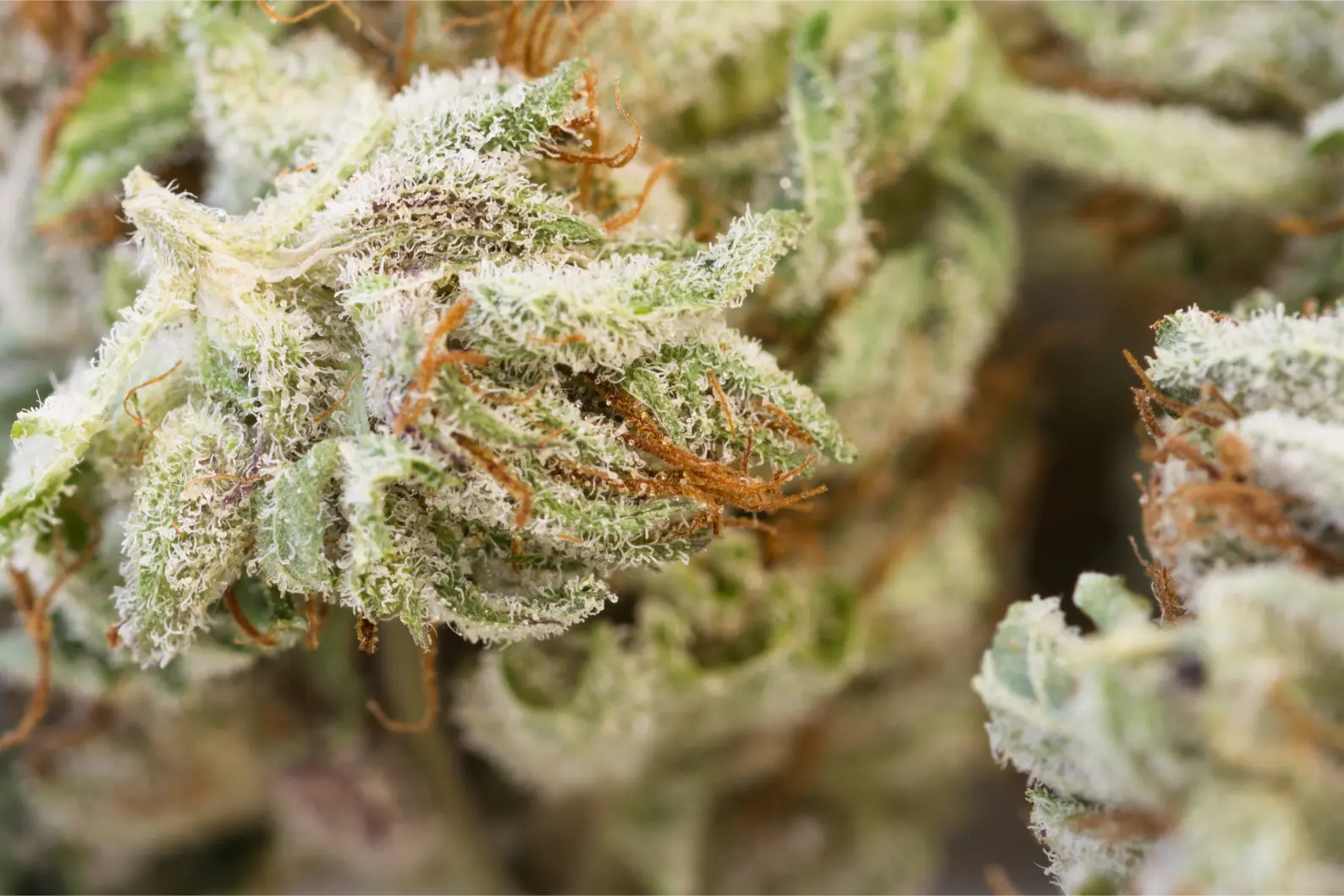
Dr. Grinspoon
Dr. Grinspoon is one of the few cannabis cultivars whose mature flowers can look almost nothing like the commercial standard. Instead of forming thick continuous colas, the plant can produce separated resinous calyxes that hang along thin stems like small beads. That morphology is not a defect to be corrected. It is the central identity of the cultivar and the reason a successful grow requires a very different idea of maturity, yield, and canopy efficiency.
The line is usually described as a pure or heirloom-style sativa, while more specific lineage claims are inconsistent. The safest editorial position is to treat the exact parentage as uncertain and focus on the traits that remain stable across descriptions: tall thin growth, long internodes, a flowering period near thirteen to fourteen weeks, bead-like flowers, modest yield, and a highly cerebral energetic effect.
The central cultivation question is: how can a grower control Dr. Grinspoon's long, flexible, low-density architecture through a ninety-day flowering cycle without trying to force the plant into dense modern buds or harvesting the separated calyxes before they are truly mature? The answer is an early flip, continuous gentle branch redirection, stable moderate nutrition, enough root capacity for a long finish, careful support, and a maturity standard based on resin and calyx completion rather than flower hardness.
The plant's open flower structure reduces some of the internal-humidity pressure associated with dense indica colas, but it does not make the grow simple. A long crop is exposed to pests, root-zone drift, irrigation mistakes, heat, and light stress for many additional weeks. Thin branches can tangle, and the plant can occupy more vertical and horizontal space than the modest final dry weight suggests.
The sensory profile is equally unusual. Honey, lemon, pine, earth, tangy tropical fruit, dry spice, and a sumac- or curry-like sharpness can appear. The effect is energetic, creative, focused, talkative, and long-lasting. Dr. Grinspoon is therefore a connoisseur sativa not because it is automatically stronger than every modern hybrid, but because the plant asks the grower to preserve a rare structure and an unusually clear experience.
Strain Features
| Feature | Details |
|---|---|
| Strain Type | Pure or heirloom-style sativa photoperiod cultivar |
| Genetic Profile | Exact lineage is disputed; commonly presented as a selected heirloom sativa line |
| THC | Commonly moderate to strong; individual test results vary widely |
| CBD | Usually low |
| Dominant Terpenes | Terpinolene, myrcene and pinene commonly recur in tested samples |
| Flavor / Aroma | Honey, lemon, pine, earth, tangy tropical fruit, dry spice, sumac-like sharpness |
| Effect Character | Energetic, creative, focused, talkative, cerebral and long-lasting |
| Flowering Time | Usually about 90 to 100 days or 13 to 14 weeks |
| Stretch | Strong and prolonged |
| Plant Architecture | Tall, thin, flexible, long-internode and lightly foliated |
| Bud Structure | Separated bead-like calyxes on thin stems rather than continuous dense colas |
| Yield Potential | Low to moderate relative to the space and time required |
| Training Compatibility | Early topping, repeated LST, wide open SCROG and gradual branch redirection |
| Primary Grow Risk | Overgrowth, premature harvest, root-zone drift over a long cycle, and judging quality by density |
| Outdoor Finish | Very late; often requires a long warm autumn or protected environment |
| Best Time of Use | Daytime |
Genetic Lineage
Dr. Grinspoon is widely described as a pure or heirloom sativa selection, but exact lineage accounts are inconsistent. Some modern accounts attach more specific parentage, while other descriptions avoid a pedigree entirely. An accurate profile should preserve that uncertainty instead of presenting one disputed account as settled fact.
The morphology supports the broader heirloom-sativa description. Long thin stems, pronounced internodes, narrow leaves, prolonged stretch, and a flowering period near fourteen weeks are all far removed from the compact hybrid structure selected for modern indoor efficiency.
The flower form is the strongest genetic fingerprint. Calyxes develop separately along delicate stems, creating a bead or pearl appearance rather than a solid spear. The plant may look sparse when compared with a dense hybrid even while the individual calyxes are resinous and mature.
Modern seed plants can still vary in height, bead spacing, color, flavor, and exact finish. Some may form slightly fuller clusters, while others show the extreme open structure associated with the name. A preservation-minded grower may value the most unusual expression, while a production-minded grower may reasonably choose a somewhat denser plant if the effect and flavor remain intact.
A useful keeper should be chosen from the full tradeoff. The plant needs to justify its room time through exceptional effect, aroma, resin quality, or preservation value. A phenotype that takes fourteen weeks and occupies a large screen without delivering a distinctive cured result is not automatically valuable merely because it is rare.
Effect Breakdown
A clear and immediate lift
Dr. Grinspoon is usually felt as mental brightness rather than body pressure. At a small dose, attention sharpens, curiosity increases, and the user may feel more interested in conversation, reading, music, or detailed creative work.
The effect can feel unusually clean because the body remains light. That clarity is still intoxication and should not be interpreted as normal reaction time or judgment.
Creative association and sensory awareness
At a moderate dose, ideas may connect rapidly and sensory detail can become more vivid. The cultivar is often described as introspective and imaginative rather than simply energetic.
Talkativeness and focus can coexist when the dose is appropriate. The same experience can become distracting when the user's task requires strict linear attention.
High doses can become mentally intense
A larger amount can produce racing thoughts, dizziness, anxiety, or an uncomfortable sense of mental acceleration. The open light body does not protect the user from overstimulation.
Dry mouth and dry eyes are common. The effect can remain active for a long time, making early redosing unnecessary and potentially unpleasant.
The late phase generally fades without strong couch-lock. Mild physical relaxation may develop, but the cultivar remains daytime-oriented. It is a better match for users seeking cerebral movement than for anyone looking for sleep or deep body heaviness.
Flavor & Aroma Profile
Honey, lemon and sharp spice
The intact flower often presents honey, lemon peel, pine, and a tangy herbal sharpness. The spice can resemble sumac, curry, or dry aromatic seeds rather than ordinary black pepper.
The aroma is usually light in volume compared with dense gas cultivars, but the profile can be extremely distinctive when the separated calyxes are fully mature.
Tropical fruit and earth inside the beads
Breaking the calyxes can reveal tangy tropical fruit, dry earth, pine resin, and a sweeter honey note. The open structure means aroma may be distributed across many small flowers rather than concentrated inside one thick bud.
Some phenotypes are more lemon-pine, while others carry stronger spice or fruit. Those differences should remain separate through cure.
A light smoke with a long aftertaste
The inhale can begin with honey and citrus. The middle becomes piney and herbal. The exhale often carries dry spice, earth, and a tangy fruit aftertaste.
A controlled dry is essential because the bead-like flowers can lose moisture quickly. Overdrying turns the unusual profile into brittle herbs and pepper.
Dr. Grinspoon is not a loud modern flavor cultivar in the usual sense. Its quality is in the unusual transition between honey, lemon, tropical tang, pine, and dry spice, and in whether those layers remain clean after a very long grow.
Dominant Terpenes
| Terpene | Aroma Role | Cultivar Relevance | Scientific Caution |
|---|---|---|---|
| Terpinolene | Fresh herbs, flowers, fruit and pine | Frequently reported in tested samples and fits the bright complex top layer | Does not guarantee stimulation or creativity |
| Myrcene | Earth, herbs and musk | Supports the grounded base beneath lemon and honey | Does not make this pure sativa sedating by itself |
| Pinene | Pine resin and fresh wood | Matches the persistent pine element | Does not guarantee focus or reverse THC impairment |
| Minor spice and fruit volatiles | Sumac-like tang, curry spice, honey and tropical fruit | Central to the cultivar's unusual sensory identity | Simple terpene panels may not explain the complete aroma |
Dr. Grinspoon should not be assigned one universal terpene profile. Tested flower is relatively uncommon, and modern seed plants can express different balances of citrus, pine, honey, earth, and spice.
The energetic effect should be discussed separately from terpinolene marketing. Terpenes shape aroma with more confidence than they predict creativity or focus. THC, dose, tolerance, and the full chemotype matter more.
Indoor vs. Outdoor Growing
| Decision Point | Indoor Growing | Outdoor Growing |
|---|---|---|
| Primary Advantage | Complete control over height, photoperiod and the very long finishing environment | Natural sunlight and root space suit the tall sativa architecture |
| Main Limitation | Large room-time cost, prolonged stretch and low yield per occupied area | Very late finish exposes the crop to autumn weather |
| Stretch | Strong and prolonged; early flip is essential | Height is easier to absorb but total plant size can become large |
| Training | Repeated gentle LST, early topping and a wide accessible screen | Early topping, broad support and perimeter control |
| Flowering Time | About 90 to 100 days | Often extends into November in suitable Northern Hemisphere climates |
| Bud Density | Very open bead-like calyx structure | Open flowers help with airflow but the long season still raises cumulative risk |
| Feeding | Moderate long-term nutrition with strong attention to root-zone stability | Large roots support scale; concentration should remain restrained |
| Best Fit | Experienced growers deliberately seeking rare sativa morphology and effects | Long warm climates or protected environments with a late dry finish |
Indoor growing is often preferred because the crop needs many weeks of stable conditions. The grower can control photoperiod, height, temperature, and late weather, but the financial and spatial cost is high relative to the dry yield.
The plant should enter flower much smaller than a compact hybrid. Empty headroom and screen area are intentional because stretch can continue for weeks while the flower remains visually sparse.
Outdoors, the architecture can express more naturally and the root system can support a larger plant. The main limitation is calendar length. A plant that needs until November is unsuitable where cold rain arrives early.
A greenhouse or protected finish can help, but only with strong ventilation and enough height. A closed humid structure around a long late plant can create more problems than it solves.
Strain-Specific Grow Guidance
Flip a small plant and expect a long transition
Dr. Grinspoon should enter flower well before a normal hybrid has filled the room. The plant can continue stretching while flower initiation proceeds slowly.
Record height at the flip, first consistent pistils, the end of major stretch, and harvest. The timeline is more useful than one generic stretch multiplier.
Train gradually rather than making one severe correction
Build support before the flowers demand it
Thin flexible branches respond well to repeated gentle bending. Small adjustments every few days are safer than allowing a leader to reach the fixture and then making a hard bend.
The screen should guide branches into separate lanes while preserving access. A tangled mat is especially difficult to maintain for another ten weeks.
Do not chase a perfectly flat canopy
Slight height tiers can work because the plant carries small separated flowers along long stems. The goal is controlled light distribution, not a rigid surface.
Every leader should have a clear path, and no branch should dominate the fixture or shade a large vertical section of the plant.
Keep enough leaf for a long cycle
Narrow leaves already allow good light penetration. Heavy defoliation is rarely necessary and can reduce the plant's ability to support a fourteen-week flower.
Remove damaged leaves, weak inward shoots, and foliage that creates real overlap. Do not strip simply because the plant is tall.
Preserve productive depth where light reaches
The open structure can produce mature resinous calyxes well below the top when side light is available. Lower sites should be judged from actual exposure rather than a fixed lower-third rule.
Keep the branch sections that prove productive and simplify the shaded base after stretch.
Feed moderately for many weeks
A long cycle magnifies small nutrient excesses. Slight overfeeding repeated for fourteen weeks can become a severe root-zone problem even when the plant initially tolerates it.
Use complete moderate nutrition and follow water use, leaf tone, and dryback. Slow bead formation is genetic and should not be treated as a phosphorus deficiency.
Choose root volume for stability
A root-bound plant can require constant irrigation during a long finish, while an oversized wet container can slow the early crop. Match the final volume to the intended trained canopy.
The goal is months of predictable oxygen and moisture, not maximum pot size for its own sake.
Support thin stems without compressing the bead structure
The flowers are individually small, but a long branch can carry many resinous calyxes and may sag late. Use soft ties or a loose upper screen.
Support should preserve separation. Pulling thin stems into one bundle increases tangling and makes harvest handling more difficult.
Accept low density as the correct flower form
Dr. Grinspoon should not be pushed toward rock-hard buds with excessive light, bloom nutrients, drought, or stress. The separated calyxes are the genetic phenotype.
Judge the flower by resin, aroma, complete calyx development, and effect rather than by the hardness standard used for an indica hybrid.
Do not harvest because the plant looks sparse
A long sativa can create grower fatigue. The flowers may look small for weeks while resin and calyx maturity continue developing.
Use mature trichomes on the actual calyxes, a decline in new pistils, completed bead swelling, and a full honey-lemon-spice aroma. The calendar should guide expectation, not force the cut.
Plan a faster and more delicate dry than the grow length suggests
Open bead-like flowers can lose moisture quickly. A fourteen-week flowering phase does not imply a fourteen-day dry.
Monitor the actual calyxes and thin branches closely. Direct fan air and excessive trimming can turn the rare flower brittle within a short time.
Weedth Bud Flavor Tips
Dr. Grinspoon's honey, lemon, tropical tang, and spice are delicate because the flower has a high surface-area-to-mass ratio. Heat and direct airflow can remove aroma quickly.
Keep the final canopy from running unnecessarily hot. The thin leaves may look healthy even when the upper calyxes are losing citrus and honey nuance.
Harvest only after the spice and fruit layers are fully developed. Premature bead-like flower can remain grassy and thin despite a long cure.
During drying, leave enough branch and protective leaf to slow moisture loss without trapping wet plant material. The correct approach can differ from the aggressive wet trim used for dense buds.
Avoid direct fan air and frequent handling. The exposed calyxes and resin are easily damaged because there is no dense bud mass protecting the surface.
During cure, raw herbs should soften while honey, lemon, pine, earth, and tangy spice separate. If the flower becomes dusty, the dry was too fast.
Store the finished calyxes in small cool airtight containers so the main batch is not exposed repeatedly. The cultivar's value is nuance, not persistent gas.
Weedth Bud Boost Tips
Dr. Grinspoon should not be evaluated by grams per plant alone. Quality yield includes the exceptional effect and preservation value produced per month of room occupancy.
The first efficiency improvement is the correct flip size. A known clone can enter flower much smaller, saving vertical correction and allowing more branch length to remain inside useful light.
Do not maximize branch count. A limited number of well-spaced leaders are easier to support for fourteen weeks and easier to dry after harvest.
Preserve productive middle branch sections when the open canopy gives them real light. Remove only the lowest shaded stems that add maintenance without resinous calyxes.
Stable roots are more valuable than bloom supplements. A long cycle needs consistent oxygen, moderate nutrition, and predictable irrigation far more than aggressive late input.
Keeper selection should include flowering duration and dry yield, but it should also include clarity of effect, aroma, and how strongly the plant expresses the bead phenotype. The purpose of the grow determines which tradeoff is acceptable.
The ideal Dr. Grinspoon harvest is a fully mature network of resinous bead-like calyxes with exceptional cerebral quality, not a forced attempt to make a rare sativa resemble a dense modern hybrid.
Medical Uses & Benefits
Dr. Grinspoon is commonly chosen by users seeking mood elevation, creative engagement, daytime energy, focus, and distraction from stress or discomfort. These are user reports, not clinical evidence that the cultivar treats a condition.
The clear cerebral character may appeal to users who dislike heavy physical sedation. It can also be unsuitable for people who are sensitive to racing thoughts or strong sensory stimulation.
Attention-related and mood-related claims appear in strain discussions, but they should not be converted into treatment statements. A stimulating THC-rich flower can improve one user's subjective focus and worsen another user's anxiety.
Dry mouth, dizziness, dry eyes, and anxiety are possible. The effect is long-lasting, making conservative dosing especially important.
Most flower is THC-dominant and should not be described as non-intoxicating. Clear energy is still impairment.
Anyone using cannabis for a diagnosed condition or alongside prescription medication should consult a qualified healthcare professional.
Ideal User Profile
Dr. Grinspoon suits users who actively want a long-lasting cerebral sativa and enjoy honey, lemon, pine, tropical tang, and dry spice rather than sweet dense dessert flower.
It fits reading, music, conversation, creative work, walking, and introspective daytime activity at a controlled dose.
For growers, it is best for experienced people who value unusual botany and effect enough to accept a long flowering room commitment and modest yield.
It is a poor fit for low ceilings, short outdoor seasons, maximum-production goals, or growers who judge flower quality primarily by density.
Preservation-minded growers may value the most extreme bead phenotype, while practical indoor growers may prefer a slightly fuller plant with the same effect. The keeper goal should be defined before selection.
Grower Notes and Feedback
The most consistent real-world observations are a thirteen-to-fourteen-week flowering period, tall thin growth, separated bead-like calyxes, and a relatively modest yield for the time and space used.
Growers frequently describe the plant as grape-tree-like or pearl-like because the calyxes hang individually along thin stems. This visual identity should be preserved in the article rather than treated as poor bud formation.
The open flower reduces some internal bud-rot pressure, but the long crop remains exposed to environmental problems for many more weeks than a fast hybrid. Pest prevention and root-zone stability are therefore central.
The plant is usually easier to control through repeated gentle bending than through one severe late correction. Thin stems remain workable for a long time but can become tangled when too many leaders are kept.
Effects reports strongly emphasize energy, creativity, focus, and long duration. Anxiety and dizziness become more likely when the dose is too high.
A second-run notebook should record flip height, first flower date, end of stretch, total flowering days, branch count, root-zone dryback, actual dry yield, and whether the unusual aroma and effect justify the room time.
The plant also changes how trim efficiency should be judged. There may be very little conventional bud to manicure, but the many exposed calyxes require delicate handling. Rough processing can remove a large share of the visible resin from a relatively small harvest.
A selected clone can make the second run less intimidating because the grower knows how far the stems travel before the bead pattern stabilizes. The structure remains unusual, but the room no longer has to be planned from a generic fourteen-week sativa estimate.
Weedth Editor's Note
Where Dr. Grinspoon earns its space
I would only choose Dr. Grinspoon if I wanted the plant to remain strange. Trying to make it dense, fast, and conventional would remove the reason to grow it.
I would flip very small, train gently for many weeks, and keep the screen open enough that I can reach every leader without crawling through a web of stems.
I would feed for stability, not for visible speed. The bead-like flowers are supposed to develop slowly, and stronger bloom input would not rewrite that genetic form.
The hardest decision would be harvest patience. I would compare whole-branch maturity, calyx trichomes, fresh pistil production, and aroma rather than allowing the sparse appearance to convince me the plant will never finish.
The keeper for me would justify the long cycle with an effect and flavor unavailable from a faster hybrid. Rarity alone would not be enough; the finished experience has to earn the space.
Weedth Score
Growing Experience 6.5/10 A long, low-yielding, highly unconventional sativa that requires height control, patience and stable roots.
Bud Structure & Visual Appeal 8.4/10 The bead-like calyxes are visually extraordinary, though far outside conventional bag-appeal standards.
Aroma Complexity 9.0/10 Honey, lemon, pine, tropical tang, earth and unusual spice create a rare profile.
Flavor & Smoothness 8.8/10 Excellent when the exposed calyxes are not overdried and the long plant reaches full maturity.
Effects & High Experience 9.4/10 Energetic, creative, focused and long-lasting cerebral effects are the main reason to accept the grow difficulty.
Overall Satisfaction & Recommendation 8.2/10 Highly rewarding for connoisseurs and preservation growers, but inefficient for ordinary production goals.
Personal closer: I would grow Dr. Grinspoon only as a deliberate connoisseur project, flipping it small and allowing the pearl-like flowers to mature on their own terms instead of judging them by the density of a modern hybrid.
FAQ
What is Dr. Grinspoon's lineage?
The cultivar is commonly described as a pure or heirloom-style sativa, but more specific lineage claims are inconsistent and should be treated as uncertain.
Why do Dr. Grinspoon buds look like beads?
Separated calyxes along thin stems are the defining flower phenotype. The plant is not supposed to form ordinary dense continuous colas.
How long does Dr. Grinspoon flower?
Usually about ninety to one hundred days, or roughly thirteen to fourteen weeks.
How much does Dr. Grinspoon stretch?
Strong prolonged stretch is normal. Indoor plants should enter flower much smaller than compact hybrids.
Does Dr. Grinspoon respond well to topping?
Yes when topping is done early. Repeated gentle LST is usually more important than aggressive high-stress training.
Is SCROG good for Dr. Grinspoon?
Yes, especially a wide open screen used to redirect long branches while preserving access and air.
Should Dr. Grinspoon be heavily defoliated?
Usually no. Narrow leaves already allow penetration, and the long flowering cycle benefits from preserving healthy foliage.
Is Dr. Grinspoon a heavy feeder?
Moderate complete nutrition is safer. The long cycle magnifies small excesses, and slow bead formation is genetic rather than proof of a deficiency.
Why is Dr. Grinspoon yield low?
The plant invests in separated calyxes rather than dense bud mass and uses a great deal of time and space. Quality and rarity are the main return.
Is Dr. Grinspoon resistant to mold?
The open flower structure can reduce internal humidity, but the very long crop still faces cumulative pest, weather and root-zone risks.
Does Dr. Grinspoon need branch support?
Thin long branches can sag under many resinous calyxes and usually benefit from soft ties or a loose upper screen.
When should Dr. Grinspoon be harvested?
Use mature trichomes on the individual calyxes, reduced fresh pistils, completed bead swelling, and a full honey-lemon-spice aroma.
Can Dr. Grinspoon grow outdoors?
Only where the season remains warm and reasonably dry very late, or in a protected environment with enough height and ventilation.
Is Dr. Grinspoon beginner-friendly?
No. The long cycle, unusual maturity cues, large structure and low efficiency make it better for experienced growers.
Is Dr. Grinspoon good for daytime use?
Many users describe it as energetic, creative, talkative and focused. High doses can become anxious or dizzy.
Similar Strains
Neville's Haze: Another extremely long cerebral sativa with major stretch, but denser flowers and more incense-fuel character.
Panama Red: A heritage-style sativa with long flowering, energetic effects and dry spice, though the flower structure is more conventional.
Malawi Gold: A long African landrace comparison with floral-minty resin and greater plant scale.
Colombian Gold: Shares open long-season architecture and clear daytime effects, with more citrus-skunk flavor.
Kali Mist: A more practical long sativa hybrid with floral spice, strong creative effects and better indoor production.
Super Silver Haze: Offers energetic Haze effects on a denser, more commercial flower structure and a shorter schedule.
Share this article
A quick overview of the topics covered in this article.
Follow us
Latest articles
September 9, 2026
September 9, 2026
September 9, 2026