
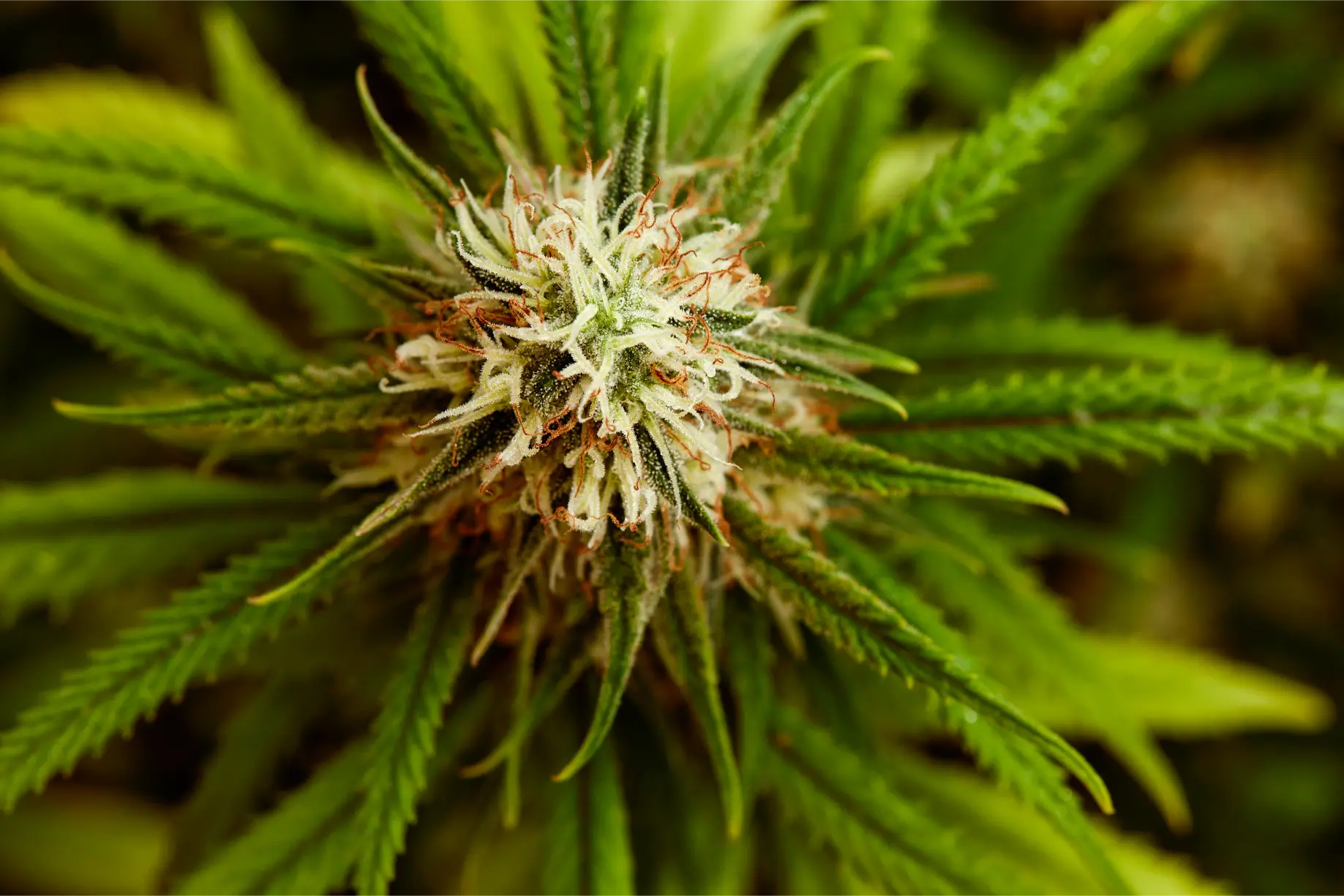
Fire OG
Fire OG is one of the better examples of why an OG cultivar can be physically manageable and still demand an experienced grower. The plant rarely needs the vertical planning of a long Haze, but its dense resinous flowers, strong lateral potential, nutrient reputation, and sensitivity to wet finishing conditions create a different kind of difficulty. A Fire OG room can look healthy for most of the cycle and still lose quality quickly if the canopy becomes too closed or the late flowers remain humid.
The most consistent lineage places Fire OG between OG Kush and SFV OG Kush. That family relationship is obvious in the finished flower: lemon peel, pine resin, dry earth, pepper, woody Kush, and a heavier fuel note in some phenotypes. The effect is also very OG-like, with a strong euphoric opening followed by a body phase that becomes increasingly relaxed and potentially sleepy.
The grow information is less uniform than the lineage. Some cultivation records describe Fire OG as a demanding feeder that performs best when pushed. Other cultivation reports describe it as happier with moderate fertilizer. Those claims are not mutually exclusive if different clones, media, and environments are involved. The more useful rule is that Fire OG is responsive, not universally heavy-feeding. A vigorous plant under strong light may use a lot. A compact, cool-rooted, or overwatered plant can burn under the same schedule.
For Weedth, the central cultivation question is how to build enough branches for a moderate-to-high quality yield without creating the dense, wet OG canopy that punishes the cultivar late. Fire OG responds to topping and pruning, and it can work as either a multi-branched plant or a simpler SOG-style structure. The training method matters less than whether the final tops remain separated, supported, and easy to inspect.
Post-harvest quality deserves equal attention. Fire OG's earth and fuel survive abuse more easily than its fresh lemon and pine. A hot or excessively fast dry can leave a powerful jar that tastes flatter than the live plant smelled. The best flower keeps the bright citrus-resin edge over the darker Kush base and finishes smooth enough that potency does not become the only thing the user remembers.
Strain Features
| Feature | Details |
|---|---|
| Strain Type | Indica-dominant OG-family hybrid |
| Genetic Profile | OG Kush × SFV OG Kush is the most consistently reported lineage |
| THC | Commonly high, often around the low-to-mid 20% range, with stronger batches possible |
| CBD | Usually very low |
| Dominant Terpenes | Myrcene, limonene, and beta-caryophyllene recur frequently; pinene may be meaningful in some samples |
| Flavor / Aroma | Lemon peel, pine, earth, wood, pepper, Kush spice, fuel |
| Effect Character | Potent euphoria and mental brightness followed by deep physical relaxation and possible sedation |
| Flowering Time | Commonly about 9 to 10 weeks |
| Outdoor Harvest | Often mid-to-late October in suitable Northern Hemisphere climates |
| Grow Difficulty | Moderate to difficult |
| Stretch | Moderate, phenotype dependent |
| Plant Architecture | Medium height with useful lateral branching and dense top-flower development |
| Bud Density | Dense to very dense |
| Training Compatibility | Topping, pruning, LST, multi-branch training, SOG, and open SCROG |
| Feeding Behavior | Responsive but inconsistent across lines; moderate-to-strong demand in vigorous plants |
| Mold Risk | Moderate to high in wet late-flower conditions because the buds can become very dense |
| Odor Intensity | Strong in late flower and drying |
| Best Time of Use | Late afternoon through nighttime |
Genetic Lineage
Fire OG is most consistently described as OG Kush crossed with SFV OG Kush. That is a relatively narrow family cross, which helps explain why the cultivar feels strongly OG in both growth and finished flower rather than like a broad mixed hybrid.
OG Kush contributes dense resinous flower, earthy pine, fuel, and a heavy physical finish. SFV OG adds sharp lemon, pine, and a slightly more extended branch habit. The combination tends to produce a medium-sized plant that is easier to contain than a long sativa but more branchy and stretch-prone than a squat Afghan.
Modern Fire OG material is not necessarily identical across every recorded line. Some plants are more lemon-pine and OG-like, while others lean fruitier or more diesel-heavy. The most useful identity markers are strong resin, lemon-earth-pine aroma, a heavy OG effect, and a flowering window around nine to ten weeks.
The family relationship also explains the cultivation challenge. OG-type branches can look strong while still developing leverage problems once dense flowers gain weight. The plant may not be tall, yet individual laterals can bend inward late enough that support becomes necessary.
A keeper should therefore be selected for more than potency. Branch spacing, late-flower stability, cured lemon-pine clarity, and resistance to canopy crowding are practical traits that determine whether a Fire OG phenotype is enjoyable to run repeatedly.
Effect Breakdown
Fire OG is usually strong from the beginning, but the first phase can feel brighter than the later reputation suggests. A moderate dose often produces euphoria, an uplift in mood, and a noticeable change around the head and eyes before the body becomes heavy.
For experienced users, that early stage can feel social or mentally engaging. Music, conversation, and quiet creative activity may remain appealing. The effect is not normally as fast or racy as a Haze, but the potency can make thought feel vivid.
The physical phase builds steadily. Muscles loosen, the body feels warmer, and the desire to remain active tends to decrease. This transition can take long enough that a user redoses before realizing how heavy the full experience will become.
At higher doses, Fire OG can become strongly sedating. Appetite may increase, eyelids become heavy, and short-term memory can become less reliable. For many users, the natural endpoint is a couch or bed rather than continued activity.
Negative effects are mostly dose related. Dry mouth and dry eyes are common. Dizziness and anxiety can appear in people who are sensitive to strong THC, even though the strain is generally associated with relaxation.
The practical lesson is to treat Fire OG as a potent evening hybrid with a brighter opening, not as a functional daytime strain. The early euphoria is real, but it should not be mistaken for the full arc.
Flavor & Aroma Profile
Fire OG's aroma is defined by the contrast between fresh and dark notes. Lemon peel and pine resin sit on top, while earth, wood, pepper, and fuel create the base. The classic profile should smell sharp without becoming purely solvent-like.
Some phenotypes carry more diesel or sweet fruit, but the lemon-earth-pine combination remains the strongest recurring identity. Unbroken buds can seem mostly piney and earthy. Grinding releases a louder citrus-fuel layer.
On the inhale, lemon and pine usually arrive first. The middle becomes woody and herbal. The exhale adds pepper, dry earth, and gas. Well-cured flower can leave an oily resin sensation on the palate without becoming harsh.
The strain is easy to flatten post-harvest because its darker notes are resilient. A grower can lose the lemon and fresh pine during a hot dry and still end up with a jar that smells very strong. That strong smell can hide the fact that sensory complexity has been lost.
The best cure reduces green bitterness while keeping the bright layer intact. Fire OG should not become sweeter during cure so much as cleaner. Lemon, pine, earth, and fuel should separate into distinct impressions rather than collapsing into generic Kush.
Average Fire OG is pungent. Exceptional Fire OG is pungent and precise. The difference is usually maturity, drying temperature, moisture control, and whether the canopy remained healthy enough to finish without late stress.
Dominant Terpenes
| Terpene | Aroma Role | Cultivar Relevance and Caution |
|---|---|---|
| Myrcene | Earth, herbs, musk | Supports the earthy Kush base and appears frequently in tested Fire OG flower. It does not independently cause couch-lock. |
| Limonene | Lemon peel, citrus | Matches the defining sharp lemon top note. Its presence does not guarantee stimulation or mood improvement. |
| Beta-caryophyllene | Pepper, dry spice, wood | Fits the peppery woody exhale and appears commonly in OG-family flower. CB2 activity does not prove cultivar-specific medical effects. |
| Pinene | Pine needles, resin | Can reinforce the fresh conifer edge in pine-forward phenotypes, although it is often secondary and batch dependent. |
No single terpene ranking should be treated as universal for Fire OG. Myrcene, limonene, caryophyllene, and pinene recur often enough to explain the cultivar's aromatic center, but their order changes among tested samples.
The heavy effect is better explained as a whole-flower THC-dominant experience than as a myrcene effect. Terpenes are most reliable for describing the lemon, pine, earth, and spice profile.
Indoor vs. Outdoor Growing
| Decision Point | Indoor | Outdoor |
|---|---|---|
| Primary Challenge | Keeping dense OG flower separated while managing feeding and stretch | Protecting resinous flowers from rain and late humidity |
| Stretch | Moderate and manageable with early topping or LST | Usually easier to absorb, but branch leverage increases with plant size |
| Training | Multi-branch training, SOG, or an open SCROG can all work | Early topping and outward branch spacing are usually enough |
| Bud Density | Easy to exploit under controlled humidity | High density becomes a risk after wet weather |
| Feeding | Repeatable irrigation makes demand easier to read | Large roots can support strong feeding, but soil variability matters |
| Flavor Control | Stable late-flower temperatures protect lemon and pine | Sun-grown aroma can be excellent if harvest weather stays mild |
| Support | A loose trellis helps dense tops remain upright and separate | Cages or stakes protect branches from wind and flower weight |
| Best Fit | Growers with strong environmental control and moderate experience | Warm, dry, sunny climates with a reliable autumn |
Indoor Fire OG has one major advantage: late-flower moisture can be controlled. That matters more than absolute plant size because the cultivar's resinous flowers can become dense enough to trap internal humidity.
The indoor plant should not be trained so aggressively that every available square becomes a flowering top. Leaving air lanes makes the final weeks easier to inspect and dry. A screen is useful when it organizes branches, not when it creates a wall.
Outdoors, Fire OG can perform very well in warm sunny climates. The problem is rain. Multiple cultivation reports describe the cultivar as vulnerable to mold when exposed to wet finishing conditions. A plant that tolerates cooler nights can still lose dense flower if autumn storms arrive.
For growers in humid climates, indoor production generally offers the more reliable quality path. Outdoor cultivation makes more sense where the autumn is predictably dry enough to let resinous OG colas finish without repeated wetting.
Strain-Specific Grow Guidance
Use the First Topping to Build the Final Framework
Fire OG responds well to topping, but the first cut should solve a structural problem rather than begin an automatic sequence. A healthy plant can be topped early enough that several side branches establish before flower.
Watch how strongly those laterals respond. If four to six branches already occupy the available footprint, additional topping usually creates smaller competing shoots rather than a better canopy.
Let Moderate Stretch Finish the Shape
Do not let the stretch make the decisions
Fire OG generally has enough transition stretch to expand after the flip, but not enough to rescue a tiny plant. Enter flower with the main width already established.
Use soft ties or a screen to guide the leaders during the first part of transition. Once stems harden and flower stacking begins, training should become less aggressive.
Keep the Center Visible
The cultivar can become deceptively dense because branchy OG growth and broad leaves overlap inside a medium-sized plant. If the grower cannot see through the middle after stretch, there are probably too many shoots or blocking leaves.
Remove weak inward branches and leaves that are permanently buried or touching developing flowers. Do not strip healthy exposed leaf area simply to make the plant look clean.
Choose SOG or Multi-Branch Training for Different Reasons
A simpler SOG-style structure makes sense when uniform plants are available and the goal is a shorter vegetative period. Fire OG can concentrate quality into a strong central flower and several supporting laterals.
A multi-branch plant is better when plant count is low and the grower can give each leader its own space. The system should match the room rather than forcing one production style onto every phenotype.
Treat Feeding as a Moving Target
Fire OG has conflicting feeding reputations. Some lines tolerate strong nutrition, while other grow reports place it closer to moderate demand. The correct interpretation is to increase input only when the plant's water use, growth rate, and leaf condition justify it.
Dark glossy leaves, clawing, burned tips, or slowing dryback are warnings that more nutrition is not creating more flower. A vigorous root system is a prerequisite for strong feeding.
Do Not Use Extra Nitrogen to Preserve Dark Color
Late green color is not a quality score. Excess nitrogen during flower can keep the canopy too leafy, delay natural fade, and make the cured flower taste greener.
Maintain healthy function rather than forcing vegetative darkness. The plant should remain capable of photosynthesis without being pushed to produce unnecessary leaf mass around dense buds.
Root-Zone Oxygen Is Part of OG Management
A Fire OG plant that remains wet for too long can appear nutrient deficient even when plenty of fertilizer is present. Poor root oxygen reduces uptake and makes feeding harder to interpret.
Water thoroughly, then allow the medium to regain air according to container size, plant mass, and environment. A predictable dryback is more useful than a fixed calendar.
Use Light to Develop the Entire Cola
Dense OG tops benefit from light reaching the sides as well as the tip. Branch spacing can improve lower-calyx development and reduce leafy sections on the shaded side.
Increasing top intensity cannot compensate for several colas pressed together. Structural separation usually produces more uniform premium flower.
Support Before the Final Resin Weight Arrives
Fire OG branches may look strong in mid-flower and then begin leaning as the buds become denser. Install a loose support layer before this happens.
The purpose is not only to stop breakage. Support should preserve the air gap between colas so a heavy top does not rest against its neighbor.
Humidity Is the Main Late-Flower Quality Risk
The center of a dense Fire OG flower can remain more humid than the room around it. Pay attention to sugar-leaf bases, hidden contact points, and any leaf that suddenly browns from the base.
Air should move through the canopy without being blasted directly at the buds. Good circulation plus physical separation is more useful than relying on one room humidity number.
Harvest After Lemon and Resin Reach the Same Point
Fire OG can look visually mature early because the trichome coat is obvious. Wait for full calyx swelling, reduced production of fresh pistils, mature flower trichomes, and a clear lemon-pine-earth aroma.
An earlier harvest can retain more mental brightness. A later mature harvest usually deepens physical heaviness and the earthy fuel side. The best window is mature but still aromatic, not the point of maximum amber at any cost.
Vegetative Time Should Build Branch Diameter, Not Just Width
Fire OG can fill horizontal space quickly after topping, but a wide canopy is only useful if the selected branches are mature enough to support dense flowers. A plant that is spread very early and flipped before the laterals thicken may fill the screen visually while still producing branches that bend badly in late flower.
With fewer plants, allow the primary laterals to establish real diameter before flowering. With a higher plant count, keep each plant simpler. The goal is not one universal veg duration but a branch framework strong enough for the production model.
The First Three Weeks Should End With a Final Map of the Canopy
By the end of transition, every major Fire OG branch should have a clear destination. If two leaders occupy the same space, choose the stronger one or redirect them before the buds harden. The later the decision is delayed, the more likely the flowers will end up touching.
This final map also makes lower cleanup easier. Once the productive tops are known, interior shoots that remain permanently shaded can be removed without guessing which branches might still rise.
Do Not Let OG Reputation Create Automatic Calcium or Magnesium Dosing
OG-family cultivation discussions frequently emphasize calcium and magnesium. That does not mean Fire OG should receive blind supplementation regardless of water source, medium, or existing fertilizer composition. Deficiency and excess can both create confusing leaf symptoms.
The practical approach is to evaluate the complete root-zone program and plant response. Supplement only when the system actually lacks those elements or the plant shows a repeatable need. Strain reputation should guide attention, not replace diagnosis.
Late-Flower Heat Can Reduce the Exact Aroma the Grower Wants
Fire OG's lemon and fresh pine are more volatile than the darker earth and fuel base. If canopy temperature rises late in bloom, the flower can remain potent and resinous while becoming less distinctive.
When the plant is already mature enough that additional light intensity creates heat without obvious gain, reducing excess heat load can protect more final quality than forcing maximum environmental stress through the last week.
Outdoor Fire OG Needs a Rain Decision Before the Forecast Turns Bad
Dense resinous OG flowers are poor candidates for repeated autumn soaking. Outdoor growers should decide in advance whether they have rain cover, enough airflow under cover, or a willingness to harvest at the first safe mature window.
Waiting until several wet days have already entered the flowers limits the available options. A slightly earlier clean harvest is often more valuable than a theoretically riper crop carrying internal moisture damage.
Use Dryback Changes to Read the Shift From Stretch to Flower
Fire OG can drink aggressively while it is building new stems and leaf area, then settle into a different irrigation rhythm once the stretch ends. That transition is useful information. If the container suddenly stays heavy for much longer after the same irrigation volume, the grower should investigate environmental change, root health, or excess salts before assuming the plant needs stronger feed.
A stable late-flower rhythm is preferable to keeping the medium continuously wet in an attempt to support dense buds. Root oxygen remains part of flower quality all the way to harvest.
Dense OG Buds Benefit From Selective Leaf Tucking Before Leaf Removal
Not every blocking fan leaf needs to be cut. Early in flower, a large leaf can sometimes be tucked beneath a productive branch or moved to the outside of the canopy. This preserves photosynthetic area while opening the flower site.
If the same leaf repeatedly returns to a position where it seals an inner bud zone, removal becomes more defensible. This slower decision process suits Fire OG better than aggressive one-day stripping.
Weedth Bud Flavor Tips
Fire OG flavor depends on protecting lemon and fresh pine. Earth, wood, pepper, and fuel are harder to lose. If the bright layer disappears, the strain remains potent but becomes much more generic.
Harvest after the live plant smells like the finished cultivar rather than fresh green tissue. Curing can clean the profile, but it cannot create lemon chemistry that never matured.
Dry dense branches evenly. Large tops can be divided into sensible sections when necessary so internal moisture does not remain trapped after the surface feels dry.
Avoid high heat and direct fan air. Both accelerate the loss of volatile citrus and pine while creating an uneven moisture gradient between the outside and center of the flower.
During cure, expect the woody-earthy base to soften and the lemon-pine edge to become more distinct. A harsh hay-like finish usually points to immature harvest, fast drying, or both.
If different phenotypes show fruity and diesel-heavy expressions, cure them separately. Keeper selection should be based on the finished flower, not a blended jar.
Cool, dark, airtight storage protects the bright top notes. Fire OG can remain pungent after poor storage, but pungency alone is not the same as flavor quality.
Fire OG should be evaluated after grinding as well as from the closed jar. Dense buds can hold their sharpest lemon-fuel aromatics internally, so an unbroken nug may smell more earthy than the same flower once the resin is exposed.
A phenotype that smells highly lemony on the live plant can change substantially during cure. The keeper decision should wait until the green edge has faded and the flavor proves that the citrus survived the full post-harvest process.
Trim quality also affects perception. Very leafy lower buds can smoke greener and obscure the citrus even when the top flowers are excellent. Improving premium-bud percentage in the grow is therefore also a flavor strategy.
Weedth Bud Boost Tips
The simplest way to improve Fire OG's quality yield is to keep fewer, better-positioned flowering branches. The cultivar already knows how to make dense buds. The grower needs to give those buds space.
One early topping plus controlled LST is usually enough for a multi-branch plant. Repeated topping can produce more sites than the canopy can illuminate or ventilate.
After stretch, remove shoots that remain buried below the productive zone. Strong outer laterals can stay when they receive direct light from above or the side.
A support net protects yield by keeping heavy flowers upright and separated. A collapsed branch is not only a structural loss; it changes light exposure and creates contact humidity.
Outdoors, give branches more horizontal space than the plant appears to need in veg. Dense flowers will occupy that air later.
Feed according to demand. Pushing a plant that is already dark, slow-drinking, or tip-burned creates more stress than premium flower.
Fire OG quality yield is dense mature resinous flower with clean lemon-pine flavor, not maximum biomass hidden inside a crowded bush.
A useful second-run metric is the percentage of the harvest that comes from the top and well-lit mid-canopy rather than from small lowers. If too much weight comes from weak shaded buds, reduce branch count or canopy depth before increasing light or nutrition.
Fire OG can reward a slightly longer vegetative period when plant count is low, but only if the extra time thickens selected branches. Additional veg that merely creates more interior shoots should be pruned rather than carried into flower.
Medical Uses & Benefits
Fire OG is commonly chosen by users seeking stress relief, physical relaxation, pain distraction, appetite stimulation, and sleep. These are user-reported patterns rather than clinical evidence that the cultivar treats a specific condition.
The strong body phase can make discomfort and muscular tension feel less intrusive, particularly in the evening when the user is already trying to rest.
The euphoric opening may improve mood for some users, but strong THC can also increase anxiety or dizziness in sensitive individuals. The strain should not be presented as universally calming.
Sleep is one of the more natural use cases at higher doses because the physical effect often becomes heavy and long-lasting.
Most Fire OG flower is THC-dominant with very little CBD. It is not a low-intoxication medical profile, and driving or safety-sensitive activity remains unsafe while impaired.
Anyone using cannabis for a diagnosed condition or alongside prescription medication should discuss cannabinoid use with a qualified healthcare professional.
Ideal User Profile
Fire OG suits experienced users who enjoy classic lemon-pine Kush flavor and want a strong evening effect that begins euphoric and ends physically heavy.
It fits quiet social settings, music, films, food, and sleep preparation better than demanding daytime work.
Beginners should use small amounts because the full effect can continue building after the first mental lift. The strain's reputation for potency is not only marketing.
For growers, Fire OG is a good fit when the room has reliable humidity control and the grower is comfortable reading plant demand instead of following a fixed heavy-feeding recipe.
It is a poor fit for wet autumn climates, extremely crowded tents, or growers who prefer a cultivar that tolerates neglect late in flower.
Grower Notes and Feedback
Cultivation reports consistently agree that Fire OG is better suited to growers who pay attention rather than to completely hands-off cultivation. The reasons differ, but feeding, dense-bud humidity, and canopy training appear repeatedly.
Topping and pruning are commonly recommended. This aligns with the plant's ability to develop multiple productive branches when the main apex is removed early.
Feeding reports conflict between moderate and heavy. That disagreement is important and should be preserved. It suggests phenotype, medium, light level, and root health matter more than the strain name alone.
Flowering-time reports cluster around nine to ten weeks. The plant should still be harvested by calyx maturity and aroma rather than because a published day count has arrived.
Outdoor reports repeatedly warn about mold under wet conditions. A cool night is less concerning than repeated rain on dense resinous flower.
Flavor reports are unusually stable: lemon, earth, pine, wood, pepper, and fuel form the core even when individual phenotypes shift the emphasis.
Another consistent pattern in OG-family grows is that a plant can appear relatively compact until the flowering branches begin leaning outward. Final footprint can therefore increase even after vertical stretch slows.
Growers who repeat a selected cut usually benefit from recording three numbers together: flip height, final height, and the point when branch support became necessary. Those observations make the second cycle far more predictable than any generic strain chart.
Weedth Editor's Note
The decision I would not postpone
If I were running Fire OG for the first time, I would be conservative with two things: canopy fill and feed strength. Both are easier to increase than to undo once the plant is in flower.
I would top early, let the best side branches establish, and stop adding new sites once the footprint is full. An OG room with visible air lanes looks underfilled only until the flowers gain real density.
I would also let the plant tell me whether it is truly hungry. A vigorous clone under strong light may want a lot. A slower plant in a wet medium does not become a 'heavy feeder' because a strain description says so.
My harvest decision would be driven by the point where the lemon note is fully mature but still bright. I would not wait for maximum amber if the flower is already dense, aromatic, and entering a humid risk window.
The keeper for me would be the Fire OG that preserves lemon and pine after cure while remaining structurally open enough to finish without constant rescue work.
I would also compare the cured top and mid-canopy flowers separately. If the tops keep the lemon-pine profile but the middle becomes leafy and earthy, the next run needs a shallower canopy or better side light rather than more nutrients.
Fire OG is the kind of cultivar where small improvements in spacing and harvest timing can matter more than adding another training technique. I would refine those basics before making the system more complicated.
Weedth Score
Growing Experience 7.8/10 Rewarding and highly trainable, but feeding ambiguity and dense-bud humidity make it less forgiving than its moderate height suggests.
Bud Structure & Visual Appeal 9.0/10 Dense frosty OG flowers with striking resin, pistils, and classic high-end bag appeal.
Aroma Complexity 8.8/10 Lemon, pine, earth, wood, pepper, and fuel create a deep recognizable OG profile.
Flavor & Smoothness 8.6/10 Excellent when the bright top notes survive drying; rushed flower becomes generic Kush quickly.
Effects & High Experience 9.0/10 Powerful euphoric opening and heavy long-lasting body finish suit experienced evening users.
Overall Satisfaction & Recommendation 8.6/10 A strong classic OG choice for growers with good environmental control and attention to detail.
Personal closer: I would keep the Fire OG whose cured flower still opens with lemon and pine before the earth and fuel arrive, not simply the phenotype with the darkest leaves or biggest top.
FAQ
What is Fire OG's lineage?
The most consistently reported lineage is OG Kush crossed with SFV OG Kush.
How long does Fire OG flower?
About nine to ten weeks is a common range. Use actual flower maturity and aroma to choose the final day.
How much does Fire OG stretch?
Usually moderate. It can expand enough to finish a screen but is easier to contain than a long sativa.
Does Fire OG respond well to topping?
Yes. One early topping can release several productive laterals and make canopy height easier to control.
Is Fire OG good for SOG?
It can be. Simpler compact plants work well in SOG when plant count is high and veg time is limited.
Is Fire OG good for SCROG?
Yes, but the screen should remain open. Dense OG flowers need physical separation late in bloom.
Is Fire OG a heavy feeder?
Some lines tolerate strong feeding while other grow reports describe moderate demand. Increase nutrition only when growth and water use justify it.
Why are my Fire OG leaves dark and clawed?
Excess nitrogen, overwatering, or root-zone stress can create that pattern. Do not assume the cultivar needs more feed because it is an OG.
Is Fire OG prone to mold?
Dense flowers make it vulnerable under wet late-flower conditions, particularly outdoors after repeated rain.
Does Fire OG need branch support?
Often yes. Dense late flowers can make otherwise sturdy side branches lean inward.
Why does my Fire OG smell earthy but not lemony?
Phenotype variation is one possibility. Early harvest, hot drying, and over-dry storage can also erase the brighter lemon and pine.
When should Fire OG be harvested for flavor?
Harvest when calyxes are fully swollen, flower trichomes are mature, fresh pistil production has slowed, and lemon-pine-earth aroma is complete.
Can Fire OG grow outdoors?
Yes in warm dry climates. It is less attractive where autumn rain is common.
Is Fire OG suitable for beginners?
A careful beginner can succeed, but feeding, training, and dense-bud humidity make it better suited to growers with some experience.
Is Fire OG good for sleep?
Many users report strong nighttime relaxation and sleepiness at moderate-to-high doses.
Similar Strains
OG Kush: Shares the core pine-earth-fuel family character with a slightly broader range of phenotypes and stretch.
Tahoe OG: A related OG-family option with strong lemon-pine identity and similarly dense late flowers.
LA Confidential: More compact and skunky, with a stronger classic indica canopy and fast dense finish.
Headband: Adds Sour Diesel influence, more stretch, and a longer fuel-citrus hybrid arc.
Kosher Kush: Heavier and more earthy-fuel driven, often with strong nighttime sedation.
Platinum OG: A resin-focused nighttime comparison with darker coffee-cedar notes and moderate raw yield.
Share this article
A quick overview of the topics covered in this article.
Follow us
Latest articles
September 9, 2026
September 9, 2026
September 9, 2026