
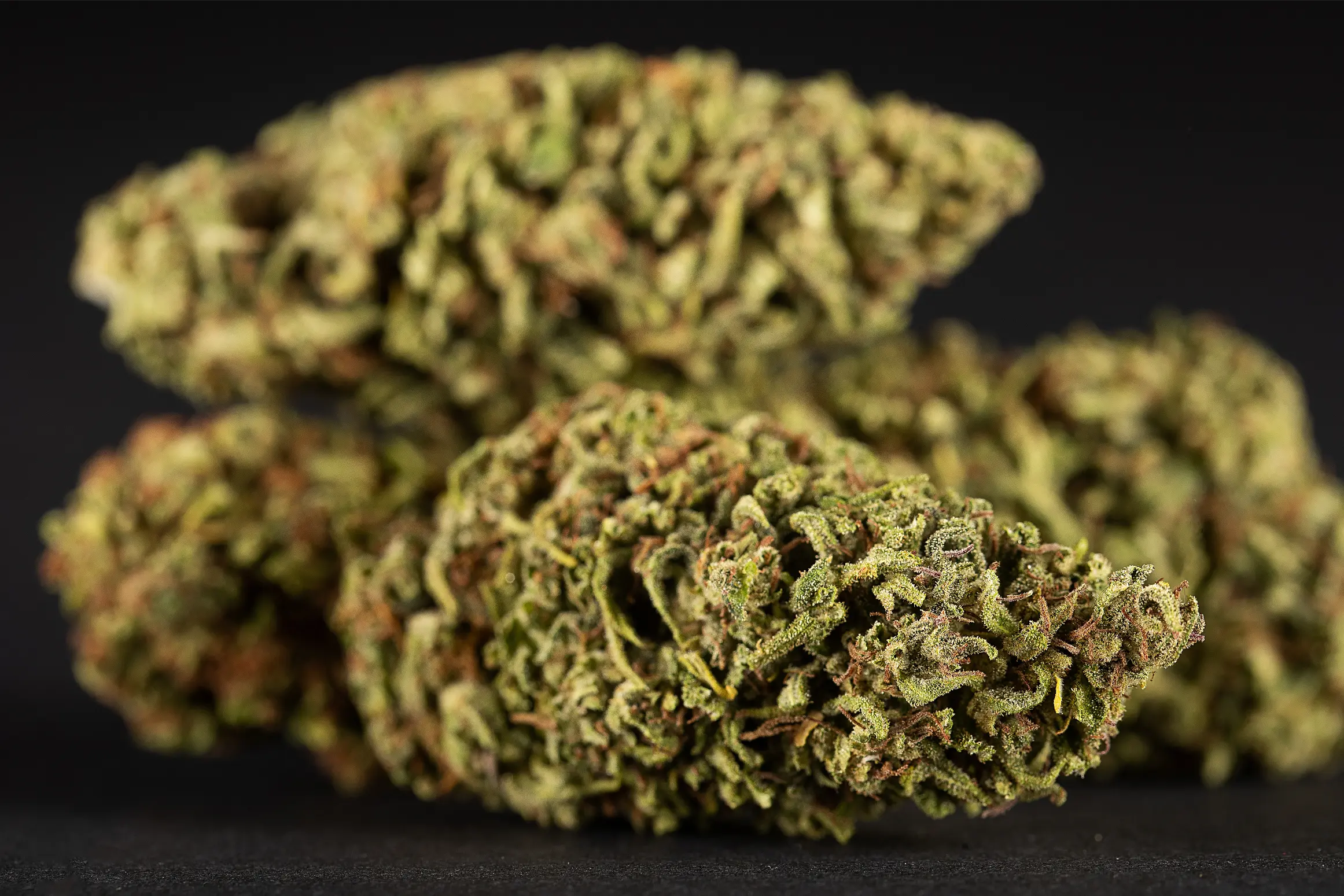
Gonzo 1
A compact indica-dominant hybrid with Skunk and William’s Wonder heritage, phenotype-driven rose or pungent aromas, and a heavy stone supported by a brief euphoric lift.
Gonzo #1 was built around an old-school request: a compact, powerful, skunky indica with enough sativa influence to keep the effect from becoming completely flat. The commonly reported cross joins a Skunk #1 and Basic 5 hybrid with William’s Wonder. The result usually finishes around 1.2 to 1.3 meters, carries thick broad leaves, resists mites better than many cultivars, and works in either Sea of Green or a multi-branch format.
The cultivar’s most important feature is phenotype variation. One plant may be sharply skunky and narcotic. Another may smell sweeter, floral, or rose-like and produce a more euphoric opening. These differences matter more than small changes in height. A grower who keeps every plant mixed together loses the opportunity to understand which expression actually performs best after cure.
Gonzo #1 is structurally easier than a long Haze, but it is not a careless grow. Dense indica-style flowers, strong late weight, and a long enough eight-and-a-half to ten-week flowering period create humidity and support requirements. Its mite resistance can reduce damage, yet resistance should never be used as a substitute for prevention. The best result is compact, clean, strongly aromatic flower with a heavy body effect and enough mental lift to feel adventurous rather than dull.
Legal note: Educational content only. Always follow the cultivation and cannabis laws that apply in your location.
Strain Features
| Feature | Details |
|---|---|
| Strain Type | Mostly indica hybrid with a small but noticeable sativa influence. |
| Commonly Reported Lineage | Skunk #1-Basic 5 hybrid x William’s Wonder. |
| THC and CBD | THC-dominant with low CBD in most reports; exact figures are not consistently documented. |
| Flowering Time | Approximately 8.5-10 weeks indoors. |
| Indoor Height | Compact to medium, commonly around 1.2-1.3 m at finish. |
| Outdoor Height | Medium and broad with greater branching and weight under full sun. |
| Yield Style | High potential in SOG or multi-branch systems; historical claims can be optimistic and should not be treated as guarantees. |
| Bud Structure | Dense indica-style flowers on a classic broad-leaf frame. |
| Aroma | Skunk, earth, hash, sweet flowers, rose, spice, and occasional fruit. |
| Flavor | Pungent Skunk and hash or a sweeter rose-herb profile, depending on phenotype. |
| Dominant Terpene Direction | Likely myrcene, caryophyllene, limonene, pinene, and floral minor terpenes, with major variation. |
| Grow Difficulty | Moderate and adaptable. |
| Best Training | SOG with a central cola or one early top followed by open multi-branch training. |
| Main Risks | Dense canopy, heavy colas, overwatering compact plants, and assuming mite resistance equals immunity. |
| Medical Interest | Reported for pain, stress, appetite, and sleep; euphoric phenotypes may feel less immediately sedating. |
| Best Time of Use | Evening or nighttime, especially at moderate-to-high doses. |
The name is sometimes confused with Dr. Gonzo and other unrelated Gonzo cultivars. Gonzo #1 refers to the old Skunk-Basic 5 and William’s Wonder hybrid described here.
Genetic Lineage
Skunk #1 and Basic 5 hybrid contribution
This side supplies vigor, pungency, reliable flowering, and a classic commercial frame. Skunk influence can create strong odor, broad adaptation, and a rapid shift from vegetative growth to flower formation. Basic 5 is associated with stable northern-adapted Afghani-type traits and a heavy physical effect.
William’s Wonder contribution
William’s Wonder contributes dense resinous flowers, compact indica structure, lemon-spice sweetness, and a long-lasting narcotic finish. It can also explain why some Gonzo #1 plants feel heavier than their skunky aroma suggests.
Two important phenotype directions
The pungent phenotype leans toward Skunk, earth, hash, and a direct heavy stone. The sweeter phenotype may show rose, flowers, fruit, or sweet herbs and a more euphoric emotional opening. Both can be authentic. Keeper selection should be based on the intended effect and the flavor that survives cure.
Why the cross is still variable
The reported parents contain complex hybrid backgrounds. Variation is therefore expected. Uniform height does not guarantee uniform chemistry. Label every plant and compare after a full cure.
Keeper rule: Do not choose Gonzo #1 from stem smell alone. The best rose or skunk expression is the one that remains clear after drying and produces clean dense flower.
Effect Breakdown
Opening phase: brief euphoric release
The first stage can feel lighter than the plant’s indica appearance suggests. Mood rises, tension decreases, and conversation or music may feel more engaging. Sweet floral phenotypes often emphasize this opening.
Middle phase: heavy body pressure
The physical effect soon becomes dominant. Limbs feel heavier, movement slows, and the user may prefer sitting or reclining. Pungent Skunk phenotypes can move into this stage more quickly.
Late phase: narcotic and long lasting
At a substantial dose, Gonzo #1 can become strongly sedating. Appetite, reduced motivation, and sleepiness are common descriptions. The mental tone often remains positive, which prevents the experience from feeling purely dull.
Unwanted effects
Dry mouth, dry eyes, dizziness, short-term memory impairment, and anxiety are possible. The heavy effect can surprise users who focus on the early euphoria. Avoid driving or complex tasks.
Timing advice: Gonzo #1 is an evening cultivar. Plan the session before the body phase arrives.
Flavor & Aroma Profile
Pungent phenotype
The pungent direction smells of Skunk, earth, hash, pepper, and warm resin. A small sweet or lemon edge may appear after grinding. The exhale is thick and old-school.
Rose and sweet phenotype
The floral direction can resemble rose bush, sweet herbs, soft fruit, and spice. It remains grounded by earth and hash, so the aroma does not become perfume-like in a superficial way.
How cure changes the balance
Freshly dried flower may smell mostly earthy. The rose or Skunk distinction becomes clearer after several weeks. Over-drying destroys the floral top notes first and leaves both phenotypes tasting similar.
Smoke density
Dense resinous flower can produce expansive smoke. A clean cure improves smoothness, but large inhalations may still feel heavy. Moderate-temperature vapor reveals more flowers, lemon, and sweetness.
Dominant Terpenes
Myrcene
Myrcene supports earth, ripe herbs, and the heavy body phase. It is likely more obvious in narcotic phenotypes.
Beta-caryophyllene
Caryophyllene adds pepper and warm spice. It connects the Skunk pungency with the hash-like finish.
Limonene
Limonene can provide lemon peel and a brighter emotional opening, especially in William’s Wonder-leaning plants.
Pinene
Pinene adds fresh resin and wood, preventing the earth profile from becoming flat.
Linalool and floral minor compounds
Rose-like phenotypes may contain more linalool or related floral volatiles. The exact chemistry should be verified with testing rather than inferred from aroma alone.
Phenotype note: A skunky plant and a rose-sweet plant may have meaningfully different terpene profiles under the same name.
Indoor vs. Outdoor Growing
| Aspect | Indoor Cultivation | Outdoor Cultivation |
|---|---|---|
| Height | Compact to medium; easy to contain. | Medium and broader with stronger side development. |
| Flowering | About 8.5-10 weeks. | Autumn finish depending on latitude and phenotype. |
| Best System | SOG or open multi-branch canopy in soil, coco, or hydro. | Large container or ground with support and dry late weather. |
| Main Risk | Crowded broad leaves, wet root zones, and touching dense colas. | Rain, caterpillars, branch leverage, and odor visibility. |
| Pest Response | Often mite-resistant, but still requires inspection. | Useful resilience, though outdoor pest diversity is wider. |
| Yield Pattern | High potential from compact plants when light reaches all selected sites. | Large per-plant potential with full sun and a long vegetative season. |
| Flavor | Controlled cure preserves rose or Skunk identity. | Sun can deepen hash and floral notes, but heat can remove sweetness. |
| Difficulty | Moderate. | Moderate in a dry finish; advanced in humid regions. |
Indoor plant count should be chosen according to the final branch strategy. A crowded group of broad-leaf plants can create a sealed canopy before the stretch is complete.
Outdoors, the plant’s compact height can still hide significant weight. Support the broad branch structure before autumn storms.
Strain-Specific Grow Guidance
Identify the phenotype before committing to structure
Stem rub and early architecture can provide clues, but do not remove cuttings or change the whole plan based on one smell. Observe internodes, branch strength, leaf width, and flowering aroma together.
Use SOG for the most compact plants
Plants with strong central dominance can be flowered after a short vegetative period. Remove weak lower branches and keep enough spacing that mature colas do not touch.
Use one early top for broad phenotypes
Plants with active side branching respond well to one early top and outward low-stress training. Preserve four to eight strong leaders and keep the center open.
Control broad-leaf canopy density
Large leaves can overlap and hold humidity. Remove leaves only where they repeatedly block airflow or rest against flower. Excess defoliation slows a compact plant and reduces its photosynthetic reserve.
Match irrigation to compact root demand
Short plants in large containers are easy to overwater. Track weight and dryback. Do not irrigate on the same schedule as a tall sativa in the same room.
Feed moderately until the phenotype proves capacity
Gonzo #1 can use a solid nutrient program, but dark broad leaves hide early nitrogen excess. Increase gradually and stop when tips or clawing indicate saturation.
Treat mite resistance as a management advantage
Resistance can slow population growth or reduce damage, but mites can still survive on the plant and spread to neighboring cultivars. Continue leaf inspections and maintain sanitation.
Install support before dense flowers lean
Compact height does not eliminate leverage. Heavy side colas can pull branches outward. Use a net, cage, or soft ties before the final weeks.
Separate touching flowers
As colas swell, maintain visible air gaps. Two dense buds pressed together create a humid contact zone that cannot be corrected by a fan across the room.
Harvest by phenotype and intended effect
The floral phenotype may be best at mostly cloudy trichomes to preserve euphoria and rose notes. The pungent phenotype can tolerate a measured amber percentage for a deeper stone. Do not wait until every plant reaches the same visual color.
The costly mistake to avoid with Gonzo 1
Compact does not mean low-maintenance. Gonzo #1 concentrates a large amount of flower and leaf into a small volume.
A Structured Phenotype-Hunt Protocol
Begin by giving every seed plant a permanent code. Record germination speed, early vigor, leaf width, internode length, and branching angle. Gonzo #1 can look uniform from a distance while carrying meaningful chemical differences. A code prevents the grower from replacing observation with memory.
Take preservation cuttings before flowering where legal and practical. Rooting performance is part of the evaluation. A spectacular plant that clones poorly may still be worth keeping, but the management cost should be known before the original is harvested.
During early flower, rub only a small lower stem and record the aroma without damaging the developing flowers. Pungent plants may show Skunk, onion-like sharpness, earth, or hash. Sweet plants may show rose, herbs, lemon, or soft fruit. Do not rank them yet.
During late flower, add resin distribution, cola density, branch support, water-use slowdown, and resistance to local pests or mildew. A plant with the best smell but weak internal flower health is not a strong keeper for repeated production.
After harvest, dry every plant separately under the same conditions. Compare at two, four, and eight weeks of cure. The rose phenotype may become clearer with time, while a pungent phenotype may deepen into hash and spice. The final decision should include premium yield, flavor stability, effect, and cultivation effort.
Routing Each Plant Into SOG or Multi-Branch Production
A central-dominant plant has short side branches and a strong vertical leader. It suits SOG after a short vegetative period. Remove low shoots, retain a clean column, and space plants according to the mature cola diameter. This route emphasizes speed and uniformity.
A broad plant develops vigorous laterals early. It suits one top and a four-to-eight-arm structure. Pull the arms outward, preserve the open center, and use one or two support layers. This route uses more vegetative time but produces several safer medium colas.
A mixed room can use both systems only if each plant retains adequate space. Do not place a broad phenotype between tightly spaced central-cola plants. Its laterals will invade neighboring zones and create a sealed canopy.
The branch route should remain stable after stretch. Late topping or repeated supercropping delays a compact plant and can create uneven maturity. Structural decisions belong in vegetative growth and the first flowering weeks.
Evaluate the two routes by usable dry flower, not by the number of tops. SOG may produce fewer but more uniform flowers. Multi-branch plants may produce more premium sites and less internal moisture. The better method depends on the phenotype and the room.
Mite Resistance and Whole-Room Pest Management
A resistant plant may slow mite reproduction, tolerate feeding, or show less visible damage. It can still carry eggs and adults. If Gonzo #1 shares a room with susceptible cultivars, the susceptible plants can maintain the population and reinfest the entire space.
Inspect the underside of leaves with magnification, especially near intake points and dry warm corners. Record pest pressure by plant code. A phenotype that remains clean under the same exposure has useful value, but one observation is not enough to establish genetic resistance.
Avoid using resistance as permission for late pesticide application. The best strategy is exclusion, sanitation, quarantine, beneficial organisms where appropriate, and early targeted response before flowers become resinous.
Finishing a Heavy Indica Without Flattening the Aroma
Late in flower, Gonzo #1 can remain dark and apparently hungry even as nitrogen demand falls. Watch tip condition, leaf posture, and dryback. Continued heavy feeding may increase leaf around the buds and create a harsh mineral finish.
The pungent phenotype often tolerates a slightly later harvest because earth, hash, and Skunk remain stable. The rose phenotype benefits from a more careful window. Too much amber and warm drying can remove flowers and leave only generic earth.
Dense plants should not be subjected to severe drought in an attempt to increase resin. A large dryback followed by heavy irrigation can split stress-sensitive roots and raise humidity. Use a controlled taper based on actual water use.
Harvest branches by phenotype and maturity. A mixed seed crop may not finish on one day. Removing mature plants or branches creates more space and airflow for the remaining flowers.
Curing Pungent and Floral Expressions
The pungent phenotype often smells strongest immediately after drying, then becomes smoother and more hash-like. The floral phenotype may seem quiet at first and develop rose, sweet herbs, and lemon after several weeks. Equal curing time does not produce equal aroma development.
Use separate containers, stable internal humidity, and a cool dark storage area. Open jars only as needed for moisture management. Constant smelling during the first week repeatedly removes the most delicate volatiles.
At four weeks, compare the clean aroma from an untouched bud with the aroma released after grinding. At eight weeks, compare smoothness and effect duration. The keeper should remain distinctive in both tests.
If the goal includes resin processing, preserve a small flower sample before converting the remainder. Concentrate yield should not erase the opportunity to evaluate smoke or vapor quality.
Weedth Bud Flavor Tips
Protect rose volatiles from heat
Floral top notes disappear quickly during warm drying. Keep the room cool and use indirect air movement.
Do not mix phenotypes at harvest
The rose and Skunk directions deserve separate drying and curing. Mixing them prevents accurate evaluation.
Allow a full cure before judging pungency
Fresh earth can dominate both phenotypes. Four to six weeks reveals whether the aroma becomes floral, lemon-spiced, or deeply skunky.
Trim without polishing away the resin
Remove leaf that harms appearance or burn quality, but avoid excessive handling. Resin-coated trim can be preserved for legal processing.
Store the floral phenotype in smaller containers
Repeated oxygen exposure removes delicate rose and sweet notes. Divide the harvest and keep the main supply sealed.
Weedth Bud Boost Tips
Use phenotype-specific plant density
Central-cola plants can be spaced more closely than broad multi-branch phenotypes, but mature flower diameter remains the limiting factor.
Build premium sites before flower
Remove weak interior shoots early. Compact plants have limited vertical space for lower flowers to escape shade.
Maintain strong root oxygen
Dense top growth demands healthy roots. Use aerated media, correct irrigation frequency, and avoid standing runoff.
Use light uniformly across the compact canopy
A short plant can tolerate strong light when acclimated, but hotspots still bleach top flowers. Uniformity supports consistent density.
Outdoor: widen the plant early
One early top and a cage distribute the crop across several supported arms, reducing the risk of one heavy central break.
Select the keeper for effect and clean yield
The highest weight is not enough. Compare mold resistance, trim ratio, cured flavor, and whether the final effect matches the intended evening use.
Medical Uses & Benefits
Gonzo #1 is usually discussed as a heavy evening cultivar for physical discomfort, stress, appetite, and sleep. The evidence is based on consumer and grower experience rather than clinical trials on a standardized product.
| Reported Use | Potential Fit and Limitation |
|---|---|
| Pain | The heavy body phase may make chronic discomfort less dominant. |
| Stress | The euphoric opening followed by relaxation can reduce tension. |
| Sleep | Later phases are often sedating, especially at higher doses. |
| Appetite | Hunger is a common late effect. |
| Muscle Tension | Physical heaviness may soften tightness and restlessness. |
| Anxiety | Some users feel calm; high THC and strong body sensations can unsettle sensitive users. |
Medical caution: The cultivar can impair balance, attention, and memory. Begin with a low dose and seek clinical guidance for medical use.
Ideal User Profile
Gonzo #1 fits evening users who enjoy old-school Skunk, hash, flowers, and a body-heavy finish. It fits growers who want compact plants and meaningful phenotype selection without a very long flowering cycle.
- Best timing: evening and nighttime.
- Best activities: music, films, food, relaxed conversation, and rest.
- Grower fit: intermediate cultivators with good airflow and labeling habits.
- Poor fit: daytime productivity, low-tolerance users, or humid crowded rooms.
- Special appeal: skunk-versus-rose phenotype hunting and a positive narcotic effect.
Common Gonzo #1 Misreads
Broad dark leaves are mistaken for perfect nutrition: compact indica leaves can remain dark even when nitrogen is excessive. Look at clawing, tip burn, slowed dryback, and excessive leaf around the flowers.
Mite resistance is mistaken for a clean room: a resistant plant may show little damage while carrying a population. Inspect magnified leaf undersides and neighboring cultivars.
Rose aroma is mistaken for weak pungency: the floral phenotype is a legitimate expression. Its value becomes clear after cure, especially when the effect retains euphoria before the heavy body phase.
Compact height is mistaken for low yield: short plants can carry substantial dense biomass. Root health, light distribution, and premium-site selection matter more than final height.
A heavy effect is mistaken for full maturity: dose and phenotype can create sedation even from slightly early flower. Harvest decisions still require calyx and trichome assessment.
Historical yield claims are treated as normal targets: exceptional reports often reflect selected clones and optimized rooms. Plan around clean dry premium yield, not an inherited grams-per-watt promise.
Outdoor Structure and Weather Management
Outdoors, top the plant early enough that four to eight arms become woody before flowering. A wide cage distributes weight and keeps the center accessible. Compact genetics can still create a dense interior when allowed to grow as an untouched shrub.
Use a site with morning sun and moving air. Broad leaves and dense flowers hold dew longer than narrow sativas. Remove interior shoots that never receive direct light and inspect after every prolonged rain.
A rain cover should remain open on the sides. Fully enclosing a broad plant traps transpiration and can create higher humidity than brief rain. Keep the cover high enough that branches do not touch wet material.
As harvest approaches, compare phenotypes. A floral plant may finish slightly differently from a pungent plant. Harvest them separately rather than exposing a ready plant to unnecessary wet weather.
Dose and Effect Calibration
The early euphoric phase can encourage a second inhalation before the body effect arrives. New users should take one small dose and wait. Experienced users should still calibrate a new phenotype because the pungent and rose expressions may peak differently.
Mostly cloudy harvests tend to preserve more emotional lift and clearer conversation. Additional amber deepens relaxation and sleepiness. Neither window is universally better; the correct choice depends on intended use.
Because the cultivar can impair short-term memory and coordination, prepare food, water, and the evening setting before use. The best experience comes when no demanding task remains.
Premium Yield Accounting
Separate dry flower into premium tops, acceptable smaller flower, and processing material where lawful. Record the clean weights by phenotype. A plant with a high total yield can rank poorly if much of the crop is shaded or difficult to trim.
Add labor and risk to the evaluation. A plant that requires constant support, develops internal moisture, or clones poorly may be less valuable than a slightly lighter plant that finishes uniformly.
Finally, compare the cured effect and flavor against the cultivation cost. Gonzo #1 is worth preserving when the plant delivers a distinct Skunk or rose profile and the positive opening remains present beneath the body stone.
Grower Notes and Feedback
The rose phenotype is often the surprise. A plant that appears like a conventional indica can develop a soft floral sweetness and more euphoric effect. It should not be discarded because it is less pungent in early flower.
Mite resistance can be real enough to notice, but neighboring susceptible plants may still support a population. The entire room needs one pest plan.
Compact height makes the plant easy to light, yet broad leaves can close the center quickly. Light defoliation and branch spacing are more useful than repeated topping.
Historical yield claims may reflect exceptional rooms. Growers should plan around realistic premium yield and clean dry flower rather than assuming multiple grams per watt.
The heavy late effect becomes clearer after cure. Fresh flower may feel more euphoric and less settled than the same batch after several weeks.
Selection advice: Keep the skunky and floral phenotypes until both have completed cure. The quieter plant may be the more interesting keeper.
Final Gonzo #1 Selection Checklist
Confirm the plant code, phenotype direction, training route, and dry premium yield. A keeper record should identify whether the plant was central-cola or broad, pungent or floral, and how much support it required.
Inspect the cured aroma at more than one time point. The pungent phenotype should gain depth rather than becoming harsh. The floral phenotype should retain rose or sweet herbs rather than fading into generic earth.
Compare the opening and late effect. The cultivar is most distinctive when euphoria remains visible before the narcotic body phase. A plant that produces only sedation may be effective, but it does not show the full Gonzo #1 balance.
Review pest observations carefully. A plant that stayed clean in one low-pressure room is not proven mite-resistant. Repeated performance and comparison with neighboring cultivars provide stronger evidence.
Review the crop’s internal moisture history. Any phenotype that repeatedly creates brown cores or touching colas should be retrained or removed from the production plan, regardless of raw weight.
Keep only the number of mothers or future selections that can be maintained cleanly. Preserving every interesting plant without space, labeling, or health management creates confusion rather than a useful genetic library.
Weedth Editor's Note
The decision I would not postpone
I would approach Gonzo #1 as a phenotype project inside a simple grow. The structure does not need complicated training, but the plants need labels from the beginning.
For compact central-cola plants, I would use short veg and clear spacing. For broad plants, I would top once and keep the center open. I would not force every phenotype into the same system.
Mite resistance would make me grateful, not careless. I would continue inspections because a resistant plant can still carry pests into the rest of the room.
At harvest, I would separate rose-sweet and pungent Skunk flowers. The cure is where the genetic difference becomes useful. A mixed jar would erase the lesson.
The finished effect is best when the early uplift remains present before the body takes over. That balance gives the cultivar personality. Without it, the flower can become just another heavy indica.
Weedth Score
Growing Experience 8.2/10 – Compact and adaptable, with phenotype and canopy-density management required.
Bud Structure & Visual Appeal 8.6/10 – Dense classic indica flowers with good resin and manageable height.
Aroma Complexity 8.9/10 – Skunk, hash, earth, rose, sweet herbs, spice, and lemon can separate into distinct expressions.
Flavor & Smoothness 8.4/10 – Rich old-school flavor; floral phenotypes need careful drying.
Effects & High Experience 9.0/10 – Positive opening followed by a long, powerful body stone.
Overall Satisfaction & Recommendation 8.7/10 – A rewarding old-school indica hybrid for growers who preserve phenotype identity.
Editor closer: Skunk or roses on the nose, but the same deep evening weight arrives underneath.
Gonzo #1 Data That Prevents Repeated Guesswork
Measure the stretch and final width of both pungent and floral phenotypes. Their heights may be similar while their lateral space requirements differ enough to change the ideal plant density.
Record the support point at which each branch began leaning. On the next run, install the net or ties before that week rather than reacting after flowers have already touched.
Track the first mite observation across every cultivar in the room. Gonzo #1 resistance is meaningful only when compared with plants exposed to the same pressure.
Record the proportion of premium tops, smaller flower, and processing material. This separates a genuinely efficient plant from one that produces impressive total weight with excessive shaded material.
Keep effect notes at a fixed dose after four and eight weeks of cure. The preferred keeper should retain the euphoric opening and a clean body finish without developing unnecessary harshness.
Why the Floral Phenotype Deserves Equal Space
Growers searching for the loudest Skunk may remove the rose-sweet plant too early. The floral expression can provide a clearer emotional opening, smoother smoke, and a more unusual cured profile. It should be judged after equal light, equal root space, and equal cure.
The floral plant may also require slightly different harvest timing. Preserve more cloudy trichomes if the goal is euphoria and flowers. Allowing excessive amber can reduce the distinction between the two phenotype directions.
A production garden does not need to keep both forever, but the first complete comparison should be fair. Selection is meaningful only when each candidate receives conditions that allow its defining traits to appear.
Balancing Compact Plants and Air Volume
A short canopy can still overload a room with leaf and moisture. Calculate spacing by final plant width and flower mass, not by height. Adequate air volume around compact plants improves both disease control and aroma retention.
For long-term preservation, keep the selected mother compact, clean, and clearly labeled. A phenotype is not truly preserved if pest pressure, root restriction, or repeated stress changes its vigor before the next production run.
Gonzo #1 also rewards honest effect notes. Record dose, time of use, harvest maturity, and cure age. Without those details, the same flower can be described as euphoric in one session and purely sedating in another, making keeper comparisons unreliable.
The final keeper should also fit the grower’s real environment. A rose phenotype with exceptional flavor may be ideal in a cool, controlled room, while a pungent plant with stronger branch structure may be more reliable outdoors. Selection should solve practical problems as well as satisfy curiosity. The most famous phenotype is not automatically the most useful phenotype for every garden.
A final comparison should be blind where possible. Number the cured samples and evaluate aroma, flavor, smoothness, and effect without looking at plant photographs. This reduces the tendency to favor the largest, darkest, or most pungent plant before the actual user experience is considered.
The decision should remain practical. Keep the phenotype that produces clean premium flower, preserves its defining aroma, and delivers the intended evening effect without demanding corrections the room cannot repeat.
A clearly labeled, healthy, repeatable plant is more valuable than a spectacular one-off expression that cannot be reproduced cleanly.
Good records turn phenotype variation into a useful selection tool rather than confusion.
FAQ
What is Gonzo #1 crossed with?
The commonly reported lineage is a Skunk #1-Basic 5 hybrid crossed with William’s Wonder.
Is Gonzo #1 the same as Dr. Gonzo?
No. They are separate cultivar names. Gonzo #1 refers to the Skunk-Basic 5 and William’s Wonder hybrid.
How long does Gonzo #1 flower?
Expect approximately eight and a half to ten weeks indoors.
How tall does it grow?
Classic reports place the finished indoor height around four feet or 1.2 to 1.3 meters, though training and phenotype change the result.
Is it resistant to spider mites?
It has a reputation for mite resistance, not immunity. Continue inspection and integrated pest management.
What are the main phenotypes?
One direction is pungent, skunky, and more narcotic. Another is sweeter, rose-like, and slightly more euphoric.
Is SOG or SCROG better?
Central-dominant plants suit SOG. Broad branching plants suit a small open screen or multi-branch canopy.
What does Gonzo #1 taste like?
Expect Skunk, earth, hash, pepper, and resin or a sweeter rose, herb, lemon, and soft fruit profile.
When should it be harvested?
Use swollen calyxes and mostly cloudy bract trichomes. A little amber deepens the body effect, while an earlier window preserves more euphoria and flowers.
Is Gonzo #1 a daytime strain?
Usually not. The initial uplift can be social, but the body phase is commonly heavy and long lasting.
Similar Strains
- William’s Wonder: A direct parent with denser lemon-spice resin and an even heavier narcotic finish.
- Shiva Skunk: Compact, pungent, and productive with strong Skunk-Afghani body effects.
- Super Skunk: Faster and more uniform, with louder pungency and less floral phenotype variation.
- Sensi Star: Dense, powerful, and evening-focused with a sharper lemon-earth profile.
- Hash Plant: More direct hash and sedation, with a simpler compact architecture. Always.
- Romulan: Heavy physical calm with pine and earth, though often more mentally dreamy.
Share this article
A quick overview of the topics covered in this article.
Follow us
Latest articles
September 9, 2026
September 9, 2026
September 9, 2026