
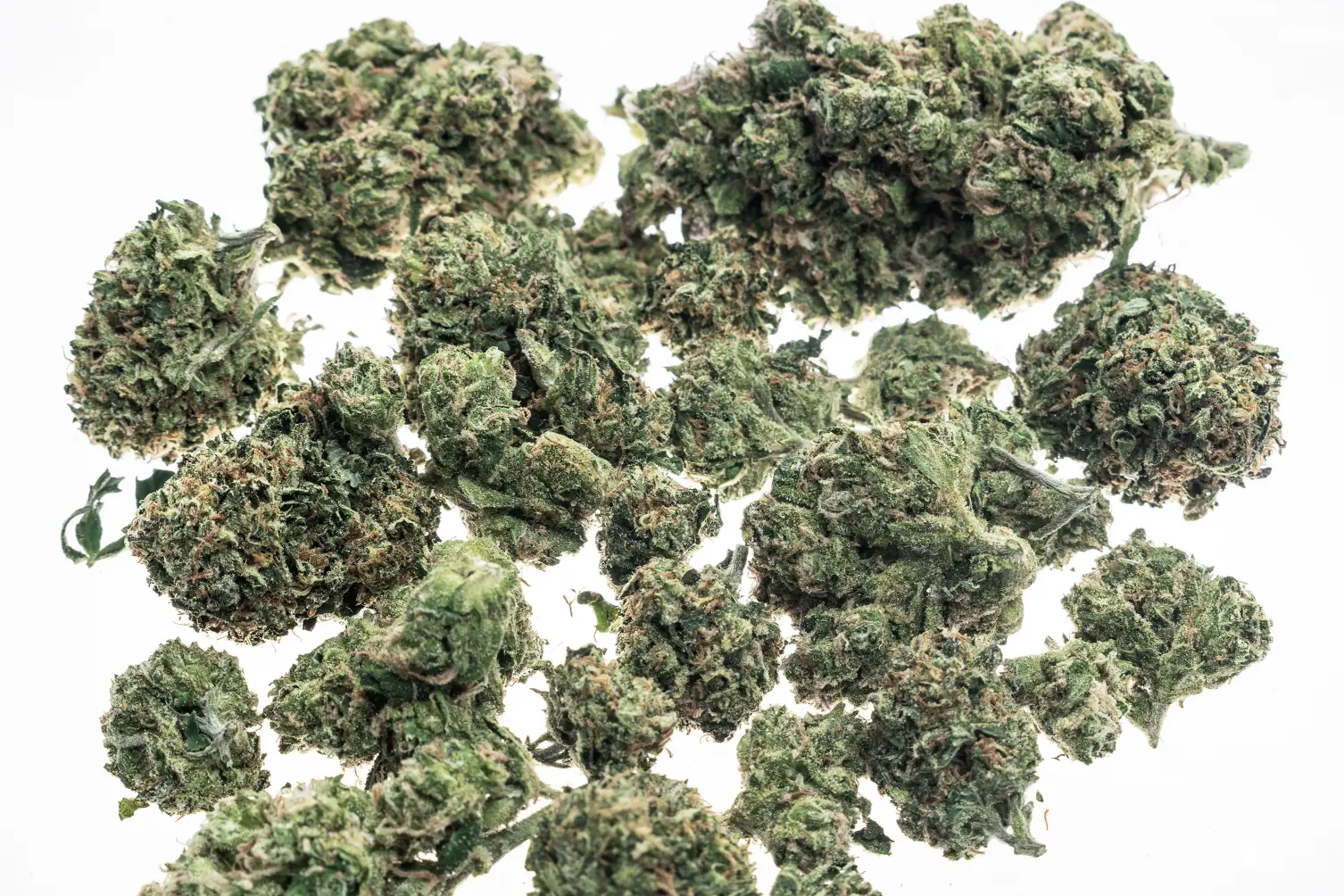
Great White Shark
A resin-heavy old-school hybrid with skunk depth, citrus-fruit lift, fast physical impact, and dense flowers that reward early canopy planning.
Great White Shark is remembered for thick trichome coverage, a penetrating skunk-and-fruit aroma, and a high that can begin bright before becoming physically heavy. The cultivar belongs to the same broad historical era as several famous resin-focused Dutch hybrids, yet it has a more aggressive body phase and a stronger skunk foundation than many balanced classics.
Its cultivation value comes from a useful combination of moderate flowering speed, solid lateral growth, and flowers that can become remarkably dense. The same density creates the central risk. A plant that looks healthy from the aisle can hold humid pockets where side branches touch the main cola or where late flower mass closes the interior canopy.
The best Great White Shark grow is not the one with the biggest single crown. It is the one that finishes with several well-supported, evenly lit colas that retain citrus, sweet fruit, earth, and skunk after drying. That requires early structure, moderate late nitrogen, careful humidity reduction, and a post-harvest process designed around resinous buds that dry more slowly inside than their surface suggests.
Strain Features
| Feature | Details |
|---|---|
| Strain Type | Indica-leaning hybrid with a fast cerebral opening and a progressively heavier body phase. |
| Commonly Reported Lineage | Historical accounts differ. It is commonly placed in the White Widow and Skunk family, while another account describes Super Skunk combined with South American and South Indian material. |
| THC Range | Often mid-to-high teens, with stronger modern samples possible. Potency varies substantially by cut and cultivation. |
| CBD | Usually low and not a defining feature. |
| Dominant Terpenes | Commonly myrcene, pinene, and beta-caryophyllene, with limonene and humulene contributing in some batches. |
| Aroma | Skunk, damp earth, citrus peel, sweet fruit, herbs, pepper, and occasional menthol or hash notes. |
| Effect Character | Fast euphoria and sociability followed by muscular relaxation, appetite, and possible couch-lock. |
| Flowering Time | Approximately 8-10 weeks indoors, depending on phenotype and the desired effect window. |
| Outdoor Harvest | Usually early-to-mid autumn in dry, temperate or Mediterranean-style climates. |
| Height | Medium; can become broad when topped and allowed lateral development. |
| Stretch | Moderate, usually strongest during the first two weeks of flower. |
| Yield | Moderate to high when the canopy is level and lower growth is removed. |
| Bud Structure | Dense, rounded-to-conical flowers with heavy trichome coverage and orange-brown pistils. |
| Training Response | Topping, LST, compact SCROG, and carefully spaced SOG all work when airflow is preserved. |
| Main Cultivation Risk | Interior humidity around dense flower clusters and branch junctions. |
| Grow Difficulty | Moderate. Structurally forgiving, but late-flower moisture and odor require attention. |
| Best Time of Use | Afternoon to evening; higher doses are better reserved for nighttime. |
The headline figures should be read as planning ranges rather than promises. Great White Shark has circulated through different cuts and reproductions, and the name can cover plants that lean more toward skunk, resin-heavy White-family traits, or landrace-derived fruit and spice.
The most useful identifying combination is not a single THC number. It is the relationship between vigorous lateral branching, dense white-frosted flowers, pungent skunk-citrus aroma, and a high that becomes heavier as it develops.
Genetic Lineage
Why the published lineage is not completely uniform
Great White Shark has more than one long-standing lineage description. One widely repeated version connects it directly to White Widow and Skunk #1. Another describes Super Skunk blended with South American and South Indian sativa material. These accounts are not fully interchangeable, but they point toward the same practical family: resin-heavy tropical and South Asian ancestry anchored by a strong Skunk structure.
For growers, the dispute matters because different material sold under the same name can express different stretch, flower density, and aroma. A White-family expression may be shorter, frostier, and more physically calming. A plant carrying more obvious tropical or sativa influence may stretch farther, produce a sharper citrus-fruit nose, and remain mentally active for longer.
The White-family contribution
The White-family side explains the pale resin blanket, the ability to form large glandular calyxes, and the strong transition from an alert head high into body relaxation. It also contributes to the cultivar’s reputation for broad adaptability. Plants often recover well from topping and moderate bending, provided the root zone remains healthy.
This side of the family can also create deceptively mature-looking flowers. Trichomes appear early and pistils may darken while the calyxes are still expanding. Harvest decisions should therefore rely on calyx swelling and gland maturity rather than frost alone.
The Skunk contribution
Skunk influence is visible in rapid vegetative growth, strong odor, thick branch development, and the tendency to form heavy flowers along a central framework. Skunk-leaning plants may accept a little more nutrition and produce larger colas, but they can also become leafy if nitrogen remains high after stretch.
The aromatic effect is equally important. Skunk supplies the fermented, animal, earth, and sharp herbal base that keeps the fruit from becoming candy-like. In a good cure, the profile feels layered rather than simply sweet.
South American and South Indian influence
Where the landrace-based account is expressed, South American material may contribute a brighter emotional lift, more open internodes, and citrus or tropical fruit. South Indian ancestry can support resin, spice, warm wood, and a slowly building physical effect. These traits explain why some examples feel functional at first while others move rapidly toward heaviness.
Lineage note: Treat the published pedigree as a map, not a guarantee. Keeper selection should be based on cured aroma, flower integrity, and effect progression, not on whether a young plant looks more indica or more sativa.
Effect Breakdown
Opening phase: fast social lift
The first stage often arrives quickly. Mood rises, conversation feels easier, and sensory details become more engaging. A small dose can feel confident and sociable rather than nervous. Music, food, and casual creative work may become more interesting without an immediate loss of structure.
This opening should not be mistaken for a purely daytime effect. Great White Shark can feel lighter than expected for the first ten to twenty minutes, which encourages some users to consume again before the body phase has developed.
Middle phase: the body catches up
As the session settles, muscular tension decreases and movement becomes slower. The shoulders and legs often feel warmer or heavier. Appetite may rise. The mind can remain positive and conversational, but the desire to complete demanding work usually falls.
At moderate doses, the balance can be pleasant for an unstructured evening. At higher doses, the body phase becomes dominant and the earlier social energy is replaced by stillness, deep comfort, and reduced coordination.
Late phase: sedation depends on dose and harvest
Flowers harvested at mostly cloudy trichomes often preserve a clearer mental ending. A later harvest with more amber can deepen the heavy finish. Individual tolerance matters just as much. New users may find a normal serving surprisingly sedating, while experienced consumers may experience a long calm plateau.
Common unwanted effects
Dry mouth and dry eyes are common. Very large doses can create dizziness, short-term confusion, or an uncomfortable sense of heaviness. A person who is sensitive to THC can still experience anxiety during the fast opening, especially if the environment is noisy or unfamiliar.
| Dose or Stage | Typical Experience | Main Caution |
|---|---|---|
| Light dose | Mood lift, conversation, sensory brightness, mild body ease. | The body effect may continue building for twenty to forty minutes. |
| Moderate dose | Euphoria, appetite, muscular relaxation, slower pacing. | Not ideal for driving, detailed work, or unfamiliar social situations. |
| Heavy dose | Strong body stone, couch-lock, sleepiness, time distortion. | Dizziness and mental fog become more likely. |
| Late comedown | Quiet mood, hunger, physical softness, possible sleep. | Some users feel residual heaviness the next morning. |
Use timing: Because the effect can build in layers, wait before redosing. The first bright minutes do not show the full strength of the body phase.
Flavor & Aroma Profile
Living plant aroma
During early flower, the plant may smell herbal, green, and mildly skunky. The aroma becomes more complex as the calyxes swell. Citrus peel, sweet fruit, pepper, and damp soil begin to separate from the heavier skunk note. By late flower, touching a support stake or leaf stem can release a persistent odor that carries beyond the grow space.
A fruit-forward phenotype may resemble grapefruit, overripe pear, or mixed tropical peel. A heavier phenotype can smell of wet earth, hash, musk, and old wood with only a narrow citrus top note.
Jar aroma after cure
A well-cured jar should open with pungent skunk and earth, followed by citrus and sweet fruit. The aroma is rarely delicate. It should have enough sharpness to feel fresh and enough bass to feel resinous. If the jar smells mostly like hay, the flowers were probably dried too quickly, sealed too early, or harvested before aromatic maturity.
Inhale, exhale, and aftertaste
The inhale often carries sweet citrus, herbs, and a soft fruit note. The exhale is heavier, bringing earth, pepper, skunk, and sometimes menthol or hash. Good flower leaves a slightly sweet, resinous coating on the palate rather than a purely acrid finish.
A harsh example may have been overfed, dried warm, or stored before internal moisture stabilized. Great White Shark produces enough resin to create thick smoke, so smoothness depends heavily on post-harvest handling.
Phenotype differences that matter
The fruit-forward expression is usually more aromatic and mentally bright. The skunk-heavy expression often produces a denser body effect and may carry larger flowers. A balanced keeper preserves citrus or sweet fruit through the exhale while maintaining enough skunk and earth to remain recognizable.
Quality target: The flavor target is fruit and citrus carried by skunk and earth, not sweetness hiding a green or chemical finish.
Dominant Terpenes
Myrcene
Myrcene commonly supports the musky earth, ripe fruit, and body relaxation. In fruit-forward flower it may read as overripe mango or fermented citrus. In darker phenotypes it feels more like damp soil and resin. Myrcene cannot predict the entire high, but it fits the cultivar’s gradual shift toward physical heaviness.
Pinene
Pinene contributes fresh wood, pine needle, and a cleaner edge behind the skunk. It may help the aroma feel more open and can be especially noticeable in vapor at lower temperatures. Pinene-rich examples often seem mentally clearer during the first stage.
Beta-caryophyllene
Beta-caryophyllene adds black pepper, dry spice, and some of the warm hash character. It is unusual among common terpenes because it can interact with CB2 receptors in laboratory settings. That does not make the flower a standardized medicine, but it helps explain why peppery cultivars are frequently described as physically grounding.
Limonene
Limonene supplies lemon rind, grapefruit, and bright fruit. It is one of the first aromatic layers to fade when flowers are dried too warm or repeatedly exposed to air. Preserving limonene is central to keeping Great White Shark from becoming a generic earthy-skunk jar.
Humulene and minor sulfurous compounds
Humulene can add dry wood, hops, and bitterness. Minor sulfur-containing volatiles may contribute to the penetrating skunk side even when present at low concentrations. These compounds help explain why odor strength can be much greater than the total terpene percentage suggests.
Chemotype note: Cultivar names do not guarantee one chemotype. Compare actual aroma, laboratory data where available, and cured performance rather than assuming every sample has the same dominant terpene.
Indoor vs. Outdoor Growing
| Factor | Indoor Cultivation | Outdoor Cultivation |
|---|---|---|
| Plant control | Moderate height is easy to shape under a net. | Longer veg creates a broad, heavy bush that needs support. |
| Best structure | Several medium colas with an open center. | Wide framework with separated branches and morning sun. |
| Flower density | High, especially under strong top light. | Can become very dense in full sun and large root volume. |
| Main risk | Night humidity and hidden moisture at branch junctions. | Rain, dew, caterpillar damage, and late-season rot. |
| Odor | Strong filtration is usually necessary. | Odor travels far and can attract unwanted attention. |
| Flavor potential | Precise harvest and drying preserve citrus. | Sun and soil can deepen fruit, earth, and spice. |
| Difficulty | Moderate. | Moderate in a dry climate; difficult in wet autumn regions. |
Indoor advantages
Indoor growing makes it easier to control the cultivar’s two decisive variables: canopy density and late-flower humidity. The plant can be topped once, spread into a shallow canopy, and cleaned below the productive zone. A net supports weight while keeping adjacent colas apart.
The indoor limitation is that strong light can create flowers denser than the room can safely dry. High yield is useful only when the dehumidification and airflow system can remove the water released by the crop during dark periods.
Outdoor advantages
Outdoors, Great White Shark can form a large, well-branched plant with strong individual yields. Direct sun reaches more levels of the canopy than top lighting alone. Natural air movement can also reduce surface humidity, provided the plant is not crowded by fences or other vegetation.
The outdoor risk appears near maturity. Dense flowers that survive normal summer humidity may fail after several cool wet nights. A dry autumn, morning sun, and a rain-aware harvest plan are more valuable than maximum vegetative size.
Greenhouse use
A greenhouse is helpful only when it vents. A closed structure can trap more nighttime moisture than open air. Side vents, roof vents, horizontal air movement, and adequate plant spacing are necessary. Flowers should never touch plastic walls where condensation forms.
Environment priority: Choose the environment that lets the last three weeks remain dry and stable. The cultivar is resilient in veg, but mature flower density is the limiting factor.
Strain-Specific Grow Guidance
Start with an open frame rather than a solid bush
Top once after the plant is well established and guide four to eight leaders outward. The central goal is not maximum branch count. It is enough space for light and air to pass between the future colas. Shoots that grow directly inward should be redirected or removed early.
Use the transition stretch to finish the canopy
Great White Shark generally stretches enough to fill gaps but not enough to rescue a very small plant. Enter flower with the intended footprint partly filled and continue gentle tucking through the first two weeks. Stop aggressive bending when stems harden and flower clusters become defined.
Match plant count to the chosen method
A SOG can work with uniform clones or selected plants because the cultivar forms a strong main crown. Leave sufficient spacing and remove weak lower sites. A SCROG is better when using fewer plants or variable seed expressions because it allows the grower to correct height differences.
Feed for momentum, then reduce late nitrogen
More feed is not automatically more quality
Healthy plants can accept moderate feeding during veg and early flower. The Skunk side may appear hungry during stretch. Do not continue high nitrogen simply because foliage remains green. Excess late nitrogen increases leaf mass inside the flowers and can delay aroma maturity.
Keep the root zone aerobic
Dense aboveground growth encourages frequent irrigation, but the medium still needs a real dryback. Use an aerated substrate and containers that match plant size. Repeatedly watering a heavy pot slows roots and makes the canopy more vulnerable to nutrient imbalance and humidity spikes.
Thin in stages
Remove weak interior shoots before the flip. After stretch, clean the lowest unproductive growth and selected leaves that completely block air channels. Avoid one extreme stripping event. The plant responds better when thinning is distributed across time and the productive leaves remain intact.
Support before the flowers become heavy
Install netting or stakes before late swelling. Support should hold branches in their planned position rather than pull them together. When a branch collapses onto a neighboring cola, the contact point becomes a humidity pocket.
Manage the dark period
Humidity often peaks after lights turn off as temperature falls and transpired moisture remains in the room. Dehumidification and air movement should be sized for the dark period, not only for daytime readings. Check the canopy at night at least once during peak flower.
Inspect where rot begins
Look at the stem side of the largest flowers, branch junctions, and places where a sugar leaf has died unexpectedly. A brown leaf that pulls out without resistance can indicate internal damage. Remove affected material generously and investigate the surrounding environment.
Harvest by calyx and trichome maturity
Early frost does not equal ripeness. Wait for calyxes to complete swelling and evaluate trichomes on the flower rather than the sugar leaves. Mostly cloudy heads preserve the brighter opening. More amber strengthens the physical finish but can reduce citrus sharpness.
| Flower Stage | Primary Goal | Typical Mistake |
|---|---|---|
| Transition | Spread stretch into open canopy space. | Letting every branch rise into one crowded crown. |
| Early flower | Choose productive sites and stabilize feeding. | Heavy defoliation while the plant is still building flowers. |
| Mid flower | Support branches and maintain even light. | Increasing irrigation automatically because buds are larger. |
| Late flower | Reduce humidity and inspect internal flower. | Waiting for visible mold before checking branch junctions. |
| Ripening | Preserve aroma while allowing full calyx maturity. | Harvesting because trichomes appeared early. |
Master advice: Great White Shark rewards structural restraint. Several separated colas usually produce more usable premium flower than one oversized, humid crown.
Flower-site mapping before the flip
A useful way to prevent late crowding is to map the future colas while the plant is still in vegetative growth. Look down from above and identify which branches can occupy a separate circle of light. Remove duplicate shoots that will rise into the same space. This simple visual exercise prevents the common situation where several healthy branches compete for one narrow opening in the screen.
Dark-period irrigation strategy
Avoid applying the largest irrigation immediately before lights off unless the medium and environmental system are designed for it. The plant releases moisture while room temperature falls, which raises relative humidity around the flowers. In many rooms, watering early in the light period gives the canopy time to use part of the water while ventilation and temperature are strongest.
Outdoor storm recovery
After rain, do not squeeze or repeatedly shake dense flowers. Support water-heavy branches, restore separation, and let moving air and morning sun remove surface moisture. Inspect damaged leaves and caterpillar wounds first because rot often begins around injured tissue. A clean cut that removes a questionable section is safer than waiting for a large cola to prove the problem.
How to judge the final ten days
During the final ten days, compare fresh pistil production, calyx swelling, aroma, water use, and flower trichomes. Great White Shark can continue gaining meaningful density after the surface already appears frosted. The correct finish is a plant that has completed expansion and developed a layered odor, not merely a plant that has reached a calendar date.
Weedth Bud Flavor Tips
Choose the harvest window for citrus and skunk balance
A slightly earlier mature window preserves more citrus peel and mental brightness. A later window deepens earth, pepper, and body heaviness. The best compromise is usually after full swelling with mostly cloudy flower trichomes and a limited amber percentage.
Dry according to flower density
Large crowns should be separated into branches if the drying room cannot maintain stable conditions. Smaller medium colas can remain intact. Air should circulate around the hanging material, not blow directly at it. The outside can become crisp while the center remains wet.
Let the cure reveal fruit
The first jar aroma may be dominated by skunk and fresh herbs. Citrus and sweet fruit usually become clearer after several weeks. Open containers only as needed to manage moisture. Constant inspection accelerates oxidation and removes the volatile top notes the grower is trying to preserve.
Store in working lots
Divide the harvest into several smaller airtight containers after moisture stabilizes. Keep one working jar and leave the rest closed in a cool, dark location. This protects the main batch from repeated warm air and oxygen exposure.
Do not add fruit peel to create flavor
Adding citrus peel or other fresh organic material can raise humidity unevenly and introduce microbes. It does not restore the cultivar’s original terpene balance. If flowers are too dry, use a controlled humidity method rather than food.
Flavor checkpoint: For this cultivar, the flavor sequence should remain sweet citrus on entry, skunk and earth through the middle, then peppery resin on the finish.
Weedth Bud Boost Tips
Indoor yield: improve the percentage of premium tops
The most reliable yield gain comes from canopy uniformity. Spread the leaders, remove weak growth below the useful light zone, and maintain enough distance between colas. This increases the share of the harvest that finishes dense and aromatic rather than simply increasing total wet biomass.
Use strong light only with matching environmental capacity
Higher light can increase inflorescence yield, but it also increases water use, room moisture, and flower density. Raise intensity gradually and watch leaf angle, bleaching, and irrigation demand. Additional light is valuable only when temperature, root health, and dehumidification remain controlled.
Consider inter-canopy light before keeping shaded branches
Where legal and practical, low-intensity side or inter-canopy lighting can improve lower flower consistency. It should not be used to justify an excessively deep canopy. Remove branches that remain structurally weak or shaded even after light distribution improves.
Outdoor yield: build support with the plant
Install a wide cage early and guide branches through separate openings. Add a second support layer before flowers gain weight. This distributes load and prevents storm movement from rubbing or splitting branches.
Use root volume that can actually dry
A larger container can support a larger plant, but only if the medium drains and the canopy can use the water. Oversized wet containers slow roots and reduce oxygen. Choose root volume according to season length, climate, and irrigation control rather than the biggest pot available.
Avoid unsupported potency tricks
Extreme drought, prolonged darkness, and aggressive late stress do not reliably create better resin. They can reduce aroma, increase disease risk, or interrupt maturation. Consistent light, healthy leaves, correct harvest timing, and careful drying have a stronger practical effect on final quality.
Yield principle: Measure success by dry premium flower, cured aroma, and internal cleanliness, not by the size of the wet branches on harvest day.
Medical Uses & Benefits
Great White Shark is commonly chosen by consumers seeking relief from pain, stress, appetite loss, and difficulty settling into sleep. These uses are based on reported experiences and the cultivar’s effect profile. They are not proof that one named strain treats a medical condition.
| Reported Use | Why Some Users Choose It | Main Limitation |
|---|---|---|
| Physical pain | The body phase can reduce the prominence of muscular and chronic discomfort. | Severe pain may require medical evaluation and a standardized treatment plan. |
| Stress | The fast mood lift may interrupt rumination before physical calm develops. | A large dose can create dizziness or anxiety in sensitive users. |
| Appetite loss | Hunger commonly increases during the middle and late phases. | The effect can be inconvenient for users avoiding appetite stimulation. |
| Sleep difficulty | Later relaxation and heaviness may support sleep. | The initial mental lift can delay sleep for some people. |
| Low mood | Sociability and euphoria can temporarily improve emotional tone. | Cannabis is not a substitute for professional mental-health care. |
| Muscle tension | Myrcene-rich, physically heavy samples may feel loosening. | Smoke and vapor can irritate the respiratory system. |
Because products carrying the same name can differ in THC and terpene composition, medical users should evaluate the actual batch, begin with a low dose, and avoid assuming that a previous response will repeat exactly.
Medical note: Anyone using cannabis for a medical reason should discuss risks, drug interactions, and dosing with a qualified clinician.
Ideal User Profile
Great White Shark is best suited to a user who enjoys a noticeable transition from social euphoria into physical calm. It works particularly well when the schedule allows the session to become heavier without creating a problem.
- Intermediate or experienced consumers who understand delayed body effects.
- Users who enjoy skunk, citrus, earth, spice, and old-school resin flavors.
- Afternoon or evening consumers who want appetite and relaxation.
- Growers who can manage odor, branch support, and late-flower humidity.
- Cultivators interested in selecting between fruit-forward and heavier skunk phenotypes.
It is less suitable for a person seeking a discreet low-odor garden, a completely clear morning effect, or a wet outdoor climate. New consumers should treat the fast opening carefully because the later physical strength may be much greater than the first minutes suggest.
Grower Notes and Feedback
What growers usually appreciate
Growers often praise the resin coverage, reliable flowering speed, and the way the plant accepts topping or bending. The cultivar can produce substantial flowers without a very long indoor cycle. It also offers a recognizable aroma that does not disappear into generic sweetness when cured properly.
What surprises first-time growers
The most common surprise is how quickly late flower density arrives. A canopy that seemed comfortably open in week four can become crowded by week seven. Another surprise is the amount of odor released during drying, when skunk and sweet fruit can become stronger than they were in the living room.
Phenotype differences
Fruit-forward plants may have narrower leaves, more stretch, and a brighter high. Heavy skunk plants may remain shorter and produce denser flowers with stronger body effects. Neither is automatically superior. The keeper depends on whether the priority is flavor, yield, effect, or structural reliability.
Mistakes that reduce the final jar
Overcrowding, high late nitrogen, and warm drying are the three most damaging patterns. Overcrowding creates hidden moisture. Excess nitrogen leaves more green material around the flowers. Warm drying removes the citrus and fruit before the heavier skunk base.
Trim and resin handling
Sugar leaves can carry considerable resin. Trim with clean sharp tools and avoid repeatedly squeezing the buds to test density. Keep trim destined for legal processing cold and clean. The flower should be handled by the stem whenever possible.
Grower note: Keep phenotype labels through drying and cure. The plant with the loudest living aroma is not always the plant with the best cured flavor.
Weedth Editor's Note
How I would judge the finished flower
What I like about Great White Shark is that it still feels connected to an older style of hybrid. The flower is not built around one sweet note. It has fruit, citrus, skunk, earth, pepper, and a physical effect that develops in stages.
My cultivation approach would be simple: top once, open the center, and decide early which branches deserve to become colas. I would not let the plant turn into a solid wall of foliage just because the growth looks vigorous. The late flowers need room before they look heavy.
I would also watch the night environment more closely than the daytime reading. Dense resinous buds can be dry on the surface and still hold moisture at the stem. A clean harvest depends on inspecting those hidden areas before a problem becomes visible.
For flavor, I would avoid taking it too early. The citrus becomes brighter before full maturity, but the fruit and skunk do not feel complete until the calyxes have finished swelling. I would then dry slowly enough for the center to equalize without letting the outer leaf become brittle.
I would recommend Great White Shark to an intermediate grower who wants an old-school jar with real presence. It is not fragile, but it rewards attention in the final weeks. The difference between average and excellent flower is mostly canopy spacing, humidity control, and patience after harvest.
Weedth Score
Growing Experience 8.4/10 – Vigorous, trainable, and productive, with late-flower humidity as the main challenge.
Bud Structure & Visual Appeal 9.0/10 – Dense, resin-heavy, pale-frosted flowers with classic orange-brown pistils.
Aroma Complexity 9.1/10 – Skunk, citrus, fruit, earth, pepper, pine, and hash create real depth.
Flavor & Smoothness 8.6/10 – Rich and persistent after a slow cure; warm drying makes it harsh and generic.
Effects & High Experience 8.8/10 – Fast euphoria followed by convincing body calm and appetite.
Overall Satisfaction & Recommendation 8.8/10 – A strong choice for growers who value resin, classic flavor, and a layered evening effect.
Still one of the better examples of an old-school hybrid that can feel social at first and deeply physical before the session ends.
FAQ
Is Great White Shark the same as Peacemaker or White Shark?
The names are often used for the same cultivar family, but regional labeling and different reproductions can create variation. Check lineage, flower structure, and aroma rather than relying on the name alone.
What is the accepted lineage?
The lineage is disputed. One account places it in the White Widow and Skunk #1 family. Another describes Super Skunk with South American and South Indian material. Both descriptions point toward resin, skunk vigor, and mixed tropical or South Asian influence.
How long does it flower?
Most plants finish in about eight to ten weeks indoors. A grower seeking a clearer effect may harvest toward the earlier mature window, while a heavier effect usually requires more complete amber development.
Is it suitable for beginners?
A careful beginner can succeed because the plant is vigorous and accepts training. The late-flower odor, support, and humidity management make it more demanding than the easiest compact cultivars.
Is SOG or SCROG better?
SOG works with uniform material and adequate spacing. SCROG is more flexible for seed plants or fewer larger plants because it corrects height variation and separates the branches.
Why do the buds look ready before they are mature?
Resin appears early and some pistils darken before calyx swelling is complete. Check flower trichomes, calyx growth, aroma development, and water use rather than relying on frost alone.
Why did the citrus disappear after drying?
Warm temperatures, direct fan airflow, excessive handling, and repeated jar opening remove volatile citrus compounds. A cool dark dry and stable storage preserve the top notes better.
Is it mold resistant?
The plant can be resilient, but mature flowers are dense and should not be considered mold-proof. Interior airflow and low night humidity remain necessary.
When should it be harvested for a balanced effect?
Wait for full calyx swelling and mostly cloudy trichomes with a small amber percentage. This usually preserves the bright opening while allowing the body effect to develop fully.
Similar Strains
- White Widow: Similar resin intensity and balanced head-to-body progression, with more pine and less heavy skunk.
- Super Skunk: Stronger direct skunk aroma, compact growth, and a more obviously sedating finish.
- White Rhino: Denser, more indica-oriented, and better suited to users seeking nighttime body relief.
- White Russian: Shares the frost and long effect but adds sharper sweet-spice and a stronger cerebral element.
- Shiva Skunk: A compact, productive alternative with pear, tea, skunk, and a warm body effect.
- Northern Lights: Easier, lower stretch, and less pungently fruity, with reliable evening relaxation.
Share this article
A quick overview of the topics covered in this article.
Follow us
Latest articles
September 9, 2026
September 9, 2026
September 9, 2026