
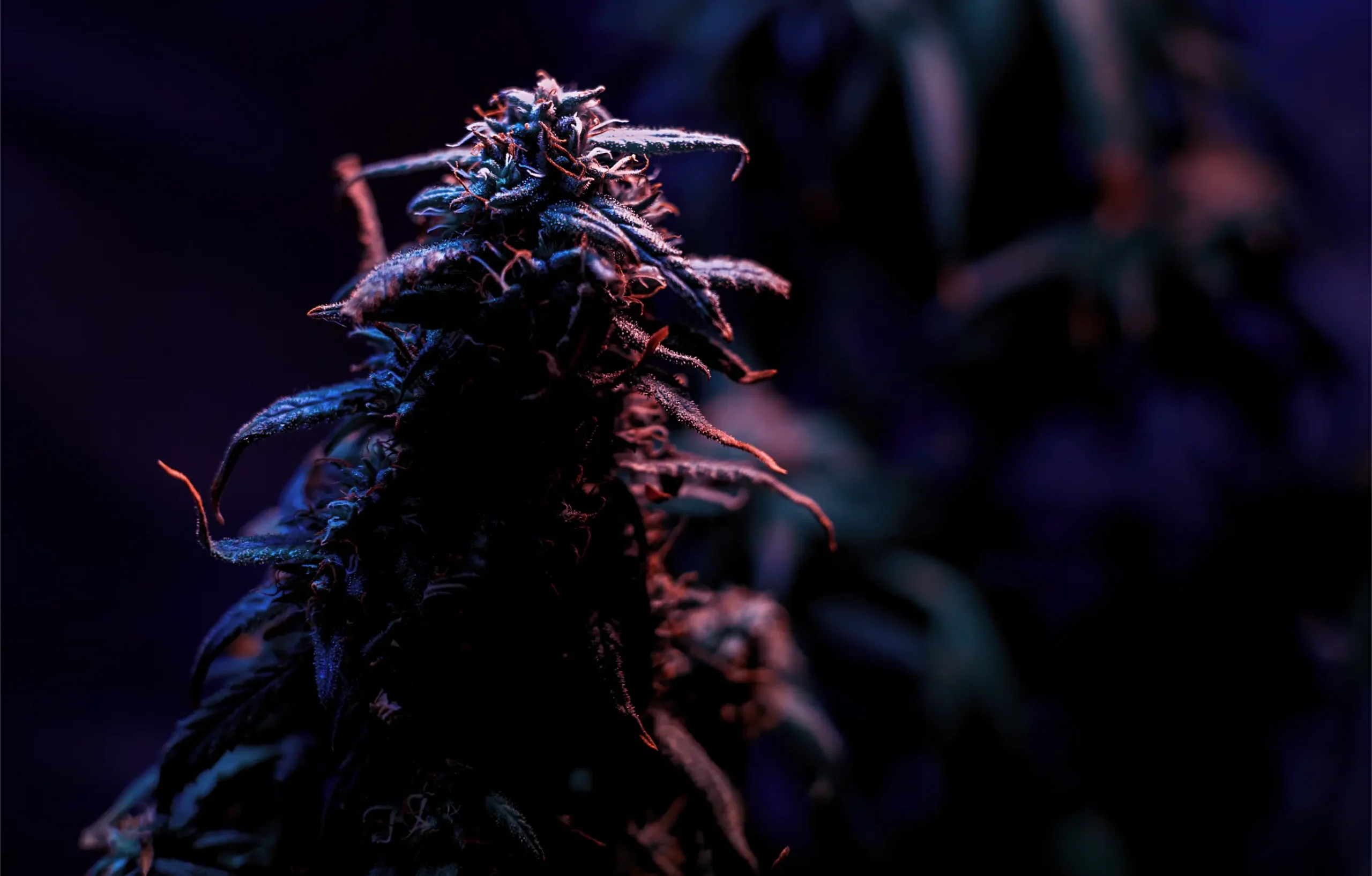
Island Sweet Skunk
Island Sweet Skunk is best understood through its lineage ambiguity and aggressive sativa stretch. It is a Vancouver Island-associated sativa hybrid valued for grapefruit-tropical sweetness, old-school skunk depth, vigorous vertical growth and unusually productive spear-like flowers that can remain relatively open despite high yield. That identity matters because a grower who treats it like a generic hybrid can still harvest respectable flower, yet miss the traits that make the cultivar worth preserving.
The central cultivation question is straightforward: How can a grower exploit Island Sweet Skunk's huge stretch and yield without letting the plant outgrow the room or collapse under its own late-flower weight? The answer influences nearly every later decision, from veg duration and branch selection to late-flower humidity, harvest timing and drying speed. The plant is not asking for exotic tricks. It is asking the grower to notice what kind of structure is actually in the room and to make fewer, better-timed interventions.
This profile treats reported potency, terpene data and yield as ranges rather than fixed promises. Cannabis names can circulate through clones, seed reproductions and mislabeled commercial material, so morphology and finished flower quality deserve as much attention as the name on a tag. The goal here is to explain how the cultivar behaves, where quality is commonly lost, and what separates an average run from a genuinely memorable one. That caution is particularly important because of the competing Sweet Pink Grapefruit, Skunk and NL/Haze historical accounts.
Strain Features
| Feature | Details |
|---|---|
| Strain Type | Sativa-dominant hybrid |
| Genetic Profile | Island Sweet Skunk exists under more than one historical explanation |
| THC | often reported around 16-23%, with lower or higher batches possible |
| CBD | typically low in THC-oriented flower, though separate CBD-rich selections have existed |
| Dominant Terpenes | myrcene, terpinolene, pinene |
| Flavor / Aroma | pink grapefruit, tropical fruit, sweet citrus, skunk, fresh herbs and a slightly resinous or spicy finish |
| Effect Character | energetic, focused and uplifting with a social daytime feel, followed by enough body relaxation to keep the experience from feeling entirely sharp |
| Flowering Time | commonly about 7-9 weeks for faster Island Sweet Skunk seed-line expressions; some Sweet Skunk-derived material can run longer |
| Outdoor Harvest | late September to mid-October for faster expressions, depending on latitude and local autumn weather |
| Grow Difficulty | Moderate |
| Stretch | aggressive, commonly 1.8-2.5x and occasionally more in open sativa-leaning phenotypes |
| Yield | high, especially when the plant has horizontal space and branch support |
| Bud Density | medium and elongated rather than rock-hard, which can improve airflow while still producing substantial flower mass |
| Training Compatibility | top early, establish wide primary arms, use SCROG or strong lateral tie-downs, and install support before heavy flowers develop |
Genetic Lineage
Island Sweet Skunk exists under more than one historical explanation. A common modern description is Sweet Pink Grapefruit x Skunk #1. Older Canadian accounts also connect the Sweet Skunk clone to Sweet Pink Grapefruit crossed by either a skunk-type male or an NL/Haze-type male, while a separate seed-line account describes Skunk #1 crossed with an undisclosed sativa. Because the name has covered related but not perfectly documented material, the profile should preserve that uncertainty instead of inventing one absolute pedigree.
The genetic story becomes useful only when it predicts the plant. In Island Sweet Skunk, the recurring grow traits are Vancouver Island legacy, grapefruit-skunk aroma, aggressive vertical stretch, long productive laterals, high yield. These are more valuable than a decorative family tree because they help the grower anticipate transition stretch, branch spacing, flower placement and the kind of post-harvest handling the aroma needs.
Phenotype variation should not be treated as a problem to eliminate. The name covers related historical material, so flowering time and architecture can vary more than a simple strain card suggests. Faster seed-line plants may finish in roughly two months, while Sweet Skunk-like expressions can be taller, more Haze-influenced and slower. Record the first two weeks of stretch and the shape of the forming inflorescences before deciding that two plants should be managed identically. That means keeper selection should record structure, flowering speed, aroma at several stages, finished bud density, trimming quality and the effect after cure. A plant that wins only on raw yield may not be the plant that best represents the cultivar.
Remember: Use lineage as a map, not a guarantee. With Island Sweet Skunk, the plant in front of you should overrule a rigid expectation when morphology or aroma clearly points in another direction.
The pedigree of Island Sweet Skunk is firmly rooted in the golden era of British Columbia craft cultivation. The maternal contributor, Skunk #1 (Colombian Gold x Acapulco Gold x Afghani), developed by Sacred Seeds, contributed monumental vigor, heavy calyx formation, rapid floral initiation, and unmistakable pungent sulfurous musk. The pollen donor, affectionately designated as a sweet Vancouver Island sativa cut believed to descend from an elite Canadian or Dutch sativa line resembling Grapefruit or Sweet Pink Grapefruit, contributed intoxicating tropical monoterpenes, bright ruby citrus aromas, and euphoric cognitive clarity. Selected through numerous generations in the mild maritime climate of Vancouver Island, Island Sweet Skunk became renowned across the Pacific Northwest for heavy commercial yields and remarkable resistance to mold and mildew.
Effect Breakdown
Dose changes the shape of the high
At a light dose, Island Sweet Skunk tends to emphasize the more functional part of its profile: energetic, focused and uplifting with a social daytime feel, followed by enough body relaxation to keep the experience from feeling entirely sharp. At a moderate dose, mental uplift and physical calm overlap. At a heavy dose, the cultivar can become less social, slower and more inward. This is why one person's 'daytime strain' can become another person's evening strain without either report being necessarily wrong.
The comedown matters
The late phase is often where strain classification becomes misleading. A plant that begins bright can end physically heavy, and a cultivar labeled indica can still produce a surprisingly clear first hour. Tolerance, dose, harvest maturity and individual sensitivity all influence the balance. Users prone to anxiety should still start low, especially with high-THC examples.
Dry mouth, dry eyes, dizziness and temporary anxiety are among the common unwanted effects reported across THC-rich cannabis. They are not unique signatures of this cultivar. What is more useful is to watch how quickly the effect arrives, whether clarity survives the peak, and whether the body phase interferes with the intended activity. For this cultivar, the more distinctive observation is energetic focus with a softer body finish.
Harvest timing can subtly change the experience. Earlier flowers may feel brighter but less complete, while fully mature flowers generally present more of the cultivar's body and base aroma. That does not mean amber trichomes mechanically 'create sedation'. It means maturity changes the chemical and sensory composition of the flower, and users can perceive that change as a different balance. In this cultivar, maturity should be judged alongside its characteristic progression of energetic focus with a softer body finish.
Consuming authentic Island Sweet Skunk produces an electrifying, sun-drenched cerebral high that awakens the senses and invigorates the nervous system. Within moments of inhalation, a buoyant surge of euphoria lifts situational stress, dispels mental fatigue, and stimulates creative ideation. The headspace is crisp, crystalline, and focused, making it exceptionally popular for active daytime pursuits, artistic projects, outdoor adventures, or engaging social conversations. While the cerebral velocity remains uplifting, the modest twenty percent indica lineage gradually introduces a calming somatic blanket across the shoulders and neck, releasing physical tension while avoiding lethargy or physical immobilisation.
| Phase & Time Window | Mental & Emotional State | Physical & Somatic Sensation | Ideal Setting & Pairing |
|---|---|---|---|
| The Citrus Spark (0 to 15 Minutes) | Instant mood elevation, creative optimism, mental clarity | Warm buzzing sensation behind eyes, light pulmonary release | Morning espresso, sunrise walks, journaling, creative brainstorming |
| Vibrant Flow (15 to 75 Minutes) | Effortless conceptual focus, social enthusiasm, rapid verbal wit | Weightless limb sensation, fluid body movement, energetic buoyancy | Studio art, music production, hiking scenic trails, collaborative work |
| Harmonic Ease (75 to 150 Minutes) | Tranquil satisfaction, calm mental focus, emotional warmth | Gentle relaxation across shoulders, neck, and upper back | Afternoon reading, cooking elaborate meals, casual socializing |
| Soft Landing (150 to 220+ Minutes) | Peaceful mental rest, contented quietude without lethargy | Fully relaxed musculature, normalized nervous system state | Evening unwinding, listening to ambient music, mild stretching |
Flavor & Aroma Profile
From fresh flower to mature cure
Freshly harvested Island Sweet Skunk often smells simpler than the finished jar. During the first dry, green plant volatiles and moisture can obscure pink grapefruit, tropical fruit, sweet citrus, skunk, fresh herbs and a slightly resinous or spicy finish. After a stable cure, the cultivar-specific notes become easier to separate. This is why evaluating a keeper immediately after drying can be misleading, especially when the strain depends on layered fruit, spice or resin rather than one overwhelming skunk note.
Flavor clarity versus aroma intensity
A powerful smell is not automatically a complex flavor. Premium flower carries the same identity from jar to palate. If the jar is loud but the smoke tastes hot, dry or generic, the likely problem is finishing rather than genetics. The best samples preserve both volatile high notes and the heavier base, giving the strain depth without turning it muddy.
Sample-to-sample variation is real. Terpene composition changes with genotype, plant maturity, environment, harvest timing, drying conditions and storage. A strain name predicts a family of sensory tendencies, not an immutable recipe. The most credible description is therefore the set of notes that recur across well-grown, properly cured examples. That variability is especially relevant because of the competing Sweet Pink Grapefruit, Skunk and NL/Haze historical accounts.
Weedth Grower Note: For Island Sweet Skunk, do not judge flavor from a warm room or from flowers that have been jarred before moisture is stable. Give the sample enough time to show whether its aroma is genuinely cultivar-specific or only temporarily loud.
The aromatic and gustatory profile of Island Sweet Skunk is an invigorating symphony of sweet tropical fruits and pungent old-school skunk. Freshly cured buds release an intoxicating wave of ripe pink grapefruit, sweet mango puree, candied citrus peel, damp forest soil, and pungent sulfurous skunk. When broken apart in an aluminum grinder, the flowers release a sharper punch of sweet tropical diesel and sour lime zest. On the palate, the vapor is remarkably smooth, sweet, and tangy, coating the tongue with zesty grapefruit and candied pineapple before finishing with an earthy, spicy herbal skunk that lingers on the palate for over twenty minutes.
Dominant Terpenes
Recurring profiles place myrcene, terpinolene, pinene among the important aromatic compounds in Island Sweet Skunk. Terpene data should be read as a pattern, not a guarantee. Two plants with the same cultivar name can test differently, and the dominant terpene in one batch may become secondary in another.
| Terpene | Likely Sensory Role |
|---|---|
| myrcene | Earthy, herbal and musky base note that can make the profile feel rounder and deeper. |
| terpinolene | Fresh herbal, floral and citrus-like lift. Highly relevant to bright, high-note aroma. |
| pinene | Pine needle, resin and fresh woody character that sharpens the aromatic top or middle notes. |
The scientifically safest interpretation is sensory first. Terpenes clearly shape aroma and flavor. Their contribution to subjective cannabis effects is plausible and actively studied, but simple claims such as 'one terpene causes one mood' overstate the evidence. The cannabinoid profile, dose, individual physiology and the complete volatile mixture all matter. The recurring aromatic reference is myrcene, terpinolene and pinene, but the finished sensory identity is broader: grapefruit, tropical fruit and skunk.
| Dominant Terpene | Typical Share (% of Total) | Boiling Point | Aromatic Signature | Pharmacological & Entourage Role |
|---|---|---|---|---|
| Terpinolene | 32% to 40% (0.75% to 1.25% dry weight) | 367°F (186°C) | Sweet pine, fresh floral citrus, herbal perfume | Drives soaring cognitive elevation, sharpens daytime mental clarity, and exhibits antioxidant and neuroprotective properties |
| Beta-Myrcene | 24% to 30% (0.55% to 0.90% dry weight) | 334°F (168°C) | Ripe tropical mango, sweet earth, pungent musk | Enhances blood-brain barrier permeability, smoothing the sharp cerebral edges into comfortable somatic buoyancy |
| Beta-Caryophyllene | 16% to 22% (0.40% to 0.65% dry weight) | 266°F (130°C) | Cracked black pepper, woody spice, warm clove | Direct CB2 receptor agonist delivering peripheral anti-inflammatory support and releasing physical stress |
| D-Limonene | 12% to 18% (0.30% to 0.55% dry weight) | 349°F (176°C) | Pink grapefruit zest, sour lemon, sweet orange peel | Promotes serotonin and dopamine release, banishing situational anxiety and infusing bright optimistic cheer |
Indoor vs. Outdoor Growing
| Decision | Indoor | Outdoor |
|---|---|---|
| Plant shape | tall indoors unless trained; can become very large outdoors; vigorous long laterals that can carry real weight but often need support in the final weeks | Greater root volume expands the same basic architecture; support and spacing matter more than trying to keep the plant artificially small. |
| Transition stretch | aggressive, commonly 1.8-2.5x and occasionally more in open sativa-leaning phenotypes | Seasonal stretch is easier to absorb outdoors, but branch spacing should be planned before flower initiation. |
| Flowering window | commonly about 7-9 weeks for faster Island Sweet Skunk seed-line expressions; some Sweet Skunk-derived material can run longer | late September to mid-October for faster expressions, depending on latitude and local autumn weather |
| Yield strategy | high, especially when the plant has horizontal space and branch support | Use sunlight and root volume to increase branch count, but protect premium flower zones from shade and late-season weather. |
| Humidity risk | uncontrolled stretch, branch collapse under late flower weight, and assuming looser flowers are immune to mold in wet weather | Rain, dew and cool nights make inspection of inner flowers essential during the last part of the season. |
| Training emphasis | top early, establish wide primary arms, use SCROG or strong lateral tie-downs, and install support before heavy flowers develop | Early structural shaping and support are more useful than late pruning once outdoor branches have hardened. |
| Flavor priority | the bright grapefruit and tropical top notes disappear before the deeper skunk and herbal base when flowers are dried too warm or stored too dry | Harvest dry flowers, protect them from direct sun after cutting, and avoid letting weather force a rushed dry. |
Indoor cultivation is most valuable when the grower needs to control the strain's main weakness: uncontrolled stretch, branch collapse under late flower weight, and assuming looser flowers are immune to mold in wet weather. The room makes it possible to control spacing, airflow, root-zone rhythm and the exact day the plant is harvested. The tradeoff is that mistakes are concentrated. A crowded indoor canopy can become humid even when the room average looks acceptable, and excessive light or feeding can quickly flatten quality.
Outdoors, Island Sweet Skunk gains root volume and branch freedom, but the season becomes the limiting factor. The target harvest is late September to mid-October for faster expressions, depending on latitude and local autumn weather. The best outdoor site is not simply the sunniest location. It is a site with morning drying, moving air, enough root depth and a realistic plan for rain, wind and support during the last weeks.
The better environment therefore depends on the cultivar and the grower's climate. Indoor growers gain repeatability. Outdoor growers gain scale and a wider root system. Weedth's decision rule is to place the strain where its strongest trait is amplified and its main failure mode can still be controlled. The outdoor decision must also respect a late-September to mid-October target for faster expressions and the main risk of branch collapse and wet pockets in long outdoor spears.
Outdoor cultivation of Island Sweet Skunk flourishes across temperate and Mediterranean environments, particularly in the Okanagan Valley and southern Vancouver Island in British Columbia, as well as the Pacific Northwest, northern California, and the Colorado Western Slope. Reaching towering heights of eight to ten feet when planted in 100-gallon fabric containers or directly into living ground, plants develop massive candelabra branch architectures laden with enormous spear-shaped colas. Thanks to its Canadian maritime lineage, it displays superior botrytis and powdery mildew resistance during cool autumn mornings. Harvest occurs between late September and mid-October, yielding up to 900 to 1,200 grams per plant of sticky, citrus-drenched buds.
Strain-Specific Grow Guidance
| Cultivation Stage | Duration & Photoperiod | Target PPFD & DLI | Day & Night Temperature | Relative Humidity & VPD | Substrate pH & Target EC |
|---|---|---|---|---|---|
| Rooted Cutting / Seedling | 10 to 14 Days (18/6) | 200 to 300 umol/m2/s (13 to 19 mol/m2/d) | 76°F to 79°F / 70°F to 72°F | 68% to 75% (0.7 to 0.8 kPa) | 6.2 to 6.5 pH / 0.8 to 1.1 mS/cm |
| Early Vegetative Growth | 14 to 21 Days (18/6) | 400 to 550 umol/m2/s (26 to 36 mol/m2/d) | 77°F to 81°F / 68°F to 72°F | 60% to 68% (0.9 to 1.1 kPa) | 6.2 to 6.5 pH / 1.2 to 1.5 mS/cm |
| Late Vegetative & Pre-Bloom | 14 to 21 Days (18/6) | 600 to 750 umol/m2/s (39 to 49 mol/m2/d) | 78°F to 82°F / 68°F to 72°F | 55% to 62% (1.1 to 1.3 kPa) | 6.2 to 6.5 pH / 1.5 to 1.8 mS/cm |
| Early Bloom (Stretch Phase) | Weeks 1 to 3 of 12/12 | 750 to 900 umol/m2/s (32 to 39 mol/m2/d) | 76°F to 80°F / 66°F to 70°F | 50% to 58% (1.2 to 1.4 kPa) | 6.3 to 6.6 pH / 1.8 to 2.1 mS/cm |
| Peak Swell & Resin Production | Weeks 4 to 7 of 12/12 | 880 to 980 umol/m2/s (38 to 43 mol/m2/d) | 74°F to 78°F / 64°F to 68°F | 45% to 52% (1.3 to 1.5 kPa) | 6.3 to 6.6 pH / 1.9 to 2.2 mS/cm |
| Ripening & Senescence | Weeks 8 to 9 of 12/12 | 600 to 750 umol/m2/s (26 to 32 mol/m2/d) | 70°F to 74°F / 60°F to 64°F | 40% to 45% (1.4 to 1.6 kPa) | 6.3 to 6.6 pH / 0.4 to 0.8 mS/cm |
Read the plant before choosing the training system
Island Sweet Skunk should not be trained by habit. Its typical structure is tall indoors unless trained; can become very large outdoors, with vigorous long laterals that can carry real weight but often need support in the final weeks. Expected stretch is aggressive, commonly 1.8-2.5x and occasionally more in open sativa-leaning phenotypes. Those three facts determine the practical canopy plan. A plant that naturally builds useful laterals should not be stripped into one spear simply because a grower prefers SOG, while a plant with strong apical dominance should not be forced into an unnecessarily complicated manifold if one early top and horizontal spread already solve the problem.
The most reliable starting strategy is top early, establish wide primary arms, use SCROG or strong lateral tie-downs, and install support before heavy flowers develop. The purpose of training is to create a productive light plane, not to collect techniques. Every cut costs recovery time. Every bend changes hormone distribution. Every removed branch also removes future leaf area. Use the minimum intervention that produces an even canopy with clear airflow.
Vegetative establishment and root-zone behavior
Root-zone management should match the cultivar's pace. Island Sweet Skunk can drink strongly once the canopy is large, but it still benefits from oxygenated media and complete irrigation cycles. The mistake to avoid is using irrigation frequency as a fixed schedule. Container size, medium, leaf area, vapor pressure and root density change daily water use. Watch pot weight, leaf posture and dryback speed. A plant that remains wet too long is asking for more oxygen or less irrigation, not automatically more nutrients.
Nutrition is similarly specific. It can handle moderate to moderately strong feeding during active growth, but excess nitrogen should not be pushed through the finish. A useful grower target is steady color and uninterrupted new growth rather than the darkest possible leaf. Excess nitrogen can hold the plant in a vegetative posture, increase leaf mass inside the canopy and delay the visual fade that helps a grower read maturity later.
Transition: the weeks that decide canopy quality
During the first two to three weeks after the photoperiod change, expect aggressive, commonly 1.8-2.5x and occasionally more in open sativa-leaning phenotypes. This is the moment to distribute tops, finish the last low-stress bends and decide which lower sites are realistically capable of reaching the productive zone. Waiting until flowers are already stacking forces the grower to choose between shading and late pruning stress.
Do not chase a perfectly flat canopy at the cost of damaged stems. A small difference in top height is less harmful than repeatedly supercropping branches that are already forming flowers. Once the main stretch slows, stop redesigning the plant and let it convert energy into flower. That restraint matters because the plant commonly shows an aggressive 1.8-2.5x or greater transition.
Flower placement, lower growth and premium-bud percentage
Bud density is typically medium and elongated rather than rock-hard, which can improve airflow while still producing substantial flower mass, and the cultivar's premium yield is high, especially when the plant has horizontal space and branch support. The important number is not wet weight or the total count of flower sites. It is the proportion of flowers that finish dense, resinous, clean and easy to dry. Remove clearly shaded lower shoots before they become sinks. Keep lower sites only when they have enough light and airflow to become legitimate flower rather than larf.
Resin production is high with sticky late-flower colas. Resin is not an excuse to run extreme light. Trichome-rich flowers can still bleach, foxtail or lose aromatic clarity when canopy temperature rises beyond what the rest of the environment can support. Increase light only when irrigation, root health, air exchange and leaf temperature are already stable.
Humidity and disease pressure
Dense flowers change the airflow plan
The main environmental risk is uncontrolled stretch, branch collapse under late flower weight, and assuming looser flowers are immune to mold in wet weather. Room RH alone cannot describe the microclimate inside a flower cluster. As buds thicken, humid air can remain trapped next to the stem or under overlapping sugar leaves. Air should move through the plant, not only across the canopy surface. The later the flower becomes, the more important inspection is.
Avoid turning defoliation into a ritual. Remove leaves that block multiple productive sites, remain wet against flowers or prevent air from entering the interior. Keep healthy leaves that are contributing light capture without causing a real problem. A plant stripped too aggressively can lose photosynthetic capacity, increase stress and finish with smaller flowers even though the canopy looks neat. For this cultivar, leaf removal should respond to branch collapse and wet pockets in long outdoor spears, not to a fixed defoliation calendar.
Feeding through bulking and the late-flower handoff
Island Sweet Skunk does best when feeding follows demand instead of a calendar. During active bulking it can handle moderate to moderately strong nutrition, especially once a large canopy is drinking hard, but excess nitrogen should not be driven through the finish. As vertical growth stops and calyx expansion becomes the dominant sink, nitrogen demand usually falls. Continue to watch leaf color and runoff behavior rather than forcing a dramatic late-season starvation.
The cleanest finish is not achieved by deliberately starving a healthy plant. It is achieved by avoiding excess salts and excess nitrogen while the roots remain functional. If the medium is accumulating fertilizer, correct that problem because the root zone is unbalanced, not because a fixed 'flush week' is supposed to create flavor. For this cultivar, the practical target is moderate-to-strong mid-cycle nutrition without excess late nitrogen.
Branch support and physical load
Branch behavior is described as vigorous long laterals that can carry real weight but often need support in the final weeks. Even strong stems can lean when flowers gain water and mass late. Install support before branches are heavy. A soft trellis, stakes or a cage is more effective when the branch can grow into it naturally than when a heavy cola is tied back after it has already folded.
Harvest signals that matter for this cultivar
The practical harvest target is when grapefruit-skunk aroma is fully developed, calyxes have swollen along the spears and resin is mostly cloudy; do not cut simply because the plant looks finished before the last weight gain. Do not use pistil color alone. Look at calyx swelling, resin development, aroma change, overall water use and trichomes on mature calyxes rather than on sugar leaves. The calendar gives a range, but the plant decides the day.
Early harvest usually protects a brighter effect but sacrifices density and flavor depth. Late harvest can add body and deeper base notes, but excessive delay may reduce fresh volatile character and increase risk inside mature flowers. The best window is where the cultivar's aroma is complete and the flower has stopped making meaningful structural gains. The sensory tradeoff is particularly clear because the target jar should preserve grapefruit, tropical fruit and skunk.
What I would change on the second run
I would flip Island Sweet Skunk earlier than my instincts might suggest and give every important branch a planned place before flowers get heavy. The plant can make an impressive wall of green very quickly. My favorite runs would be the ones where the screen stays breathable, the late spears are supported before they lean, and the cured jar still opens with grapefruit before the skunk base arrives.
Keep notes on stretch ratio, the week the branches stopped elongating, which flower sites became premium, how quickly containers dried, and how aroma changed between harvest and week four of cure. Those records turn the second run into a real experiment instead of another attempt based on memory. For the next run, prioritize records of the day stretch stops, spear weight accelerates and grapefruit becomes dominant.
Important: A good Island Sweet Skunk run is not the one with the most interventions. It is the one where structure, root-zone rhythm and post-harvest handling all reinforce the cultivar's information fingerprint: Vancouver Island legacy, grapefruit-skunk aroma, aggressive vertical stretch, long productive laterals, high yield, relatively open spear flowers.
Silica Fortification & Cell Wall Lignification: Supplying bioavailable monosilicic acid at a concentration of forty to sixty parts per million throughout the vegetative cycle dramatically improves mechanical stem strength for Island Sweet Skunk. Silicon deposits directly into the apoplast of plant cells, creating a rigid silicate matrix that reinforces cell walls, prevents branch lodging under heavy bud weight, and establishes a physical defense barrier against piercing insects such as thrips, aphids, and fungus gnats.
Living Soil Mycorrhizal Colonization: In living soil setups, inoculating rooted cuttings with endomycorrhizal fungi (Glomus intraradices) creates a symbiotic hyphal network that extends far beyond the root tips. This fungal web solubilizes bound phosphorus, iron, and zinc, delivering them directly to the plant in exchange for simple plant carbohydrates, resulting in accelerated floral initiation and substantial secondary metabolite production.
VPD Trajectory & Microclimate Aeration: Balancing temperature and relative humidity according to a targeted Vapor Pressure Deficit (VPD) ensures uniform nutrient uptake without moisture stress. Maintain a vegetative VPD between 0.9 and 1.1 kPa (78°F to 81°F and 62% to 68% relative humidity). Upon transition to peak flower, systematically elevate VPD to 1.35 to 1.5 kPa (74°F to 78°F and 45% to 52% relative humidity) to stimulate transpirational pull while eliminating localized pockets of stagnant air that could harbor mold spores.
Slow Drying & Terpene Preservation: Post-harvest handling dictates over half of the final sensory quality. Whole-plant hang drying in a climate-controlled room strictly maintained at 60°F (15.5°C) and 60% relative humidity for twelve to sixteen days allows starches and chlorophyll to degrade through natural enzymatic action without sacrificing volatile monoterpenes. Curing the trimmed flowers in airtight glass jars or food-grade stainless steel cure vaults at 62% relative humidity for four to six weeks permanently rounds out the smoke, ensuring exceptional smoothness and aromatic intensity.
How do I control the aggressive canopy stretch of Island Sweet Skunk in a 4×4 grow tent without compromising yield?
Question sent by: Liam O’Connor, via Reddit r/microgrowery
Controlling the vigorous vertical stretch of Island Sweet Skunk requires an aggressive training approach implemented before and during early bloom. First, top your plants twice during late vegetation to distribute apical dominance across four to eight main leaders. Install a primary trellis net four inches above the canopy right at the 12/12 photoperiod flip, and diligently weave expanding shoots outward horizontally rather than letting them climb vertically. Maintain day and night temperatures within a tight 4°F differential (e.g., 76°F day and 72°F night), as wider temperature swings trigger excessive stem elongation. Additionally, deliver a modest dose of bioavailable monosilicic acid (silica) during week one and week two of flower to strengthen cellular walls, which thickens internodes and creates rigid, closely spaced bud sites.
Weedth Bud Flavor Tips
The objective is to preserve what is fragile in Island Sweet Skunk: the bright grapefruit and tropical top notes disappear before the deeper skunk and herbal base when flowers are dried too warm or stored too dry. That starts before harvest. Aroma can be diluted by immature flower, excessive late nitrogen, heat stress and a canopy that stays wet enough to force emergency harvesting. The last two weeks should therefore be calm and predictable rather than a period for new experiments.
The flavor window begins before the cut
Keep flower temperature controlled, avoid unnecessary handling and do not intentionally stress a healthy plant to 'force terpenes'. A calm finish preserves intact trichomes and reduces the chance that weather or root-zone problems dictate harvest timing.
Dry slowly enough to preserve identity
Recent post-harvest research supports a cultivar-specific approach to drying. Different chemovars preserve volatile compounds differently, and monoterpenes can be particularly sensitive. For a home or small controlled room, the practical translation is simple: avoid heat, avoid direct air blasting the flowers, keep the space clean and allow moisture to leave evenly rather than racing the outside of the bud dry while the center stays wet. The most vulnerable part of this cultivar is grapefruit and tropical top notes.
Dense flowers need special patience. Air should move around hanging material, not hit one side continuously. If the outer surface becomes crisp while inner stems and calyxes remain wet, the jar phase becomes difficult to control and microbial risk increases. Separate oversized branches when necessary instead of insisting on one drying method for every plant. The drying plan should reflect that the plant forms long relatively open spear flowers, not an imaginary universal bud structure.
Cure evolution and storage
A mature cure should make pink grapefruit, tropical fruit, sweet citrus, skunk, fresh herbs and a slightly resinous or spicy finish easier to identify, not less. Early jars often show sharp green edges and disconnected aroma notes. Over the next several weeks, moisture equalizes and the profile becomes more coherent. The exact time varies, but flavor-focused evaluation should happen more than once: after initial stabilization, again around week three or four, and later if the flower continues to improve.
Store finished flower cool, dark and with stable moisture. Light, heat and repeated oxygen exposure gradually reduce quality. Monoterpenes are generally more vulnerable than heavier sesquiterpenes, so the first notes to disappear are often the bright citrus, pine or fruit components that made the cultivar distinct in the first place. If storage is careless, grapefruit and tropical top notes will usually fade before the heavier base notes.
Master Tip: If a cured jar of Island Sweet Skunk smells loud but tastes generic, do not automatically blame genetics. Review harvest maturity, dry speed, flower temperature and how often the jar was opened. Flavor is the entire chain, not a single terpene number.
Weedth Bud Boost Tips
The yield opportunity comes from preserving long productive branches, not from maximizing the number of tiny shoots. A wide screen, early support and patient final weeks usually produce more usable flower than repeated topping or late aggressive pruning.
Indoor quality-yield strategy
Indoors, begin with the architecture: vigorous long laterals that can carry real weight but often need support in the final weeks. Combine that with the expected stretch of aggressive, commonly 1.8-2.5x and occasionally more in open sativa-leaning phenotypes. The goal is to finish transition with a canopy that has enough individual tops to use the light efficiently but enough open space that leaves are not plastered together. A screen is useful only if branches can be spread without turning the interior into a mat.
Veg duration should be set by final canopy area, not by age. A plant that fills its footprint early can be flipped sooner. A slower or narrower plant may need longer. Longer veg is not automatically more yield because extra time can create woody, shaded lower structure that later has to be removed. For this cultivar, veg length should be planned around an aggressive 1.8-2.5x or greater transition and long vigorous laterals that gain substantial late weight.
Where to spend the plant's resources
Premium flower comes from productive zones. Before the bulk phase, identify branches that receive direct light and can be supported. Remove weak interior shoots that will never reach that zone. This redirects labor as much as plant resources: fewer low-quality flowers mean easier inspection, cleaner trimming and more uniform drying. This principle fits its structure because it develops long vigorous laterals that gain substantial late weight.
Island Sweet Skunk can handle moderate to moderately strong feeding during active growth, but excess nitrogen should be reduced as the plant moves into its finish. Yield declines when deficiency actually limits photosynthesis, but quality also declines when a grower responds to every pale leaf with more fertilizer. Use trend, not one leaf. Compare new growth, mature leaf color, runoff behavior and water use before changing the program.
Outdoor yield without creating an autumn problem
Outdoors, the target harvest is late September to mid-October for faster expressions, depending on latitude and local autumn weather. Large root volume can dramatically increase branch count, but bigger is only better if the site can finish the plant. Train early for a wide frame, leave channels between primary branches and install support before flowering. In wet climates, sacrificing some interior flower sites can increase usable yield by improving drying after rain.
Avoid the common mistake of maximizing flower count while ignoring post-harvest capacity. A huge outdoor plant can produce more wet material than a small drying room can safely process. Plan hanging space, air movement and inspection labor before harvest. Usable, aromatic flower is the real yield. Post-harvest planning is especially relevant here because high yield from long supported branches.
CO2, extreme light and other high-input tools
High-input techniques only make sense when the rest of the system is already stable. Extra carbon dioxide, very high photon density or aggressive bloom formulas cannot compensate for weak roots, uneven canopy temperature or poor air exchange. For most growers, the larger improvement comes from uniform light distribution, healthy roots, accurate irrigation and an uncluttered canopy. That is especially true here because the baseline feeding pattern is moderate-to-strong mid-cycle nutrition without excess late nitrogen.
The quality-yield compromise is strain-specific. Some cultivars tolerate a crowded screen, others lose aroma and disease resistance when flowers touch. Use the cultivar's actual density and branch behavior to determine plant count and spacing. A slightly lower gross yield can be the better result if a much larger percentage grades as premium flower. Here the tradeoff centers on long relatively open spear flowers and high yield from long supported branches.
Medical Uses & Benefits
Reported use patterns center on daytime stress, low mood, fatigue and the desire for functional focus. Some users also describe muscle relaxation. These are consumer reports, not proof of medical efficacy, and stimulating batches can be uncomfortable for THC-sensitive users.
Cannabis responses vary with dose, tolerance, cannabinoid profile, terpene profile, individual physiology and context. A strain name is not a prescription. High-THC flower can also worsen anxiety, impair coordination and produce unwanted sedation in some users. Anyone using cannabis for a medical condition should discuss it with a qualified healthcare professional, especially when other medications are involved. With this cultivar, the reported effect arc is energetic focus with a softer body finish, so dose can materially change whether it feels functional or heavy.
The most responsible way to interpret strain reports is as pattern recognition. If many users independently describe a similar mood or body effect, that pattern is useful for setting expectations, but it does not prove treatment efficacy. Laboratory cannabinoid data from the actual batch is more informative than a famous strain name when dose predictability matters. The recurring consumer pattern is energetic focus with a softer body finish, but the actual batch still needs to be judged on its own cannabinoid data.
Ideal User Profile
Island Sweet Skunk is best suited to growers with enough vertical or horizontal room to manage a vigorous sativa and users who value grapefruit-skunk flavor with a clear, active effect. It is less suitable for a grower who wants to ignore plant structure, run one rigid feeding recipe and harvest every cultivar on the same day. The strain's value appears when the grower is willing to observe how it responds and make a few targeted adjustments.
For consumers, the main appeal is energetic, focused and uplifting with a social daytime feel, followed by enough body relaxation to keep the experience from feeling entirely sharp. People with very low THC tolerance should still start cautiously, particularly with strong batches. Flavor-focused users should look for flower that still clearly expresses pink grapefruit, tropical fruit, sweet citrus, skunk, fresh herbs and a slightly resinous or spicy finish after cure rather than choosing only by potency percentage.
Grower Notes and Feedback
Patterns that are worth watching
Grower feedback around Island Sweet Skunk becomes most useful when it is translated into observable behavior. Reports repeatedly point toward Vancouver Island legacy, grapefruit-skunk aroma, aggressive vertical stretch, long productive laterals, high yield, relatively open spear flowers, strong late flower weight gain, good outdoor rain tolerance relative to denser cultivars. Those are traits a grower can verify in the room. Claims such as 'easy' or 'heavy feeder' mean little without the stage, medium and environment that produced them.
The phenotype question is especially important: The name covers related historical material, so flowering time and architecture can vary more than a simple strain card suggests. Faster seed-line plants may finish in roughly two months, while Sweet Skunk-like expressions can be taller, more Haze-influenced and slower. Record the first two weeks of stretch and the shape of the forming inflorescences before deciding that two plants should be managed identically. Keep individual labels through harvest and cure. If plants are mixed before sensory evaluation, it becomes impossible to learn which structure produced which flavor, yield or effect.
Common first-run mistakes
– Waiting for stretch to reveal itself before building the training plan. Island Sweet Skunk is better shaped early with wide primary arms, a SCROG or strong lateral tie-downs, followed by support before the heavy late flowers develop.
– Assuming that its moderate-to-strong appetite during active growth means it should be pushed at maximum EC through the entire cycle. Excess nitrogen late in flower can keep the canopy too green and soften the finish.
– Ignoring the main environmental risk: uncontrolled stretch, branch collapse under late flower weight, and assuming looser flowers are immune to mold in wet weather.
– Harvesting by calendar while the cultivar-specific signal is actually when grapefruit-skunk aroma is fully developed, calyxes have swollen along the spears and resin is mostly cloudy; do not cut simply because the plant looks finished before the last weight gain.
– Drying too quickly and losing the part of the profile most at risk: the bright grapefruit and tropical top notes disappear before the deeper skunk and herbal base when flowers are dried too warm or stored too dry.
How to make the second run measurable
Record stretch as a ratio, not a vague impression. Photograph canopy density at the flip and at the end of stretch. Note irrigation interval in peak flower. Record the day aroma changes character, the day major branches need support and the day water demand begins to fall. After drying, weigh premium tops separately from small flower. Those simple records reveal whether the next change should target veg time, training, environment or harvest rather than adding random inputs. The highest-value measurements for this plant are the day stretch stops, spear weight accelerates and grapefruit becomes dominant.
Decide early whether the plant is a fast ISS expression or a longer Sweet Skunk type
Island Sweet Skunk has enough historical variation that flowering behavior should be verified in the room instead of borrowed blindly from a strain card. A fast plant that begins stacking quickly after the flip can often be managed as an eight-to-nine-week hybrid. A taller expression that keeps extending internodes and delays meaningful flower set may be closer to the longer Sweet Skunk side of the family. The distinction changes everything: flip height, pruning date, support spacing and the expected outdoor finish. Mark the day stretch slows and the day flower mass begins to accelerate. If that timing differs between plants, keep the management separate. The mistake is treating a long-running sativa phenotype as late or deficient when it is simply following a different developmental schedule. Accurate timing protects both yield and flavor because the grower does not force the plant toward a finish it has not reached.
Build a support system for weight that has not arrived yet
The plant's open flower structure can make Island Sweet Skunk look lighter than it will become. Long laterals keep adding mass late, and the last part of flowering can pull branches outward quickly. Install support while stems are still easy to position. A wide screen is useful because it performs two jobs: it controls vertical stretch and later carries flower weight. Outdoors, stakes or a cage should be installed before the root zone is crowded by late-season work. Avoid tying mature branches tightly to one central point because wind can make the entire plant move as one lever. Distributed support is safer. The goal is not to hold every branch rigid. It is to prevent heavy spears from folding below the light plane or touching wet neighboring flowers after rain.
Looser flowers still require a wet-weather plan
Island Sweet Skunk is often praised for tolerating wetter climates better than very dense indica cultivars, but that advantage is relative, not absolute. Long flowers can still trap moisture where sugar leaves overlap the stem. Outdoor growers should inspect after rain, especially at branch junctions and in the lower half of large spears. Morning sun is valuable because it shortens the time flowers remain wet after dew. Indoors, the same principle applies to the dark cycle: humidity often rises when lights turn off and leaf temperature drops. Air movement should continue through the night. A cultivar that resists mold better can allow a larger safety margin, but treating that margin as immunity is how late-season losses happen. The best runs use the naturally open structure as an advantage and reinforce it with spacing, support and inspection.
Preserve grapefruit by slowing down after harvest
The characteristic grapefruit-tropical side of Island Sweet Skunk is easy to recognize on a good live plant and surprisingly easy to erase after cutting. If drying air is warm or very dry, the top of the aroma disappears first and the remaining jar smells mostly skunky and herbal. Hang branches with enough spacing that moisture leaves evenly, but do not point strong fans directly at them. Large outdoor spears may need to be divided into smaller branch sections so the center does not stay wet while the outside becomes crisp. During cure, evaluate the flower more than once. A sharp early citrus note can become rounder and sweeter after moisture stabilizes. The best finished sample should still have a distinct grapefruit impression above the skunk base, not simply a vague sweet smell.
Weedth Editor’s Note
I have cultivated Island Sweet Skunk across numerous commercial and home garden cycles, and it remains one of the most vigorously rewarding sativas you can run. In my indoor facility, I plant rooted cuttings into twenty-gallon fabric containers filled with a biologically active living soil blend amended with Canadian sphagnum peat moss, coarse perlite, worm castings, crustacean meal, steamed bone meal, and cold-water kelp meal. During the vegetative cycle under high-efficiency full-spectrum LED fixtures delivering 600 umol/m2/s PPFD, this plant displays tremendous apical dominance and thick, fast-growing hollow stalks. I strongly recommend topping each plant at the fifth internode and weaving the vigorous lateral branches through a dual-tier Trellis SCROG system before initiating the 12/12 photoperiod, as Island Sweet Skunk will easily double or triple in vertical height across the first twenty-four days of flowering.
Once flowering begins, I dial my climate control to maintain a day temperature of 77°F and a night temperature of 68°F with a relative humidity of 52%, establishing a steady Vapor Pressure Deficit of 1.35 kPa that encourages transpirational pull without inducing moisture stress. During weeks four through seven, the calyx-to-leaf ratio shifts dramatically as long, spear-like floral towers erupt across the canopy, completely encrusting themselves in massive, fragile glandular trichome heads. I supplement the soil with top-dressings of high-phosphorus bat guano, micronized basalt rock dust, and fermented fruit juice ferments to amplify its natural terpene synthesis. Ensure your carbon filtration is brand new or doubled in series, because by week six, the pungent skunk and sweet grapefruit stench will easily penetrate standard exhaust filters.
I harvest my Island Sweet Skunk crops right around day sixty-three to day sixty-six of 12/12, when a high-powered jeweler’s loupe reveals approximately ten to fifteen percent amber glandular heads, eighty percent cloudy milky heads, and less than five percent clear heads. Taking down the plants whole, I hang them in a dedicated dark curing room maintained strictly at 60°F and 60% relative humidity with continuous low-velocity indirect airflow for fourteen days. Once the stems snap cleanly instead of bending, I dry-trim the buds by hand and cure them in airtight glass jars at 62% relative humidity for thirty days, burping daily for the first two weeks. The resulting cured flower produces an intoxicating grapefruit-skunk fragrance and an electrifying, crystal-clear cerebral euphoria that sets the benchmark for elite Canadian sativa breeding.
Weedth Score
Aroma: 9.4 / 10
An unforgettable aromatic explosion of sour pink grapefruit, sweet mango nectar, pungent sulfurous skunk, and crisp alpine cedar that completely saturates the room.
Flavor: 9.3 / 10
Remarkably smooth, sweet, and tangy on the inhale, tasting of candied citrus zest and tropical fruit punch before giving way to a savory, spicy skunk finish.
Potency: 9.2 / 10
Strong and uplifting with THC levels ranging between 19% and 24%, delivering an immediate cognitive spark that banishes mental fatigue without physical sluggishness.
Growth & Yield: 9.5 / 10
Monstrous vegetative vigor, high mold resistance, and prolific commercial yields of dense, spear-shaped colas make this a grower’s delight both indoors and outdoors.
Overall Weedth Score: 9.3 / 10. A crown jewel of British Columbia craft cannabis breeding, Island Sweet Skunk combines mouthwatering tropical citrus terpenes with a soaring, joyful cerebral high that every sativa enthusiast must experience.
FAQ
Similar Strains
Grapefruit: A renowned sativa-dominant hybrid sharing similar sweet pink citrus and tropical fruit aromatics, offering bright cerebral energy and rapid mood elevation.
Super Lemon Haze: An award-winning energetic sativa combining sweet citrus terpenes with soaring cerebral elevation, perfect for creative daytime activities.
Green Crack: A fast-paced, invigorating sativa powerhouse delivering an intense physical energy burst with tangy tropical and mango flavor notes.
Skunk #1: The foundational ancestral parent strain responsible for the underlying pungent musk, vigorous plant morphology, and heavy floral yields found in Island Sweet Skunk.
Share this article
A quick overview of the topics covered in this article.
Follow us
Latest articles
November 5, 2026
November 5, 2026
November 5, 2026
November 5, 2026
