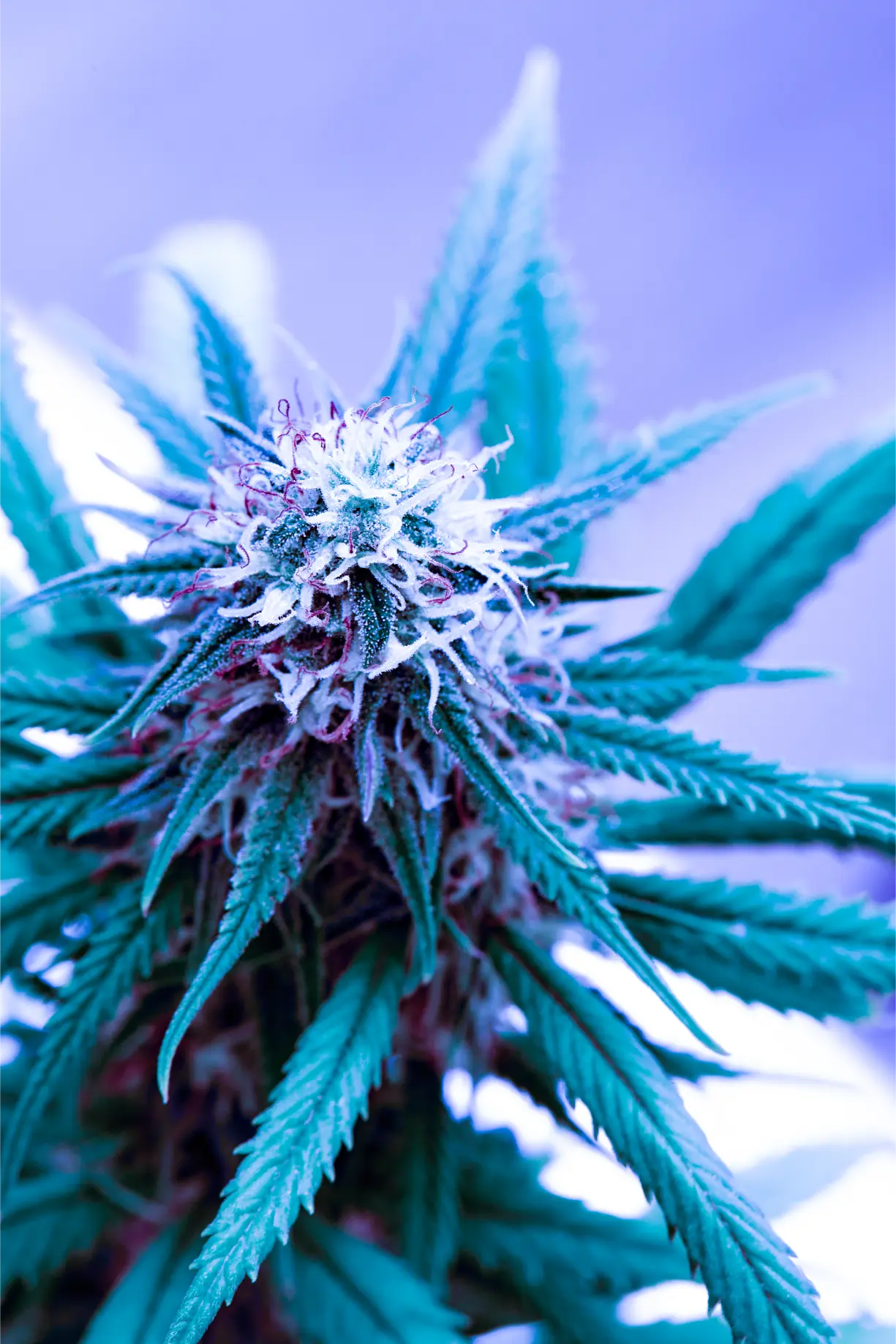
Kali Mist
Kali Mist is a long-flowering sativa that breaks one of the most common indoor assumptions: a tall plant does not always need aggressive defoliation. Many Kali Mist expressions grow with relatively few large leaves and an open architecture that lets light travel deep into the plant. The lower branches can remain surprisingly productive when the grower preserves that openness instead of pruning by habit.
The lineage is historically complicated. Different accounts describe Southeast Asian, Colombian, African, and Afghan influences, while other records simply describe two early sativa-dominant hybrids whose exact ancestry was never fully published. The cultivar has also been revised through selection over time. That makes one precise parent list less reliable than the recurring plant identity: strong sativa dominance, tall open growth, long flowering, high resin, spiral or spear-like flower clusters, and a spicy herbal floral aroma.
The central cultivation question is therefore not how to make Kali Mist compact at any cost. It is how to control height while preserving the natural light penetration that makes the cultivar unusually efficient for a sparse-leaf sativa. If the grower overfills a screen or removes too much useful lower structure, Kali Mist loses one of its biggest natural advantages.
Flowering time is another major part of the cultivar's identity. Ten to twelve weeks is common for modern material, but twelve to fourteen weeks and longer are reported in some plants. A grower must be willing to keep roots, nutrition, environmental control, and support stable for a cycle that lasts far longer than a typical compact hybrid.
The finished flower should justify that patience with spicy herbs, floral tea, incense, earth, mild fruit, citrus, and a clear cerebral effect. Kali Mist is not a strain to rush for room turnover. It is a strain to grow because its open architecture and long mental effect are different from modern dense hybrids.
Strain Features
| Feature | Details |
|---|---|
| Strain Type | Strongly sativa-dominant classic hybrid |
| Genetic Profile | Historical ancestry is disputed and has changed through selection; Southeast Asian, Colombian, African, and Afghan influences are frequently cited |
| THC | Usually moderate to strong rather than extreme by current standards |
| CBD | Generally low |
| Dominant Terpenes | Terpinolene, beta-caryophyllene, myrcene, pinene, and limonene may appear depending on line |
| Flavor / Aroma | Spicy herbs, floral tea, incense, earth, sweet fruit, citrus, mild skunk |
| Effect Character | Clear, energetic, focused, creative, euphoric, and potentially psychedelic at high doses |
| Flowering Time | Commonly 10 to 12 weeks; some phenotypes extend to 13 or 14 weeks or longer |
| Outdoor Harvest | Late autumn in many Northern Hemisphere locations |
| Grow Difficulty | Moderate to advanced indoors |
| Stretch | Moderate to strong, but highly phenotype dependent |
| Plant Architecture | Tall, open, relatively sparse leaf coverage, strong lower light penetration |
| Bud Structure | Long spiral or spear-like clusters, resinous, medium density rather than rock hard |
| Training Compatibility | Topping, LST, wide SCROG, manifold-style shaping when planned early |
| Lower Flower Potential | Better than many cultivars because the open canopy allows light deep into the plant |
| Mold Risk | Often relatively manageable due to open structure, but long flowering still increases seasonal exposure |
| Best Time of Use | Daytime to early evening |
Genetic Lineage
Kali Mist does not have one universally accepted modern pedigree. Some historical descriptions connect it to Cambodian, Colombian, African, and Afghan material. Other accounts refer more generally to two early sativa-dominant hybrids without disclosing the exact parents.
The cultivar was also reworked through selection after its original release, which helps explain why growers distinguish earlier and later versions. The safest editorial approach is to describe the lineage as historically sativa-dominant and uncertain rather than convert one repeated parent list into fact.
The growth traits are more stable. Kali Mist is known for a classic sativa silhouette with height, relatively few leaves, open branch spacing, and long flowering. That sparse foliage is not a weakness. It allows light to reach lower branches that would be shaded on a dense hybrid.
The Afghan or broader indica influence reported in some lineage accounts may help explain why the flowers can become denser and more resinous than a pure tropical landrace, yet the plant still behaves overwhelmingly sativa in timing and architecture.
Keeper selection should prioritize the combination of open structure, spicy floral aroma, clear effect, and a flowering duration the grower can realistically accommodate. A slightly shorter plant may be more useful indoors without losing the cultivar's essential identity.
Effect Breakdown
Kali Mist is most strongly associated with clear cerebral energy. A moderate dose often produces focus, motivation, and a sense that ordinary activity has become more interesting rather than physically heavier.
The effect can be especially appealing for creative or detailed work because many users describe mental clarity rather than immediate fog. Conversation, music, writing, movement, and daytime social activity often fit the cultivar well.
Physical effects are usually secondary. The body may feel light or comfortable, but deep muscle heaviness is not the main identity. This separates Kali Mist from balanced hybrids that begin cerebral and end heavily sedated.
At higher doses, the same mental clarity can become more psychedelic or intense. Sensory detail increases, thoughts can become unusually associative, and some users may find the experience too stimulating if they are sensitive to THC.
Dry mouth and dry eyes are common. Anxiety is possible even though many users describe Kali Mist as unusually smooth for a strong sativa.
The late phase tends to fade gradually rather than collapse into couch-lock. This is one reason the strain is valued for daytime use and long creative sessions.
Kali Mist is also unusual because moderate potency can still feel subjectively strong when the effect is clear and long-lasting. A user does not need an extreme THC percentage to experience a powerful change in attention and sensory perception.
The strain's reputation among sativa users comes from this quality more than from raw numbers. The effect can feel precise and extended rather than blunt, which is why experienced consumers often distinguish it from modern high-THC hybrids.
Flavor & Aroma Profile
Kali Mist is more spicy and floral than fruity. Dry herbs, incense, black pepper, sweet flowers, tea, earth, and a mild skunky edge form the core. Fruit or citrus can appear as a brighter secondary layer.
The aroma can feel airy in the same way the plant looks airy. Instead of one heavy dense note, it often presents several lighter layers that become clearer when the flower is broken apart.
On inhale, floral herbs and mild sweetness often lead. The middle becomes peppery and tea-like. The exhale carries incense, earth, spice, and a light citrus or fruit finish.
Some phenotypes are more tropical or pineapple-like, while others remain firmly spicy and floral. This variation is consistent with the cultivar's complex and historically uncertain ancestry.
Long flowering increases the temptation to harvest when the plant finally looks 'good enough.' If cut early, the flower can remain grassy and thin in flavor even when the trichomes appear cloudy on exposed sugar leaves.
A slow cure helps the spicy tea-like profile become cleaner. The goal is not louder sweetness but better separation between herbs, flowers, incense, earth, and fruit.
Dominant Terpenes
| Terpene | Aroma Role | Cultivar Relevance | Scientific Caution |
|---|---|---|---|
| Terpinolene | Herbal, floral, fresh pine, light fruit | Consistent with the complex spicy-floral sativa character reported in some Kali Mist lines | Not dominant in every modern sample and should not be assumed universally |
| Beta-caryophyllene | Pepper, dry spice, wood | Fits the black-pepper and incense-like base | CB2 activity does not prove strain-specific medical effects |
| Myrcene | Earth, herbs, musk | Can support the earthy herbal foundation without defining the effect | Does not automatically make the strain sedating |
| Pinene | Pine, fresh herbs | May sharpen the bright dry herbal side | Often secondary and line dependent |
| Limonene | Citrus peel | Can explain brighter citrus phenotypes | Does not guarantee energy or focus |
Kali Mist chemistry should be treated as line dependent because the cultivar has changed through selection and modern seed versions are not perfectly uniform. A fixed terpene hierarchy would overstate certainty.
The spicy-floral identity is more stable than any one laboratory ranking. Terpenes explain aroma best, while the clear energetic effect should be discussed as a whole-flower experience.
Indoor vs. Outdoor Growing
| Decision Point | Indoor | Outdoor |
|---|---|---|
| Primary Challenge | Managing height and a long finish without destroying the natural open canopy | Providing enough season length while protecting late flowers from prolonged wet weather |
| Stretch | Moderate to strong, with significant phenotype variation | Height is easier to absorb outdoors |
| Leaf Density | Relatively low, allowing unusual lower-light penetration | Open structure helps branches receive sun from multiple angles |
| Training | Topping, LST, and a wide screen work well when planned early | Early topping and broad spacing are generally enough |
| Flowering Duration | Long room occupancy is the main cost | Requires a late autumn or warm long-season climate |
| Lower Branches | Often more productive than expected because light reaches deep | Many lower branches can remain worthwhile outdoors |
| Mold | Open structure can help, but a long cycle still demands airflow | Seasonal rain is a larger risk than individual cola density |
| Best Fit | Sativa-focused growers with patience, height control, and long-cycle environmental capacity | Warm long-season climates with a reasonably dry finish |
Kali Mist indoors should be grown because the grower wants the cultivar, not because it is the fastest route to grams per week. The long cycle occupies room time but rewards the grower with a plant architecture and effect that compact hybrids do not reproduce.
The most important indoor advantage is control. Height can be redirected, the long final weeks can remain warm and dry, and lower branches can be kept productive through careful canopy spread.
Outdoors, Kali Mist can use its open structure naturally, but the flowering calendar becomes the limiting factor. A plant that wants twelve or fourteen weeks may still be active when cool rain arrives in many temperate climates.
Greenhouse cultivation can extend the season if ventilation remains strong. A covered sativa with weeks left to flower still needs dry moving air around the entire plant.
Indoor growers should plan access before the screen is installed. A long-flowering plant may need months of inspection, so a canopy that cannot be reached from the sides becomes increasingly frustrating as the cycle continues.
Outdoor Kali Mist can remain visually open yet still become enormous. Plant spacing should account for final branch reach, not only trunk-to-trunk distance in early summer.
Strain-Specific Grow Guidance
Do Not Assume a Sativa Must Be Defoliated Heavily
Kali Mist often carries fewer large leaves than dense hybrids. That natural openness is a productive trait because lower branches receive light.
Remove leaves only when they create a real airflow or shading problem. Aggressive stripping can reduce useful photosynthetic area without solving a structural issue the plant did not have.
Build the Main Shape Before Flowering
Top early enough for several leaders to establish and thicken. The plant can respond well to topping, but the long flowering cycle does not mean the grower should keep cutting deep into transition.
Use LST to spread the leaders and reserve vertical space. The aim is an open wide framework, not a flat dense carpet.
Expect Phenotype-Dependent Stretch
Kali Mist has a tall reputation, but individual modern lines can stretch less than expected. Some growers report surprisingly controlled transition movement while others see much stronger extension.
Record the actual phenotype. Flip height should be adjusted on the second run rather than using one universal multiplier.
Use a Wide Screen Without Filling Every Opening
A screen helps distribute long branches and keep the canopy under the light. The plant's sparse foliage means the screen does not need to be packed to achieve good light capture.
Leave open lanes for access and airflow. Lower flower can remain productive because light penetrates naturally through the canopy.
Keep More Lower Branches Than You Would on a Dense Indica
Kali Mist is specifically known for lower branches that can develop well under the open canopy. Removing everything below a fixed line can waste one of the cultivar's strongest traits.
Remove only the shoots that are genuinely shaded, weak, or tangled. Edge and interior branches with clear light paths can remain worthwhile.
Feed for a Long Cycle, Not a Short Peak
A long flowering plant needs stable nutrition for many weeks. The goal is continuity rather than one aggressive mid-flower push.
Do not let the stretch make the decisions
Avoid excessive nitrogen that encourages unnecessary stretch or delays the clean shift into flowering. Later, do not intentionally starve a healthy plant that is still producing new mature flower.
Keep Root Volume Functional for Months
A root-bound Kali Mist can become difficult late because a large plant in a small container dries extremely fast and accumulates salts.
Choose enough root volume for the intended canopy and maintain good drainage. The plant should not spend the final month oscillating between saturation and severe drought.
Use Light Penetration Instead of Extreme Top Intensity
The open canopy already allows light deep into the plant. Take advantage of that by maintaining even branch spacing rather than concentrating excessive intensity on the highest tips.
If the tallest branch begins dominating, reposition it. A uniform broad light field produces more mature lower flower than a few overlit tops.
Support Long Flowering Spears Before They Lean
Kali Mist flowers may be less compact than heavy indica colas, but long branches and elongated clusters still create leverage late in the cycle.
A loose trellis or soft ties keep branches open and prevent one long flowering spear from falling across several lower sites.
Long Flowering Means Long Pest and Disease Exposure
Open structure can reduce mold pressure, but a twelve-to-fourteen-week flower still spends a long time exposed to pests, root problems, and environmental drift.
Continue inspecting leaf undersides, branch junctions, and root-zone behavior deep into the cycle rather than treating the final month as passive waiting.
Harvest Only After the Spice and Calyxes Finish
Kali Mist can look resinous before the flowers have reached full maturity. Wait for calyx expansion, mature trichomes on the actual buds, slowing fresh pistil production, and a developed spicy-floral aroma.
An earlier harvest can feel sharper and more stimulating. A later mature harvest may feel rounder while keeping the cultivar clearly cerebral. The correct point is complete maturity without unnecessary environmental risk.
Sparse Foliage Changes How the Grower Should Read Plant Health
Kali Mist can look visually less lush than an indica even when it is healthy. A grower used to broad dense canopies may interpret the natural openness as weak vigor and respond with unnecessary feeding or extra vegetative time.
Judge health from new growth, leaf color, water use, branch strength, and flowering progression rather than from how completely the plant fills visual space.
Long Internodes Can Be Productive When Light Reaches the Branch
Wide spacing between nodes is not automatically stretch damage. On Kali Mist, longer internodes can allow light and air to reach successive flower clusters along the branch.
The real problem is uncontrolled vertical distance that places part of the plant outside the effective light field. Manage height without trying to compress every node into an indica-like structure.
Do Not Over-Prune Just Because the Flowering Cycle Is Long
A grower may think a twelve-week plant has plenty of time to recover from repeated pruning. The long cycle is for flower development, not an invitation to keep removing productive tissue.
Complete major structural decisions early. Later work should be selective and focused on damaged, shaded, or tangled growth.
The Final Month Still Requires Active Nutrition Observation
Kali Mist can remain metabolically active deep into a long flower. Do not automatically cut nutrition to near zero because a normal nine-week hybrid would already be finishing.
At the same time, late demand may decline gradually. Watch water use and leaf condition so the plant receives enough support without accumulating unnecessary salts.
Open Buds Can Still Hold Moisture at Branch Junctions
Kali Mist's individual flowers may be less dense than indica colas, but long clustered branches still create contact points where small sugar leaves and stems trap moisture.
Inspect those junctions during humid periods. Open overall architecture reduces risk; it does not eliminate the need for late-flower hygiene.
Outdoor Keeper Selection Should Include Calendar Fit
A spectacular fourteen-week phenotype may be a poor outdoor choice in a region where cold rain arrives early. Finish time should be treated as a quality trait when the local season is limited.
A slightly less exotic phenotype that matures cleanly before prolonged bad weather can deliver far more usable premium flower.
Staged Harvest Is More Useful Than Forcing Lower Flowers Early
Because lower branches can remain productive, there may be cases where the top canopy reaches maturity first while illuminated lower branches are still developing. A staged harvest can preserve both zones when the maturity difference is substantial.
Do not assume all lower flower needs extra time simply because it is lower. The open canopy can produce surprisingly synchronized maturity when light distribution is good.
The Screen Should Respect the Plant's Natural Vertical Rhythm
Kali Mist does not need to be forced perfectly flat to benefit from a screen. Allowing small height differences between major leaders can preserve the open vertical rhythm of the plant while still keeping all tops within an effective light range.
A perfectly flat but overfilled screen can create more leaf and flower overlap than a slightly tiered canopy. The goal is uniform useful light, not geometric perfection.
Long Flowering Makes Environmental Drift a Real Variable
A room can change over twelve or fourteen weeks. Seasonal outdoor temperature around the building, dehumidifier performance, irrigation demand, and plant size may all shift during one Kali Mist cycle.
The grower should therefore review the environment repeatedly rather than assuming settings that worked in week three remain ideal in week eleven. Long-cycle stability is an active process.
Resin Maturity Should Be Read on the Flower, Not the Sugar Leaves
Kali Mist can coat narrow sugar leaves with trichomes before the main calyx clusters have finished developing. Those exposed leaves may mature visually earlier than the flower itself.
Check trichomes on the calyxes, then combine that information with flower swelling, pistil behavior, and aroma. This reduces the risk of cutting a long sativa simply because the most visible leaves looked ready.
Weedth Bud Flavor Tips
Kali Mist's floral, herbal, and light fruit notes are delicate compared with earth and spice. A hot dry can leave the flower tasting peppery and flat even when the original plant smelled complex.
Do not harvest simply because the long cycle has become inconvenient. Immature sativa flower can remain grassy after curing because the aromatic profile never completed on the plant.
The open buds may dry faster than giant dense indica colas. Adjust drying to the actual flower rather than using the same number of days for every cultivar.
Avoid direct fan air. Light airy flowers can lose surface moisture and volatile aroma very quickly.
During cure, expect the tea-like, incense, and floral qualities to become cleaner as chlorophyll-like notes decline. The goal is clarity rather than heavy sweetness.
Keep different phenotypes separate. A spicy incense plant and a fruitier tropical plant may both be valid but useful for different keeper goals.
Store cool and airtight. Kali Mist is often grown for nuanced sensory character, so long-term flavor preservation matters as much as potency.
Kali Mist should be evaluated in a clean vapor or low-smoke context when possible because its floral tea and light fruit notes are easier to cover with combustion than the heavier spice and earth.
A spicy phenotype can smell less dramatic in the jar than a fruitier plant while delivering more complex flavor on the exhale. Keeper selection should include actual consumption quality, not only jar loudness.
Long storage can soften the brighter floral edge. Small sealed containers help preserve the main crop while allowing periodic evaluation of cure development.
The spice and incense side can remain strong even when delicate floral notes are lost. That makes a poorly dried batch seem more intact than it really is. Compare the cured flower with the late-flower aroma and look for the lighter tea, flower, and fruit layers.
A slower line may justify its extra flowering time if the additional weeks produce a clearly richer aroma and more mature lower flower. If the longer cycle adds little quality, a faster phenotype becomes more attractive for future runs.
Weedth Bud Boost Tips
Kali Mist's yield advantage comes from open structure and useful lower branches, not from building the densest possible top canopy.
Use topping and LST to spread the plant before flowering, then preserve the natural light channels instead of filling them with extra shoots.
Do not remove productive lower branches just because a generic lollipopping guide says to clear the bottom third. Evaluate actual light exposure.
A wide screen can support many flowering runs without becoming a solid wall. Empty space is part of the system because it allows light to reach deeper.
Root volume and long-term irrigation consistency matter more than aggressive bloom additives during a twelve-week or longer cycle.
Outdoors, season length is the real yield limit. A giant plant that cannot finish before prolonged cold rain does not deliver high usable yield.
Kali Mist quality yield is mature resinous flower distributed through an open light-efficient plant, not maximum density concentrated only at the top.
Kali Mist can create high yield from a surprisingly low leaf mass because light reaches a large number of flowering sites. Adding more foliage is not a yield goal. Preserving efficient light paths is.
If a lower branch repeatedly produces mature resinous flower, document its position and keep that structural pattern on the next run. The cultivar rewards learning which lower zones are genuinely productive.
Room-time efficiency should be considered honestly. A fourteen-week phenotype needs to produce enough unique quality to justify the extra weeks compared with a ten- or eleven-week sister.
Medical Uses & Benefits
Kali Mist is commonly chosen by users seeking daytime mood support, focus, energy, and functional pain distraction. These are user-reported patterns rather than strain-specific clinical evidence.
The clear cerebral profile may appeal to users who dislike sedating cannabis during the day. Some report remaining engaged with ordinary activities while physical discomfort becomes less distracting.
The stimulating side can also be a limitation. People sensitive to THC, racing thoughts, or panic should approach cautiously, especially at larger doses.
Some historical user communities associate Kali Mist with menstrual discomfort and other specific symptoms, but those anecdotes should not be presented as clinical proof or as a reliable treatment claim.
Most modern Kali Mist flower is THC-dominant and not a low-intoxication option. Driving and safety-sensitive tasks remain unsafe while impaired.
Anyone using cannabis medically or alongside prescription medication should speak with a qualified healthcare professional.
Ideal User Profile
Kali Mist suits the user who specifically wants a long, clear, energetic sativa effect rather than a body-heavy hybrid.
It fits creative work, music, conversation, daytime social activity, walking, and detailed hobbies when the dose remains comfortable.
Flavor preference should lean toward spice, herbs, tea, incense, flowers, and mild fruit rather than dessert cream or heavy gas.
For growers, it suits people who enjoy training tall plants and are willing to give the flowering room more time than average.
It is a poor choice for a low-ceiling room with a fixed short production schedule or an outdoor climate where autumn becomes wet early.
Grower Notes and Feedback
Grow reports repeatedly describe Kali Mist as tall, sativa-dominant, and long flowering. Ten to twelve weeks is common, while longer cycles are also reported.
One of the most distinctive cultivation observations is the low leaf density. The open structure allows light to reach lower branches and can make lower flowers more useful than on dense hybrids.
Stretch reports are not uniform. Some growers see substantial height, while individual modern phenotypes can stop earlier than expected. This should be treated as real line variation.
Topping, LST, and SCROG are repeatedly recommended, but the screen works best when it preserves openness rather than creates a packed canopy.
The flower structure is often described as spiral, elongated, resinous, and less compact than heavy indicas. That structure should not be mistaken for poor development when the flower is mature.
Flavor reports center on spice, herbs, flowers, tea, incense, earth, and occasional tropical or citrus sweetness.
Grow diaries illustrate why the cultivar's stretch reputation should not be treated as absolute. Some modern plants remain surprisingly controlled after the flip, while others show the classic tall sativa movement.
This variation makes clone notes especially valuable. Once the exact stretch and flowering duration are known, Kali Mist becomes much easier to place in an indoor schedule.
Growers accustomed to compact hybrids also note that Kali Mist can appear visually sparse while still using the light efficiently. Empty air between leaves is not necessarily wasted canopy when flowering branches receive direct light through that space.
The cultivar rewards keeping records of productive lower branches. Their success or failure tells the grower how much of the open architecture should be retained on the next run.
Weedth Editor's Note
What matters after the headline numbers
Kali Mist is the kind of strain that would make me write 'do less' in the grow journal. The plant already has natural light penetration. I would not attack it with heavy defoliation simply because it is tall.
I would top early, spread the main leaders, and leave a wide screen with more open squares than feels normal. The plant can use that light through the lower canopy.
The most difficult part for me would be patience. A twelve-week plant can look tempting in week nine, especially when the trichomes are already visible. I would wait for the flowers and the spicy floral aroma to finish, not the room schedule.
I would also choose a keeper partly by flowering duration. An exceptional thirteen-week plant may be worth it, but a nearly identical ten-week phenotype could be much more practical indoors.
The Kali Mist I would keep is the plant that preserves open architecture, develops useful lower flowers, and cures into a spicy tea-and-incense profile without losing the clear daytime effect.
I would keep the lower branches visible during the first run instead of stripping them automatically. Their performance would teach me more about this cultivar than a generic pruning rule.
I would also treat a shorter-flowering phenotype as a serious keeper candidate if it preserves the spicy floral identity. In a long-cycle sativa, saving two weeks without losing character is a meaningful horticultural advantage.
I would not judge the first Kali Mist run by how dense the buds look compared with modern hybrids. I would judge whether the flowers are fully mature, resinous, aromatic, and smooth enough to justify the long cycle.
The second run would focus on exact flip height and which lower branches proved productive. That information could reduce wasted space without changing the open structure that makes the cultivar special.
Weedth Score
Growing Experience 7.6/10 Highly educational and naturally open, but long flowering and height management raise the indoor difficulty.
Bud Structure & Visual Appeal 8.2/10 Long resinous sativa clusters are distinctive even without modern rock-hard density.
Aroma Complexity 8.8/10 Spice, herbs, floral tea, incense, earth, and fruit create a sophisticated old-school profile.
Flavor & Smoothness 8.7/10 Excellent when fully mature and gently dried, with a notably smooth spicy-herbal character.
Effects & High Experience 9.1/10 Clear focused energetic effects are the cultivar's defining strength.
Overall Satisfaction & Recommendation 8.5/10 A rewarding classic sativa for growers who value effect and architecture more than short flowering time.
Personal closer: I would keep the Kali Mist that lets light reach its own lower branches and still cures into spicy floral tea, even if a denser phenotype looks more modern.
FAQ
What is Kali Mist's lineage?
The historical ancestry is disputed and has changed through selection. It is best treated as a strongly sativa-dominant classic with mixed Asian, American, African, and possible Afghan influences reported across records.
How long does Kali Mist flower?
Ten to twelve weeks is common, with some phenotypes extending to thirteen or fourteen weeks or longer.
How much does Kali Mist stretch?
Moderate-to-strong stretch is typical, but modern phenotypes can vary significantly.
Does Kali Mist respond well to topping?
Yes. Early topping can create several leaders and make height easier to manage.
Is SCROG good for Kali Mist?
Yes, especially a wide open screen that spreads branches without blocking natural light penetration.
Should Kali Mist be heavily defoliated?
Usually not. The cultivar is known for relatively sparse foliage, so remove leaves only when they create a real problem.
Should I remove Kali Mist lower branches?
Not automatically. Lower branches can be unusually productive because the open canopy allows light to reach them.
Is Kali Mist a heavy feeder?
Long flowering requires stable nutrition, but aggressive feeding is not automatically beneficial. Follow the plant's actual demand.
Is Kali Mist prone to mold?
The open structure can reduce some internal humidity risk, but the long flowering period still creates exposure to wet weather and disease.
Does Kali Mist need support?
Long branches and elongated flower clusters can lean late in flower, so a trellis or soft ties can help.
Why are my Kali Mist buds not rock hard?
The cultivar often forms elongated medium-density sativa flowers. Mature resinous open buds are normal and should not be judged by indica density standards.
When should Kali Mist be harvested?
Wait for mature flower trichomes, calyx expansion, reduced fresh pistils, and a complete spicy-floral aroma.
Can Kali Mist grow outdoors?
Yes in long-season climates. Cool wet autumns can make full maturity difficult.
Is Kali Mist suitable for a small tent?
Only with careful topping, LST, and enough vertical planning. It is not an ideal low-ceiling strain.
Is Kali Mist good for daytime use?
Many users describe it as clear, energetic, focused, and motivating at moderate doses.
Similar Strains
Super Silver Haze: A long-flowering classic sativa hybrid with more citrus-incense and somewhat denser flower.
Jack Herer: A more manageable indoor sativa with pine-spice aroma and clear daytime effects.
Colombian Gold: A landrace-style long-season comparison with citrus-skunk flavor and stronger extreme stretch potential.
Durban Poison: A faster classic sativa with anise-spice character and similarly energetic effects.
Amnesia Haze: A taller long-flowering Haze-style option with stronger lemon-incense identity.
Chocolope: A branchy sativa comparison with coffee-cocoa and fruit instead of floral spice.
Share this article
A quick overview of the topics covered in this article.
Follow us
Latest articles
September 9, 2026
September 9, 2026

September 9, 2026