
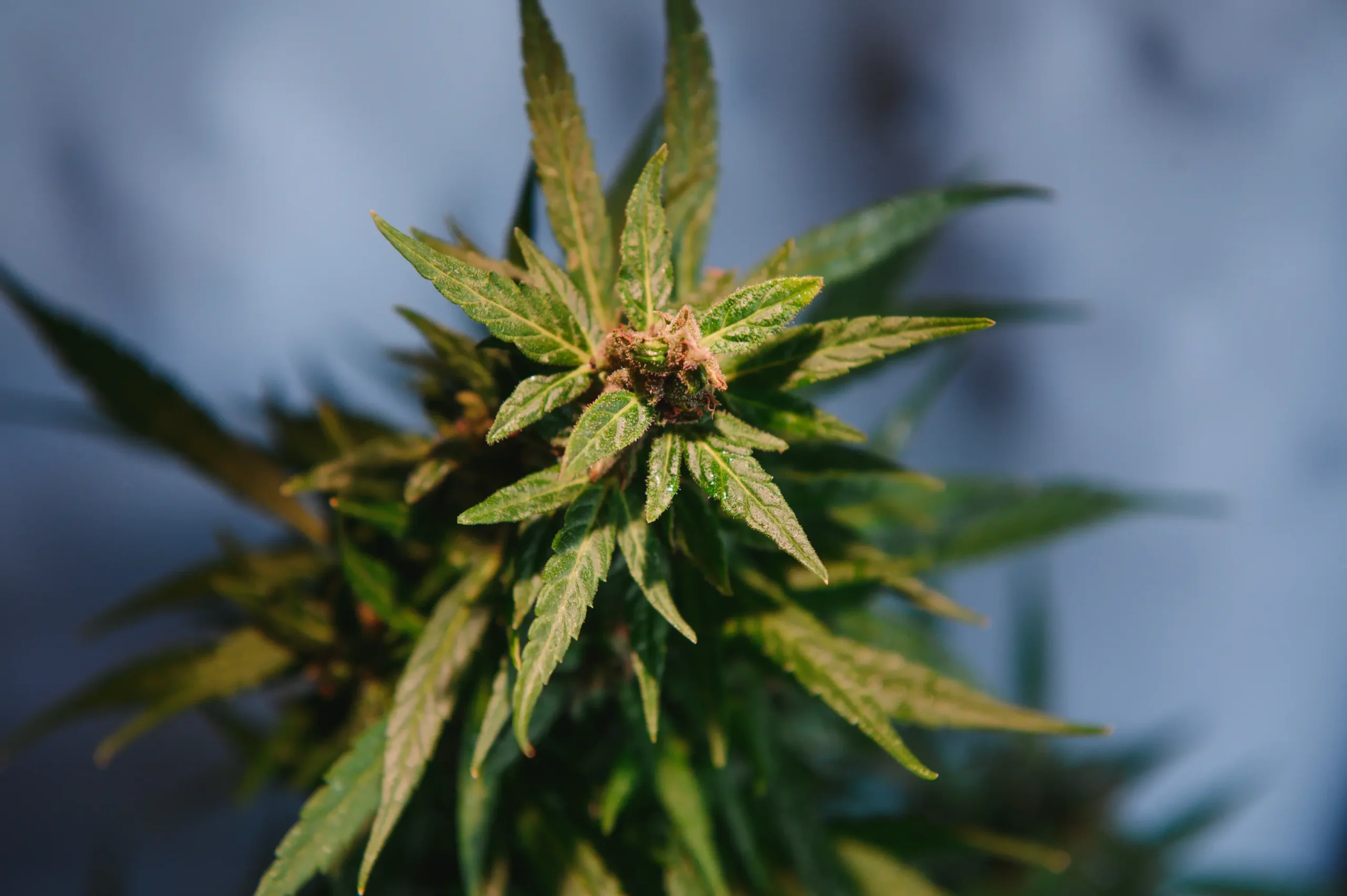
Liberty Haze
Liberty Haze is a medium-tall, broad hybrid whose name suggests a classic Haze pedigree even though the most widely accepted lineage is G13 crossed with Chem 91. The plant earns the Haze label through behavior and effect rather than through a direct Original Haze parent: energetic cerebral effects, lime-forward aroma, rapid early growth, and long colas that continue gaining density late in an eight-to-nine-week flowering cycle.
That late swelling pattern is the cultivar's most important cultivation clue. Liberty Haze can look comfortably open through early flower, then build substantial girth and long dense tops during the final weeks. A grower who judges plant spacing only from the first half of bloom can end with touching colas, inward-leaning branches, and a flower microclimate that is much more humid than the room sensor suggests.
The central cultivation question is: how can a grower use Liberty Haze's moderate stretch and strong branching to create a wide productive canopy while reserving enough physical space for the late formation of long, dense lime-scented colas? The answer is early topping, outward branch angles, limited top count, support before the final swell, and nutrition guided by actual demand rather than the cultivar's reputation for vigor.
The plant is often described as a medium-to-heavy feeder. That description should be treated as a potential ceiling under strong growth, not as a universal starting point. Liberty Haze can produce broad, vigorous foliage and dense flowers, but excess nitrogen can make the canopy leafier, reduce light access, and complicate drying without strengthening the lime profile.
The sensory identity is brighter than the musky lineage suggests. Lime peel, lemon, pine, herbs, earth, pepper, and skunk form the core. The effect is typically immediate, euphoric, focused, and energetic before a calmer physical phase appears later. A well-grown batch should preserve that contrast: bright citrus over a dense resinous flower, with enough body influence to keep the experience grounded.
Strain Features
| Feature | Details |
|---|---|
| Strain Type | Sativa-leaning hybrid with strong indica structural influence |
| Genetic Profile | G13 x Chem 91 |
| THC | Commonly strong to very strong; exact potency varies by batch and line |
| CBD | Usually low |
| Dominant Terpenes | Limonene, beta-caryophyllene, myrcene and sometimes linalool recur |
| Flavor / Aroma | Lime peel, lemon, pine, herbs, earth, pepper, musk and mild skunk |
| Effect Character | Immediate euphoria, focus, energy and creativity followed by calmer body relaxation |
| Flowering Time | Usually about 8 to 9 weeks or roughly 60 to 65 days |
| Stretch | Moderate, with strong branch expansion during transition |
| Plant Architecture | Medium-to-tall, bushy, substantial girth, strong side branching |
| Bud Structure | Long dense colas that often gain much of their weight late |
| Color Potential | Red or purple calyx tones can appear, but color is not universal |
| Yield Potential | Moderate to high with even canopy exposure |
| Training Compatibility | Topping, LST, open SCROG and supported multi-top systems |
| Primary Grow Risk | Underestimating late cola width and overcrowding the mature canopy |
| Best Time of Use | Daytime to early evening, depending on dose |
Genetic Lineage
Liberty Haze is most consistently described as G13 crossed with Chem 91. The name can create confusion because it does not require direct Haze ancestry. Its Haze-like reputation comes from the clear energetic effect, citrus profile, and sativa-leaning growth behavior rather than from a documented Original Haze parent.
G13 contributes density, resin, body weight, and a broad plant frame. Chem 91 contributes sharp citrus, musk, skunk, fuel, and vigorous branching. Together they create a plant that can remain medium in height while building substantial width and long dense flowers.
The combination also explains the effect arc. The Chem side supports the immediate cerebral rise, while the G13 side becomes more obvious as physical relaxation develops later. The result is neither a pure daytime sativa nor a heavy couch-lock indica at a moderate dose.
Modern Liberty Haze examples can vary in exact stretch, potency, and citrus intensity. Some phenotypes are strongly lime-forward and mentally bright, while others carry more earth, spice, or body weight. This variability should be acknowledged rather than hidden behind one exact THC percentage or one guaranteed terpene order.
A useful keeper combines strong lime aroma with a branch structure that remains open through the late swelling phase. A plant that smells excellent but produces tightly clustered colas around an inaccessible center may be less practical than a slightly lighter phenotype with better branch angles and storage stability.
Effect Breakdown
An immediate cerebral rise
Liberty Haze often announces itself quickly. Euphoria, heightened awareness, and an energized mental state can appear before the user has fully settled into the session.
At a light dose, this can feel focused and socially positive. Visual detail, music, conversation, and creative work often become more engaging without an immediate loss of physical motivation.
Strong focus can become hyper-awareness
At a moderate dose, the user may feel very present and mentally absorbed. The effect can support creative attention, but it can also become intense for people sensitive to strong THC or fast cerebral strains.
The line between focus and overstimulation is dose-dependent. A useful amount can feel organized, while a larger amount can create anxiety, dizziness, or a sense that ordinary sensory information is too loud.
The body becomes calmer later
Physical relaxation tends to develop after the initial mental peak. The body feels less tense, and the effect becomes more balanced without necessarily becoming sleepy.
At higher doses, the late body phase can be heavier and less functional. Dry mouth and dry eyes are common, and low-tolerance users may find the strength disorienting.
The full experience is best suited to daytime or early evening for experienced users. It offers a stimulating first half and a calmer second half, but the potency means that the word 'focused' should never be interpreted as unimpaired.
Flavor & Aroma Profile
A sharp lime top note
Liberty Haze is defined by lime more than by generic lemon. The best flower has a green citrus-peel quality with mild bitterness, supported by pine and fresh herbs.
The intact jar can smell clean and bright, especially when the flower was dried without excessive heat. A muted jar is not always weak, because breaking the dense calyxes can release more citrus and musk.
Chem and G13 beneath the citrus
Inside the flower, earth, skunk, pepper, musk, and mild fuel become more obvious. The bright lime should sit above this darker base rather than disappear into it.
Some phenotypes show more woody or herbal character, while others are sharper and more chemical-citrus. Those differences are useful keeper information.
A changing flavor through the session
The inhale usually begins with lime and lemon. Pine and herbs appear through the middle. The exhale can shift toward pepper, earth, musk, and skunk, with citrus remaining in the aftertaste when the cure is successful.
A hot finish or fast dry often leaves the flower loud but less distinctive. Musk and earth remain while lime becomes faint, making the result taste like a generic strong hybrid.
Liberty Haze quality depends on preserving brightness inside a dense, high-potency flower. Potency and frost are easy to notice, but the lime layer is what separates an exceptional batch from ordinary resinous Chem-G13 flower.
Dominant Terpenes
| Terpene | Aroma Role | Cultivar Relevance | Scientific Caution |
|---|---|---|---|
| Limonene | Lime peel, lemon and citrus brightness | Frequently dominant in tested samples and central to the cultivar's identity | Does not guarantee energy, euphoria or anxiety relief |
| Beta-caryophyllene | Pepper, wood and dry spice | Supports the spicy Chem-like exhale | CB2 activity does not prove cultivar-specific medical effects |
| Myrcene | Earth, herbs and musk | Rounds the darker base beneath lime | Does not independently cause relaxation or couch-lock |
| Linalool and minor volatiles | Flowers, soft herbs, musk and skunk | Can add complexity to selected phenotypes | Minor compounds and sulfurous volatiles may matter more than headline terpene percentages |
Limonene is a recurring laboratory feature, but Liberty Haze should not be reduced to one citrus terpene. Lime, skunk, musk, pine, and fuel emerge from a broader volatile mixture.
The focused and euphoric effect should not be attributed directly to limonene. Potency, dose, tolerance, harvest maturity, and the complete chemotype are more useful explanations of the experience.
Indoor vs. Outdoor Growing
| Decision Point | Indoor Growing | Outdoor Growing |
|---|---|---|
| Primary Advantage | Fast flowering for a sativa-leaning hybrid and strong production from medium height | Substantial width and branch vigor can create large plants |
| Main Limitation | Late cola swelling can close gaps that looked safe early | Dense long flowers need a dry enough autumn finish |
| Stretch | Moderate and easy to redirect during the first flowering weeks | Vertical movement is less restrictive but branch width expands |
| Training | Topping, LST and an open supported screen | Early topping and broad cage or stake support |
| Flowering Time | Usually 60 to 65 days | Often early October in suitable Northern Hemisphere climates |
| Bud Density | Long dense colas require spacing and inspection | Rain and dew can remain inside mature flowers |
| Feeding | Can use substantial nutrition under strong growth, but follow demand | Large roots increase total consumption without justifying excessive concentration |
| Best Fit | Growers who want strong lime-forward effects on a practical schedule | Warm sunny sites with enough space and a relatively dry finish |
Liberty Haze is naturally compatible with indoor cultivation because it completes flower quickly while remaining trainable. The medium height allows topping and a broad screen without the extreme vertical commitment of a true long Haze.
The mistake is treating medium height as compactness. The plant can develop substantial girth, and long colas can gain much of their density late. A room planned only from stretch may still become overfilled by flower volume.
Outdoors, the cultivar can take advantage of greater lateral space and can produce large plants. The late flower still needs protection from repeated rain because the colas are dense, not airy Haze spears.
A protected outdoor structure can help with weather, but only when ventilation remains strong. Removing rain while trapping humid air does not solve the flower microclimate.
Strain-Specific Grow Guidance
Top early and spread the main frame
Liberty Haze responds well to topping because it naturally develops substantial side branches. One early cut followed by LST can create several strong leaders with enough time to thicken before flower.
Repeated topping can produce more tops than the final canopy can separate once the colas gain width. The goal is strong lanes, not maximum shoot count.
Reserve space for late cola girth
The plant's flowers often fatten substantially during the final weeks. Branch gaps should be planned for mature bud diameter rather than for stems in week three.
If two leaders are already close at the end of stretch, move them apart before resin and flower weight make correction expensive.
Use transition to finalize branch angles
The first flowering weeks are ideal for redirecting the fastest leaders outward. After real flower clusters establish, repeated tucking can damage resin and distort the long colas.
A slight height tier is acceptable when each branch has its own light lane. A perfectly flat screen is less important than maintaining access and air.
Keep the center from becoming a Chem-G13 knot
Bushy growth can send several leaders toward the same central space. Tie them outward early and remove weak inward shoots after stretch.
The mature plant should have a visible center and enough room to inspect the bases of the long colas without touching neighboring flowers.
Feed from water use, not reputation
Liberty Haze is often described as capable of medium-to-heavy feeding. A rapidly growing plant under strong light may indeed use substantial nutrition, but the plant should prove the need.
Dark clawed leaves, burned tips, and slow dryback indicate that the ceiling has been exceeded. More input does not create more lime or automatically increase yield.
Adjust irrigation after the stretch changes
Water use can be aggressive during transition and then slow as vertical growth ends. Continue checking container dryback rather than maintaining one fixed schedule through day sixty-five.
A chronically wet root zone late in flower can flatten plant vigor and make nutrient symptoms harder to interpret.
Support the long colas before they lean inward
A loose second net or outward ties should be installed before final swelling. The objective is to keep each cola in its assigned light lane.
Support that pulls branches toward the center closes airflow and increases flower contact. Hold the branch from below or outward instead.
Inspect internal flower humidity
Dense long colas can remain significantly more humid inside than the surrounding room. Room RH is useful but incomplete.
Check sugar-leaf bases, branch junctions, and any point where flowers touch. Enhanced air circulation is helpful when it moves through the canopy without blasting one top directly.
Protect lime from the hottest canopy zone
Citrus can decline before the plant shows obvious heat damage. Smell the hottest top and a cooler side flower separately late in bloom.
If the top becomes earthy and musky while the side remains lime-forward, reduce local temperature or intensity before assuming the phenotype is weak.
Harvest each phenotype from complete maturity
Sixty to sixty-five days is common, but seed plants can differ. The entire room should not be cut automatically on one date.
Use calyx completion, mature flower trichomes, reduced fresh pistils, and an integrated lime-pine-earth aroma. A late mature plant can gain body weight, while a biologically unfinished early cut often tastes sharp and green.
Liberty Haze also benefits from comparing branch stiffness before the late swell. Two plants with similar height can behave very differently once the long colas gain weight. A phenotype that naturally holds an outward angle can be more valuable in production than a slightly heavier plant that collapses toward the center.
Dense flowers change the airflow plan
Do not let the fast schedule turn drying into an afterthought. The crop may finish in a practical sixty-to-sixty-five-day window, but dense colas still need enough space and time for internal moisture to equalize. Flowering speed and drying speed are separate traits.
Weedth Bud Flavor Tips
Liberty Haze flavor quality begins with protecting the lime top note. Earth, musk, pepper, and skunk are much more durable and can keep the flower smelling strong after the distinctive citrus has already faded.
Keep late canopy temperature conservative enough that the hottest tops smell as bright as the middle branches. A zone-by-zone aroma difference is a practical environmental test.
Do not use citrus peel, flavored additives, terpene sprays, or sweeteners. Authentic lime comes from genetics, maturity, and volatile preservation.
Long dense flowers should be dried by density. Separate heavy central branches from smaller side flowers if they are releasing moisture at different rates.
Avoid direct fan air. A rapidly dry surface can hide a moist interior and leave the lime impression thin and harsh.
During cure, sharp green citrus should become smoother while pine, herbs, and musk integrate underneath it. A cure cannot restore limonene and minor citrus volatiles already lost to heat.
Use a small evaluation jar and keep the main batch closed. The plant's best quality is volatile, and repeated warm oxygen exposure simplifies the profile.
Weedth Bud Boost Tips
Liberty Haze yield improves when final flower width is considered during veg. A canopy with fewer strong lanes can produce more premium dry flower than a screen packed with small tops.
The selected clone's stretch and late swelling pattern should determine plant count. A known clone can be flipped earlier and spaced more precisely than a mixed seed population.
Preserve outer laterals that reach their own light lane. Remove inward or buried shoots after stretch so the plant spends the short finish on flowers that can become dense and mature.
Support timing is part of production. A branch that leans into the center loses side light and creates humidity risk even if the stem never breaks.
Feed increases should be small and data-driven. A cultivar that tolerates rich nutrition may not produce better flower from it, and late leafiness reduces trim efficiency.
Compare premium cured flower across canopy zones. If the middle is softer, less lime-forward, or more leafy, reduce depth or branch count on the next run.
The Liberty Haze target is a wide, supported canopy with long lime-forward colas that still have visible air around them in the final week.
Medical Uses & Benefits
Liberty Haze is commonly chosen for mood elevation, focus, daytime energy, stress distraction, and later physical relaxation. These are user-reported patterns, not clinical proof that the cultivar treats depression, anxiety, or pain.
The immediate cerebral effect can feel useful when the dose is small and the task is creative. The same intensity can worsen anxiety or sensory overload in sensitive users.
The later body relaxation may make tension feel less intrusive, but the cultivar is not reliably sedating enough to be described as a sleep strain.
Dry mouth, dizziness, dry eyes, and anxiety are commonly reported limitations. Modern high-potency batches can be especially intense for low-tolerance users.
Most flower is THC-dominant with little CBD. A focused subjective effect does not make the user safe to drive or perform hazardous tasks.
Anyone using cannabis for a diagnosed condition or alongside prescription medication should consult a qualified healthcare professional.
Ideal User Profile
Liberty Haze suits users who want strong citrus, immediate euphoria, and a balance between mental stimulation and later body calm.
It fits creative work, music, conversation, gaming, walking, and early-evening social time at a controlled dose.
For growers, it suits people who enjoy topping and shaping a broad plant but do not want a fourteen-week Haze cycle. The eight-to-nine-week finish gives the plant a useful production advantage.
It is less suitable for low-tolerance users, extremely crowded rooms, or growers who want to perform major structural work late in flower.
Flavor-focused growers should evaluate lime after storage, not only live-plant aroma. The best keeper is the plant that remains bright after cure.
Grower Notes and Feedback
The most repeated cultivation traits are medium height, substantial girth, strong response to topping, and long dense colas that finish in roughly sixty to sixty-five days.
Late flower swelling is especially important because it changes the canopy after vertical stretch has already slowed. Growers who stop thinking about spacing too early can be surprised in the final weeks.
The cultivar is often described as a medium-to-heavy feeder, but real demand varies by environment and phenotype. A response-based approach remains safer than a high-input recipe.
Lime, citrus, pine, earth, musk, and skunk recur across descriptions. The brightness of the citrus is one of the best sensory traits for keeper comparison.
Effects reports consistently emphasize focus, happiness, energy, and later relaxation, with anxiety or dizziness appearing when the dose is high.
A second-run journal should record flip width, actual stretch, late cola diameter, support week, dryback slowdown, and lime intensity after four weeks of storage.
A useful keeper test is lime persistence after storage. Some plants are intensely citrusy in late flower yet cure into musk and earth, while another phenotype retains lime for weeks. The second plant may be more valuable even when its live aroma seemed quieter.
Clone-based repeat runs are especially productive because the grower can match the screen fill to both stretch and late cola diameter. This reduces the two main sources of crowding at once.
Weedth Editor's Note
How I would judge the finished flower
I would design Liberty Haze around late flower, not around the appearance of the plant at the end of stretch. The colas need room to become wide without becoming neighbors.
I would top early, move the leaders outward, and keep the center visible. After flower formation begins, I would stop trying to perfect the geometry and focus on support and environment.
I would not chase the cultivar's feeding reputation. If the plant is using water rapidly and staying healthy, I can increase gradually. If the pot is slow and the leaves are dark, the answer is not another bloom product.
The lime profile would be my quality reference. I would compare the hottest top with cooler side flower and use that difference to improve the next cycle.
The keeper for me would remain manageable, hold its long colas apart, and keep bright lime through cure. Potency is common in this family; refinement is the harder trait.
I would keep a small reference sample from the strongest lime harvest and compare future clone runs against it. A heavier crop would not count as progress if the defining citrus became weaker.
Weedth Score
Growing Experience 8.2/10 Fast and responsive with excellent topping behavior, but late cola swelling and strong potency demand attention.
Bud Structure & Visual Appeal 9.0/10 Long dense resinous colas and possible red-purple calyx tones provide strong visual quality.
Aroma Complexity 9.0/10 Lime, lemon, pine, herbs, earth, musk and skunk form a vivid layered profile.
Flavor & Smoothness 8.8/10 Excellent when lime survives late heat and the dense flowers dry evenly.
Effects & High Experience 9.0/10 Immediate euphoria and focus followed by grounded relaxation create a powerful balanced arc.
Overall Satisfaction & Recommendation 8.8/10 A highly rewarding fast hybrid for growers who reserve space for the final colas and protect citrus quality.
Personal closer: I would grow Liberty Haze again for the combination of a practical flowering time and a true lime-led effect, but I would plan every branch gap around the bud it will carry in week nine rather than the stem it has in week three.
FAQ
Is Liberty Haze a true Haze strain?
Its most widely accepted lineage is G13 x Chem 91, so the name reflects Haze-like effects and growth more than a documented Original Haze parent.
How long does Liberty Haze flower?
Usually about eight to nine weeks, often around sixty to sixty-five days indoors.
How much does Liberty Haze stretch?
Usually moderately. The plant can add meaningful height and width during transition, then gain additional canopy volume from late cola swelling.
Does Liberty Haze respond well to topping?
Yes. Early topping is one of the best ways to distribute the bushy structure into several open leaders.
Is SCROG good for Liberty Haze?
Yes, especially an open screen that reserves space for long dense colas rather than filling every square before the flip.
Is Liberty Haze a heavy feeder?
Some plants can use substantial nutrition under strong growth, but feed should follow water use, root health, leaf color, and tip condition.
Why is my Liberty Haze too bushy?
Several leaders may be growing toward the center. Redirect them outward early and remove weak inward shoots after stretch.
Why are Liberty Haze colas touching late?
The cultivar can add a great deal of bud diameter during the final weeks. Branch spacing should be planned from mature flower width, not early stem position.
Does Liberty Haze need support?
Often yes. Long dense colas can lean late and benefit from a second loose net or soft outward ties.
Is Liberty Haze prone to mold?
Dense long flowers can hold internal moisture, especially when colas touch or airflow cannot reach the center.
Why is my Liberty Haze losing lime aroma?
Late heat, direct airflow during drying, or excessive dryness can remove the bright citrus while earth, musk, and skunk remain.
When should Liberty Haze be harvested?
Use complete calyx development, mature flower trichomes, slowing fresh pistils, and a full lime-pine-earth aroma rather than one fixed day.
Can Liberty Haze grow outdoors?
Yes in warm sunny climates with enough space and a relatively dry finish. Dense colas are less suitable for repeated autumn rain.
Is Liberty Haze beginner-friendly?
A careful beginner can succeed, but strong potency, late cola swelling, and feeding claims make good observation important.
Is Liberty Haze good for daytime use?
Many experienced users describe it as focused, happy, and energetic at moderate doses. Higher doses can become anxious, dizzy, or physically heavier.
Similar Strains
G13: The denser parent-side comparison, with heavier body effects and less lime-driven brightness.
Chemdawg: Shares pungent musk, skunk and potency but usually carries more fuel and less clean lime.
Super Lemon Haze: A more direct Haze-family citrus cultivar with longer flowering and stronger vertical growth.
Alien OG: Another powerful lemon-pine hybrid with dense flowers, though it is more OG-heavy and physically relaxing.
Headband: Combines Chem and OG influence with strong fuel-citrus aroma and a slower, more body-oriented finish.
Clementine: A brighter citrus alternative with more orange sweetness, stronger sativa growth, and less dense late cola structure.
Share this article
A quick overview of the topics covered in this article.
Follow us
Latest articles
September 9, 2026
September 9, 2026

September 9, 2026