Mango Widow
WEEDTH STRAIN LIBRARY | CULTIVATION, BUD QUALITY & FLAVOR
Mango Widow is a phenotype-selection strain more than a one-line flavor promise. The cultivar is generally described as a cross between a mango-forward Haze family and a White Widow-type resin line, which creates a useful but variable combination: Haze-style stretch and fruit, Widow-style resin and flower weight, and enough segregation that two siblings may not express those traits in the same proportion. A grower who expects every seed to deliver identical ripe mango aroma and identical nine-week structure is likely to misread the population.
The central grower question is therefore not simply how to make Mango Widow yield more. It is how to identify the phenotype that balances manageable stretch, strong resin, full mango-citrus aroma and a finish time that fits the room. Some expressions lean taller and more Haze-like, with longer internodes, a longer finish and brighter fruit or incense. Others pull toward the Widow side, becoming stockier, frostier and denser. Both can be good. The correct keeper depends on whether the priority is flavor, speed, yield, structure or a particular effect.
One cultivation detail appears repeatedly across historical descriptions: Mango Widow does not need to be driven with aggressive fertilizer to perform. Moderate feeding, an oxygenated root zone and a broad, evenly lit canopy generally suit it better than dark, overfed foliage. The plant is commonly recommended for screens because long lateral growth can be spread into productive lanes. That does not mean every phenotype wants the same training. A Haze-dominant plant may need earlier height control, while a more compact resinous expression can tolerate a little more vegetative time.
Flavor is the reason the strain deserves careful post-harvest work. Well-finished flower can move from ripe mango and citrus skin into sweet herb, earth, spice and a lightly incense-like Haze background. Average flower can lose that distinction quickly and collapse toward generic woody-earthy cannabis. Heat during late flower, a fast dry and prolonged warm storage all target the bright fruit fraction first. Mango Widow is therefore a good example of Weedth's core principle: the same genetics can produce very different bud quality depending on how the grower handles the last three weeks and the first three weeks after harvest.
Strain Features
| Feature | Mango Widow Profile |
|---|---|
| Strain Type | Sativa-leaning hybrid with substantial phenotype variation |
| Genetic Profile | Mango-forward Haze family x White Widow / Black Widow family |
| THC | Commonly potent, but exact values are sample- and phenotype-dependent |
| CBD | Usually low in psychoactive selections |
| Effect Character | Cerebral lift and sensory engagement followed by calmer body ease; heavier phenotypes can feel more relaxing |
| Flavor / Aroma | Ripe mango, citrus peel, sweet herb, earth, spice and occasional Haze-like incense |
| Dominant Terpene Pattern | Myrcene, limonene and caryophyllene are commonly consistent with reported aroma; exact terpene dominance varies by phenotype |
| Flowering Time | Approximately 8-10 weeks indoors, with Haze-leaning plants often at the longer end |
| Outdoor / Greenhouse Finish | Best where autumn is long enough for a 9-10 week expression; greenhouse control can improve consistency |
| Stretch | Moderate to high; strongest in Haze-dominant phenotypes |
| Plant Architecture | Flexible lateral growth, useful branching and good screen compatibility |
| Bud Structure | Medium to dense resinous flowers; Haze-leaning plants may be more open and elongated |
| Resin Production | High in strong Widow-influenced selections |
| Feeding Behavior | Generally performs well on moderate fertility; unnecessary high nutrient concentration can reduce finesse without fixing phenotype structure |
| Grow Difficulty | Moderate because phenotype recognition and canopy planning matter more than basic plant fragility |
| Main Grow Risk | Treating every phenotype identically and overfeeding a plant whose quality depends more on balance than brute-force inputs |
| Best Grow Style | SCROG, wide low-stress training, greenhouse or a phenotype-selected indoor mother line |
Central grower question: Which phenotype actually gives me the mango aroma, resin, finish time and stretch I want, and how should I change the grow once I know which side of the family that plant favors?
Genetic Lineage
Why the cross naturally creates more than one useful phenotype
Mango Widow combines two families that contribute different strengths. The mango-Haze side tends to push aromatic fruit, longer branching, mental brightness and a more extended flowering rhythm. The Widow side contributes resin, firmer flowers, stronger hybrid vigor and a more grounded physical finish. When those traits recombine, the result is not a single fixed midpoint. One seed can lean strongly toward Haze architecture while a sibling builds a denser, frostier frame.
This is exactly why old descriptions of Mango Widow sometimes seem inconsistent. One grower reports a ten-week sativa with long branches; another describes a more compact plant finishing closer to eight or nine weeks. Both can fit the genetic concept. Instead of averaging those reports into a false certainty, the grower should use them to build a phenotype checklist.
The Haze contribution
The Haze side is most obvious when internodes open in early flowering and branches continue rising after the canopy appears established. Leaves become narrower, the plant takes longer to set dense flowers and the aroma may move toward citrus, incense and bright tropical fruit. These plants often benefit most from an early screen and a shorter vegetative period.
The reward is often flavor and an especially clear cerebral opening. The tradeoff is patience. A Haze-dominant keeper should be selected because its fruit or effect justifies the extra space and time, not simply because the plant is tallest.
The Widow contribution
Widow-leaning expressions usually reveal themselves through resin density, shorter spacing, a more compact flower silhouette and a slightly faster sense of floral completion. Mango can still be present, but earth, spice and resin may become more prominent. These plants can be easier to manage in a standard indoor room and may produce a higher percentage of visually dense flower.
A more compact expression is not automatically less 'authentic.' The cultivar's identity comes from the interaction. For a grower selling none of the hype and simply trying to produce excellent personal flower, the best phenotype may be the one that keeps enough mango to be recognizable while inheriting the Widow side's finish and frost.
Selection should continue through cure
Live-plant aroma is useful but incomplete. Some mango-forward plants become quieter after drying, while a less dramatic plant can develop a richer cured fruit-spice profile. Keep phenotypes separate through harvest and cure on the first run. Compare dried aroma, smoke smoothness, effect, bud density and storage stability before choosing a keeper.
The best Mango Widow phenotype is the one that stays distinctive after cure, not the one that wins the week-six stem rub. That single principle prevents a lot of poor selection decisions in flavor-focused genetics.
Effect Breakdown
Light dose: bright hybrid functionality
At a small amount, Mango Widow commonly begins in the head. Mood can lift, sensory interest increases and conversation or creative work may feel easier to enter. The effect is generally less sharp than an extreme tropical sativa because the Widow side contributes a steadier physical background. That combination can feel versatile for experienced users who want some mental energy without a completely weightless body.
Fruit-forward Haze phenotypes tend to emphasize this stage. The user may notice music, flavor and visual detail more strongly before body relaxation appears. The experience can still impair reaction and judgment even when it feels clear.
Moderate dose: the hybrid balance becomes obvious
With a moderate dose, the mental lift remains but physical tension begins to soften. This is the point where Mango Widow often feels more balanced than a pure Haze. The user can be mentally engaged while the shoulders and limbs feel calmer. Social use, films, music, food and relaxed creative work all fit the profile.
Widow-dominant phenotypes can reach body calm sooner, while Haze-dominant plants may stay mentally active for longer. Treat phenotype as part of dose response rather than expecting one universal timeline.
Heavy dose: euphoria can become heaviness or overstimulation
At higher amounts, the split between phenotypes becomes more noticeable. A denser, more Widow-like plant may become physically heavy and couch-oriented. A very Haze-like plant may remain mentally active enough that excessive THC feels anxious or racy before the body catches up. Dry mouth, dry eyes and dizziness remain ordinary dose-related risks.
For a new batch, stop after a modest amount and allow the peak to develop. The pleasant fruit aroma can encourage repeated inhalation faster than the effect arrives, which is not a good reason to ignore dose.
Late phase and duration
Most users describe a gradual settling rather than an abrupt crash. Appetite may increase, physical comfort becomes more prominent and the mind becomes less insistent. Some people can use a moderate session in late afternoon and remain functional; others find the late body phase better suited to evening. Potency, tolerance and phenotype decide more than a generic sativa-indica ratio.
Flavor & Aroma Profile
Mango is a top note, not the whole flavor
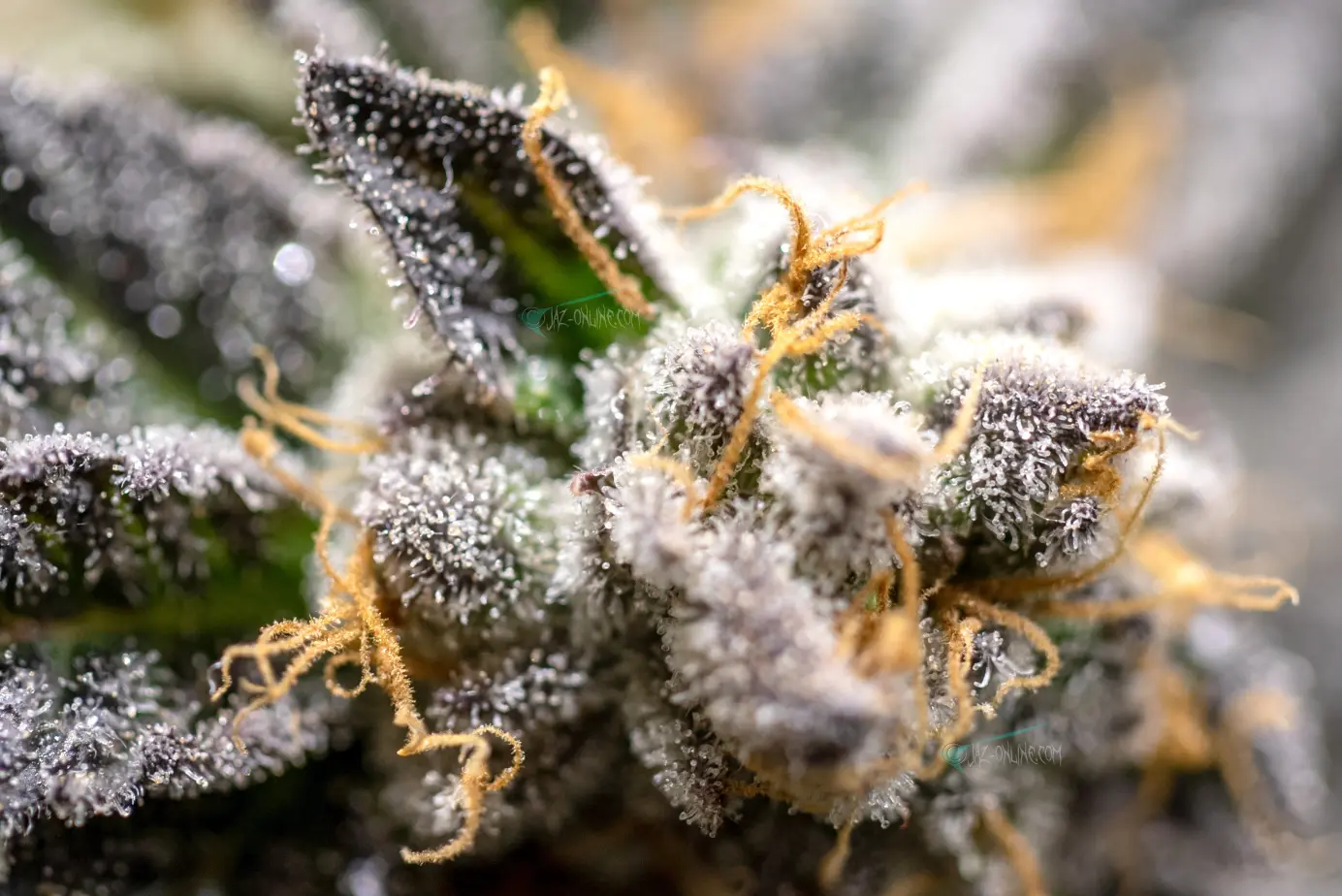
The best Mango Widow flowers can smell unmistakably tropical, but the profile is more interesting when the fruit is supported by citrus peel, sweet green herb and resin. Ripe mango flesh is a useful comparison for some phenotypes; others are closer to mango skin, dried tropical fruit or a mixed fruit bowl. The aroma should not be expected to smell like artificial candy unless a particular phenotype truly leans that way.
Under the fruit sits earth and spice from the Widow side. That base keeps the profile from becoming thin. A light incense or dry Haze note can appear on broken flower, especially in longer-finishing plants.
Grinder aroma can reveal the keeper
Intact buds may smell sweet but restrained. Grinding ruptures more resin-bearing surfaces and can release a stronger combination of mango, lemon-like zest and peppery herb. On the first phenotype run, compare each plant at the same cure age. One phenotype may be visually frostier while another becomes far more aromatic once broken apart.
That comparison is more useful than evaluating living stems alone because it reflects the product that will actually be consumed.
Inhale, exhale and aftertaste
The inhale usually carries the fruit most clearly when the flower has been dried gently. Citrus and sweet mango sit at the front, while earth and resin appear mid-palate. The exhale can become spicier, with a dry herbal or incense-like finish. A well-cured example leaves a faint tropical sweetness after the heavier earth has faded.
A rushed dry reverses that hierarchy. The palate becomes dry wood, pepper and generic earth, with mango reduced to a suggestion in the jar. That is why flavor preservation needs its own cultivation strategy rather than being treated as a cosmetic bonus.
Phenotype and cure create two different kinds of variation
Genetic variation determines what aromas are possible; post-harvest handling determines which of those aromas survive. A Haze-leaning mango phenotype cannot be cured into a dense Widow aroma, and a weakly fruity phenotype cannot be rescued with fruit peels. But excellent drying can preserve a delicate tropical top that would otherwise disappear.
After several weeks of cure, the best jars usually become smoother and more integrated. Mango shifts from a sharp fresh-fruit note toward a deeper dried-fruit sweetness while spice and resin become rounder.
Dominant Terpenes
There is no standardized Mango Widow terpene certificate that defines every phenotype. Recurring descriptions are most consistent with myrcene, limonene and caryophyllene, with other Haze-associated floral, pine or terpinolene-like notes possible in individual plants. Terpenes should be used here as a sensory explanation, not as a promise of a specific mood.
| Terpene Pattern | Flavor / Aroma | Role in Mango Widow |
|---|---|---|
| Myrcene | Ripe fruit, earth, herbal depth | Can support both mango-like ripeness and the earthy base. Its presence alone does not determine whether a phenotype will feel sedating. |
| Limonene | Citrus peel, bright fruit lift | A logical contributor to the lemon-mango top in brighter phenotypes. Heat and extended warm storage can make this part of the profile feel noticeably flatter. |
| Caryophyllene | Pepper, dry spice, warm wood | Adds structure under the fruit and explains the spicier exhale in many Widow-influenced flowers. |
| Variable secondary terpenes | Incense, pine, floral herb | Haze-leaning phenotypes can carry additional aromatic complexity that differs from plant to plant. Laboratory testing of the actual flower is the only way to know the exact balance. |
For quality-focused cultivation, the key is straightforward: protect the fruit fraction first. Earth and pepper can remain after heat abuse, giving the illusion that the flower still has a complete aroma. The loss becomes obvious only when compared with a cooler-grown, slower-dried jar from the same phenotype.
Indoor vs. Outdoor Growing
| Decision | Indoor | Outdoor / Greenhouse |
|---|---|---|
| Phenotype Control | Excellent. Each plant can be trained and harvested on its own schedule, making selection easier | Greater plant size reveals vigor, but weather can mask the true finish quality of later Haze phenotypes |
| Stretch | Manage with short-to-moderate veg, topping and screen space reserved for flower | Less restrictive if there is open space, though large Haze expressions still need support and access |
| Feeding | Moderate input is usually enough; easy to compare phenotypes when nutrition remains consistent | Rich soil can support large plants, but excessive late fertility can keep leaves lush during a long finish |
| Flower Density | Widow-leaning expressions can become compact; Haze plants stay more open | Natural sun can build large flowers, while rain risk rises in denser phenotypes |
| Flavor Control | Strong advantage because late heat, rain and drying environment can be controlled | Potentially excellent fruit complexity, but harvest logistics and hot weather can strip volatile mango notes |
| Training | SCROG and low-stress spreading are especially useful for lateral growth | Topping plus wide open branching usually makes more sense than a formal flat screen |
| Harvest Window | Approximately 8-10 weeks, phenotype-specific | Needs a local autumn long enough for the selected phenotype; greenhouse protection improves reliability |
| Best Fit | Grower hunting a keeper and prioritizing flavor consistency | Warm outdoor or greenhouse grower who can finish and dry each phenotype separately |
Indoor cultivation is especially valuable on the first run because it separates genetics from weather. If one plant stretches 50 percent more or takes a week longer, the grower can record that difference without a rainstorm forcing all plants to harvest together. A screen also makes the Haze side productive rather than merely tall.
Outdoor cultivation can create larger plants and a broad fruit profile, but phenotype choice becomes more consequential. In a short season, the fastest resinous plant may be the practical winner even if a later sibling has more intense mango. In a greenhouse or Mediterranean autumn, the grower can afford to keep the longer aromatic expression. The best environment is the one that lets the preferred phenotype finish, not the one that sounds most natural for cannabis in general.
Strain-Specific Grow Guidance
First run: treat the room as a phenotype trial
Keep environmental variables as consistent as possible so plant differences remain interpretable. Use the same medium, similar root volume and comparable irrigation logic. Label each plant and photograph structure before the flip, during stretch and at the start of real flower stacking. The goal is to learn which traits travel together.
A mango-forward plant that stretches hard but finishes beautifully may be worth the extra training. A frosty compact plant with little fruit may be better for yield but not for the reason you chose Mango Widow. Selection should reflect the intended final product.
Build a screen around lateral branches, not just the main stem
Mango Widow is frequently suited to screen-style growing because the lateral branches can be productive. Top once when the plant is healthy, allow several leaders to establish and spread them into separate lanes. The Haze-dominant expressions will continue to extend, so leave space before the flip. More compact plants can be allowed to occupy slightly more screen area in vegetative growth.
Do not force every sibling to the exact same canopy height by repeated high-stress bending. The phenotype trial is more informative when normal structural differences remain visible. Use gentle guidance to keep the room functional, then record which plant needed the most intervention.
Watch nitrogen before assuming a hungry Haze hybrid
Historical cultivation descriptions often emphasize that Mango Widow does not need strong fertilizer. That fits the practical observation that vigorous sativa-leaning growth can continue on moderate nutrition. Dark glossy leaves, clawing tips and excessive leafy stretch are signs to reduce input rather than add bloom boosters.
Keep transition nutrition balanced while the plant is still extending. Then gradually reduce unnecessary nitrogen as flower mass becomes dominant. There is no reason to starve the plant, but there is also no evidence that forcing high nutrient concentration creates more mango flavor or better resin.
Watering: avoid using the thirstiest phenotype as the schedule for all plants
Phenotype variation can include water demand. A tall Haze expression with more leaf area may dry its pot faster than a compact sibling. If every container is watered on the same clock, one can remain saturated while another becomes too dry. Lift containers, inspect substrate moisture or use appropriate sensors so irrigation follows root-zone reality.
Good drainage is especially valuable because an oxygenated root zone keeps moderate feeding efficient. Overwatered roots can create pale growth that growers misdiagnose as a need for more fertilizer, beginning a cycle of wet media and salt accumulation.
Defoliation should follow phenotype architecture
A Haze-leaning plant with narrow leaves and open spacing may need very little leaf removal. Focus on low shoots that will never reach the light and individual leaves blocking major flower lanes. A Widow-leaning plant can develop denser clusters and a more crowded interior, justifying more selective thinning after stretch.
Using the same heavy defoliation recipe on both expressions erases one of the main lessons of the cultivar. Mango Widow is exactly the kind of strain where adaptive pruning beats calendar pruning.
Light and heat: fruit quality sets the upper limit
Strong light can support resin and yield, but the practical ceiling is the point where upper leaves remain healthy and flowers keep their aromatic clarity. Haze-leaning tops that continue rising can approach fixtures quickly. Raise or spread the canopy before bleaching and chronic heat appear.
High late-flower temperature is especially expensive for mango expression. The flower can remain potent and resinous while losing the volatile fruit note. If the room must choose between maximum intensity and a cooler stable canopy, flavor-focused growers should protect the environment.
Flower development: do not harvest the whole room by the earliest plant
Eight-to-ten-week variation is meaningful. A compact phenotype may be ripe while a Haze sibling is still producing fresh calyxes. Harvesting both together simplifies logistics but defeats phenotype evaluation. If possible, cut each plant when its own maturity signals agree: swollen calyxes, reduced new pistil production, mature resin and a stable aroma.
The longer plant should not be extended forever merely because it is sativa-leaning. Heat-driven foxtails or repeated fresh tips can continue after the main flower is mature. Read representative older flower, not only the newest growth at the top.
Outdoor rain risk depends on which side of the family wins
Dense flowers change the airflow plan
A more open Haze flower sheds moisture more easily than a dense Widow expression. Inspect the actual bud architecture instead of assigning one mold rating to the name. In a humid greenhouse, compact phenotypes need more spacing and stronger air exchange. Outdoor growers should keep dense tops supported and separated so rain does not press flowers together.
If a particularly aromatic phenotype reliably finishes too late for the local climate, it may be an indoor keeper rather than an outdoor failure. Environment matching is part of selection.
Trim quality and resin handling
Widow influence can make sugar leaves very resinous. A precise dry trim often preserves appearance and gives the grower time to separate phenotypes carefully. Haze-leaning flowers may have a slightly higher leaf profile but can still trim cleanly when the productive canopy received enough light.
Handle by stems and avoid repeatedly squeezing aromatic flowers during phenotype comparison. The most resinous plant is also the easiest to damage through unnecessary inspection.
Grower note: On the first Mango Widow run, consistency of environment is more valuable than maximum yield. You are trying to see the plant clearly enough to choose the phenotype worth optimizing on the second run.
Weedth Bud Flavor Tips
Choose harvest timing by aroma plus maturity
Mango aroma can change quickly late in flower. Some plants move from green tropical fruit toward ripe sweetness; others become more resinous and earthy as they mature. Smell the same flower sites regularly rather than relying on a single impression. Harvest when the fruit is fully developed and the resin is mature, not simply on the earliest possible day.
If waiting an extra week produces only more brown pistils while the mango note is fading and the resin is already mature, later is not automatically better. Flavor-focused harvest timing is a balance, not a contest for maximum amber.
Protect fruit during the first hours after cutting
Do not leave branches in warm light while trimming the entire room. Fruit-forward volatiles are especially vulnerable to heat. Move harvested material into darkness and a controlled environment promptly. For outdoor or greenhouse plants, harvest logistics should be planned before the day arrives so a large batch is not stacked in bins while the drying space is prepared.
Wet trimming can expose more surface area and accelerate drying. A partial or dry-trim approach may be better when the room is naturally dry, provided dense phenotypes are monitored carefully for internal moisture.
Dry slowly enough to keep mango but not so slowly that dense Widow flowers become risky
Phenotype again controls the answer. An open Haze flower can lose water relatively quickly and may need protection from an overly dry room. A compact Widow-heavy cola holds more internal moisture and needs sufficient air exchange. Separate plants or branch sizes when necessary instead of forcing one drying schedule onto everything.
Fans should circulate room air, not blow directly on flower. Darkness and moderate temperature protect aromatic quality. The target is an even transition where the outside does not become brittle days before the inner stem and calyxes have equilibrated.
Cure until fruit and resin become one profile
Early cured Mango Widow can smell sharply fruity but slightly green. Over several weeks, spice and earthy resin integrate under the mango. The best jars become smoother without losing identity. If fruit disappears completely, the usual causes are phenotype, heat or over-drying rather than insufficient cure time.
Store stable flower in small airtight containers in a cool dark place. Do not add mango peel or other organic material to 'restore' flavor. That changes humidity and contamination risk but cannot rebuild plant terpenes that were lost.
Indoor and outdoor flavor priorities
Indoors, keep canopy heat stable and use the ability to harvest phenotypes separately. Outdoors, protect flowers from prolonged hot afternoons late in the season where possible and move cut material rapidly to shade. Outdoor sun can create rich resin and complexity, but the harvest process is less forgiving when weather is warm.
The finished goal is not maximum sweetness. It is clear mango over a resinous Haze-Widow base. That layered identity is what separates excellent flower from a generic fruity hybrid.
Weedth Bud Boost Tips
Optimize the chosen phenotype on the second run
The first run identifies the keeper. The second run is where yield optimization becomes meaningful because stretch, feed response and finish time are now known. Clone or otherwise preserve the selected phenotype where legal, then set vegetative duration around its measured stretch rather than a generic estimate.
This alone can increase quality yield because the screen fills more precisely and fewer branches end up shaded or pressed into the light.
SCROG works when the screen is not overcrowded
Mango Widow's lateral growth can convert well into a flat productive canopy. Aim for a limited number of strong branches and give each space to carry a line of flowers. Remove weak growth below the productive plane after stretch rather than keeping every shoot for raw weight.
A Haze-heavy keeper should enter flower with more empty screen. A compact keeper can be vegetated longer. The screen method is the same concept, but the timing is phenotype-specific.
Keep moderate nutrition efficient instead of chasing high EC
A plant that performs on moderate feed has an efficiency advantage. Healthy roots, proper pH for the chosen medium and consistent irrigation allow the plant to use nutrients without excessive concentration. Pushing salts beyond what the leaves can use creates tip burn and root-zone imbalance without proving that flowers will become larger.
This is especially relevant in mid-to-late flower. If the plant is stacking, resin is increasing and leaf color is appropriate, there is no reason to disturb a stable system because another cultivar tolerated stronger input.
Quality yield is the premium canopy, not all biomass
After the stretch, remove low shoots that remain below useful light and small inward branches that increase humidity. This can reduce the number of tiny buds while improving the size, resin and trim quality of the upper flowers. The goal is not to make the plant empty underneath by rule; keep lower sites that genuinely receive light in a wide outdoor frame.
A clean productive zone also simplifies phenotype comparison because the final yield reflects the plant's real high-light flower potential rather than variable amounts of larf.
Support the resinous phenotype before weight changes branch angle
Widow-leaning plants can add enough flower density late that flexible branches begin to sag. A trellis is already present in many indoor runs, which makes support simple. Outdoors, stakes or a broad net prevent mature flowers from falling into one another after rain or wind.
Support is a quality tool as much as a yield tool. Upright separated flowers receive more even light and air and suffer less trichome abrasion.
Do not use stress myths as a bud booster
There is no need to subject Mango Widow to extreme drought, long darkness, excessive ultraviolet exposure or aggressive late pruning in the hope of manufacturing resin. Evidence for many traditional stress tricks is limited or context-dependent. A flavor-first phenotype already has the genetic capacity to produce resin. Stable health lets it express that capacity more reliably.
If yield is disappointing, first audit canopy fill, root health, light distribution, vegetative duration and phenotype. Those variables have clearer practical relationships with usable flower than a dramatic last-week trick.
Medical Uses & Benefits
Reported mood and stress use
Mango Widow's uplifting opening and later physical calm make it appealing to some users for subjective stress relief or low mood. The balanced progression can feel less sedating than a heavy indica and less sharply stimulating than a pure Haze, depending on phenotype and dose. That can suit users who want to remain engaged while feeling less tense.
These are user-reported experiences, not proof that Mango Widow treats anxiety or depression. High-THC flower can worsen anxiety in sensitive users, especially when the Haze side is strong.
Pain and tension
Some users report that the body phase makes everyday aches or muscular tension less intrusive. THC can alter pain perception, and caryophyllene is biologically interesting, but cultivar-specific clinical evidence is not available. Medical consumers should rely on the tested cannabinoid profile of the actual batch and professional guidance when appropriate.
Appetite and nausea
Appetite may increase later in the session, particularly with a more relaxing phenotype. Cannabis is also used medically for nausea in some contexts, but individual response varies and high chronic exposure has its own risks. The strain name should not be used as a dosing protocol.
Daytime versus evening medical fit
A light dose of a Haze-leaning phenotype may fit daytime use better, while a dense Widow-leaning plant may be more comfortable in the evening. Patients should treat phenotype and dose as part of the product identity rather than assuming every Mango Widow jar has the same functional window.
Ideal User Profile
Choose Mango Widow if flavor and hybrid balance matter more than uniformity
The ideal user enjoys tropical fruit but wants more resinous depth and body calm than a pure fruit sativa provides. They are comfortable with THC and prefer an experience that can begin creative or social before becoming more relaxed. A person who loves mango aroma but dislikes incense, earth or spice should not assume every phenotype will be pure fruit.
The ideal grower likes phenotype hunting. They have enough space to keep plants separate, can record differences and are willing to wait until after cure before making a final selection. This is not a strain that rewards choosing the keeper only by vegetative vigor.
Best time and setting
Late afternoon and early evening are flexible windows for many users. A modest dose can suit music, socializing, food or creative work. A larger dose or a heavier phenotype is better when the schedule allows physical relaxation afterward. Avoid safety-critical activities regardless of how clear the first phase feels.
Less ideal for
Growers who demand identical plants from seed, very fast turnover or a fixed eight-week room may find the variation frustrating. Users who are extremely sensitive to THC-related anxiety should approach Haze-leaning expressions cautiously. People seeking immediate heavy sedation may prefer a more consistently indica-dominant cultivar.
Grower Notes and Feedback
Phenotype variation is the headline, not a footnote
Recurring reports emphasize that selection matters. Some plants are clearly more Haze-like, stretching harder and running longer, while others are shorter and more resin-focused. Yield figures quoted for the strain are therefore less useful than a range unless the phenotype and method are described.
Growers who keep clones of promising plants often get far more value from the second run because the first cycle reveals how much space each expression actually needs.
Moderate feeding surprises growers used to aggressive hybrids
Another recurring pattern is that excellent results do not require a heavy nutrient program. Dark leaf color and burnt tips can appear before additional feed creates any obvious benefit. This reinforces the value of healthy roots and steady irrigation over high concentration.
A plant that looks slightly lighter than a heavily fed neighboring cultivar may still be exactly where it should be. Compare growth and flower development, not just leaf darkness.
The mango can disappear after harvest if the dry is poor
Flavor-focused growers frequently notice that fruit intensity changes more from drying than they expected. A living plant can fill the room with tropical aroma and then produce a jar dominated by earth after a hot rapid dry. The genetics did not vanish; the volatile balance changed.
Separate phenotype drying also matters. Open Haze flowers can become too dry before dense siblings are safe to jar.
SCROG is useful, but only after the grower understands stretch
Screens are repeatedly associated with Mango Widow because the branches spread well. The mistake is filling every square too early. Once the specific phenotype's stretch is known, the method becomes much more efficient. Before that, leave extra room and accept a slightly less full pre-flower canopy.
Growers who follow that approach usually report fewer emergency bends and a more even premium flower zone.
The best-looking plant is not always the best smoke
A very frosty compact phenotype can dominate visual selection, yet a looser fruit-heavy sibling may have the aroma and effect that make the cultivar special. That is why the first run should finish with a blind or at least disciplined post-cure comparison. Bag appeal is one criterion, not the final verdict.
The strongest selection combines finish time, manageable growth, resin, distinctive mango expression, smoothness and preferred effect.
Weedth Editor's Note
How I would judge the finished flower
I think Mango Widow is easiest to misunderstand when the name becomes the selection criterion. I would not keep a plant simply because it smells most like mango in mid-flower. I would keep the plant that still smells like mango after drying, still has enough resin and structure to justify the space, and finishes without forcing the whole room to wait on one stubborn phenotype.
My first run would be intentionally conservative with feed. If the line already has a reputation for performing without heavy fertilizer, I want to see the natural differences between plants rather than covering them with dark, overfed growth. Moderate nutrition also makes it easier to spot which plant actually has the efficient root system and flower vigor I want to preserve.
I would use a screen, but I would leave it visibly unfinished before the flip. That empty area is insurance against the Haze side. After I know the keeper, I can become more aggressive on the second run and fill the canopy with measured confidence instead of guesswork.
The part I care about most comes after harvest. Fruit-forward cannabis is unforgiving of heat. If a carefully selected mango phenotype becomes generic earth in the jar, I would audit the dry before blaming the genetics. The flower does not need gimmicks; it needs a gentle transition from living plant to stable cured bud.
For me, Mango Widow is worth growing when phenotype selection sounds interesting rather than inconvenient. Its variability is the work, but it is also the path to the best version of the strain.
Weedth Score
Growing Experience – 8.1/10
Responsive and screen-friendly, with deductions for phenotype variation and the need to adapt feeding and stretch management plant by plant.
Bud Structure & Visual Appeal – 8.6/10
Strong resin potential and attractive hybrid flowers, though Haze-dominant plants can be more open than modern density-focused growers expect.
Aroma Complexity – 9.0/10
Excellent phenotypes combine mango, citrus, herb, spice, resin and light incense rather than offering one-dimensional fruit.
Flavor & Smoothness – 8.8/10
Superb with a careful dry and cure. The bright fruit fraction is fragile enough that poor post-harvest handling deserves a real deduction.
Effects & High Experience – 8.6/10
A versatile cerebral-to-body hybrid progression, with phenotype-dependent variation that can be either a strength or a consistency problem.
Overall Satisfaction & Recommendation – 8.7/10
Highly recommended to flavor-focused growers who enjoy selecting a keeper; less ideal when uniform seed-to-seed production is the priority.
Personal closer: The Mango Widow I would keep is not the loudest plant in the room; it is the one that carries its mango identity all the way into a smooth cured jar.
FAQ
Why do Mango Widow plants look so different from each other?
The cross combines a mango-Haze family with Widow-family genetics, so offspring can inherit different proportions of stretch, flower density, finish time and aroma. Meaningful phenotype variation is expected. Use the first run to record those differences rather than assuming one plant is wrong.
How long does Mango Widow flower?
Approximately eight to ten weeks is a useful indoor range. More compact Widow-leaning plants can finish toward the early end, while Haze-dominant expressions may need the full longer window. Harvest each phenotype according to actual maturity.
Is Mango Widow good for SCROG?
Yes. Flexible lateral branches and sativa-leaning stretch make a screen useful. Leave open screen area before flowering, especially on an unknown first run. Once the keeper's stretch is measured, the screen can be filled more precisely on later cycles.
Does it need heavy nutrients?
Generally not. Historical grow descriptions repeatedly indicate that moderate fertility is sufficient. Stronger feed should be justified by plant response, not by the assumption that more nutrients automatically create more yield or flavor.
Why does my plant not smell like mango?
Phenotype is the first explanation. Some plants emphasize earth, spice or Haze incense more strongly. Environment and drying also matter. High late-flower heat or a rapid dry can remove bright fruit notes even when the living plant smelled tropical.
Should I keep the frostiest phenotype?
Only if it also meets your other goals. Resin coverage is valuable, but a less frosty-looking plant may have superior mango aroma, smoother smoke or a better effect. Evaluate after cure before making the final keeper decision.
Is it mold resistant?
There is no single answer because flower density varies. Open Haze phenotypes may ventilate better; dense Widow-leaning tops can hold more moisture. Manage each plant's actual architecture, especially outdoors or in humid greenhouses.
When should I harvest for the best mango flavor?
Look for full resin maturity and a ripe stable fruit aroma rather than waiting automatically for the latest possible harvest. If the mango note peaks and then begins flattening while the main flowers are already mature, extra days may not improve flavor.
Is Mango Widow beginner-friendly?
A careful beginner can grow it, but phenotype variation adds complexity. It is easier for someone who already understands basic watering and training and is ready to adjust vegetative time and pruning to individual plants.
Does the cure really change the flavor?
Yes, mainly by reducing green harshness and integrating fruit with earth and spice. Cure cannot create mango that was genetically absent or restore terpenes lost to heat, but good curing can make a promising phenotype substantially smoother and clearer.
Similar Strains
White Widow
A direct family comparison for resin, hybrid vigor and earthy-spicy depth. White Widow is generally more uniform and less mango-forward, making it useful for growers who like the frost and balance but want fewer phenotype decisions.
Super Silver Haze
Similar for Haze-influenced stretch, bright cerebral effects and citrus-incense complexity. It usually leans less tropical-mango and may flower longer, while Mango Widow adds more body calm and Widow-style resin.
Mango Haze
The closest flavor-side comparison. Mango Haze emphasizes tropical fruit and Haze structure more strongly, often with a longer or more sativa-like grow. Mango Widow is the better option when the grower wants fruit plus denser resinous hybrid traits.
SAGE
Comparable for sativa-leaning structure, aromatic complexity and the need to respect stretch. SAGE tends to be more herbal, sandalwood and spice-forward, while Mango Widow offers a clearer tropical fruit target.
Chocolope
A useful alternative for growers who like clear creative effects and long lateral growth but want cocoa, coffee and sweet earth rather than mango-resin flavor. Chocolope can also reward screens and height planning.
Mimosa
Similar for bright fruit and an uplifting opening, but Mimosa usually emphasizes citrus and orange over mango and tends to come from a more modern dense-flower background. Mango Widow feels more Haze-like and phenotype-driven in structure.
Share this article
A quick overview of the topics covered in this article.
Follow us
Latest articles
September 9, 2026
September 9, 2026
September 9, 2026