
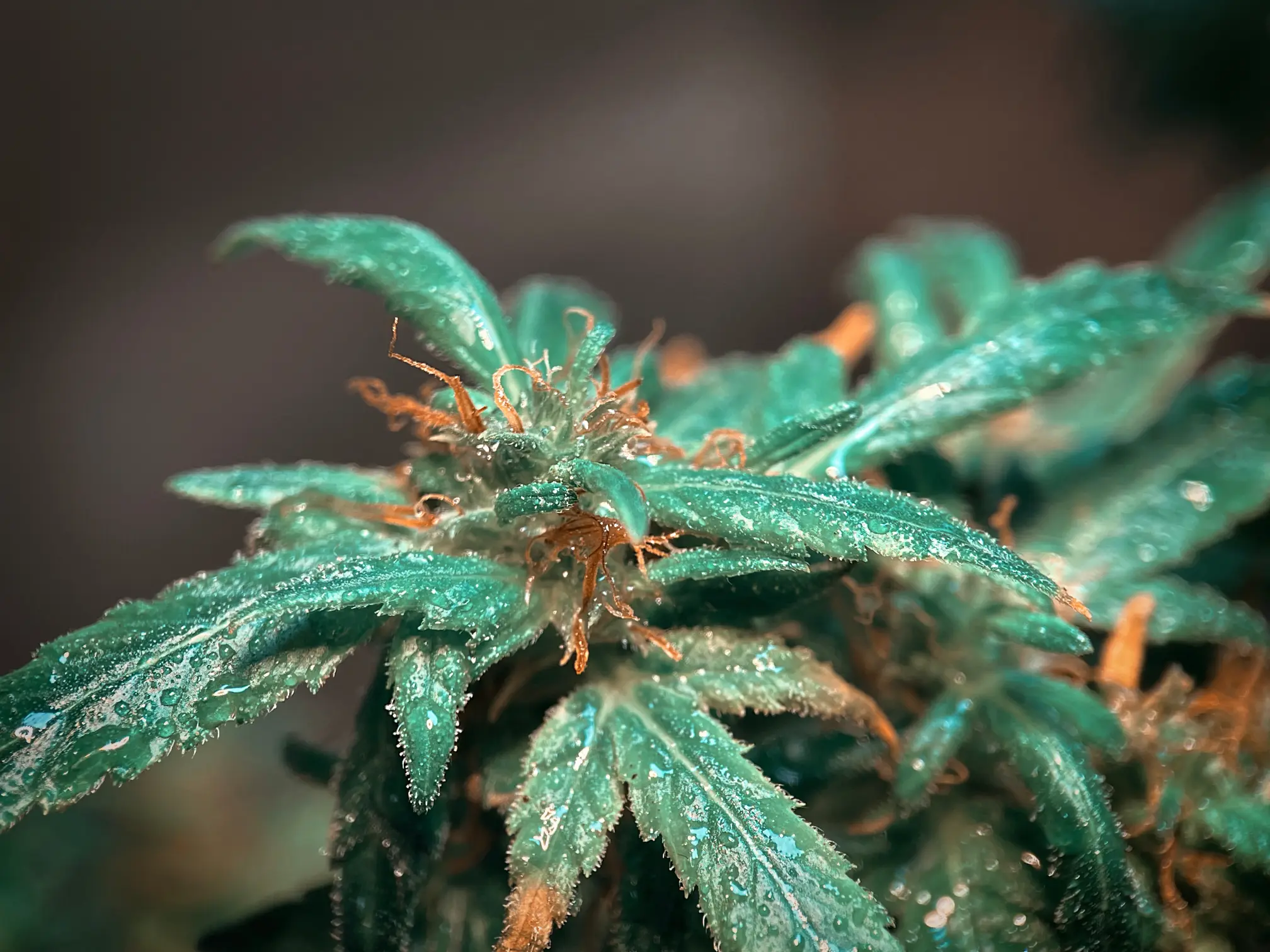
Motorbreath
Motorbreath is a cultivar where the name describes the sensory target almost perfectly. The best flower smells like fuel, hot machinery, chemical cleaner, pepper, wet earth, sour citrus, and greasy resin. That aroma can become so dominant that growers focus on smell and potency while overlooking the real cultivation problem: Motorbreath can build dense, heavy flowers on a medium frame, and the same compact stacking that produces bag appeal can create late-flower moisture and support problems.
The lineage is usually described as Chemdog crossed with SFV OG Kush. The widely discussed #15 selection is one of the best-known expressions, but not every plant sold under the Motorbreath name should automatically be treated as that exact cut. Modern seed lines range from roughly eight or nine weeks to ten or eleven weeks in flower, and reports vary from tight internodes to more noticeable transition stretch.
That variation makes one fixed grow recipe unreliable. Motorbreath should be treated as a medium-height Chem-OG plant that may stretch enough to double, then rapidly converts that structure into dense resinous flower. The safest training approach is to establish a few strong leaders, spread them early, and stop adding branch count once the canopy is full.
Feeding deserves the same caution. Some Motorbreath material is marketed as easy and tolerant. Other grow records describe stronger mineral demand. A grower can use that information without turning it into an aggressive recipe. Dense greasy flowers are genetic; excessive nitrogen or salts do not create gas terpenes.
Post-harvest is unusually important because a fuel-heavy cultivar can smell powerful even after quality has been lost. The deepest gas and earth notes survive rough drying more easily than sour citrus, pepper, and the cleaner resinous edge. Exceptional Motorbreath should smell offensive in a complex way, not merely harsh.
Strain Features
| Feature | Details |
|---|---|
| Strain Type | Indica-leaning Chem-OG hybrid; exact dominance varies by line |
| Genetic Profile | Chemdog × SFV OG Kush |
| Common Named Selection | Motorbreath #15 is a widely recognized phenotype, but not every modern Motorbreath plant is the same cut |
| THC | Frequently high, often in the low-to-upper 20% range |
| CBD | Usually very low |
| Dominant Terpenes | Limonene, beta-caryophyllene, and myrcene recur frequently |
| Flavor / Aroma | Diesel, chemical cleaner, grease, pepper, earth, sour citrus, skunk, pine |
| Effect Character | Strong euphoria followed by heavy relaxation, tingling, appetite, and possible sleepiness |
| Flowering Time | Commonly 9 to 11 weeks across modern lines; some selected cuts finish earlier |
| Outdoor Harvest | Often early to mid October in suitable Northern Hemisphere climates |
| Grow Difficulty | Moderate |
| Stretch | Moderate and phenotype dependent; some plants approach roughly double their flip height |
| Plant Architecture | Medium height, sturdy branches, regular-to-tight internodes, broad leaves |
| Bud Density | Dense to very dense |
| Resin Production | Very high, often greasy and sticky |
| Training Compatibility | Topping, LST, open SCROG, and branch support |
| Humidity Risk | Moderate to high in dense late flowers |
| Odor Intensity | Extremely strong |
| Best Time of Use | Evening and nighttime |
Genetic Lineage
Motorbreath combines Chemdog with SFV OG Kush. The cross concentrates two families famous for pungent chemical, fuel, earth, pine, and citrus aromas, so the finished flower rarely feels subtle.
Chemdog contributes raw chemical funk, sour fuel, potency, and a tendency toward vigorous hybrid growth. SFV OG contributes pine, lemon, OG resin, and a more structured Kush finish. The combination usually produces a medium plant rather than an extreme sativa or squat indica.
The #15 designation refers to a particular selected Motorbreath phenotype that became especially recognized. Growers should avoid assuming that any seed-derived plant called Motorbreath #15 is genetically identical to a historic clone. The useful approach is to document the exact plant and treat named-cut claims cautiously.
Modern cultivation descriptions disagree on exact flowering time. Some place mature flower near eight to nine weeks, while others run ten to eleven. That range is wide enough that harvest should be based on the plant's calyx development, resin maturity, and aroma rather than a fixed schedule.
Keeper selection should prioritize more than gas intensity. A plant that smells like raw fuel but produces unstable branches, excessive internal density, or flat flavor after cure may be less valuable than a slightly less aggressive-smelling phenotype with better structure and storage stability.
Effect Breakdown
Motorbreath is usually too potent to describe as casually functional. The first phase can bring a fast euphoric lift, a tingly mental shift, and a sense that the body is beginning to loosen even while the mind remains engaged.
At a restrained dose, experienced users may find the early phase pleasant and social. Thoughts can wander in an enjoyable way, music becomes absorbing, and tension begins to drop without immediate couch-lock.
The physical effect becomes stronger with time. Muscles relax, appetite often increases, and the user's willingness to continue demanding activity falls. The experience can move from euphoric to deeply settled rather than simply becoming sleepy at once.
Higher doses are heavy. Mental concentration weakens, the body feels weighted, and sleep becomes more likely. This is where the cultivar's high-THC reputation matters. New users can overshoot quickly.
Dry mouth and dry eyes are common. Dizziness and anxiety are also reported, particularly when a user takes a large dose before the full body phase has arrived.
The overall arc suits evening use. Motorbreath can begin lively enough to feel social, but its natural destination is relaxation rather than sustained productivity.
Tolerance changes the perceived balance dramatically. A frequent THC user may describe Motorbreath as euphoric and relaxing without being incapacitating, while a low-tolerance user can experience the same flower as overwhelming and sleep-inducing. This explains why user reports range from focused and giggly to extremely heavy.
The onset also makes redosing a practical issue. The first cerebral lift can arrive before the full body weight, so waiting for the second phase is more sensible than assuming the initial head change represents the complete effect.
Flavor & Aroma Profile
Motorbreath is famous for fuel, but high-quality flower has more layers than gasoline. Chemical cleaner, grease, diesel, wet earth, black pepper, sour lemon, pine, and skunk can all appear in the same jar.
The smell often begins before late flower. Some growers report pungency even in vegetative growth. That early odor should not be used as a maturity signal, but it is a useful warning that odor control needs to be installed before the final weeks.
Breaking the bud releases the harshest-smelling layer. Dense greasy flower can smell almost metallic or oily inside, while the outside of the nug carries more earth and lemon.
On inhale, sour citrus and earthy resin can appear first. The exhale becomes peppery, chemical, and diesel-heavy. The flavor is intentionally aggressive, but good flower should still feel clean enough that 'chemical' does not become 'burnt plant matter.'
The terpene table does not fully explain the garage-like aroma. Cannabis fuel and skunk perception likely involves complex mixtures of minor volatiles as well as the common terpenes. The grower should therefore judge finished aroma from the flower itself rather than trying to recreate the strain from three terpene percentages.
Fast drying exaggerates the rough side. Fuel remains while citrus and nuanced spice fade. The result can smell strong but taste one-dimensional. Proper cure separates the grease, pepper, sour lemon, and earth instead of blending them into harsh smoke.
Dominant Terpenes
| Terpene | Aroma Role | Cultivar Relevance | Scientific Caution |
|---|---|---|---|
| Limonene | Citrus peel, sour lemon | Frequently reported as dominant and fits the sharp citrus edge beneath the fuel | Does not guarantee uplift or anxiety relief |
| Beta-caryophyllene | Black pepper, dry spice, wood | Matches the peppery chemical finish | CB2 activity does not establish cultivar-specific medical benefits |
| Myrcene | Earth, herbs, musk | Supports the wet-earth and heavy herbal background | Does not independently explain sedation |
| Pinene / minor conifer terpenes | Pine, resin | Can reinforce the OG side of the aroma | Presence and concentration vary by batch |
Motorbreath is a strong example of why a terpene list cannot capture total aroma. The perception of grease, fuel, industrial cleaner, and skunk can involve low-concentration volatile compounds that have a large sensory impact.
Limonene, caryophyllene, and myrcene are recurring anchors, but the final effect and smell should not be reduced to those molecules alone.
Indoor vs. Outdoor Growing
| Decision Point | Indoor | Outdoor |
|---|---|---|
| Primary Challenge | Keeping dense Chem-OG flowers separated through a 9-to-11-week finish | Managing plant size, odor, and late-season moisture |
| Stretch | Moderate; some plants can approach roughly double in transition | More vertical freedom, but larger branches need support |
| Training | Topping plus LST or a loose screen works well | Early topping and outward branch spacing are usually enough |
| Bud Density | High, making internal airflow important | Dense flowers require a dry finishing period |
| Odor | Extremely strong and easier to contain indoors | Can travel far from an outdoor plant |
| Feeding | Controlled irrigation helps distinguish true demand from root-zone stress | Large roots can support vigorous growth but do not guarantee heavy demand |
| Support | A second net or soft ties are useful late | Cages or perimeter stakes protect large branches |
| Best Fit | Growers comfortable with potent odor, dense flowers, and phenotype-aware harvest timing | Warm dry climates with privacy and a long enough season |
Motorbreath is manageable indoors because its final height is usually medium rather than extreme. The risk is horizontal and internal density, especially after the stretch is finished and flowers begin stacking quickly.
Indoor growers also gain control over drying, which matters greatly for fuel-heavy flower. A stable post-harvest environment helps preserve sour citrus and pepper instead of leaving only coarse diesel.
Outdoors, the cultivar can become significantly larger than the indoor version. Reports of very large plants show that the genetics can scale when root volume and season length are available. That size magnifies odor and branch-support requirements.
A covered greenhouse can protect flowers from rain, but it must ventilate properly. Dense Motorbreath buds under a humid roof are not safer simply because direct rainfall is excluded.
Indoor plant count should be conservative enough that every mature top can be reached. Motorbreath's odor and density make inspection especially important, and a wall-to-wall room can turn small problems into hidden late-flower losses.
Outdoor growers should also remember that large plants need a correspondingly large drying plan. A legal outdoor plant can produce far more dense flower than a small indoor setup, and the post-harvest room must be able to handle that moisture load without heat or crowding.
Strain-Specific Grow Guidance
Flip With Stretch Reserve, Not Empty Vertical Space
Do not let the stretch make the decisions
Motorbreath often shows a moderate transition stretch and some modern lines can approach roughly double their flip height. Do not flower a tiny plant expecting it to become a tree, but leave enough reserve that the tallest leaders are not forced into emergency bending.
Record the stretch of the actual phenotype. The second run becomes much easier once the grower knows whether the clone adds 50 percent, doubles, or barely moves.
Top Early and Keep the Best Leaders
Topping and LST are repeatedly recommended because the plant responds well to a multi-branch shape. The first topping should create the future flowering framework, not begin an endless sequence of cuts.
Once several strong laterals occupy the footprint, stop multiplying tips. Dense Motorbreath buds need space more than they need maximum branch count.
Use LST to Preserve Growth Momentum
Chem-OG plants can recover from high-stress work, but there is little reason to keep cutting when simple branch positioning solves the problem. Flexible ties can keep leaders separated throughout the early transition.
If one branch becomes dominant, lower it gradually rather than creating a severe bend late in stretch.
Keep Internodal Stacking From Becoming Canopy Compression
Regular or tight internodes are useful because they create continuous flower mass. They become a problem when several branches occupy the same vertical plane.
The grower should be able to see air between major flowering columns. If the tops are touching before mid-flower, they will be too close once they swell.
Remove Weak Interior Shoots After Stretch
The lower center of a Motorbreath plant can produce many small sites that remain shaded under broad leaves and dense upper flowers. Once stretch settles, remove shoots that have no realistic path to good light.
Keep strong outer laterals that reach the canopy. The objective is a shallow productive zone, not a bare trunk.
Feed From Plant Demand, Not Fuel-Strain Reputation
Motorbreath can grow vigorously, and some lines tolerate strong nutrition. That does not mean the plant needs maximum feed from the beginning.
Use water consumption, new growth, leaf tone, and tip condition to decide whether input should rise. Excessive mineral concentration can slow water use and create a false impression that the plant is hungry.
Do Not Let Nitrogen Thicken an Already Dense Canopy
Late nitrogen excess increases leaf mass around flowers that are genetically inclined to stack tightly. That extra foliage slows drying after lights-out and reduces light penetration.
Maintain green functional leaves without trying to keep the plant vegetatively dark until harvest.
Keep the Root Zone Predictable Through the Long Finish
A nine-to-eleven-week cycle gives root-zone mistakes time to accumulate. Chronic saturation, salt buildup, or repeated severe drought can reduce late swelling.
Adjust irrigation to actual demand. If the plant starts drinking more slowly after stretch, the watering schedule should change even if the nutrient recipe does not.
Humidity Control Must Reach the Flower Interior
Motorbreath flowers can become dense and greasy enough to hold moisture around the central stem. Good room RH is useful but not sufficient.
Inspect sugar-leaf bases, hidden bud contact points, and the back side of large tops. Separate flowers that lean together before they create a stagnant pocket.
Install Support Before the Greasy Weight Appears
Late resin and calyx mass can pull branches downward. A second net, stakes, or soft ties should be ready before the plant visibly needs them.
Support should maintain air gaps. Pulling multiple colas into one central tie reduces the very airflow the plant needs.
Harvest When the Gas Becomes Clean, Not Merely Loud
Motorbreath can smell extremely strong before it is fully mature. The correct window combines calyx swelling, mature flower trichomes, reduced fresh pistils, and a complete gas-pepper-citrus profile.
An early cut can preserve more mental brightness and sour citrus. A later mature cut deepens body weight, earth, and grease. The best window depends on phenotype and user preference, but immature harshness should not be mistaken for desirable chemical funk.
Odor Management Should Be Independent From Airflow Management
Motorbreath can become extremely pungent early enough that growers may be tempted to increase extraction or fan speed simply because the room smells stronger. Odor containment and canopy airflow are related but not identical problems.
The flower needs gentle, consistent air movement through the canopy. Odor should be managed with the room's containment system rather than by blasting the plant with more direct airflow, which can dry leaf surfaces and later damage flower quality.
Medium Height Does Not Mean a Shallow Root Requirement
A Motorbreath plant may remain only medium height indoors, yet dense flower and a long finish can still demand a substantial functioning root system. Undersized containers can create rapid dryback, salt concentration, and unstable irrigation deep into bloom.
Choose root volume according to intended canopy size and production method rather than final height alone. A wide multi-branch plant needs more root support than a narrow central-column plant of the same height.
Chem-OG Branches Should Be Spaced Before the Grease Arrives
The resinous character becomes physically inconvenient late in flower. Sticky tops are harder to move without damaging trichomes or transferring resin onto hands and supports. Make the major spacing decisions while the flowers are still small.
If two branches are likely to collide, redirect one during transition. Late correction is messier, riskier, and more likely to create a compressed support point.
Watch for the Difference Between Healthy Fade and Root Failure
A long-finishing Motorbreath can naturally lose some lower leaf color near maturity, but rapid whole-plant yellowing while the buds are still actively building can indicate root-zone stress, underfeeding, or irrigation problems.
Do not force a dramatic fade because of the idea that yellow plants smoke better. Smoothness depends far more on healthy flower development and controlled drying than on deliberately creating deficiency.
The Final Two Weeks Should Be an Aroma and Moisture Audit
Once structure is fixed and flowers are dense, the grower's job becomes observational. Check whether the gas profile is becoming cleaner, whether water demand is changing, whether any leaves die unexpectedly from the base, and whether branches remain separated.
Major nutrient or training changes this late often create more risk than benefit. Stable conditions allow the plant to finish the resin and calyx development already in progress.
Outdoor Size Can Turn Odor Into a Security Constraint
A large outdoor Motorbreath can produce far more odor than a small indoor plant. The cultivar's intense volatile profile may travel well beyond the garden, especially in still evening air.
Where cultivation is legal, site planning should still account for privacy and neighboring properties. The plant's smell is a biological trait, not a problem that can be solved at harvest.
The Best Canopy Is Often Less Full Than the Plant Can Produce
Motorbreath can release enough lateral growth to fill a footprint rapidly after topping. That vigor makes it tempting to keep every branch that reaches the screen. The problem is that late flower adds far more physical volume than early flower suggests. A canopy that looks only slightly crowded in week three can become a mass of touching greasy tops later.
Leave deliberate empty lanes between the strongest leaders. Those spaces are not lost yield. They become airflow, inspection access, side light, and room for the flowers to expand.
Use the Lower Nodes as a Quality Test
After stretch, compare the development of the lower nodes on each retained branch. If the upper half is stacking strongly while the bottom remains leafy and soft, the productive zone is too deep. Removing those weak lower clusters concentrates the harvest into flower that can actually reach the cultivar's dense resinous standard.
If lower nodes mature well because branches are widely spaced, keep more of them on the next run. Motorbreath should be refined from its actual light response rather than from a fixed lollipopping height.
Weedth Bud Flavor Tips
Motorbreath's brightest notes are sour lemon and fresh pepper. Diesel, earth, and chemical funk survive abuse more easily. Preserve the bright layer if the goal is complex rather than merely aggressive flower.
Do not harvest because the room already reeks. Odor intensity begins early and is not a reliable maturity test. Wait for complete flower structure and resin maturity.
Dry dense branches evenly and without high heat. A fuel-heavy room can smell powerful while volatile citrus is disappearing, so aroma intensity alone should not guide the dry.
Avoid direct fan air. The surface of a greasy bud can become crisp while the center remains wet, creating an uneven cure and harsher smoke.
During cure, the chemical edge should become smoother without disappearing. Pepper, sour lemon, earth, and greasy fuel should separate rather than turn into hay and solvent.
Evaluate phenotypes after several weeks of storage. A plant whose fuel identity remains distinct and whose citrus does not disappear has more keeper value than one that is loud only at harvest.
Use cool airtight storage and minimize repeated opening. Motorbreath's darker odor lasts a long time, but the clean top notes do not.
Motorbreath also rewards a slow sensory comparison between the first week of cure and later storage. Early flower can smell sharply chemical, while a cleaner sour-citrus and pepper layer often becomes easier to recognize after internal moisture stabilizes.
The strongest phenotype is not necessarily the best-tasting phenotype. A plant can be explosively gassy but harsh, while another carries slightly less raw intensity and a much more complete fuel-lemon-pepper progression.
For keeper selection, evaluate the exhale and aftertaste. True quality should remain distinct after smoke or vapor, not disappear into generic burnt fuel.
The sour component is particularly useful when comparing plants. A finished jar that contains only blunt fuel can be impressive for a few seconds, but the phenotype that keeps a sour citrus edge over the grease usually tastes more complete through an entire session.
Drying-room temperature should be judged at the canopy level of the hanging flowers, not only from a distant room sensor. Large moisture loads can create warmer or more humid pockets around closely hung branches, especially during the first days.
Weedth Bud Boost Tips
Motorbreath's best quality yield comes from a medium canopy with enough selected branches to use the light and enough empty space to keep dense flowers apart.
One topping plus LST is often sufficient. The cultivar's own vigor can build the rest of the canopy without repeated high-stress training.
Remove deeply shaded interior sites after stretch. Those buds usually remain smaller and leafier while increasing humidity and trim labor.
Support long leaders before the final weeks so dense tops stay in their intended light position.
Outdoors, large root volume can create enormous plants. That potential only becomes useful yield when branch spacing, support, and autumn weather allow the flowers to finish cleanly.
Do not chase gas aroma with stress or extreme nutrient concentration. The fuel character is genetic and post-harvest sensitive, not a reward for pushing the plant into toxicity.
The target is greasy, dense, mature flower with clean airflow and a layered fuel profile, not the largest possible mass of pungent biomass.
Uniform branch height also improves drying consistency. When the crop contains similar-sized dense tops, the post-harvest room can be managed more predictably than when one plant produces a few giant colas and many small lowers.
If a phenotype repeatedly requires extreme support, compare whether that extra labor is justified by flavor and yield. A slightly sturdier sister can be a better long-term keeper even if the most dramatic plant looks better on harvest day.
Medical Uses & Benefits
Motorbreath is commonly chosen by users seeking stress relief, physical relaxation, mood improvement, appetite, pain distraction, and sleep. These are user-reported patterns rather than clinical evidence.
The strong body phase may make muscular tension or persistent discomfort feel less intrusive, especially at evening doses.
Users often report euphoria and a positive mental shift before the heavier phase, which may be one reason the strain is chosen for stress or low mood.
The same potency can work against sensitive users. Anxiety, dizziness, dry mouth, and cognitive impairment can appear at higher doses.
Motorbreath is typically THC-dominant with very little CBD. It should not be presented as a low-intoxication medical option.
Anyone using cannabis for a diagnosed condition or with prescription medication should seek guidance from a qualified healthcare professional.
Ideal User Profile
Motorbreath suits experienced consumers who actively enjoy gas, diesel, pepper, chemical funk, and earthy resin. Someone who dislikes those aromas is unlikely to be converted by a well-grown batch.
It fits evenings, films, music, food, and quiet social settings. Low doses may remain engaging, but the full effect usually moves toward deep relaxation.
Beginners should be cautious because the potency can be high and the flavor is smooth enough in good flower to make overconsumption easy.
For growers, Motorbreath fits a room with strong odor control, reliable late-flower humidity management, and enough patience for a nine-to-eleven-week finish.
It is less ideal for growers who need a discreet outdoor plant or an extremely short flowering schedule.
Grower Notes and Feedback
Grow reports consistently describe a medium rather than extreme final height, but notable transition stretch is common. Some plants remain tighter while others approach roughly double in size.
Topping and LST are repeatedly recommended. This fits the cultivar's ability to build several strong leaders without requiring a very long vegetative period.
Flowering-time reports range from roughly eight or nine weeks to ten or eleven. This suggests named cuts and seed-derived lines should not be treated as one universal schedule.
Dense resinous flowers are a recurring positive trait. The same structure creates a clear need for late-flower airflow and support.
Odor intensity is one of the most stable cultivar traits. Fuel, chemical cleaner, pepper, earth, sour citrus, and skunk appear across many descriptions.
Some growers report strong smell even before flower. That makes odor control a cultivation planning issue rather than a late-flower afterthought.
Growers commonly disagree about whether Motorbreath is easy or demanding. That disagreement makes sense because modern seed versions and named cuts can differ, and a medium-sized plant can still become difficult once dense flowers, odor, and a long finish overlap.
The safest conclusion is that basic growth is not unusually fragile, but premium results depend on canopy spacing, root stability, and patient post-harvest handling.
Another practical pattern is that dense Motorbreath tops can appear visually finished before the lower calyxes along the same branch have fully hardened. A grower comparing top-only photographs can therefore underestimate the value of the final part of the flowering window.
A repeat clone run is the best way to resolve the wide published flowering range. Once the exact cut is known, the grower can record when stretch stops, when support becomes necessary, and when the gas profile stops improving. Those dates are more useful than a generic strain average.
Weedth Editor's Note
Where Motorbreath earns its space
I would keep Motorbreath structurally simpler than its vigor might tempt me to. The plant can create plenty of flower sites without turning the canopy into a maze.
My first run would use one topping, wide branch spacing, and an adjustable support net. I would record stretch carefully because that number determines the next run's exact flip height.
I would also separate odor intensity from quality. The plant is likely to smell strong no matter what. My keeper would need to preserve sour citrus and pepper after cure, not just produce the loudest raw fuel smell in week seven.
Feeding would stay responsive. A Chem-OG plant can eat well under strong roots and light, but I would not increase input unless the plant is actually drinking and growing fast enough to use it.
The Motorbreath I would keep is the one that finishes dense without sealing its own canopy and whose gas becomes cleaner rather than flatter after several weeks in storage.
I would label each Motorbreath phenotype carefully through cure. In a gas-heavy room it is easy for everything to smell similar by week eight, but individual jars can separate dramatically after drying.
The plant I would keep would need to justify both its odor and its structure. Loud gas is common in the family. Loud gas plus clean sour citrus, manageable stretch, and a stable dense canopy is much more valuable.
Weedth Score
Growing Experience 8.0/10 Strong vigor and good response to topping make it manageable, while odor, dense flowers, and flowering-time variation require attention.
Bud Structure & Visual Appeal 8.9/10 Dense greasy resin-coated flowers have excellent classic Chem-OG bag appeal.
Aroma Complexity 9.3/10 Fuel, grease, chemical funk, pepper, sour citrus, earth, pine, and skunk create an unusually forceful profile.
Flavor & Smoothness 8.7/10 Exceptional when cured cleanly; poor drying turns complex gas into harsh one-dimensional smoke.
Effects & High Experience 9.0/10 Heavy potent euphoria-to-relaxation arc is memorable but best suited to experienced users.
Overall Satisfaction & Recommendation 8.8/10 A standout gas cultivar for growers who can manage dense flowers and intense odor.
Personal closer: I would keep the Motorbreath whose cure reveals sour lemon and pepper underneath the grease, not simply the plant that makes the room smell most like fuel.
FAQ
What is Motorbreath's lineage?
The most consistently reported lineage is Chemdog crossed with SFV OG Kush.
Is Motorbreath the same as Motorbreath #15?
Not necessarily. Motorbreath #15 is a well-known selected phenotype, while modern seed-derived Motorbreath plants may not be the exact same cut.
How long does Motorbreath flower?
Modern lines commonly fall around nine to eleven weeks, though selected cuts may finish earlier.
How much does Motorbreath stretch?
Moderate stretch is common and some plants can approach roughly double their flip height.
Does Motorbreath respond well to topping?
Yes. Topping followed by LST is widely reported as a useful way to create several strong leaders.
Is SCROG good for Motorbreath?
Yes when kept open. A screen helps distribute stretch and support dense late flowers.
Is Motorbreath a heavy feeder?
It can grow vigorously, but feeding should follow actual plant demand rather than a fixed aggressive schedule.
Why does Motorbreath smell so strong even before harvest?
The cultivar has an unusually pungent volatile profile and some plants become aromatic early. Odor strength does not mean the flowers are mature.
Is Motorbreath prone to mold?
Dense flowers create a moderate-to-high risk when humidity and flower contact are not controlled.
Does Motorbreath need support?
Often yes. Dense resinous tops can pull medium-length branches downward late in flower.
Why does my Motorbreath smell mostly earthy instead of chemical?
Phenotype variation and post-harvest handling both matter. Some plants emphasize earth and pine more than sour chemical gas.
When should Motorbreath be harvested?
Use full calyx development, mature flower trichomes, reduced fresh pistils, and a complete gas-pepper-citrus aroma.
Can Motorbreath grow outdoors?
Yes, and it can become very large with enough root space. A dry autumn and strong odor privacy are important.
Is Motorbreath suitable for beginners?
The plant can be manageable, but potency, odor, dense-bud humidity, and harvest timing make it better for growers with some experience.
Is Motorbreath good for sleep?
Many users report strong evening relaxation and sleepiness at larger doses.
Similar Strains
GMO: Shares intense savory gas, Chem ancestry, and a long heavy effect, but often grows taller and finishes more slowly.
Chemdawg: Provides the raw chemical-fuel side in a less OG-shaped package.
Tahoe OG: Shares the pine-citrus OG side with less industrial chemical funk.
Headband: Adds Sour Diesel-style citrus fuel and more extended branching.
Death Star: Combines diesel-skunk intensity with a more compact SOG-oriented frame.
Fire OG: A lemon-pine OG comparison with less grease and more classic Kush aroma.
Share this article
A quick overview of the topics covered in this article.
Follow us
Latest articles

September 9, 2026

September 9, 2026

September 9, 2026