
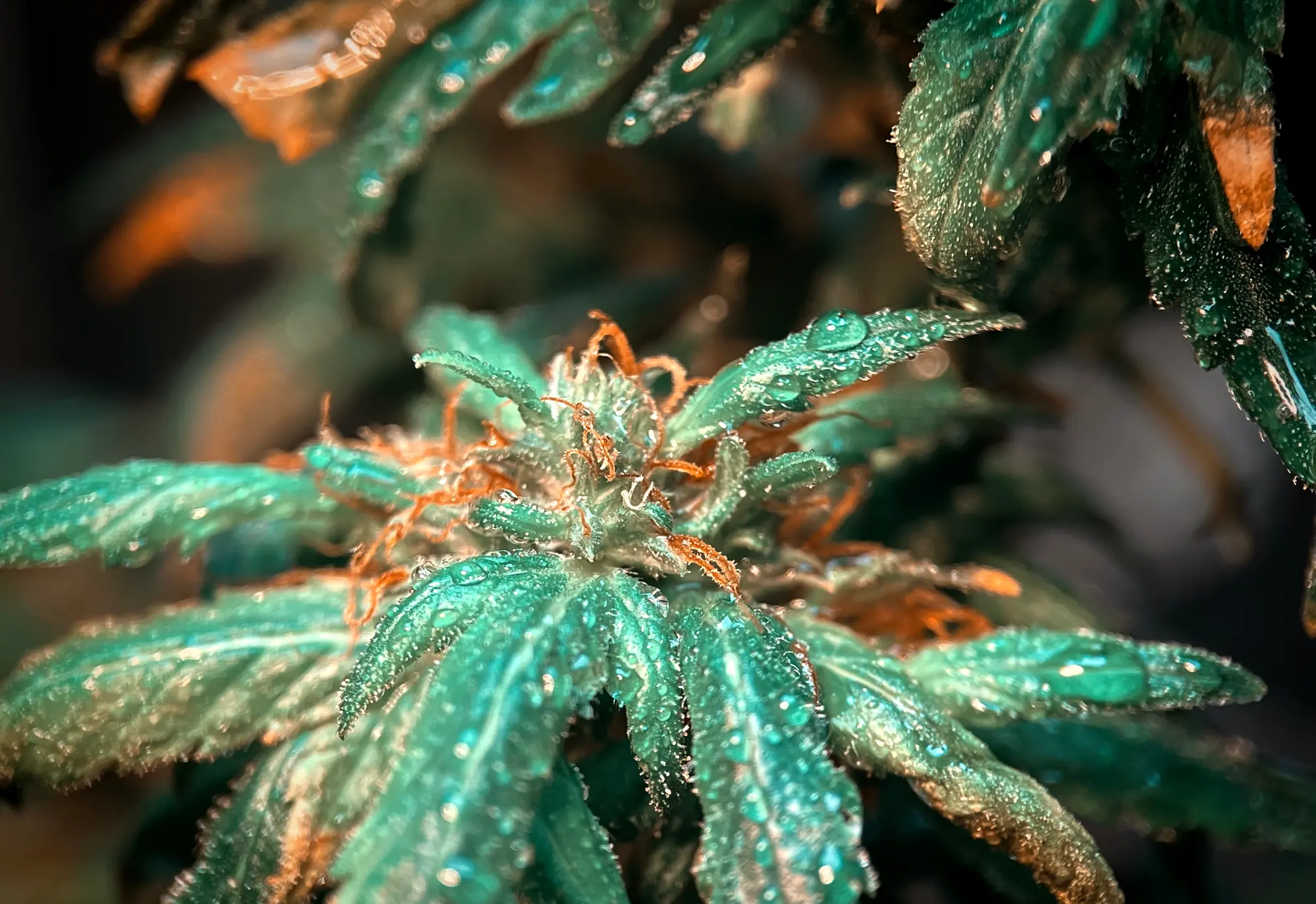
Nebula
Nebula is easiest to understand as a fast sativa-leaning indoor cultivar that behaves more vigorously than its relatively short flowering window suggests. It can rise hard after the flip, carry a surprising amount of flower on a compact footprint, and finish before many classic Haze-influenced plants have even settled into late bloom. That combination is exactly why it became associated with dense Sea of Green rooms: the plant can turn a short vegetative phase into a field of upright flowering leaders without demanding the long finish normally associated with more tropical sativas.
The same combination creates its main cultivation problem. A grower can look at a 60-to-65-day flowering estimate, assume the plant will stay modest, and then discover that the canopy has climbed rapidly while dozens of lower flower sites disappear beneath a crowded ceiling. Nebula rewards plant density only when light, spacing, airflow, and flip height are planned together. Packed too tightly, the room may still produce plenty of dry weight, but a larger share of that weight becomes shaded secondary flower rather than the resinous, compact top and mid-canopy buds the cultivar is capable of producing.
Its sensory identity is lighter than its name might suggest. Well-finished flower can show honey, sweet herbs, floral perfume, fruit, and a bright Haze-like edge instead of the heavy fuel or dark hash profile found in many modern hybrids. Those notes are vulnerable to late-flower heat and a fast dry. A batch can remain potent while losing the delicate honey-floral layer that makes Nebula recognizable. For a quality-focused grower, that means harvest maturity and post-harvest handling deserve as much attention as canopy yield.
Nebula is also a useful reminder that historical strain names are not laboratory-standardized products. The cultivar is commonly described as a 1990s, roughly 60% sativa / 40% indica hybrid, but the exact historical parent naming is less securely documented than its recurring growth pattern, flowering range, and sensory character. The practical grower should therefore select from the actual plant in front of them. Measure stretch, watch how quickly lower sites fall behind, note whether the bouquet leans honey-floral or herbal-fruity, and keep the expression that delivers the best combination of usable canopy, resin, and cured aroma.
Strain Features
| Feature | Details |
|---|---|
| Strain Type | Sativa-leaning hybrid, commonly described around 60% sativa / 40% indica |
| Historical Identity | Mid-1990s Dutch hybrid with Haze-family and White-Widow-family ancestry commonly reported; exact historical parental naming is not perfectly documented |
| THC | Commonly reported in the high teens to low 20% range; actual potency is batch- and phenotype-dependent |
| CBD | Usually low in THC-dominant material |
| Indoor Flowering | Commonly about 60-65 days, with some plants needing a little longer for full calyx and aroma maturity |
| Outdoor Finish | Often early October in suitable Northern Hemisphere climates, depending on latitude and phenotype |
| Stretch | Moderate to strong; sativa-influenced expressions can climb quickly during the first half of flowering |
| Plant Architecture | Upright, vigorous, productive central and secondary leaders; well suited to short-veg multi-plant canopies |
| Best Grow Style | SOG is a natural fit; topping plus a light screen also works where plant count is lower |
| Bud Structure | Compact, resin-heavy top flowers with better density than many longer-flowering sativas; shaded lowers can remain airy |
| Yield Identity | Good canopy productivity when plant density and light penetration are balanced; premium-bud percentage falls if the room is overcrowded |
| Feeding Behavior | Moderate appetite; excessive nitrogen during stretch can worsen height and leaf crowding |
| Main Quality Risk | Overcrowded SOG, excessive stretch, shaded lower sites, late-flower heat, and drying too quickly for the honey-floral top notes |
| Aroma / Flavor | Honey, floral sweetness, soft fruit, sweet herbs, spice and a bright Haze-like lift; expressions vary |
| Effect Character | Uplifting, creative and socially bright at first, developing into a calmer balanced finish rather than immediate heavy sedation |
| Difficulty | Easy to moderate for an experienced indoor grower; beginners mainly need to plan flip height and plant density correctly |
Genetic Lineage
Nebula belongs to a period when Dutch hybrid breeding was combining established Haze, Skunk, Widow, and indica-derived material into plants that could deliver a more exotic head effect without requiring a tropical-length flowering cycle. Historical descriptions consistently place Nebula on the sativa-leaning side and connect it with Haze-family influence and a resin-heavy White-Widow-family selection. The exact parental labels vary across old records, so it is better to treat those names as the strongest historical account rather than an absolute genetic certificate.
The Haze side explains more of Nebula's grow behavior than the word "hybrid" does. It can accelerate strongly once flowering begins, increasing internodal distance and pushing upper leaders toward the light. It also retains the brighter, more cerebral effect and airy aromatic top notes often associated with Haze-influenced plants. What it does not inherit is the extremely long 12-to-16-week maturation of a classic tropical Haze. The other side of the family appears to have compressed the flowering schedule and improved flower density, resin coverage, and indoor efficiency.
That combination is visible in the finished canopy. Nebula can look relatively narrow and energetic during early flower, yet the best tops fill into more compact, rounded clusters than a pure long-season sativa. Resin appears early enough that the upper bracts can develop a distinctly frosted surface before the final swell. The plant therefore asks for a different strategy from both a compact Afghanica and a pure Haze. It should not be over-vegged like a slow indica, but it also should not be treated as an endlessly stretching tropical line that needs months to finish.
Seed-grown variation matters. One plant may remain more compact and finish close to the lower end of the expected range, while another may continue stretching and need extra days for the floral aroma to move from green-sweet to honeyed and complete. A grower choosing a mother should record pre-flip height, maximum stretch, flowering duration, bud-to-leaf ratio, lower-site quality, and cured aroma. Those measurements reveal the actual Nebula expression far better than a historical percentage on a label.
For breeding-history enthusiasts, Nebula's value is partly that it represents an earlier kind of commercial hybrid: the goal was not merely maximum cannabinoid percentage, but a compact enough plant, short enough finish, resinous flower, and an effect that remained lively and expansive. That older balance still shapes how the cultivar should be judged today. The most successful selection is not necessarily the one with the hardest single cola. It is the one that maintains the sativa brightness while making a high percentage of the canopy worth trimming and curing as premium flower.
Effect Breakdown
Nebula usually announces itself mentally before the body has much to say. At a modest dose, the first stage is commonly described as bright, uplifted, and socially easy. Thoughts may feel faster without necessarily becoming chaotic. Conversation, music, creative work, and visually engaging tasks can feel more interesting. The effect is often less forceful than a highly racy tropical sativa, which is one reason some users find it functional in moderate amounts.
As the dose rises, the cerebral character becomes more obvious. Attention can narrow around whatever already holds interest, so the same batch may feel productive during an intentional task and distractingly immersive during passive entertainment. Creative users often appreciate this middle phase because associations can feel loose and flexible. Sensitive users should still respect the possibility of over-stimulation. High-THC flower can raise heart rate, dry the mouth, and make a pleasant mental lift feel edgy when too much is consumed too quickly.
The body usually becomes more noticeable later rather than dominating the onset. Muscles can soften, physical tension may feel less intrusive, and the initial mental brightness gradually becomes more balanced. This is where Nebula often separates itself from a pure electric sativa. It can remain mentally present while the body settles, making the experience feel rounded rather than one-dimensional. In larger doses, the later phase can become heavier and more inward, especially for users with low tolerance.
Duration depends on dose, individual metabolism, route of use, and batch potency. The strain name itself is not a dosage system. Two Nebula harvests can differ because of phenotype, maturity, environment, storage, and analytical variability. A user trying a new batch should therefore begin conservatively even if they know the cultivar well.
Harvest timing can also shift the subjective balance. Flower taken at full cloudy maturity with only limited amber often preserves more of the bright, clear expression. A later harvest with greater trichome aging may feel heavier and less crisp, although cannabinoid chemistry is more complicated than a simple "amber equals sedating" rule. The practical point is to choose a harvest window that matches the desired experience while protecting flower health and aroma.
Flavor & Aroma Profile
Nebula's best aroma is not built around brute pungency. Its identity lives in the lighter layers: honeyed sweetness, floral perfume, soft fruit, fresh herbs, and a slightly spicy or Haze-like lift. The intensity can still be substantial in a mature room, but the bouquet is more delicate than a fuel-heavy cultivar. That makes cultivation and drying errors easier to taste.
On the living plant, the early aroma can be deceptively simple. During the middle of flowering, flowers may smell sweet-green or herbal before the richer honeyed note appears. Near maturity, rubbing a lower sugar leaf or lightly pressing a ripe bract can reveal a more rounded profile: sweet floral nectar at the top, soft fruit in the middle, and a resinous herbal-spice base. If the plant is cut too early, the profile often stays greener and less integrated.
After drying, the jar should become clearer rather than merely louder. A successful slow dry lets the fresh green plant smell recede while the honey-floral character becomes easier to separate. Some expressions lean toward sweet herbs and sage-like dryness; others show more fruit or a minty edge. These differences are useful phenotype markers. A grower who wants the classic sweet-floral character should not select a mother only from live-plant aroma. The cure can rearrange the sensory hierarchy.
On the inhale, Nebula is usually smoother when the dry has been slow enough to equalize internal moisture. The palate can begin sweet and slightly floral, then move toward herb, spice, and faint fruit. The exhale may carry more of the Haze-like character than the jar does, particularly in expressions with a brighter terpinolene-style aromatic pattern. Warm vapor can make these top notes easier to detect than smoke because combustion adds its own toasted and bitter compounds.
The aftertaste is often lighter than the first aroma. Honey, dry herbs, and faint floral resin can linger, while poorly dried flower collapses toward generic green sweetness. This is why a powerful smell during late flower should not be treated as evidence that the finished bud will taste equally good. If the drying room is too warm, those volatile notes can leave the flower while making the room smell impressive.
Nebula also changes with storage. A few weeks of stable cure can integrate sweetness and reduce sharp chlorophyll-like edges. Months of warm, frequently opened storage can flatten the floral high notes and leave a duller resinous-herbal core. Whole flowers stored cool, dark, and reasonably airtight usually preserve the original fingerprint better than pre-ground material.
Dominant Terpenes
Nebula samples are not chemically identical, but modern consumer and analytical summaries often point toward a bright terpene pattern in which terpinolene, myrcene, and beta-caryophyllene recur. That pattern is consistent with the cultivar's mix of floral, herbal, sweet, and lightly spicy notes. It should still be read as a recurring tendency rather than a guaranteed formula.
| Terpene | Aroma Role | Practical Interpretation |
|---|---|---|
| Terpinolene | Floral-herbal, sweet, fresh, sometimes lightly citrus or pine-like | Fits the bright Haze-like lift and is especially vulnerable to heat and prolonged open-air handling |
| Myrcene | Earthy, herbal, musky, soft fruit | Can give the sweet top notes a deeper resinous base; concentration varies widely by sample |
| Beta-Caryophyllene | Pepper, dry spice, wood | Helps explain the spiced finish that appears beneath the honey and floral layer |
| Pinene, where present | Pine, fresh resin, green brightness | Can sharpen the fresh upper register of certain expressions |
| Limonene / Ocimene, where present | Citrus, floral-fruity brightness | Plausible contributors to brighter fruity or perfumed phenotypes, but not fixed dominant markers |
Terpenes are much more reliable as aroma chemistry than as a shortcut for predicting a specific psychoactive effect. Terpinolene does not automatically "cause energy," myrcene does not automatically "cause couch-lock," and caryophyllene does not turn a cannabis flower into a treatment. The subjective experience emerges from cannabinoids, dose, individual biology, context, and the full chemical mixture.
For the grower, the most useful terpene lesson is environmental. Monoterpenes are volatile. A late-flower canopy that repeatedly overheats can smell stronger in the room because aromatic molecules are evaporating from the plant. The same thing can happen during drying. Protecting Nebula's brighter chemistry means controlling temperature, avoiding direct hot airflow, and reducing unnecessary handling once mature trichomes become fragile.
Phenotype selection should therefore include cured aroma, not only a laboratory-style terpene assumption. If one plant smells intensely honey-floral alive but cures to plain herbs, while another retains a layered sweet-floral jar after four weeks, the second is often the better flavor keeper even if both grew similarly.
Indoor vs. Outdoor Growing
| Aspect | Indoor Growing | Outdoor Growing |
|---|---|---|
| Main Advantage | Precise control of flip timing, stretch, light distribution and 60-65 day flowering window | Full sun can support vigorous branching and large flower production without ceiling limits |
| Main Limitation | SOG density can crowd lower sites and create uneven light penetration | Finish quality depends on latitude, autumn rain, night humidity and local season length |
| Plant Size | Easy to keep medium if flipped early; can become unexpectedly tall if vegged too long | Strong vertical and lateral growth in unrestricted roots; often much larger than indoor plants |
| Best Structure | Short-veg SOG, or one topping plus light screen in lower plant-count rooms | Open multi-branch framework with support and enough spacing for sun and airflow |
| Humidity Concern | Dense plant spacing is usually the larger issue than naturally massive single buds | Dew and rain around maturing flowers become the key late-season variable |
| Flavor Control | Easier to protect floral/honey notes through stable late-flower temperature | Full sun can produce excellent aroma, but hot harvest handling and wet-weather drying can erase it |
| Harvest Decision | Can wait for complete maturity because weather is controlled | Maturity must be balanced against forecast, especially in marginal northern climates |
Indoors is where Nebula's original practical logic makes the most sense. A grower can deliberately shorten vegetative time, place several plants at predictable spacing, and use the cultivar's strong flowering response to fill a level canopy quickly. The mistake is assuming more plants automatically means more premium yield. Once neighboring leaves overlap heavily, the lower half of the canopy becomes a light and humidity problem. The correct SOG density is the density at which each main leader receives direct light and air without turning the room into a green wall.
In a low plant-count room, one early topping can be more efficient. Nebula generally has enough vigor to recover quickly and form several productive leaders. A light screen can then spread those tops before the stretch peaks. This approach uses slightly more vegetative time but gives the grower more control over lower-site cleanup and light distribution.
Outdoors, the cultivar's speed is useful because it does not demand an extremely long tropical season. In warm southern or Mediterranean-like environments, it can take advantage of strong sun and finish with fewer weather compromises. In cooler northern regions, site selection becomes more important. A south-facing, early-sun location helps dry dew and supports maturity before autumn conditions deteriorate.
The outdoor grower should not confuse versatility with universal weather immunity. Nebula is not a specialist rain cultivar. If a forecast brings prolonged cold rain near maturity, the cleanest quality may come from harvesting fully mature sections rather than leaving the entire plant outside only to chase a few more days of swell.
Strain-Specific Grow Guidance
Build the Room Around the Stretch Window
Nebula's central cultivation question is simple: how do you exploit its fast SOG productivity without allowing sativa stretch and plant density to flatten the lower canopy? The answer begins before flowering. Record plant height on flip day. During the next two to three weeks, measure the same leaders every few days. That first run creates a real stretch ratio for the phenotype instead of relying on an internet average.
If the room has limited headspace, flowering smaller plants is usually better than aggressive late bending. Nebula can continue lengthening internodes after bud initiation, so waiting until tops are already near the fixture turns training into damage control. A short vegetative phase followed by early directional bending is cleaner. The goal is not to suppress vigor. It is to convert vertical vigor into evenly lit flower sites.
In SOG, uniformity matters more than individual plant beauty. Remove obviously weak or outlier plants before the canopy closes if legal plant counts and starting material allow. A single much taller phenotype can shade several neighbors. If it is valuable enough to keep, move it to a position where it can be bent or flower it separately rather than forcing the entire canopy to follow its height.
SOG Density: More Stems Are Not Always More Yield
Nebula's reputation for SOG can tempt growers to crowd containers. The better metric is productive leaders per square meter, not plants per square meter. Each leader should have enough horizontal space that fan leaves can occupy light without permanently lying on neighboring tops.
Once branches are interlocked, the lower canopy becomes difficult to inspect. That increases the chance of dead leaves, pests, and moist pockets remaining unnoticed. Before the flowers harden, remove weak shoots that are clearly below the future light line. Do not strip every lower branch automatically. Some mid-level Nebula sites can mature well if the canopy remains open. The cleanup should follow actual light, not a fixed percentage of plant height.
Topping and Screens in Lower Plant Counts
One early topping is usually enough for a training-based Nebula run. Repeated topping can create more leaders than the root volume and light footprint can support. After the first cut, spread the resulting branches and let the strong secondary growth fill the screen.
A screen should be used to distribute growth, not to trap it. Continue tucking during the early stretch, then stop once flower clusters have formed enough that repeated manipulation would rub developing trichomes or twist stiffening branches. The upper canopy should end as a shallow field of individual flowers rather than a mesh of crossing stems.
Build support before the flowers demand it
Supercropping can rescue an unexpectedly tall leader early in stretch, but it should not be the primary architecture plan. Late crushing of stems near established flowers increases support needs and can slow that branch while the rest of the canopy continues developing.
Root Zone and Watering
Nebula's fast transition creates a changing water demand. Plants that were drinking modestly in late veg can increase uptake quickly as leaf area and transpiration rise. That does not justify keeping the medium constantly wet. Saturated roots reduce oxygen availability and can make vigorous plants suddenly look tired, droopy, or nutritionally confused.
Use container weight, media moisture, and plant demand rather than a fixed calendar. In a peat or coco-based medium, irrigation frequency will be different from a mineral soil or living mix. The universal target is an oxygenated root zone with no prolonged anaerobic saturation.
In dense SOG rooms, irrigation access becomes a practical issue. Design the layout so every container can be checked. If back-row pots are impossible to reach, they are more likely to become chronically too wet or too dry. Uneven root-zone conditions create uneven stretch, which then creates uneven lighting and lowers the whole canopy's premium-bud percentage.
Feeding: Do Not Fertilize the Stretch
Nebula generally does not need extreme nutrient concentration to grow aggressively. Excess nitrogen during transition can exaggerate leaf size, deepen canopy shade, and prolong soft vegetative growth when the objective is to move energy toward flowers. Watch the newest leaves and overall color. Very dark foliage, clawing, or excessive soft growth are reasons to reduce nitrogen pressure rather than add more bloom products.
Phosphorus and potassium must be adequate during reproductive growth, but controlled cannabis research does not support the idea that endlessly increasing mineral concentration creates endlessly larger or more potent flowers. Keep electrical conductivity within a range the plant is actually using. If runoff or substrate EC climbs while uptake slows, more fertilizer is not the answer.
A moderate, consistent feeding program makes phenotype comparison easier. If every plant is pushed to the edge, genetic differences become mixed with stress responses. A mother-selection run should reveal natural structure, aroma, and finish, not simply which plant tolerated the most salts.
Light Distribution and Flower Quality
Nebula can reward strong light, but the entire canopy needs useful exposure. High intensity at the top does not compensate for darkness 40 centimeters below. Before increasing fixture power, check whether the plant architecture is converting that light into flower across the intended depth.
Scientific work in controlled cannabis environments shows that increasing photosynthetic photon flux can increase inflorescence yield when other resources remain adequate. For Nebula, the strain-specific implication is to create enough top separation that individual leaders receive strong light without heavily shading each other. Raising intensity while maintaining a crowded wall of leaves may increase top stress without improving lower flower quality.
Watch for heat at the actual flower surface. A room thermometer several feet away does not reveal the temperature of a top sitting close to a fixture. If the upper bracts bleach, foxtail excessively, or lose aroma while lower flowers remain dark and underdeveloped, the canopy is too uneven.
Humidity and the Hidden SOG Microclimate
Nebula's individual buds are not necessarily the most mold-prone flowers in the library. The risk comes from how it is commonly grown. Dozens of upright plants in a tight SOG create a continuous transpiring layer. Room RH can appear acceptable while leaf-to-leaf contact and shaded stem zones stay much wetter.
Thin only what blocks meaningful airflow or light. Aggressive stripping can reduce photosynthetic capacity and trigger unnecessary recovery. Instead, remove dead material, weak interior shoots, and selected large leaves that permanently seal a pocket. After defoliation, the goal should be visible channels through the canopy, not bare stems.
During late flower, humidity should trend lower than in vegetative growth. Pay attention to lights-off spikes. As temperature falls, relative humidity can rise sharply even when absolute moisture has not changed much. A dehumidifier or stronger room exchange may need to work hardest during the dark period rather than while lights are on.
Flower Development and the Late Swell
Nebula's short flowering reputation causes some growers to cut as soon as the calendar reaches day 60. The better approach is to start inspection there. Look at calyx swelling, pistil behavior, trichome maturity, aroma, and whether the plant is still clearly adding new flower mass.
The best top flowers become resin-heavy and visually white, but trichome abundance alone is not proof of ripeness. A plant can be frosty before the bracts are fully swollen. If the flower still smells mostly green-herbal and the calyxes have not finished expanding, a few extra days may materially improve flavor and dry density.
At the other extreme, leaving a mature plant under high heat in search of maximum amber can cost more aroma than the extra days add weight. The ideal harvest is the point where the desired effect, flower maturity, and sensory intensity overlap.
Branch Support
In SOG, central stems often support themselves until the flowers become heavy, then lean together and close the gaps that were carefully preserved earlier. A light upper trellis can prevent that final collapse. Install it before branches become brittle and resinous.
Topped plants may need more individual support because several leaders share the load. Soft ties, stakes, or a second screen can keep flowers separated without squeezing them. Support is part of airflow management, not merely a way to stop branches from breaking.
Trimming and Premium-Bud Percentage
Nebula can produce an efficient trim when the canopy is well lit. The top and mid-level flowers usually carry enough calyx mass that sugar leaf can be removed without reducing the bud to loose material. Shaded lowers are where labor rises. They can contain more leaf relative to finished flower and dry into soft, low-aroma pieces.
After curing, separate the crop into premium whole flower, acceptable secondary flower, and low-grade material. Weigh those categories. A grow that produces 10% more total dry weight but 20% more low-grade lowers is not necessarily an improvement. For Nebula, the goal is to make the fast canopy uniform from the light line down, not simply maximize biomass.
What to Change on the Second Run
The second run should respond to actual measurements. If stretch exceeded expectations, reduce veg time or flip height. If the lower third was weak, clean it earlier. If upper flowers were excellent but neighboring tops touched, increase plant spacing. If aroma was strongest alive but weak after cure, keep the cultivation plan and change the dry.
Do not change five variables at once. A stable mother, repeatable environment, and one or two deliberate adjustments reveal more than a completely redesigned recipe. Nebula is fast enough that a grower can iterate efficiently; use that speed to refine the system rather than chase novelty.
Weedth Bud Flavor Tips
Nebula's honey-floral identity is easiest to lose after the plant has already done the hard work. The first flavor decision is harvest maturity. Begin close inspection around the expected finish, but wait until the bracts are swollen and the aroma has moved beyond green sweetness. If the cultivar is harvested early only because it already looks frosty, the cured flower can be bright but thin, with less honey and less depth.
Indoors, late-flower temperature is the second major variable. A very warm canopy may smell spectacular because volatile compounds are leaving the flowers. Keep mature tops away from hot fixtures and avoid severe day/night swings. The objective is not to make the room smell stronger; it is to keep the aroma inside the resinous tissue until harvest.
Outdoor plants should be harvested into shade and handled gently. Do not leave cut branches in direct sun while the rest of the plant is being processed. Warm flowers lose top notes quickly. If the crop is wet from dew, wait for surface moisture to dry when conditions allow. If rain forces a harvest, increase drying-room spacing rather than applying heat.
For drying, branch spacing matters more than a rigid day count. Nebula tops can be compact enough that the exterior feels ready before the center has equalized. Use cool darkness, gentle indirect air movement, and enough space that branches do not touch. Direct fans aimed at flower surfaces can dry the outside rapidly while the inner moisture remains high.
The cure should be judged by aroma evolution. During the first weeks, green plant odors should recede and the honey, floral, sweet-herbal and fruit notes should become easier to distinguish. If the jar smells sour, ammonia-like, or excessively wet, the flower was sealed too early. If it smells flat and papery, the dry may have gone too far.
Store the finished buds whole, cool, dark, and with minimal repeated exposure to warm air. Grind only what is needed. Nebula's lighter top notes are less forgiving of months of warm, frequently opened storage than a heavy earthy-fuel profile.
Weedth Bud Boost Tips
Nebula's best yield improvement comes from canopy engineering, not a special additive. In SOG, use short veg, consistent plant size, and enough spacing for each main stem to form a separate vertical flower. If tops are touching by week three, the room was planted too densely or flipped too late.
In lower plant-count systems, top once and spread the branches across a light screen. The objective is to create eight or fewer strong, evenly exposed leaders rather than a thicket of small shoots. Remove only the branches that cannot reach useful light by the end of stretch.
Strong light can raise yield when the plant can use it, but intensity should be increased only after temperature, root health, and CO2 availability under normal room conditions are stable. Supplemental CO2 can support higher photosynthesis in a sealed, high-light environment, but it is not useful if the canopy is overheated, water-stressed, or poorly lit below the top layer.
Do not use UV as an automatic resin booster. Controlled studies have not shown a universal increase in cannabinoid concentration or yield from added UV-B, and stronger exposure can reduce performance. Nebula already has strong resin potential. Protecting healthy leaf area and mature trichomes is more reliable than stressing the crop with an unproven shortcut.
For outdoor plants, yield depends heavily on root volume, sun exposure, and branch support. Give the plant enough soil depth or container volume that the vigorous flowering stretch does not outrun the root system. Open the framework early so sun reaches inner branches. Support before the flowers gain weight, not after a storm has already bent them together.
Track premium yield separately from total yield. A more open canopy may look less massive in week three but finish with more dense, aromatic flowers and less trim waste. That is the kind of gain Weedth values.
Medical Uses & Benefits
There is no clinical evidence showing that Nebula as a named strain treats a specific disease. Consumers may choose its uplifting and later-relaxing profile when they want a cannabis experience that feels mentally bright without beginning as a heavy body sedative, but that is a preference pattern rather than a medical indication.
Some people report using similar THC-dominant cultivars for temporary mood change, stress relief, appetite, or distraction from discomfort. Others may experience the opposite, including anxiety, dizziness, dry mouth, impaired coordination, or a racing heart. Dose and individual sensitivity matter more than the marketing category of "sativa" or "hybrid."
Anyone using cannabis for persistent pain, insomnia, anxiety, depression, or another medical condition should seek guidance from a qualified clinician where legal. A laboratory-tested product and known dose are more relevant to medical decision-making than the strain name alone.
Ideal User Profile
Nebula suits growers who want sativa-like energy without committing to a very long flower cycle. Indoor gardeners with limited seasonal patience but enough vertical control for a moderate stretch can get excellent results. It is especially logical for a grower who enjoys SOG or a simple screen and is willing to manage density precisely.
Flavor-focused growers should like the cultivar if they prefer honey, floral sweetness, herbs, and fruit over heavy fuel. The grower must enjoy post-harvest discipline, because the difference between average and excellent Nebula is often more obvious in the jar than on the scale.
For consumers, moderate doses fit daytime, social, creative, or early-evening use for many people. Very sensitive users should start small because the cerebral onset can become stimulating when the dose rises.
Grower Notes and Feedback
The most repeatable grower observation is that Nebula is quicker than its sativa character makes it look. The plant can stretch like a brighter hybrid, then begin finishing on a schedule closer to a compact indoor cultivar. That makes early canopy decisions disproportionately important. A mistake during the first two weeks of flower cannot always be corrected later without reducing quality.
Another recurring point is that SOG works because the plant naturally wants to send productive leaders upward. That does not mean every seed plant is identical. A compact expression may be ideal for tight spacing, while a taller plant can dominate neighboring sites. Mother selection should favor the architecture that matches the room rather than trying to make every phenotype fit the same spacing.
Aroma feedback is more variable than flowering time. Honey, sweet herbs, flowers, fruit, mint, and spice can all appear. This variation is a reason to cure each phenotype separately during a selection run. Blending flowers immediately hides the differences that matter most for future quality.
Nebula is forgiving enough that a beginner can finish it, but the premium version is not accidental. The grower must stop the canopy from becoming a single crowded surface, wait for actual maturity rather than a calendar date, and dry cool enough that the lighter aromatic compounds remain in the flower.
On a second run, the most useful data are simple: flip height, maximum height, number of productive leaders, percentage of premium flower, finish date, and cured aroma after four weeks. Those six observations turn Nebula from a generic "fast sativa hybrid" into a predictable cultivar.
Weedth Editor's Note
How I would judge the finished flower
I like Nebula when I treat it as a canopy crop rather than as a collection of individual plants. The first time I see a vigorous plant in veg, the temptation is to give it more time because the stems look capable of carrying a bigger harvest. With this strain, I would rather flip slightly early and let the flowering stretch build the final canopy. That keeps the lower half useful and gives me room to separate the tops instead of fighting them later.
The smell I am watching for is not the loudest plant in week six. I want the expression that keeps a clean honey-floral sweetness after drying. If a plant smells huge while alive and then cures into plain herbs, I do not consider that a flavor keeper. The best Nebula for me is the one that stays recognizably sweet and perfumed after a month in the jar.
I also do not rush the harvest just because the flower is already white with resin. I look for swollen bracts and an aroma that feels complete. A few extra days can be the difference between a pretty crop and a crop I actually want to smoke slowly. Fast flowering is useful, but full maturity is still the goal.
Weedth Score
Growing Experience 9.0/10 Fast, vigorous and highly efficient once flip height and density are understood
Bud Structure & Visual Appeal 8.9/10 Resinous, compact tops with a strong white finish; lower quality depends heavily on canopy light
Aroma Complexity 9.0/10 Honey, floral, herb and fruit layers can be distinctive and elegant
Flavor & Smoothness 8.8/10 Excellent when dried slowly; top notes flatten quickly under heat or a fast dry
Effects & High Experience 8.9/10 Bright and creative with a balanced later phase rather than instant heaviness
Overall Satisfaction & Recommendation 9.0/10 A strong choice for growers who want a short-finish sativa-leaning indoor plant with real flavor character
Overall Weedth Score: 8.9/10.
I would grow Nebula for its combination of speed and brightness. The plant is easy to finish, but the honey-floral keeper only appears when the canopy and dry are handled with intention.
FAQ
Is Nebula easy to grow?
Yes, it is generally easy to moderate. The plant is vigorous and finishes relatively quickly, but its stretch can surprise growers who veg too long. The main difficulty is not keeping it alive. It is maintaining a level, open canopy so the fast flowering cycle produces a high percentage of mature top and mid-level buds rather than a large layer of shaded lowers.
How long does Nebula flower indoors?
A common working range is about 60 to 65 days. That should be treated as the beginning of the harvest inspection window, not an automatic chop date. Some expressions need additional days for complete calyx swelling and a fuller honey-floral aroma.
How much does Nebula stretch after the flip?
Expect moderate to strong stretch. Sativa-leaning plants can climb quickly during the first several weeks of flower. The safest method is to record pre-flip height and maximum height on the first run, then use the actual ratio to set future flip timing.
Is Nebula good for Sea of Green?
Yes. SOG is one of its most natural indoor styles because the plant can turn a short vegetative phase into strong upright flowering leaders. The main warning is density. Too many plants reduce light penetration and airflow, lowering premium-bud percentage even if total dry weight remains respectable.
Should Nebula be topped?
Topping is optional. In a dense SOG, untopped or lightly pinched plants can be more efficient. In a low plant-count room, one early topping followed by LST or a light screen can distribute the stretch into several productive leaders. Repeated topping is usually unnecessary.
Does Nebula need heavy feeding?
No. Moderate, consistent nutrition is a better starting point. Excess nitrogen during the transition can exaggerate leaf mass and stretch. Increase nutrient strength only in response to plant demand and root-zone measurements rather than assuming a vigorous cultivar always needs a strong feed.
What is the biggest indoor mistake with Nebula?
Overcrowding. Its SOG reputation encourages growers to pack the room, but a continuous leaf wall creates shaded lower sites and humid stem zones. Space plants so individual leaders remain distinguishable and clean weak growth before the flowers harden.
Is Nebula mold resistant?
It should not be treated as mold-proof. Its individual flowers can be manageable, but a dense SOG creates its own microclimate. Keep late-flower humidity controlled, prevent dead leaves from remaining inside the canopy, and watch dark-period RH spikes.
When should Nebula be harvested for the best flavor?
Harvest when the bracts are swollen, trichomes are predominantly mature, and the aroma has moved beyond green sweetness into a more complete honey-floral profile. Cutting only because the calendar says day 60 can leave flavor underdeveloped.
How do I preserve Nebula's honey and floral aroma?
Avoid late-flower heat, harvest into shade, dry in cool darkness with indirect air movement, and do not seal thick buds before internal moisture has equalized. Store cured flower whole, cool, and dark. The lighter top notes are more vulnerable than the earthy-herbal base.
Is Nebula suitable outdoors?
Yes, especially in warm sunny regions. Its relatively short flowering period also makes it more practical than very long sativas in some temperate climates. Outdoor quality still depends on latitude, autumn rain, and whether the site receives enough early-day sun to dry dew.
Why are my lower Nebula buds airy?
The most likely reason is canopy shade, especially in a dense SOG. Strong light at the top cannot compensate for a dark lower layer. Reduce plant density, clean weak shoots earlier, or spread the canopy so light reaches productive secondary sites.
Does Nebula need a long cure?
It does not require months to become usable, but several weeks of stable cure can noticeably improve aromatic separation. The initial green-herbal smell should fade while honey, floral sweetness, and fruit become more coherent. A hot or over-dry cure will not improve with time, so the drying stage remains more important than a very long cure.
Similar Strains
Silver Haze: A useful comparison for growers who enjoy a bright Haze-like effect, although Silver Haze usually asks for more stretch management and a longer flowering commitment.
Cinderella 99: Similar in the sense that it compresses lively sativa character into a relatively efficient indoor cycle. Cinderella 99 often leans fruitier and can stretch differently, but both reward early canopy planning.
Jack Herer: Shares an energetic, resinous hybrid identity with Haze-family influence. Jack Herer tends to show broader phenotype variation and can need a slightly longer finish.
SAGE: Another sativa-leaning indoor cultivar that can deliver bright effects and layered herbs/spice. SAGE generally has a longer, more open growth pattern and a different flavor architecture.
Super Silver Haze: A stronger choice for growers willing to accept more height and time in exchange for classic Haze intensity. Nebula is the more compact, faster option.
White Widow: Useful as a comparison for resin coverage and old-school hybrid balance. White Widow is usually less vertically assertive and more earthy-spicy, while Nebula keeps a lighter honey-floral edge.
Share this article
A quick overview of the topics covered in this article.
Follow us
Latest articles
September 9, 2026
September 9, 2026
September 9, 2026