
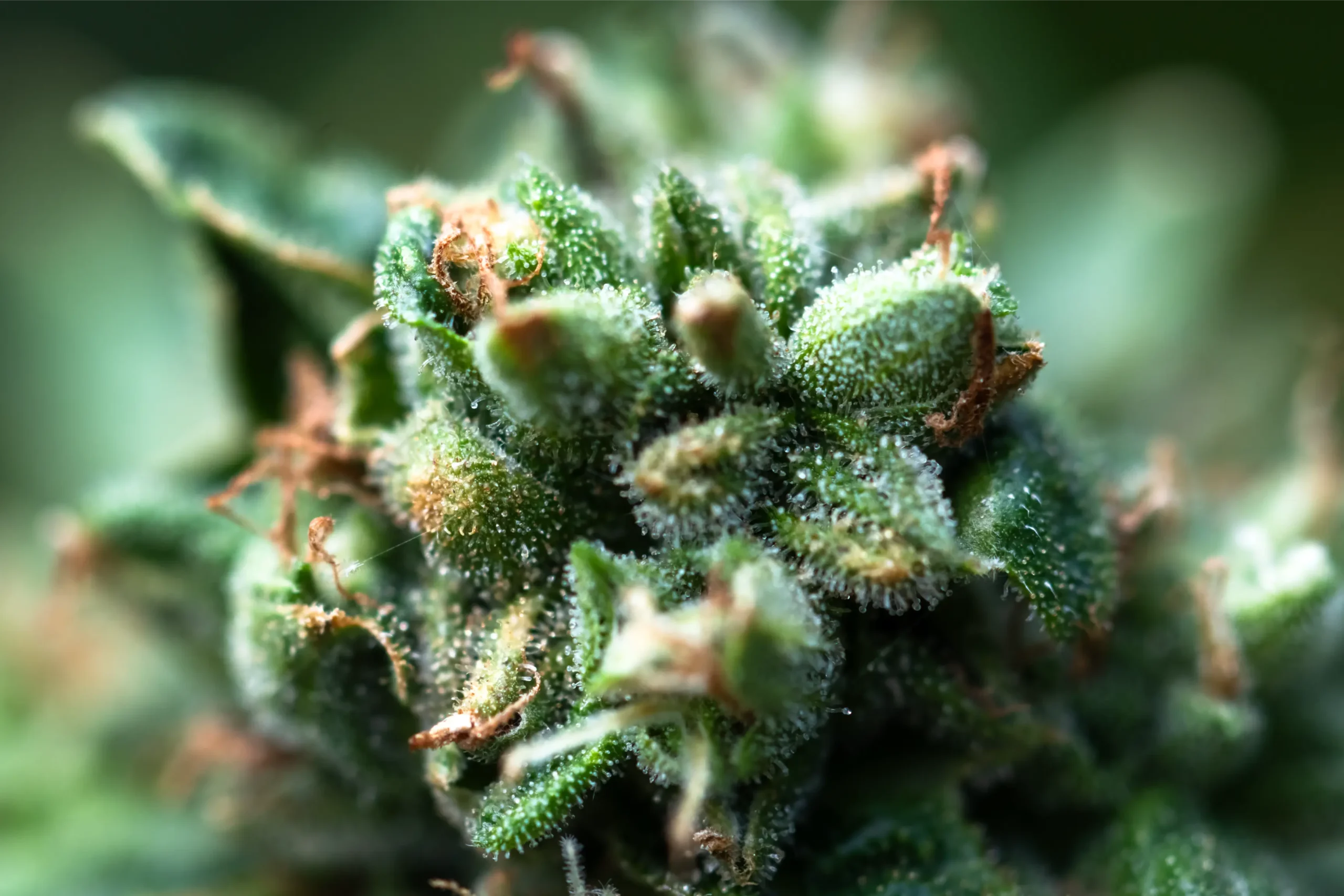
Opium
A balanced resin-heavy hybrid with thick stems, spear-shaped colas, fruit-punch depth, and an early trichome display that can mislead impatient growers.
Opium is a cultivar whose public lineage is intentionally vague, so the plant must be understood through its repeatable behavior rather than a dramatic family tree. It usually grows as a medium-sized, thick-stemmed hybrid with a bushy base, controlled stretch, and resin that appears early across swelling flowers. The early frost is visually impressive, but it creates the cultivar’s main harvest mistake: growers assume the plant is finished before the calyxes have reached full volume and the fruit-spice aroma has rounded out.
The grow style can move in two directions. In hydroponic or coco systems, Opium can build heavy spear-shaped colas quickly and respond to frequent root-zone management. In soil, it may produce slightly less speed but a more layered earthy-fruit profile. Sea of Green takes advantage of its medium height and central flower development, while a small multi-branch canopy can improve airflow and reduce the risk created by a few oversized spears.
The sensory target is not one simple fruit. Properly finished Opium can suggest grape, fruit punch, citrus, cream, earth, spice, and a light fuel edge. The effect mirrors that balance: euphoria and sensory brightness first, then a warmer relaxed body phase. The cultivar is capable of both flower quality and extraction-grade resin, but only when the grower controls moisture around its dense bracts.
Legal note: Educational content only. Always follow the cultivation and cannabis laws that apply in your location.
Strain Features
| Feature | Details |
|---|---|
| Strain Type | Balanced hybrid, often described near 50% indica and 50% sativa. |
| Lineage | Undisclosed or proprietary hybrid background; exact parents are not reliably public. |
| THC and CBD | Commonly mid-to-high THC with low CBD; published values vary by batch. |
| Flowering Time | About 8-9 weeks indoors, often close to 60 days. |
| Indoor Height | Medium with thick stems, bushy branching, and controlled stretch. |
| Outdoor Height | Medium to large in warm sun; performance is less reliable in guerrilla or poor-soil sites. |
| Yield Style | High potential with SOG, hydroponics, coco, or a well-supported multi-branch canopy. |
| Bud Structure | Dense spear-shaped or chunky colas with early, greasy resin. |
| Aroma | Fruit punch, grape, citrus, earth, cream, spice, and occasional fuel. |
| Flavor | Sweet fruit and grape on entry, followed by earthy spice and a creamy herbal finish. |
| Dominant Terpene Direction | Often associated with myrcene, caryophyllene, limonene, and pinene. |
| Grow Difficulty | Moderate; easy structure but dense flowers require disciplined humidity and irrigation. |
| Best Training | SOG, one early topping, open-bowl LST, and a support net before late swell. |
| Main Risks | Early resin mistaken for maturity, oversized wet colas, high nighttime humidity, and root-zone saturation. |
| Medical Interest | Reported for stress, mood, pain, and physical tension; dose can shift the balance toward sedation. |
| Best Time of Use | Late afternoon or evening, depending on dose and harvest maturity. |
Because the parentage is not reliably disclosed, Opium should be described through observable phenotype and batch chemistry. Claims of one exact ancestry should be treated cautiously.
Genetic Lineage
What an undisclosed lineage means for growers
An undisclosed pedigree does not make the plant unknowable. It means the grower should avoid pretending that every feature can be traced to a named parent. Opium’s practical identity is a medium hybrid frame, thick branches, fast resin development, dense flowers, and a balanced effect.
Stable traits and variable traits
The thick stems, manageable height, and early frost are relatively consistent. Aroma can vary more. Some plants lean toward grape and fruit punch, while others show more earth, citrus, or fuel. The effect may also range from bright and euphoric to noticeably heavier.
Keeper selection under uncertain ancestry
A useful keeper combines four traits: clean internal flower, strong resin adhesion, flavor that survives cure, and an effect that remains balanced at a moderate dose. Selecting only for the earliest visible trichomes encourages premature conclusions.
Why laboratory testing matters
The same cultivar name can represent different cannabinoid and terpene profiles. Scientific research has documented substantial within-name variation in cannabis. A current certificate of analysis, where available, is more informative than inherited assumptions about the name.
Lineage note: Unknown parents do not justify invented certainty. Describe the plant you can observe and the batch you can test.
Effect Breakdown
Opening phase: sensory brightness and euphoria
Opium often begins with a noticeable mood lift. Color, music, food, and touch may feel more vivid. The mental effect is active without necessarily becoming fast or scattered. Conversation can become easier and the user may feel more socially comfortable.
Middle phase: balance becomes physical
After the initial lift, warmth develops through the shoulders and limbs. The body relaxes while the mind remains present. At a moderate dose, this phase can suit a quiet social evening, creative hobby, or unstructured time at home.
Late phase: dose determines the landing
A small amount may fade gently with little sedation. A large amount can produce heavy eyelids, appetite, and reduced motivation. Later-harvested flower generally emphasizes this physical finish, while a mostly cloudy harvest preserves more brightness.
Unwanted effects
Dry mouth, dry eyes, dizziness, and temporary mental fog are possible. The fruit flavor can make repeated dosing easy, so users should pause before taking more. THC-sensitive users may experience anxiety even though the cultivar is broadly described as balanced.
Dose advice: The effect often deepens after the attractive first phase. Do not judge the final intensity in the first few minutes.
Flavor & Aroma Profile
Flowering-room aroma
Opium develops sweet fruit over an earthy base. Stem rub may show citrus peel, green spice, and a light fuel note. As the flowers swell, grape and fruit-punch impressions become more apparent, especially in warmer fruit-forward phenotypes.
Cured jar profile
The jar can open with grape skin, mixed berries, tropical punch, and cream. Beneath that are soil, pepper, and dry herbs. A good cure keeps the fruit distinct rather than allowing it to collapse into generic sweetness.
Inhale and exhale
The inhale is often sweet and round, with grape or citrus. The exhale carries more earth, pepper, and a mild diesel edge. Resin-heavy flower can feel thick in the lungs if combustion temperature is high.
Phenotype differences
Fruit-forward plants are attractive but may be more sensitive to warm drying because the volatile top notes are easily lost. Earth-forward plants can remain louder after cure but may lack the layered punch expected from the best examples. Keep batches separate until evaluation is complete.
Dominant Terpenes
Myrcene
Myrcene supports ripe fruit, herbs, and the relaxing body phase. Higher-myrcene batches may feel heavier and smell more earthy.
Beta-caryophyllene
Caryophyllene contributes pepper, dry spice, and warmth. It can make the exhale feel more serious than the sweet aroma suggests.
Limonene
Limonene provides citrus and fruit-punch brightness. It is vulnerable to heat and repeated oxygen exposure, making drying and storage especially important.
Pinene
Pinene adds fresh wood and a clearer green edge. It may be more noticeable in plants with less dominant fruit sweetness.
Linalool and minor floral compounds
Floral or creamy impressions may come from linalool and other minor volatiles. These compounds help create the soft, almost perfumed layer found in some phenotypes.
Chemotype note: Opium can shift from fruit-led to earth-led between batches. The dominant terpene should be verified rather than assumed.
Indoor vs. Outdoor Growing
| Aspect | Indoor Cultivation | Outdoor Cultivation |
|---|---|---|
| Height | Medium and manageable with controlled stretch. | Medium to large in a warm, prepared site. |
| Flowering | About 8-9 weeks. | Often mid-October in the Northern Hemisphere. |
| Best System | SOG, coco, hydro, or aerated soil with support. | Large container or amended ground in warm, sunny, low-humidity conditions. |
| Main Risk | Dense colas, overnight RH, and overwatering during late demand slowdown. | Fickle response to poor sites, autumn rain, and uneven soil moisture. |
| Resin | Appears early and heavily under strong light. | Strong sun can increase visual resin, but heat can reduce aroma. |
| Yield Pattern | High potential when colas are spaced and roots remain oxygenated. | Potentially very high per plant in favorable climates. |
| Flavor | Best control over fruit and cream preservation. | Can develop deeper earth and spice with sun-grown complexity. |
| Difficulty | Moderate. | Moderate to advanced depending on autumn weather and site quality. |
Indoors, Opium’s thick stems and medium height make plant arrangement straightforward. The main discipline is preventing spear-shaped flowers from touching and tracking the reduced water use that often appears near maturity.
Outdoors, the cultivar prefers a prepared, sunny site. Reports of weaker guerrilla performance are consistent with a hybrid selected for controlled cultivation. Poor drainage, shade, and irregular irrigation reduce both yield and fruit expression.
Strain-Specific Grow Guidance
Do not use early frost as a harvest clock
Trichomes can appear on leaves and flowers early. Harvest maturity still requires calyx swelling, slowed pistil production, and a completed aroma. Inspect trichomes on the bracts, not the oldest sugar leaves.
Select one of two canopy strategies
For SOG, maintain a strong central leader and remove weak lower sites. For a multi-branch grow, top once and spread four to eight leaders into an open bowl. Avoid an intermediate structure with too many crowded spears.
Match irrigation to the root system
Hydro and coco can support rapid growth when dissolved oxygen and irrigation timing are correct. In soil, allow a clear dryback and avoid keeping the heavy root ball wet. Thick stems do not mean the roots tolerate stagnation.
Increase feed gradually during active flower build
Opium can use a moderate-to-strong nutrient program when healthy, especially in inert media. The correct level is shown by sustained growth and clean tips. Dark clawed leaves and slowing dryback indicate that concentration has exceeded demand.
Open the lower third after stretch
Remove small interior branches and shaded popcorn sites after the final stretch pattern is clear. This redirects resources toward the supported spears and improves airflow beneath the canopy.
Install support before the greasy late swell
The stems are thick, but the flowers can become top-heavy. A net, stakes, or soft ties should be installed before the weight changes branch angles. Support also prevents neighboring colas from leaning together.
Control night humidity at flower level
Ambient room RH can underestimate moisture inside dense inflorescences. Research has measured much higher humidity within cannabis flowers than in the surrounding air. Keep dark-cycle conditions stable and move air below and beside the colas.
Inspect resinous flowers without damaging them
Use neutral light and gently separate contact points. Avoid repeated squeezing, which breaks trichomes and can spread contamination. A dead sugar leaf emerging from one spot deserves immediate investigation.
Taper water and nitrogen as demand slows
Late flower may remain visually green while water use decreases. Continuing peak irrigation raises root-zone moisture and room humidity. Reduce volume or frequency according to measured dryback.
Harvest for the desired balance
Mostly cloudy calyx trichomes preserve more euphoria and fruit. A controlled amber percentage produces a warmer, heavier finish. Waiting until the fruit aroma becomes dull is rarely an improvement.
The costly mistake to avoid with Opium
Opium’s resin appears before its flavor and effect are complete. Finish the plant, not the photograph.
Medium Choice: Soil, Coco, and Recirculating Systems
In aerated soil, Opium tends to develop a broad root system and a rounded fruit-earth profile. The medium buffers small feeding errors, but the dense canopy can outgrow the container if vegetative time is extended. Use enough volume for the planned plant size, not the largest pot available. A living or amended soil also requires restraint with late liquid feeding because nutrient release may continue after the grower expects it to stop.
Coco offers the most direct control over the cultivar’s fast reproductive demand. Frequent, measured irrigation can support heavy spears while maintaining root oxygen. The danger is treating every day as peak demand. As the plant matures, runoff pattern and container weight may show that the same frequency is no longer necessary. Late over-irrigation increases flower humidity even when root disease is not yet visible.
Recirculating hydroponics can produce rapid growth and very large colas, but system cleanliness becomes part of flower quality. Warm solution, low dissolved oxygen, or unstable pH can damage the roots quickly. The plant’s thick stems may remain upright while the root zone is already declining. Monitor roots and solution behavior rather than relying on above-ground vigor alone.
No medium automatically creates better flavor. Flavor improves when the root zone remains active, nutrition matches demand, and the plant is allowed to complete maturation without excess salt or water. Choose the system the grower can control most consistently.
Managing Resin-Heavy Spear Density
Spear-shaped flowers create a long internal moisture path. The top may feel dry while the lower junctions remain humid. Keep the branch vertical or slightly separated rather than allowing it to fold against another cola. A second net should support the stem without compressing the flower surface.
Defoliation should focus on leaves that create contact points. Removing every fan leaf can reduce transpiration control and slow late flower. Keep leaves that receive light and stand away from the bud. Remove damaged, shaded, or trapped leaves that repeatedly remain wet.
Air movement should pass beside the spears and through the lower canopy. A fan aimed directly at one resinous top can dry the exterior, damage trichomes, and leave the core unchanged. Oscillation and multiple gentle air paths are safer than one strong stream.
The densest flowers should be checked more often after irrigation days and during humid weather. Inflorescence humidity can remain much higher than room humidity. A safe wall sensor does not prove that the flower core is safe.
If one phenotype consistently produces oversized wet spears, consider a different training system on the next run. Topping once and distributing the same biomass across more medium colas can increase clean premium yield even when the total plant weight changes little.
A Phenotype Evaluation Protocol
Record vegetative vigor, internode spacing, branch strength, stem aroma, and response to topping. During flower, add stretch ratio, resin onset, flower diameter, support needs, water-use pattern, and any signs of stress. These observations create a useful plant profile before the subjective harvest evaluation begins.
At harvest, label every branch group. Do not combine plants because they finished on the same day. Dry and cure them separately. After two weeks, compare aroma development. After four to six weeks, compare flavor, smoothness, effect progression, and the amount of usable premium flower.
A fruit-forward plant may win the first jar test and then fade quickly in storage. An earth-forward plant may seem less exciting but remain stable for months. Keeper selection should include a second evaluation after longer storage, especially when long-term flower quality matters.
The preferred keeper for flower may not be the preferred keeper for resin processing. One plant can produce abundant greasy trichomes but average smoke, while another produces lower total resin with superior fruit flavor. Define the goal before ranking plants.
Handling Greasy Resin From Harvest to Storage
Harvest tools and gloves become coated quickly. Keep scissors clean and rotate between pairs rather than scraping resin onto the flower. Handle branches by the stem and avoid stacking wet colas in containers, where heat and pressure can damage trichomes.
During dry trimming, resin becomes more brittle as moisture falls. Work in a cool room and support the flower rather than rolling it in the hand. Save clean resinous trim separately where lawful, but do not leave excessive leaf on the buds only because it is frosty.
Long-term storage should minimize movement. Dense resinous flowers can shed trichome heads when jars are shaken repeatedly. Use containers sized to the amount, keep them cool and dark, and move only a small working supply into frequent use.
Weedth Bud Flavor Tips
Protect fruit-forward phenotypes from heat
Keep canopy and drying temperatures moderate. Limonene and other top notes disappear quickly under warm conditions.
Dry medium colas rather than one compressed mass
Separate touching spears and hang branches with space around them. If a central cola is exceptionally thick, divide it into safe sections.
Cure fruit and earth phenotypes separately
A heavy earthy batch can dominate a mixed container. Separate plants until the keeper selection is complete.
Wait for the cream layer
The first dry may emphasize grape and soil. Several weeks of cure can reveal cream, soft herbs, and a smoother transition.
Use cool, dark long-term storage
Fruit-punch notes fade with warmth and oxygen. Store the main harvest in small sealed containers and keep only a working amount in frequent use.
Weedth Bud Boost Tips
SOG: space by finished cola diameter
Plant density should be based on how wide the mature spears become, not on vegetative leaf width. Touching colas sacrifice airflow and premium yield.
Multi-branch: keep fewer, stronger leaders
Four to eight well-lit branches often outperform a crowded bush. Remove interior shoots that cannot reach the productive zone.
Use hydroponics only with environmental capacity
Fast root delivery increases canopy and flower demand. It also increases humidity load. The room must be able to remove the additional moisture.
Maintain photosynthesis without late heat
Strong light supports density, but fruit quality falls when leaf temperature remains excessive. Balance intensity, CO2 only where properly controlled, and air exchange.
Outdoor: prepare the root zone before planting
Loose, well-drained, biologically active soil improves reliability. A poor hidden site cannot be corrected after the plant is large.
Measure usable resin, not only yield
The best result includes intact trichomes, clean internal flowers, and flavor that survives cure. Wet weight and visual frost alone are incomplete metrics.
Medical Uses & Benefits
Consumers most often discuss Opium for stress, low mood, physical discomfort, and evening relaxation. The cultivar is THC-dominant and not standardized, so these reports should not be treated as clinical evidence.
| Reported Use | Potential Fit and Limitation |
|---|---|
| Stress | The euphoric opening may improve mood before the body relaxes. |
| Pain | Physical warmth may reduce the prominence of mild-to-moderate discomfort. |
| Low Mood | Sensory brightness and social ease may feel helpful at a low dose. |
| Muscle Tension | The middle and late phases can produce substantial physical relaxation. |
| Sleep | Higher doses or later-harvested flower may support sleep, but the opening can be mentally active. |
| Anxiety | Some users feel calm; THC-sensitive users can still experience unease or dizziness. |
Medical caution: Cannabis can interact with medications and may worsen some mental-health conditions. Seek individualized professional guidance.
Ideal User Profile
Opium suits users who enjoy a sensory, fruit-led opening followed by body relaxation. It also suits growers who want a medium plant with high resin potential but are prepared to manage dense flowers.
- Best timing: late afternoon through evening.
- Best activities: music, food, conversation, films, and quiet creative work.
- Grower fit: intermediate cultivators with reliable humidity control.
- Poor fit: low-tolerance users who redose quickly or outdoor growers in wet autumn climates.
- Special appeal: resin production, fruit-punch complexity, and a balanced effect progression.
Troubleshooting Root and Flower Density Problems
The plant is dark, drooping, and slow after irrigation: the root zone is likely remaining wet or the solution concentration is too high. Check container weight, runoff behavior, root temperature, and oxygen. Do not assume the plant needs more nutrition because the leaves look heavy.
Colas are long but the lower half is soft: light penetration or airflow is uneven. On the next cycle, reduce plant density, remove weak lower sites after stretch, and support spears so that the full length remains inside the productive light zone.
The room smells fruity but the dried flower tastes earthy: volatile top notes were probably lost during warm drying, the harvest was late, or the fruit-forward flower was mixed with earth-heavy phenotypes. Lower drying temperature and preserve separate batches.
Trichomes are abundant but the effect feels short: visible resin does not describe cannabinoid maturity or chemical content. The plant may have been harvested early, or the phenotype may simply produce attractive low-mass glands. Use calyx maturity and testing where available.
The central spear repeatedly develops brown interior spots: the architecture is too dense for the current room. Correcting humidity is necessary, but the next cycle should distribute biomass across more medium colas. Genetic potential must be matched to environmental capacity.
Hydroponic growth slows suddenly in late flower: inspect roots and solution before increasing feed. Warm water, biofilm, low oxygen, or unstable pH can reduce uptake while electrical conductivity remains high.
Harvest-Room Workflow for Opium
Bring down one phenotype at a time and keep labels on every branch group. Place cut material directly into the drying area rather than stacking it in warm bins. Heavy resin and dense flower trap heat quickly when branches are piled.
Arrange spears so that none touch. Larger crowns should occupy the driest, best-monitored part of the room, while smaller branches should be checked earlier. Air should exchange throughout the room without blowing directly against one flower surface.
During the first days, inspect for moisture concentration at branch junctions. Later, compare the flexibility of small stems and the feel of the flower core. Exterior crispness can appear before internal moisture is ready for sealed curing.
Move each branch group into cure according to its own condition. Use hygrometers as tools, not as substitutes for inspection. If a container rises rapidly in humidity after sealing, return the flower to a controlled drying environment rather than repeatedly leaving the jar open in a warm room.
Maintaining Flavor During Long-Term Storage
Fruit-punch and grape notes decline faster than earth and pepper. Store the main supply at a cool stable temperature in darkness. Small containers reduce the amount of air exchanged each time flower is removed.
Avoid refrigerating ordinary jars where condensation can form during temperature changes. Long-term cold storage requires sealed packaging and careful acclimation before opening. For routine use, a consistently cool cupboard is safer than repeated movement between cold and warm environments.
Grower Notes and Feedback
The most repeated observation is the amount of early resin. It is exciting, but it encourages an early harvest. Growers who wait for full calyx expansion usually report better fruit depth and a more complete body finish.
Hydroponic runs can produce impressive colas, yet the additional plant transpiration raises room humidity. Yield and environmental capacity must increase together.
The thick stems reduce breakage but do not eliminate the need for support. Once the spears lean, they touch neighboring flowers and create hidden wet zones.
Outdoor success is strongly site-dependent. A warm prepared garden can produce a large plant, while a shaded or irregularly watered site may never show the cultivar’s indoor quality.
Phenotype separation is valuable. Grape-forward, citrus-forward, and earth-forward plants may finish close together but cure very differently.
Grower note: Keep one sample from each plant untouched for four weeks of cure before deciding which phenotype deserves another run.
Final Opium Crop Review
A successful Opium canopy contains separated spears with support already carrying their weight. Leaves remain functional without forming a wet shell around the flowers, and the root zone completes a slower but still predictable dryback near maturity.
The aroma should have moved beyond simple green sweetness. Fruit-forward plants develop grape, citrus, or mixed punch over cream and earth. Earth-forward plants should still retain a clear spice or fuel accent rather than smelling flat.
Harvest samples should be taken from calyx tissue at several canopy positions. If the top is cloudy but the middle remains clear, the plant is not uniformly finished. A split harvest may be safer than waiting until the upper spears become overripe.
After cure, record not only potency and flavor but also how the flower handled storage. A phenotype that loses fruit in one month may be less valuable than a slightly less dramatic plant with stable aroma.
The final selection should reflect the intended product. Flower production favors smoothness and preserved fruit. Resin production may favor gland density and separation. One keeper does not need to win every category.
Weedth Editor's Note
The tradeoff I would plan around
I would grow Opium with a clear choice between SOG and an open multi-branch shape. The plant does not need a complicated training routine. It needs enough space around every final spear.
The early frost would not influence my harvest date. I would watch the calyxes, water use, and aroma. Resin visibility is one part of maturity, not the whole decision.
In an inert medium, I would take advantage of the plant’s vigor but monitor nighttime humidity as closely as nutrient strength. More growth only helps when the room can dry the air.
During drying, I would divide any unusually thick crown and keep phenotypes separate. The fruit-punch layer is too easy to lose through warm air or uneven moisture.
I see Opium as an intermediate grower’s cultivar. It is structurally cooperative, but the best result depends on late-flower discipline. When it is finished and cured correctly, the combination of grape, fruit, earth, and warm relaxation feels complete rather than exaggerated.
Weedth Score
Growing Experience 8.1/10 – Manageable size and strong stems, with meaningful humidity and maturity challenges.
Bud Structure & Visual Appeal 9.0/10 – Dense spear-shaped flowers and heavy early resin.
Aroma Complexity 8.8/10 – Grape, fruit punch, citrus, cream, earth, spice, and fuel can all appear.
Flavor & Smoothness 8.6/10 – Rich and rounded after a cool dry; resin-heavy smoke can be thick.
Effects & High Experience 8.7/10 – Euphoria transitions into satisfying physical calm.
Overall Satisfaction & Recommendation 8.6/10 – Strong flower and resin potential for growers who finish patiently.
Editor closer: The frost catches the eye first, but the fruit, spice, and balanced landing are what make the cultivar worth keeping.
Opium Records That Improve the Next Run
Track the week when visible resin first appeared and the week when calyx swelling actually completed. The gap between those dates is the best reminder that early frost is not a maturity signal.
Record the finished diameter of each spear and the distance between neighboring flowers. If contact points formed, reduce plant density or change the topping plan before the next cycle.
Track irrigation volume and dryback time from mid-flower through harvest. A rising dryback time shows when water demand begins to slow and helps prevent late root saturation.
Finally, compare fruit intensity at harvest, after drying, and after six weeks of cure. The stage at which aroma was lost points toward canopy heat, drying conditions, or storage rather than vague genetic disappointment.
Why Opium Benefits From a Two-Layer Support System
The first support layer controls the branch position at the end of stretch. The second layer carries the mature spear and prevents it from leaning into a neighboring flower. One net often performs only the first function, leaving the heavy upper section unsupported.
Install the upper layer before the resinous flowers become difficult to move. Guide each spear through an individual opening without squeezing the bracts. The system should preserve an air gap and make inspection easier, not create a woven wall.
After harvest, record which branches needed extra ties. Those branches reveal whether the next run needs earlier topping, wider spacing, or a stronger second net.
Opium should be evaluated with the same environmental discipline used during cultivation. A jar that smells powerful on day three can still become harsh or unstable if the flower entered cure with uneven moisture. Slow evaluation protects both the resin and the credibility of the keeper decision.
When the plant is grown repeatedly, compare the same phenotype in soil and an inert medium before declaring one system superior. Root oxygen, irrigation precision, and drying conditions may explain more of the difference than the medium label itself.
The best Opium run should be repeatable. Record the selected phenotype, rooted-cutting age, flip size, irrigation pattern, canopy temperature, and drying duration. Repeatability allows the grower to improve one variable at a time instead of attributing every change in resin or fruit aroma to unstable genetics.
Opium is most convincing when visual resin, internal flower health, cured fruit, and effect progression all point in the same direction. If one of those categories fails, adjust the system before chasing a different nutrient product.
The final benchmark is consistency across repeated cycles. A cultivar with strong resin but unstable moisture behavior needs a revised canopy before it becomes a reliable keeper.
That repeatable balance matters more than one unusually large harvest or one visually dramatic resin display.
FAQ
What is the genetic lineage of Opium?
The exact parentage is not reliably public. It is best described as a balanced proprietary hybrid with stable medium growth and heavy resin.
How long does Opium flower?
Most indoor plants finish in about eight to nine weeks, often close to sixty days.
Why does Opium look ready early?
Trichomes appear early on leaves and flowers. The calyxes and aroma continue developing after the plant already looks frosty.
Is Opium good for SOG?
Yes. Its medium height, thick stem, and central spear development make it suitable, provided finished colas are spaced apart.
Does Opium prefer hydro or soil?
It can perform in both. Hydro and coco may maximize speed and weight, while aerated soil can support a deeper earthy-fruit flavor.
What does Opium taste like?
Common descriptions include grape, fruit punch, citrus, cream, earth, pepper, and light fuel.
Is Opium difficult outdoors?
It can thrive in a warm, sunny, prepared site. Poor drainage, shade, and irregular guerrilla conditions reduce reliability.
When should Opium be harvested?
Use swollen calyxes, slowed pistil production, mostly cloudy bract trichomes, and a rounded fruit-spice aroma. Do not rely on early leaf frost.
Is Opium sedating?
The opening can be euphoric and active. Higher doses and later harvests produce a stronger relaxed body finish.
How should dense Opium colas be dried?
Space branches, divide oversized crowns where needed, use a cool dark environment, and move each branch to cure according to its actual internal moisture.
Similar Strains
- White Berry: Fast, resinous, fruit-led, and balanced, with more explicit berry-citrus character.
- Wappa: Compact and productive with a cheerful opening and comfortable body phase.
- Ice Cream: Resinous and creamy, with a denser dessert-earth profile and heavier finish.
- Purple Punch: Sweeter and more sedating, with grape-dessert flavor and compact flowers.
- Blueberry: A softer fruit classic with more phenotype sensitivity and a slower, calmer effect.
- Afgoo: Heavier pine-resin and tar, with a more clearly indica-dominant nighttime identity.
Share this article
A quick overview of the topics covered in this article.
Follow us
Latest articles
September 9, 2026
September 9, 2026
September 9, 2026