
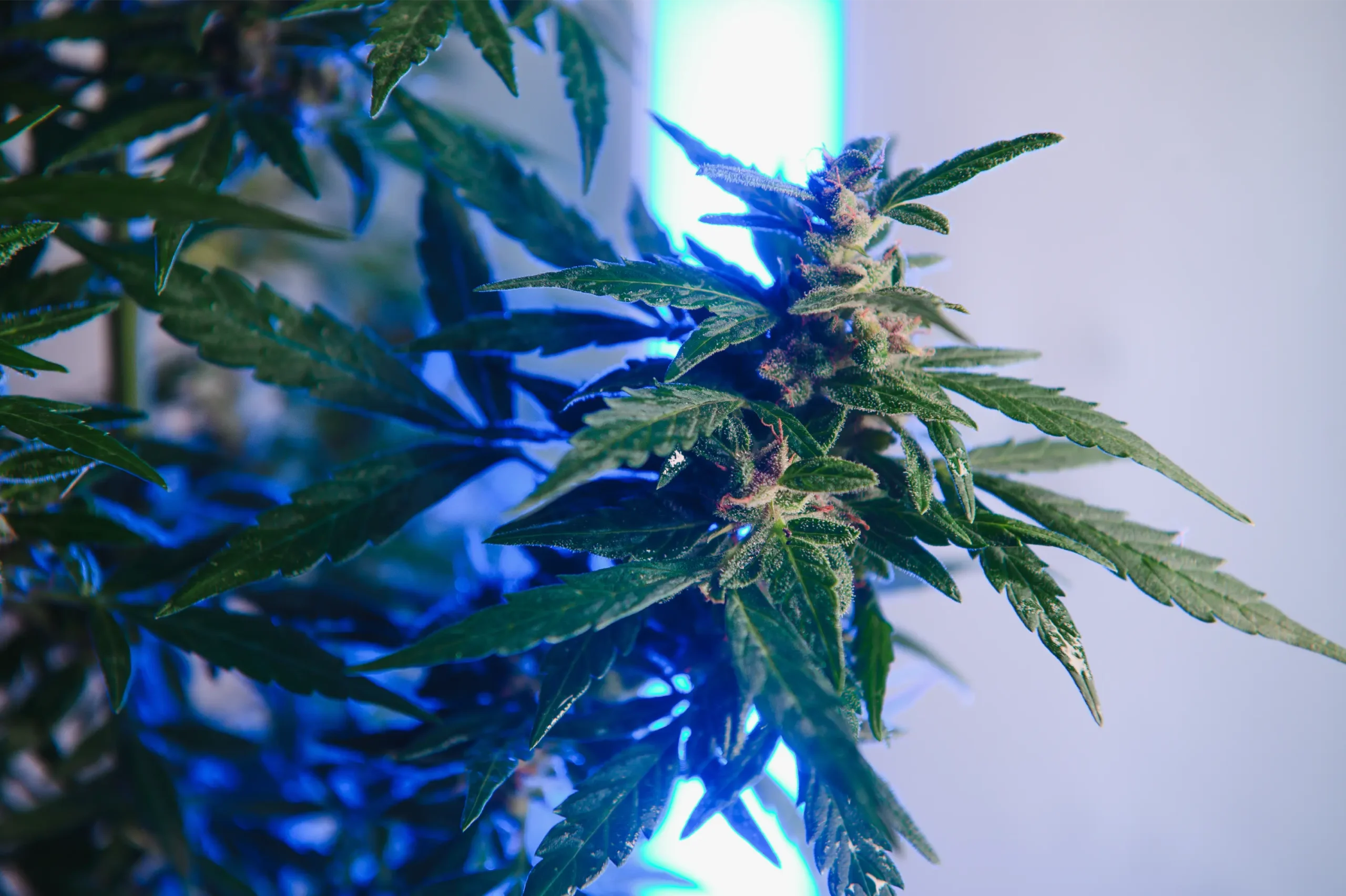
Purple Trainwreck
Purple Trainwreck is a hybrid built from Mendocino Purps x Trainwreck in the line profiled here. It is a cultivar that can confuse growers because its name is sometimes used interchangeably with Purple Wreck, even though another well-known Purple Wreck line is documented as Purple Urkle x Trainwreck. For cultivation, that distinction matters. This guide focuses on the Mendo Purps x Trainwreck expression: vigorous, colorful, strongly branched, capable of significant stretch, and usually finishing in roughly eight to nine weeks.
The cultivar combines two useful but competing tendencies. Trainwreck contributes speed, vertical movement, resin, lemon-pine sharpness, and a cerebral front end. Mendocino Purps contributes dark fruit, floral depth, color potential, broader structure, and a heavier physical finish. The strongest plants use the Trainwreck vigor to carry Purps-like flower quality, but that same combination creates the main grow challenge: many strong branches can become many heavy branches.
Purple Trainwreck is therefore best treated as a canopy-management cultivar rather than a simple purple indica. Its quality ceiling depends on how well the grower controls stretch, opens the middle of the plant, supports side branches, protects late flowers from humidity, and harvests for resin and flavor rather than color alone.
Strain Features
| Feature | Details |
|---|---|
| Type | Indica-leaning hybrid with strong sativa-style vigor |
| Core genetics | Mendocino Purps x Trainwreck |
| Naming warning | Not every Purple Wreck is the same line; some Purple Wreck material is Purple Urkle x Trainwreck |
| Typical THC | Often mid-to-high teens in older documentation, with stronger modern samples possible |
| CBD | Usually low |
| Indoor flowering | Roughly 58-65 days for the profiled line |
| Outdoor harvest | Commonly early autumn in suitable climates |
| Plant height | Medium to tall; can become very large outdoors |
| Stretch | Moderate to strong, with reports ranging from near doubling to substantially more |
| Branching | Strong, numerous lateral branches |
| Yield | High potential when the side branches are well lit and supported |
| Bud structure | Dense side-branch flowers, resinous, often colorful |
| Aroma | Sweet fruit, citrus, flowers, earth, spice, fuel |
| Flavor | Lemon, pine, lavender, berry, wood, mild sourness |
| Common terpene pattern | Terpinolene, myrcene, caryophyllene are frequently reported |
| Difficulty | Moderate; biologically forgiving but structurally vigorous |
| Main grow risk | Stretch plus branch loading plus late-flower humidity |
| Quality priority | Preserve lemon-lavender clarity without sacrificing mature purple-fruit depth |
Genetic Lineage
The profiled Purple Trainwreck is a Mendocino Purps x Trainwreck hybrid. That cross makes sense horticulturally. Mendocino Purps is associated with purple color, sweet and berry-like aroma, floral notes, and a slower, broader indica-influenced frame. Trainwreck is famous for rapid growth, substantial stretch, strong lateral development, pine-citrus aroma, and an energetic cerebral high. Crossing the two can increase vigor while retaining much of the purple-family sensory identity.
The most important lineage issue is naming. "Purple Trainwreck," "Granddaddy Trainwreck," "Granddaddy Wreck," and sometimes "Purple Wreck" have been used around Mendo Purps x Trainwreck material. At the same time, a distinct Purple Wreck exists from Purple Urkle x Trainwreck. Growers should not assume that all products or seeds carrying these names are identical. Check stated parentage before applying a grow guide.
Within the Mendo Purps x Trainwreck population, phenotype expression can still vary. A Trainwreck-dominant plant often stretches harder, develops longer internodes, smells sharper and more citrus-pine, and may show a more energetic effect. A Purps-dominant plant may remain broader, show deeper color, emphasize sweet fruit or lavender, and finish with more physical relaxation. Both can be excellent.
The most useful keeper usually combines strong branch vigor with manageable internodal distance. Excessively tight internodes can produce crowded flower clusters and humid interior zones. Excessively long spacing wastes canopy volume. A balanced plant uses the Trainwreck side to create many productive tops while allowing enough air between them.
Color should be recorded, but not prioritized over resin. Some phenotypes turn dramatic violet as temperatures naturally decline. Others remain greener. Color is controlled partly by genetics and partly by anthocyanin expression under environmental conditions. It does not measure cannabinoid content, smoothness, or flavor.
The lineage also produces a two-stage effect. Trainwreck contributes a fast mental lift, while Purps genetics help anchor the experience physically later. That makes harvest timing particularly relevant: an early mature harvest can emphasize the first stage, while later maturity increases the second.
Effect Breakdown
Purple Trainwreck often begins with an uplifting cerebral effect that feels more energetic than the flower's purple appearance suggests. Users report euphoria, creativity, improved mood, and a desire to engage with music, conversation, or a task. The onset can be quick.
The early phase is not necessarily racy, but high doses can become intense. Trainwreck ancestry is capable of strong mental stimulation, and users sensitive to THC should not assume that a purple-colored bud will behave like a sedating indica from the first minute.
As time passes, physical relaxation builds. The effect settles into the body, tension becomes less noticeable, and the mood stays positive while movement becomes less urgent. This middle phase is the cultivar's strongest hybrid characteristic.
Later, the Purps side becomes more obvious. Higher doses can produce hunger, heaviness, and sleepiness. Moderate doses may simply end in a calm, quiet state. The strain can therefore fit an afternoon that turns into evening better than a morning that requires sustained performance.
The cultivar's aroma and effect can feel linked subjectively because lavender, berry, citrus, and pine create an impression of calm brightness. That sensory association should not be confused with proof that specific terpenes cause a guaranteed psychological effect.
Dry mouth, dry eyes, dizziness, anxiety, or headache can occur. Dose slowly, especially with a new phenotype or concentrated product.
Harvest maturity changes the balance. Mostly cloudy trichomes with limited amber tend to preserve the brighter phase. More amber can create a heavier finish. Waiting too long risks losing lemon and floral clarity.
Flavor & Aroma Profile
Purple Trainwreck can be unusually layered when the two parents remain distinguishable. The jar may open with sweet berry, grape-like fruit, floral lavender, lemon peel, pine, earth, and a sour-fuel edge. The exact order differs by phenotype.
The live plant often begins citrus-forward. Trainwreck-like lemon and pine can dominate early flower. As the buds mature and color develops, floral and darker fruit notes become clearer. This transition is a useful maturity clue. If a phenotype never develops much complexity beyond sharp citrus, it may be more Trainwreck dominant.
On vaporization, lemon, floral notes, and sweet fruit are easiest to separate. On combustion, pine, wood, earth, spice, and fuel become stronger. A high-quality cure keeps at least a trace of lavender or berry through the exhale.
The biggest flavor mistake is to assume that purple color equals ripe fruit flavor. The plant can color under cool nights before the trichomes are fully mature. Harvesting because the buds look beautiful can leave the aroma thin and the effect shorter than expected.
The second mistake is hot drying. Terpinolene-rich and limonene-rich profiles can lose brightness quickly. When this happens, Purple Trainwreck becomes sweet, woody, and earthy but loses the lemon-lavender contrast that separates it from many other purple hybrids.
A controlled cure often improves the floral component. Early cured flower may smell sharp, sour, and green. After several weeks, the berry and lavender can integrate with pine and wood. Do not judge the final phenotype after the first week in a jar.
Dominant Terpenes
Common terpene reporting for Purple Trainwreck often highlights terpinolene, myrcene, and caryophyllene. Other samples may contain meaningful limonene, pinene, linalool, or humulene.
Terpinolene contributes fresh, floral, herbal, sweet, and citrus-like elements. It fits the cultivar's lemon and perfumed character. It is also relatively volatile, making temperature and drying rate important.
Myrcene adds earth, musk, and darker herbal fruit. In a purple phenotype it can support the heavier berry impression and round the effect subjectively.
Caryophyllene brings pepper, wood, and warm spice. It helps connect Trainwreck's pine-citrus side with the richer Purps base.
Linalool, when present, may reinforce the lavender association. Pinene sharpens the forest quality. The whole profile matters more than one dominant terpene.
Terpene rankings can change with environment and harvest stage. Use lab data as a chemotype snapshot, not as an identity certificate.
Indoor vs. Outdoor Growing
Indoors, Purple Trainwreck needs active height and branch management. It can be bushy at the base while individual leaders stretch strongly. That combination can create vertical towers emerging from a crowded middle.
Top early, spread the primary branches, and use a screen if the space benefits from it. Because side branches can produce thick flowers, the cultivar makes good use of horizontal area. Do not pack plants too tightly simply because the early veg frame looks manageable.
The indoor advantage is the ability to protect colorful dense flowers from rain and autumn humidity. Temperature can also be kept moderate enough to preserve citrus and lavender. The challenge is airflow inside the canopy.
Outdoors, Purple Trainwreck can be excellent. The Trainwreck side provides vigor and the Purps side can develop striking color as the season cools. Historical grow descriptions often emphasize its suitability for outdoor cultivation and good productivity.
However, "outdoor-friendly" does not mean humidity-proof. Some reports describe mold resistance, while grow diaries also warn about sensitivity to humidity and pests. The reasonable interpretation is that the plant can handle outdoor conditions well when structure and airflow are good, but dense flowers still create risk under persistent wetness.
Give outdoor plants broad spacing and early support. A large root zone allows substantial yields, but the plant becomes difficult to protect if branches are allowed to tangle. A wide open scaffold is easier to inspect, cover, and harvest.
Strain-Specific Grow Guidance
Control the stretch before it becomes a problem
Purple Trainwreck can stretch from around double its flip height to substantially more depending on phenotype and environment. The first run should be treated as a measurement cycle. Record height at flip and at the end of weeks one, two, and three. The second run can then be planned accurately.
Do not wait until tops are near the fixture to bend them. Train branches horizontally during veg. A late emergency supercrop can work, but it creates a weak point at the same time flower weight is beginning to build.
Use the side branches
One of the cultivar's strengths is vigorous lateral growth. Side branches can form real colas rather than popcorn. Topping the main stem can redirect enough energy to turn several laterals into productive leaders.
Keep the strongest arms and remove thin interior shoots. The goal is not a plant with the most branches. The goal is a plant where every retained branch has a realistic path to premium flower.
Canopy depth
Purple Trainwreck can build many thick side buds. That is useful only if the canopy is not excessively deep. A productive layer of roughly the upper portion of the plant is usually more efficient than maintaining flowers deep in shade.
After stretch, remove late weak shoots and leaves that create stagnant pockets. Keep healthy photosynthetic leaves that are not causing a specific problem.
Feeding
Some grow reports describe Purple Trainwreck as relatively tolerant and not especially nutrient hungry, while other descriptions recommend rich feeding. The safest interpretation is phenotype and system dependence. Start moderate and increase only when the plant demonstrates demand.
Dark clawed leaves suggest too much nitrogen. Burned tips and rising runoff EC suggest concentration is outpacing uptake. The cultivar can yield heavily without being pushed to the edge of toxicity.
Irrigation
Vigorous plants can drink quickly, but avoid permanent saturation. In organic soil, maintain a stable moist-aerated zone. In coco, irrigate frequently enough to stabilize EC while ensuring rapid drainage.
During late flower, water demand may remain high because branches are still bulking. Do not force dry stress to intensify color.
Temperature
Some grower records suggest the cultivar dislikes high heat. That fits the flavor profile. Keep late flower moderate rather than hot. Hot canopies can produce looser flowers, faster water loss, and reduced aromatic brightness.
Cooler nights can encourage purple expression, but only within a healthy range. Cold roots and condensation are poor trades for extra color.
Humidity
Humidity is the main quality risk. Dense purple flowers can hide damaged tissue. Control RH especially after lights out, when the room cools.
Inspect large flowers physically. Brown sugar leaves, unusual softness, or a sour musty smell can indicate internal rot. Remove affected tissue immediately and improve environmental control.
Pest management
Outdoor plants can attract caterpillars and other insects. Caterpillar damage inside a dense cola can become a Botrytis starting point. Scout before flowers close around the damage.
Indoors, mites and thrips should be controlled in veg. Avoid introducing sprays once resinous flowers are dense.
Light
Build support before the flowers demand it
Strong light supports the high yield potential, but Purple Trainwreck does not need a scorched canopy. Uniform light across several side colas is better than extreme intensity on one central top.
Scientific cannabis studies show yield can rise with appropriate light intensity. Use that principle with plant response, not as an excuse to chase maximum numbers.
Support
Branch support is essential in productive phenotypes. Install a second net indoors or stakes outdoors before the colas lean. Trainwreck vigor creates long arms, and Purps density gives them weight.
Flower timing
The profiled line often finishes around 58-65 days, but do not harvest purely on that number. Some grow logs report longer. Variation can come from phenotype, environment, counting method, or mislabeling.
Look for full calyx swell, mostly cloudy trichomes, slowing fresh pistil production, mature aroma, and reduced vertical activity. Purple color is not a harvest clock.
Staged harvest
Large outdoor plants or deep indoor canopies may mature unevenly. Harvest mature tops first if needed. Lower branches can gain quality with additional light after the top is removed.
Confirm the genetic identity before comparing grow reports
Purple Trainwreck is a name that creates more confusion than many growers realize. The profile discussed here is the Mendo Purps x Trainwreck line. Other material has circulated under closely related purple-wreck naming, including crosses built from Purple Urkle and Trainwreck. Those plants can share obvious traits such as purple color, grape-like aroma, and Trainwreck vigor, yet they should not be treated as a single standardized cultivar.
This distinction matters most when reading cultivation reports. A grower may describe a compact purple plant with a certain flowering time while another reports a much taller plant that stretches aggressively. Some of that variation is normal phenotype variation, but some may reflect genuinely different parental combinations sold or shared under similar names. Before using somebody else's feeding, flip-height, or harvest advice, ask whether the described lineage matches the plant in the room.
For a home grower working from seed, the practical answer is to treat the first run as a characterization run. Label every plant and record structure rather than forcing all of them into the same prediction. The cultivar's value comes from the interaction between Mendo Purps-style color and fruit with Trainwreck-style vigor and branching. The exact balance can shift considerably between individuals.
Build a wide scaffold instead of a tall tower
Purple Trainwreck's most efficient indoor shape is usually a broad framework of strong side branches. The plant has enough lateral vigor that the main stem does not need to dominate the canopy. Topping once above a healthy node and then training the resulting leaders outward can create a stable frame without repeatedly wounding the plant.
The timing of that first top matters. Top only after the root system is established and the plant is growing quickly. A stressed or recently transplanted plant gains nothing from being cut on a schedule. Once growth resumes, guide the leaders outward with soft ties. The objective is to create horizontal distance between future colas before flowering begins.
A second topping can be useful in a large space, but it is not automatically better. Every additional top creates more leaders and therefore more future flower clusters competing for canopy area. In a smaller tent, four to eight well-positioned leaders may produce a higher percentage of premium flower than a dense web of fifteen or twenty smaller tops.
Use the plant's strong side branches rather than continually manufacturing new ones. If a naturally vigorous lateral reaches the canopy with a thick stem and good node spacing, it is already a candidate for a main cola. This is one reason Purple Trainwreck can respond well to SCROG: the plant supplies plenty of branches to distribute across the screen.
Measure stretch as a percentage, not an impression
Grow reports for this line suggest substantial stretch, with some plants reaching roughly one-and-a-half times or more their flip height. The useful number is specific to the individual plant. Measure from the medium surface to the tallest top at flip, then repeat the measurement at the same time every few days through the first three weeks.
If a plant goes from 45 cm to 110 cm, its behavior is very different from a sibling that goes from 45 cm to 75 cm. Those numbers should determine the second run's flip height. Recording them also prevents a common mistake: remembering a plant as "very stretchy" without knowing whether the room, light distance, temperature, or phenotype caused the impression.
Stretch should also be evaluated by internode quality. Long stems with well-spaced nodes can be useful in a screen because each flower site receives air and light. Extremely long bare sections are less productive. Conversely, very short internodes can create dense clusters that trap moisture. The ideal keeper is not necessarily the shortest plant. It is the plant whose stretch creates an efficient flowering architecture.
Use a two-layer support plan
Purple Trainwreck can surprise growers twice. First, Trainwreck-style vigor produces long arms. Later, the Purps influence can add enough flower density that those arms become top-heavy. A support system installed only after branches begin falling is late.
For indoor plants, use the first net or ties to shape the canopy and a second loose support layer above it to catch finished colas. The upper support should hold branches upright without compressing flowers against each other. Leave enough spacing that individual colas remain surrounded by moving air.
Outdoors, stake the major arms before late flower. Tie branches with flexible material that will not cut into expanding stems. In windy areas, a single central stake is often insufficient because long side branches can twist independently. A perimeter frame or several stakes can stabilize the plant while still allowing movement.
Support is a quality tool, not merely a way to prevent breakage. A branch that leans onto another cola creates a contact point where moisture can remain trapped. Keeping flowers separated reduces physical damage and improves airflow through the most valuable part of the plant.
Purple color is not a stress target
The cultivar can develop attractive purple coloration, particularly when the phenotype carries strong anthocyanin expression and nights become moderately cooler. That does not mean the grower should deliberately shock the plant with cold.
Color should be treated as a genetic expression that appears under healthy conditions. A modest, natural reduction in night temperature can deepen color in responsive plants. Severe cold can slow root activity, reduce nutrient uptake, increase condensation, and prolong drying of flowers after irrigation. Those costs are not justified for darker buds.
The same principle applies to late nutrient restriction. Purple or red leaves can appear during senescence, but aggressively starving the plant does not create better color. It can simply reduce late calyx development. Maintain enough nutrition for the plant to finish while allowing normal fade.
Most importantly, purple is not a maturity indicator. A plant can become beautifully colored while trichomes remain clear and calyxes are still expanding. Another phenotype can stay mostly green and be fully mature. Harvest decisions must be based on resin and flower development rather than the camera-ready appearance of the canopy.
Humidity resistance should never become complacency
Some descriptions of Purple Trainwreck emphasize outdoor toughness and resistance to common diseases. That is useful information, but it should not be translated into "mold-proof." Mature flowers can still become dense, and any dense flower can develop internal humidity problems when environmental conditions stay favorable for disease.
Think in terms of the disease triangle: susceptible flower tissue, a pathogen, and an environment that supports infection. Genetic resilience can reduce susceptibility, but it does not remove wetness, dead insect damage, or saturated nighttime air. A week of rain near harvest can overwhelm a plant that looked perfectly healthy all summer.
Indoors, the most important reading is the dark-period environment. Room RH often rises after lights turn off because air cools and transpiration changes. A daytime humidity reading therefore tells only part of the story. Check the maximum nighttime RH and look for condensation on cold surfaces. If the room repeatedly approaches saturation, improve dehumidification or air exchange before the largest colas finish.
Outdoors, inspect after dew and rain. Open a few representative large flowers gently and look at the inner stem area. Internal rot often begins before the outside looks obviously damaged. A small brown sugar leaf that pulls out with almost no resistance is a warning sign. So is an unusual musty odor or soft tissue inside an otherwise firm cola.
Caterpillars and hidden flower damage
Purple Trainwreck's outdoor flower mass makes insect inspection particularly important. A caterpillar can feed inside a cola, leave damaged tissue and waste, and create a moist infection point. By the time the outer flower changes color, the damage may be much larger inside.
Scout during the transition into flower, not only after buds become dense. Check leaf undersides, stems, and developing flower sites. Once flowers close tightly, mechanical inspection becomes more difficult and aggressive spraying is undesirable. Prevention and early detection are therefore more valuable than late rescue.
If damaged flower is found, remove clearly affected tissue with clean tools and inspect nearby sections. Do not leave a decaying center inside a premium cola in the hope that it will dry out. The goal is to protect the rest of the plant.
Feeding a vigorous plant without making it leafy
Trainwreck ancestry can create the impression that a fast-growing plant must be fed heavily. Purple Trainwreck often performs better when vigor is supported without forcing excessively dark foliage. The plant should have enough nitrogen to build stems and leaf area during veg, but the transition into flower should be allowed to happen cleanly.
Watch the newest fully expanded leaves. Deep glossy green, downward clawing, and very soft stems can indicate that nitrogen supply is ahead of demand. In that condition, adding more fertilizer because the plant is "big" may produce more leaf and less efficient flower architecture.
During flower, use plant response and root-zone data where available. A healthy plant that is drinking rapidly and maintaining color may tolerate a gradual increase in nutrient concentration. A plant with burned tips, stalled drinking, or rising runoff EC does not need a stronger mix. It needs the limiting condition corrected.
Late flower is not the moment for dramatic booster experiments. The cultivar's final quality depends on keeping leaves functional while flowers mature. Large nutrient swings can stress roots and alter water uptake precisely when dense colas are becoming most vulnerable to humidity problems.
Irrigation and the large-rooted phenotype
A vigorous Purple Trainwreck can develop a large root system and drink aggressively under bright light. That does not mean constant saturation is safe. Roots need oxygen, and the cultivar's fast top growth can slow abruptly when the root zone remains wet.
In soil, water thoroughly and then allow enough drawdown for air to return to the pore space. Learn the weight and feel of the container rather than watering because a fixed number of hours has passed. In coco, frequency can be higher, but each event should still produce the root-zone stability intended by the system and adequate drainage.
Outdoor containers deserve special attention during cool autumn weather. The plant may have been drinking heavily in summer, but water use can drop as temperatures fall. Continuing midsummer irrigation volume into a cool, humid finish can leave the root zone wet for too long and raise whole-plant humidity risk.
Premium-bud percentage versus total yield
Purple Trainwreck can yield heavily, especially when numerous strong side branches are allowed to develop. The temptation is to keep every branch because many appear capable of flowering. The better target is quality yield: how much of the final dry weight is mature, resinous, well-lit flower rather than airy lower material.
Before flip, remove weak shoots that are trapped near the main stem. During early stretch, watch which laterals actually reach the productive canopy. After stretch, remove small flowering branches that remain buried below the light. This concentrates the plant's long list of potential bud sites into a manageable number of high-quality sites.
Do not make the canopy paper-thin. Purple Trainwreck can produce useful secondary flowers on well-lit side branches. The decision is spatial. If a flower site receives strong indirect or direct light, has airflow around it, and sits on a substantial branch, it can be worth keeping. If it is hidden deep behind leaves and stronger branches, it is more likely to become trim-grade material.
A high premium-bud percentage also reduces drying complexity. Similar-sized colas dry more predictably than a harvest containing huge tops, tiny popcorn, and large amounts of leafy lower material. Uniformity is part of quality control.
A second-run optimization plan
After the first run, evaluate the cultivar in four categories: architecture, finish timing, flavor, and flower quality. For architecture, record stretch ratio and the number of leaders that produced genuinely premium colas. For finish timing, note when calyx expansion slowed and when the best trichome window appeared. For flavor, compare living-plant aroma with the cured jar. For flower quality, assess density, resin retention, trim burden, and any mold-prone areas.
Use those observations to redesign the second run. If the first plant stretched beyond the support net, flip earlier. If lower side branches produced surprisingly good flowers, preserve a slightly deeper canopy next time. If the center became humid, open the scaffold more aggressively in veg. If citrus and lavender faded during drying, slow the dry and reduce heat rather than changing nutrients.
The most productive second run often uses fewer corrections because the plant is anticipated rather than controlled reactively. Purple Trainwreck responds well to this approach. Its vigor is an advantage when space is planned for it and a liability when the grower spends flower trying to restrain it.
Outdoor site selection and season fit
Purple Trainwreck can perform extremely well outdoors, but the best site is not simply the hottest corner of the garden. The cultivar benefits from strong sun and enough warmth to finish, yet late-season heat can flatten aroma and excessive humidity can threaten dense flowers.
Prioritize long direct sun, especially morning light that dries dew. Give the plant space from fences and dense vegetation. Wind exposure should be enough to exchange air but not so strong that long branches are repeatedly whipped. In exposed sites, build support before the plant becomes heavy.
The expected finish around early autumn can make the cultivar more practical than a very long tropical sativa, but local weather still determines success. In climates where rain becomes frequent before the flowers are mature, a sheltered location or movable container can be valuable. In dry climates, watch irrigation because the large plant can deplete containers rapidly.
Deciding whether to stage the harvest
Large plants often mature unevenly. Top flowers receive more light and may reach full resin maturity before lower side buds. Purple Trainwreck is particularly suited to staged harvest because the retained lower branches can continue ripening once the upper canopy is removed.
Before cutting in stages, verify that the difference is real. Compare trichomes on calyxes rather than sugar leaves. Check flower firmness, pistil recession, aroma, and calyx swell. If the top is clearly ready and the lower productive sites still have substantial clear trichomes and active swelling, harvesting the top first can improve overall premium-bud percentage.
After the first cut, protect the remaining plant from excessive stress. Maintain appropriate light distance and irrigation. Do not suddenly increase intensity just because the canopy is shorter. The lower flowers need time, not punishment.
Staging is especially useful outdoors when weather risk changes across the plant. Mature exposed tops can be removed before rain while more sheltered branches continue. This is not a guarantee against mold, but it gives the grower another decision tool instead of treating the entire plant as one maturity point.
Weedth Bud Flavor Tips
Purple Trainwreck's premium flavor target is lemon-pine brightness layered with lavender and dark fruit. The entire finishing strategy should protect that contrast.
Avoid unnecessary heat in the final weeks. Do not run intense light closer simply because stretch has stopped. If the top flowers are already receiving adequate light, extra radiant heat can cost more aroma than it adds weight.
Harvest clean and handle carefully. Resin can be abundant, and trichome heads are easily damaged when colorful buds are squeezed for photos or forced through a net.
A dark branch dry is usually preferable. Keep flowers separated and air moving around, not directly through, the buds. Large side colas can dry unevenly, so check interior moisture before curing.
Post-harvest research in cannabis demonstrates that volatile profiles change substantially during drying and storage. Purple Trainwreck contains several aroma families that are easy to flatten, especially monoterpene-rich citrus and floral notes.
During cure, the sharp citrus may initially dominate. Over several weeks, berry, floral, and woody notes can become more coherent. If the jar becomes musty or ammonia-like, moisture is too high. If aroma disappears quickly, the flower may be too dry or stored too warm.
Do not add lavender, citrus peel, or fruit to the container. These introduce foreign aroma and moisture rather than preserving the cultivar.
For outdoor flower, inspect every cola before hanging. Remove dead leaves, insect-damaged sections, and suspicious tissue so one compromised bud does not contaminate the dry room.
Weedth Bud Boost Tips
Purple Trainwreck's yield comes from productive side branches, so training should increase usable lateral surface rather than simply lower height.
Top once early and spread the arms. In a large indoor space, a second selective topping can increase uniformity. Avoid repeatedly cutting every branch.
A screen supports both training and late weight. Place the first screen for shape and a second for support if needed. Keep enough open space that air can move between flower columns.
Lower cleanup should be decisive. Remove shoots that cannot reach useful light before they consume weeks of resources. This improves trim quality and premium-bud percentage.
Do not overfeed to chase yield. Strong roots, stable moisture, even light, and adequate leaf area are more reliable. Excess salts late can damage flavor and root function.
Outdoors, root volume and support determine the ceiling. Build a wide cage early. Mulch can help stabilize moisture, but keep the stem base dry and do not create a constantly wet zone near the trunk.
CO2 is optional indoors and only useful in a sealed, high-light, environmentally controlled room. It is not a substitute for canopy management.
Avoid unproven stress tricks. The cultivar already has resin and color potential. Severe drought, stem injury, or extreme cold can reduce yield and increase disease risk.
Medical Uses & Benefits
Consumers commonly report using Purple Trainwreck for stress, low mood, pain, nausea, or evening relaxation. These reports should be treated as subjective patterns rather than clinical evidence.
The early uplift can temporarily shift attention away from stress, while the later body effect may feel soothing. Some users also report appetite stimulation.
THC-sensitive people can experience anxiety, dizziness, headache, or uncomfortable intensity. Start low, especially with a new phenotype.
Terpenes such as terpinolene, myrcene, caryophyllene, and linalool are studied biologically, but their presence does not make a strain a treatment.
Anyone using cannabis for a health condition should seek qualified medical advice, particularly when taking prescription medication or managing psychiatric, cardiovascular, or other significant conditions.
Ideal User Profile
Purple Trainwreck suits users who enjoy a bright cerebral start but do not want the experience to remain purely stimulating. It fits afternoon or early evening better than a high-responsibility morning.
Flavor-focused consumers who like grape, lavender, lemon, pine, and fuel will find more complexity than in a simple sweet purple strain.
Growers with some training experience are a strong match. Beginners can succeed, but need to respect stretch and branch support.
Outdoor growers in dry temperate regions may especially appreciate the plant. Very humid autumn climates raise risk.
It is less suitable for someone seeking a tiny compact plant or immediate heavy sedation.
Grower Notes and Feedback
Grow reports repeatedly emphasize strong side branching and good response to topping. That makes Purple Trainwreck easier to shape than an extremely apical sativa.
Stretch reports vary widely, which reinforces the importance of phenotype logging. One plant may nearly double while another moves much more aggressively.
Some growers find the cultivar tolerant of feeding mistakes and modest nutrient levels. Others describe significant appetite. Instead of treating those reports as contradictory, use them to justify a cautious ramp based on plant response.
Color can vary. Cooler finishing nights may intensify purple, but the best growers do not sacrifice root temperature or humidity control for appearance.
The cultivar's branch strength is good, but productive flowers can still overwhelm it. Support before late bloom.
A well-run plant can finish with a strong calyx-to-leaf ratio and attractive resin, making trimming straightforward. Handle gently to preserve trichomes.
The second-run improvement is usually earlier structural work, better stretch prediction, and a more conservative late-flower environment.
Weedth Editor's Note
What this cultivar asks from the room
Purple Trainwreck is one of those plants where I would write the stretch ratio directly on the label after the first run. The internet gives a range. The keeper gives you the real number.
I would also separate color from quality. A purple plant can be beautiful, but I want the phenotype that still smells like lemon, lavender, pine, and fruit after cure. If the green sibling tastes better, the green sibling wins.
The side branches are the cultivar's advantage, so I would design the canopy around them instead of treating them as secondary growth. Top early, spread wide, remove weak interior shoots, then stop interfering constantly.
Late flower is where I would become conservative. Stable temperature, lower humidity, no unnecessary sprays, and support already in place. The plant does not need drama at the finish.
For outdoor growing, I would rather have a slightly smaller open plant than a giant tangled one. Access for inspection becomes extremely valuable when dense flowers start holding autumn moisture.
Weedth Score
Growing Experience – 8.7/10. Vigorous and trainable, but stretch and humidity deserve planning.
Bud Structure & Visual Appeal – 9.3/10. Dense resinous flowers with excellent color potential.
Aroma Complexity – 9.1/10. Lemon, lavender, fruit, pine, earth, and fuel create a layered profile.
Flavor & Smoothness – 8.9/10. Excellent when the floral-citrus top end is preserved.
Effects & High Experience – 8.9/10. Cerebral lift transitions into a relaxed body finish.
Overall Satisfaction & Recommendation – 9.0/10. Particularly good for growers who enjoy vigorous outdoor-style genetics but want purple-family flavor.
The best Purple Trainwreck is not the darkest plant. It is the one that stays bright with lemon and lavender after the jar has been closed for a month.
FAQ
What are Purple Trainwreck's genetics?
The version profiled here is Mendocino Purps x Trainwreck.
Is Purple Trainwreck the same as Purple Wreck?
Not always. Some Purple Trainwreck material is called Purple Wreck, but a separate Purple Wreck line is documented as Purple Urkle x Trainwreck. Verify parentage.
How long does it flower?
Roughly eight to nine weeks is common for the profiled line, with phenotype and grow-environment variation.
How much does it stretch?
Moderate to strong. Reports vary from around doubling to substantially more. Measure your phenotype.
Is it good for topping?
Yes. It produces strong side branches and generally responds well to topping.
Is it good for SCROG?
Yes. A screen helps distribute lateral branches and support heavy flowers later.
Does it need a lot of nutrients?
Not necessarily. Start moderate. Some phenotypes tolerate strong feeding, while others perform well at lower EC.
Does it like high temperatures?
It generally performs better under moderate flower temperatures, especially when flavor preservation is a priority.
Is it mold resistant?
Some reports describe good resistance, but dense flowers can still rot under sustained humidity. Do not rely on genetics alone.
How do I make it turn purple?
Choose a genetically colorful phenotype and let normal healthy late-season temperature differences express it. Do not use extreme cold stress.
Does purple color mean it is ready?
No. Use trichomes, calyx swelling, pistil behavior, aroma, and overall plant maturity.
What does it taste like?
Common notes include lemon, pine, lavender, sweet fruit, wood, and mild fuel.
What are the common terpenes?
Terpinolene, myrcene, and caryophyllene are frequently reported, with other terpenes varying.
Does it need branch support?
Productive plants usually benefit from support because side branches can carry heavy colas.
Is it good outdoors?
Yes in climates with enough sun and a reasonably dry finish. Large plants need support and late-weather planning.
Is it beginner friendly?
Moderately. It is vigorous and forgiving, but a beginner should learn early training and humidity control.
Similar Strains
Trainwreck: The obvious comparison for more pine, lemon, stretch, and cerebral energy with less purple fruit.
Mendocino Purps: Highlights the darker fruit, floral, color, and physical side of the cross.
Purple Urkle: Similar purple-family sensory appeal with a slower, more compact growth pattern.
Granddaddy Purple: A heavier, grape-forward purple alternative with stronger evening sedation.
Tropicana Cookies: For growers who want color and bright citrus in a more modern orange-candy direction.
Purple Haze: A useful alternative for users who prefer purple aesthetics with a more clearly sativa-style cerebral effect.
Share this article
A quick overview of the topics covered in this article.
Follow us
Latest articles
August 15, 2026
August 15, 2026
August 15, 2026
August 15, 2026