
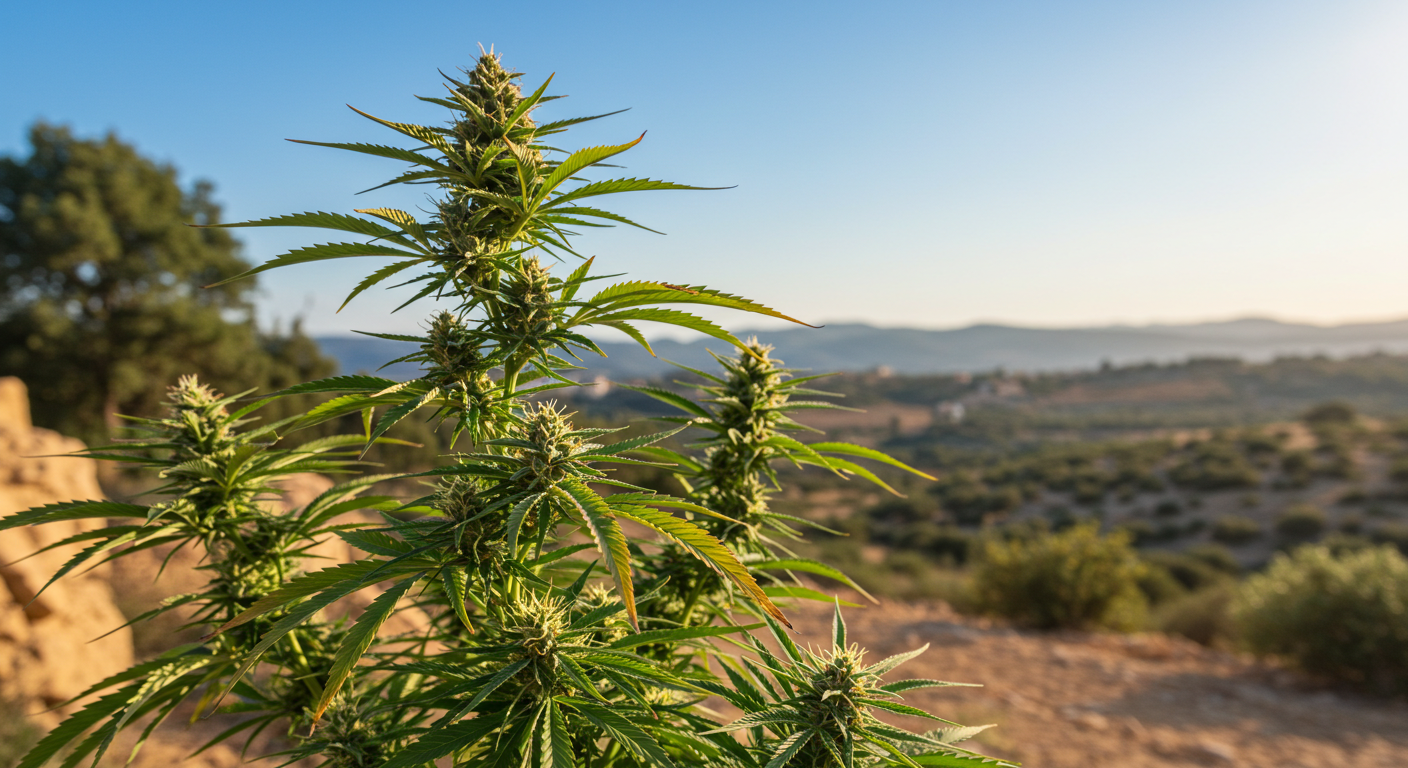
Outdoor Cannabis in Hot, Arid Climates
Outdoor cannabis can grow successfully in a hot, arid climate, but the garden has to be designed around atmospheric demand and root-zone buffering rather than around temperature alone. The difficult days are rarely defined by one number on a weather app. A plant can look reasonably comfortable at a high air temperature when the root zone is moist, the canopy is moving air, and the afternoon vapor pressure deficit is manageable. The same plant can wilt hard at a lower temperature when dry wind, reflected heat, a small container, salty irrigation water, and a depleted root zone arrive together.
The practical decision is therefore not, “Can cannabis handle heat?” It is, “Can this site keep water moving from the source, through the root zone, and through the plant fast enough to match the atmosphere without overheating the roots or concentrating salts?” That is the system this resource will help you build and verify.
This page stays focused on hot, dry outdoor conditions. For broader site selection, seasonal planning, training, pests, flowering, harvest, and general outdoor cultivation, use the Outdoor Grow Comprehensive Guide instead of trying to turn this one climate problem into a complete outdoor manual.
Start With the Real Constraint: Heat, Dry Air, or Water Supply?
“Hot and arid” describes a climate, not a diagnosis. Before changing the garden, separate the stresses that usually arrive together. High air temperature raises tissue temperature and respiration. Low humidity raises the atmosphere’s drying power. Strong solar radiation heats leaves, containers, walls, soil surfaces, and irrigation lines. Wind strips away the humid boundary layer around leaves and can accelerate water loss. Limited rainfall shifts almost the entire water budget onto irrigation. Mineral-rich source water can leave salts behind each time water evaporates.
These forces reinforce one another, but they are not interchangeable. Shade can reduce radiant heat without repairing an empty root zone. More irrigation can correct water deficit while making salinity worse if the root zone has no drainage and the source water is already mineral-rich. A larger container can add water and thermal buffering, but it can still become a hot reservoir if dark walls sit against reflective paving all afternoon.
Vapor Pressure Deficit (VPD)
VPD describes the difference between how much water vapor the air could hold at saturation and how much it currently holds. In practical field terms, it is one way to describe how strongly the atmosphere is pulling water from the crop. Hot, very dry air usually creates a stronger evaporative demand than the same temperature at higher humidity.
Use temperature and humidity together
A thermometer by itself can miss the most stressful afternoon. Two days can reach the same maximum air temperature while placing very different demands on the plant. On a dry, windy day, leaves may lose water rapidly even when the root zone was irrigated that morning. On a day with slightly higher humidity, the same air temperature can feel less aggressive to the crop because the atmospheric demand is lower.
You do not need to chase an indoor-style VPD target outdoors. Outdoor humidity, wind, sunlight, and leaf temperature change continuously. Use VPD as a context signal: when the forecast combines high temperature with unusually dry air and wind, plan for faster depletion, earlier inspection, and a narrower margin for irrigation failure.
Do not convert one cannabis temperature study into a universal limit
Cannabis genotypes do not respond identically to heat. Controlled research has found different photosynthetic temperature optima among Cannabis sativa varieties, with some performing best nearer the mid-20s Celsius and others nearer 30–35°C under the test conditions. At 40°C, photosynthetic performance declined in the tested varieties, but the magnitude of that decline differed substantially by genotype.
That is useful evidence, but it does not give a universal outdoor “safe maximum.” A laboratory leaf chamber controls light, humidity, CO₂, and water status in ways a garden does not. Outdoors, leaf temperature can exceed air temperature in still, intense sun and may run closer to air temperature when transpiration and air movement are strong. Use research to understand the direction of risk, then verify your own site with measurements and plant response.
Field Advice: If a garden repeatedly struggles on hot afternoons, do not begin by asking which product will fix heat stress. Ask which part of the water-and-energy pathway is failing first: atmospheric demand, water delivery, root-zone storage, root temperature, drainage, salinity, or canopy exposure.
Water reliability is the first design question
In an arid climate, a garden with excellent sun and poor water access is not an excellent site. Before planting, estimate the worst realistic irrigation demand, not the pleasant spring demand. Confirm that the source can deliver enough water during the hottest part of the season and that a pump, timer, hose, emitter, tank, or human schedule will not become the single point of failure.
For an in-ground garden, look at soil depth, texture, infiltration, and how much of the root zone can be wetted. For containers, note total substrate volume, wall material, exposure to direct sun, and how quickly a fully irrigated pot returns to the next irrigation point. Small pots can move from comfortable to critically dry far faster than deep ground soil.
“My plants only droop in the afternoon and recover by evening. Does that mean they are fine?”
Question sent by: CoastalCanopy, via email.
Recovery is useful information, but it does not prove the stress is harmless. Check root-zone moisture before the droop, during the hottest period, and after recovery. Also compare canopy temperature, wind, and VPD. A short midday depression can be a protective response to extreme atmospheric demand, while repeated severe wilting can reduce growth and indicate that water transport or root-zone buffering is falling behind.
Decide whether the site is hot, arid, or both at plant height
Regional climate classifications are helpful for planning, but the plant experiences a microclimate. A yard beside pale masonry, gravel, concrete, or a south- or west-facing wall may run much hotter than the official weather station. A low irrigated garden can be less dry than an exposed rooftop or patio in the same city. Start with local weather data, then measure where the canopy and roots will actually live.
Night recovery matters as much as the daytime peak
A garden that reaches a high daytime temperature but cools substantially after sunset is experiencing a different stress pattern from a site that stays hot through the night. Warm nights reduce the recovery period between heat events and keep respiration elevated for longer. They can also keep containers and masonry warm, so the next day starts from a higher thermal baseline.
Add minimum nighttime temperature to the field record during heat waves. If plants look progressively worse after several consecutive hot nights even though daytime irrigation is adequate, the problem may be cumulative rather than a single afternoon peak. Increasing water alone may not solve that pattern. Look for stored radiant heat, poor nighttime airflow, containers against warm walls, and root zones that never cool.
Plant stage changes the consequence of the same weather
A small vegetative plant, a large preflower plant, and a dense late-flowering canopy do not use water or tolerate intervention in the same way. A large canopy can move much more water and can empty a limited container rapidly. Dense flowers also make routine overhead cooling a poor default because prolonged wetting can create a different set of risks.
During flowering, focus even more strongly on root-zone delivery, structural shade above rather than on the plant, and airflow that does not desiccate the canopy. As biomass increases, recheck emitter number, wetted diameter, container stability, and the time between full irrigation and the next depletion point. The irrigation system that was adequate six weeks earlier may now be undersized.
Measure Heat Load Above and Below the Canopy
A useful hot-climate map has at least two layers: the air around the leaves and the environment around the roots. The most common mistake is to monitor one and assume the other follows it. A plant can have tolerable air temperature while its container wall and outer root zone are overheating in direct sun. It can also have a cool root zone while the canopy is being desiccated by hot wind.
Build a reference point and two stress points
Choose one location that represents the garden’s normal exposure. Then select the two places most likely to be stressful, such as a west wall, a gravel edge, an exposed corner, or a dark container sitting on paving. Use the same type of temperature and humidity sensor at the same approximate canopy height. Shield air sensors from direct solar radiation so you are measuring air rather than heating the sensor body in the sun.
Log several representative days, including a normal warm day and at least one hotter, drier event. Record morning, early afternoon, late afternoon, and evening conditions. If a sensor logs continuously, note the time of maximum temperature, minimum humidity, and the duration of the harsh period rather than only the single peak.
Measure the root zone, not just the container wall
An infrared thermometer can show that a pot wall or soil surface is extremely hot, but it does not tell you the temperature where most active roots are located. For containers, place a clean temperature probe into the medium at a repeatable depth away from the very edge. For ground soil or raised beds, choose a consistent root-zone depth and compare exposed and mulched areas.
Do not leave a metal probe where it becomes a heat conductor or a hazard. If you use a logger, protect the cable and mark the location so it is not damaged during watering or cultivation.
| Measurement | What it tells you | What it can miss |
|---|---|---|
| Air temperature + RH at canopy height | Atmospheric conditions around the plant | Leaf temperature, radiant heat, root-zone heat |
| VPD from temperature/RH | Relative atmospheric drying demand | Root-zone moisture, wind gusts, plant hydraulic limits |
| Root-zone temperature | Thermal exposure around active roots | Water distribution and salinity by itself |
| Soil/substrate moisture | Available-water trend between irrigations | Salt load, oxygen status, sensor placement errors |
| Source-water EC | Approximate dissolved-ion load entering the system | Specific ions and root-zone accumulation |
| Catch-can or emitter-volume check | Actual irrigation delivery | Whether water spread evenly through the whole root zone |
Map reflected and stored heat
Walk the garden in late afternoon. Put your hand near, but not on, walls and surfaces to notice radiated heat, then confirm differences with instruments where useful. Concrete, stone, masonry, artificial turf, metal fencing, and dark surfaces can continue releasing stored heat after direct sun shifts away. This can extend the daily stress period beyond the official maximum air-temperature hour.
The goal is not to eliminate every warm surface. It is to avoid placing the most heat-sensitive part of the system, often a container root zone, inside the strongest radiant pocket without a reason. Sometimes moving a pot 0.5–1 m (1.5–3 ft) or changing the barrier between the container and a wall produces more benefit than adding another irrigation event.
Use a simple hot-day field sheet
Record the same variables each time: date, cloud cover, maximum forecast, observed canopy-zone temperature/RH, wind character, root-zone temperature, root-zone moisture before irrigation, irrigation volume, and plant response. Add a photo from the same angle. Within a few heat events, patterns become visible.
- Canopy-height air temperature and relative humidity
- Root-zone temperature in at least one representative plant
- Moisture before the main irrigation decision
- Actual irrigation delivery, not timer duration alone
- Wind and reflected-heat exposure
- Source-water EC if salinity is a known local issue
- Late-afternoon recovery or continued decline
Do not let the weather station replace the garden
A regional station is excellent for forecasting trends and calculating reference evapotranspiration, but a home garden has walls, shade, soil differences, irrigation, and wind shelter. Use the station to anticipate risk. Use your garden measurements to decide what actually happens at the plant.
Build a Root Zone That Buffers Heat and Salinity
In a hot, dry climate, the root zone is both a water reservoir and a thermal buffer. The more frequently it swings from saturated to critically dry, or from cool morning conditions to overheated afternoon conditions, the harder the plant has to work to maintain water flow.
Ground soil and containers solve heat differently
Deep, suitable native soil has a major advantage: mass. Temperature changes more slowly below the surface, and roots can explore a larger volume for water when soil structure allows it. The disadvantages are less control over texture, salinity, contamination, and drainage.
Containers offer a known medium and precise irrigation, but they trade that control for exposure. Their entire root zone can be heated from the sides and bottom. A small dark pot in direct afternoon sun can dry and warm rapidly. A larger container generally buffers both water and temperature better, although it becomes heavier and can remain too wet if the medium is poorly aerated.
If you are still choosing a container system, see Containers and Pots. For the soil and media decisions behind the root zone, use the Cannabis Soil and Growing Media Guide.
Choose water-holding capacity without creating a swamp
A hot-climate medium needs enough plant-available water to bridge the interval between irrigations. That does not mean packing the pot with fine, waterlogged material. Roots still need oxygen after irrigation, and severe heat does not protect a saturated root zone from hypoxia.
Think in terms of a complete irrigation cycle: water enters evenly, the root zone reaches a useful moisture level, excess can leave, the plant draws moisture down, and air returns through the pore space. If the medium is so coarse that a large plant empties it several times a day, the system may be too fragile for your schedule. If it remains heavy and wet for days despite strong heat, it may be too dense or too large for the current root system.
Mulch is a root-zone tool, not a decoration
A porous mulch can reduce direct solar heating of the soil surface and slow evaporation. In hot climates, that can reduce the amplitude of root-zone moisture and temperature swings. Use clean material appropriate for a horticultural bed or container, keep it away from direct contact with the stem base, and continue checking moisture below the mulch rather than assuming the surface appearance tells you when to irrigate.
Mulch changes the watering schedule. If you add it, re-measure dry-down. Do not keep the old irrigation frequency simply because it worked when the surface was bare.
Remember: Any change that reduces evaporation can also keep the root zone wet longer. Hot weather does not cancel overwatering. Recheck moisture after adding mulch, wind protection, shade, or a larger container.
Protect containers from radiant heat
Container color, wall thickness, airflow around the pot, and the surface beneath it all affect root-zone heating. Dark containers absorb solar energy readily. Fabric containers increase side evaporation and air exchange, which can help cooling in some conditions but can also accelerate water loss in dry wind.
There is no single best container for every desert garden. A useful test is simple: compare root-zone temperature and dry-down in two candidate setups during a hot afternoon before committing the entire crop. A light-colored outer sleeve, spacing from a hot wall, a reflective barrier that does not trap stagnant air, or shading the container while leaving the canopy in suitable light may be enough.
Expect salts to become more visible in arid systems
When irrigation water evaporates or is transpired, dissolved minerals do not evaporate with it. In low-rainfall climates, there may be less natural leaching from seasonal rain, so salts can accumulate in containers and irrigated soil if the source water, fertilizer program, drainage, and leaching strategy are not balanced.
Measure source-water EC before blaming fertilizer. If the source itself carries a substantial mineral load, repeated irrigation can raise root-zone salinity even with moderate feeding. An EC measurement is a screening tool, not a complete water analysis. If sodium, chloride, alkalinity, or hardness is suspected, obtain a proper water report or laboratory test.
Do not treat every white crust as “nutrient burn”
Mineral deposits on a container, soil surface, or emitter can come from source water, fertilizer, or both. Measure the incoming water and the root zone before flushing aggressively. Repeated blind flushing with the same saline source water may move salts temporarily without solving the underlying input.
“Would a smaller fabric pot keep the roots cooler because more air reaches the sides?”
Question sent by: CedarRoute, via email.
It can increase evaporative cooling at the wall, but it also reduces water reserve and can dry very quickly in hot wind. In an arid climate, the safer comparison is not fabric versus plastic in isolation. Compare total root-zone volume, wall exposure, irrigation reliability, afternoon root temperature, and how fast the center of the medium dries.
Irrigate to Replace Water Use Without Creating Salt or Oxygen Problems
Hot-climate irrigation has two opposing failure modes: falling behind the plant and overreacting to heat with constant water. A fixed calendar handles neither well. The better approach is to combine measured delivery with evidence from the root zone.
Start with actual delivery
If you water by hand, measure how much your watering can, hose setting, or pump delivers in a known period. If you use drip irrigation, collect water from several emitters for the same timed interval and compare volumes. A timer that runs for ten minutes does not prove each plant received the same amount.
Heat exposes weak irrigation systems because the margin for error shrinks. A partially clogged emitter that was merely inconvenient in spring can become a plant-loss event during a hot, dry week.
Measure depletion instead of guessing frequency
For containers, pot weight, a moisture probe used consistently, or a calibrated sensor can show how quickly the root zone moves from fully irrigated to ready for the next event. In ground soil, use a soil probe or moisture measurement at more than one depth. The top few centimeters can look dry while deeper soil still contains useful water.
Track the interval during mild weather and again during the hottest conditions. If a container that lasted 36 hours in spring now approaches the irrigation point in 12 hours, the climate did not make the plant “needy.” It changed the water balance. Your system must either increase available water, reduce heat/wind load, increase irrigation frequency with good oxygen management, or use a combination.
Water the active root zone deeply enough to matter
Frequent shallow splashes encourage a shallow wet zone and can leave deeper roots dry. Apply water slowly enough for infiltration and evenly enough to wet the active root volume. In very dry peat-based media or hydrophobic soil, the first water may run down channels. Split the event into passes and verify that the center rewets rather than simply producing fast edge runoff.
For drip systems, emitter placement must match root spread. One emitter beside a large plant may create a narrow wet column while much of the root zone stays dry. As plants enlarge, the wetted footprint often needs to enlarge too.
Use early-day irrigation strategically, not dogmatically
Morning irrigation can start a hot day with a charged root zone and gives time to inspect delivery before peak stress. That is often useful in arid climates. But the correct timing still depends on depletion. If a container reaches a damaging deficit in late afternoon, refusing to irrigate because “watering is only for mornings” is not sound management.
Likewise, avoid turning evening into a routine overhead soak of dense flowers. Root-zone irrigation is easier to measure and usually keeps the canopy drier.
- Measure emitter or hand-watering delivery.
- Check moisture below the dry surface.
- Expand the wetted area as the root system expands.
- Keep an emergency water reserve if supply can fail.
- Recheck EC when evaporation and irrigation frequency rise.
- Adding water only because the afternoon is hot.
- Using timer duration as proof of delivered volume.
- Letting one emitter serve a large root zone without testing spread.
- Allowing peat or organic media to become repeatedly hydrophobic.
- Increasing fertilizer concentration because growth slowed during a heat wave.
Do not use drought stress as a potency technique
Some cultivation discussions treat water stress as a way to increase resin or cannabinoid concentration. The evidence does not support turning severe drought into a routine flowering technique. Recent floral-hemp research found that severe drought reduced flower yield and cannabinoid concentrations, while responses to more moderate stress varied with treatment and cultivar. Other work has also shown genotype-specific losses under water deficit.
The practical lesson for a hot, arid garden is conservative: do not create severe water stress on purpose while the climate is already imposing it. If you experiment with irrigation intervals, do it through measured root-zone depletion and plant response, not visible collapse.
Plan for source-water salinity and leaching
In dry regions, irrigation water may contain substantial alkalinity, hardness, sodium, chloride, or total dissolved salts. Measure source EC regularly if your supply changes seasonally or comes from a well, tank, canal, or blended source. A full laboratory report is more useful when EC is elevated or plants show a repeated salt pattern.
Leaching can be necessary in some container and irrigated-soil systems, but it must be designed. The root zone needs drainage, and the leach water needs somewhere legal and environmentally responsible to go. Do not create nutrient-rich runoff into storm drains, streams, neighboring property, or natural water.
“It is 40°C outside. Should I keep the soil wet all day so the plant never dries?”
Question sent by: WestSideRoots, via contact form.
No. The goal is reliable plant-available water with oxygen still returning to the root zone. Keep the plant from reaching damaging deficit, but do not maintain a saturated medium simply because the air is hot. Measure how quickly the root zone actually depletes and adjust volume, frequency, container size, or heat protection accordingly.
Use evapotranspiration as context, not as a copied cannabis coefficient
Reference evapotranspiration data can be extremely useful in arid regions because it describes how weather is changing evaporative demand. A sharp rise in reference ET can warn you that the garden is likely to deplete water faster. What you should not do is copy a crop coefficient from an unrelated crop, or even from an industrial-hemp field experiment, and assume it calculates the exact water requirement of a home cannabis plant.
Use ET trends as an early-warning layer, then calibrate them against your measured dry-down. If several previous days with similar ET produced a predictable irrigation interval, you have a local relationship worth using. As canopy size and plant stage change, recalibrate it. The number becomes valuable because it is tied to your garden, not because it came from a generic calculator.
Build enough reserve for a failed irrigation cycle
Automation reduces labor but can hide failures. In a mild climate, a missed cycle may be noticed before serious damage. In a hot, dry climate, a stuck valve, empty tank, tripped breaker, blocked filter, or disconnected line can become urgent within hours for a large container plant.
Design for failure. Know how long the root zone can safely bridge without irrigation under severe conditions. Keep a lawful backup water source where practical. Make critical valves and filters accessible. If a remote timer or controller reports that it ran, treat that as evidence of a command, not proof that water reached the roots. Periodically verify the physical result.
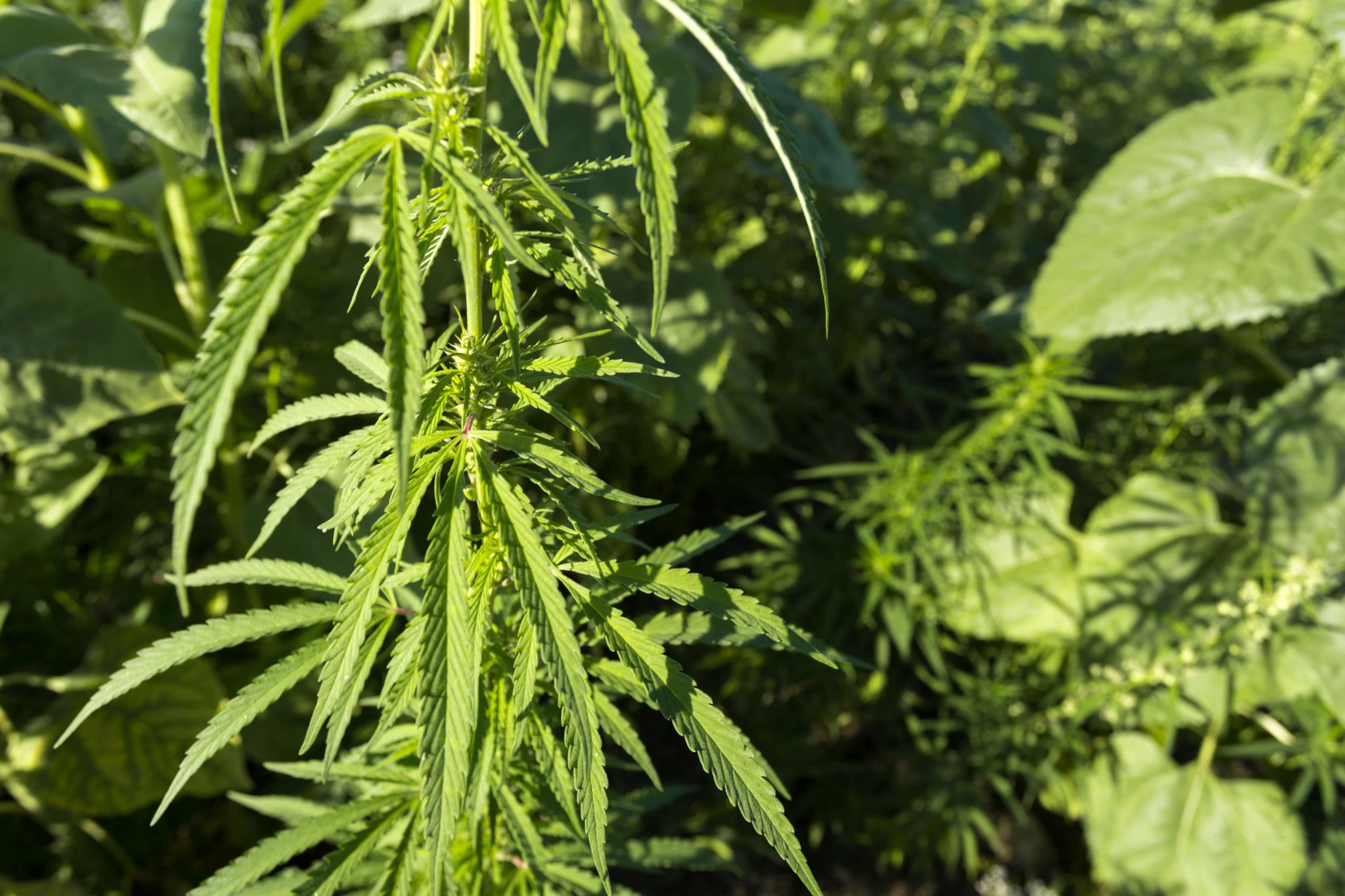
Manage Sun, Wind, and Seasonal Timing Without Over-Shading
Hot-climate growers often respond to heat by adding shade. Sometimes that is exactly the right move. Sometimes it trades heat stress for chronic light limitation. The goal is not the coolest possible garden. The goal is a light environment the plant can use without repeatedly exceeding the water and thermal capacity of the system.
Separate radiant overload from useful light
A plant in strong light may still be functioning well if leaf temperature, water status, and gas exchange remain stable. Another plant may overheat beside a reflective wall even with fewer direct-sun hours. Before adding shade cloth, compare the problem zone with a reference area. Note when wilting begins, when leaf edges curl, whether the root zone is adequately moist, and whether the stress aligns with direct sun or with reflected afternoon heat.
Temporary shade during an exceptional heat event can be safer than permanently reducing the entire season’s light. If you use shade cloth, support it above the canopy with airflow and test the result. Do not lay fabric directly on flowering plants.
Do not borrow a shade percentage from another crop as a cannabis target
Extension recommendations for desert ornamentals and vegetables often use particular shade-cloth percentages, but those numbers are crop- and situation-specific. Cannabis responses depend on cultivar, acclimation, canopy architecture, latitude, season, and water status. Treat any external percentage as a starting context, not a cannabis prescription.
If you need shade, make the smallest change that solves the measured problem. Recheck canopy temperature, root-zone depletion, plant posture, and available light after installation.
Use wind protection carefully
Wind can cool leaves, but in very dry air it can also accelerate water loss. A solid wall may reduce desiccating wind while creating a stagnant hot pocket on the protected side. A porous windbreak can reduce wind speed without stopping airflow completely. The right choice depends on direction, site geometry, and heat storage around the garden.
Map the afternoon wind and compare plant response on exposed and sheltered sides. If the windward edge is always the first to wilt even when root moisture is similar, wind desiccation is part of the load. If the sheltered side remains hotter into evening, excessive blockage may be the problem.
Acclimate plants before the hardest weather arrives
Plants moved from indoor or protected conditions into full arid sun can be damaged even when established outdoor plants nearby look comfortable. Increase exposure progressively when practical. Transplanting a soft plant into the harshest site immediately before a heat wave compresses several stresses into the same week: root disturbance, higher radiation, lower humidity, stronger wind, and faster water loss.
Use the forecast. If you can choose among several legal planting dates, avoid making the first days outdoors coincide with the most extreme early-season heat event.
Seasonal timing includes the finish window
A hot desert spring can become a different problem by late flowering. Day length shortens, nights cool, monsoon or autumn moisture may appear, and the risk balance shifts. A site chosen entirely for midsummer heat protection may become too shaded later when the sun path lowers.
Record where late-season shadows fall before planting permanent beds. Cultivar behavior also matters. Earlier finishing plants may avoid some late-season weather, while long-season plants may spend more time exposed to the transition from arid heat to cooler or wetter conditions. Do not use one strain’s calendar as a universal schedule.
Master Advice: In a hot, arid garden, climate management should be reversible where possible. Temporary shade, adjustable wind protection, movable container shielding, and irrigation settings that can be changed are easier to tune than permanent fixes made from one afternoon’s observation.
Protect the root zone before sacrificing the whole canopy’s light
If the canopy is healthy but container temperatures are extreme, start by shielding or relocating the container, insulating the surface with appropriate mulch, increasing the buffer volume, or separating the pot from radiant paving. Reducing light to the entire plant may be unnecessary when the real failure is below ground.
Genetics change the margin, not the laws of water balance
Cannabis populations and cultivars can differ in temperature response, drought response, maturation time, canopy architecture, and water-use efficiency. That makes cultivar choice relevant in climates with long periods of high heat. It does not make a “heat-tolerant” label a substitute for irrigation design.
When evaluating genetics for a hot-arid site, prioritize evidence from repeated outdoor performance in comparable climates over marketing language. Record which plants maintain posture, leaf function, and flowering progress under the same measured conditions. If one genotype consistently uses water faster, matures earlier, or shows more heat injury, treat that as useful selection information for future seasons.
Acclimation can change what looks like a genetic limit
A plant that has spent weeks developing outdoors under rising temperatures may respond differently from a plant moved abruptly from a mild protected environment into intense heat. When comparing plants, record their history. Differences in hardening, root development, container volume, and recent transplant stress can look like cultivar differences.
This is another reason not to diagnose from one heat event. The useful question is whether the same plant improves, stabilizes, or deteriorates across repeated events after the root zone and irrigation system have been verified.
Diagnose Heat Stress, Drought, and Salinity Before You Correct Anything
Heat, drought, salinity, root damage, and overwatering can produce overlapping symptoms. Leaves can curl, droop, discolor, slow growth, or develop dry edges under several different problems. The correction must follow evidence, because the wrong response often amplifies stress.
Start with timing
Ask when the symptom appears. Heat-load problems often worsen through the hottest part of the day and partially recover as conditions moderate. Root-zone drought usually tracks declining moisture and may persist into evening if the deficit is severe. Chronic salinity is more likely to build over days or weeks, often with slowed growth, marginal injury, and increasingly high root-zone EC. Overwatering can remain present overnight and into cool periods because the root zone does not regain adequate air.
| Pattern | Check first | Do not assume |
|---|---|---|
| Afternoon droop, morning recovery | VPD, wind, root moisture, root temperature | That more fertilizer is needed |
| Pot dries extremely fast | Root volume, irrigation uniformity, wall exposure | That the cultivar is simply “thirsty” |
| Leaf edges burn over time | Source EC, feed EC, root-zone EC, drainage | That heat alone caused it |
| Plant stays drooped after irrigation | Root oxygen, drainage, root temperature, disease | That it still needs more water |
| One plant wilts while neighbors do not | Emitter output, root damage, container exposure | That the whole garden needs a schedule change |
| Growth slows during a heat wave | Heat duration, nighttime recovery, moisture, salinity | That a stronger nutrient mix will force growth |
Use the one-variable correction rule
When possible, change one major variable at a time and verify the next irrigation cycle. If you simultaneously add shade, double irrigation frequency, change fertilizer concentration, flush the root zone, and move the pot, you may rescue the plant but you will not learn which correction mattered. Worse, several large corrections can create a new problem.
There are exceptions. If a plant is in obvious acute danger, safety comes before experimental neatness. Restore access to water, move an overheating container out of extreme radiant exposure if practical, and correct a failed irrigation line. Once the immediate danger has passed, return to measured adjustments.
Do not foliar-spray a stressed canopy in intense sun
Do not use unverified sprays as a heat treatment. Some oils, soaps, fertilizers, pesticides, or other foliar products can increase injury under high temperature or strong light, and pesticide labels may restrict application conditions. If a legally permitted product is needed for a separate pest problem, follow its label and temperature restrictions.
Recognize the compound-stress pattern
The most serious hot-arid failures are often combinations. A container becomes root-bound, irrigation frequency rises, source-water salts accumulate, one emitter partially clogs, and then a dry wind event arrives. The plant shows severe wilt and marginal burn. Calling that “heat stress” misses most of the system.
Trace the pathway in order: source water → delivery → wetted volume → drainage → root-zone moisture and EC → root-zone temperature → canopy exposure → plant response. That sequence is slower than guessing, but it prevents repeated mistakes.
Severe heat is not a cannabinoid-enhancement strategy
Recent controlled cannabis and hemp studies have shown biochemical stress and cannabinoid losses under severe or prolonged high-temperature treatments. Those experiments use conditions that are not identical to a home garden, so they should not be converted into a precise outdoor threshold. They do support a practical conclusion: prolonged extreme heat is a stress to manage, not a quality technique to chase.
“The leaves have dry edges, but the pot is wet. Is that still drought?”
Question sent by: Amber, via email.
Not necessarily. Check root-zone EC, drainage, root temperature, and how long the medium stays saturated. A wet root zone can still have poor water uptake if roots are oxygen-limited or damaged, and high salinity can make water harder for roots to acquire even when the medium contains moisture.
Verify recovery, not just symptom disappearance
After a correction, inspect new growth and the next hot-day response. Damaged leaf edges will not become green again. A successful correction is shown by more stable moisture, improved turgor, normal new growth, reliable irrigation delivery, and a root zone that returns to an appropriate moisture range after watering.
Pre-Season Commissioning and the Weekly Hot-Weather Routine
A hot-arid garden should be tested before the plants depend on it. Commissioning means deliberately proving that the water source, irrigation system, root-zone buffer, sensors, shade strategy, and emergency plan work under realistic load.
Commission the irrigation before planting
Run the system at the time of day you expect to use it. Measure total flow and compare delivery at the beginning and end of the line. Check filters, pressure, emitters, hose temperature, leaks, drainage, and where runoff goes. If using tanks, calculate how many full irrigation events the stored volume can provide.
Wet an empty prepared bed or representative container and watch the pattern. Does water infiltrate evenly? Does it run down one side? Does the middle remain dry? How long does drainage continue? Repeat the test after the medium has dried substantially, because some materials wet differently when dry.
Run a root-zone heat rehearsal
Before the crop is large, expose the planned container or bed setup to a representative hot day. Measure root-zone temperature morning, afternoon, and evening. Compare a control setup with one proposed heat-management change, such as mulch, container shielding, relocation from a wall, or greater substrate volume.
This simple test can prevent a season of chasing symptoms. If the modification does not improve the measured root-zone environment, do not keep it because it looks sensible.
Create a two-level response plan
Your normal plan covers routine hot weather. Your extreme-heat plan covers the few days when atmospheric demand, wind, or water risk moves beyond normal. The second plan may include earlier inspection, temporary shade, a backup water source, manual verification of automatic irrigation, or moving manageable containers away from radiant surfaces.
Write the trigger for the extreme plan in measurable terms based on your own garden. It might be a forecast combination, a root-zone depletion rate, repeated afternoon canopy response, or a water-supply constraint. Avoid a universal internet threshold.
- Confirm cultivation and water use are lawful at the site.
- Measure source-water EC and obtain a fuller analysis if local salinity is a concern.
- Verify irrigation delivery at multiple points.
- Confirm drainage and a lawful runoff destination.
- Map late-afternoon radiant heat and wind exposure.
- Test root-zone temperature in the planned container or bed.
- Measure dry-down after a full irrigation.
- Test any shade or windbreak before relying on it.
- Store enough backup water for a realistic supply interruption if appropriate.
- Record the normal and extreme-heat response plan.
Recheck water quality as the season concentrates the problem
A source that seems manageable in spring can become more difficult later if groundwater composition shifts, reservoir levels fall, municipal blends change, or evaporation increases. In containers, visible deposits around emitters or on pot walls are a reason to compare current source-water EC with the earlier baseline.
Do not wait for leaf injury if you already know the water is mineral-rich. Track the trend and inspect drainage. If a laboratory report shows elevated sodium, chloride, alkalinity, or another concern, interpret it with local horticultural guidance and the actual growing medium. The corrective strategy is different for excessive alkalinity than for sodium-dominated salinity.
Separate emergency cooling from routine cultivation
During an exceptional heat emergency, temporary measures may be justified that you would not use every day. A removable shade layer, an extra inspection, or moving a manageable container out of an extreme radiant pocket can buy margin. Once the event passes, remove or reverse measures that unnecessarily reduce light or airflow.
Do not let emergency behavior become the permanent schedule without evidence. If every hot week requires the same rescue, redesign the root zone, irrigation capacity, or site exposure. A resilient garden should handle normal local summer conditions without constant crisis management.
Use a weekly baseline, then add event checks
During stable weather, one thorough weekly system inspection can catch slow failures. Check filters, emitters, leaks, container condition, mulch depth and contact with stems, drainage, water EC, root-zone trend, and any salt crust. Review the coming week’s forecast and compare expected heat with the garden’s previous response.
During extreme heat, the plant may need observation more than once in a day. The goal is not constant interference. It is to catch a failed water delivery or unusually fast depletion before the plant spends hours in severe stress.
| Check | Normal warm week | Extreme-heat event |
|---|---|---|
| Forecast + VPD context | Review weekly | Review daily |
| Irrigation delivery | Spot-check several emitters | Verify before or during each critical cycle |
| Root-zone moisture | Track normal dry-down | Check before predicted peak stress |
| Root-zone temperature | Check representative hot day | Check if stress exceeds normal pattern |
| Source/root-zone EC | Periodic baseline | Recheck if irrigation frequency rises or symptoms appear |
| Shade/wind protection | Inspect structure | Deploy only when trigger is met and verify effect |
| Plant response | Photograph weekly | Compare morning, peak heat, and evening recovery |
Keep legal and safety decisions separate from plant stress
Heat does not justify unsafe improvisation. Do not run household electrical equipment through wet irrigation areas unless it is designed and installed for that environment. Do not create hidden wires, traps, or barriers that can injure people or animals. Follow local water restrictions, runoff rules, fire restrictions, property rules, and cannabis cultivation requirements.
In wildfire-prone regions, dry vegetation and temporary fabrics or structures can add fuel or obstruct access. Keep access routes clear and follow local fire-safety guidance. A plant is never worth blocking emergency access or creating an ignition hazard.
Use a five-question hot-day decision
- Is the root zone actually approaching the irrigation point? Check moisture, not surface appearance alone.
- Did the intended volume reach the plant? Verify delivery.
- Is the root zone overheating or accumulating salts? Check temperature and EC when indicated.
- Is atmospheric demand unusually high? Read temperature, humidity/VPD, wind, and radiant exposure together.
- Did the last correction improve the next hot-day response? If not, reassess before adding another intervention.
What a Resilient Hot-Arid Garden Looks Like
A resilient hot-arid cannabis garden does not depend on one heat-tolerant cultivar, one giant irrigation event, or permanent shade. It has enough root-zone volume to buffer change, a water source that has been measured, irrigation delivery that has been verified, drainage that prevents chronic saturation, and a plan for the few days when atmospheric demand exceeds normal conditions.
Most of the useful corrections are not dramatic. They are measurable: move a container away from reflected heat, enlarge the wetted root area, clean a partially blocked emitter, reduce unnecessary salt input, protect the root surface with appropriate mulch, add temporary rather than permanent shade, or increase the frequency of a well-aerated irrigation system when actual depletion shows that the plant needs it.
The final test is repeatability. If the plant enters a hot day with a known root-zone condition, receives a verified amount of water, avoids severe midday collapse, and returns to a stable evening condition without accumulating excess salts or remaining saturated, the system is working. Record that pattern. It is far more useful than copying a temperature threshold from someone else’s climate.
Share this article
A quick overview of the topics covered in this article.
Follow us
Latest articles
September 1, 2026

September 1, 2026
September 1, 2026

September 1, 2026