
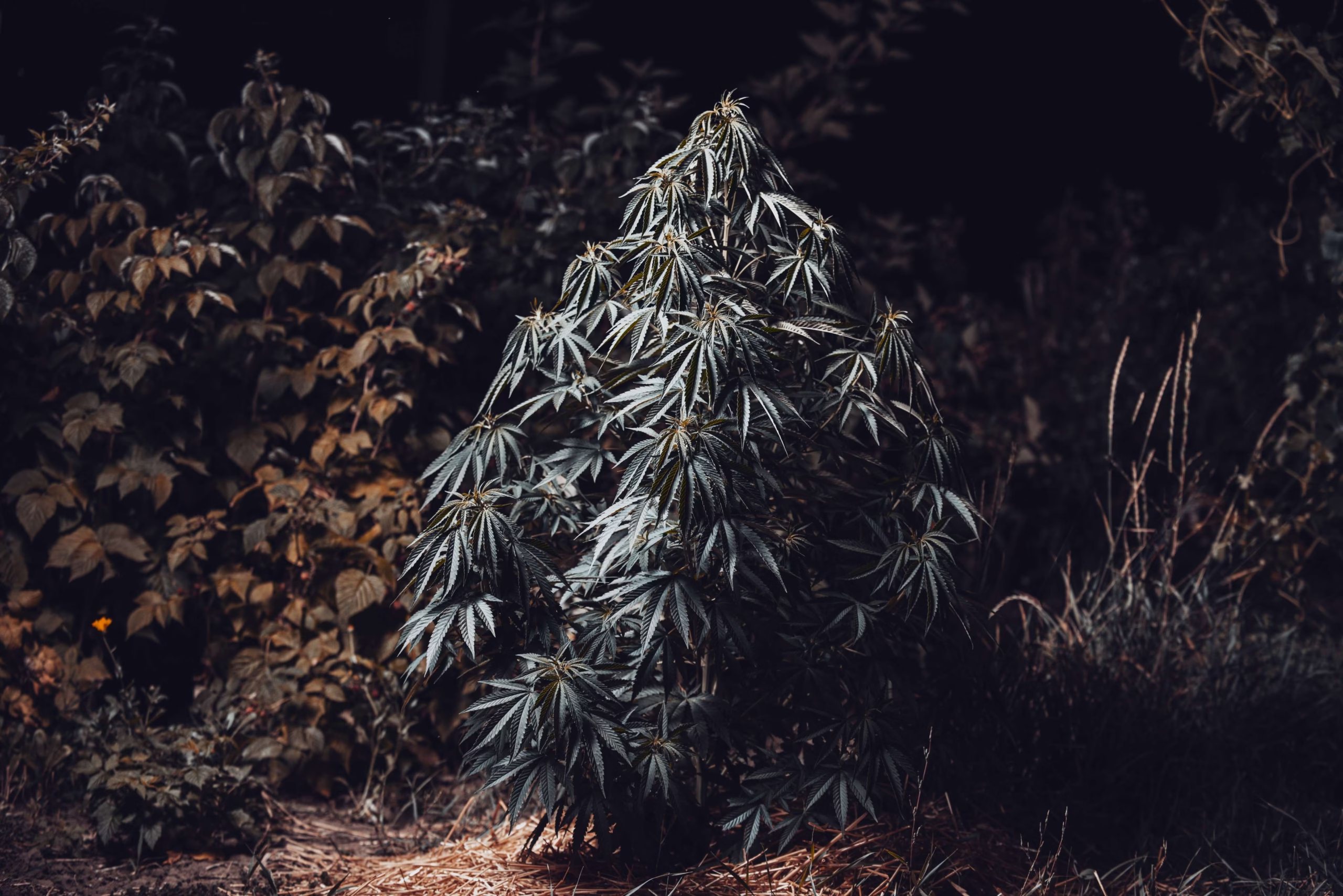
Outdoor Cannabis Photoperiod: Latitude, Twilight, Light Pollution, and Flowering Trigger
Outdoor cannabis does not wait for a universal calendar date or a perfect 12-hour day before it begins to flower. A photoperiod-sensitive plant responds to the relationship between light and uninterrupted darkness, and the exact response can vary substantially with genetics. Latitude changes the seasonal day-length curve, twilight can extend biologically useful light beyond sunset, and artificial light at night can interrupt a dark period that would otherwise support flowering.
That is why the practical question is not simply, “When will my plant flower at this latitude?” The better question is: when does this specific plant begin receiving a long enough effective night, at this exact site, without enough twilight or artificial light to delay the transition? You cannot answer that from a latitude chart alone. You need a seasonal day-length reference, a site-level night-light audit, and repeated observation of the plant.
Research now makes another point clear. The familiar indoor 12/12 schedule is a dependable horticultural tool, but it is not a universal biological threshold for every Cannabis sativa genotype. Studies have documented flowering under longer photoperiods, cultivar-specific critical photoperiods, meaningful responses to differences as small as 15 minutes in some hemp cultivars, and sensitivity to surprisingly low levels of light during the night. Outdoor planning therefore works best when you treat flowering as a genetics x effective photoperiod x uninterrupted darkness x season problem.
This resource stays focused on that photoperiod decision. It does not repeat the full outdoor cultivation system. For soil, irrigation, site preparation, security, weather, cultivar selection, and the rest of the season, use the Outdoor Grow Comprehensive Guide.
In This Resource
- Define the outdoor decision in terms of site, season, climate, legal access, and plant risk
- Measure the site: sun path, shade, temperature, humidity, wind, drainage, water access, cold pockets, or contamination as relevant
- Seasonal timing: latitude, photoperiod, weather windows, and cultivar behavior
- Practical setup/response plan with materials, placement, inspection points, and a backup option
- Failure modes: stagnant air, trapped moisture, heat load, frost, wind damage, water shortage, security, or neighbor impact
- Legal/safety boundary without guessing local rules or recommending dangerous traps
- Pre-season and weekly checklist that turns the article into a repeatable field procedure
Define the outdoor decision in terms of site, season, climate, legal access, and plant risk
The direct answer: outdoor flowering is controlled by the effective night, not a date on the calendar
For most photoperiod-sensitive cannabis, the seasonal move toward flowering is associated with nights becoming long enough to support reproductive development. The common shorthand is that cannabis is a short-day plant, but physiologically it is often more useful to think about the length and continuity of darkness. A plant can experience the same sunset time as another plant nearby and still receive a different biological night if one canopy is exposed to a porch light, security light, greenhouse glow, billboard, streetlight, or repeated vehicle headlights.
The word effective matters. Sunrise and sunset are astronomical reference points. The plant does not read a weather app. It responds to photons reaching its photoreceptors. Civil twilight continues after apparent sunset and before apparent sunrise. Artificial light can arrive in the middle of the night. The spectrum of that light also matters because photoperiodic signaling is mediated largely through phytochrome, which is especially responsive to red and far-red wavelengths.
Key Term
Effective Photoperiod
The light period that is biologically meaningful to the plant, rather than the clock interval between listed sunrise and sunset. Outdoors, effective photoperiod can be influenced by twilight, local horizon obstructions, artificial light at night, light spectrum, and the sensitivity of the cultivar.
Cannabis Critical Photoperiod Explained
A critical photoperiod is the day length around which a photoperiod-sensitive genotype changes its flowering response. It is not one universal number for cannabis. In a 2021 study of 27 hemp cultivars, researchers identified critical photoperiod thresholds for several cultivars and found that some essential-oil types had critical day lengths around 13 hours 45 minutes to 14 hours. For many of the tested essential-oil cultivars, moving from 13 hours 45 minutes to 14 hours delayed flowering by several days. The lesson is not that 13:45 is the correct target for drug-type cannabis. The lesson is that small changes in photoperiod can matter and the threshold is genotype dependent.
Drug-type cannabis shows the same broad principle. A 2023 University of Guelph study tested ten cultivars under 12, 12.5, 13, 13.5, 14, and 15 hours of light. All ten initiated flowering at photoperiods up to 14 hours, although the timing and strength of the response differed by cultivar. Some initiated at 15 hours, but the floral tissues did not continue normal development. This is strong evidence against treating 12/12 as the natural outdoor trigger for every cultivar.
There is also a difference between flower initiation and robust floral development. A plant may show early reproductive signs under a marginal photoperiod without progressing at the same rate it would under a stronger short-day signal. Outdoors, that can appear as a slow transition, continued vertical growth, scattered pistillate clusters, or a plant that seems to hover between strong vegetative growth and full flower development.
Weedth Verdict: Do not ask for the one cannabis flowering photoperiod. Ask for the response range of the cultivar you are growing, then verify that response at your site as the season changes.
Latitude and Outdoor Cannabis Flowering
Latitude changes the annual pattern of day length. Near the equator, day length changes relatively little through the year. Farther from the equator, the difference between summer and winter becomes much larger. That matters because a photoperiod-sensitive cultivar adapted to one latitude may encounter a very different seasonal signal somewhere else.
The table below gives rough geometric daylight examples around the solstices. These are not flowering predictions. They are simplified astronomical values to show how latitude changes the seasonal envelope. Actual sunrise and sunset times are affected by atmospheric refraction, local horizon height, elevation, and the definition used by the calculator. Twilight is not included in the values below.
| Latitude | Approx. midsummer daylight | Equinox daylight | Approx. midwinter daylight |
|---|---|---|---|
| 25 degrees | 13.6 h | About 12 h | 10.4 h |
| 35 degrees | 14.4 h | About 12 h | 9.6 h |
| 45 degrees | 15.4 h | About 12 h | 8.6 h |
| 55 degrees | 17.1 h | About 12 h | 6.9 h |
In the Southern Hemisphere the seasonal pattern is reversed by roughly six months. The biological logic does not change. A grower in either hemisphere should track the local decline in effective photoperiod toward the finishing season rather than copying dates from a grow calendar written for another latitude.
Latitude is therefore a calendar framework, not a cultivar-specific answer. Two cultivars grown side by side at the same latitude may begin visible reproductive development on different dates. A third may be day-neutral or strongly autoflowering and transition largely according to age rather than seasonal day length. Even plants sold under the same cultivar name can show genetic variation if the seed or clone source is not uniform.
Grower Question
“If I know my latitude, can I calculate the exact day flowering will start?”
Question sent by: SoilAndSun, via email.
No. Latitude lets you calculate the seasonal day-length pattern, but it does not reveal the cultivar’s critical photoperiod or its sensitivity to twilight and artificial night light. Use latitude to build the expected window, then verify the plant’s actual response in the garden.
Photoperiod-sensitive and day-neutral plants belong in different planning models
The procedure in this article is primarily for photoperiod-sensitive cannabis. Some Cannabis sativa genotypes are relatively photoperiod insensitive. Genetic work has identified major-effect loci associated with autoflowering and flowering time, which helps explain why day-neutral plants can progress toward flowering under long days or even continuous light conditions that keep many photoperiod-sensitive plants vegetative.
If the plant is a true autoflower, latitude still affects DLI, temperature, weather, and the amount of useful sun available during its life cycle, but it does not provide the main flowering trigger. Do not use an autoflowering plant as a control for a photoperiod cultivar when you are trying to diagnose delayed flowering.
Define the decision before you start measuring
You are usually trying to answer one of four practical questions. Will this cultivar begin flowering early enough to finish before the local weather window closes? Is a nearby artificial light likely to be delaying flowering? Does civil twilight materially extend the plant’s effective day at this site? Or is the plant’s apparent delay actually normal cultivar behavior rather than a site problem?
Write the question at the top of the field log. That prevents the investigation from expanding into unrelated variables. If the concern is light pollution, measure the night environment. If the concern is late seasonal initiation, compare the local day-length decline with the cultivar’s observed transition. If the concern is finishing before frost or autumn rain, photoperiod must be read together with the cultivar’s flowering duration and local weather window.
| What you know | What it can tell you | What it cannot tell you alone |
|---|---|---|
| Latitude | Seasonal day-length pattern | Exact cultivar flowering date |
| Sunrise and sunset | Astronomical daylight reference | Effective biological photoperiod |
| Civil twilight | Low solar illumination around dawn and dusk | Universal cannabis response to that light |
| Night PPFD or irradiance | Photon level at the measured point | Cultivar response without biological observation |
| First preflowers | Sexual maturity and reproductive potential | Proof of full-canopy flowering transition |
| Repeated flowering observations | Actual response of that plant at that site | A universal threshold for other cultivars |

Measure the site: sun path, shade, temperature, humidity, wind, drainage, water access, cold pockets, or contamination as relevant
Start with a night map, not just a daytime site map
A normal outdoor site map records sun, shade, wind, drainage, and access. A photoperiod map adds a second layer that many growers miss: where light comes from after the sun is gone. Stand at the future canopy position after dark and look in every direction. Mark porch lights, path lights, security fixtures, neighboring windows, streetlights, greenhouses, parking areas, illuminated signs, and roads where headlights sweep across the site.
Do not perform this audit only once. Some lights are controlled by motion sensors. Some switch off after midnight. Others appear only when a neighbor is home. Stadium, business, parking, and seasonal decorative lighting can follow weekly or seasonal schedules. The biologically relevant question is whether light reaches the foliage during what would otherwise be the dark period, and how often that happens.
Map the source, direction, approximate height, duration, color appearance, and whether the plant receives direct line-of-sight illumination or only reflected sky glow. A source hidden from your eyes at ground level may become visible to the upper canopy as the plant grows.
Outdoor Light Pollution and Delayed Flowering
Artificial light at night can delay or disrupt flowering in sensitive short-day plants by interrupting the dark period. Cannabis research now shows that the sensitivity can be extreme and highly cultivar dependent. Earlier work reported disrupted flowering around 2 micromoles per square meter per second in a hemp cultivar under greenhouse conditions. Controlled cannabis work has also described delayed flowering responses at localized leaf-level intensities at or below 0.1 micromoles per square meter per second in one cultivar.
A 2025 study pushed this question further by testing seven cannabis cultivars under very low night-light levels. The most sensitive cultivars showed delayed flowering at only 0.01 micromoles per square meter per second, or 10 nanomoles per square meter per second. Red light caused stronger photoperiodic disruption than white light at comparable photon levels, consistent with phytochrome involvement. Those numbers are research observations, not universal outdoor safe and unsafe thresholds.
Important
Do not turn a published light level into a universal “safe nighttime PPFD”
Cultivar sensitivity, spectrum, duration, timing within the night, sensor accuracy, canopy position, and experimental conditions all matter. A level that caused a response in one study is evidence that very dim light can matter. It is not a guaranteed threshold for your plant.
Duration and timing matter as much as the nightly average. A garden can look dark for most of the night and still receive a biologically meaningful interruption from a motion light, a late-night security cycle, or a bright source that turns on for an hour. Controlled horticulture uses this principle deliberately in “night break” lighting, where a period of light interrupts a long dark interval and changes a short-day plant’s photoperiodic response.
Recent cannabis work testing a one-hour night break during vegetative production showed that interrupting the night can maintain vegetative behavior under conditions that would otherwise contain a long dark period. That experiment was indoors and should not be converted directly into a streetlight rule, but it reinforces the mechanism: darkness is not simply the total number of dark hours. Continuity matters.
Grower Question
“The streetlight is weak. If I can barely read under it, can the plant still care?”
Question sent by: WestWindowGrow, via contact form.
Possibly. Human visual impression is a poor detector of photoperiodic risk. Some cannabis cultivars have shown responses to extremely low photon levels in controlled studies. Measure the canopy if practical, document the spectrum or fixture type when possible, and use the plant’s response over time as the final check.
Measure low light with the right tool and the right expectations
A standard PAR quantum sensor is designed primarily for photosynthetically active radiation. Some instruments perform well at very low photon flux; others have too much noise or insufficient resolution near darkness for night-light diagnostics. Before trusting a reading such as 0.01 or 0.1 micromoles per square meter per second, check the sensor’s lower measurement range, resolution, cosine response, spectral response, calibration information, and manufacturer guidance.
A lux meter can be useful for mapping relative brightness, but lux weights light according to human visual sensitivity. Plants do not use the same weighting. Converting lux to PPFD requires assumptions about spectrum, and those assumptions become especially risky when comparing very different sources such as warm LEDs, cool LEDs, high-pressure sodium, metal halide, or narrow-spectrum red light. At the low levels relevant to photoperiodism, a neat conversion number can create false confidence.
A phone sensor or camera can help you find where the garden is brighter or darker, but do not use it to declare a biological threshold unless it has been validated for that measurement. If you do not own a low-light-capable instrument, a structured relative survey is still useful: same device, same orientation, same camera settings, same observation points, same time after sunset, and clear notes about which light sources were on.
Measure at canopy locations, not only where the pot or stem begins
Night light is directional. Measure where leaves actually intercept it. If a streetlight is east of the garden, the east-facing upper canopy may receive much more light than the shaded west side. A fence may protect the lower plant while the upper branches grow above the fence line. A nearby wall can reflect light onto one side of the canopy even when the source itself is not directly visible.
For a large outdoor plant, use multiple sampling points: upper canopy facing the source, upper canopy opposite the source, middle canopy, and the darkest internal reference point you can reach safely. Record whether the sensor is horizontal or aimed toward the source. Do not mix orientations between readings and then compare the numbers as if they represented the same geometry.
| Night audit point | What to record | Why it matters |
|---|---|---|
| Upper canopy toward source | Low-light reading, source direction, fixture status | Often the highest exposure point |
| Upper canopy away from source | Same measurement method | Shows directional difference |
| Middle canopy | Reading plus obstruction notes | Checks whether fencing or foliage blocks light |
| Dark reference zone | Lowest repeatable reading | Provides a comparison baseline |
| Motion-light event | Start time, duration, frequency, peak reading if possible | Captures interrupted darkness that an average can hide |
Do not let photoperiod mapping erase the rest of the site
A perfectly dark corner can still be a poor garden. Continue to map sun path, drainage, wind, water access, frost exposure, security, and contamination risk. A tall opaque fence that blocks a streetlight may also reduce morning sun and airflow. A deep low spot may be dark at night but collect cold air and water. A location farther from the house may solve a porch-light problem and create a water-access or security problem.
Photoperiod is one layer in the site decision. If moving the plant to obtain darker nights produces a larger agronomic or legal problem, the move is not automatically an improvement.
Field Advice: Add a “night light” layer to the same site map you use for sun, wind, drainage, and access. The best outdoor site is the one where the layers work together, not the point that wins one measurement.
Seasonal timing: latitude, photoperiod, weather windows, and cultivar behavior
Civil Twilight and Cannabis Flowering: Does It Count?
Civil twilight is the period when the sun is between the horizon and 6 degrees below it. NOAA defines the end of evening civil twilight at a solar elevation of minus 6 degrees. Nautical twilight extends to minus 12 degrees and astronomical twilight to minus 18 degrees. Those categories are astronomical definitions, not plant-development thresholds.
For cannabis, the correct answer to “does civil twilight count?” is sometimes, and not as a fixed number of minutes that can be added to every sunset. The 2021 hemp photoperiod study found civil twilight around 2 micromoles per square meter per second to be biologically effective in regulating flowering in their system. That tells us twilight can matter. It does not prove that every cultivar responds to the entire civil-twilight interval at dawn and dusk in the same way.
Twilight intensity changes continuously. Clouds, aerosols, horizon obstruction, terrain, canopy shade, and atmospheric conditions alter what reaches the plant. Dawn and dusk may also differ biologically. Research in other photoperiod-sensitive species has shown that twilight sensitivity can be asymmetric between morning and evening, and cannabis-specific outdoor data are not yet strong enough to justify a universal correction such as “add 30 minutes to sunrise and sunset.”
The practical method is to use civil twilight as a warning band. If the cultivar appears to initiate flowering later than sunrise/sunset calculations predict, compare the plant’s response with civil-twilight timing and, when possible, measure low PAR near the canopy during that period. Keep the resulting estimate cultivar and site specific.
Key Distinction
Sunset, twilight, and darkness are not interchangeable
Sunset is an astronomical event. Civil twilight is a low-light interval after sunset and before sunrise. Biological darkness begins when the light reaching the plant falls below the level that meaningfully affects that plant’s photoperiodic signaling. That level can vary with genetics and spectrum.
Use sunrise and sunset as the reference clock, then bracket the uncertainty
Start with a reputable solar calculator for the exact latitude and longitude. Record sunrise, sunset, and civil-twilight start/end for the dates surrounding the expected transition. This creates a transparent reference that another grower could reproduce. Then record site-specific deviations: a mountain that hides the sun early, a building that blocks the western horizon, a tree line that delays direct morning light, or artificial lighting that continues after twilight.
Do not subtract a building’s afternoon shadow from astronomical photoperiod automatically. Photoperiodic receptors can respond to low diffuse light even when the solar disk is blocked. Likewise, do not assume the plant is in full biological darkness because the garden looks dim to you. The relevant measurement is photon exposure at the plant.
Latitude changes the slope of the seasonal transition
At some latitudes, day length declines relatively quickly around the late-summer transition. At others, the seasonal change is gentler. This affects how rapidly a photoperiod-sensitive plant crosses from a marginal response into a stronger flowering signal. A cultivar may appear to “suddenly” commit to flowering when the day length moves below its critical range, even though the astronomical decline has been continuous for weeks.
Higher-latitude summers can keep photoperiod-sensitive plants vegetative for a long time, supporting large canopies, but the later finishing window may collide with colder nights, rain, reduced DLI, and frost. Lower latitudes may provide a shorter long-day vegetative period for some genetics. Neither latitude is automatically better. The question is whether the cultivar’s flowering behavior fits the available weather window.
Flowering trigger and flowering duration are separate planning problems
A cultivar that initiates early can still require a long time to mature. Another may begin later but finish faster. When you are choosing outdoor genetics, separate these two variables in the field log. Record the first clear whole-plant transition and the date of harvest readiness. Over several seasons, that becomes far more useful than a strain description that says only “harvest in October.”
The transition date is also not identical to the first isolated preflower. Mature cannabis can show sex expression at the nodes while still growing strongly vegetatively. For field mapping, use a consistent reproductive marker such as multiple new floral clusters with paired stigmas developing at several shoot tips, increasing across repeated inspections. The 2023 controlled study defined flowering initiation as at least three pairs of stigmas at the apex of the primary shoot. Outdoors, you can use a similar repeatable observation standard without pretending the research definition is the only valid field marker.
Grower Question
“My plant has a few pistils at the nodes. Does that mean the critical photoperiod has been reached?”
Question sent by: NorthernRoots, via Facebook page.
Not necessarily. Node preflowers can indicate sexual maturity without proving that the whole plant has entered a robust flowering transition. Record whether reproductive growth is expanding at multiple shoot tips over the next several inspections.
Weather windows determine whether a late trigger becomes a real problem
A flowering date only matters in context. If a cultivar transitions late at a site with a long dry autumn, the plant may still have plenty of time. The same trigger date can be unacceptable where autumn brings persistent rain, high humidity, declining light, or early frost. That is why the photoperiod log should include the local finish window instead of stopping at the first pistil cluster.
Use historical climate data to frame risk, then use current-season forecasts and observations for decisions. Do not promise a harvest date from long-term averages. Weather is not a schedule.
Practical setup/response plan with materials, placement, inspection points, and a backup option
Build the photoperiod map before flowering pressure becomes urgent
The best time to discover a night-light problem is before the plant has spent two weeks under a marginal flowering signal. Begin the formal photoperiod log several weeks before you expect seasonal transition based on local experience, cultivar information, or the broader regional pattern. If you have no useful cultivar history, start earlier and treat the first season as data collection.
You do not need an expensive laboratory to build a useful map. You need consistency. Use the same observation points, the same timing logic, and the same flowering marker from one check to the next.
Photoperiod Field Kit
- Exact garden latitude and longitude.
- A reputable sunrise, sunset, and civil-twilight calculator.
- A site sketch with north marked and all artificial night-light sources shown.
- A clock or timestamped logging method.
- A low-light-capable PAR sensor when quantitative night measurements are required.
- A lux meter only as a relative mapping tool unless spectrum-specific conversion is justified.
- A fixed canopy-level measurement position or repeatable reference height.
- A notebook or spreadsheet for day length, twilight, artificial light events, weather, and flowering observations.
- A camera for consistent reproductive-development photos from the same shoot tips.
- A safe backup location or light-shielding plan when local rules and site conditions allow it.
Step 1: record the astronomical reference
For each observation date, record sunrise, sunset, civil-twilight start and end, and the listed day length. If you are comparing multiple seasons, record the calculator or data source as well. Do not mix apparent sunrise from one source with geometric sunrise from another without noting the difference.
Use local clock time only for field convenience. Photoperiod itself does not care about daylight-saving time. A clock change shifts the human label on sunrise and sunset; it does not change the solar geometry.
Step 2: mark the real horizon and obstruction pattern
Observe the plant or candidate site near dawn and dusk. Note when the garden first receives useful sky light, when direct sun appears, when it disappears behind local terrain or structures, and when the site becomes visually dark. This is not a substitute for low-light measurement. It gives the photon measurements a physical explanation.
Repeat after major seasonal changes. A plant growing above a fence, a tree gaining foliage, or a neighboring structure can alter the site-level exposure even when the astronomical day length is predictable.
Step 3: perform a three-part night-light audit
Measure or observe the canopy during three windows: shortly after civil twilight ends, around the middle of the dark period, and before morning civil twilight begins. Add event-based checks when a known source switches on. If a motion light is the suspected problem, deliberately trigger it only from your own property and only if doing so is safe and lawful, then record duration and canopy exposure.
At each window, inspect the upper leaves facing the source, the opposite side of the canopy, and a darker reference point. Record whether the source is steady, intermittent, moving, reflected, or screened by foliage. A single measurement from the center of the garden can miss the illuminated side of a large plant.
Step 4: log flowering development every three to seven days
Choose several repeatable shoot tips. Photograph them from similar distance and angle. Record a simple development code rather than relying on memory. For example: 0 = vegetative tip only; 1 = isolated preflowers; 2 = multiple pistillate clusters at several tips; 3 = clear expanding inflorescences; 4 = established flowering across the canopy. The numbers are editorial field codes, not scientific stages. Their value comes from consistency.
Do not inspect only the branch nearest the artificial light. Compare the exposed and darker sides. If the illuminated side lags while the darker side advances, the pattern strengthens the light-pollution hypothesis. If the whole plant transitions uniformly late, genetics or seasonal day length may be the stronger explanation.
| Check | Record | Decision question |
|---|---|---|
| Solar reference | Sunrise, sunset, civil twilight, date | What seasonal signal should exist? |
| Night-light map | Source, direction, duration, spectrum/fixture if known | Is the dark period being interrupted? |
| Low-light measurement | Canopy points and instrument details | How large is the exposure at the plant? |
| Reproductive inspection | Same shoot tips every 3-7 days | Is flowering initiation progressing? |
| Weather check | Rain, cloud, heat, frost risk, storm events | Does the remaining finish window still work? |
Step 5: change one variable only when the evidence justifies it
If a controllable light on your own property is clearly reaching the plant, start with the least disruptive correction. Re-aim the fixture downward, add a manufacturer-appropriate shield, reduce unnecessary operating time, reposition a motion sensor, or use a lower-impact path-lighting solution that still meets safety needs. Do not compromise required security lighting or create an unsafe dark walkway simply to protect a plant.
If the problematic source is not yours, do not tamper with it. A freestanding opaque screen on your property may be an option if it is permitted, stable in wind, does not trap moisture, and does not block needed daylight. In some gardens the safer decision is to place the plant elsewhere before it becomes large or rooted in native ground.
After any correction, repeat the same night measurement and the same flowering inspections. If several variables are changed at once, you lose the ability to tell which correction mattered.
Do
- Use a reproducible solar-time source and keep the same definition throughout the season.
- Measure artificial light at the actual canopy and from multiple directions.
- Track flowering development on the same shoot tips.
- Shield or re-aim lighting you control when it can be done safely and legally.
- Recheck after the plant grows above fences, screens, or neighboring vegetation.
Avoid
- Assuming 12/12 is the natural trigger for every cultivar.
- Adding a fixed number of twilight minutes to every location.
- Using one research PPFD value as a universal safe threshold.
- Tampering with public, utility, or neighboring lighting.
- Wrapping the whole plant in an improvised tarp that traps heat and moisture.
Step 6: keep a backup option that does not create a new agronomic problem
A backup can be another legal planting position, a directional screen, a change to your own lighting, or a future cultivar choice with earlier or more suitable flowering behavior. Do not wait until the plant is enormous to discover that every backup requires root disturbance or a large structure.
Commercial light-deprivation systems can manipulate flowering more aggressively, but that is a separate cultivation system with its own ventilation, heat, moisture, labor, and legal considerations. This resource is about understanding and protecting the natural outdoor photoperiod, not converting an outdoor garden into a blackout greenhouse.
Master Advice: The strongest diagnosis combines physics and biology. Measure the light environment, then ask whether the plant changed in the direction the measurement predicts.
Failure modes: stagnant air, trapped moisture, heat load, frost, wind damage, water shortage, security, or neighbor impact
Failure mode 1: treating 12/12 as an outdoor flowering date
This is the most common conceptual error. A grower looks up the date when local daylight reaches 12 hours and assumes flowering begins then. Many photoperiod-sensitive cannabis cultivars can initiate flowering under longer days, while others respond later or more slowly. Waiting for 12-hour daylight can make the predicted start dramatically too late.
Use 12/12 as an indoor control convention, not as an outdoor calendar. The relevant outdoor event is when the cultivar crosses its effective critical photoperiod range and receives sufficiently long, uninterrupted nights to sustain reproductive development.
Failure mode 2: confusing preflowers with the whole-plant transition
A mature vegetative plant can show sex expression without being fully committed to flowering. If you mark that first isolated pistil as “flowering day one,” your field data may make a cultivar appear earlier than it really is. Use a consistent multi-tip marker and require progression on the next inspection.
Failure mode 3: using an average night reading that hides interruptions
An average can look low while a one-hour security light creates a strong night break. Photoperiodic signaling depends on when photons arrive, not just the nightly total. Log switching events and duration separately from background sky glow.
Intermittent vehicle headlights are more difficult to interpret because exposure is brief and variable. Record frequency rather than assuming either zero effect or guaranteed disruption. If the road is busy and headlights repeatedly sweep the canopy for hours, the pattern deserves more attention than one isolated vehicle.
Failure mode 4: trusting a meter below its useful range
A display that shows two decimal places is not proof that the instrument is accurate at those values. Low-light measurements can be dominated by sensor noise, calibration limits, spectral mismatch, or orientation errors. Check specifications. When the meter is not suited to the task, report the result as relative brightness rather than false PPFD precision.
Failure mode 5: solving light pollution by creating stagnant air or trapped moisture
Opaque screens can change the garden microclimate. A screen placed close to dense flowering plants can reduce wind movement and increase the time leaves and flowers remain wet after dew or rain. A dark barrier can also absorb heat during the day. If you add a screen, observe airflow, morning drying, midday heat, and wind load afterward.
Do not drape opaque material directly over a mature outdoor cannabis plant as a casual light-pollution fix. Beyond mechanical damage, a cover can trap humidity around flowers, accumulate rain, flap in wind, block ventilation, and create heat during the day if it is not removed correctly. Purpose-built light-deprivation structures are engineered systems, not tarps thrown over a canopy.
Warning
A photoperiod fix can create a flower-health problem
If a barrier reduces nighttime light but leaves dense flowers wetter for longer, the trade may be worse than the original problem. Recheck airflow, dew drying, drainage, wind stability, and daytime shade after every physical site modification.
Failure mode 6: ignoring heat load and water demand when moving to a darker site
The darker night location may receive harsher daytime sun, hotter reflected radiation, or less convenient water access. Moving a container to escape a streetlight can increase midday drought stress. Moving behind a masonry wall can reduce night light while increasing radiated heat. Evaluate the full 24-hour environment before relocating the plant.
Failure mode 7: diagnosing a late cultivar as a lighting failure
Some genetics simply need a shorter effective day or longer night before flowering becomes robust. If multiple plants of the same cultivar transition together despite different exposure to a suspected light source, genetics and seasonal timing become stronger explanations. If different cultivars in the same garden transition at very different times under the same night environment, that also points toward cultivar response rather than a universal site failure.
A related trap is cultivar-name confidence. The same marketed name does not guarantee identical flowering genetics across seed lots, breeders, or clone sources. Research in hemp has documented different flowering behavior among materials carrying the same cultivar name from different sources.
Failure mode 8: forgetting the finish window
Delayed initiation matters because it compresses the remaining season. Once flowering begins, continue watching autumn rain, humidity, cold nights, frost probability, and declining solar radiation. A plant can finally receive the right photoperiod and still be poorly matched to the climate if it cannot mature before weather quality collapses.
Failure mode 9: creating security or neighbor problems with the correction
A tall opaque panel may change sightlines, violate fence or structure rules, shade a neighbor’s property, or attract more attention than the plant did. Turning off essential exterior lighting can create fall or security hazards. Re-aiming a fixture so it shines into another property simply transfers the problem.
The best correction reduces plant exposure while preserving normal property safety and minimizing impact on other people.
Grower Question
“Can moonlight delay flowering the same way a streetlight can?”
Question sent by: Felix Keller, via email.
Natural moonlight is part of the environment in which photoperiod-sensitive plants evolved and is far dimmer than most artificial fixtures. Do not treat a bright moon as equivalent to a nearby streetlight. If delayed flowering is occurring, investigate artificial sources, cultivar behavior, twilight, and the seasonal photoperiod before blaming the moon.
Legal/safety boundary without guessing local rules or recommending dangerous traps
Legal cultivation does not automatically make every location or modification legal
Home-grow rules can regulate more than plant count. Depending on jurisdiction, outdoor cultivation may be subject to visibility, locked-area, access, setback, structure, electrical, nuisance, odor, rental, homeowner-association, or property-use rules. A privacy screen, temporary wall, security light modification, or greenhouse-style covering can also fall under local building or property requirements.
Verify the current rules for the exact property before building around the garden. Do not copy legal claims from another state, province, territory, municipality, or country. If a rule is unclear, use the relevant official authority rather than a forum summary. The photoperiod method remains the same; the physical solutions available to you may not.
Do not alter lights that do not belong to you
Never disable, cover, rewire, unscrew, damage, climb toward, or otherwise interfere with a streetlight, utility fixture, neighboring security light, or public lighting system. If an external source is causing a problem, solve it from your own property where possible or use the appropriate legal communication channel.
Likewise, do not place reflective material where it can create glare for drivers, neighbors, or aircraft. Do not run temporary electrical wiring across wet ground or pedestrian routes simply to power measurement equipment or replacement lighting.
Keep safety lighting safe
A dark-period strategy should not turn stairs, pathways, gates, or working areas into hazards. If you need exterior lighting for safe access, use good fixture design: direct light downward, shield it from the canopy, use task lighting only where needed, and control unnecessary spill. Motion control can reduce total operating time, but remember that repeated motion events can still interrupt the plant’s dark period if the light reaches the canopy.
When working around the garden at night, use a safe personal light for walking. Do not rely on the idea that a particular color is guaranteed to be invisible to cannabis. Research indicates spectrum influences photoperiodic response, and red wavelengths can be especially effective at phytochrome signaling. The simplest approach is to keep unnecessary light away from the canopy rather than searching for a magic “safe” color.
Grower Question
“Should I switch my security light to red because plants use red light differently?”
Question sent by: Chloe, via X.
No. Red light is not a safe-darkness solution for a photoperiod-sensitive cannabis canopy. Recent controlled work found red night light more disruptive than white light at comparable photon levels in sensitive cultivars. Shield and redirect required lighting instead of choosing a color based on a myth.
Use barriers as normal garden structures, not hazards
A legal screen should be stable, visible, wind-rated for the site, and installed without sharp concealed edges, trip wires, electrified improvisations, or anything intended to injure an animal or person. Photoperiod management never justifies a dangerous trap. It also should not block emergency access to the property.
Safety Note: The goal is controlled darkness at the plant, not a dark and hazardous property. Preserve safe human access, legal security, and emergency visibility.
Pre-season and weekly checklist that turns the article into a repeatable field procedure
Pre-season photoperiod audit
Before Planting
- Confirm that outdoor home cultivation is legal at the exact property and check site-specific restrictions.
- Record the garden latitude and longitude.
- Identify whether the cultivar is photoperiod sensitive, day neutral, or uncertain.
- Record any credible cultivar information about outdoor finish or photoperiod response, while treating marketing claims cautiously.
- Pull sunrise, sunset, and civil-twilight times for the expected late-summer or seasonal transition window.
- Map every artificial light source visible from the future canopy height.
- Check whether fences, trees, buildings, or terrain alter the local dawn/dusk environment.
- Choose at least one darker reference point for comparison if the garden layout allows it.
- Confirm that any proposed screen will not create dangerous wind load, poor airflow, trapped moisture, illegal construction, or lost daytime sun.
- Identify a backup location or lighting correction before the plant becomes difficult to move.
Weekly transition-season routine
Once the local day length begins approaching the range where you expect the cultivar to respond, run the same short procedure each week. Keep the routine compact enough that you will actually repeat it.
| Weekly checkpoint | What to do | What confirms the result |
|---|---|---|
| Solar timing | Record sunrise, sunset, and civil twilight | Day length is changing as expected |
| Night-light status | Check known sources and new sources | No unexpected exposure or event pattern |
| Canopy exposure | Measure or compare the same night points | Readings are stable or the change is explained |
| Flowering progression | Inspect and photograph the same tips | Reproductive development advances between checks |
| Finish-window risk | Review rain, humidity, cold, and frost trend | Remaining season still fits the cultivar |
| Physical corrections | Inspect screens, fixtures, airflow, and access | The fix did not create a new site problem |
A simple decision sequence for delayed flowering
If flowering appears late, work through the possibilities in order rather than changing everything at once. First confirm that the plant is photoperiod sensitive. Second, check the current astronomical day length and civil twilight. Third, inspect the garden during the real dark period for artificial light. Fourth, compare exposed and darker parts of the canopy. Fifth, review cultivar history and the behavior of other plants at the same site. Sixth, make one safe correction if the evidence points to a controllable source. Seventh, verify the response over the next one to two inspection cycles.
Do not expect an immediate visible reset the morning after you block a light. Flowering is a developmental response. The useful signal is whether reproductive growth begins to progress more consistently after the correction while the seasonal nights continue to lengthen.
Final decision checklist: can you explain the flowering signal without guessing?
Decision Check
- I know whether the plant is expected to be photoperiod sensitive.
- I know my exact latitude and the current sunrise/sunset pattern.
- I have recorded civil twilight instead of assuming sunset equals complete darkness.
- I have checked the actual canopy after dark for artificial light sources.
- I have not converted one research threshold into a universal safe number.
- I can identify whether night light is continuous, intermittent, or a brief event.
- I use the same flowering marker at each inspection.
- I can separate isolated preflowers from a progressing whole-plant transition.
- I have compared the flowering window with the remaining autumn weather window.
- Any correction I make is legal, safe, and does not create stagnant air, heat, moisture, or access problems.
- I remeasure after corrections instead of assuming they worked.
What a reliable outdoor photoperiod map should tell you
By the end of the process, you should be able to explain the garden in plain language: the seasonal day length is now approximately this long; civil twilight extends low solar illumination beyond sunset; the canopy receives or does not receive artificial night light from these directions; the cultivar began a consistent reproductive transition within this window; and the remaining weather window is or is not long enough for normal finishing.
You may still not know the cultivar’s critical photoperiod to the minute. That is acceptable. Outdoor biology rarely rewards false precision. The useful result is a narrowing of uncertainty until you can make the next decision without guessing. Over multiple seasons, your own standardized records become increasingly valuable because they connect a specific genetic source with a specific latitude, site, night-light environment, and flowering response.
Share this article
A quick overview of the topics covered in this article.
Follow us
Latest articles

September 4, 2026
September 4, 2026
September 4, 2026
September 4, 2026