

Frost Cloth for Cannabis: Setup, Removal, and Failure Points
Frost cloth can be useful for an outdoor cannabis plant when a short, relatively mild cold event is approaching and you need a few degrees of extra protection. It is not a portable greenhouse, it does not make a poorly placed plant frost-proof, and it cannot guarantee survival through every freeze. Its value comes from slowing heat loss, reducing direct exposure to the cold night sky, and holding some of the warmth stored in the soil and surrounding air close to the plant.
The method works best when the cover is installed before the site has already lost its daytime heat, reaches the ground or another suitable lower boundary, is secured against wind, and is held far enough from large cannabis branches and flowers that the cloth cannot collapse, rub, or freeze against the canopy. Morning removal matters just as much as evening installation. A cover that protects a plant overnight can become a warm, damp, low-airflow enclosure after sunrise.
This resource gives you a repeatable frost-cloth procedure: decide whether cloth is appropriate, measure the plant and site, build the support system before the cold night, deploy it at the right time, inspect the protected microclimate, remove and dry the cover, and verify whether the system actually worked. It stays focused on temporary frost-cloth protection rather than repeating the full outdoor cultivation process. For broader planning around site selection, seasonal timing, irrigation, weather, flowering, and harvest, use the complete outdoor cannabis growing guide.
Resource Navigation
In This Resource
- Define the outdoor decision in terms of site, season, climate, legal access, and plant risk
- Measure the site: sun path, shade, temperature, humidity, wind, drainage, water access, cold pockets, or contamination as relevant
- Seasonal timing: latitude, photoperiod, weather windows, and cultivar behavior
- Practical setup/response plan with materials, placement, inspection points, and a backup option
- Failure modes: stagnant air, trapped moisture, heat load, frost, wind damage, water shortage, security, or neighbor impact
- Legal/safety boundary without guessing local rules or recommending dangerous traps
- Pre-season and weekly checklist that turns the article into a repeatable field procedure
Define the outdoor decision in terms of site, season, climate, legal access, and plant risk
The first decision is not, “Do I own frost cloth?” It is, “Is this the kind of cold event that a passive cover can realistically help with, and can I install it without damaging the plant?” Frost cloth is most useful when you are trying to protect a plant from a short frost or light freeze and the garden still has useful heat to retain. Its effectiveness becomes less predictable as the event gets colder, windier, longer, wetter, or more severe.
For a cannabis grower, plant architecture matters as much as forecast temperature. A low vegetable bed can tolerate a lightweight floating cover that rests loosely over leaves. A tall, branched cannabis plant in late flower is different. Flowers can be heavy, resinous, wet, and vulnerable to abrasion. A loose sheet that works on lettuce can crush a cola, bend a branch, hold moisture against flowers, or flap hard enough in wind to cause more damage than the frost would have caused.
Frost cloth
Frost cloth is a breathable or semi-breathable horticultural fabric, commonly made from spunbonded synthetic fibers, used as a temporary cover to slow heat loss and reduce frost exposure. Fabric weight, construction, light transmission, installation method, wind, soil heat, and event severity all affect how much protection it provides.
Treat frost cloth as a temperature margin, not a survival guarantee
Extension guidance for row covers commonly reports protection measured in only a few degrees, although heavier fabrics and well-sealed systems can sometimes produce a larger difference under favorable conditions. That is enough to matter when the unprotected canopy is close to a damaging temperature. It is not enough to justify ignoring a much colder forecast or a prolonged freeze.
The honest way to use cloth is to think in terms of margin. If your own garden commonly runs colder than the regional forecast, the cover must make up that local penalty before it provides any additional safety. If the coldest corner of your property is routinely 2°C colder than the reference zone, a fabric that gives a modest temperature gain may only bring the covered plant back toward the temperature experienced elsewhere in the garden.
This is why frost-cloth planning belongs after site assessment, not before it. A better-drained air location plus a correctly installed cover is usually a stronger strategy than placing the plant in a confirmed cold pocket and expecting fabric to rescue it every time.
Separate radiation frost from a windy regional freeze
Passive covers are especially useful during radiational cooling, when clear skies and light wind allow heat to escape from the ground and plant surfaces. A cover reduces that radiative loss and traps some of the warmer air near the soil. When strong cold air is moving through the entire site, the temperature difference between covered and uncovered areas can shrink because wind strips away the warm boundary layer and pushes cold air through gaps.
You do not need to diagnose atmospheric physics perfectly before every event, but you should notice the practical signs. A clear, calm night after a reasonably mild day is a different protection problem from a cold, windy front that keeps temperatures low for many hours. If the forecast combines strong wind, precipitation, or a hard freeze, move from “cloth should handle this” to “cloth may be only one limited layer of the plan.”
Field Advice: If the event is severe enough that your entire plan depends on a few degrees of fabric performance, the plan is already fragile. Give yourself a backup option before sunset.
Decide which plants actually need protection
Not every plant in the garden needs the same response. A small container may be movable to a sheltered legal location. A large in-ground plant may require a temporary frame. A plant nearing harvest may face a different decision altogether: whether the expected remaining ripening benefit is worth repeated wet-cold exposure and emergency protection.
For each plant, write down four things: current growth stage, mobility, cold exposure, and consequence of cover failure. A young plant can be mechanically damaged by a heavy cover but may be easy to relocate. A flowering plant may be structurally strong enough to support itself but too large for a last-minute frame. Dense flowers create an additional moisture concern because a wet cloth or trapped condensation can extend the period that flowers stay damp.
| Plant situation | Main frost-cloth concern | Preferred planning response |
|---|---|---|
| Small movable container | Root-zone exposure and easy tipping under a cover | Consider lawful relocation first; use cloth only if relocation is impractical. |
| Young in-ground plant | Tender new growth and limited canopy mass | Use a simple supported frame with clear space around foliage. |
| Large vegetative plant | Wide canopy, wind loading, branch contact | Build a wider anchored structure before the cold event. |
| Late-flowering plant | Heavy colas, abrasion, trapped moisture, difficult drying | Keep fabric off flowers, prioritize ventilation after sunrise, and inspect closely after removal. |
| Plant in a confirmed frost pocket | Local temperature may fall below the regional forecast | Use local temperature data and consider a better site or stronger contingency. |
The forecast says 1°C. Should I automatically cover my outdoor plant?
Editorial example. Question sent by: FrostLineGrower, via contact form.
Not automatically. A forecast is a regional estimate, while leaf and flower temperature depends on your exact site, sky exposure, wind, ground heat, and cold-air drainage. If your local canopy sensor shows that the garden often runs colder than forecast on clear nights, preparing the cover makes sense earlier. If the site stays warmer and the night is cloudy or breezy, the risk may be lower. Use your local pattern rather than one forecast number alone.
Keep the decision inside the legal growing boundary
A warmer porch, shed, greenhouse, side yard, or neighboring property is not automatically an acceptable backup location. Confirm that the plant remains within the lawful cultivation area and that any temporary structure, screening, access, visibility, or security requirement still applies. Frost does not suspend local rules.
If the only “safe” horticultural response requires moving the plant somewhere you cannot legally keep it, choose another lawful response. Likewise, do not build a night cover that blocks emergency access, crosses a shared path, or creates a hazard for neighbors, children, pets, or anyone who may enter the garden after dark.
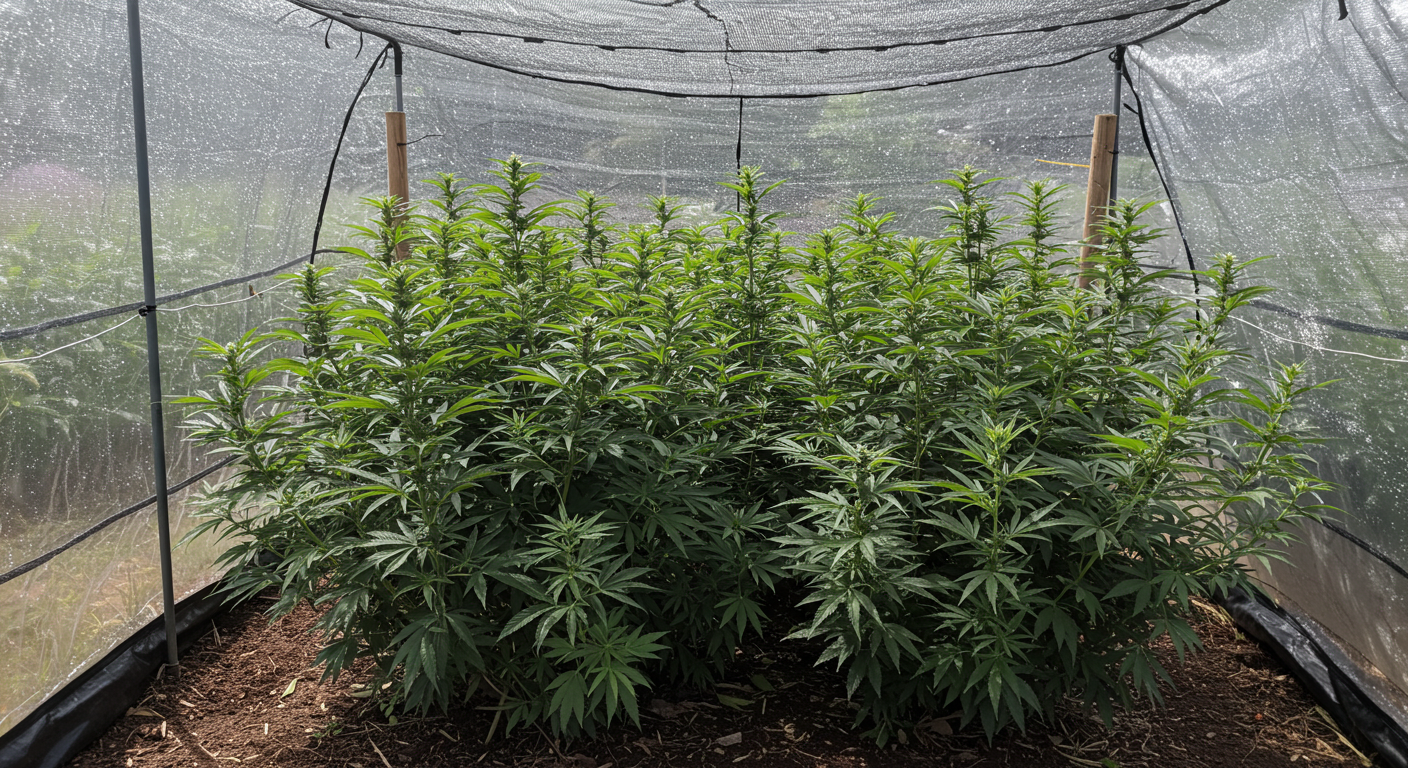
Measure the site: sun path, shade, temperature, humidity, wind, drainage, water access, cold pockets, or contamination as relevant
A frost cloth works as part of a microclimate. Before buying fabric or cutting supports, measure the space it must protect and the conditions that determine whether passive protection will work. The minimum useful survey covers plant dimensions, cold exposure, ground boundary, wind, access, and a temperature comparison point.
Measure the plant as a three-dimensional object
Measure maximum plant height, maximum canopy width, and the width at the heaviest flowering branches. Then add clearance. The structure should not merely fit the plant at noon on a calm day. It needs enough room for the plant to move slightly in wind without branches repeatedly contacting the cloth.
For a large cannabis plant, the highest cola is not the only dimension that matters. Side branches may extend beyond the central frame, especially after rain or late-flower weight pulls them outward. Walk around the plant and identify every branch that would touch a vertical cover line. If the cloth has to pull those branches inward to close, the frame is too small.
Also measure the ground footprint available for anchoring. You need a lower sealing line outside the canopy, not directly through stems, irrigation lines, or root-zone hardware. Leave enough access to open or remove the cover without stepping through branches.
Map the cold side and the wind side
Cold air and wind create different pressures on the structure. A garden slope or low corner may expose one side to pooling cold, while prevailing wind hits from another direction. Mark both. If you anchor only the obvious windward side, a gust that shifts direction overnight can still lift the opposite edge.
Check nearby fences, walls, hedges, sheds, and dense vegetation. They may reduce wind, but they can also block cold-air drainage. If you have already mapped a frost pocket, use that information here. If not, compare at least one canopy-height temperature point near the plant with a nearby reference zone on cold nights.
Use an inside/outside temperature comparison
The easiest way to verify whether your cover is helping is to compare a sensor inside the protected space with one outside it. Use the same sensor model if possible, at approximately the same height, and shield both consistently from direct radiation and wet surfaces.
Do not tape the inside sensor to the cloth. Do not place the outside sensor on a stone wall while the inside sensor hangs in open air. You want a meaningful air-temperature comparison, not two different thermal environments.
For a large flowering plant, place the protected sensor near representative canopy height but away from direct contact with leaves or flowers. If you are especially concerned about a low plant or root-zone surface, add a second pair closer to the ground. Record from before deployment until after removal.
| Measurement | What to record | Why it matters |
|---|---|---|
| Plant height | Top of highest branch or flower | Sets minimum support height. |
| Canopy width | Widest branch-to-branch distance | Sets frame width and side clearance. |
| Anchor footprint | Clear ground around the plant | Determines whether edges can be sealed safely. |
| Local overnight minimum | Canopy-height temperature at the plant | Shows whether regional forecasts match the garden. |
| Covered vs uncovered temperature | Matched sensor pair | Verifies actual protection in your installation. |
| Wind | Direction and expected strength | Predicts uplift, flapping, and heat-loss problems. |
| Ground condition | Dry, moist, saturated, mulched, frozen | Affects stored heat and access. |
| Morning moisture | Condensation, wet fabric, wet flowers | Determines removal and drying urgency. |
Inspect the ground boundary before you rely on it
Passive covers work by retaining heat, so open gaps at the bottom matter. A fabric skirt hanging 15 cm above the soil is not equivalent to a cover that reaches the lower boundary and is secured around the perimeter. Heat can escape and wind can enter.
At the same time, sealing does not mean burying irrigation lines, crushing stems, or creating a trip hazard with scattered weights. Plan the edge as deliberately as the frame. Smooth boards, sandbags, suitable weights, or a continuous soil edge can hold fabric down, depending on the site. Avoid sharp anchors or exposed stakes in walking routes.
If the garden surface is uneven, walk the entire perimeter after installation. A low tunnel can look closed from one angle while leaving a large opening behind a pot, raised bed, or slope change.
Do not overwater just because frost is forecast
Moist soil can store and release more heat than very dry soil, and many frost-protection guides use that fact. But “moist” is not the same as saturated. Flooding a cannabis root zone before a cold night can create oxygen problems, muddy access, heavier containers, colder evaporative conditions, and a longer wet period around roots.
Water according to root-zone need. If the soil is already adequately moist, do not add a large irrigation merely to chase thermal mass. If the plant is genuinely dry and irrigation is due, watering earlier in the day gives the surface time to settle before you are handling cloth and anchors in the dark.
Do not let fabric or plastic lie wet against flowering tops
Contact points can become the coldest and wettest parts of the setup. They can abrade resinous flowers, transfer condensation, hold moisture against dense tissue, and in some cover systems increase frost injury where the material touches the plant. Support the cover away from flowers whenever possible.
Check for contamination before reusing old covers
Reusable cloth should be inspected before it returns to the garden. Soil, dead leaves, pest eggs, fungal residue, rodent contamination, or chemical spills can turn a weather-protection tool into a sanitation problem. If a cover was used around diseased plant material, stored wet, exposed to pesticides, or dragged through contaminated ground, do not place it over flowers until you know it is clean and suitable for reuse.
Dry the material fully after each event and store it away from rodents, fuels, fertilizers, pesticides, and standing moisture. Labeling the clean side and ground-contact side can also help reduce unnecessary contact with flowers during the next deployment.
Seasonal timing: latitude, photoperiod, weather windows, and cultivar behavior
Frost cloth is a weather-response tool, but the value of using it changes through the season. A spring event around a small vegetative plant is not the same as an autumn event around a mature flowering canopy. The plant is larger, nights are longer, humidity patterns change, and the remaining value of extending the season may be very different.
Build the system before the first serious cold forecast
The worst time to discover that your cloth is too small is thirty minutes after sunset while the temperature is dropping. Assemble the frame, test the fabric, and mark the anchor points during mild weather. If the plant is still growing rapidly, leave expansion room and remeasure weekly as the cold season approaches.
A useful pre-season dry run answers simple questions: Can one person install the cover safely? Can it be removed without dragging across flowers? Does the fabric actually reach the ground? Does the frame bend under the weight of wet cloth? Can you open one side for morning ventilation? Can you still reach the plant if a branch breaks overnight?
Deploy before the garden has finished losing daytime heat
Frost covers work partly by trapping heat stored in the ground and the air near the plant. That is why extension guidance commonly recommends installing them in the afternoon or before sundown when a frost is expected. Waiting until the canopy is already at its overnight minimum throws away part of the passive protection mechanism.
You do not need to cover in full midday heat. The practical window is late enough that you are not unnecessarily cooking or shading the plant, but early enough that the ground and surrounding structure still contain useful warmth. If your own inside/outside logger data shows that the covered space heats excessively before sunset, adjust deployment later. If it shows that the protected space never gains a useful margin because you close it too late, move deployment earlier.
Remember: The clock is not the target. The target is to close the cover while useful heat remains, without creating an overheating problem before night.
Morning removal is part of frost protection
As soon as frost danger has passed and the protected space begins warming, reassess the cover. Breathable fabric is more forgiving than plastic, but a closed structure can still reduce airflow, retain humidity, limit light, and warm quickly in sun. Heavy fabrics transmit less light than lightweight materials, which makes daytime management even more important.
For a late-flowering cannabis plant, morning drying deserves special attention. If condensation has formed on the cloth, supports, or flowers, remove or vent the cover carefully so water does not shake down through the canopy. Let the plant regain airflow and sunlight. Inspect dense flowers later in the morning once surfaces are easier to see.
Do not leave a temporary cover closed for several days by default
A run of cold nights does not automatically justify leaving the plant wrapped continuously. The decision depends on daytime temperature, fabric weight, light transmission, wind, rain, plant stage, and disease pressure. Some lightweight row covers are designed to remain on compatible crops for longer periods, but a large cannabis plant under a purpose-built frost enclosure has different airflow and moisture behavior.
If cold nights repeat, think in cycles: deploy, protect, remove or vent, dry, inspect, and redeploy. If daytime conditions remain extremely cold and the cover must stay in place, monitor temperature and humidity under it rather than assuming the protected microclimate remains safe.
Can I leave frost cloth on all week if every night is cold?
Editorial example. Question sent by: ColdMorningGrow, via contact form.
Only if your daytime measurements show that the covered environment remains acceptable and the material is appropriate for extended use. For flowering cannabis, repeatedly opening or removing the cover during safe daytime conditions is often the better default because it restores light and airflow and lets wet surfaces dry. Recheck under-cover temperature and moisture instead of deciding by calendar alone.
Late flower changes the cost-benefit calculation
As the season closes, protection decisions become less about keeping the plant alive indefinitely and more about whether a few additional nights materially improve finish quality. If flowers are already mature and the forecast is moving toward repeated wet freezes, heavy frost, or prolonged cold, building increasingly complicated rescue systems may add more moisture and mechanical risk than useful finishing time.
Use frost cloth alongside your finish-window planning, not instead of it. The cloth may extend a marginal window. It cannot restore lost sunlight, shorten a cultivar’s genetically late flowering response, or make a wet cold spell disappear.
Latitude and photoperiod still matter, but cloth does not change them
At higher latitudes, the first serious frost risk may overlap with a photoperiod-sensitive cultivar that is still developing flowers. At lower latitudes, cold events may be later or less frequent. The cloth only modifies the immediate microclimate around the plant. It does not change day length, critical photoperiod, or the cultivar’s flowering program.
If a cultivar consistently finishes too late for the local climate, frost cloth should not become the permanent solution to a seasonal mismatch. A better-matched finish window, a more favorable legal site, or a different outdoor strategy is usually more reliable than designing every autumn around repeated emergency covering.

Practical setup/response plan with materials, placement, inspection points, and a backup option
The strongest frost-cloth system is simple enough to deploy correctly when the weather turns. You do not need a complicated permanent structure, but you do need a frame that clears the canopy, fabric that matches the job, anchors that hold in expected wind, and a removal path that does not drag the cover across flowers.
Choose breathable horticultural fabric by specification, not appearance
Frost fabrics vary in weight, light transmission, durability, and claimed protection. In general, heavier materials trade more insulation for less light transmission. Lightweight material is easier to handle but may provide less cold protection and may tear sooner. There is no universal “white cloth” specification.
Read the product’s stated weight and use conditions. If a manufacturer supplies a frost-protection range, treat it as a starting estimate rather than a guarantee. Extension tables commonly show that actual protection depends on fabric weight and installation, and garden studies repeatedly show that wind and gaps can reduce performance.
For a tall cannabis plant, durability matters because the cloth is more exposed to wind than it would be over a low vegetable bed. The fabric should be wide enough to travel over the top of the support structure and reach the lower boundary without stretching tight across the flowers.
Build a supported cover rather than hanging fabric on the plant
Use hoops, a temporary frame, smooth poles, or another stable support system appropriate to the legal garden. The frame should take the load. The cannabis branches should not.
Create clearance above the top flowers and around the side branches. The exact distance depends on plant movement, frame rigidity, and cover type, so do not use one fixed centimeter rule for every garden. Shake the frame gently during the dry run. If the cloth can slap the flowers or snag branch tips, increase clearance or add support.
Round or protect sharp frame edges. A small burr on metal or a cut PVC edge can tear fabric in wind. If you use clips, attach them to the frame or the fabric where they cannot pinch stems or scrape flowers.
Make the lower edge continuous
Once the cloth is over the frame, bring it to the ground around the entire protected footprint. Use smooth, stable weights or an appropriate anchoring method so the lower edge does not flap open. The objective is not an airtight seal. Breathable frost fabric still exchanges air. The objective is to prevent large uncontrolled gaps that dump stored warmth and invite wind under the cover.
Do a perimeter walk after dark with a flashlight. Look from ground level. A gap that is invisible while you are standing upright can be obvious from the side.
Install a temperature checkpoint inside the protected space
Place one logger or minimum thermometer inside the cover at representative canopy height. Place a matched comparison sensor outside in similar exposure. The first real frost night is a commissioning test as much as a protection event.
Record:
- time the cover was closed;
- outside temperature at closure;
- inside and outside minimum temperature;
- time of each minimum;
- wind conditions;
- any edge failure or fabric movement;
- morning condensation;
- visible plant injury after the event.
That log tells you whether the actual installation provided a useful margin. It is more valuable than relying forever on a catalog claim measured under different conditions.
A repeatable deployment sequence
- Recheck the event. Compare regional forecast, local canopy temperature trend, wind, cloud cover, and precipitation.
- Inspect the plant. Support heavy branches and remove nothing aggressively immediately before the cold event.
- Inspect the frame. Confirm clearance, stable supports, smooth edges, and a clear removal path.
- Check root-zone condition. Water only if the plant needs it; do not saturate the site for the sake of the cover.
- Deploy before night heat is lost. Pull fabric over the frame without dragging across flowers.
- Seal the lower boundary. Walk the full perimeter and secure loose edges.
- Start the inside/outside log. Record the time and initial readings.
- Check once after full dark if safe. Look for wind uplift, collapse, contact points, or an anchor that has shifted.
- Reassess after sunrise. Open, vent, or remove once frost danger passes and the space begins warming.
- Dry and inspect. Let the canopy and cloth dry, then check flowers, branches, supports, and sensors.
Do
- Build and test the frame before the cold night.
- Keep cloth off heavy flowers and branch tips.
- Secure the cover to the lower boundary.
- Measure covered and uncovered temperature.
- Remove or vent when daytime conditions are safe.
- Dry the cloth before storage.
Avoid
- Throwing a heavy blanket directly onto flowering colas.
- Leaving large gaps because the top looks covered.
- Using direct-contact plastic on leaves or flowers.
- Assuming catalog protection equals your garden result.
- Leaving a wet enclosure closed after sunrise.
- Improvising open flames or unsafe heaters under fabric.
Use a backup option before the forecast becomes an emergency
A backup plan depends on the plant. Small legal containers may be moved to a safer lawful location. A large plant may have a second, heavier cover available, a stronger outer wind support, or a decision threshold at which you stop trying to extend the season. The backup should be chosen before sunset, not invented at 3 a.m.
If a second layer is used, it should still be supported and managed for moisture, light, and wind. More material is not automatically better. Added weight can collapse a weak frame, and extra layers can warm rapidly after sunrise.
Master Advice: Build the backup around the failure you are most likely to face. If wind is your recurring problem, strengthen anchoring. If condensation is the problem, improve morning ventilation and removal. If the site is simply too cold, stop expecting fabric to substitute for site choice.
Verify the morning result, not just the overnight temperature
A cover “worked” only if the plant came through the event without a new problem. Check leaf posture, branch bends, abrasions, wet flower surfaces, torn fabric, shifted supports, and anchor damage. Recheck again later in the day because some cold injury becomes easier to see after tissues warm.
If the protected sensor stayed warmer but several flowers were damaged where cloth touched them, the thermal system succeeded and the mechanical system failed. If the frame stayed perfect but the inside temperature nearly matched the outside temperature, the likely problem is sealing, wind, cover grade, deployment timing, or event severity. Diagnose the part that failed rather than discarding the whole method.
Failure modes: stagnant air, trapped moisture, heat load, frost, wind damage, water shortage, security, or neighbor impact
Frost cloth fails in recognizable ways. The useful habit is to identify the failure mechanism, change one part of the system, and test again. Adding more fabric without understanding the problem can make moisture, wind loading, or morning heat worse.
Failure 1: the cloth touches leaves or flowers
Direct contact creates a cold bridge and a mechanical contact point. Extension guidance for several horticultural crops notes that frost injury can occur where row covers touch sensitive tissue. On cannabis, the contact also creates abrasion risk, especially when resinous flowers move under wind-driven fabric.
Correction: Increase frame clearance, support side branches, add a smooth crossbar where the fabric sags, and repeat the dry run before the next frost.
Failure 2: the cover is warm inside but cold wind enters underneath
This usually means the top is functioning but the lower boundary is not. Wind lifting one corner can exchange the protected air rapidly and make performance inconsistent across the canopy.
Correction: Walk the perimeter, add continuous anchoring, remove sharp or unstable weights, and confirm that the cloth reaches the ground without tension pulling it upward.
Failure 3: the fabric flaps against the canopy all night
A frost cloth has a large wind-catching surface. Tall structures amplify that problem. Repeated flapping can tear fabric, loosen anchors, abrade leaves, break pistillate flowers, and bend branches.
Correction: Reduce loose sail area, strengthen the support frame, use distributed anchoring, and reconsider relying on cloth if the forecast wind is beyond what the temporary structure can safely withstand.
Failure 4: condensation stays trapped after sunrise
Warm air inside the cover can hold moisture that later condenses on fabric, supports, or plant surfaces. If you leave the enclosure closed into the morning, dense flowers may dry more slowly than the rest of the garden. Repeated wet mornings are a poor trade for small thermal gains late in flower.
Correction: Vent or remove promptly when frost danger passes, avoid shaking wet fabric over flowers, separate cloth from the canopy, and inspect dense flower interiors after surfaces begin to dry.
Failure 5: the protected space overheats in sun
Even breathable row covers can raise daytime temperature, and plastic enclosures can heat much faster. A system installed for a 3°C dawn can become a heat trap by late morning if forgotten.
Correction: Set a morning removal trigger based on actual under-cover temperature, not convenience. If you cannot return to the garden in time, use a protection strategy that does not depend on precise manual venting.
Failure 6: the cover gets heavy with rain, dew, snow, or ice
A dry fabric that barely clears the canopy may sag dramatically when wet. Snow or ice can exceed the load a light hoop frame was built to carry. Once the structure collapses, branches become the support system.
Correction: Design for wet weight, not dry weight. Increase support spacing, create enough slope for water shedding where practical, and do not rely on a light frost-cloth frame for a forecast snow or icing event it was never designed to carry.
Failure 7: the cloth was installed after the site had already cooled
Passive protection cannot trap heat that has already escaped. Covering a cold plant late at night may still reduce further radiational cooling, but performance can be smaller than a properly timed deployment.
Correction: Record deployment time and temperature. If the protected margin is consistently weak, deploy earlier during the late-afternoon cooling curve while avoiding excessive daytime heat.
Failure 8: the fabric grade is too light for the event
Thin material may perform well against a marginal frost but offer less protection as temperatures fall. The opposite problem also exists: a very heavy fabric may be unnecessarily difficult to handle, transmit much less light, and impose more structural load.
Correction: Match material to expected conditions using manufacturer specifications and your own inside/outside test history. Keep a record of which cover was used on each event.
Failure 9: the site itself is the main problem
If a plant sits in a recurring frost pocket, behind a cold-air barrier, or in a location that remains several degrees colder than nearby ground, cloth may appear to “underperform” simply because it is being asked to compensate for a persistent site disadvantage.
Correction: Compare the protected site with a warmer reference zone. If relocation is possible and legal, solve the microclimate problem before adding more layers of fabric.
Failure 10: repeated protection keeps late flowers wet
One dry frost night and one week of cold rain are different problems. If repeated covering is increasing condensation while the broader weather pattern is already humid, you may be trading freeze risk for flower-disease risk.
Correction: Reassess the finish window, improve morning drying, remove the cover during safe daylight, and stop extending the season automatically when the weather pattern has become fundamentally unfavorable.
Failure 11: the protected sensor gives a false sense of security
A sensor placed high inside the cover may stay above freezing while exposed leaf tips near a gap become colder. A sensor touching warm soil can read differently from the canopy. One point cannot describe the entire enclosure.
Correction: Put the main sensor at representative canopy height and periodically move or add a second sensor to the historically cold edge. Combine instrument data with physical inspection.
Failure 12: a temporary structure becomes a security or access problem
Dark fabric, ropes, weights, stakes, and frames can create trip hazards. A covered cannabis plant may also become more visually conspicuous rather than less. If the structure blocks a gate or hides a child or pet hazard, the frost protection has created a broader site problem.
Correction: Keep walkways clear, use visible safe anchors, maintain required security, and remove the structure when it is no longer needed.
| Failure sign | Likely cause | First correction |
|---|---|---|
| Cold injury only at contact points | Fabric touching plant tissue | Increase support clearance. |
| Inside temperature nearly equals outside | Gaps, wind, light fabric, late deployment, severe event | Inspect perimeter and compare event conditions. |
| Torn cloth or bent branches | Wind loading or weak frame | Strengthen frame and reduce loose fabric. |
| Wet flowers after sunrise | Condensation and delayed removal | Vent/remove earlier and improve drying. |
| Hot, limp canopy after sunrise | Cover left closed too long | Use an under-cover temperature removal trigger. |
| Sagging cover | Wet fabric, snow, ice, wide support spacing | Add structural support or abandon unsuitable setup. |
| Repeated need for emergency covering | Season/site/cultivar mismatch | Reassess finish window and site strategy. |
I covered the plant and it still showed cold damage. Does that mean frost cloth does not work?
Editorial example. Question sent by: CedarLaneGrower, via email.
Not necessarily. Look at where the damage occurred and compare the inside/outside temperature log. If injury is concentrated where the cloth touched flowers, improve support. If the whole protected space reached nearly the same minimum as outside, inspect gaps, wind, fabric grade, deployment timing, and event severity. The cover may have provided some protection without providing enough for that particular night.
Do not combine cloth with improvised flame or unsafe electrical heat
Open flames, combustion heaters, exposed heating elements, damaged extension cords, and wet outdoor electrical connections create fire, carbon-monoxide, shock, and property risks. A temporary plant cover is not a safe enclosure for improvised heating. Use passive cloth within its limits or a purpose-designed legal system installed according to applicable safety requirements.

Legal/safety boundary without guessing local rules or recommending dangerous traps
Frost protection is still part of a legal home grow. Rules can affect whether outdoor plants must be screened, locked, inaccessible to minors, kept within a specific part of the property, or protected from public view. Temporary frames may also interact with property, rental, fire, electrical, or structure rules.
Do not assume that because the cover is temporary it is exempt from every local requirement. The correct process is the same as with the grow itself: verify current rules through authoritative government or property sources instead of copying a forum post or an old summary.
Keep children and pets away from the temporary structure
Anchors, cords, fabric folds, clips, stakes, hoops, and weighted edges can become hazards in a dark garden. A pet can crawl under a loose edge and become trapped or damage the plant. A child can trip over a low anchor line that was obvious during installation but nearly invisible at night.
Use a protected growing area with controlled access. Keep weights stable, avoid exposed sharp ends, and do not create loops or low lines across walkways. Inspect the site again after wind because a shifted anchor can move into an access path.
Do not create an electrical frost hazard
If the garden already uses pumps, timers, cameras, or lighting, frost-cloth setup should not pull wet fabric onto electrical equipment or trap condensation around connectors. Outdoor electrical equipment should remain weather-rated and installed appropriately. Do not run a household heater under the cloth with an improvised extension-cord arrangement.
If you need active heating rather than passive frost protection, that becomes a different system requiring its own fire, electrical, ventilation, and legal assessment. This article does not treat improvised active heating as a frost-cloth technique.
Keep emergency and neighbor access clear
A last-minute cover should not block a gate, stair, fire route, utility access point, shared path, or neighboring property. Do not tie fabric to someone else’s fence or structure without permission. Do not use anchors that cross property lines.
If wind is forecast to carry unsecured fabric off the property, take that seriously. A large sheet can become a hazard. Secure it properly or do not deploy a system you cannot control.
Safety Note: No amount of crop protection justifies an unsafe heater, blocked exit, unstable frame, exposed sharp stake, or trip line. Frost cloth should lower risk, not move it from the plant to the people around the garden.
Sanitation rules still apply to reusable cloth
A cover that touches diseased tissue, contaminated soil, pesticide residue, or animal waste should not be treated as clean simply because it has dried. Use cleaning and storage practices appropriate to the fabric and contamination. If the material cannot be cleaned safely without damaging it, replacing it may be the lower-risk choice.
Keep frost cloth out of chemical storage areas. Do not use a fabric that has absorbed fuel, solvent, pesticide concentrate, or another unknown substance over consumable flowers.
Pre-season and weekly checklist that turns the article into a repeatable field procedure
A frost-cloth system becomes reliable when you treat it like seasonal equipment rather than an emergency blanket. Measure it before you need it, test it in calm weather, keep records from real cold nights, and update the setup as the plant grows.
Pre-season frost-cloth commissioning checklist
- Confirm the legal growing area and any outdoor security or visibility requirements.
- Identify whether the site is a known frost pocket or colder than nearby ground.
- Measure plant height, canopy width, branch spread, and anchor footprint.
- Select frost cloth by weight, light transmission, durability, and stated use rather than appearance alone.
- Build a stable support frame that keeps fabric off the canopy.
- Protect sharp frame edges that could tear the cloth.
- Confirm that fabric reaches the ground or lower boundary on every side.
- Choose stable anchors that do not create trip or pet hazards.
- Install matched inside/outside temperature sensors.
- Perform a dry deployment and removal in daylight.
- Confirm one person can open the cover without dragging it across flowers.
- Define a backup response for wind, a harder freeze, or frame failure.
- Store the clean, dry cloth where rodents and chemicals cannot contaminate it.
The weekly cold-season recheck
Once nights are trending colder, spend a few minutes each week checking the system before a frost advisory forces you to rush. Re-measure canopy height and width. Check whether flowering branches have leaned outward. Look for frame movement, UV-damaged fabric, torn hems, lost weights, and new obstacles around the perimeter.
Also review the garden itself. Has a hedge become denser and slowed cold-air drainage? Has a temporary privacy screen changed wind exposure? Are containers now sitting on colder bare ground? Has repeated rain saturated the soil? Has a branch grown into the removal path?
The cover must evolve with the plant.
The frost-night checklist
- Check the latest forecast and local temperature trend.
- Note wind, cloud cover, precipitation, and expected duration of cold.
- Decide whether cloth is appropriate or whether the backup plan is needed.
- Inspect branches and supports before covering.
- Deploy while useful ground heat remains.
- Secure the entire lower perimeter.
- Start inside/outside temperature logging.
- Perform one safe after-dark structure check if conditions allow.
- After sunrise, reassess temperature and remove or vent when frost risk passes.
- Dry the canopy and cloth, then inspect for cold, moisture, and mechanical damage.
Use a simple pass/fail verification after every event
| Checkpoint | Pass | Fail means |
|---|---|---|
| Thermal margin | Inside stayed meaningfully warmer than matched outside point | Inspect gaps, wind, fabric, timing, or event severity. |
| Mechanical clearance | No fabric contact damage or branch deformation | Widen or reinforce frame. |
| Wind security | Edges and anchors remained in place | Improve anchoring before reuse. |
| Moisture recovery | Canopy dried normally after removal | Vent/remove earlier and inspect flowers. |
| Daytime temperature | No overheating after sunrise | Set an earlier removal trigger. |
| Access and safety | No blocked routes, sharp hazards, or loose material | Redesign the footprint. |
Know when to stop using the same strategy
Frost cloth is no longer the right main tool when the expected event exceeds its proven margin, repeated wet-cold cycles are keeping flowers damp, wind makes the temporary structure unstable, snow or ice loading exceeds the frame design, or the plant’s finish window no longer justifies extending the season.
That decision is not failure. Good outdoor planning includes knowing when a temporary protection method has reached its limit.
The shortest repeatable frost-cloth procedure
If you want the whole system reduced to one field sequence, use this:
- Confirm the event is within the realistic limits of passive frost protection.
- Measure the plant and build a frame that clears every flower and branch.
- Use suitable horticultural frost fabric and bring it to the lower boundary.
- Secure the entire perimeter against expected wind.
- Deploy before the site has lost all daytime heat.
- Measure temperature inside and outside the cover.
- Remove or vent after frost danger passes and daytime warming begins.
- Dry the plant and fabric.
- Inspect for cold injury, abrasion, moisture, sagging, and anchor movement.
- Change the failed part of the system before the next event.
Frost cloth is most useful when it is boring. The frame fits, the edges close, the sensors confirm a modest temperature advantage, the cloth comes off cleanly in the morning, and the plant returns to normal airflow without damage. That repeatable routine is far safer than waiting for a severe forecast and improvising a heavy cover over a mature cannabis plant in the dark.
Share this article
A quick overview of the topics covered in this article.
Follow us
Latest articles

September 4, 2026

September 4, 2026
September 4, 2026
September 4, 2026