
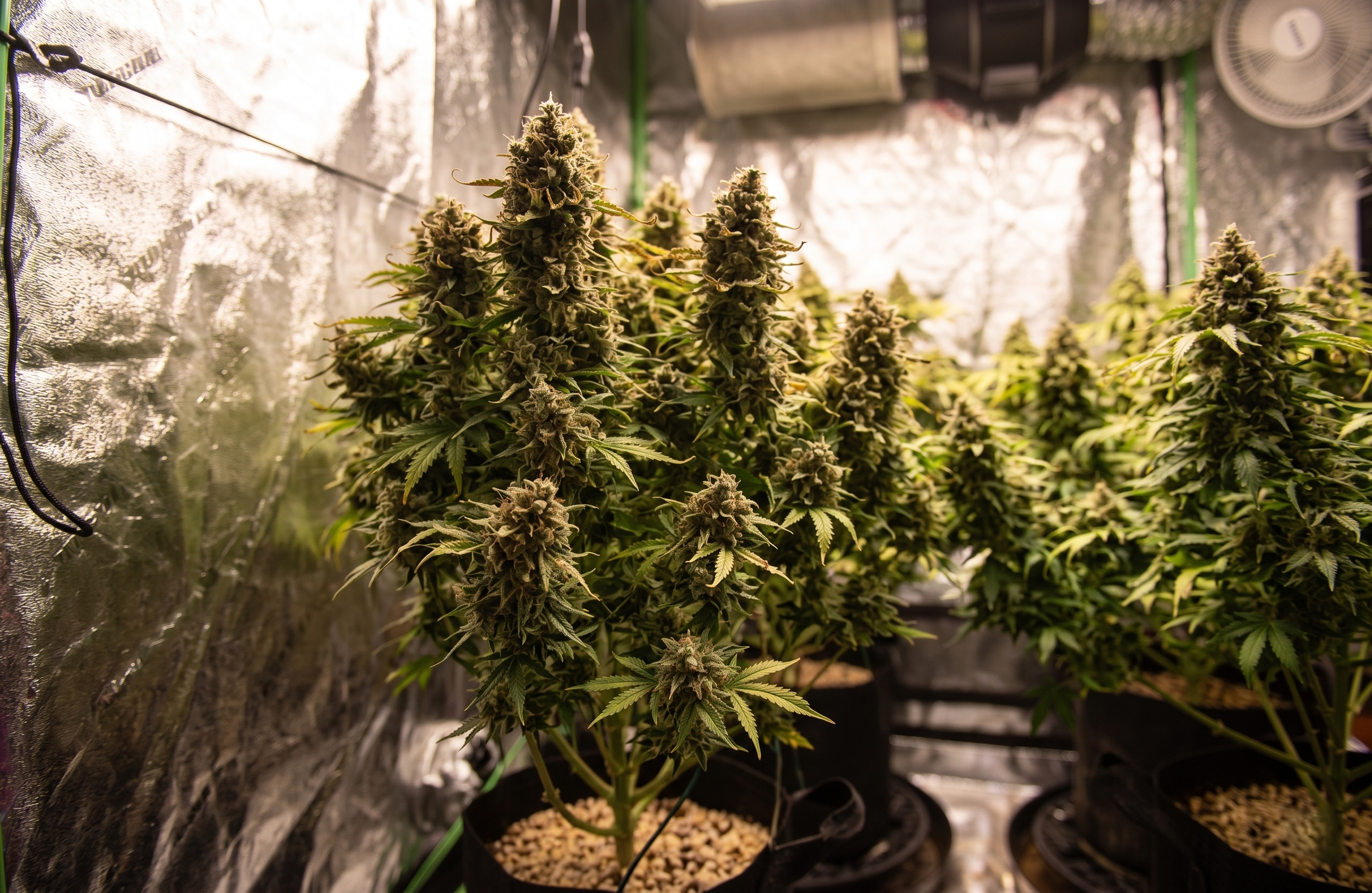
Low-Stress Training Outdoors
Low-stress training outdoors is a way to reshape a cannabis plant without intentionally removing the main growing tip. Instead of cutting the plant, you gradually redirect flexible stems and branches so the canopy spreads wider, stays lower, and exposes more growing points to direct light. The practical goal is not to force the plant into a decorative shape. It is to build a canopy that is easier to inspect, easier to support, and better matched to the space and weather around it.
Outdoors, LST works differently from a small indoor tie-down. A branch that looks manageable in early vegetative growth can become a heavy lever later in the season. Wind changes the load on anchors. Rain increases flower weight. Stems thicken around ties. Containers can shift or tip. A low, wide canopy can improve access and reduce one dominant vertical leader, but it can also create a broad sail, trap moisture if branches are crowded, or become difficult to support if training continues too late.
The useful question is therefore not simply, “Can this branch bend?” It is, “Will this bend improve the final outdoor structure without creating a new weakness?” The best LST decisions come from plant condition, stem flexibility, available recovery time, expected flower load, wind exposure, and the support plan that will carry the canopy later.
What Low-Stress Training Changes
LST changes plant architecture primarily by changing orientation and exposure, not by removing the shoot apex. The main tip remains alive. A stem that was growing vertically is redirected toward a shallower angle, which changes how the shoot responds to gravity, light, and internal growth signals. Lower shoots that were shaded or physically subordinate may receive more light and can become more competitive as the canopy opens.
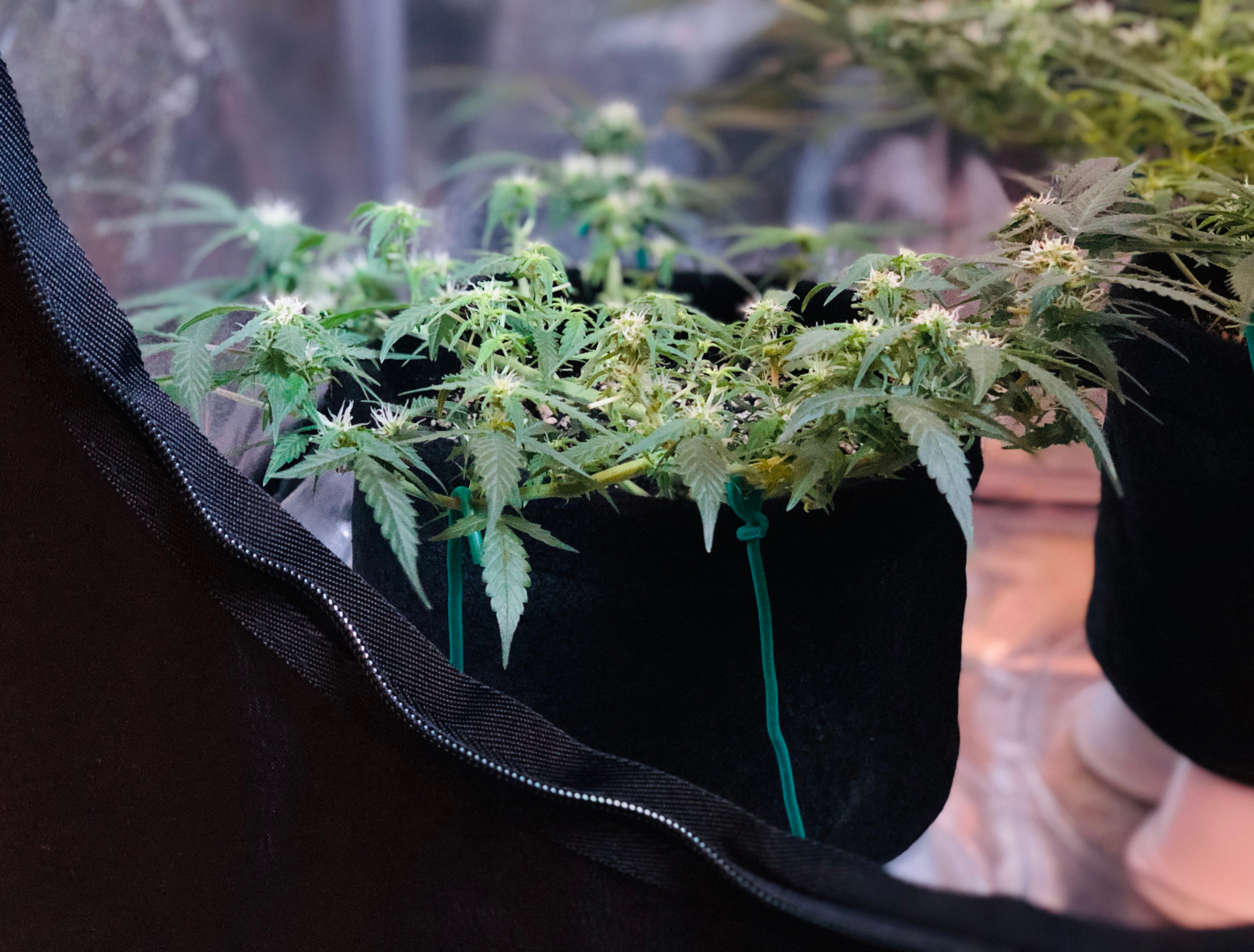
This matters because plant architecture is not only a shape problem. Branch angle influences where leaves intercept light, how shoots compete with one another, how wind moves through the canopy, and where flower weight will eventually be carried. Reviews of plant branching show that auxin-related gravitropic and anti-gravitropic responses help regulate branch angle across many species. Cannabis-specific canopy research also shows that architecture changes can alter light penetration and microclimate within large plants, although those studies mostly tested pruning and defoliation rather than LST itself.
Low-stress training
A canopy-management method that redirects flexible stems or branches with gentle bends and soft restraints while keeping the shoot tip intact. The objective is structural redistribution, not deliberate tissue injury.
Apical dominance is modified, not removed
Topping removes the apical meristem and directly disrupts the main source of apical dominance. LST does not. The terminal shoot remains present, but its new orientation changes the competitive geometry of the canopy. Other growing points may receive stronger light and may rise relative to the bent leader. In practice, growers often see a flatter canopy with several tips occupying similar height bands instead of one leader clearly above the rest.
This is why LST and topping should not be treated as interchangeable. Topping creates a wound and eliminates the original apex. LST preserves it and relies on repeated positioning. The biological response can overlap in the sense that lateral growth becomes more relevant, but the intervention and recovery cost are different.
Branch angle changes the future load path
A branch trained outward becomes a longer horizontal or diagonal lever. Early in vegetative growth that branch may weigh very little. In late flower, the same branch may carry several heavy inflorescences plus rainwater and experience gust loading from changing directions. Outdoor LST therefore creates a structural question that indoor LST often hides: where will the flower load eventually go?
A good bend should make the future support system easier to understand, not harder. If training creates long unsupported arms extending far outside the plant’s central support zone, the canopy may look open in June and become mechanically awkward in September. The best outdoor shape usually leaves room for stakes, netting, cages, or branch ties to take over later.
Canopy distribution can improve inspection access
A broad canopy can make interior nodes, leaf undersides, branch unions, and flowers easier to inspect. That is a real management benefit. Pest scouting, disease checks, tie inspection, and post-rain flower inspection all become easier when the canopy has visible lanes rather than one dense central mass.
But wider is not automatically better. If branches are pulled into the same horizontal plane and overlap, light may improve at the top while airflow becomes worse inside the layer. LST should create separation, not just width.
Build distinct branch lanes
Use gentle bends to separate strong shoots, expose interior growth, and leave visible access for inspection and later support.
Flatten every branch into one layer
A very flat, overlapping canopy can trade vertical crowding for horizontal crowding and may become difficult to dry or support.
| What LST changes | Practical outdoor consequence |
|---|---|
| Stem and branch angle | Changes canopy spread and future leverage under wind and flower weight. |
| Relative tip height | Can reduce the dominance of one tall leader and bring several tips into a similar light zone. |
| Light distribution | May expose previously shaded shoots, but the result depends on spacing, sun path, leaf area, and canopy density. |
| Inspection access | Can create clearer paths for checking pests, branch unions, ties, flowers, and interior moisture. |
| Support geometry | Can make later support easier if branch paths are planned, or harder if long arms are trained beyond practical anchors. |
Best Timing and Plant Condition Before Training
The best time to start LST is when the plant is actively growing and the target stem is flexible enough to move gradually without cracking. That sounds simple, but outdoors the condition of the whole plant matters more than a fixed age or node count. Two plants of the same age can have very different stem stiffness, water status, root establishment, and recovery capacity.
Use plant condition, not a universal node count
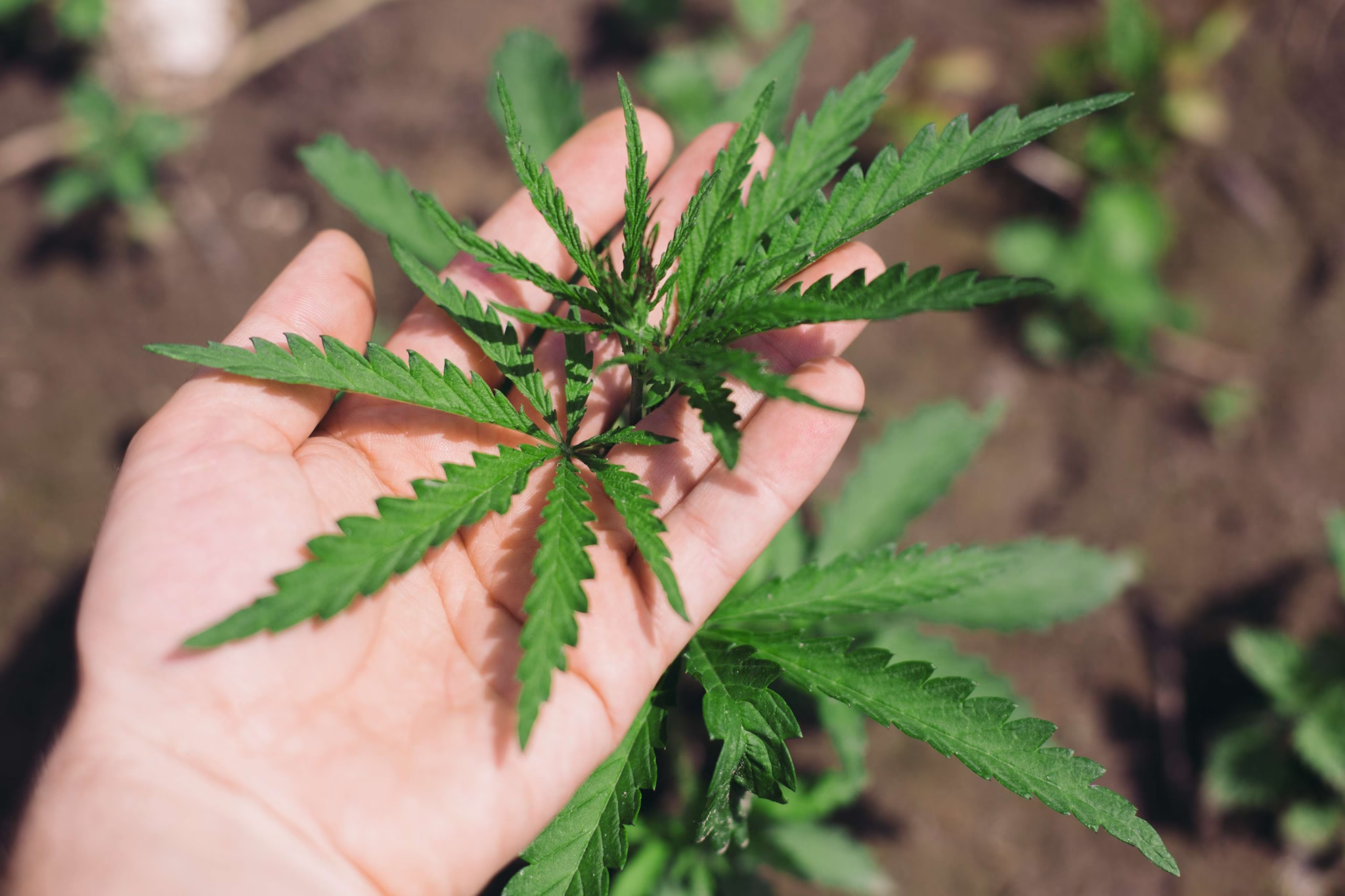
There is no well-validated cannabis rule showing that every outdoor plant should begin LST at a specific node. A useful plant has enough established structure to anchor safely, but the stem has not yet become rigid and heavily lignified. The root system should be functioning well enough that the plant is producing new growth without obvious wilt, nutrient stress, transplant shock, or root-zone saturation.
Starting too early can make the plant unstable because the stem and root ball are still small. Starting too late increases the force needed to move the branch and raises the chance of splitting tissue at a node or branch union.
Train a hydrated, normally functioning plant
A plant under severe drought stress should not be forced into a new position simply because the branch feels temporarily limp. Water status changes tissue mechanics. Likewise, a plant sitting in a saturated root zone may appear soft while its root system is already under stress. The target is a plant that is normally turgid, actively growing, and not already managing another major stress event.
If the plant has just been transplanted, heavily pruned, damaged by wind, heat-stressed, or recovering from pest pressure, adding another intervention may make the response difficult to interpret. LST is called low stress because it avoids intentional tissue removal, not because the plant is biologically unaffected by being repositioned.
Read the weather window
Outdoor timing also depends on the next weather event. A fresh tie-down before a strong wind can expose a new lever angle before the plant has stabilized. A heavy rain immediately after the canopy is pulled low may place wet foliage onto soil, mulch, container edges, or nearby vegetation. Very hot, dry weather can increase water demand while exposed leaves are repositioned into stronger sunlight.
You do not need perfect weather, but avoid stacking a new structural change directly on top of a forecasted stress event when there is no reason to rush.
Field Advice: Before bending anything, look at the plant from the side and from above. Decide where you want each major branch to finish and where future support can attach. A planned bend is easier to maintain than a series of reactive tie-downs.
“Should I wait until the main stem is tall before I start LST?”
Question sent by: Ethan Brooks, via email.
Not necessarily. Waiting for height can make the lower stem harder to redirect. Start when the plant is established enough to anchor securely and the target section still bends with modest force. The exact timing depends on stem flexibility, root stability, weather, and how much space you actually need to manage.
Outdoor variables that change the same bend
The same branch angle can behave very differently from one garden to another. A plant in a heavy in-ground soil with a broad root system may tolerate a wide canopy that would tip a small fabric pot. A protected courtyard can support a shape that becomes a wind-catching sail on an exposed ridge. A dry climate may reward extra branch separation because light is abundant and wetting events are brief, while a humid garden may place more value on interior drying and keeping flower clusters from overlapping.
Genotype also matters, but not in the simplistic sense that one named strain is always ideal for LST. What matters is the phenotype in front of you: internode length, branch stiffness, natural lateral growth, stem diameter, response to previous bends, and how quickly the plant replaces vertical growth. Two plants from the same seed line can require different amounts of restraint.
Root-zone stability is part of the same decision. A well-rooted plant in firm ground transfers branch forces into a broad soil mass. A tall plant in a light container may rotate around the root ball or move the whole pot before the branch itself reaches a dangerous angle. Container growers should therefore treat pot stability, anchor location, and branch leverage as one system.
Plant stage changes the meaning of every adjustment. Early vegetative bends are mostly architecture decisions. Near flowering, the same bend also changes the position of future inflorescences, support geometry, rain exposure, and access for inspection. Once flowers are gaining weight, a minor positional improvement may not justify disturbing a branch that already has a stable load path.
One bend can change several microclimates at once
When a tall branch is redirected outward, leaves that were shaded may receive direct sun, interior foliage may become exposed to wind, and the branch itself may cast a new shadow on another part of the plant. These changes can alter leaf temperature, water demand, and the speed at which wet surfaces dry. That is why LST should be evaluated after the plant has experienced normal sun and weather, not only five minutes after the tie is installed.
A branch that looks perfectly placed in cool morning light may droop or heat differently in strong afternoon sun. A low branch may also contact mulch or neighboring vegetation after irrigation or rain. The follow-up check should therefore include both plant posture and the new physical environment around the trained branch.
A Repeatable Outdoor LST Method
A good LST procedure is incremental. You should be able to stop at any point and still have a stable plant. The goal is not to achieve the final canopy in one session.
1. Define the structural objective
Before touching the plant, choose the problem you are solving. Common outdoor reasons include lowering one tall leader, opening a dense center, redirecting a branch away from a fence, separating two competing shoots, improving inspection access, or preparing the canopy for a support frame.
If you cannot describe the objective clearly, do not bend the plant just because LST is a popular technique. An outdoor plant with good spacing, manageable height, strong branch angles, and accessible flowers may not need training.
2. Choose a safe anchor path
The anchor must hold the desired position without cutting into the stem or destabilizing the container. Soft garden ties, coated wire with adequate padding, fabric plant tape, or other broad flexible restraints can work when they distribute pressure and remain visible for inspection.
Thin wire, fishing line, sharp cord, or anything that behaves like a cutting edge is a poor choice for expanding cannabis stems. A tie that is harmless today can become a constricting ring after rapid secondary growth.
3. Stabilize the base before pulling the top
When the main stem is redirected strongly to one side, a counter-anchor lower on the stem or opposite side of the container may prevent the root crown from being torqued. The idea is not to clamp the plant rigidly. It is to stop the entire stem base from leaning or twisting while the upper section is repositioned.
In ground-grown plants, the soil mass provides more resistance than a small container, but crown movement still matters. In containers, also check whether the pot itself can tip or rotate under wind once branches are pulled outward.
4. Bend gradually at a flexible section
Support the stem with your hand and move it slowly. Do not concentrate all force on one node. A gradual arc distributes strain across a longer section of tissue. Stop if you hear cracking, see the epidermis whitening sharply, feel sudden loss of resistance, or notice the branch folding at a single point.
There is no universal correct angle. The correct bend is the smallest change that solves the structural problem while the tissue remains intact and the anchor remains secure.
LST should not become accidental supercropping
If the stem folds, splits, or is deliberately crushed internally, the intervention is no longer ordinary low-stress training. The plant now has a wound or structural injury that needs a different recovery decision.
5. Secure without strangling the stem
Leave enough room for stem expansion. The tie should control direction while still allowing movement and growth. Contact points should be broad and easy to see. If possible, place the restraint where it cannot slide toward a narrow node junction and tighten itself.
Marking or photographing the tie point can make rechecks easier, especially on a large outdoor plant with several restraints.
6. Train competing branches separately
Once the main leader changes position, lateral shoots may rise rapidly. Do not immediately force every new tip outward. First observe which shoots actually become dominant and where the canopy is becoming crowded. Then make smaller corrections.
This staged method matters outdoors because the sun path changes through the season and neighboring branches keep expanding. A branch that looks shaded at one moment may move into direct light as the canopy reorients.
7. Recheck after growth and weather
Return to the plant after it resumes active growth and after meaningful wind or rain. Check tie pressure, anchor stability, branch posture, leaf orientation, crown movement, and whether the bend still solves the original problem. Reposition or loosen restraints before they become embedded.
Pro Tip: Photograph the canopy from the same angle before training and again after the plant has resumed tip growth. The comparison is more useful than remembering how flat you thought the canopy looked.
Recovery Signs, Failure Signs, and Re-Adjustment
LST recovery should be judged by function, not by a fixed number of hours or days. A healthy plant usually begins reorienting its tips and leaves after the bend. The terminal shoot often curves upward again because the plant continues responding to light and gravity. Lateral shoots may also change direction as relative dominance within the canopy shifts.
Useful recovery signs
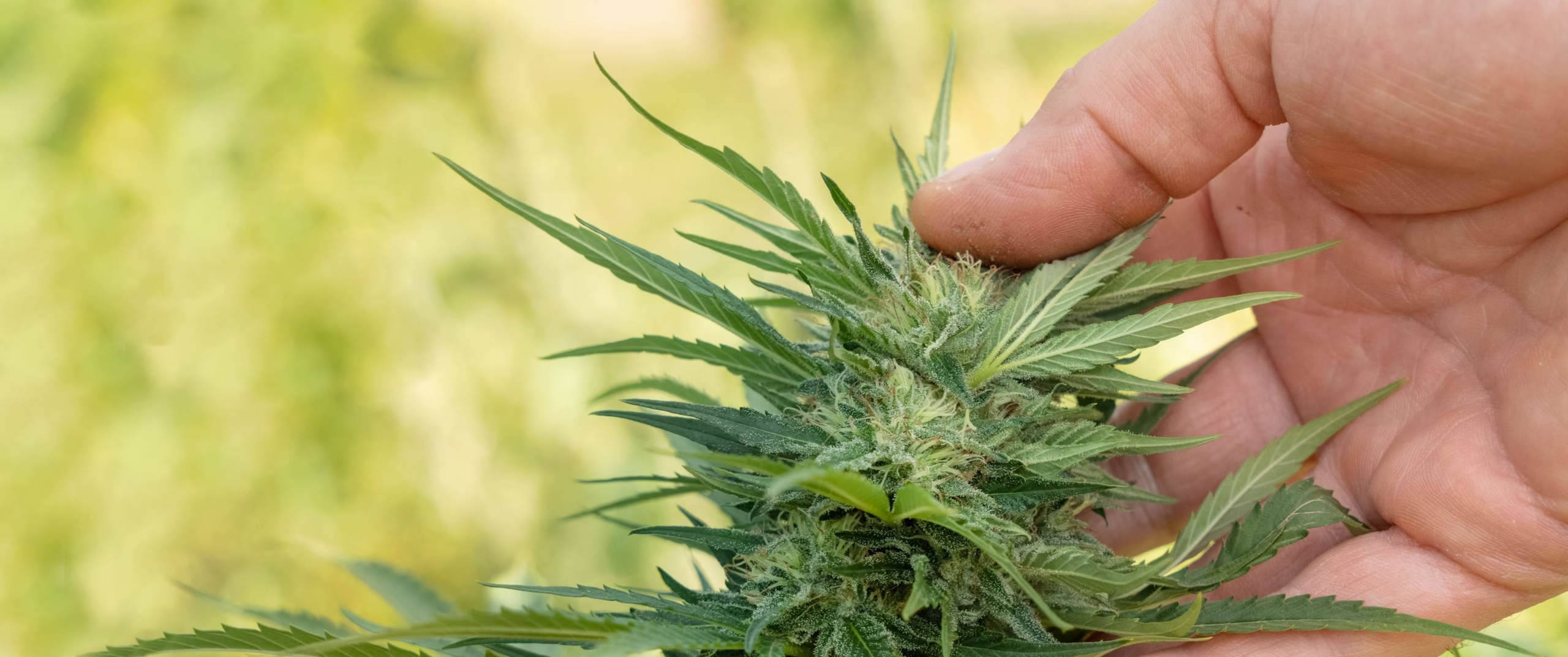
Look for continued extension of the trained shoot, normal leaf posture, new leaves opening without distortion, no expanding split at the bend, and a secure stem base. The branch should remain mechanically connected and capable of supporting itself between tie points.
The plant does not need to look visually unchanged. Reorientation is the expected response. What matters is whether growth continues and the training point remains structurally sound.
Failure signs require a different response
A branch that wilts independently of the rest of the plant, collapses at a node, develops an expanding split, or hangs from partially torn tissue is no longer experiencing routine LST. Stop adding force and support the damaged structure. If vascular connection is severely compromised, the branch may not recover normally.
Also inspect the root crown and container. Sometimes the branch looks fine while the entire plant has been pulled off-center or the root ball has shifted inside a light container.
Tie damage can appear after successful training
One of the most common delayed failures is girdling. A tie that initially held the branch perfectly may become embedded as the stem thickens. The branch can look healthy until constriction becomes obvious. Frequent inspection is therefore part of the technique, not optional maintenance.
“How long should I wait before bending the same branch again?”
Question sent by: Julia Schneider, via contact form.
Use plant response rather than a universal interval. Wait until the branch is stable, the tip has resumed active growth, the existing tie is not creating damage, and the plant is not entering another stress period. A calendar cannot tell you whether a particular stem has recovered mechanically.
| Observation | Possible Cause | How to Confirm | Corrective Action | Prevention |
|---|---|---|---|---|
| Tip turns upward after bending | Normal gravitropic/light response | New growth remains vigorous and leaves stay functional | No correction needed unless canopy position is no longer useful | Expect reorientation and leave room for it |
| Tie sinks into stem | Rapid secondary growth around restraint | Inspect the complete contact point | Loosen, move, or replace tie before girdling progresses | Use broad visible ties and recheck frequently |
| Branch droops beyond intended bend | Partial split, weak hinge, or overloaded anchor | Support branch and inspect node and bark closely | Remove force and support the branch | Bend gradually over a longer flexible section |
| Whole plant leans in container | Anchor pulling against root ball or unstable pot | Check crown position and container movement | Rebalance anchors and stabilize the container | Counter-anchor and plan for wind load |
When to Stop Training
LST should stop when the benefit of another bend becomes smaller than the structural or recovery risk. Outdoors, that point often arrives before the plant has technically stopped growing.
Stop forcing stems that have become rigid
As stems mature, secondary growth and lignification make them less tolerant of large positional changes. A branch that once moved easily may later require enough force to create cracking. At that point, the original LST window for that section has closed.
You may still guide flexible new growth farther out on the same branch, but do not assume the older base should remain bendable because it was trained earlier.
Flowering changes the cost of repositioning
As flowering progresses, branches become more valuable structurally and flowers become easier to damage. Repeated major bending can disturb developing inflorescences, change support geometry, or place flowers against leaves and adjacent branches. The practical priority shifts from building canopy shape toward preserving healthy flowers, airflow, inspection access, and support.
There is no universal calendar date when all LST must stop. Photoperiod response, cultivar, latitude, weather, plant size, and the severity of the proposed bend all matter. A useful rule is to stop major structural repositioning when the canopy is already carrying developing flowers and the stems no longer respond easily.
Stop when the plant is already stressed
Drought, waterlogging, root injury, severe nutrient imbalance, disease, pest outbreaks, storm damage, and heat stress can all reduce the value of elective training. Fix the limiting problem first. A prettier canopy is not more important than a functioning root system or an intact branch.
Stop when the support system cannot follow
A branch trained outward needs a later load path. If the branch now extends beyond any practical stake, cage, trellis, or support anchor, another outward bend may create more risk than benefit. Training and support should converge as the season progresses.
Let support replace training late in the season
Once flower load and stem stiffness increase, preserve branch position with support instead of repeatedly forcing new angles.
Keep bending because the technique has a name
LST is a tool for a structural objective, not a routine that must continue until harvest.
Yield Claims vs Reality
LST is commonly described online as a yield-increasing technique, but the evidence needs careful wording. Cannabis research clearly shows that plant architecture can change light penetration, canopy microclimate, inflorescence distribution, and yield response. What is not well established is a direct, universal LST yield percentage for outdoor cannabis.
Architecture matters, but techniques are not interchangeable
Large-cannabis studies have shown that changing architecture through pruning, branch removal, and defoliation can alter light penetration and inflorescence performance. Some treatments increased yield, some had no significant effect, and severe branch removal greatly reduced yield. That variation is exactly why results from topping or pruning cannot simply be relabeled as proof for LST.
A recent review of cannabis mainlining describes LST tie-downs as part of broader canopy-management systems, but also notes major gaps in standardized cannabis training research. This is useful context, not a license to assign a fixed yield advantage to bending alone.
The realistic benefit is redistribution
LST can redistribute where productive shoots sit in the canopy. If the original plant would have developed a tall, shaded structure, widening and separating branches may allow more of the existing leaf and shoot system to operate under useful light. That can improve the productive use of the plant’s architecture.
But redistribution is not creation of unlimited capacity. Root volume, genetics, season length, water, nutrition, disease pressure, total leaf area, and environmental stress still limit production. A wider canopy that runs out of root-zone water or breaks during a storm is not an improvement.
Important: Treat a more even canopy as an architectural outcome, not a yield guarantee. Measure harvest results over repeated grows before deciding whether LST improved productivity in your own system.
Outdoor sunlight changes the indoor LST argument
Indoor LST is often justified by the fixed footprint and distance constraints of an artificial light. Outdoors, sunlight moves through the sky and penetrates a plant from changing angles. This does not make LST useless, but it changes the reason for using it. Height control, branch separation, access, support geometry, and disease-management visibility may be as valuable as creating a perfectly level canopy.
Trying to copy an indoor flat-canopy pattern outdoors without considering the sun path and weather can create an unnecessarily broad plant with poor storm behavior.
“If I make every top the same height, will I definitely harvest more?”
Question sent by: MapleGrower, via Facebook page.
No. Equal height can improve canopy organization, but outdoor yield still depends on genetics, season, root capacity, total healthy leaf area, flower retention, weather, pests, disease, and post-training recovery. Use canopy uniformity as a management goal only when it solves a real limitation.
Late-Season Support, Inspection Access, and Storm Readiness
The final test of outdoor LST is not how attractive the vegetative canopy looks. It is whether the structure remains manageable when flowers gain mass and the weather stops cooperating.

Convert restraints into a support map
By late season, identify which LST ties are still directing growth and which branches now need load-bearing support. A small training tie attached to a container rim is not necessarily an adequate flower support. Stakes, cages, trellis points, or dedicated branch supports should carry mature loads without relying on a thin vegetative tie.
Remove or reposition obsolete restraints before they disappear inside thick stems or flowers.
Check the canopy after rain
A trained branch may hold flowers at a shallower angle than an upright branch. That can change how water sits inside flower clusters and how quickly the canopy dries. After rain, inspect whether the trained structure creates persistent contact points between wet flowers, leaves, supports, or neighboring branches.
This does not mean that LST causes bud rot. It means architecture changes microclimate, and outdoor architecture should be checked under the weather conditions that matter.
Inspect branch unions, not only ties
Wide branches can place torque on their original unions, especially when flowers develop far from the trunk. Inspect the branch base for cracks, bark separation, twisting, or unusual movement. If a branch moves excessively at its union while the distal tie remains tight, the support strategy is working against the plant.
Leave space for scouting and removal
A successful canopy should still allow you to reach leaf undersides, interior stems, and individual flowers without crawling through a web of restraints. If every branch is tied across the inspection route, disease or pest response becomes harder exactly when it matters most.
Do not let a training tie become a permanent hidden constriction
Outdoor stems can thicken dramatically. Any restraint left in place must remain visible and inspectable. If you can no longer see the full contact point, replace or relocate it.
Final outdoor LST checklist
Before and After Each LST Adjustment
- Define the structural problem before moving a branch.
- Confirm the plant is actively growing and not already under major stress.
- Choose a flexible section rather than forcing mature rigid tissue.
- Use a broad, soft, visible restraint.
- Stabilize the stem base or container if the bend creates leverage.
- Make the smallest bend that solves the problem.
- Stop immediately if tissue folds, splits, or loses structural integrity.
- Photograph the canopy and tie point for later comparison.
- Recheck tie pressure, branch posture, and crown stability after growth and weather.
- Remove or replace restraints before they girdle thickening stems.
- Reduce major repositioning as stems stiffen and flowers gain weight.
- Make sure every trained branch has a realistic late-season support path.
- Judge success by access, stability, healthy growth, and final performance, not by canopy flatness alone.
Use the next section to turn the related background into a specific follow-up decision.
Share this article
A quick overview of the topics covered in this article.
Follow us
Latest articles
September 26, 2026
September 26, 2026

September 26, 2026
September 26, 2026